India Infectious Disease Surveillance Market Size & Growth Rate
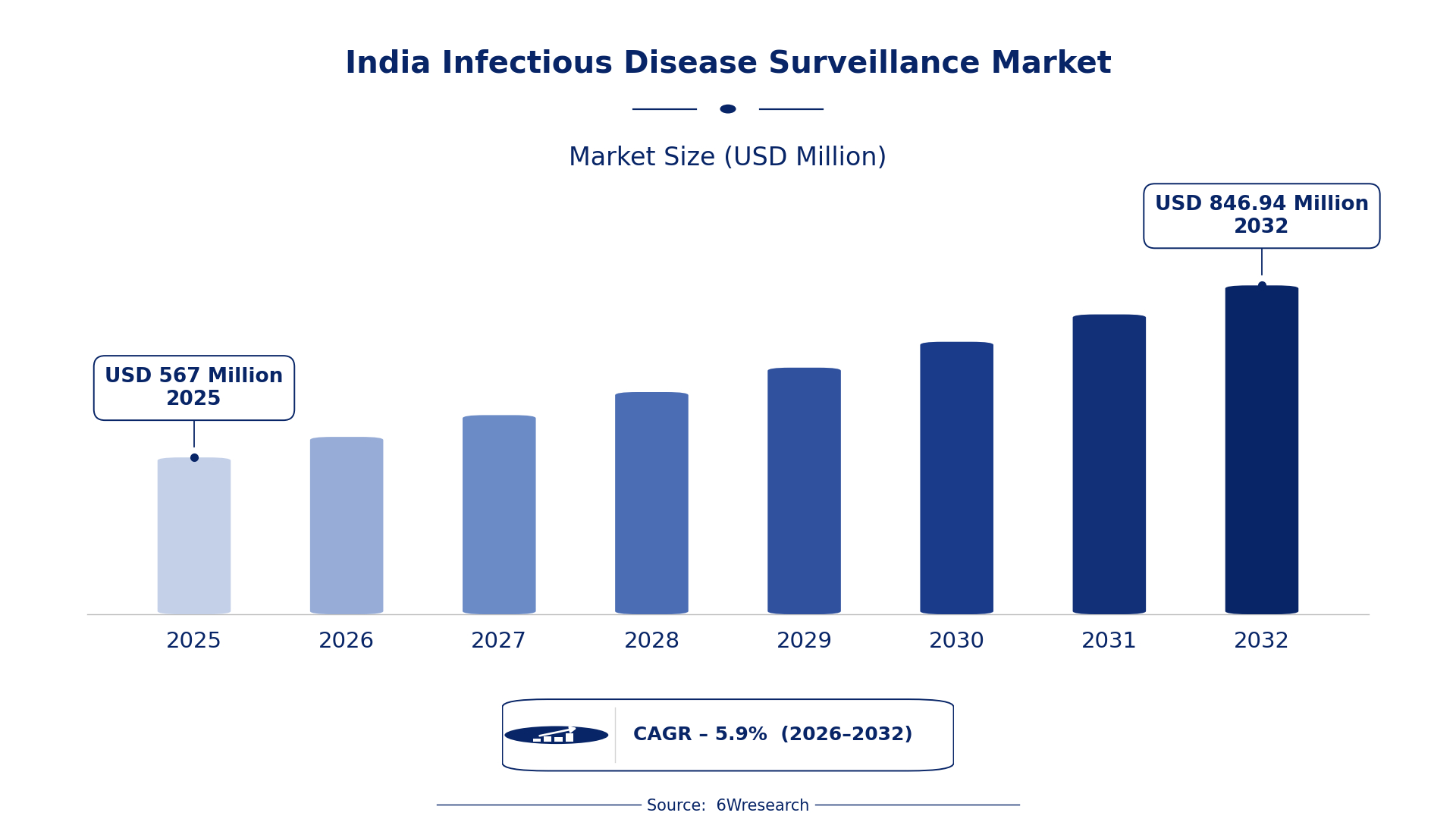
According to 6Wresearch internal database and industry insights, the India Infectious Disease Surveillance Market was valued at USD 567.0 million in 2025 and is projected to reach USD 846.94 million by 2032, growing at a CAGR of approximately 5.9% during 2026–2032.
India Infectious Disease Surveillance Market Highlights
| Report Metric | Details |
| Report Name | India Infectious Disease Surveillance Market |
| Market Size 2025 | USD 567.0 million |
| Market Size 2032 | USD 846.94 million |
| Absolute Growth 2025–2032 | USD 279.94 million |
| CAGR 2026–2032 | 5.9% |
| Peak Annual Growth | 8.0% in 2030 |
| Forecast Period | 2026–2032 |
| Historical Data | 2022–2025 |
| Base Year | 2025 |
| Leading System Type, 2025 | Real-Time Surveillance (47% share) |
| Leading Technology Stack, 2025 | IoT / Cloud (47% share) |
| Leading Stakeholder, 2025 | Public Health Departments (39% share) |
| Leading Distribution Channel, 2025 | SaaS Providers (42% share) |
| Fastest-Growing System Type | GIS Mapping Systems (7.3% CAGR) |
| Fastest-Growing Technology Stack | AI-Powered Visualization (7.2% CAGR) |
| Fastest-Growing Stakeholder | Epidemiologists (8.6% CAGR) |
| Growing Sector | SaaS Providers |
| Key End Users | SaaS Providers, Government Contracts, Digital Health Vendors, App Stores / Agencies |
India Infectious Disease Surveillance Market Year-wise Growth Rate and Key Drivers (2022–2032)
This graph illustrates the annual growth rates of the market from 2022 to 2032, highlighting a steady upward trajectory and projected market expansion over the forecast period.
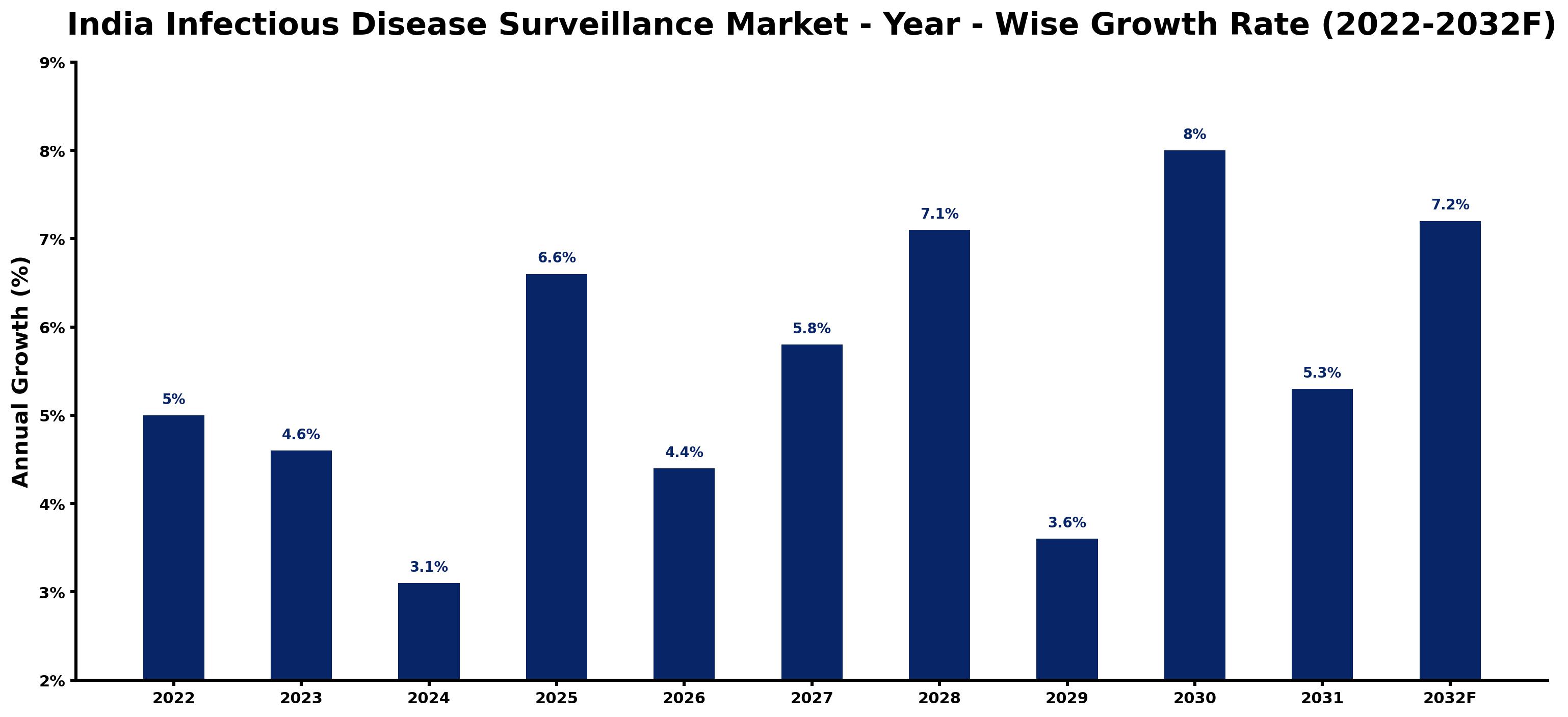
The following table presents the estimated annual growth rate for each year together with the principal factor influencing market performance.
| Year | Estimated Annual Growth (%) | Market Rationale |
| 2022 | 5.0 | The market showed steady growth, driven by the ongoing implementation of the Integrated Disease Surveillance Programme. |
| 2023 | 4.6 | Growth slowed as public health departments faced challenges in upgrading their surveillance systems. |
| 2024 | 3.1 | Demand continued to rise, but at a slower pace due to budget constraints in health initiatives. |
| 2025 | 6.6 | The market rebounded with increased funding and focus on real-time surveillance systems. |
| 2026 | 4.4 | Growth slowed again as the integration of new technologies faced delays in rural areas. |
| 2027 | 5.8 | Demand increased as more public health departments adopted advanced surveillance tools. |
| 2028 | 7.1 | The market maintained momentum, supported by rising awareness of disease outbreak risks. |
| 2029 | 3.6 | Growth slowed as competition for funding from health initiatives intensified. |
| 2030 | 8.0 | The market peaked with heightened investments in AI-driven disease prediction models. |
| 2031 | 5.3 | Growth slowed as public health departments adjusted to new technologies and practices. |
| 2032 | 7.2 | Demand is expected to rise again with improved data integration and health policy support. |
Note: Market size estimations and growth projections presented in this report are based on 6Wresearch's proprietary forecasting methodology, utilizing the latest available industry data, government publications, and primary research inputs.
India Infectious Disease Surveillance Market Synopsis
80-120 words in 5-6 full sentences (never fewer than 80): first sentence defines the market (product + country), then a ~40-word product overview, then the market name and why it grows; no challenges
Market Dynamics Impact Analysis (2026–2032)
| Factor | Type | Impact | Primary Segment Affected |
| Increased funding for health infrastructure | Driver | High | Public Health Departments |
| Adoption of AI-driven disease prediction models | Driver | High | Epidemiologists |
| Growing need for real-time data collection | Opportunity | High | Mobile App Reporting |
| Expansion of GIS mapping systems in health departments | Opportunity | High | GIS Mapping Systems |
| Inadequate infrastructure affecting response times | Restraint | High | Real-Time Surveillance |
| Skills shortages limiting effective data collection | Restraint | High | Mobile App Reporting |
| Slow technology integration across regions | Challenge | Medium | Digital Health Vendors |
| Fragmented funding from various health initiatives | Challenge | Medium | Government Contracts |
Evaluation of Drivers in India Infectious Disease Surveillance Market (2026–2032)
Below mentioned are some major drivers and their influence on market dynamics.
| Drivers | Primary Segment Affected | Why It Matters (Evidence) |
| Increased funding for health initiatives | Public Health Departments | The National Health Mission allocated ₹1,500 crores in 2022, enabling better disease surveillance capabilities. |
| Expansion of real-time surveillance systems | Real-Time Surveillance | Over 20 states implemented real-time systems, improving immediate response to outbreaks. |
| Growing adoption of GIS mapping | GIS Mapping Systems | Public health departments increased GIS usage by 30% since 2020, enhancing disease spread visualization. |
| Integration of AI-driven tools | AI-Powered Visualization | AI tools are being integrated into public health data systems, improving outbreak prediction accuracy. |
| Collaboration among stakeholders | Epidemiologists | Increased collaboration among epidemiologists and public health departments enhances data analysis and response strategies. |
Market growth for Infectious Disease Surveillance in India is underpinned by increasing investments in public health infrastructure, rising demand for real-time data collection, and enhanced collaboration among health departments. The National Health Mission allocated ₹1,500 crores in 2022 to strengthen disease surveillance systems, which has boosted public health departments' capabilities. The growing use of GIS mapping systems, which increased by 30% since 2020, has facilitated better visualization of disease spread, leading to more informed public health decisions. Furthermore, the National Digital Health Mission aims to digitize health records, enhancing data accessibility for epidemiologists and policymakers.
Evaluation of Restraints in India Infectious Disease Surveillance Market
The table below lists the restraints and the evidence behind each.
| Market Restraint | Primary Segment Affected | Why It Matters (Evidence) |
| Inadequate infrastructure for surveillance | Public Health Departments | Limited infrastructure delays response times, affecting outbreak management and increasing costs. |
| Skills shortages in data collection | Epidemiologists | Only 15% of healthcare workers use mobile app reporting, limiting effective data collection. |
| Slow technology integration | Real-Time Surveillance | Despite a 30% increase in GIS usage, many regions lack access to advanced surveillance tools. |
| Fragmented funding sources | Digital Health Vendors | Competition for funding complicates coordination efforts across states, affecting surveillance effectiveness. |
| Regulatory hurdles for new technologies | AI-Powered Visualization | Approval processes for integrating new technologies slow down implementation in public health. |
India Infectious Disease Surveillance Market Challenges
Infectious Disease Surveillance in India encounters immediate cost challenges due to inadequate infrastructure, which can delay response times by up to 30%. Buyers, particularly public health departments, face high expenses from outdated systems, resulting in inefficient tracking of disease outbreaks. Skills shortages hinder progress, as only 15% of healthcare workers currently utilise mobile app reporting for real-time data collection, limiting the effectiveness of surveillance. Technology integration is slow; despite a 30% increase in GIS mapping usage, many regions still lack access to advanced tools, impacting overall data accuracy. Competition for funding from various health initiatives creates a fragmented approach to disease surveillance, complicating coordination efforts across states.
Trends in the India Infectious Disease Surveillance Market
The trends below show where the India Infectious Disease Surveillance Market is heading.
- Rise of AI-Driven Disease Prediction Models: The Indian government initiated a pilot program for AI-driven disease prediction models in 2021, enhancing forecasting accuracy. This shift is expected to improve outbreak management and response strategies across public health departments.
- Increased Use of GIS Mapping Systems: Since 2020, the adoption of GIS mapping systems in public health departments has surged by 30%. This trend allows for better visualisation of disease spread, aiding in timely public health interventions.
- Focus on Real-Time Data Collection: The National Health Mission's emphasis on strengthening disease surveillance systems began in 2021, leading to enhanced real-time data collection capabilities. This focus is crucial for effective outbreak response and public health management.
- Expansion of Mobile App Reporting: Mobile app reporting has been adopted by 15% of healthcare workers for real-time data collection. This trend reflects a growing commitment to improving data collection methods in public health.
Investment Opportunities in the India Infectious Disease Surveillance Market
Several openings in the India Infectious Disease Surveillance Market merit attention from investors.
- Public Health Departments Seeking Advanced Tools: Public health departments are increasingly looking for advanced surveillance tools, with a market gap of ₹1,500 crores identified in 2022. Collaborating with local vendors can facilitate technology adoption and improve disease tracking.
- Growing Demand for Data Analytics Solutions: With a projected market size of USD 846.94 million by 2032, there is a significant opportunity for data analytics solutions. Partnering with digital health vendors can enhance data processing capabilities for public health.
- Need for Enhanced Training Programs: The National Centre for Disease Control's new training program for public health officials in 2023 highlights the need for enhanced skills in data analysis. Investing in training solutions can address this skills gap effectively.
- Integration of Health Data Systems: The Digital Health Mission aims to integrate health data systems, creating opportunities for software providers. Engaging in public-private partnerships can facilitate smoother implementation and access to funding.
Government Initiatives in the India Infectious Disease Surveillance Market
The National Health Mission launched the 'Strengthening of Disease Surveillance Systems' initiative in 2021 to enhance local capacities for disease monitoring and response. This initiative aims to improve the efficiency of disease tracking across various states, ensuring timely interventions. In 2022, the Ministry of Health and Family Welfare approved the 'Digital Health India' strategy, which focuses on improving data collection and disease tracking capabilities. This strategy is crucial for integrating health data systems, enabling better coordination among public health departments. Furthermore, the Integrated Disease Surveillance Programme received a budget increase of ₹500 crores in 2023 to expand its reach across rural areas, ensuring that surveillance systems are accessible to all regions. The National Centre for Disease Control has also initiated a training program for public health officials to enhance their data analysis skills for effective disease surveillance.
In 2023, the National Centre for Disease Control allocated ₹200 crores to improve training programs for public health officials, focusing on data analysis for disease surveillance. This funding supports the development of skills necessary for effective monitoring and response to outbreaks. The Ministry of Health and Family Welfare oversees the implementation of various surveillance programs, ensuring compliance with national health policies. Additionally, the Digital Health Mission integrates various health data systems, allowing for more efficient data sharing among stakeholders. The National Health Authority is working on linking surveillance data with health insurance schemes, which will enhance the overall effectiveness of public health responses. These efforts collectively aim to strengthen the capacity of health departments to manage infectious disease outbreaks effectively.
Future Insight of the India Infectious Disease Surveillance Market
The Infectious Disease Surveillance market in India is set to evolve by 2032, driven by advancements in technology and government initiatives. The National Health Mission's focus on strengthening disease surveillance systems will improve data collection capabilities across states. By 2025, the integration of AI-driven disease prediction models is expected to enhance outbreak forecasting accuracy, benefiting public health departments and epidemiologists. The National Digital Health Mission aims to digitise health records, streamlining data access and analysis, which will lead to more effective public health responses.
Market Segmentation Analysis
The report offers a comprehensive study of the following market segments and their leading categories in the market.
By System Type – Real-Time Surveillance Dominated, GIS Mapping Systems Expected to Grow Fastest
According to Shubham Deep, Research Manager at 6Wresearch, with a 47% revenue share in 2025, Real-Time Surveillance was the largest system type category. Real-Time Surveillance holds the largest share as it is vital for immediate responses to disease outbreaks. The Integrated Disease Surveillance Programme exemplifies this reliance, utilising real-time data to effectively monitor health threats across India. GIS Mapping Systems are set to record the highest CAGR in this split, 7.3% over 2026–2032. GIS Mapping Systems are experiencing rapid growth, evidenced by a 30% increase in usage among public health departments since 2020. This trend is likely to continue as geographic insights become essential for effective disease management. Suppliers should focus on enhancing real-time capabilities while integrating GIS technologies to meet the growing demands of public health departments.
By Technology Stack – IoT / Cloud Dominated, AI-Powered Visualization Expected to Grow Fastest
The largest technology stack category in 2025 was IoT / Cloud, with a 47% share of total revenue. IoT / Cloud technology leads the market share by supporting the data storage and processing capabilities essential for effective surveillance systems. This technology is crucial for managing the extensive data generated by various health initiatives across India. Over 2026–2032, AI-Powered Visualization is expected to post the fastest growth, at a CAGR of 7.2%. AI-Powered Visualization is the fastest-growing segment, as it improves the interpretation of complex data sets for public health officials. The integration of these tools is becoming increasingly important for accurate disease prediction and trend analysis. Buyers should invest in advanced AI solutions to improve data analysis and decision-making processes in infectious disease surveillance.
By Stakeholder – Public Health Departments Dominated, Epidemiologists Expected to Grow Fastest
Public Health Departments held a 39% share of the India Infectious Disease Surveillance Market by stakeholder in 2025. Public Health Departments command the largest market share as they are the primary users of surveillance data, which is crucial for managing health responses and interventions. Their ongoing initiatives, such as the National Health Mission, significantly drive demand for effective surveillance solutions. Epidemiologists are projected to grow fastest, at a CAGR of 8.6% during 2026–2032. Epidemiologists represent the fastest-growing group as they increasingly depend on surveillance data to analyse disease patterns and trends. Their role is expanding with the adoption of new technologies and methodologies in disease monitoring. Suppliers must tailor their offerings to meet the specific analytical needs of epidemiologists to capture this growing segment.
By Distribution Channel – SaaS Providers Dominated and Is Expected to Record the Fastest Growth
In 2025, SaaS Providers led the distribution channel split with a 42% share. SaaS Providers dominate the market share as they deliver essential software solutions that facilitate the implementation of surveillance systems. Their flexibility and scalability make them the preferred choice for public health departments aiming to enhance their surveillance capabilities. SaaS Providers are also forecast to expand faster than any other category, at a CAGR of 7.3% over 2026–2032. SaaS Providers are also the fastest-growing channel, as the demand for cloud-based solutions continues to rise in response to the increasing need for efficient data management. This growth is likely to accelerate as more health departments transition to digital platforms. Both suppliers and buyers should prioritise partnerships with SaaS Providers to leverage their expertise in developing effective surveillance systems.
Key Attractiveness of the Report
- 10 Years of Market Numbers
- Historical Data Starting from 2022 to 2025
- Base Year 2025
- Forecast Data until 2032
- Key Performance Indicators Impacting the Market
- Major Upcoming Developments and Projects
Key Highlights of the Report:
- India Infectious Disease Surveillance Market Outlook
- Market Size of India Infectious Disease Surveillance Market, 2025
- Forecast of India Infectious Disease Surveillance Market, 2032
- Historical Data and Forecast of India Infectious Disease Surveillance Revenues & Volume for the Period 2022 - 2032F
- India Infectious Disease Surveillance Market Trend Evolution
- India Infectious Disease Surveillance Market Drivers and Challenges
- India Infectious Disease Surveillance Price Trends
- India Infectious Disease Surveillance Porter's Five Forces
- India Infectious Disease Surveillance Industry Life Cycle
- Historical Data and Forecast of India Infectious Disease Surveillance Market Revenues & Volume By System Type for the Period 2022 - 2032F
- Historical Data and Forecast of India Infectious Disease Surveillance Market Revenues & Volume By Real-Time Surveillance for the Period 2022 - 2032F
- Historical Data and Forecast of India Infectious Disease Surveillance Market Revenues & Volume By GIS Mapping Systems for the Period 2022 - 2032F
- Historical Data and Forecast of India Infectious Disease Surveillance Market Revenues & Volume By Data Dashboards for the Period 2022 - 2032F
- Historical Data and Forecast of India Infectious Disease Surveillance Market Revenues & Volume By Mobile App Reporting for the Period 2022 - 2032F
- Historical Data and Forecast of India Infectious Disease Surveillance Market Revenues & Volume By Technology Stack for the Period 2022 - 2032F
- Historical Data and Forecast of India Infectious Disease Surveillance Market Revenues & Volume By IoT / Cloud for the Period 2022 - 2032F
- Historical Data and Forecast of India Infectious Disease Surveillance Market Revenues & Volume By Geographic Modeling for the Period 2022 - 2032F
- Historical Data and Forecast of India Infectious Disease Surveillance Market Revenues & Volume By AI-Powered Visualization for the Period 2022 - 2032F
- Historical Data and Forecast of India Infectious Disease Surveillance Market Revenues & Volume By Crowd-sourced Input for the Period 2022 - 2032F
- Historical Data and Forecast of India Infectious Disease Surveillance Market Revenues & Volume By Stakeholder for the Period 2022 - 2032F
- Historical Data and Forecast of India Infectious Disease Surveillance Market Revenues & Volume By Public Health Departments for the Period 2022 - 2032F
- Historical Data and Forecast of India Infectious Disease Surveillance Market Revenues & Volume By Epidemiologists for the Period 2022 - 2032F
- Historical Data and Forecast of India Infectious Disease Surveillance Market Revenues & Volume By Policy Makers for the Period 2022 - 2032F
- Historical Data and Forecast of India Infectious Disease Surveillance Market Revenues & Volume By General Public for the Period 2022 - 2032F
- Historical Data and Forecast of India Infectious Disease Surveillance Market Revenues & Volume By Distribution Channel for the Period 2022 - 2032F
- Historical Data and Forecast of India Infectious Disease Surveillance Market Revenues & Volume By SaaS Providers for the Period 2022 - 2032F
- Historical Data and Forecast of India Infectious Disease Surveillance Market Revenues & Volume By Government Contracts for the Period 2022 - 2032F
- Historical Data and Forecast of India Infectious Disease Surveillance Market Revenues & Volume By Digital Health Vendors for the Period 2022 - 2032F
- Historical Data and Forecast of India Infectious Disease Surveillance Market Revenues & Volume By App Stores / Agencies for the Period 2022 - 2032F
- India Infectious Disease Surveillance Import Export Trade Statistics
- Market Opportunity Assessment By System Type
- Market Opportunity Assessment By Technology Stack
- Market Opportunity Assessment By Stakeholder
- Market Opportunity Assessment By Distribution Channel
- India Infectious Disease Surveillance Top Companies Market Share
- India Infectious Disease Surveillance Competitive Benchmarking By Technical and Operational Parameters
- India Infectious Disease Surveillance Company Profiles
- India Infectious Disease Surveillance Key Strategic Recommendations
Market Covered
This report examines the market across the segments below.
By System Type
- Real-Time Surveillance
- GIS Mapping Systems
- Data Dashboards
- Mobile App Reporting
By Technology Stack
- IoT / Cloud
- Geographic Modeling
- AI-Powered Visualization
- Crowd-sourced Input
By Stakeholder
- Public Health Departments
- Epidemiologists
- Policy Makers
- General Public
By Distribution Channel
- SaaS Providers
- Government Contracts
- Digital Health Vendors
- App Stores / Agencies































