India Livestock Market Size, Share & Growth Rate
The India Livestock Market was estimated at USD 937 Million in 2025 and is projected to reach USD 1336 Million by 2032, growing at a CAGR of 5.2% from 2026 to 2032. This robust growth trajectory is primarily driven by the soaring demand for animal-derived products, including meat, dairy, and leather, from a burgeoning population. Additionally, rising disposable incomes are leading to increased consumption of protein-rich foods, further propelling the market forward.
India Livestock Market Year-wise Growth Rate and Key Drivers
This graph highlights how the India Livestock Market has steadily grown over the years, supported by major growth factors.
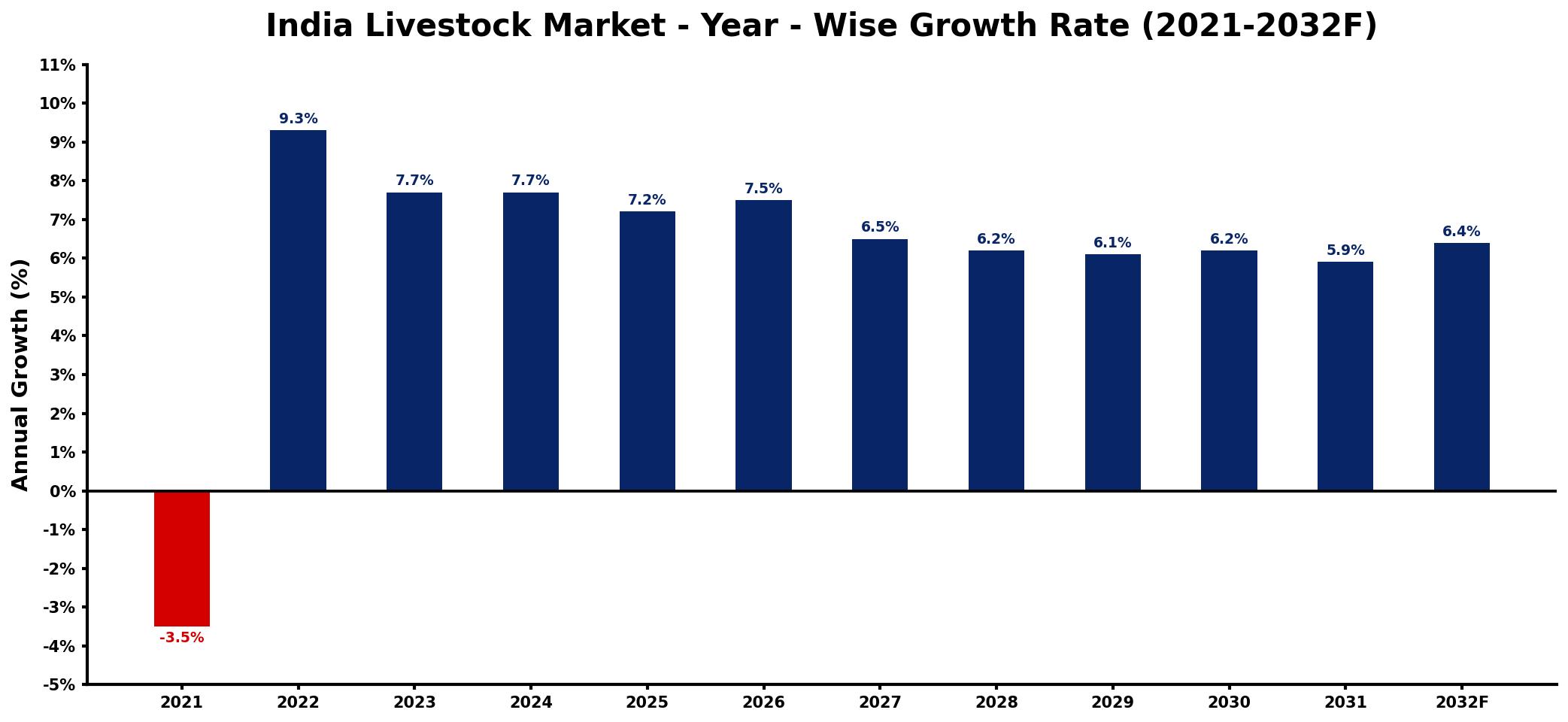
The table below presents the year‑wise growth rates along with the key drivers influencing the market
| Year | Growth Rate | Major Drivers |
| 2021 | -3.5% | decrease in consumer spending habits |
| 2022 | 9.3% | rise in export opportunities |
| 2023 | 7.7% | increased demand for protein sources |
| 2024 | 7.7% | expansion of feed production facilities |
| 2025 | 7.2% | growth in rural entrepreneurship initiatives |
| 2026 | 7.5% | enhancements in veterinary services availability |
| 2027 | 6.5% | adoption of sustainable farming practices |
| 2028 | 6.2% | investment in agricultural technology solutions |
| 2029 | 6.1% | improvements in supply chain efficiency |
| 2030 | 6.2% | rising export shipment volumes |
| 2031 | 5.9% | growing regional consumption patterns |
| 2032 | 6.4% | increased consumer awareness programs |
Note: Market size estimations and growth projections presented in this report are based on 6Wresearch's proprietary forecasting methodology, utilizing the latest available industry data, government publications, and primary research inputs.
India Livestock Market Synopsis
The India livestock market has shown remarkable resilience, rebounding from the challenges posed by the Covid-19 pandemic. Looking ahead, the sector is poised for steady growth, fueled by government initiatives and an ever-expanding consumer base eager for high-quality animal products. The combination of traditional farming practices and modern technology will play a pivotal role in enhancing productivity.
However, as the market evolves, it must navigate various challenges to ensure sustainable development. The contrast between the current momentum and future potential highlights a pressing need for investment in infrastructure, technology, and veterinary services to bolster overall productivity and efficiency.
India Livestock Market Key Takeaways
- The livestock market in India is the largest globally, with over 591 million animals projected by 2025.
- Meat production reached 7.1 billion kilograms in 2018-19, underscoring India's significance as a meat producer.
- Rising protein consumption is a key driver of market expansion, aligning with increasing urbanization.
- Government policies are pivotal in enhancing animal husbandry and productivity in the sector.
- Challenges such as disease management and infrastructure gaps remain critical issues for the industry's future.
Evaluation of Restraints in India Livestock Market
Despite its promising growth, the India livestock market faces significant restraints that impede its potential. A primary concern is the prevalence of livestock diseases, which can severely affect animal health and reduce productivity. The limitations in veterinary care and insufficient disease surveillance exacerbate this issue, making it crucial for stakeholders to prioritize health management. Furthermore, the lack of modern infrastructure, including advanced breeding and feeding technologies, hampers operational efficiency. The market's unorganized structure often leads to price volatility, creating income instability for farmers. Lastly, environmental challenges such as climate change pose serious risks to livestock welfare and feed availability, necessitating urgent and innovative responses.
India Livestock Market Trends
Several trends are reshaping the India livestock market. Increasing demand for organic and antibiotic-free meat and dairy products is steering consumer preferences toward healthier and more sustainable options. Technological advancements in breeding, feeding, and health management are increasingly being adopted to enhance productivity and reduce costs. Furthermore, the integration of e-commerce in livestock trading is revolutionizing market accessibility for farmers, while consumers benefit from a wider selection of products. Lastly, there is a growing emphasis on sustainable practices, prompting industry players to adopt eco-friendly farming techniques and improve animal welfare.
India Livestock Market Opportunities
The India livestock market presents numerous opportunities for growth and investment. The rising urban population and shifting dietary preferences toward protein-rich foods are clear indicators of increased demand. Furthermore, advancements in biotechnology and veterinary services offer significant potential for improving livestock health and productivity. The expansion of export markets for Indian meat and dairy products also signifies an opportunity for economic growth. Additionally, investments in modernizing infrastructure and supply chains can lead to enhanced market efficiency and stability, benefiting both farmers and consumers alike.
Government Initiatives in the India Livestock Market
The Indian government has implemented a range of initiatives aimed at bolstering the livestock sector. Various programs have been introduced to support animal husbandry, improve breed quality, and enhance veterinary care. Investments in research and development are being prioritized to promote innovations in livestock management practices. Additionally, subsidies and financial assistance for farmers are being provided to encourage the adoption of advanced technologies. Public spending on infrastructure related to livestock markets aims to facilitate smoother supply chains and improve overall productivity.
Future Insights of the India Livestock Market
Looking ahead to 2026-2032, the India livestock market is expected to undergo transformative changes driven by evolving consumer preferences and technological advancements. As health-consciousness rises among consumers, the demand for quality and sustainably produced animal products will intensify. Investment in modern farming practices and infrastructure will be crucial to meet this growing demand. Furthermore, strengthening the supply chain and market linkages will enhance stability and profitability for farmers, ultimately supporting the sector's long-term growth.
India Livestock Market Latest Developments (2025 - 2026)
Recent developments in the India livestock market indicate a strategic shift towards sustainability and modernization. Stakeholders are increasingly focusing on enhancing animal welfare standards and reducing the environmental impact of livestock farming. The use of digital platforms for livestock trading has gained traction, helping farmers connect with buyers more efficiently. Furthermore, government funding for veterinary research and animal health initiatives has been ramped up, aiming to curb disease outbreaks and enhance overall livestock productivity. These initiatives reflect a proactive approach to address challenges and harness opportunities for growth.
India Livestock Market - Key Attractiveness of the Report
- 10 Years of Market Numbers
- Historical Data Starting from 2022 to 2025
- Base Year: 2025
- Forecast Data until 2032
- Key Performance Indicators Impacting the Market
- Major Upcoming Developments and Projects
Key Highlights of the Report:
- India Livestock Market Outlook
- Market Size of India Livestock Market, 2025
- Forecast of India Livestock Market, 2032
- Historical Data and Forecast of India Livestock Revenues & Volume for the Period 2022-2032F
- India Livestock Market Trend Evolution
- India Livestock Market Drivers and Challenges
- India Livestock Price Trends
- India Livestock Porter's Five Forces
- India Livestock Industry Life Cycle
- Historical Data and Forecast of India Livestock Market Revenues & Volume By Animal Type for the Period 2022-2032F
- Historical Data and Forecast of India Livestock Market Revenues & Volume By Ruminants for the Period 2022-2032F
- Historical Data and Forecast of India Livestock Market Revenues & Volume By Poultry for the Period 2022-2032F
- Historical Data and Forecast of India Livestock Market Revenues & Volume By Swine for the Period 2022-2032F
- Historical Data and Forecast of India Livestock Market Revenues & Volume By Aquaculture for the Period 2022-2032F
- India Livestock Import Export Trade Statistics
- Market Opportunity Assessment By Animal Type
- India Livestock Top Companies Market Share
- India Livestock Competitive Benchmarking By Technical and Operational Parameters
- India Livestock Company Profiles
- India Livestock Key Strategic Recommendations






































