India Real‑Time AQ Alert System Market Size & Growth Rate
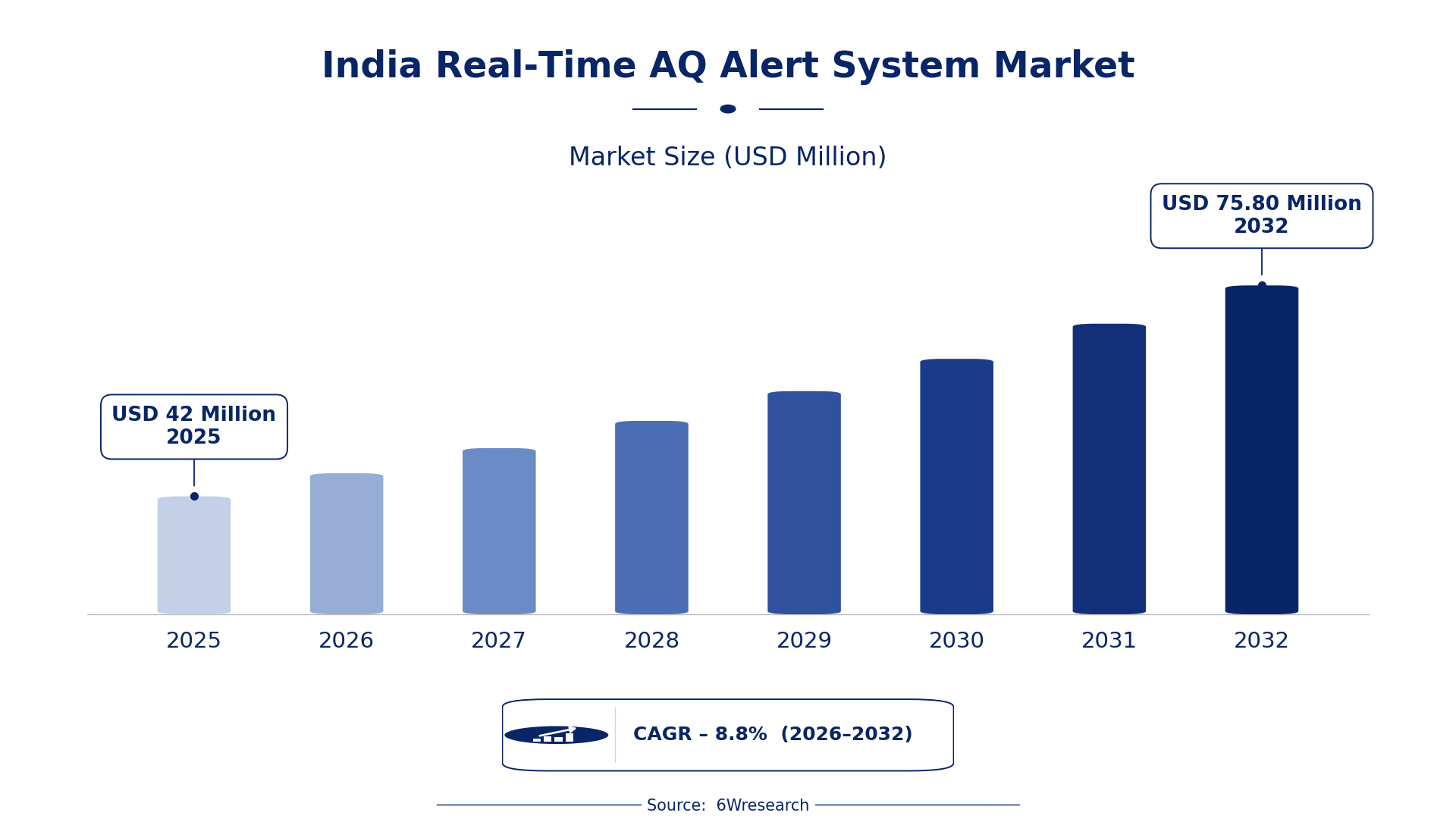
According to 6Wresearch internal database and industry insights, the India Real‑Time AQ Alert System Market was valued at USD 42 million in 2025 and is projected to reach USD 75.80 million by 2032, growing at a CAGR of approximately 8.8% during 2026–2032.
India Real‑Time AQ Alert System Market Highlights
| Report Metric | Details |
| Report Name | India Real‑Time AQ Alert System Market |
| Market Size 2025 | USD 42 million |
| Market Size 2032 | USD 75.80 million |
| Absolute Growth 2025–2032 | USD 33.80 million |
| CAGR 2026–2032 | 8.8% |
| Peak Annual Growth | 10.7% in 2031 |
| Forecast Period | 2026–2032 |
| Historical Data | 2022–2025 |
| Base Year | 2025 |
| Leading Sensor Type, 2025 | Fixed Outdoor AQ Sensors (36% share) |
| Leading Alert Model, 2025 | Threshold-Based Alerts (41% share) |
| Leading Deployment Setting, 2025 | Urban Monitoring (41% share) |
| Leading End User, 2025 | Municipal Environmental Agencies (49% share) |
| Fastest-Growing Sensor Type | Portable Air Quality Monitors (11.5% CAGR) |
| Fastest-Growing Alert Model | Predictive Alerts (10.0% CAGR) |
| Fastest-Growing Deployment Setting | Smart City Networks (11.6% CAGR) |
| Fastest-Growing End User | Public Health Units (11.1% CAGR) |
| Growing Sector | Public Health Units |
| Key End Users | Municipal Environmental Agencies, Public Health Units, Facility Managers, Workers in Utilities/Construction |
India Real‑Time AQ Alert System Market Year-wise Growth Rate and Key Drivers (2022–2032)
This graph illustrates the annual growth rates of the market from 2022 to 2032, highlighting a steady upward trajectory and projected market expansion over the forecast period.
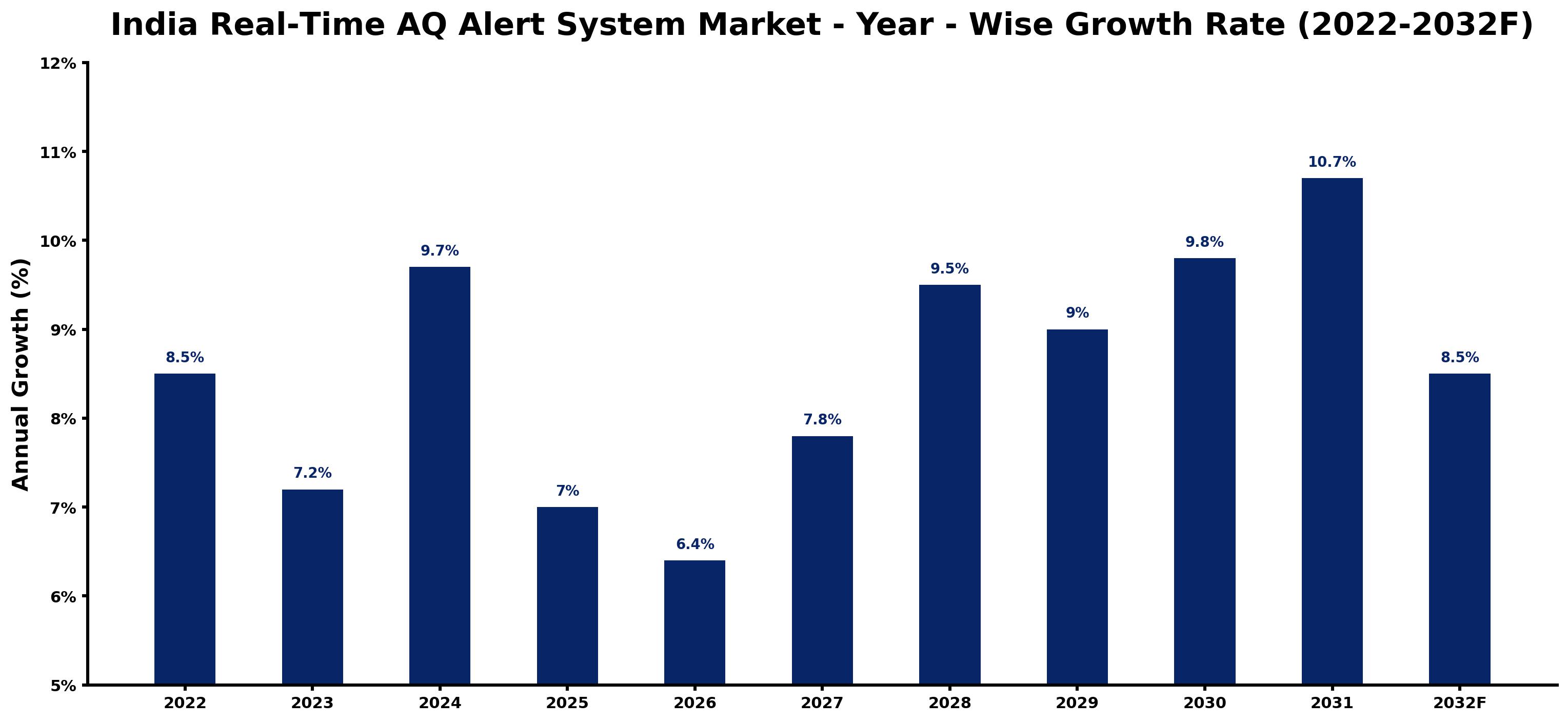
Below, each year's estimated growth is shown next to the factor that most influenced it.
| Year | Estimated Annual Growth (%) | Market Rationale |
| 2022 | 8.5 | The market experienced steady growth due to ongoing urban air quality concerns. |
| 2023 | 7.2 | Demand growth slowed as public health units adjusted to new monitoring standards. |
| 2024 | 9.7 | Increased investment in environmental monitoring led to a surge in system installations. |
| 2025 | 7.0 | Growth decelerated as municipal agencies faced budget constraints amid rising pollution levels. |
| 2026 | 6.4 | Demand growth slowed due to challenges in integrating new technologies into existing frameworks. |
| 2027 | 7.8 | Public health units began expanding their monitoring initiatives, boosting demand. |
| 2028 | 9.5 | Urban monitoring projects gained momentum, driving further investments in alert systems. |
| 2029 | 9.0 | Demand growth slowed as the market faced saturation in some urban areas. |
| 2030 | 9.8 | Increased awareness of air quality issues spurred renewed interest in monitoring solutions. |
| 2031 | 10.7 | Investment in smart city initiatives led to peak demand for real-time alert systems. |
| 2032 | 8.5 | Growth slowed as market maturity set in, stabilising demand for monitoring systems. |
Note: Market size estimations and growth projections presented in this report are based on 6Wresearch's proprietary forecasting methodology, utilizing the latest available industry data, government publications, and primary research inputs.
India Real‑Time AQ Alert System Market Synopsis
Real-Time AQ Alert System Market in India encompasses technologies that monitor air quality through sensors and data analytics. The National Clean Air Programme seeks a substantial reduction in pollution levels, driving demand from municipal environmental agencies and public health units. With over 1,000 monitoring stations operational, the need for real-time data has never been more pressing.
Market Dynamics Impact Analysis (2026–2032)
| Factor | Type | Impact | Primary Segment Affected |
| Increasing urbanisation and air quality concerns drive demand for monitoring systems. | Driver | High | Urban Monitoring |
| Investment in smart city initiatives enhances the integration of AQ alert systems. | Driver | High | Smart City Networks |
| Public health units require advanced monitoring systems to issue health advisories. | Opportunity | High | Public Health Units |
| Municipal environmental agencies seek to comply with stricter air quality regulations. | Opportunity | Medium | Municipal Environmental Agencies |
| Budget constraints limit the capacity of agencies to invest in new systems. | Restraint | High | Municipal Environmental Agencies |
| Integration challenges with existing monitoring frameworks hinder system adoption. | Restraint | Medium | Urban Monitoring |
| Suppliers face difficulties in meeting stringent compliance standards. | Challenge | High | Fixed Outdoor AQ Sensors |
| Technological advancements require continuous investment, straining budgets. | Challenge | Medium | IoT-Connected Nodes |
Evaluation of Drivers in India Real‑Time AQ Alert System Market (2026–2032)
The factors lifting demand, and the evidence behind each, are summarised below.
| Drivers | Primary Segment Affected | Why It Matters (Evidence) |
| Investment in smart city initiatives drives infrastructure for monitoring systems. | Smart City Networks | With the Smart Cities Mission, urban areas are integrating AQ monitoring, leading to increased system demand. |
| Public health units require timely data to inform health advisories. | Public Health Units | As pollution spikes, these units increasingly rely on real-time data to protect public health and inform citizens. |
| Growing urbanisation leads to higher pollution levels, increasing demand for monitoring. | Urban Monitoring | Over 50% of urban areas in India face severe air quality issues, necessitating real-time solutions for monitoring. |
| The Central Pollution Control Board mandates compliance with air quality standards. | Fixed Outdoor AQ Sensors | This regulation drives municipal agencies to invest in advanced monitoring systems to meet compliance requirements. |
| Technological advancements in sensors improve data accuracy and reliability. | IoT-Connected Nodes | Improved sensor capabilities lead to greater trust in monitoring systems, encouraging purchases from municipal agencies. |
The incorporation of air quality monitoring systems into urban planning is propelling the need for more effective solutions. Public health units are increasingly dependent on real-time data to shape health advisories, particularly during pollution spikes. Urban areas grapple with serious air quality issues, necessitating immediate solutions to safeguard citizens.
Evaluation of Restraints in India Real‑Time AQ Alert System Market
The table below lists the restraints and the evidence behind each.
| Market Restraint | Primary Segment Affected | Why It Matters (Evidence) |
| Budget constraints limit the ability of municipal agencies to invest in new systems. | Municipal Environmental Agencies | As budgets tighten, agencies struggle to allocate funds for advanced monitoring solutions, impacting system upgrades. |
| Integration challenges with existing monitoring frameworks hinder system adoption. | Urban Monitoring | Legacy systems often complicate the implementation of new technologies, slowing down upgrades and increasing costs. |
| Suppliers face difficulties in meeting stringent compliance standards set by regulators. | Fixed Outdoor AQ Sensors | Compliance with updated standards increases operational costs for manufacturers, affecting pricing and market entry. |
| Technological advancements require continuous investment, straining budgets. | IoT-Connected Nodes | As technology evolves, suppliers must invest in upgrades, which can be financially burdensome for municipal agencies. |
| Market saturation in urban areas leads to slower growth rates. | Urban Monitoring | With many systems already deployed, new installations face diminishing returns, limiting growth opportunities. |
India Real‑Time AQ Alert System Market Challenges
Municipal environmental agencies in the India Real-Time AQ Alert System market struggle with regulatory challenges, as the Bureau of Indian Standards mandates strict guidelines for air quality monitoring equipment, resulting in deployment delays of up to six months for public health units. A shortage of skilled personnel exacerbates this issue; many local governments cannot find qualified operators for these systems, increasing operational costs by approximately 20%. Intense competition arises from the presence of over 1,000 fixed outdoor air quality monitoring stations, making it difficult for new suppliers to enter the market. Supply chain issues occur due to reliance on imported components, causing price fluctuations that can strain budgets for municipal agencies, with costs rising by 15% in some cases.
Trends in the India Real‑Time AQ Alert System Market
The trends below show where the India Real‑Time AQ Alert System Market is heading.
- Shift from Traditional to IoT-Connected Monitoring Systems: India is moving from traditional monitoring systems to IoT-connected nodes for real-time data. The Smart Cities Mission is driving this transformation, with over 1,000 fixed outdoor monitoring stations now equipped with IoT technology.
- Increase in Predictive Alert Systems: There is a rising trend towards predictive alert systems that forecast air quality changes. As of 2023, predictive alerts are expected to grow by 10% annually, improving public health responses.
- Focus on Urban Air Quality Management: Urban areas are increasingly emphasising air quality management initiatives. The National Clean Air Programme targets a 20-30% reduction in pollution levels by 2024, driving demand for effective monitoring solutions.
- Expansion of Real-Time Mobile Alerts: Real-time mobile alerts are becoming crucial for public awareness of air quality. With over 20 million residents in Delhi, timely notifications are vital for health advisories during pollution spikes.
Investment Opportunities in the India Real‑Time AQ Alert System Market
Some of the investment opportunities in the India Real‑Time AQ Alert System Market are mentioned below.
- Municipal Environmental Agencies seeking advanced monitoring solutions: With over 50% of urban areas facing severe air quality challenges, there is a strong demand for advanced monitoring systems. Collaborating with local agencies can facilitate market entry.
- Public Health Units expanding their monitoring initiatives: Public health units are increasingly investing in real-time alert systems for health advisories. With a projected growth of 11.1% in this sector, suppliers can target these units for potential partnerships.
- Urban Monitoring projects gaining momentum: The urgency for effective urban air quality management is high, with substantial funding available. Engaging with smart city projects can create new investment and supply opportunities.
- Smart City Networks integrating AQ monitoring: As smart city initiatives grow, there is rising demand for integrated AQ monitoring solutions. Suppliers can enter this market by partnering with local governments.
Government Initiatives in the India Real‑Time AQ Alert System Market
The National Clean Air Programme, initiated in 2019, aims for a 20-30% reduction in particulate matter by 2024. This initiative compels municipal agencies to implement real-time monitoring systems to meet new standards. The updated framework provides clearer guidelines for air quality monitoring, ensuring better compliance and public health outcomes. The Ministry of Environment, Forest and Climate Change oversees this initiative, facilitating the integration of advanced monitoring technologies.
With an allocation of INR 48,000 crore, the Smart Cities Mission encourages the use of real-time AQ monitoring systems in urban areas. The Ministry of Housing and Urban Affairs manages this initiative, funding projects that incorporate air quality monitoring into urban planning. This support enables municipalities to enhance their monitoring capabilities and improve public health responses, ensuring better community health outcomes.
Future Insight of the India Real‑Time AQ Alert System Market
The India Real-Time AQ Alert System market is set for substantial changes by 2032, driven by the National Clean Air Programme's objective to reduce pollution levels by 20% by 2024, which will heighten demand for advanced monitoring solutions. The integration of smart technology in city planning will facilitate seamless data sharing, allowing public health units to respond effectively during pollution spikes. Initiatives under the Smart Cities Mission will prioritise the deployment of air quality monitoring systems, improving resilience against air quality challenges. By 2032, most urban areas will have implemented these systems to ensure better air quality management.
Market Segmentation Analysis
The report offers a comprehensive study of the following market segments and their leading categories in the market.
By Sensor Type – Fixed Outdoor AQ Sensors Dominated, Portable Air Quality Monitors Expected to Grow Fastest
According to Ravi Bhandari, Research Head at 6Wresearch, Fixed Outdoor AQ Sensors took a 36% share of sensor type in 2025, more than any other category. Fixed outdoor AQ sensors dominate the market due to their critical role in continuous outdoor air quality monitoring. With over 1,000 such stations established across India, they are essential for municipal environmental agencies to track pollution levels effectively. Portable Air Quality Monitors are set to record the highest CAGR in this split, 11.5% over 2026–2032. The growth of portable air quality monitors is fuelled by increasing public awareness about air quality and the need for personal monitoring solutions. Their usage in various locations, especially in urban areas, is becoming more common as individuals seek to understand their immediate environment. This trend indicates that suppliers should focus on developing and marketing portable solutions to meet rising consumer demand.
By Alert Model – Threshold-Based Alerts Dominated, Predictive Alerts Expected to Grow Fastest
Threshold-Based Alerts held a 41% share of the India Real‑Time AQ Alert System Market by alert model in 2025. Threshold-based alerts hold the largest market share as they provide immediate notifications when air quality exceeds safe levels, which is crucial for public health. Municipal agencies implement this model extensively to comply with air quality standards and protect citizens from pollution-related health risks. The quickest growth will come from Predictive Alerts, forecast to expand at a CAGR of 10.0% between 2026 and 2032. Predictive alerts are growing rapidly because they enable users to anticipate air quality changes, which is vital for issuing timely health advisories. The increasing availability of data analytics tools will further boost the demand for these proactive alert systems. Suppliers should focus on integrating predictive alert features into their offerings to meet the rising expectations of users.
By Deployment Setting – Urban Monitoring Dominated, Smart City Networks Expected to Grow Fastest
With a 41% revenue share in 2025, Urban Monitoring was the largest deployment setting category. Urban monitoring captures the largest market share as it is essential for addressing air quality issues in densely populated areas like Delhi, where the population exceeds 20 million. With over 50% of urban areas facing severe air quality challenges, these systems are critical for effective local governance. Over 2026–2032, Smart City Networks are expected to post the fastest growth, at a CAGR of 11.6%. Smart city networks are experiencing the fastest growth as they allow for the integration of multiple air quality monitoring systems, enhancing overall data accuracy. This integration supports better urban planning and resource allocation in cities grappling with pollution. Vendors should tailor their products to align with smart city initiatives to unlock new growth opportunities in urban air quality management.
By End User – Municipal Environmental Agencies Dominated, Public Health Units Expected to Grow Fastest
Municipal Environmental Agencies accounted for a 49% market share by end user in 2025. Municipal environmental agencies are the primary end users of real-time AQ alert systems, as they require accurate data for regulatory compliance and public safety. Their established role in monitoring air quality makes them a key market segment. Public Health Units are projected to grow fastest, at a CAGR of 11.1% during 2026–2032. Public health units are experiencing rapid growth in their use of AQ data to inform health advisories and policies, especially during pollution spikes. This trend highlights the increasing recognition of air quality's impact on public health. Suppliers should tailor their solutions to meet the specific needs of public health units to capitalise on this growing segment.
Key Attractiveness of the Report
- 10 Years of Market Numbers
- Historical Data Starting from 2022 to 2025
- Base Year 2025
- Forecast Data until 2032
- Key Performance Indicators Impacting the Market
- Major Upcoming Developments and Projects
Key Highlights of the Report:
- India Real‑Time AQ Alert System Market Outlook
- Market Size of India Real‑Time AQ Alert System Market, 2025
- Forecast of India Real‑Time AQ Alert System Market, 2032
- Historical Data and Forecast of India Real‑Time AQ Alert System Revenues & Volume for the Period 2022 - 2032F
- India Real‑Time AQ Alert System Market Trend Evolution
- India Real‑Time AQ Alert System Market Drivers and Challenges
- India Real‑Time AQ Alert System Price Trends
- India Real‑Time AQ Alert System Porter's Five Forces
- India Real‑Time AQ Alert System Industry Life Cycle
- Historical Data and Forecast of India Real‑Time AQ Alert System Market Revenues & Volume By Sensor Type for the Period 2022 - 2032F
- Historical Data and Forecast of India Real‑Time AQ Alert System Market Revenues & Volume By Fixed Outdoor AQ Sensors for the Period 2022 - 2032F
- Historical Data and Forecast of India Real‑Time AQ Alert System Market Revenues & Volume By Portable Air Quality Monitors for the Period 2022 - 2032F
- Historical Data and Forecast of India Real‑Time AQ Alert System Market Revenues & Volume By Indoor AQ Systems for the Period 2022 - 2032F
- Historical Data and Forecast of India Real‑Time AQ Alert System Market Revenues & Volume By IoT-Connected Nodes for the Period 2022 - 2032F
- Historical Data and Forecast of India Real‑Time AQ Alert System Market Revenues & Volume By Alert Model for the Period 2022 - 2032F
- Historical Data and Forecast of India Real‑Time AQ Alert System Market Revenues & Volume By Threshold-Based Alerts for the Period 2022 - 2032F
- Historical Data and Forecast of India Real‑Time AQ Alert System Market Revenues & Volume By Predictive Alerts for the Period 2022 - 2032F
- Historical Data and Forecast of India Real‑Time AQ Alert System Market Revenues & Volume By LEED/Well Cert Alerts for the Period 2022 - 2032F
- Historical Data and Forecast of India Real‑Time AQ Alert System Market Revenues & Volume By Real-Time Mobile Alerts for the Period 2022 - 2032F
- Historical Data and Forecast of India Real‑Time AQ Alert System Market Revenues & Volume By Deployment Setting for the Period 2022 - 2032F
- Historical Data and Forecast of India Real‑Time AQ Alert System Market Revenues & Volume By Urban Monitoring for the Period 2022 - 2032F
- Historical Data and Forecast of India Real‑Time AQ Alert System Market Revenues & Volume By Wearable Devices for the Period 2022 - 2032F
- Historical Data and Forecast of India Real‑Time AQ Alert System Market Revenues & Volume By Smart Buildings for the Period 2022 - 2032F
- Historical Data and Forecast of India Real‑Time AQ Alert System Market Revenues & Volume By Smart City Networks for the Period 2022 - 2032F
- Historical Data and Forecast of India Real‑Time AQ Alert System Market Revenues & Volume By End User for the Period 2022 - 2032F
- Historical Data and Forecast of India Real‑Time AQ Alert System Market Revenues & Volume By Municipal Environmental Agencies for the Period 2022 - 2032F
- Historical Data and Forecast of India Real‑Time AQ Alert System Market Revenues & Volume By Workers in Utilities/Construction for the Period 2022 - 2032F
- Historical Data and Forecast of India Real‑Time AQ Alert System Market Revenues & Volume By Facility Managers for the Period 2022 - 2032F
- Historical Data and Forecast of India Real‑Time AQ Alert System Market Revenues & Volume By Public Health Units for the Period 2022 - 2032F
- India Real‑Time AQ Alert System Import Export Trade Statistics
- Market Opportunity Assessment By Sensor Type
- Market Opportunity Assessment By Alert Model
- Market Opportunity Assessment By Deployment Setting
- Market Opportunity Assessment By End User
- India Real‑Time AQ Alert System Top Companies Market Share
- India Real‑Time AQ Alert System Competitive Benchmarking By Technical and Operational Parameters
- India Real‑Time AQ Alert System Company Profiles
- India Real‑Time AQ Alert System Key Strategic Recommendations
Market Covered
This report examines the market across the segments below.
By Sensor Type
- Fixed Outdoor AQ Sensors
- Portable Air Quality Monitors
- Indoor AQ Systems
- IoT-Connected Nodes
By Alert Model
- Threshold-Based Alerts
- Predictive Alerts
- LEED/Well Cert Alerts
- Real-Time Mobile Alerts
By Deployment Setting
- Urban Monitoring
- Wearable Devices
- Smart Buildings
- Smart City Networks
By End User
- Municipal Environmental Agencies
- Workers in Utilities/Construction
- Facility Managers
- Public Health Units































