China Real‑Time AQ Alert System Market Size & Growth Rate
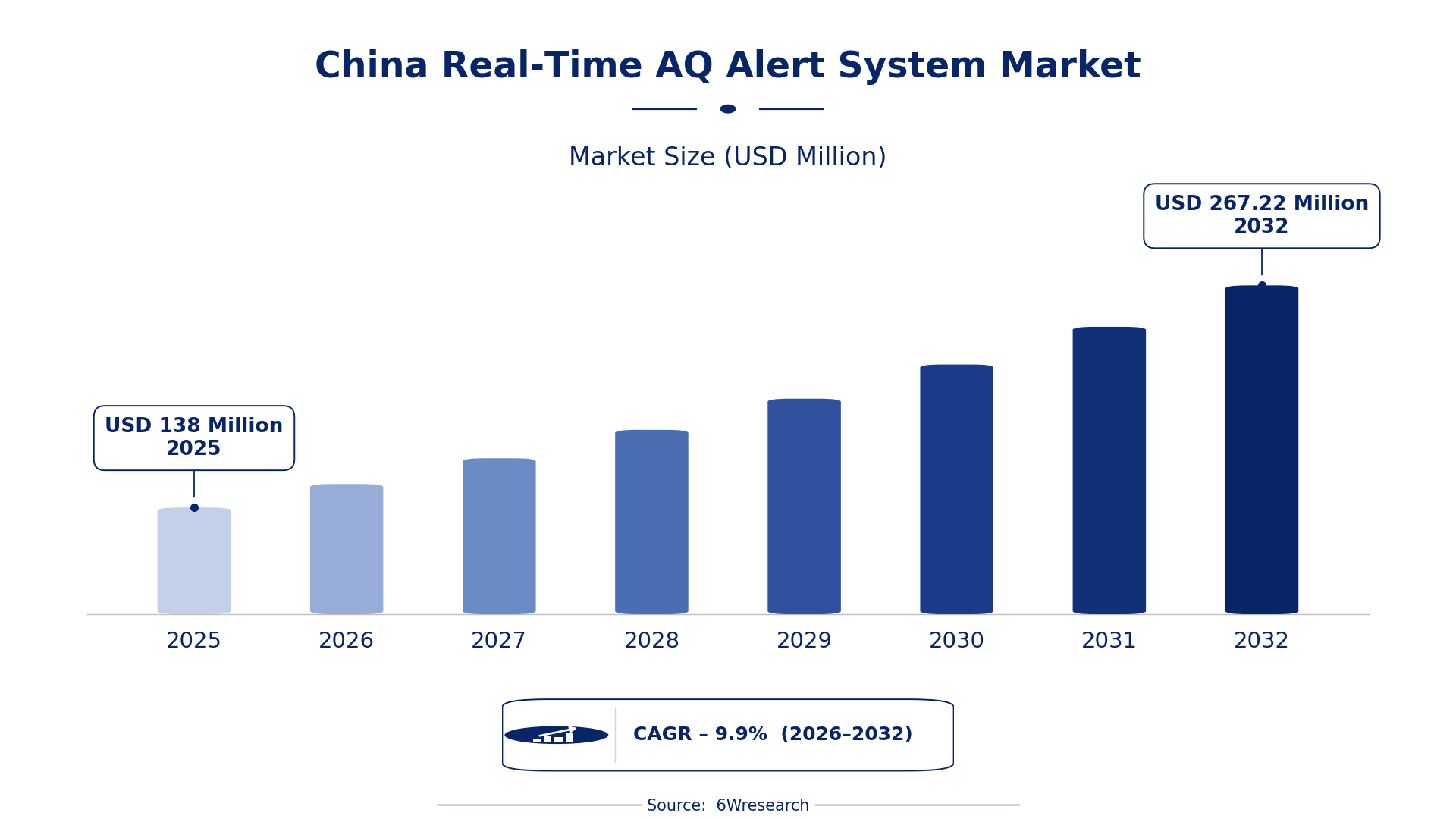
According to 6Wresearch internal database and industry insights, the China Real‑Time AQ Alert System Market was valued at USD 138 million in 2025 and is projected to reach USD 267.22 million by 2032, growing at a CAGR of approximately 9.9% during 2026–2032.
China Real‑Time AQ Alert System Market Highlights
| Report Metric | Details |
| Report Name | China Real‑Time AQ Alert System Market |
| Market Size 2025 | USD 138 million |
| Market Size 2032 | USD 267.22 million |
| Absolute Growth 2025–2032 | USD 129.22 million |
| CAGR 2026–2032 | 9.9% |
| Peak Annual Growth | 12.4% in 2031 |
| Forecast Period | 2026–2032 |
| Historical Data | 2022–2025 |
| Base Year | 2025 |
| Leading Sensor Type, 2025 | Fixed Outdoor AQ Sensors (51% share) |
| Leading Alert Model, 2025 | Threshold-Based Alerts (51% share) |
| Leading Deployment Setting, 2025 | Urban Monitoring (38% share) |
| Leading End User, 2025 | Municipal Environmental Agencies (39% share) |
| Fastest-Growing Sensor Type | Portable Air Quality Monitors (12.5% CAGR) |
| Fastest-Growing Alert Model | Predictive Alerts (12.6% CAGR) |
| Fastest-Growing Deployment Setting | Smart City Networks (12.0% CAGR) |
| Fastest-Growing End User | Public Health Units (11.1% CAGR) |
| Growing Sector | Public Health |
| Key End Users | Municipal Environmental Agencies, Public Health Units, Facility Managers, Urban Planners |
China Real‑Time AQ Alert System Market Year-wise Growth Rate and Key Drivers (2022–2032)
This graph illustrates the annual growth rates of the market from 2022 to 2032, highlighting a steady upward trajectory and projected market expansion over the forecast period.
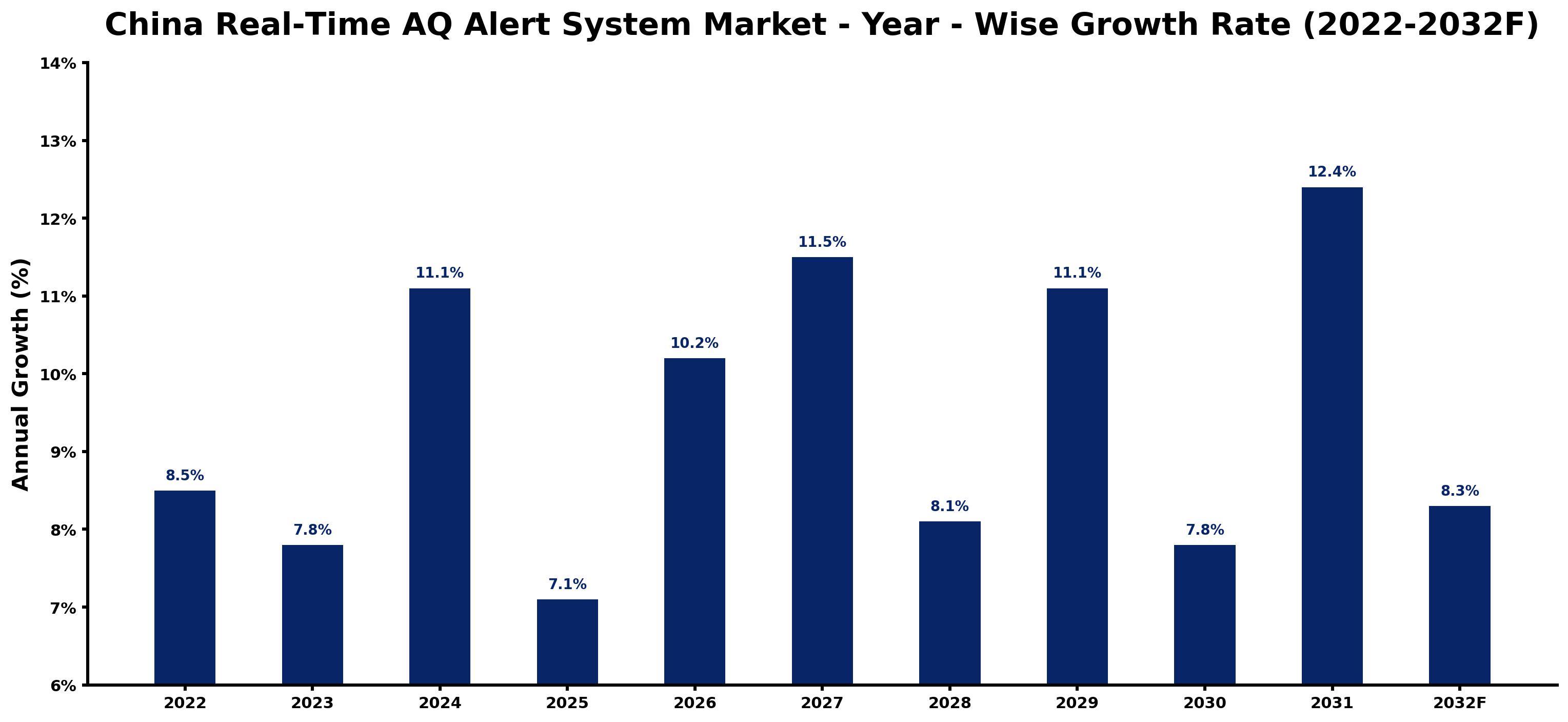
Year by year, the estimates below pair each growth rate with the development that shaped it.
| Year | Estimated Annual Growth (%) | Market Rationale |
| 2022 | 8.5 | The market experienced steady growth as urban areas expanded and air quality concerns intensified due to the Air Quality Improvement Plan. |
| 2023 | 7.8 | Growth slowed as regulatory adjustments in air quality standards and monitoring requirements were implemented by the Ministry of Ecology and Environment. |
| 2024 | 11.1 | Demand surged following public health initiatives that highlighted the need for improved air quality monitoring systems. |
| 2025 | 7.1 | A slowdown occurred as market maturity began to set in, affecting growth rates in urban monitoring. |
| 2026 | 10.2 | Investment in smart city projects is expected to increase demand for advanced air quality monitoring systems in over 200 cities. |
| 2027 | 11.5 | Growing public awareness of air pollution's health impacts will drive demand for monitoring solutions, particularly among municipal agencies. |
| 2028 | 8.1 | Demand growth is projected to slow as the market adjusts to increased competition and technology adoption in urban areas. |
| 2029 | 11.1 | A resurgence in demand is anticipated as new urban policies prioritise air quality management, especially in major cities. |
| 2030 | 7.8 | Growth is expected to slow again due to market saturation in certain urban areas and regulatory compliance challenges faced by local governments. |
| 2031 | 12.4 | The market is projected to peak with heightened investment in environmental monitoring technologies driven by public health initiatives. |
| 2032 | 8.3 | A slowdown is expected as the market stabilises, reflecting ongoing urban environmental initiatives and smart city projects. |
Note: Market size estimations and growth projections presented in this report are based on 6Wresearch's proprietary forecasting methodology, utilizing the latest available industry data, government publications, and primary research inputs.
China Real‑Time AQ Alert System Market Synopsis
The Real‑Time AQ Alert System in China encompasses advanced technologies for monitoring air quality. These systems utilise sensors and data analytics to provide alerts on air pollution levels, supporting public health and urban planning. The market is expanding due to increasing urbanisation, with over 900 million people living in urban areas as of 2023. Government initiatives, such as the Air Quality Improvement Plan, are driving demand for real-time monitoring solutions. Smart city projects in cities like Beijing and Shanghai are also creating new opportunities for investment in air quality management.
Market Dynamics Impact Analysis (2026–2032)
| Factor | Type | Impact | Primary Segment Affected |
| Increasing urbanisation and population density drive demand for real-time air quality monitoring solutions. | Driver | High | Urban Monitoring |
| Government funding for smart environmental monitoring technologies boosts system adoption. | Driver | High | IoT-Connected Nodes |
| Growing public health awareness creates opportunities for portable air quality monitors. | Opportunity | High | Portable Air Quality Monitors |
| The integration of air quality systems in smart buildings presents new market opportunities. | Opportunity | Medium | Smart Buildings |
| Regulatory compliance costs may hinder smaller municipalities from adopting advanced systems. | Restraint | High | Municipal Environmental Agencies |
| Competition from low-cost monitoring solutions could limit market growth for premium systems. | Restraint | Medium | Fixed Outdoor AQ Sensors |
| The Real-Time AQ Alert System Market in China faces challenges from regulatory compliance complexities. | Challenge | High | Indoor AQ Systems |
| Limited consumer awareness of air quality monitoring benefits poses a challenge to market penetration. | Challenge | Medium | Wearable Devices |
Evaluation of Drivers in China Real‑Time AQ Alert System Market (2026–2032)
Key forces behind demand, with the segment each one moves most, are listed below.
| Drivers | Primary Segment Affected | Why It Matters (Evidence) |
| Investment in smart city initiatives drives demand for real-time air quality monitoring systems. | IoT-Connected Nodes | Over 50 cities are deploying IoT-connected air quality nodes as part of smart city projects. |
| Public health initiatives are increasing the need for effective air quality monitoring solutions. | Portable Air Quality Monitors | Public health units reported a 15% rise in air quality-related health advisories in 2023. |
| Government subsidies for technology adoption support the growth of air quality monitoring systems. | Fixed Outdoor AQ Sensors | The National Development and Reform Commission allocated 500 million yuan for smart environmental monitoring technologies. |
| Urbanisation drives the need for continuous air quality monitoring in densely populated areas. | Urban Monitoring | China had over 200 cities implementing real-time air quality monitoring systems in 2022. |
| Rising consumer demand for personal air quality assessments boosts portable monitor sales. | Portable Air Quality Monitors | Sales of portable air quality monitors increased by 30% in 2023. |
Market growth for Real‑Time AQ Alert System in China is underpinned by substantial investments in smart city projects, which drive demand for advanced air quality monitoring systems. Over 1,000 fixed outdoor monitoring stations are being deployed, improving data collection capabilities. The urbanisation trend is evident, with over 200 cities implementing real-time air quality monitoring systems, further driving demand. The National Development and Reform Commission's allocation of 500 million yuan for smart environmental monitoring technologies supports system adoption among municipalities.
Evaluation of Restraints in China Real‑Time AQ Alert System Market
The key brakes on demand, and where they bite hardest, are shown below.
| Market Restraint | Primary Segment Affected | Why It Matters (Evidence) |
| Regulatory compliance costs may hinder smaller municipalities from adopting advanced systems. | Municipal Environmental Agencies | Smaller municipalities face high costs associated with meeting air quality monitoring regulations. |
| Competition from low-cost monitoring solutions could limit market growth for premium systems. | Fixed Outdoor AQ Sensors | Low-cost alternatives may deter buyers from investing in higher-quality air quality monitoring systems. |
| Limited funding for environmental initiatives restricts the deployment of advanced monitoring technologies. | Indoor AQ Systems | Budget constraints in local governments affect the adoption of sophisticated indoor air quality systems. |
| Consumer awareness of air quality monitoring benefits remains low, affecting market penetration. | Wearable Devices | Many consumers are unaware of the advantages of personal air quality monitoring devices. |
| Technological complexities in integrating systems may slow down market adoption rates. | Smart Buildings | Integration challenges can delay the implementation of air quality monitoring in new smart buildings. |
China Real‑Time AQ Alert System Market Challenges
In the China Real-Time AQ Alert System market, municipal agencies struggle with inadequate air quality monitoring coverage, as only 338 cities are part of the National Air Quality Monitoring Network, leaving many urban areas vulnerable to pollution-related health issues. Regulatory inconsistencies complicate compliance for suppliers, leading to delays in implementing essential monitoring systems that can affect public health initiatives. Advanced sensor technologies are difficult to source due to stringent government standards, increasing costs for manufacturers by up to 20%. The rapid pace of technological advancements also risks obsolescence for existing systems, undermining the effectiveness of real-time data for urban planners and public health units.
Trends in the China Real‑Time AQ Alert System Market
Below mentioned are some of the trends shaping the China Real‑Time AQ Alert System Market growth.
- Public Health Units Increasingly Prioritising Air Quality Monitoring: Public health units in China are placing greater emphasis on air quality monitoring, responding to rising pollution levels. In 2023, there was a 15% increase in air quality-related health advisories, highlighting the need for effective monitoring solutions.
- Urban Areas Adopting Smart City Technologies: Cities like Beijing and Shanghai are embracing smart city technologies to improve air quality management. As of 2023, over 200 cities have implemented real-time air quality monitoring systems, reflecting a shift towards smart urban planning.
- Growth of Portable Air Quality Monitors: The demand for portable air quality monitors is rising, with a 30% increase in sales reported in 2023. This trend is driven by consumer awareness of air pollution and the need for personal monitoring solutions.
- Integration of Air Quality Systems in Smart Buildings: Smart buildings are increasingly integrating air quality monitoring systems to improve indoor environments. The updated building codes in 2023 mandate air quality monitoring systems in new constructions, reflecting a growing trend.
Investment Opportunities in the China Real‑Time AQ Alert System Market
Several openings in the China Real‑Time AQ Alert System Market merit attention from investors.
- Smart City Projects in Urban Areas: Smart city initiatives in cities like Beijing are creating opportunities for advanced air quality monitoring systems. With over 900 million people in urban areas, the demand for effective monitoring solutions is substantial.
- Public Health Units Seeking Advanced Solutions: Public health units are actively searching for advanced air quality monitoring solutions to support health initiatives. The rise in air quality-related health advisories indicates a growing need for effective monitoring technologies.
- Growing Demand for Portable Monitors: The rising concern for personal health drives the demand for portable air quality monitors. With a 30% increase in sales in 2023, suppliers can enter this market by partnering with local retailers.
- Integration of Monitoring in Smart Buildings: The updated building codes in 2023 mandate air quality monitoring systems in new constructions. This presents an opportunity for suppliers to provide advanced systems to facility managers in urban areas.
Government Initiatives in the China Real‑Time AQ Alert System Market
The "Air Quality Improvement Plan" launched by the Ministry of Ecology and Environment in 2021 aims to improve monitoring systems across 50 major cities by 2025. This plan mandates the implementation of real-time air quality monitoring technologies, ensuring compliance with national standards. The initiative is expected to enhance air quality management and increase the demand for advanced monitoring solutions in urban areas.
The National Environmental Protection Agency oversees the National Air Quality Monitoring Network, which standardises air quality data collection nationwide. This agency approves funding for projects that improve air quality monitoring capabilities, assisting municipalities in adopting necessary technologies. The network aims to cover 338 cities, facilitating better data-driven decision-making for air quality management.
Future Insight of the China Real‑Time AQ Alert System Market
The China Real-Time AQ Alert System market will evolve by 2032, driven by smart city initiatives and improved IoT integration. Urban areas will see over 1,000 fixed outdoor monitoring stations deployed, greatly enhancing access to real-time air quality data. Government subsidies will encourage the adoption of advanced monitoring technologies, while public awareness campaigns will boost demand for innovative solutions. The increase in portable air quality monitors, with a 30% sales rise in 2023, reflects a growing consumer interest in personal air quality management.
Market Segmentation Analysis
The analysis below covers each segmentation, its leading category in 2025 and its fastest-growing category through 2032.
By Sensor Type – Fixed Outdoor AQ Sensors Dominated, Portable Air Quality Monitors Expected to Grow Fastest
According to Ravi Bhandari, Research Head at 6Wresearch, in 2025, Fixed Outdoor AQ Sensors led the sensor type split with a 51% share. Fixed Outdoor AQ Sensors dominate the market as they are integral for continuous outdoor air quality monitoring, with over 1,000 fixed stations deployed across China. These sensors are vital for municipal agencies to comply with air quality standards mandated by the Ministry of Ecology and Environment. Portable Air Quality Monitors are projected to grow fastest, at a CAGR of 12.5% during 2026–2032. Portable Air Quality Monitors are rapidly gaining traction, evidenced by a 30% surge in consumer sales in 2023, as individuals increasingly seek personal and localized assessments of air quality. This trend highlights a growing public awareness and concern regarding air quality issues. Suppliers should prioritise expanding the availability of portable monitors to cater to the increasing consumer demand.
By Alert Model – Threshold-Based Alerts Dominated, Predictive Alerts Expected to Grow Fastest
Threshold-Based Alerts held a 51% share of the China Real‑Time AQ Alert System Market by alert model in 2025. Threshold-Based Alerts hold the largest market share as they are essential for notifying users when air quality exceeds safe levels, directly impacting public health initiatives. This model aligns with the Air Quality Standards established by the government, ensuring safety for urban populations across China. Over 2026–2032, Predictive Alerts are expected to post the fastest growth, at a CAGR of 12.6%. Predictive Alerts are rapidly gaining traction due to their ability to forecast air quality issues based on current data trends, which is increasingly vital for proactive public health strategies. The growing emphasis on predictive analytics indicates a rising demand for these advanced alert systems. Suppliers should focus on developing predictive alert technologies to meet the evolving needs of air quality management.
By Deployment Setting – Urban Monitoring Dominated, Smart City Networks Expected to Grow Fastest
With a 38% revenue share in 2025, Urban Monitoring was the largest deployment setting category. Urban Monitoring is critical in densely populated areas, where over 200 cities in China implement real-time air quality monitoring systems. This focus on urban environments is vital for addressing the needs of the 900 million people living in urban areas as they require effective air quality management. Smart City Networks are set to record the highest CAGR in this split, 12.0% over 2026–2032. Smart City Networks are rapidly developing as part of broader urban environmental monitoring systems, driven by smart city initiatives in major cities like Beijing and Shanghai. This growth highlights the integration of technology into urban planning for improved air quality management. Suppliers should align their offerings with smart city initiatives to capture emerging opportunities in urban air quality monitoring.
By End User – Municipal Environmental Agencies Dominated, Public Health Units Expected to Grow Fastest
Municipal Environmental Agencies accounted for a 39% market share by end user in 2025. Municipal Environmental Agencies dominate the market as they are the primary users of air quality monitoring systems, requiring accurate data for regulatory compliance and public health initiatives. Their critical role in enforcing air quality standards guarantees a steady demand for these monitoring systems. The quickest growth will come from Public Health Units, forecast to expand at a CAGR of 11.1% between 2026 and 2032. Public Health Units are witnessing significant growth as they rely more on air quality data to inform health advisories and policies, particularly following a 15% increase in health advisories reported in 2023. This trend highlights the essential link between air quality data and public health outcomes. Suppliers should strengthen partnerships with public health units to enhance the effectiveness of air quality monitoring systems.
Key Attractiveness of the Report
- 10 Years of Market Numbers
- Historical Data Starting from 2022 to 2025
- Base Year 2025
- Forecast Data until 2032
- Key Performance Indicators Impacting the Market
- Major Upcoming Developments and Projects
Key Highlights of the Report:
- China Real‑Time AQ Alert System Market Outlook
- Market Size of China Real‑Time AQ Alert System Market, 2025
- Forecast of China Real‑Time AQ Alert System Market, 2032
- Historical Data and Forecast of China Real‑Time AQ Alert System Revenues & Volume for the Period 2022 - 2032F
- China Real‑Time AQ Alert System Market Trend Evolution
- China Real‑Time AQ Alert System Market Drivers and Challenges
- China Real‑Time AQ Alert System Price Trends
- China Real‑Time AQ Alert System Porter's Five Forces
- China Real‑Time AQ Alert System Industry Life Cycle
- Historical Data and Forecast of China Real‑Time AQ Alert System Market Revenues & Volume By Sensor Type for the Period 2022 - 2032F
- Historical Data and Forecast of China Real‑Time AQ Alert System Market Revenues & Volume By Fixed Outdoor AQ Sensors for the Period 2022 - 2032F
- Historical Data and Forecast of China Real‑Time AQ Alert System Market Revenues & Volume By Portable Air Quality Monitors for the Period 2022 - 2032F
- Historical Data and Forecast of China Real‑Time AQ Alert System Market Revenues & Volume By Indoor AQ Systems for the Period 2022 - 2032F
- Historical Data and Forecast of China Real‑Time AQ Alert System Market Revenues & Volume By IoT-Connected Nodes for the Period 2022 - 2032F
- Historical Data and Forecast of China Real‑Time AQ Alert System Market Revenues & Volume By Alert Model for the Period 2022 - 2032F
- Historical Data and Forecast of China Real‑Time AQ Alert System Market Revenues & Volume By Threshold-Based Alerts for the Period 2022 - 2032F
- Historical Data and Forecast of China Real‑Time AQ Alert System Market Revenues & Volume By Predictive Alerts for the Period 2022 - 2032F
- Historical Data and Forecast of China Real‑Time AQ Alert System Market Revenues & Volume By LEED/Well Cert Alerts for the Period 2022 - 2032F
- Historical Data and Forecast of China Real‑Time AQ Alert System Market Revenues & Volume By Real-Time Mobile Alerts for the Period 2022 - 2032F
- Historical Data and Forecast of China Real‑Time AQ Alert System Market Revenues & Volume By Deployment Setting for the Period 2022 - 2032F
- Historical Data and Forecast of China Real‑Time AQ Alert System Market Revenues & Volume By Urban Monitoring for the Period 2022 - 2032F
- Historical Data and Forecast of China Real‑Time AQ Alert System Market Revenues & Volume By Wearable Devices for the Period 2022 - 2032F
- Historical Data and Forecast of China Real‑Time AQ Alert System Market Revenues & Volume By Smart Buildings for the Period 2022 - 2032F
- Historical Data and Forecast of China Real‑Time AQ Alert System Market Revenues & Volume By Smart City Networks for the Period 2022 - 2032F
- Historical Data and Forecast of China Real‑Time AQ Alert System Market Revenues & Volume By End User for the Period 2022 - 2032F
- Historical Data and Forecast of China Real‑Time AQ Alert System Market Revenues & Volume By Municipal Environmental Agencies for the Period 2022 - 2032F
- Historical Data and Forecast of China Real‑Time AQ Alert System Market Revenues & Volume By Workers in Utilities/Construction for the Period 2022 - 2032F
- Historical Data and Forecast of China Real‑Time AQ Alert System Market Revenues & Volume By Facility Managers for the Period 2022 - 2032F
- Historical Data and Forecast of China Real‑Time AQ Alert System Market Revenues & Volume By Public Health Units for the Period 2022 - 2032F
- China Real‑Time AQ Alert System Import Export Trade Statistics
- Market Opportunity Assessment By Sensor Type
- Market Opportunity Assessment By Alert Model
- Market Opportunity Assessment By Deployment Setting
- Market Opportunity Assessment By End User
- China Real‑Time AQ Alert System Top Companies Market Share
- China Real‑Time AQ Alert System Competitive Benchmarking By Technical and Operational Parameters
- China Real‑Time AQ Alert System Company Profiles
- China Real‑Time AQ Alert System Key Strategic Recommendations
Market Covered
Segments analysed in this report are listed below.
By Sensor Type
- Fixed Outdoor AQ Sensors
- Portable Air Quality Monitors
- Indoor AQ Systems
- IoT-Connected Nodes
By Alert Model
- Threshold-Based Alerts
- Predictive Alerts
- LEED/Well Cert Alerts
- Real-Time Mobile Alerts
By Deployment Setting
- Urban Monitoring
- Wearable Devices
- Smart Buildings
- Smart City Networks
By End User
- Municipal Environmental Agencies
- Workers in Utilities/Construction
- Facility Managers
- Public Health Units































