India Renewable Integration AI Market Size & Growth Rate
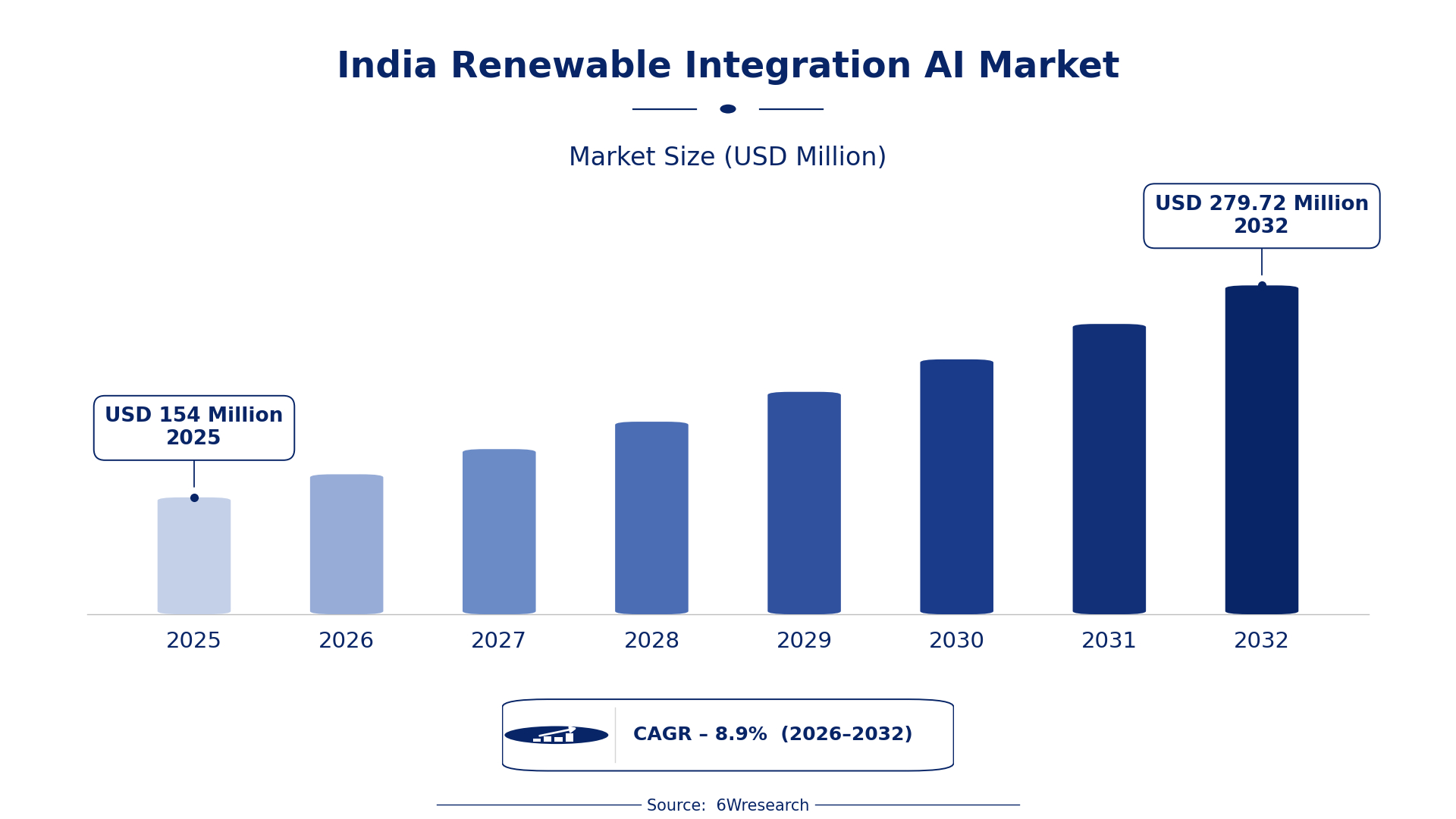
According to 6Wresearch internal database and industry insights, the India Renewable Integration AI Market was valued at USD 154.0 million in 2025 and is projected to reach USD 279.72 million by 2032, growing at a CAGR of approximately 8.9% during 2026–2032.
India Renewable Integration AI Market Highlights
| Report Metric | Details |
| Report Name | India Renewable Integration AI Market |
| Market Size 2025 | USD 154.0 million |
| Market Size 2032 | USD 279.72 million |
| Absolute Growth 2025–2032 | USD 125.72 million |
| CAGR 2026–2032 | 8.9% |
| Peak Annual Growth | 11.5% in 2027 |
| Forecast Period | 2026–2032 |
| Historical Data | 2022–2025 |
| Base Year | 2025 |
| Leading AI Application, 2025 | Load Forecasting AI (35% share) |
| Leading Use Case, 2025 | Demand Prediction (35% share) |
| Leading Deployment Mode, 2025 | Grid-Edge (42% share) |
| Leading End User, 2025 | Utility Operators (43% share) |
| Fastest-Growing AI Application | Grid Balancing AI (10.2% CAGR) |
| Fastest-Growing Use Case | Real-Time Dispatch (10.4% CAGR) |
| Fastest-Growing Deployment Mode | Cloud/Edge (11.3% CAGR) |
| Fastest-Growing End User | Smart Grid Managers (11.2% CAGR) |
| Growing Sector | Grid Balancing AI |
| Key End Users | Load Forecasting AI, Grid Balancing AI, Fault Detection, Renewable Forecasting |
India Renewable Integration AI Market Year-wise Growth Rate and Key Drivers (2022–2032)
This graph illustrates the annual growth rates of the market from 2022 to 2032, highlighting a steady upward trajectory and projected market expansion over the forecast period.
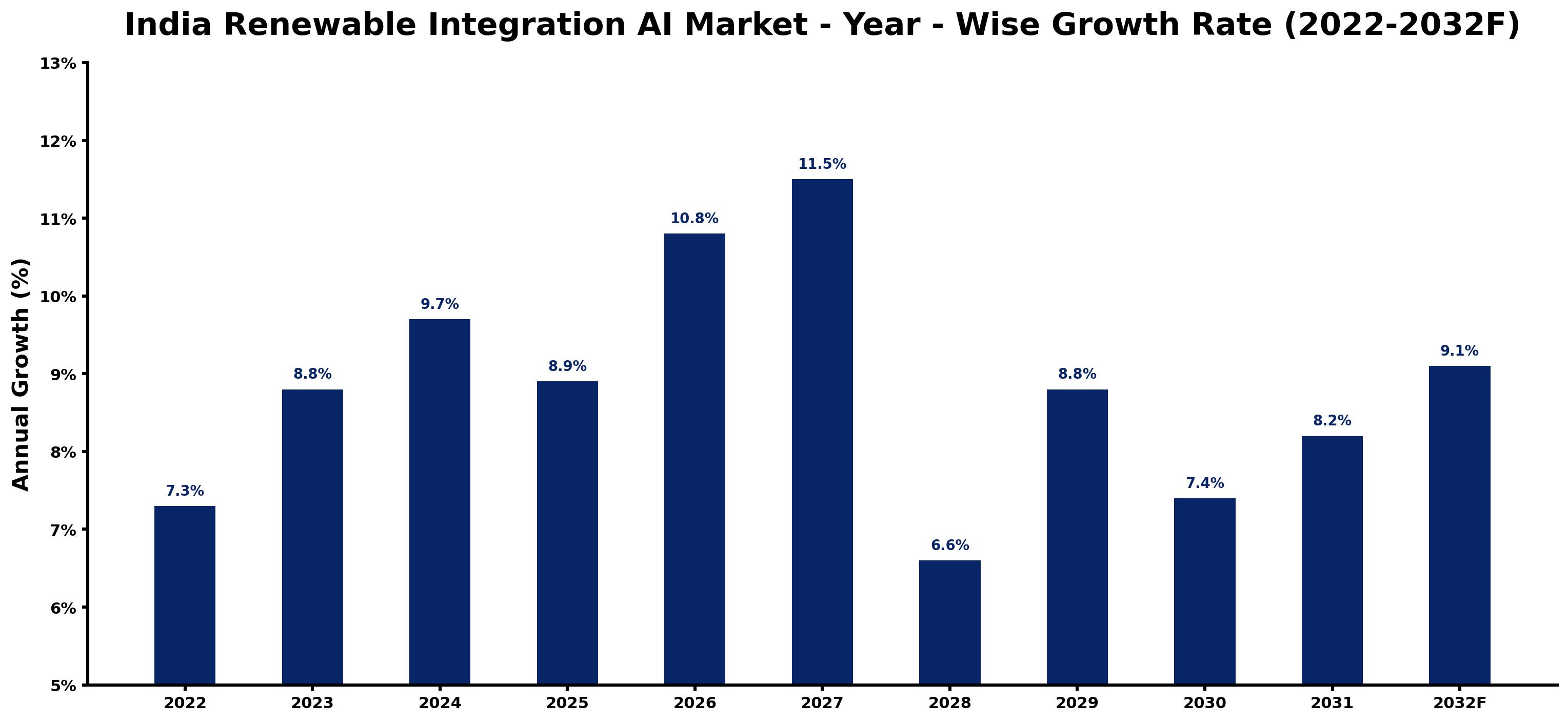
Below, each year's estimated growth is shown next to the factor that most influenced it.
| Year | Estimated Annual Growth (%) | Market Rationale |
| 2022 | 7.3 | The market experienced steady growth driven by the National Clean Energy Fund supporting clean energy technologies. |
| 2023 | 8.8 | Demand surged as the installed renewable energy capacity reached 150 GW, boosting market activity. |
| 2024 | 9.7 | Growth accelerated due to heightened investments in the Smart Grid Mission, modernising power infrastructure. |
| 2025 | 8.9 | A slight slowdown occurred as the market adjusted to rapid changes in energy demand and grid integration. |
| 2026 | 10.8 | Investment in grid-edge technologies is expected to increase, propelling growth back to higher levels. |
| 2027 | 11.5 | The market is projected to peak as demand for AI solutions in energy management intensifies, driven by the Smart Cities Mission. |
| 2028 | 6.6 | Growth is expected to slow as the market begins to stabilise after reaching peak demand. |
| 2029 | 8.8 | Renewed investments in smart grid projects will revitalise market growth momentum, particularly in urban areas. |
| 2030 | 7.4 | A further slowdown is anticipated as the market adjusts to new operational standards and technologies. |
| 2031 | 8.2 | Growth will resume as utility operators increasingly adopt AI for energy management, supported by the National Wind-Solar Hybrid Policy. |
| 2032 | 9.1 | The market is projected to stabilise with consistent demand from utility operators and energy infrastructure firms. |
Note: Market size estimations and growth projections presented in this report are based on 6Wresearch's proprietary forecasting methodology, utilizing the latest available industry data, government publications, and primary research inputs.
India Renewable Integration AI Market Synopsis
The India Renewable Integration AI Market encompasses technologies that optimise the integration of renewable energy into power grids using AI. This involves machine learning algorithms that improve grid stability, energy efficiency, and predictive maintenance. The market is growing due to rising energy demands from a population of approximately 1.4 billion and government initiatives promoting clean energy. The installed renewable energy capacity reached 150 GW in 2023, with a target of 500 GW by 2030, driving further investments and demand.
Market Dynamics Impact Analysis (2026–2032)
| Factor | Type | Impact | Primary Segment Affected |
| Increasing investment in smart grid technologies and AI solutions | Driver | High | Grid Balancing AI |
| Rising energy demands from a growing population and industrial activities | Driver | High | Demand Prediction |
| Significant government incentives for renewable energy projects | Opportunity | High | Utility Operators |
| Emerging demand for predictive maintenance solutions in renewable energy systems | Opportunity | Medium | Predictive Maintenance |
| Challenges in integrating diverse renewable sources into existing grids | Restraint | High | Grid Balancing AI |
| Limited awareness and understanding of AI applications in energy management | Restraint | Medium | Load Forecasting AI |
| Infrastructure development delays affecting project timelines | Challenge | High | Smart Grid Managers |
| Shortage of skilled professionals in AI and renewable energy sectors | Challenge | Medium | Energy Infrastructure Firms |
Evaluation of Drivers in India Renewable Integration AI Market (2026–2032)
The table below links each growth driver to the segment it affects and the evidence for it.
| Drivers | Primary Segment Affected | Why It Matters (Evidence) |
| Investment in smart grid projects | Grid Balancing AI | The Smart Grid Mission aims to modernise India's power infrastructure by 2025, increasing demand for AI solutions. |
| Growing energy consumption due to population increase | Demand Prediction | India's population of approximately 1.4 billion creates substantial energy needs, driving demand for predictive AI. |
| Government initiatives promoting renewable energy | Utility Operators | The National Wind-Solar Hybrid Policy encourages hybrid projects, increasing the need for AI in grid management. |
| Demand for predictive maintenance in renewable systems | Predictive Maintenance | The installed solar capacity is expected to exceed 100 GW by 2025, necessitating efficient maintenance solutions. |
| Focus on energy efficiency programs | Load Forecasting AI | The Bureau of Energy Efficiency promotes energy efficiency under the Energy Conservation Building Code, driving AI adoption. |
Expansion of the Renewable Integration AI market in India is backed by increasing investments in smart grid technologies and growing end-use demand for energy management solutions. The Smart Cities Mission includes renewable energy integration as a key component for urban development, which drives demand for AI applications. India's population of approximately 1.4 billion creates substantial energy needs, pushing the adoption of predictive AI for demand forecasting. The installed solar capacity is expected to exceed 100 GW by 2025, necessitating effective predictive maintenance solutions to manage this growth.
Evaluation of Restraints in India Renewable Integration AI Market
The key brakes on demand, and where they bite hardest, are shown below.
| Market Restraint | Primary Segment Affected | Why It Matters (Evidence) |
| Integration challenges with diverse renewable sources | Grid Balancing AI | The Central Electricity Authority has set standards for grid integration, complicating the adoption of AI solutions. |
| Limited awareness of AI applications in energy management | Load Forecasting AI | Many stakeholders lack understanding of how AI can improve energy efficiency and grid stability. |
| Infrastructure development delays | Smart Grid Managers | Ongoing delays in infrastructure projects hinder timely implementation of AI technologies. |
| Shortage of skilled professionals in AI | Energy Infrastructure Firms | The demand for skilled professionals in AI and renewable sectors exceeds the current supply, limiting growth opportunities. |
| High initial investment costs for AI systems | Utility Operators | Utility operators face substantial upfront costs when integrating AI solutions into existing systems. |
India Renewable Integration AI Market Challenges
India's Renewable Integration AI market faces several challenges, beginning with supply chain inefficiencies. The ongoing reliance on traditional energy sources hampers the integration of AI technologies, resulting in potential revenue losses for producers estimated at 20% annually. A lack of skilled professionals in AI and renewable energy sectors restricts project execution, causing delays of up to six months for buyers. Outdated technology in existing power grids obstructs the deployment of advanced AI solutions, raising operational costs for suppliers by about 15%. Additionally, buyers encounter high upfront costs for implementing AI systems, which may deter investment in renewable energy projects.
Trends in the India Renewable Integration AI Market
Below mentioned are some of the trends shaping the India Renewable Integration AI Market growth.
- Shift from Traditional to Smart Grid Solutions: India is transitioning from traditional grid systems to smart grid technologies, improving energy management. The Smart Grid Mission, initiated in 2015, aims to modernise power infrastructure and includes over 100 smart grid projects across various states.
- Emergence of Predictive Maintenance Solutions: Since 2023, there has been a notable increase in predictive maintenance solutions for renewable energy systems. The installed solar capacity is expected to exceed 100 GW by 2025, driving demand for these technologies.
- Growing Demand for Hybrid Renewable Projects: The National Wind-Solar Hybrid Policy, launched in 2021, promotes the integration of hybrid renewable energy projects. This initiative is expected to improve efficiency and increase the adoption of AI technologies in energy management.
- Increased Focus on Energy Efficiency: The Bureau of Energy Efficiency has intensified efforts to promote energy efficiency programs. The Energy Conservation Building Code encourages the adoption of AI solutions, further driving market growth.
Investment Opportunities in the India Renewable Integration AI Market
Below are the investment opportunities with the strongest case in the India Renewable Integration AI Market.
- Increasing Demand for Predictive Maintenance Solutions: With India's renewable energy capacity expected to reach 500 GW by 2030, there is a growing need for predictive maintenance solutions. Utility operators are seeking advanced AI systems to enhance operational efficiency, with investments projected to exceed USD 50 million by 2025.
- Investment in Smart Grid Technologies: The Smart Grid Mission aims to modernise India's power infrastructure, creating a demand for AI applications. This initiative is expected to generate over USD 100 million in investments by 2025, particularly from energy infrastructure firms.
- Focus on Hybrid Renewable Projects: The National Wind-Solar Hybrid Policy encourages investments in hybrid renewable energy projects, which are gaining traction. This policy is projected to attract USD 30 million in investments by 2025, primarily from energy producers.
- Expansion of Grid-Edge Solutions: As urban areas grow, the demand for grid-edge solutions is rising. With an expected market size of USD 20 million by 2025, smart grid managers are increasingly investing in AI technologies to optimise local energy management.
Government Initiatives in the India Renewable Integration AI Market
The National Wind-Solar Hybrid Policy, launched in 2021, promotes hybrid renewable energy projects to improve efficiency. This policy builds on prior initiatives by the Ministry of New and Renewable Energy, encouraging the integration of renewable sources into the energy mix.
The Smart Grid Mission, initiated in 2015, includes funding for over 100 smart grid projects across various states. The Ministry of Power oversees this mission, aiming to modernise India's power infrastructure and enhance energy management capabilities.
Future Insight of the India Renewable Integration AI Market
The Renewable Integration AI market in India is set for substantial changes by 2032, primarily driven by advancements in smart grid technologies and government initiatives. The Smart Grid Mission aims to modernise power infrastructure, with over 100 smart grid projects improving overall efficiency. By 2030, India's renewable energy capacity is projected to reach 500 GW, generating considerable demand for AI solutions that optimise energy management. The establishment of the Renewable Energy Management Center will further enhance grid management capabilities, benefiting both suppliers and buyers in the renewable energy sector.
Market Segmentation Analysis
Each segment group is reviewed below, with the leader by share and the fastest grower by CAGR.
By AI Application – Load Forecasting AI Dominated, Grid Balancing AI Expected to Grow Fastest
According to Ravi Bhandari, Research Head at 6Wresearch, Load Forecasting AI accounted for a 35% market share by ai application in 2025. Load Forecasting AI holds the largest share due to its critical role in predicting energy demand based on historical data, which is essential for utility operators. With India's renewable energy capacity reaching 150 GW in 2023, accurate load forecasting is vital for effective grid management. Over 2026–2032, Grid Balancing AI is expected to post the fastest growth, at a CAGR of 10.2%. Grid Balancing AI is experiencing rapid growth as it is essential for maintaining grid stability with variable renewable sources, particularly as India aims for 500 GW by 2030. This increasing focus on hybrid projects under the National Wind-Solar Hybrid Policy will further drive demand for grid balancing solutions. Suppliers should prioritise developing advanced grid balancing solutions to meet the growing needs of the renewable energy sector.
By Use Case – Demand Prediction Dominated, Real-Time Dispatch Expected to Grow Fastest
With a 35% revenue share in 2025, Demand Prediction was the largest use case category. Demand Prediction holds the largest market share as it is crucial for anticipating energy needs and optimising supply in a country with a population of approximately 1.4 billion. This capability is essential for utility operators to ensure a consistent and reliable energy supply. Real-Time Dispatch is projected to grow fastest, at a CAGR of 10.4% during 2026–2032. Real-Time Dispatch is rapidly growing due to its necessity for managing energy distribution effectively, especially with the rise of smart grid projects. The Smart Grid Mission's objective to modernise power infrastructure will further boost the demand for real-time solutions. Buyers must invest in real-time dispatch technologies to improve energy distribution efficiency and meet increasing demand.
By Deployment Mode – Grid-Edge Dominated, Cloud/Edge Expected to Grow Fastest
Grid-Edge took a 42% share of deployment mode in 2025, more than any other category. Grid-Edge technology commands the largest market share as it is vital for localised energy management solutions, enabling better integration of renewable sources. The anticipated growth of solar energy installations, projected to exceed 100 GW by 2025, highlights the need for effective grid-edge solutions. The quickest growth will come from Cloud/Edge, forecast to expand at a CAGR of 11.3% between 2026 and 2032. Cloud/Edge deployment is the fastest-growing mode because it enhances data processing and storage capabilities, which are essential for optimising renewable energy integration. The establishment of over 100 smart grid projects across various states supports the shift towards cloud-based solutions. Suppliers should focus on cloud and edge solutions to enhance data management capabilities for renewable energy integration.
By End User – Utility Operators Dominated, Smart Grid Managers Expected to Grow Fastest
In 2025, Utility Operators led the end user split with a 43% share. Utility Operators dominate the market share as they are the primary users of technology for grid management and optimisation, which is crucial for maintaining a reliable energy supply. Their role is vital in managing India's expanding renewable energy capacity effectively. Smart Grid Managers are set to record the highest CAGR in this split, 11.2% over 2026–2032. Smart Grid Managers represent the fastest-growing end user group, as they are essential for overseeing smart grid operations and efficiency, particularly with the increase in smart grid projects. The ongoing push for modernisation under the Smart Grid Mission will further elevate their importance. Buyers in the utility sector should prioritise solutions that improve smart grid management to stay competitive in the evolving energy landscape.
Key Attractiveness of the Report
- 10 Years of Market Numbers
- Historical Data Starting from 2022 to 2025
- Base Year 2025
- Forecast Data until 2032
- Key Performance Indicators Impacting the Market
- Major Upcoming Developments and Projects
Key Highlights of the Report:
- India Renewable Integration AI Market Outlook
- Market Size of India Renewable Integration AI Market, 2025
- Forecast of India Renewable Integration AI Market, 2032
- Historical Data and Forecast of India Renewable Integration AI Revenues & Volume for the Period 2022 - 2032F
- India Renewable Integration AI Market Trend Evolution
- India Renewable Integration AI Market Drivers and Challenges
- India Renewable Integration AI Price Trends
- India Renewable Integration AI Porter's Five Forces
- India Renewable Integration AI Industry Life Cycle
- Historical Data and Forecast of India Renewable Integration AI Market Revenues & Volume By AI Application for the Period 2022 - 2032F
- Historical Data and Forecast of India Renewable Integration AI Market Revenues & Volume By Load Forecasting AI for the Period 2022 - 2032F
- Historical Data and Forecast of India Renewable Integration AI Market Revenues & Volume By Grid Balancing AI for the Period 2022 - 2032F
- Historical Data and Forecast of India Renewable Integration AI Market Revenues & Volume By Fault Detection for the Period 2022 - 2032F
- Historical Data and Forecast of India Renewable Integration AI Market Revenues & Volume By Renewable Forecasting for the Period 2022 - 2032F
- Historical Data and Forecast of India Renewable Integration AI Market Revenues & Volume By Use Case for the Period 2022 - 2032F
- Historical Data and Forecast of India Renewable Integration AI Market Revenues & Volume By Demand Prediction for the Period 2022 - 2032F
- Historical Data and Forecast of India Renewable Integration AI Market Revenues & Volume By Real-Time Dispatch for the Period 2022 - 2032F
- Historical Data and Forecast of India Renewable Integration AI Market Revenues & Volume By Predictive Maintenance for the Period 2022 - 2032F
- Historical Data and Forecast of India Renewable Integration AI Market Revenues & Volume By Weather/Production for the Period 2022 - 2032F
- Historical Data and Forecast of India Renewable Integration AI Market Revenues & Volume By Deployment Mode for the Period 2022 - 2032F
- Historical Data and Forecast of India Renewable Integration AI Market Revenues & Volume By Grid-Edge for the Period 2022 - 2032F
- Historical Data and Forecast of India Renewable Integration AI Market Revenues & Volume By Cloud/Edge for the Period 2022 - 2032F
- Historical Data and Forecast of India Renewable Integration AI Market Revenues & Volume By AIoT + SCADA for the Period 2022 - 2032F
- Historical Data and Forecast of India Renewable Integration AI Market Revenues & Volume By ML Models for the Period 2022 - 2032F
- Historical Data and Forecast of India Renewable Integration AI Market Revenues & Volume By End User for the Period 2022 - 2032F
- Historical Data and Forecast of India Renewable Integration AI Market Revenues & Volume By Utility Operators for the Period 2022 - 2032F
- Historical Data and Forecast of India Renewable Integration AI Market Revenues & Volume By Smart Grid Managers for the Period 2022 - 2032F
- Historical Data and Forecast of India Renewable Integration AI Market Revenues & Volume By Energy Infrastructure Firms for the Period 2022 - 2032F
- Historical Data and Forecast of India Renewable Integration AI Market Revenues & Volume By Wind & Solar Aggregators for the Period 2022 - 2032F
- India Renewable Integration AI Import Export Trade Statistics
- Market Opportunity Assessment By AI Application
- Market Opportunity Assessment By Use Case
- Market Opportunity Assessment By Deployment Mode
- Market Opportunity Assessment By End User
- India Renewable Integration AI Top Companies Market Share
- India Renewable Integration AI Competitive Benchmarking By Technical and Operational Parameters
- India Renewable Integration AI Company Profiles
- India Renewable Integration AI Key Strategic Recommendations
Market Covered
Segments analysed in this report are listed below.
By AI Application
- Load Forecasting AI
- Grid Balancing AI
- Fault Detection
- Renewable Forecasting
By Use Case
- Demand Prediction
- Real-Time Dispatch
- Predictive Maintenance
- Weather/Production
By Deployment Mode
- Grid-Edge
- Cloud/Edge
- AIoT + SCADA
- ML Models
By End User
- Utility Operators
- Smart Grid Managers
- Energy Infrastructure Firms
- Wind & Solar Aggregators































