China Renewable Integration AI Market Size & Growth Rate
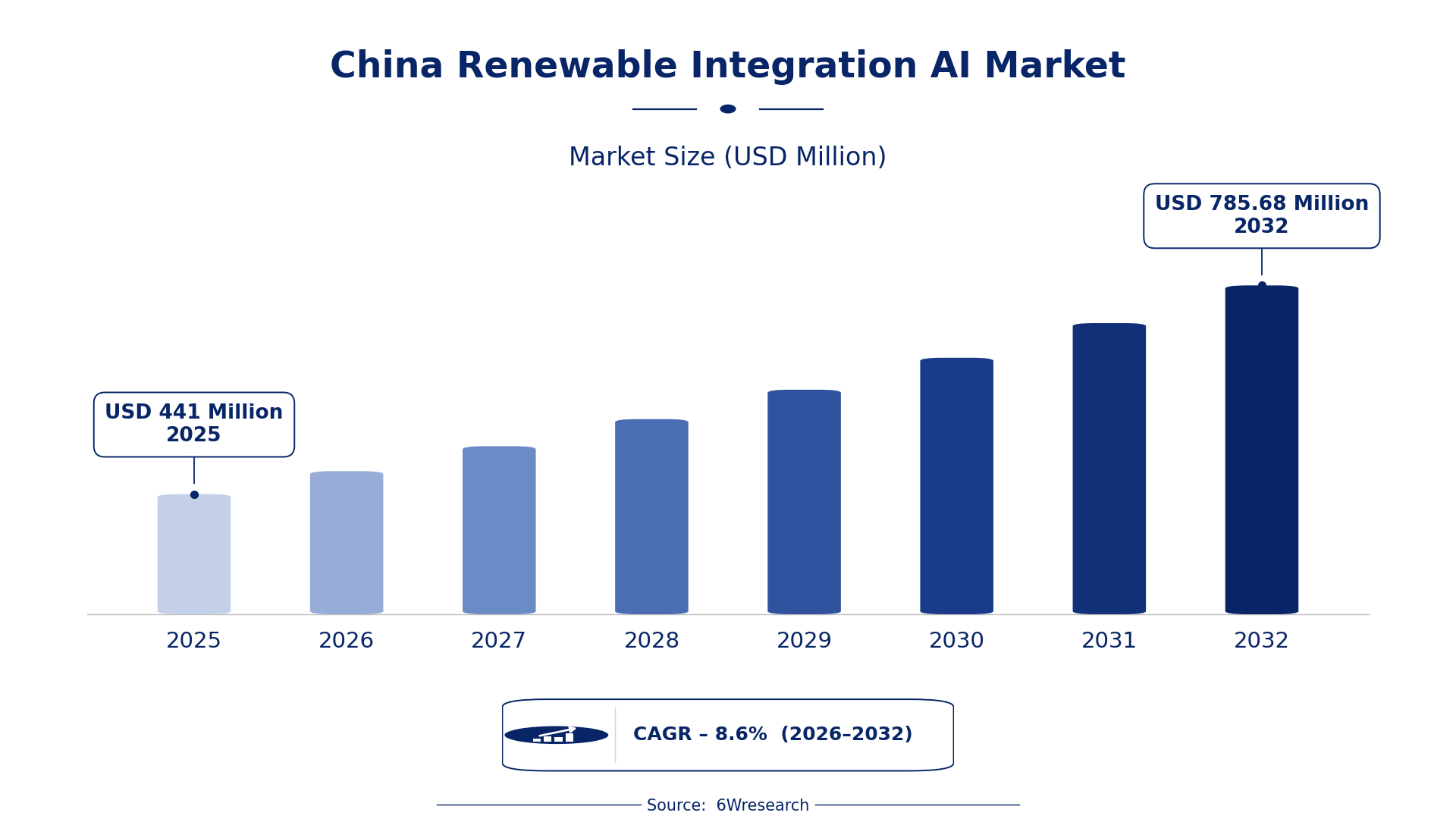
According to 6Wresearch internal database and industry insights, the China Renewable Integration AI Market was valued at USD 441.0 million in 2025 and is projected to reach USD 785.68 million by 2032, growing at a CAGR of approximately 8.6% during 2026–2032.
China Renewable Integration AI Market Highlights
| Report Metric | Details |
| Report Name | China Renewable Integration AI Market |
| Market Size 2025 | USD 441.0 million |
| Market Size 2032 | USD 785.68 million |
| Absolute Growth 2025–2032 | USD 344.68 million |
| CAGR 2026–2032 | 8.6% |
| Peak Annual Growth | 10.6% in 2031 |
| Forecast Period | 2026–2032 |
| Historical Data | 2022–2025 |
| Base Year | 2025 |
| Leading AI Application, 2025 | Load Forecasting AI (50% share) |
| Leading Use Case, 2025 | Demand Prediction (41% share) |
| Leading Deployment Mode, 2025 | Cloud/Edge (42% share) |
| Leading End User, 2025 | Utility Operators (41% share) |
| Fastest-Growing AI Application | Renewable Forecasting (10.5% CAGR) |
| Fastest-Growing Use Case | Predictive Maintenance (11.2% CAGR) |
| Fastest-Growing Deployment Mode | AIoT + SCADA (10.4% CAGR) |
| Fastest-Growing End User | Energy Infrastructure Firms (11.1% CAGR) |
| Growing Sector | Renewable Forecasting |
| Key End Users | Load Forecasting AI, Grid Balancing AI, Renewable Forecasting, Fault Detection |
China Renewable Integration AI Market Year-wise Growth Rate and Key Drivers (2022–2032)
This graph illustrates the annual growth rates of the market from 2022 to 2032, highlighting a steady upward trajectory and projected market expansion over the forecast period.
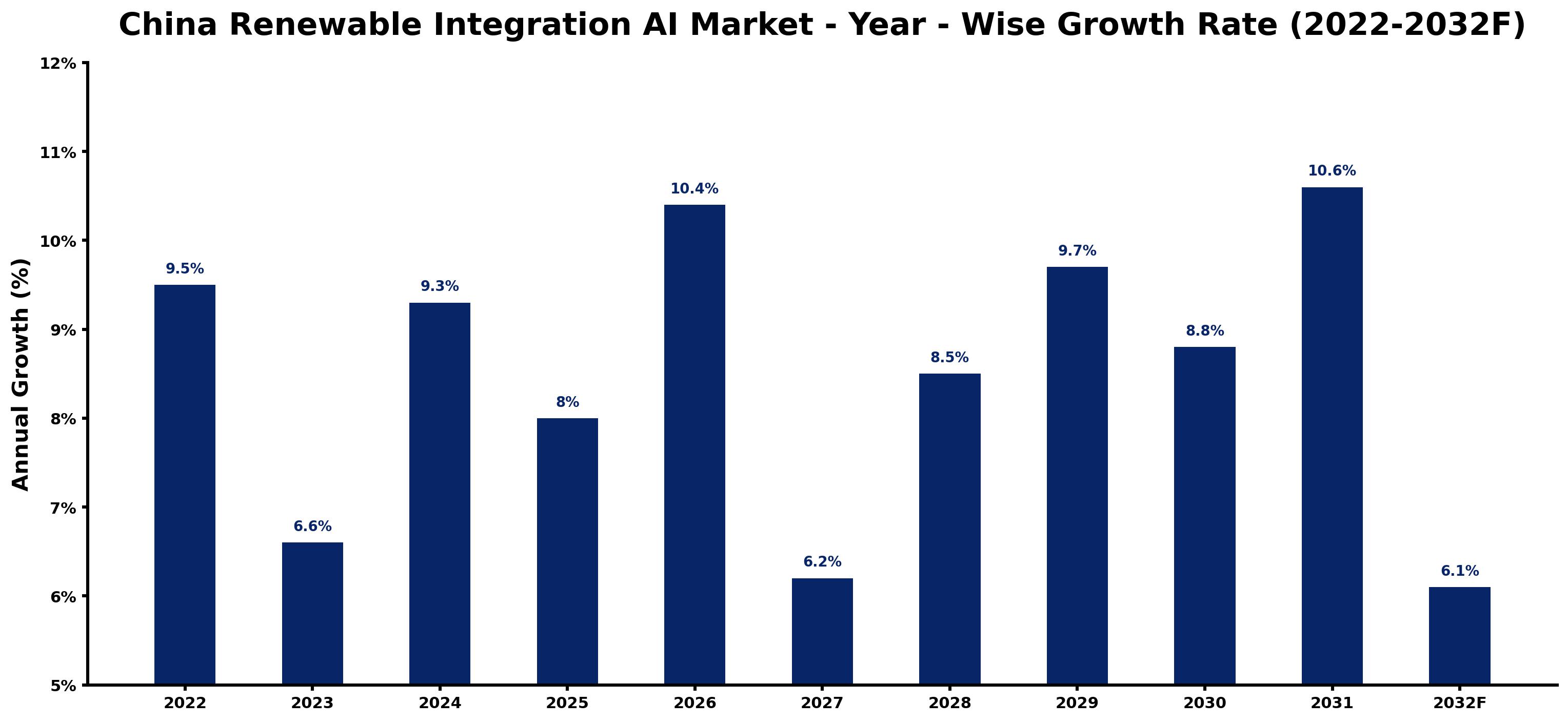
The table below sets out the estimated growth rate for each year and the main factor behind it.
| Year | Estimated Annual Growth (%) | Market Rationale |
| 2022 | 9.5 | Demand for renewable energy solutions surged due to increased energy consumption and investments. |
| 2023 | 6.6 | Growth slowed as the market adjusted to the previous year's rapid expansion. |
| 2024 | 9.3 | Renewable energy projects accelerated, boosting the need for AI integration in energy management. |
| 2025 | 8.0 | Investment in smart grid technologies continued, sustaining market demand despite a slight slowdown. |
| 2026 | 10.4 | Demand is expected to increase as AI technologies improve energy forecasting and grid stability. |
| 2027 | 6.2 | Growth is projected to slow due to market saturation in some AI applications for energy management. |
| 2028 | 8.5 | Renewable energy capacity expansion will drive renewed interest in AI solutions for efficiency. |
| 2029 | 9.7 | Increased operational efficiency through AI will attract more utility operators to adopt these technologies. |
| 2030 | 8.8 | Market growth is expected to slow as AI integration becomes standard practice among energy firms. |
| 2031 | 10.6 | A surge in investments in renewable infrastructure will lead to peak growth in AI applications. |
| 2032 | 6.1 | Growth will decelerate as the market matures, but demand for efficiency will remain strong. |
Note: Market size estimations and growth projections presented in this report are based on 6Wresearch's proprietary forecasting methodology, utilizing the latest available industry data, government publications, and primary research inputs.
China Renewable Integration AI Market Synopsis
The China Renewable Integration AI Market encompasses technologies that optimise the integration of renewable energy into power grids. This technology improves grid stability, enhances energy forecasting, and facilitates real-time decision-making. The market is growing due to significant investments in renewable infrastructure and increasing energy consumption among domestic users. In 2022, China's renewable energy capacity reached 1,000 GW, with AI technologies playing a critical role in this expansion. The ongoing push for smart grid technologies further fuels demand for these innovative solutions.
Market Dynamics Impact Analysis (2026–2032)
| Factor | Type | Impact | Primary Segment Affected |
| Investment in renewable energy infrastructure is driving the need for AI technologies to optimise grid management. | Driver | High | Demand Prediction |
| The increasing complexity of energy management systems creates opportunities for AI solutions. | Driver | High | Grid Balancing AI |
| Utility operators are seeking advanced AI solutions to enhance operational efficiency and reliability. | Opportunity | High | Utility Operators |
| The push for renewable energy integration presents significant opportunities for AI applications. | Opportunity | High | Renewable Forecasting |
| Limited awareness of AI benefits among smaller energy firms may hinder market growth. | Restraint | Medium | Predictive Maintenance |
| High initial investment costs for AI technologies can deter adoption among smaller players. | Restraint | Medium | Fault Detection |
| Buyers face challenges in integrating new AI technologies with existing systems, leading to delays. | Challenge | High | Real-Time Dispatch |
| Suppliers encounter difficulties in scaling AI solutions to meet diverse energy management needs. | Challenge | High | Grid-Edge |
Evaluation of Drivers in China Renewable Integration AI Market (2026–2032)
The main growth drivers and the segments they affect most are set out below.
| Drivers | Primary Segment Affected | Why It Matters (Evidence) |
| Increased investment in renewable infrastructure drives demand for AI technologies. | Demand Prediction | China's renewable energy capacity reached 1,000 GW in 2022, driving the need for AI in energy management. |
| The complexity of energy management systems necessitates advanced AI solutions. | Grid Balancing AI | The installed base of smart grid technologies surpassed 300 million smart meters in 2023. |
| Utility operators are adopting AI technologies to improve operational efficiency. | Utility Operators | A 15% increase in operational efficiency was reported through AI applications in 2023. |
| The growth of renewable energy sources creates demand for accurate forecasting solutions. | Renewable Forecasting | Wind and solar sectors are expected to grow by 20% in AI applications by 2025. |
| The integration of AI in energy management is supported by government initiatives. | Real-Time Dispatch | The '14th Five-Year Plan for Renewable Energy Development' emphasises AI integration. |
The Renewable Integration AI market in China is growing on the back of substantial investments in renewable energy infrastructure, coupled with rising demand for efficient energy management solutions. In 2022, China's renewable energy capacity reached 1,000 GW, driving the need for AI technologies. The installed base of smart grid technologies surpassed 300 million smart meters in 2023, necessitating advanced AI solutions for grid management. Utility operators reported a 15% increase in operational efficiency through AI applications, further boosting demand. The wind and solar sectors are projected to see a combined growth of 20% in AI applications by 2025, indicating a strong market outlook.
Evaluation of Restraints in China Renewable Integration AI Market
The following restraints limit how fast demand can grow.
| Market Restraint | Primary Segment Affected | Why It Matters (Evidence) |
| Limited awareness of AI benefits among smaller energy firms can hinder adoption. | Predictive Maintenance | Many smaller firms lack understanding of how AI can optimise their operations, leading to missed opportunities. |
| High initial investment costs for AI technologies may deter smaller players from adopting them. | Fault Detection | The upfront costs associated with AI implementation can be a barrier for budget-constrained firms. |
| Integration challenges with existing systems can delay AI adoption in energy management. | Real-Time Dispatch | Buyers often struggle to incorporate new AI technologies into their current infrastructure, causing operational delays. |
| Supplier difficulties in scaling AI solutions may limit market growth. | Grid-Edge | The varying needs of energy management across different firms complicate the scalability of AI applications. |
| Regulatory complexities can slow the approval process for new AI technologies. | Renewable Forecasting | Navigating the regulatory process can be time-consuming, delaying the deployment of AI solutions. |
China Renewable Integration AI Market Challenges
Buyers and suppliers in the China Renewable Integration AI market encounter a skills shortage, as the rapid advancement of AI technologies outpaces workforce training, delaying project implementations by up to six months. Heightened competition among technology providers leads to price wars, which can erode profit margins for suppliers, making it challenging for them to invest in research and development. Regulatory compliance presents another hurdle, as the National Renewable Energy Law mandates AI integration, incurring additional costs for producers who must adapt their systems to meet these standards. Supply chain disruptions can occur from reliance on imported components, causing project timeline delays for buyers and increasing costs by approximately 20%.
Trends in the China Renewable Integration AI Market
The trends below show where the China Renewable Integration AI Market is heading.
- Shift towards Smart Grid Technologies: China is increasingly adopting smart grid technologies to improve energy management efficiency. The installed base of smart meters surpassed 300 million in 2023, indicating a strong trend towards digitalisation in energy systems.
- Integration of AI in Renewable Energy Forecasting: The 'Smart Grid Technology Roadmap' published in 2022 emphasises AI's role in improving renewable energy forecasting. This shift is vital as AI improves forecasting accuracy, supporting the growth of renewable energy sources.
- Growing Demand for Predictive Maintenance Solutions: The focus on reducing operational costs is leading to increased demand for predictive maintenance solutions. The fastest-growing segment in AI applications is expected to be predictive maintenance, with a CAGR of 11.2% through 2032.
- Advancements in Energy Storage Technologies: The 'Energy Storage Technology Roadmap' released in 2022 highlights AI's role in optimising energy storage solutions. This trend supports the integration of renewable energy into the grid.
Investment Opportunities in the China Renewable Integration AI Market
Several openings in the China Renewable Integration AI Market merit attention from investors.
- Utility Operators Seeking Efficiency: Utility operators are eager to improve operational efficiency through AI technologies. With China's renewable energy capacity reaching 1,000 GW in 2022, there is a robust demand for AI solutions to optimise grid management.
- Investment in AI Technologies: Investing in AI technologies for energy management is timely, as projected investments in this sector are expected to exceed 50 billion CNY by 2025. Collaborating with energy infrastructure firms can facilitate market entry.
- Partnerships for AI Integration: Establishing partnerships with local energy firms can streamline the adoption of AI solutions. The 'National AI Development Plan' targets advancements in AI for energy sectors by 2025, creating opportunities for collaboration.
- Focus on Predictive Maintenance: The growing demand for predictive maintenance solutions presents a notable opportunity. With a projected CAGR of 11.2% through 2032, suppliers can develop targeted offerings for energy infrastructure firms.
Government Initiatives in the China Renewable Integration AI Market
The '14th Five-Year Plan for Renewable Energy Development' launched by the National Energy Administration in 2021 aims for a 50% increase in renewable capacity by 2025. This initiative emphasises the integration of AI technologies, improving operational efficiency and driving market growth. The plan builds on previous efforts, reinforcing the commitment to renewable energy and AI integration in China's energy sector.
In 2023, the State Council initiated the 'Energy Internet Development Strategy' to enhance AI applications in energy management across the country. This strategy is supported by the National Renewable Energy Law, which mandates AI integration in renewable energy systems, ensuring compliance and promoting innovation in the sector. The strategy aims to improve energy efficiency and facilitate the transition to a more sustainable energy system.
Future Insight of the China Renewable Integration AI Market
The outlook for the China Renewable Integration AI market through 2032 shows promising advancements, driven by the '14th Five-Year Plan for Renewable Energy Development', which prioritises AI integration. Investment in AI for energy management is projected to exceed 50 billion CNY by 2025, creating enhanced capabilities for both buyers and suppliers. The adoption of ISO 50001 standards will streamline energy management processes, improving operational efficiency across the sector. The wind and solar sectors are expected to experience substantial growth in AI applications, encouraging innovation and collaboration.
Market Segmentation Analysis
The report offers a comprehensive study of the following market segments and their leading categories in the market.
By AI Application – Load Forecasting AI Dominated, Renewable Forecasting Expected to Grow Fastest
According to Ravi Bhandari, Research Head at 6Wresearch, Load Forecasting AI held a 50% share of the China Renewable Integration AI Market by ai application in 2025. Load Forecasting AI holds the largest share due to its essential role in predicting energy demand, which is critical for maintaining grid stability in China’s vast renewable energy landscape. With an installed capacity of 1,000 GW, accurate load forecasting ensures efficient energy distribution. The quickest growth will come from Renewable Forecasting, forecast to expand at a CAGR of 10.5% between 2026 and 2032. Renewable Forecasting is rapidly growing as it is vital for anticipating energy production from renewable sources. Given the expected 20% growth in China's wind and solar sectors by 2025, the demand for precise forecasting solutions will continue to escalate. Suppliers should enhance their capabilities to meet the increasing demand for accurate forecasting solutions in the renewable energy sector.
By Use Case – Demand Prediction Dominated, Predictive Maintenance Expected to Grow Fastest
Demand Prediction took a 41% share of use case in 2025, more than any other category. Demand Prediction leads the market as it is crucial for anticipating energy needs and optimising supply in a country with over 1.4 billion people. This high population drives the necessity for effective energy management solutions to ensure reliability. Over 2026–2032, Predictive Maintenance is expected to post the fastest growth, at a CAGR of 11.2%. Predictive Maintenance is the fastest-growing use case, significantly reducing operational costs and enhancing reliability in energy systems. As the complexity of energy infrastructure increases, the demand for predictive maintenance solutions is intensifying. Buyers will benefit from investing in predictive maintenance technologies to improve operational efficiency and minimise unexpected downtimes.
By Deployment Mode – Cloud/Edge Dominated, AIoT + SCADA Expected to Grow Fastest
With a 42% revenue share in 2025, Cloud/Edge was the largest deployment mode category. Cloud/Edge deployment commands the largest market share as it facilitates efficient data processing and storage for applications critical to managing China's extensive renewable energy resources. This approach allows for scalable solutions that can adapt to growing data demands. AIoT + SCADA is projected to grow fastest, at a CAGR of 10.4% during 2026–2032. AIoT + SCADA is the fastest-growing deployment mode, integrating operational technology with advanced monitoring capabilities across energy systems. This integration is essential for enabling real-time decision-making in energy management. Suppliers should focus on developing AIoT + SCADA solutions to leverage the growing trend of integrated technologies in energy management.
By End User – Utility Operators Dominated, Energy Infrastructure Firms Expected to Grow Fastest
Utility Operators accounted for a 41% market share by end user in 2025. Utility Operators dominate the market as they are the primary users of technologies for grid management, ensuring efficient energy distribution across China. Their substantial role in managing the extensive energy network solidifies their leading market position. Energy Infrastructure Firms are set to record the highest CAGR in this split, 11.1% over 2026–2032. Energy Infrastructure Firms are the fastest-growing end user group, applying technologies to optimise energy systems and improve operational efficiency. As investments in renewable energy infrastructure rise, these firms will increasingly rely on advanced solutions. Suppliers should target energy infrastructure firms to offer tailored solutions that address their specific operational challenges.
Key Attractiveness of the Report
- 10 Years of Market Numbers
- Historical Data Starting from 2022 to 2025
- Base Year 2025
- Forecast Data until 2032
- Key Performance Indicators Impacting the Market
- Major Upcoming Developments and Projects
Key Highlights of the Report:
- China Renewable Integration AI Market Outlook
- Market Size of China Renewable Integration AI Market, 2025
- Forecast of China Renewable Integration AI Market, 2032
- Historical Data and Forecast of China Renewable Integration AI Revenues & Volume for the Period 2022 - 2032F
- China Renewable Integration AI Market Trend Evolution
- China Renewable Integration AI Market Drivers and Challenges
- China Renewable Integration AI Price Trends
- China Renewable Integration AI Porter's Five Forces
- China Renewable Integration AI Industry Life Cycle
- Historical Data and Forecast of China Renewable Integration AI Market Revenues & Volume By AI Application for the Period 2022 - 2032F
- Historical Data and Forecast of China Renewable Integration AI Market Revenues & Volume By Load Forecasting AI for the Period 2022 - 2032F
- Historical Data and Forecast of China Renewable Integration AI Market Revenues & Volume By Grid Balancing AI for the Period 2022 - 2032F
- Historical Data and Forecast of China Renewable Integration AI Market Revenues & Volume By Fault Detection for the Period 2022 - 2032F
- Historical Data and Forecast of China Renewable Integration AI Market Revenues & Volume By Renewable Forecasting for the Period 2022 - 2032F
- Historical Data and Forecast of China Renewable Integration AI Market Revenues & Volume By Use Case for the Period 2022 - 2032F
- Historical Data and Forecast of China Renewable Integration AI Market Revenues & Volume By Demand Prediction for the Period 2022 - 2032F
- Historical Data and Forecast of China Renewable Integration AI Market Revenues & Volume By Real-Time Dispatch for the Period 2022 - 2032F
- Historical Data and Forecast of China Renewable Integration AI Market Revenues & Volume By Predictive Maintenance for the Period 2022 - 2032F
- Historical Data and Forecast of China Renewable Integration AI Market Revenues & Volume By Weather/Production for the Period 2022 - 2032F
- Historical Data and Forecast of China Renewable Integration AI Market Revenues & Volume By Deployment Mode for the Period 2022 - 2032F
- Historical Data and Forecast of China Renewable Integration AI Market Revenues & Volume By Grid-Edge for the Period 2022 - 2032F
- Historical Data and Forecast of China Renewable Integration AI Market Revenues & Volume By Cloud/Edge for the Period 2022 - 2032F
- Historical Data and Forecast of China Renewable Integration AI Market Revenues & Volume By AIoT + SCADA for the Period 2022 - 2032F
- Historical Data and Forecast of China Renewable Integration AI Market Revenues & Volume By ML Models for the Period 2022 - 2032F
- Historical Data and Forecast of China Renewable Integration AI Market Revenues & Volume By End User for the Period 2022 - 2032F
- Historical Data and Forecast of China Renewable Integration AI Market Revenues & Volume By Utility Operators for the Period 2022 - 2032F
- Historical Data and Forecast of China Renewable Integration AI Market Revenues & Volume By Smart Grid Managers for the Period 2022 - 2032F
- Historical Data and Forecast of China Renewable Integration AI Market Revenues & Volume By Energy Infrastructure Firms for the Period 2022 - 2032F
- Historical Data and Forecast of China Renewable Integration AI Market Revenues & Volume By Wind & Solar Aggregators for the Period 2022 - 2032F
- China Renewable Integration AI Import Export Trade Statistics
- Market Opportunity Assessment By AI Application
- Market Opportunity Assessment By Use Case
- Market Opportunity Assessment By Deployment Mode
- Market Opportunity Assessment By End User
- China Renewable Integration AI Top Companies Market Share
- China Renewable Integration AI Competitive Benchmarking By Technical and Operational Parameters
- China Renewable Integration AI Company Profiles
- China Renewable Integration AI Key Strategic Recommendations
Market Covered
This report examines the market across the segments below.
By AI Application
- Load Forecasting AI
- Grid Balancing AI
- Fault Detection
- Renewable Forecasting
By Use Case
- Demand Prediction
- Real-Time Dispatch
- Predictive Maintenance
- Weather/Production
By Deployment Mode
- Grid-Edge
- Cloud/Edge
- AIoT + SCADA
- ML Models
By End User
- Utility Operators
- Smart Grid Managers
- Energy Infrastructure Firms
- Wind & Solar Aggregators































