India Residential Wi-Fi Systems Market Size & Growth Rate
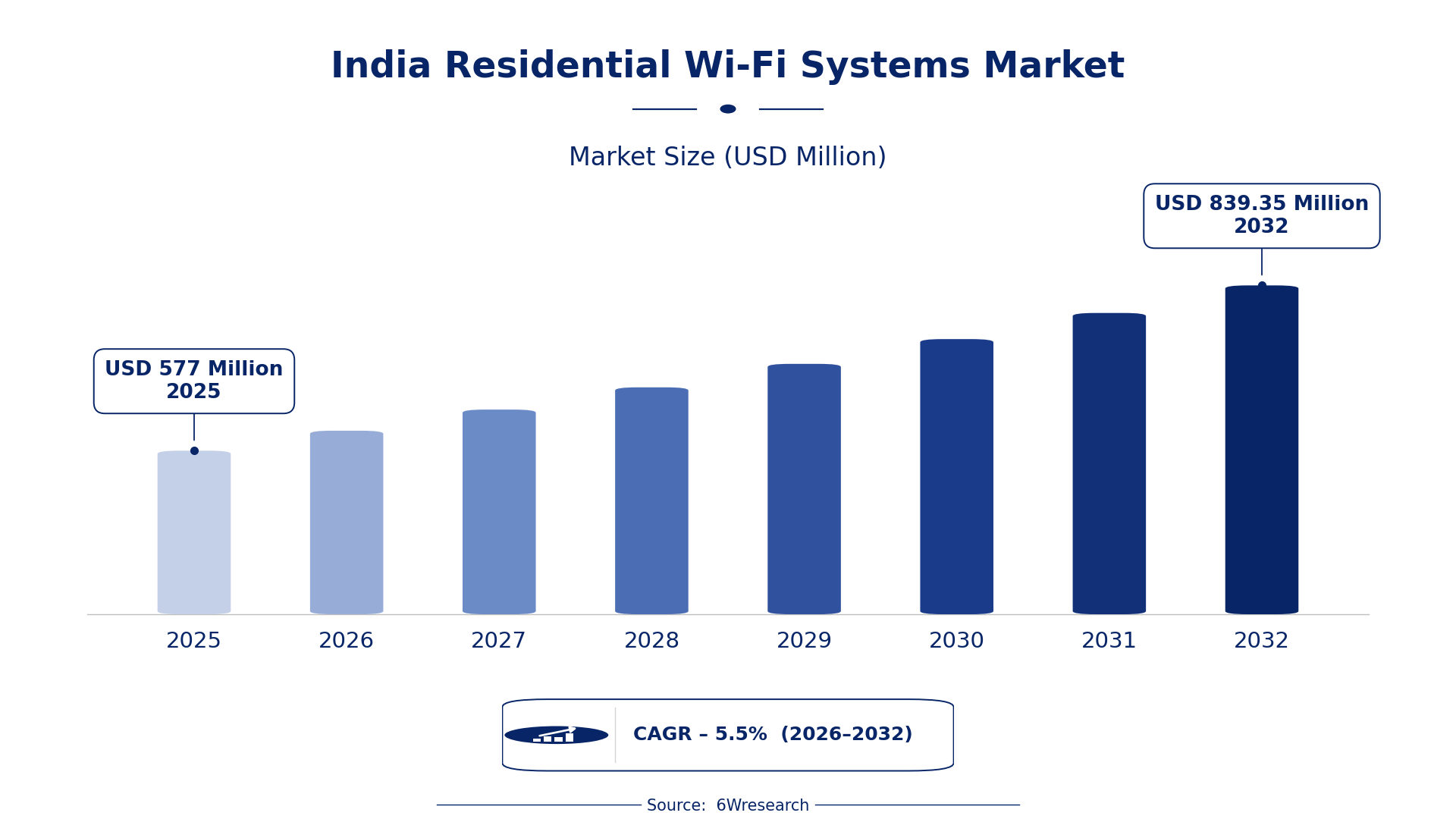
According to 6Wresearch internal database and industry insights, the India Residential Wi-Fi Systems Market was valued at USD 577.0 million in 2025 and is projected to reach USD 839.35 million by 2032, growing at a CAGR of approximately 5.5% during 2026–2032.
India Residential Wi-Fi Systems Market Highlights
| Report Metric | Details |
| Report Name | India Residential Wi-Fi Systems Market |
| Market Size 2025 | USD 577.0 million |
| Market Size 2032 | USD 839.35 million |
| Absolute Growth 2025–2032 | USD 262.35 million |
| CAGR 2026–2032 | 5.5% |
| Peak Annual Growth | 7.3% in 2027 |
| Forecast Period | 2026–2032 |
| Historical Data | 2022–2025 |
| Base Year | 2025 |
| Leading System Type, 2025 | Mesh Wi-Fi Systems (38% share) |
| Leading Frequency Band, 2025 | Dual/Triband (42% share) |
| Leading Network Mode, 2025 | Mesh/Seamless Roaming (48% share) |
| Leading End User, 2025 | Large Residences (36% share) |
| Fastest-Growing System Type | Wi-Fi 6 Routers (8.1% CAGR) |
| Fastest-Growing Frequency Band | 2.4 GHz / 5 GHz / 6 GHz (7.0% CAGR) |
| Fastest-Growing Network Mode | High-Speed Streaming (6.5% CAGR) |
| Fastest-Growing End User | Smart Home Users (6.8% CAGR) |
| Growing Sector | Residential connectivity solutions |
| Key End Users | Urban households, Smart home users, Large residences, Multi-floor houses |
India Residential Wi-Fi Systems Market Year-wise Growth Rate and Key Drivers (2022–2032)
This graph illustrates the annual growth rates of the market from 2022 to 2032, highlighting a steady upward trajectory and projected market expansion over the forecast period.
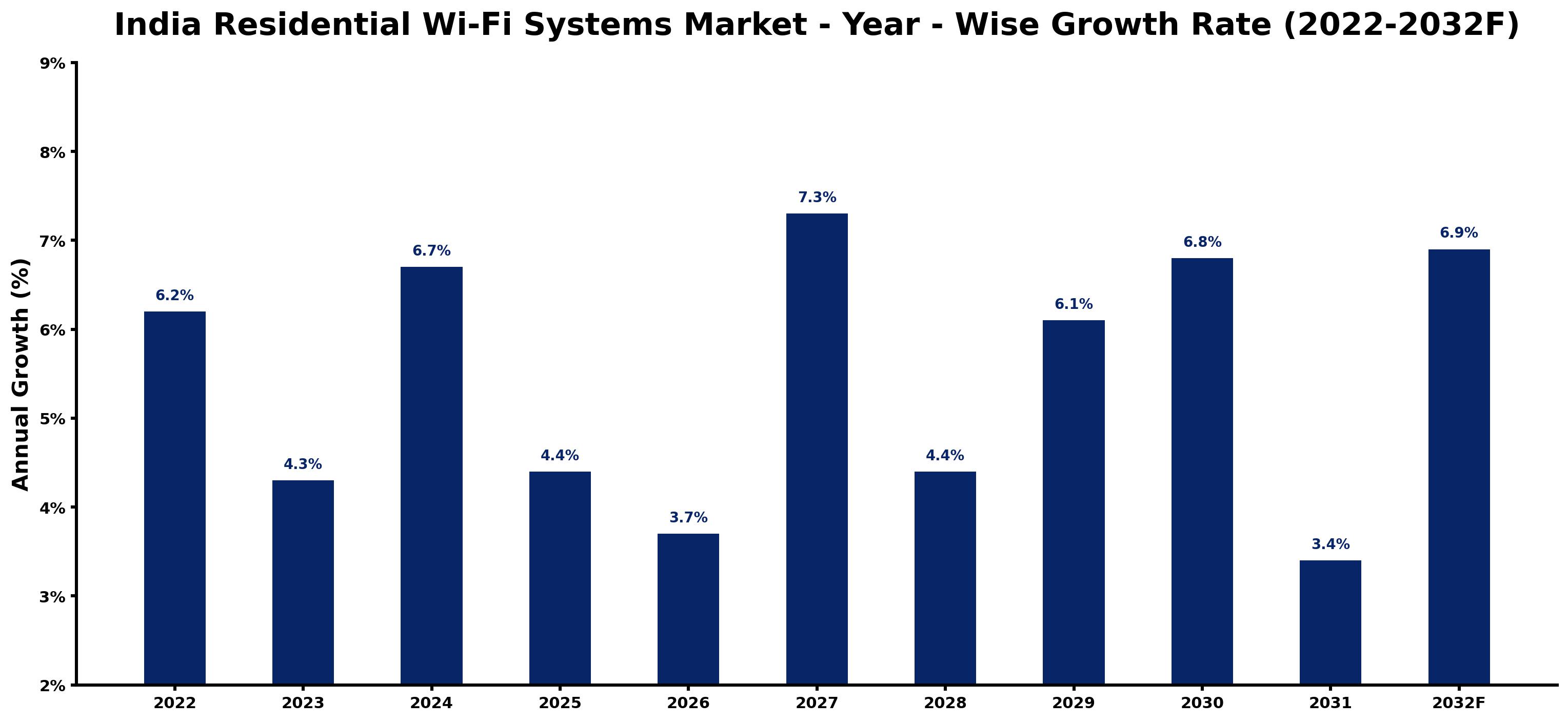
Below, each year's estimated growth is shown next to the factor that most influenced it.
| Year | Estimated Annual Growth (%) | Market Rationale |
| 2022 | 6.2 | The market showed steady demand due to a growing number of internet users. |
| 2023 | 4.3 | Growth slowed as urban households adjusted to existing connectivity solutions. |
| 2024 | 6.7 | Increased adoption of Wi-Fi 6 technology boosted market performance. |
| 2025 | 4.4 | Demand moderated as the Digital India initiative continued to improve connectivity. |
| 2026 | 3.7 | A slowdown occurred as investments in broadband infrastructure began to stabilise. |
| 2027 | 7.3 | The peak growth year is driven by rising smart home technology adoption. |
| 2028 | 4.4 | Growth slowed again as the market adjusted to new technology standards. |
| 2029 | 6.1 | Demand increased as urban areas expanded their broadband capabilities. |
| 2030 | 6.8 | Growth rose with higher average data consumption per user projected. |
| 2031 | 3.4 | A slowdown occurred as competition intensified in the residential Wi-Fi sector. |
| 2032 | 6.9 | The market rebounded with strong demand from large residences and smart home users. |
Note: Market size estimations and growth projections presented in this report are based on 6Wresearch's proprietary forecasting methodology, utilizing the latest available industry data, government publications, and primary research inputs.
India Residential Wi-Fi Systems Market Synopsis
The India Residential Wi-Fi Systems Market includes technology products that provide wireless internet connectivity in homes. These systems consist of routers and extenders, enabling high-speed internet access for multiple devices and supporting smart home technology. Demand is driven by urban households' increasing reliance on connectivity, supported by over 700 million internet users and initiatives like the Digital India programme. Ongoing investments in broadband infrastructure and the adoption of Wi-Fi 6 technology are further propelling growth in this sector.
Market Dynamics Impact Analysis (2026–2032)
| Factor | Type | Impact | Primary Segment Affected |
| Growing number of internet users in urban areas | Driver | High | Mesh Wi-Fi Systems |
| Rising demand for smart home devices | Driver | High | Wi-Fi 6 Routers |
| Increasing adoption of high-speed internet services | Opportunity | High | Extenders/Boosters |
| Need for seamless connectivity in large residences | Opportunity | Medium | Mesh Wi-Fi Systems |
| High competition among service providers | Restraint | Medium | Gateway Modem-Routers |
| Regulatory challenges in broadband service quality | Restraint | High | Dual/Triband |
| Supply chain disruptions affecting component availability | Challenge | High | Mesh/Seamless Roaming |
| High costs of advanced technology integration | Challenge | Medium | Wi-Fi 6 Routers |
Evaluation of Drivers in India Residential Wi-Fi Systems Market (2026–2032)
The factors lifting demand, and the evidence behind each, are summarised below.
| Drivers | Primary Segment Affected | Why It Matters (Evidence) |
| Increased internet penetration in urban households | Mesh Wi-Fi Systems | Over 700 million internet users in India drive demand for better connectivity solutions. |
| Growing adoption of smart home devices | Wi-Fi 6 Routers | With over 30% of urban households using smart devices, the need for reliable Wi-Fi increases. |
| Expansion of broadband infrastructure | Extenders/Boosters | The National Digital Communications Policy aims to improve broadband connectivity by 2025. |
| Demand for uninterrupted connectivity in large residences | Mesh Wi-Fi Systems | Mesh systems are popular in multi-floor houses, ensuring consistent coverage. |
| Increasing data consumption per user | Gateway Modem-Routers | Average data consumption is projected to reach 18 GB per month by 2025. |
The Residential Wi-Fi Systems market in India is growing on the back of rising urban household connectivity needs and increased smart home device adoption. With over 700 million internet users, demand for high-speed systems is surging. The average data consumption per user is expected to reach 18 GB per month by 2025, prompting households to upgrade their systems. The popularity of mesh Wi-Fi systems in large residences is also a key factor in market growth.
Evaluation of Restraints in India Residential Wi-Fi Systems Market
The key brakes on demand, and where they bite hardest, are shown below.
| Market Restraint | Primary Segment Affected | Why It Matters (Evidence) |
| Intense competition among service providers | Gateway Modem-Routers | High competition can lead to price wars, affecting margins for suppliers. |
| Regulatory challenges in broadband service quality | Dual/Triband | Compliance with evolving standards can delay product approvals and market entry. |
| Supply chain disruptions affecting component availability | Mesh Wi-Fi Systems | Global shortages of electronic components can hinder production timelines. |
| High costs of advanced technology integration | Wi-Fi 6 Routers | Investing in the latest technology can be prohibitive for smaller suppliers. |
| Consumer price sensitivity in urban markets | Extenders/Boosters | Price-sensitive consumers may delay purchases when faced with higher costs. |
India Residential Wi-Fi Systems Market Challenges
The India Residential Wi-Fi Systems market faces a critical supply challenge stemming from limited local manufacturing capabilities, forcing producers to rely heavily on imports. This reliance raises costs for manufacturers, as tariffs and logistics can inflate prices by up to 20%. Skills shortages impede progress, as the rapid adoption of advanced technologies like Wi-Fi 6 requires a workforce proficient in modern networking, delaying product development for suppliers. Buyers encounter connectivity issues; with urban households averaging 3-4 connected devices, insufficient infrastructure can lead to user dissatisfaction and reduced internet performance.
Trends in the India Residential Wi-Fi Systems Market
Four trends stand out in the India Residential Wi-Fi Systems Market.
- Shift from Traditional Routers to Mesh Systems: As of 2023, mesh Wi-Fi systems are gaining popularity in large residences, accounting for 38% of the market. This shift improves connectivity across multi-floor houses, meeting the needs of urban consumers.
- Increase in Wi-Fi 6 Adoption: Since 2023, Wi-Fi 6 technology has been increasingly adopted in urban areas, improving performance for households with multiple devices. This trend will grow as more users seek faster internet solutions.
- Rising Demand for Smart Home Integration: In 2023, over 30% of urban households are using smart devices, driving the need for compatible residential Wi-Fi systems. This trend highlights the importance of reliable connectivity for modern living.
- Focus on Improved Broadband Infrastructure: The National Digital Communications Policy aims for improved broadband access by 2025, promoting investments in digital infrastructure. This initiative is vital for enhancing overall connectivity in urban areas.
Investment Opportunities in the India Residential Wi-Fi Systems Market
The following opportunities in the India Residential Wi-Fi Systems Market pair current demand with a clear way in.
- Large Residences Seeking Reliable Connectivity: With 36% of the market share in 2025, large residences require effective Wi-Fi systems. Suppliers can partner with local distributors to address this growing demand.
- Urban Apartments Needing Better Coverage: The average urban household has 3-4 connected devices, revealing a gap in connectivity solutions. Suppliers can enter this market by offering tailored products for urban apartments.
- Smart Home Users Demanding Advanced Systems: Smart home technology adoption is on the rise, with over 30% of urban households using smart devices. Investing in Wi-Fi systems that support these technologies presents a valuable opportunity.
- BharatNet Project Enhancing Rural Connectivity: The BharatNet project aims for 100% broadband coverage in rural areas by 2025. Suppliers can explore opportunities to provide Wi-Fi systems in these underserved regions.
Government Initiatives in the India Residential Wi-Fi Systems Market
The National Digital Communications Policy 2020 aims to provide broadband access to all citizens by 2025, overseen by the Ministry of Communications. This policy builds on previous efforts by promoting infrastructure investments and improving service quality. It mandates that service providers ensure connectivity in both urban and rural areas, facilitating the deployment of residential Wi-Fi systems. The policy also encourages the adoption of new technologies, which is essential for meeting the increasing demand for internet access.
The Digital India initiative, launched in 2015, continues to support digital infrastructure and connectivity across the country. The Ministry of Electronics and Information Technology oversees this initiative, which funds projects aimed at improving broadband access. Additionally, the BharatNet project targets expanding broadband access in rural areas, ensuring that residential Wi-Fi systems reach underserved communities. This initiative supports the development of smart cities, where improved connectivity is essential for urban planning and management.
Future Insight of the India Residential Wi-Fi Systems Market
The India Residential Wi-Fi Systems market is set to evolve by 2032 driven by several pivotal factors. The National Digital Communications Policy aims to boost broadband connectivity by 2025, improving access for urban households. The adoption of Wi-Fi 6 technology will increase, delivering better performance for users. The government's Digital India initiative will further promote digital infrastructure growth, raising demand for residential Wi-Fi systems. By 2025, the average data consumption per user is projected to reach 18 GB per month, emphasising the need for robust Wi-Fi solutions.
Market Segmentation Analysis
The analysis below covers each segmentation, its leading category in 2025 and its fastest-growing category through 2032.
By System Type – Mesh Wi-Fi Systems Dominated, Wi-Fi 6 Routers Expected to Grow Fastest
According to Ravi Bhandari, Research Head at 6Wresearch, Mesh Wi-Fi Systems held a 38% share of the India Residential Wi-Fi Systems Market by system type in 2025. Mesh Wi-Fi systems hold the largest market share due to their ability to provide seamless coverage across expansive areas, which is crucial for urban households with multiple devices. Their effectiveness is particularly evident in large residences where uninterrupted connectivity is essential for daily activities. Wi-Fi 6 Routers are projected to grow fastest, at a CAGR of 8.1% during 2026–2032. Wi-Fi 6 routers are witnessing rapid growth as they support higher speeds and connect more devices simultaneously, addressing the needs of urban households that typically have 3-4 connected devices. This increasing demand for enhanced performance will likely further widen the lead of mesh systems. Suppliers should focus on advancing Wi-Fi 6 technology to meet the rising demand for high-performance residential Wi-Fi systems.
By Frequency Band – Dual/Triband Dominated, 2.4 GHz / 5 GHz / 6 GHz Expected to Grow Fastest
With a 42% revenue share in 2025, Dual/Triband was the largest frequency band category. Dual/Triband systems command a significant share of the market as they provide multiple frequency bands, ensuring reliable performance across various devices. This versatility is particularly attractive to urban users who require dependable connectivity for numerous gadgets. The quickest growth will come from 2.4 GHz / 5 GHz / 6 GHz, forecast to expand at a CAGR of 7.0% between 2026 and 2032. The 2.4 GHz / 5 GHz / 6 GHz segment is rapidly expanding due to its support for a diverse range of devices and applications, catering to the needs of modern households. As the adoption of smart home technology increases, this frequency band will become increasingly vital for maintaining seamless connectivity. Buyers should consider investing in dual/triband systems to ensure optimal performance and compatibility with future devices.
By Network Mode – Mesh/Seamless Roaming Dominated, High-Speed Streaming Expected to Grow Fastest
Mesh/Seamless Roaming took a 48% share of network mode in 2025, more than any other category. Mesh/seamless roaming is the leading network mode, enabling uninterrupted connectivity throughout the home, which is vital for users with multiple devices. This capability is particularly important in large residences where achieving comprehensive coverage can be challenging. High-Speed Streaming is set to record the highest CAGR in this split, 6.5% over 2026–2032. High-speed streaming is the fastest-growing network mode, essential for streaming services and online gaming, which are gaining popularity among consumers. The anticipated rise in data consumption, projected to reach 18 GB per user per month by 2025, will further amplify demand for this segment. Suppliers should prioritise high-speed streaming capabilities in their products to align with rising consumer expectations for seamless entertainment experiences.
By End User – Large Residences Dominated, Smart Home Users Expected to Grow Fastest
The largest end user category in 2025 was Large Residences, with a 36% share of total revenue. Large residences represent the largest end-user segment, necessitating robust systems for extensive coverage to accommodate multiple users and devices. The increasing prevalence of connected devices in urban households further solidifies this segment's market share. Over 2026–2032, Smart Home Users are expected to post the fastest growth, at a CAGR of 6.8%. Smart home users are the fastest-growing end-user group, as the integration of various smart home devices becomes more common, with over 30% of urban households already embracing this technology. This trend indicates a shift towards interconnected living environments, driving the demand for compatible Wi-Fi systems. Suppliers should tailor their offerings to meet the specific needs of smart home users, ensuring compatibility with a wide array of devices.
Key Attractiveness of the Report
- 10 Years of Market Numbers
- Historical Data Starting from 2022 to 2025
- Base Year 2025
- Forecast Data until 2032
- Key Performance Indicators Impacting the Market
- Major Upcoming Developments and Projects
Key Highlights of the Report:
- India Residential Wi-Fi Systems Market Outlook
- Market Size of India Residential Wi-Fi Systems Market, 2025
- Forecast of India Residential Wi-Fi Systems Market, 2032
- Historical Data and Forecast of India Residential Wi-Fi Systems Revenues & Volume for the Period 2022 - 2032F
- India Residential Wi-Fi Systems Market Trend Evolution
- India Residential Wi-Fi Systems Market Drivers and Challenges
- India Residential Wi-Fi Systems Price Trends
- India Residential Wi-Fi Systems Porter's Five Forces
- India Residential Wi-Fi Systems Industry Life Cycle
- Historical Data and Forecast of India Residential Wi-Fi Systems Market Revenues & Volume By System Type for the Period 2022 - 2032F
- Historical Data and Forecast of India Residential Wi-Fi Systems Market Revenues & Volume By Mesh Wi-Fi Systems for the Period 2022 - 2032F
- Historical Data and Forecast of India Residential Wi-Fi Systems Market Revenues & Volume By Wi-Fi 6 Routers for the Period 2022 - 2032F
- Historical Data and Forecast of India Residential Wi-Fi Systems Market Revenues & Volume By Extenders/Boosters for the Period 2022 - 2032F
- Historical Data and Forecast of India Residential Wi-Fi Systems Market Revenues & Volume By Gateway Modem-Routers for the Period 2022 - 2032F
- Historical Data and Forecast of India Residential Wi-Fi Systems Market Revenues & Volume By Frequency Band for the Period 2022 - 2032F
- Historical Data and Forecast of India Residential Wi-Fi Systems Market Revenues & Volume By Dual/Triband for the Period 2022 - 2032F
- Historical Data and Forecast of India Residential Wi-Fi Systems Market Revenues & Volume By 2.4 GHz / 5 GHz / 6 GHz for the Period 2022 - 2032F
- Historical Data and Forecast of India Residential Wi-Fi Systems Market Revenues & Volume By 2.4 GHz for the Period 2022 - 2032F
- Historical Data and Forecast of India Residential Wi-Fi Systems Market Revenues & Volume By Broadband Integration for the Period 2022 - 2032F
- Historical Data and Forecast of India Residential Wi-Fi Systems Market Revenues & Volume By Network Mode for the Period 2022 - 2032F
- Historical Data and Forecast of India Residential Wi-Fi Systems Market Revenues & Volume By Mesh/Seamless Roaming for the Period 2022 - 2032F
- Historical Data and Forecast of India Residential Wi-Fi Systems Market Revenues & Volume By High-Speed Streaming for the Period 2022 - 2032F
- Historical Data and Forecast of India Residential Wi-Fi Systems Market Revenues & Volume By Repeater Mode for the Period 2022 - 2032F
- Historical Data and Forecast of India Residential Wi-Fi Systems Market Revenues & Volume By ISP Bundled for the Period 2022 - 2032F
- Historical Data and Forecast of India Residential Wi-Fi Systems Market Revenues & Volume By End User for the Period 2022 - 2032F
- Historical Data and Forecast of India Residential Wi-Fi Systems Market Revenues & Volume By Large Residences for the Period 2022 - 2032F
- Historical Data and Forecast of India Residential Wi-Fi Systems Market Revenues & Volume By Smart Home Users for the Period 2022 - 2032F
- Historical Data and Forecast of India Residential Wi-Fi Systems Market Revenues & Volume By Multi-Floor Houses for the Period 2022 - 2032F
- Historical Data and Forecast of India Residential Wi-Fi Systems Market Revenues & Volume By Urban Apartments for the Period 2022 - 2032F
- India Residential Wi-Fi Systems Import Export Trade Statistics
- Market Opportunity Assessment By System Type
- Market Opportunity Assessment By Frequency Band
- Market Opportunity Assessment By Network Mode
- Market Opportunity Assessment By End User
- India Residential Wi-Fi Systems Top Companies Market Share
- India Residential Wi-Fi Systems Competitive Benchmarking By Technical and Operational Parameters
- India Residential Wi-Fi Systems Company Profiles
- India Residential Wi-Fi Systems Key Strategic Recommendations
Market Covered
Segments analysed in this report are listed below.
By System Type
- Mesh Wi-Fi Systems
- Wi-Fi 6 Routers
- Extenders/Boosters
- Gateway Modem-Routers
By Frequency Band
- Dual/Triband
- 2.4 GHz / 5 GHz / 6 GHz
- 2.4 GHz
- Broadband Integration
By Network Mode
- Mesh/Seamless Roaming
- High-Speed Streaming
- Repeater Mode
- ISP Bundled
By End User
- Large Residences
- Smart Home Users
- Multi-Floor Houses
- Urban Apartments































