China Residential Wi-Fi Systems Market Size & Growth Rate
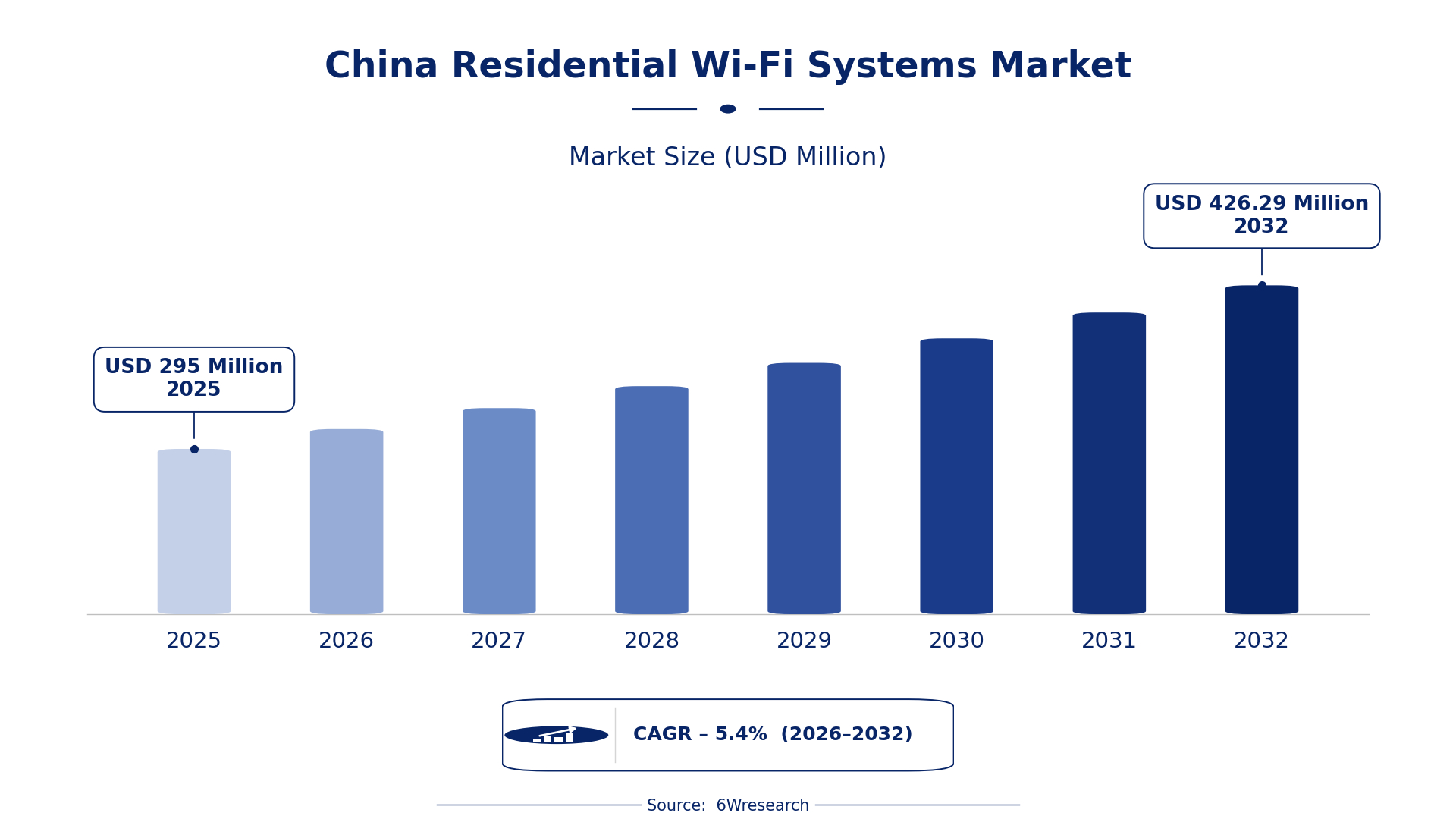
According to 6Wresearch internal database and industry insights, the China Residential Wi-Fi Systems Market was valued at USD 295.0 million in 2025 and is projected to reach USD 426.29 million by 2032, growing at a CAGR of approximately 5.4% during 2026–2032.
China Residential Wi-Fi Systems Market Highlights
| Report Metric | Details |
| Report Name | China Residential Wi-Fi Systems Market |
| Market Size 2025 | USD 295.0 million |
| Market Size 2032 | USD 426.29 million |
| Absolute Growth 2025–2032 | USD 131.29 million |
| CAGR 2026–2032 | 5.4% |
| Peak Annual Growth | 7.4% in 2028 |
| Forecast Period | 2026–2032 |
| Historical Data | 2022–2025 |
| Base Year | 2025 |
| Leading System Type, 2025 | Mesh Wi-Fi Systems (44% share) |
| Leading Frequency Band, 2025 | Dual/Triband (38% share) |
| Leading Network Mode, 2025 | Mesh/Seamless Roaming (42% share) |
| Leading End User, 2025 | Smart Home Users (44% share) |
| Fastest-Growing System Type | Wi-Fi 6 Routers (6.7% CAGR) |
| Fastest-Growing Network Mode | High-Speed Streaming (8.2% CAGR) |
| Fastest-Growing End User | Large Residences (7.3% CAGR) |
| Growing Sector | Large Residences |
| Key End Users | Smart Home Users, Large Residences, Multi-Floor Houses, Urban Apartments |
China Residential Wi-Fi Systems Market Year-wise Growth Rate and Key Drivers (2022–2032)
This graph illustrates the annual growth rates of the market from 2022 to 2032, highlighting a steady upward trajectory and projected market expansion over the forecast period.
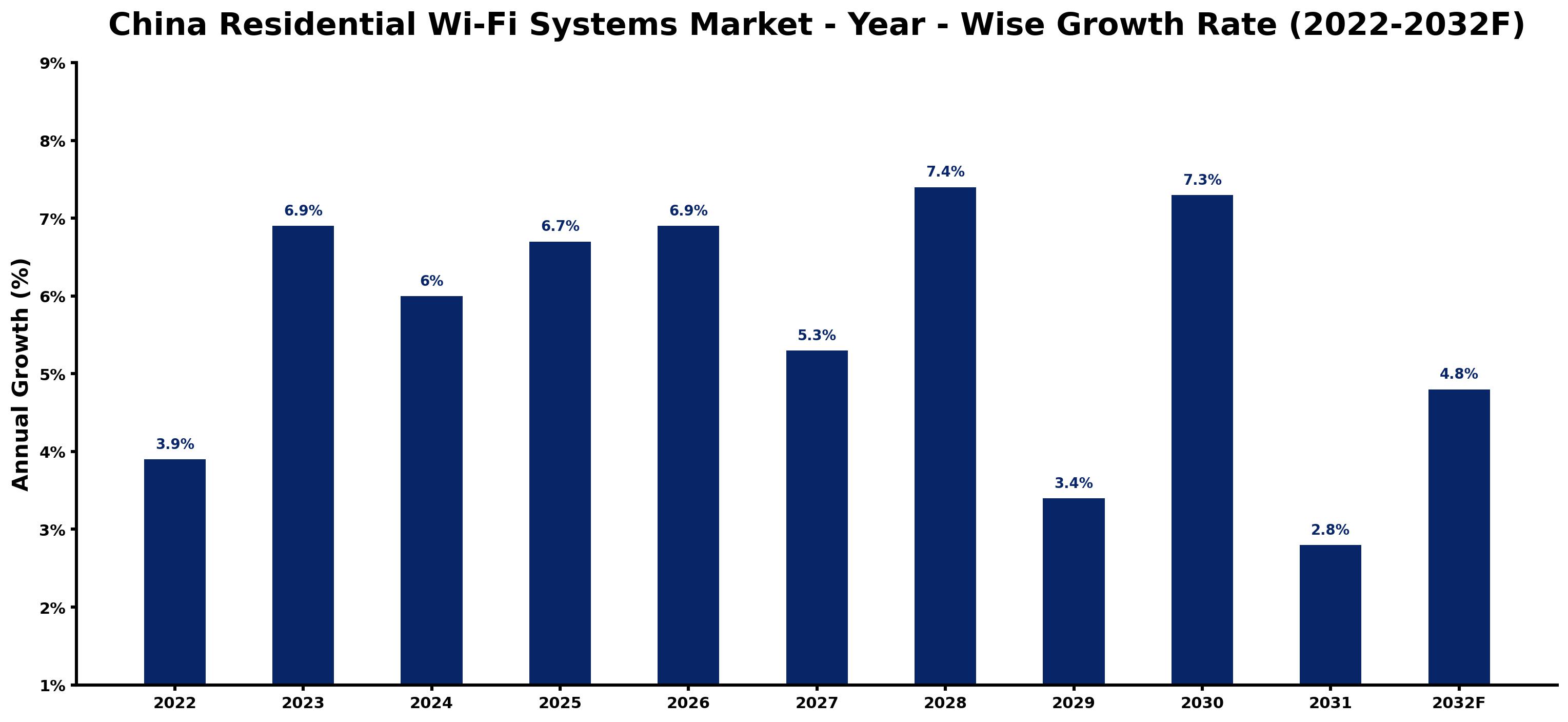
Each row of the following table gives one year's estimated growth and the event or demand shift that explains it.
| Year | Estimated Annual Growth (%) | Market Rationale |
| 2022 | 3.9 | The market experienced steady growth due to increasing internet connectivity among households. |
| 2023 | 6.9 | Demand surged as urban households adopted more devices, boosting Wi-Fi system sales. |
| 2024 | 6.0 | Growth slowed slightly as the market adjusted to previous high demand levels. |
| 2025 | 6.7 | An increase in broadband subscriptions contributed to higher sales of Wi-Fi systems. |
| 2026 | 6.9 | The adoption of Wi-Fi 6 technology accelerated demand for advanced residential systems. |
| 2027 | 5.3 | Growth slowed as market saturation began to affect new purchases. |
| 2028 | 7.4 | Smart home integration became more prevalent, driving peak demand for Wi-Fi systems. |
| 2029 | 3.4 | Market growth slowed again as competition increased among providers. |
| 2030 | 7.3 | Demand rose again as urban areas expanded their smart home capabilities. |
| 2031 | 2.8 | The market experienced a slowdown as growth stabilised in mature segments. |
| 2032 | 4.8 | Growth picked up as new residential buildings increasingly featured built-in Wi-Fi. |
Note: Market size estimations and growth projections presented in this report are based on 6Wresearch's proprietary forecasting methodology, utilizing the latest available industry data, government publications, and primary research inputs.
China Residential Wi-Fi Systems Market Synopsis
Residential Wi-Fi Systems in China encompasses technology products that enable wireless internet access in homes. These systems are built using advanced networking technologies and components such as routers and extenders. The China Residential Wi-Fi Systems Market is expanding due to a surge in urban households adopting smart devices and the rapid integration of Wi-Fi 6 technology. In 2022, over 1 billion internet users in China drove demand for reliable Wi-Fi solutions. The Smart Home Industry Development Plan emphasises the incorporation of Wi-Fi technology, further stimulating market growth.
Market Dynamics Impact Analysis (2026–2032)
| Factor | Type | Impact | Primary Segment Affected |
| Increasing number of internet users driving demand for connectivity solutions | Driver | High | Mesh Wi-Fi Systems |
| Rapid adoption of Wi-Fi 6 technology for better performance | Driver | High | Wi-Fi 6 Routers |
| High demand for seamless coverage in large residences | Opportunity | High | Mesh Wi-Fi Systems |
| Growing smart home market requiring reliable connectivity | Opportunity | Medium | Smart Home Users |
| Market saturation leading to slower growth rates | Restraint | High | Extenders/Boosters |
| Competition among providers affecting pricing strategies | Restraint | Medium | Gateway Modem-Routers |
| Challenges in integrating advanced technologies into existing infrastructure | Challenge | High | Wi-Fi 6 Routers |
| High costs associated with upgrading to new Wi-Fi standards | Challenge | Medium | Mesh Wi-Fi Systems |
Evaluation of Drivers in China Residential Wi-Fi Systems Market (2026–2032)
Below mentioned are some major drivers and their influence on market dynamics.
| Drivers | Primary Segment Affected | Why It Matters (Evidence) |
| Growing urban population increasing demand for internet access | Mesh Wi-Fi Systems | In urban areas like Beijing, over 70% of households reported using mesh systems for better coverage. |
| Rapid increase in connected devices per household | Wi-Fi 6 Routers | The average urban household has 10 connected devices, driving the need for reliable systems. |
| Government initiatives promoting smart home technologies | Smart Home Users | The Smart Home Industry Development Plan aims for greater integration of Wi-Fi technology in residences. |
| Expansion of broadband subscriptions improving internet access | Gateway Modem-Routers | A 15% increase in broadband subscriptions in 2023 supports demand for modern routers. |
| Rising demand for high-speed streaming services | High-Speed Streaming | The demand for uninterrupted video streaming drives the adoption of advanced Wi-Fi systems. |
Market growth for Residential Wi-Fi Systems in China is underpinned by the increasing number of internet users, the rapid adoption of Wi-Fi 6 technology, and the expansion of broadband subscriptions. In 2022, over 1 billion internet users drove demand for residential Wi-Fi systems. Urban households now average 10 connected devices, which increases the need for reliable Wi-Fi solutions. A 15% increase in broadband subscriptions in 2023 supports market potential.
Evaluation of Restraints in China Residential Wi-Fi Systems Market
The following restraints limit how fast demand can grow.
| Market Restraint | Primary Segment Affected | Why It Matters (Evidence) |
| Market saturation limiting new customer acquisition | Extenders/Boosters | As the market matures, fewer new customers are entering, impacting growth rates. |
| Increasing competition affecting pricing strategies | Gateway Modem-Routers | Intense competition among providers is impacting pricing strategies and profit margins. |
| Challenges in upgrading existing infrastructure to support new technologies | Wi-Fi 6 Routers | Many households face difficulties integrating advanced Wi-Fi systems into older setups. |
| High costs associated with adopting new Wi-Fi standards | Mesh Wi-Fi Systems | The transition to more advanced systems can be financially burdensome for consumers. |
| Limited awareness of new technologies among consumers | Smart Home Users | Many potential buyers are unaware of the benefits of upgrading to newer systems. |
China Residential Wi-Fi Systems Market Challenges
Buyers in the China Residential Wi-Fi Systems market face rising costs as the adoption of Wi-Fi 6 technology has increased prices for new routers by approximately 20%. Competition among suppliers is intensifying, with over 30% of new routers sold in 2023 being Wi-Fi 6 compatible, which forces some to lower prices and diminishes their profit margins. Manufacturers encounter technological challenges due to the National Standard for Wireless Local Area Networks, potentially delaying product launches by up to six months for those needing to meet compliance. The cost of integrating Wi-Fi solutions into new residential buildings has surged, as 60% of these structures now include built-in Wi-Fi, inflating construction expenses for developers.
Trends in the China Residential Wi-Fi Systems Market
Several trends are reshaping the China Residential Wi-Fi Systems Market; the most important are set out below.
- Shift to Mesh Wi-Fi Systems in Urban Areas: In urban centres like Beijing, the adoption of mesh Wi-Fi systems is increasing, with over 70% of households using them in 2023. This reflects the demand for reliable connectivity in densely populated environments.
- Rise of Wi-Fi 6 Technology Adoption: In 2023, over 30% of new routers sold were Wi-Fi 6 compatible, marking a shift towards faster, more efficient internet access. This trend is driven by the need for high-speed connectivity in smart homes.
- Integration of Wi-Fi in New Residential Buildings: In 2023, 60% of new residential buildings in major cities were equipped with built-in Wi-Fi solutions. This integration supports the growing demand for reliable internet access in modern living spaces.
- Government Emphasis on Smart Home Technologies: The '14th Five-Year Plan for Digital Economy Development' approved in 2022 focuses on promoting smart home technologies, including Wi-Fi systems. This initiative aims to encourage innovation and integration in residential settings.
Investment Opportunities in the China Residential Wi-Fi Systems Market
The following opportunities in the China Residential Wi-Fi Systems Market pair current demand with a clear way in.
- High Demand for Mesh Wi-Fi Systems: With over 70% of households in tier-1 cities using mesh systems, there is a strong opportunity to supply advanced solutions. Partnering with local distributors can facilitate market entry.
- Growth in Smart Home Integration: The Smart Home Industry Development Plan indicates a growing need for Wi-Fi systems. Suppliers can target smart home users by offering integrated solutions that improve connectivity.
- Expansion of Broadband Access in Rural Areas: The plan to enhance rural broadband access in 2023 presents an opportunity for suppliers to provide residential Wi-Fi systems. Collaborating with local governments can help reach these markets effectively.
- Investment in Wi-Fi 6 Technologies: As Wi-Fi 6 technology gains traction, there is a gap in the market for suppliers to offer compatible devices. Focusing on urban apartments can yield high returns.
Government Initiatives in the China Residential Wi-Fi Systems Market
The 'Broadband China' initiative launched by the Ministry of Industry and Information Technology in 2021 aims to improve internet infrastructure, targeting 100 Mbps access in urban areas by 2025. This measure directly impacts residential Wi-Fi systems by increasing demand for high-speed connectivity solutions. Additionally, the '14th Five-Year Plan for Digital Economy Development' approved in 2022 promotes smart home technologies, encouraging the adoption of advanced Wi-Fi systems in new residential projects.
In 2023, the Ministry of Housing and Urban-Rural Development issued regulations ensuring new residential projects include high-quality internet access. This regulation is vital for Wi-Fi system demand as it mandates infrastructure that supports modern connectivity. Furthermore, the National Development and Reform Commission's 'Smart Home Development Guidelines' introduced in 2021 encourage the integration of advanced Wi-Fi technologies in residential buildings, creating a conducive environment for growth.
Future Insight of the China Residential Wi-Fi Systems Market
Several forward-looking factors should support the China Residential Wi-Fi Systems market in the coming years. The expansion of 5G networks will stimulate demand for advanced Wi-Fi solutions, especially in densely populated urban areas. The Smart Home Industry Development Plan will encourage the integration of Wi-Fi technology in homes, facilitating connectivity for smart devices. In 2023, over 70% of households in tier-1 cities reported using mesh systems, indicating a shift towards improved network coverage. These trends will create new opportunities for suppliers and enhance accessibility for buyers.
Market Segmentation Analysis
The analysis below covers each segmentation, its leading category in 2025 and its fastest-growing category through 2032.
By System Type – Mesh Wi-Fi Systems Dominated, Wi-Fi 6 Routers Expected to Grow Fastest
According to Ravi Bhandari, Research Head at 6Wresearch, Mesh Wi-Fi Systems took a 44% share of system type in 2025, more than any other category. Mesh Wi-Fi Systems dominate the market share due to their ability to provide seamless coverage across large areas, which is crucial for urban households with multiple connected devices. In tier-1 cities, over 70% of households have adopted these systems to enhance their internet connectivity. The quickest growth will come from Wi-Fi 6 Routers, forecast to expand at a CAGR of 6.7% between 2026 and 2032. The rapid growth of Wi-Fi 6 Routers is attributed to their capability to offer faster speeds and improved performance, which are increasingly necessary for homes with numerous devices. As more consumers upgrade to Wi-Fi 6 technology, this segment's growth will likely continue to accelerate. Suppliers should focus on developing advanced mesh systems and Wi-Fi 6 technology to meet the increasing demand from urban households.
By Frequency Band – Dual/Triband Dominated and Is Expected to Record the Fastest Growth
Dual/Triband accounted for a 38% market share by frequency band in 2025. Dual/Triband systems lead the market share as they effectively support multiple devices, catering to households with numerous internet-connected devices. This is particularly important in densely populated urban areas where bandwidth availability can be limited. Its lead should widen, with a projected CAGR of 6.7% during 2026–2032, the highest in this split. The Dual/Triband segment is also the fastest-growing due to its rising adoption in new residential buildings equipped with advanced Wi-Fi solutions. As consumers seek high-bandwidth options, this segment is expected to maintain its growth momentum. Buyers will benefit from investing in Dual/Triband systems to ensure optimal performance in their increasingly connected homes.
By Network Mode – Mesh/Seamless Roaming Dominated, High-Speed Streaming Expected to Grow Fastest
The largest network mode category in 2025 was Mesh/Seamless Roaming, with a 42% share of total revenue. Mesh/Seamless Roaming holds the largest market share because it significantly improves user experience in larger homes, where traditional systems often struggle. This is especially vital in urban environments, where space and connectivity are critical. Over 2026–2032, High-Speed Streaming is expected to post the fastest growth, at a CAGR of 8.2%. High-Speed Streaming is emerging as the fastest-growing segment, driven by the rising demand for uninterrupted video streaming services in households. As online streaming continues to gain popularity, this segment's growth is anticipated to accelerate. Suppliers should enhance their offerings in Mesh/Seamless Roaming technology to meet the connectivity needs of consumers.
By End User – Smart Home Users Dominated, Large Residences Expected to Grow Fastest
With a 44% revenue share in 2025, Smart Home Users was the largest end user category. Smart Home Users represent the largest market share, as they require robust Wi-Fi systems to seamlessly connect various smart devices. The integration of Wi-Fi technology in smart homes is becoming essential, especially in urban areas with high device density. Large Residences are projected to grow fastest, at a CAGR of 7.3% during 2026–2032. Large Residences are the fastest-growing end-user segment, driven by the need for comprehensive Wi-Fi coverage in spacious homes. As urban populations increase and residences expand, demand in this segment is expected to surge. Suppliers must tailor their products to meet the specific needs of smart home users and large residences to capture the growing market.
Key Attractiveness of the Report
- 10 Years of Market Numbers
- Historical Data Starting from 2022 to 2025
- Base Year 2025
- Forecast Data until 2032
- Key Performance Indicators Impacting the Market
- Major Upcoming Developments and Projects
Key Highlights of the Report:
- China Residential Wi-Fi Systems Market Outlook
- Market Size of China Residential Wi-Fi Systems Market, 2025
- Forecast of China Residential Wi-Fi Systems Market, 2032
- Historical Data and Forecast of China Residential Wi-Fi Systems Revenues & Volume for the Period 2022 - 2032F
- China Residential Wi-Fi Systems Market Trend Evolution
- China Residential Wi-Fi Systems Market Drivers and Challenges
- China Residential Wi-Fi Systems Price Trends
- China Residential Wi-Fi Systems Porter's Five Forces
- China Residential Wi-Fi Systems Industry Life Cycle
- Historical Data and Forecast of China Residential Wi-Fi Systems Market Revenues & Volume By System Type for the Period 2022 - 2032F
- Historical Data and Forecast of China Residential Wi-Fi Systems Market Revenues & Volume By Mesh Wi-Fi Systems for the Period 2022 - 2032F
- Historical Data and Forecast of China Residential Wi-Fi Systems Market Revenues & Volume By Wi-Fi 6 Routers for the Period 2022 - 2032F
- Historical Data and Forecast of China Residential Wi-Fi Systems Market Revenues & Volume By Extenders/Boosters for the Period 2022 - 2032F
- Historical Data and Forecast of China Residential Wi-Fi Systems Market Revenues & Volume By Gateway Modem-Routers for the Period 2022 - 2032F
- Historical Data and Forecast of China Residential Wi-Fi Systems Market Revenues & Volume By Frequency Band for the Period 2022 - 2032F
- Historical Data and Forecast of China Residential Wi-Fi Systems Market Revenues & Volume By Dual/Triband for the Period 2022 - 2032F
- Historical Data and Forecast of China Residential Wi-Fi Systems Market Revenues & Volume By 2.4 GHz / 5 GHz / 6 GHz for the Period 2022 - 2032F
- Historical Data and Forecast of China Residential Wi-Fi Systems Market Revenues & Volume By 2.4 GHz for the Period 2022 - 2032F
- Historical Data and Forecast of China Residential Wi-Fi Systems Market Revenues & Volume By Broadband Integration for the Period 2022 - 2032F
- Historical Data and Forecast of China Residential Wi-Fi Systems Market Revenues & Volume By Network Mode for the Period 2022 - 2032F
- Historical Data and Forecast of China Residential Wi-Fi Systems Market Revenues & Volume By Mesh/Seamless Roaming for the Period 2022 - 2032F
- Historical Data and Forecast of China Residential Wi-Fi Systems Market Revenues & Volume By High-Speed Streaming for the Period 2022 - 2032F
- Historical Data and Forecast of China Residential Wi-Fi Systems Market Revenues & Volume By Repeater Mode for the Period 2022 - 2032F
- Historical Data and Forecast of China Residential Wi-Fi Systems Market Revenues & Volume By ISP Bundled for the Period 2022 - 2032F
- Historical Data and Forecast of China Residential Wi-Fi Systems Market Revenues & Volume By End User for the Period 2022 - 2032F
- Historical Data and Forecast of China Residential Wi-Fi Systems Market Revenues & Volume By Large Residences for the Period 2022 - 2032F
- Historical Data and Forecast of China Residential Wi-Fi Systems Market Revenues & Volume By Smart Home Users for the Period 2022 - 2032F
- Historical Data and Forecast of China Residential Wi-Fi Systems Market Revenues & Volume By Multi-Floor Houses for the Period 2022 - 2032F
- Historical Data and Forecast of China Residential Wi-Fi Systems Market Revenues & Volume By Urban Apartments for the Period 2022 - 2032F
- China Residential Wi-Fi Systems Import Export Trade Statistics
- Market Opportunity Assessment By System Type
- Market Opportunity Assessment By Frequency Band
- Market Opportunity Assessment By Network Mode
- Market Opportunity Assessment By End User
- China Residential Wi-Fi Systems Top Companies Market Share
- China Residential Wi-Fi Systems Competitive Benchmarking By Technical and Operational Parameters
- China Residential Wi-Fi Systems Company Profiles
- China Residential Wi-Fi Systems Key Strategic Recommendations
Market Covered
The report offers an extensive study of the following market segments.
By System Type
- Mesh Wi-Fi Systems
- Wi-Fi 6 Routers
- Extenders/Boosters
- Gateway Modem-Routers
By Frequency Band
- Dual/Triband
- 2.4 GHz / 5 GHz / 6 GHz
- 2.4 GHz
- Broadband Integration
By Network Mode
- Mesh/Seamless Roaming
- High-Speed Streaming
- Repeater Mode
- ISP Bundled
By End User
- Large Residences
- Smart Home Users
- Multi-Floor Houses
- Urban Apartments































