India Retail Automation Systems Market Size & Growth Rate
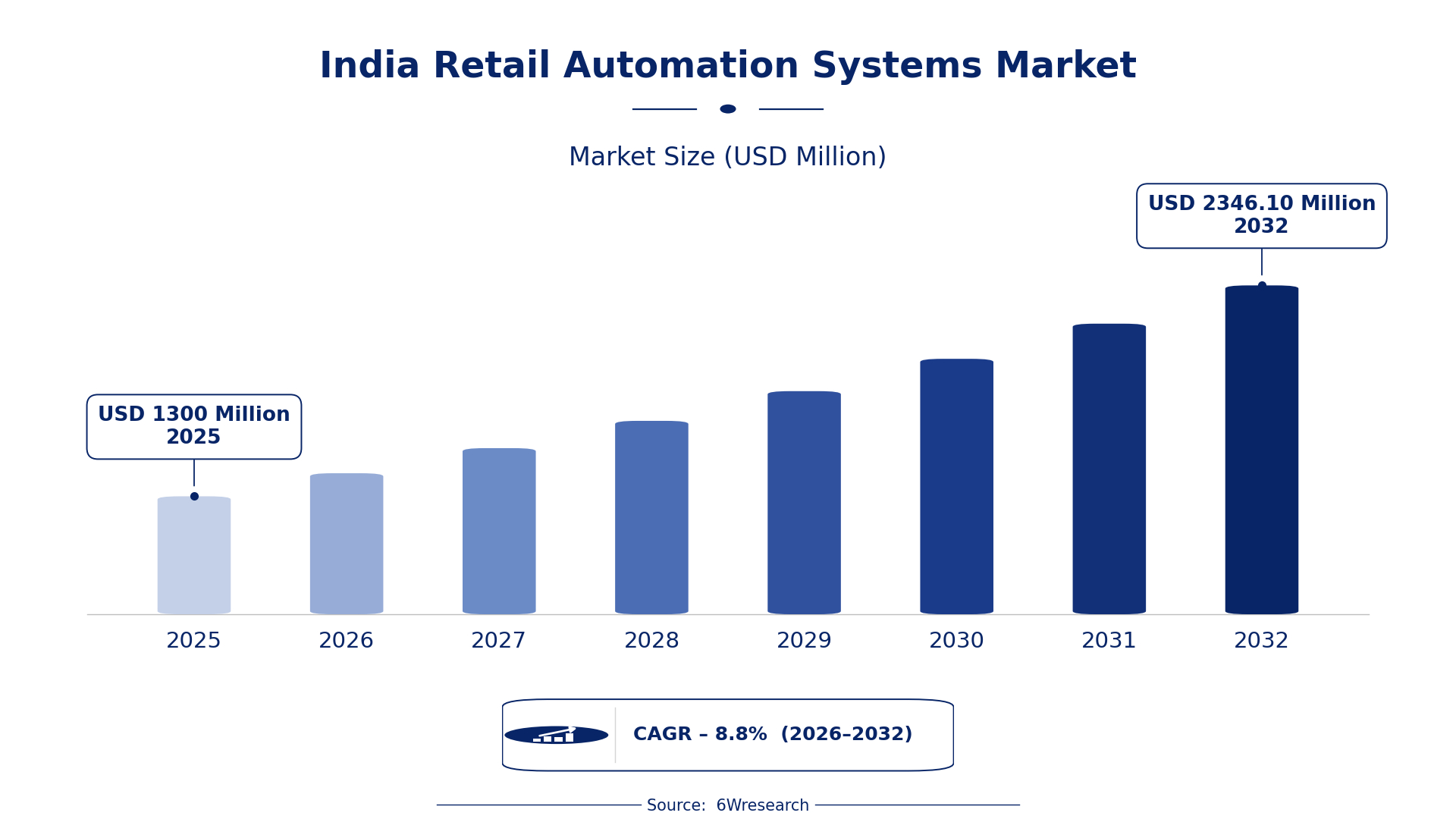
According to 6Wresearch internal database and industry insights, the India Retail Automation Systems Market was valued at USD 1,300.0 million in 2025 and is projected to reach USD 2,346.10 million by 2032, growing at a CAGR of approximately 8.8% during 2026–2032.
India Retail Automation Systems Market Highlights
| Report Metric | Details |
| Report Name | India Retail Automation Systems Market |
| Market Size 2025 | USD 1,300.0 million |
| Market Size 2032 | USD 2,346.10 million |
| Absolute Growth 2025–2032 | USD 1,046.10 million |
| CAGR 2026–2032 | 8.8% |
| Peak Annual Growth | 11.4% in 2030 |
| Forecast Period | 2026–2032 |
| Historical Data | 2022–2025 |
| Base Year | 2025 |
| Leading System Type, 2025 | Self-checkout Kiosks (44% share) |
| Leading Automation Focus, 2025 | Payment & Scanning (44% share) |
| Leading Integration Level, 2025 | RFID/Barcode + POS (43% share) |
| Leading End User, 2025 | Supermarkets & Retail Chains (49% share) |
| Fastest-Growing System Type | Robotic Shelf Replenishment (10.8% CAGR) |
| Fastest-Growing Automation Focus | Dynamic Pricing (11.3% CAGR) |
| Fastest-Growing Integration Level | AI/Robotics (10.4% CAGR) |
| Fastest-Growing End User | Warehouses & Retail Stores (10.6% CAGR) |
| Growing Sector | Retail |
| Key End Users | Supermarkets, Retail Chains, Warehouses, E-commerce Platforms |
India Retail Automation Systems Market Year-wise Growth Rate and Key Drivers (2022–2032)
This graph illustrates the annual growth rates of the market from 2022 to 2032, highlighting a steady upward trajectory and projected market expansion over the forecast period.
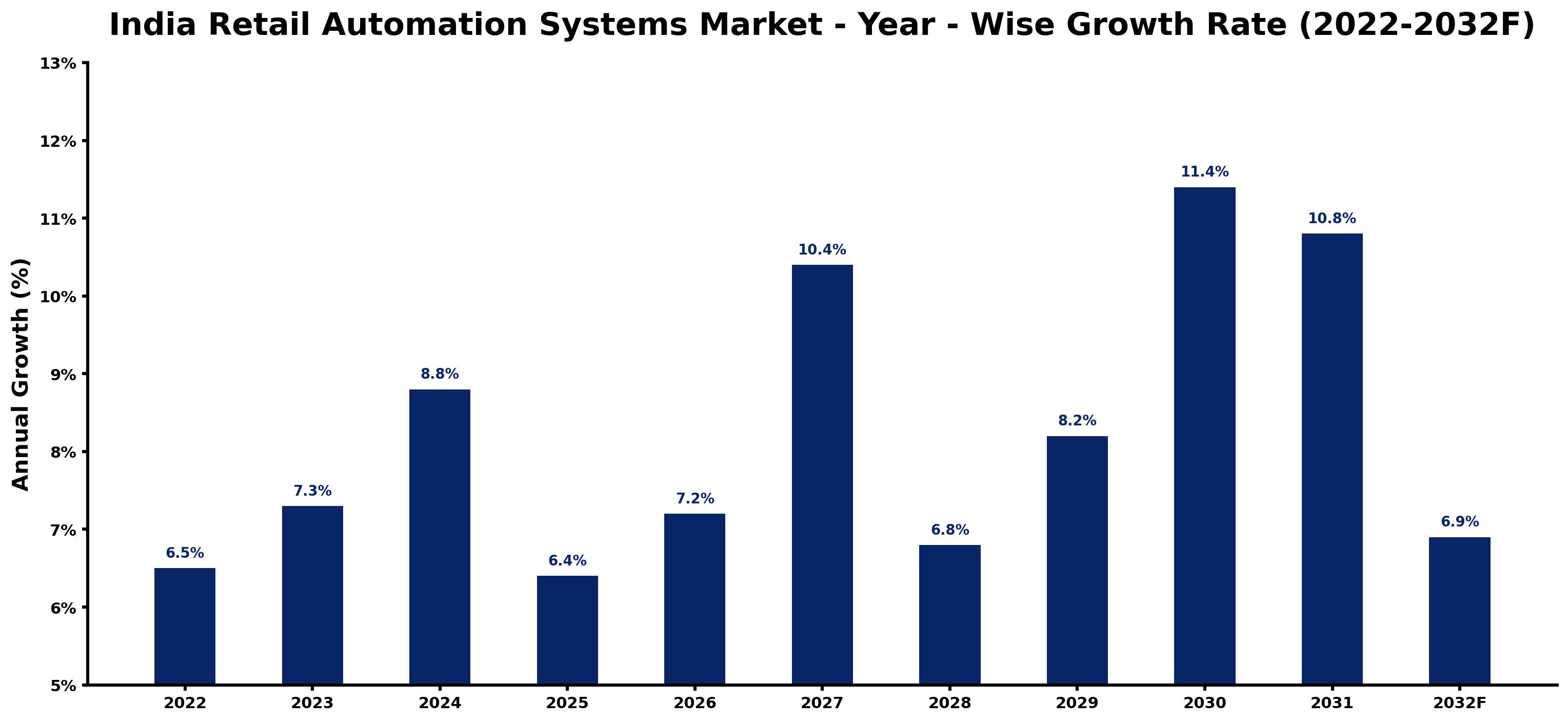
Year by year, the estimates below pair each growth rate with the development that shaped it.
| Year | Estimated Annual Growth (%) | Market Rationale |
| 2022 | 6.5 | The market experienced steady growth due to the implementation of the 'Digital India' initiative promoting technology in retail. |
| 2023 | 7.3 | Demand accelerated as more supermarkets implemented self-checkout kiosks to improve customer service. |
| 2024 | 8.8 | The introduction of advanced robotic systems contributed to a rise in market activity. |
| 2025 | 6.4 | Growth slowed as some retailers faced challenges integrating new technologies with existing systems. |
| 2026 | 7.2 | Increased investments in payment and scanning systems across retail chains are expected to boost the market. |
| 2027 | 10.4 | Robotic shelf replenishment is projected to gain traction, driving demand for automation solutions in stores. |
| 2028 | 6.8 | Retailers are adjusting to evolving technological requirements, moderating growth expectations. |
| 2029 | 8.2 | Dynamic pricing strategies are expected to be increasingly adopted, boosting sales and operational efficiency. |
| 2030 | 11.4 | Peak growth is projected as the retail sector embraces comprehensive automation solutions. |
| 2031 | 10.8 | The market will see a slight slowdown as competition intensifies among automation providers. |
| 2032 | 6.9 | Growth is expected to continue but at a reduced pace as retailers focus on optimizing existing systems. |
Note: Market size estimations and growth projections presented in this report are based on 6Wresearch's proprietary forecasting methodology, utilizing the latest available industry data, government publications, and primary research inputs.
India Retail Automation Systems Market Synopsis
The India Retail Automation Systems Market encompasses technologies that streamline operations, including self-checkout kiosks and digital pricing solutions. These systems improve customer experience and operational efficiency. Demand is rising from supermarkets and the growing e-commerce sector, which is expected to reach $200 billion by 2026. The 'Digital India' initiative promotes technology adoption across retail, further driving market growth. As a result, the market is expanding rapidly, with increasing investments in automation technologies.
Market Dynamics Impact Analysis (2026–2032)
| Factor | Type | Impact | Primary Segment Affected |
| Increasing adoption of self-checkout kiosks enhances customer experience and reduces wait times. | Driver | High | Self-checkout Kiosks |
| The growth of the e-commerce sector drives demand for efficient retail automation solutions. | Driver | High | Payment & Scanning |
| The rise of dynamic pricing strategies presents opportunities for retailers to optimize pricing. | Opportunity | High | Dynamic Pricing |
| The push for local manufacturing under the 'Make in India' initiative opens new investment avenues. | Opportunity | High | Robotic Shelf Replenishment |
| Integration challenges with existing systems can hinder the adoption of new technologies. | Restraint | Medium | RFID/Barcode + POS |
| The high initial investment costs for automation systems may deter smaller retailers. | Restraint | Medium | Back-store Fulfillment Robots |
| Talent shortages in skilled workers for operating advanced systems can limit growth. | Challenge | High | AI/Robotics |
| Regulatory compliance with standards can delay the implementation of new technologies. | Challenge | Medium | Electronic Shelf Labels |
Evaluation of Drivers in India Retail Automation Systems Market (2026–2032)
The factors lifting demand, and the evidence behind each, are summarised below.
| Drivers | Primary Segment Affected | Why It Matters (Evidence) |
| Adoption of self-checkout kiosks improves customer service and reduces operational costs. | Self-checkout Kiosks | Over 80% of supermarkets in India are adopting these systems to streamline operations. |
| Growth in the e-commerce sector drives demand for efficient transaction processes. | Payment & Scanning | The e-commerce market is projected to grow to $200 billion by 2026, increasing automation needs. |
| Dynamic pricing strategies help retailers adjust prices based on market demand. | Dynamic Pricing | Approximately 50% of major retailers in India are adopting these strategies to remain competitive. |
| The 'Make in India' initiative encourages local production of automation technologies. | Robotic Shelf Replenishment | This initiative aims for 25% local sourcing by 2025, boosting domestic manufacturing. |
| RFID technology implementation improves inventory management and tracking. | RFID/Barcode + POS | Over 60% of large retail chains in India are adopting RFID for better efficiency. |
Growth across the Retail Automation Systems market in India is anchored in rising adoption of self-checkout kiosks, the booming e-commerce sector, and dynamic pricing strategies. Approximately 50% of major retailers are adopting dynamic pricing strategies, enabling them to remain competitive. This combination of factors is boosting demand for retail automation solutions across the country.
Evaluation of Restraints in India Retail Automation Systems Market
The key brakes on demand, and where they bite hardest, are shown below.
| Market Restraint | Primary Segment Affected | Why It Matters (Evidence) |
| Integration challenges with existing retail systems can slow down automation adoption. | RFID/Barcode + POS | Many retailers struggle to seamlessly integrate new technologies with legacy systems. |
| High initial investment costs deter smaller retailers from adopting automation solutions. | Back-store Fulfillment Robots | Smaller retailers often lack the capital to invest in advanced automation technologies. |
| Talent shortages in skilled workers can limit the effective implementation of automation. | AI/Robotics | The retail sector is facing a shortage of trained personnel to operate advanced systems. |
| Regulatory compliance with standards can delay the rollout of new technologies. | Electronic Shelf Labels | Retailers must navigate complex regulations to ensure compliance before implementation. |
| Market competition can lead to price wars, affecting profitability for automation providers. | Self-checkout Kiosks | Intense competition among providers may drive down prices, impacting margins. |
India Retail Automation Systems Market Challenges
The India Retail Automation Systems market still has to solve a few problems, starting with supply chain disruptions. Many producers rely on imported components, leading to delivery delays that can increase costs for retailers by up to 15%. Regulatory hurdles also create obstacles; compliance with the Bureau of Indian Standards can slow technology rollouts, impacting market entry for suppliers and delaying product launches by several months. Buyers face rising operational costs, as the average Indian household spends approximately 30% of its income on retail purchases, making them sensitive to price increases. Skills shortages complicate effective implementation; the 'Skill India' programme aims to address this by 2025, but current gaps still hinder operational efficiency for retailers, resulting in potential losses of up to 20% in productivity.
Trends in the India Retail Automation Systems Market
Buyers and suppliers in the India Retail Automation Systems Market are adjusting to the following trends.
- Shift Towards Self-Checkout Solutions: The trend towards self-checkout solutions is transforming the retail experience, with over 80% of supermarkets adopting these systems to enhance customer service. This shift streamlines operations and reduces wait times.
- Rise of Dynamic Pricing Strategies: Dynamic pricing strategies are gaining popularity, with 50% of major retailers in India implementing them to adjust prices based on demand. This approach enables retailers to remain competitive and maximise profits.
- Increased Adoption of RFID Technology: RFID technology is being adopted by over 60% of large retail chains, improving inventory management and tracking. This trend boosts operational efficiency and reduces costs.
- Growth of E-commerce Driving Automation: The e-commerce sector in India is projected to grow to $200 billion by 2026, significantly driving demand for retail automation solutions. This growth is prompting retailers to invest in advanced technologies.
Investment Opportunities in the India Retail Automation Systems Market
Below are the investment opportunities with the strongest case in the India Retail Automation Systems Market.
- Gap in Local Manufacturing: With the 'Make in India' initiative aiming for 25% local sourcing by 2025, there is a gap in local manufacturing of retail automation systems. Companies can partner with local manufacturers to meet this demand.
- Investment in AI and Robotics: AI adoption in retail is set to increase by 30% in the next five years, presenting opportunities for suppliers of automation technologies. Collaborating with technology firms can improve product offerings.
- Expansion of Supermarket Chains: The rapid growth of supermarket chains in India creates opportunities for automation providers. Suppliers can enter this market by forming joint ventures with established retail chains.
- Support for Skill Development: The 'Skill India' programme aims to train 500 million people in various sectors, including retail technology skills by 2025. This initiative provides a chance for training providers to develop tailored programs.
Government Initiatives in the India Retail Automation Systems Market
The 'Digital India' programme, launched in 2020 by the Ministry of Electronics and Information Technology, aims to improve digital infrastructure in retail with a budget of ₹1 trillion. This initiative promotes the adoption of technology in retail, facilitating smoother operations and better customer experiences. Additionally, the 'Make in India' initiative, updated in 2021, encourages local manufacturing of retail automation technologies, aiming for 25% local sourcing by 2025, which supports domestic production and reduces dependency on imports.
The 'Skill India' initiative, updated in 2022, aims to train 500 million people in various sectors, including retail automation skills by 2025. This initiative is vital for addressing the talent shortage in the retail automation sector. The Bureau of Indian Standards has established the 'IS 16046' standard for electronic shelf labels in retail, effective from 2021, ensuring quality and safety compliance for products in the market. These measures collectively improve the operational capabilities of retailers and ensure compliance with industry standards.
Future Insight of the India Retail Automation Systems Market
The India Retail Automation Systems market will experience transformative changes by 2032, primarily driven by the expected growth of the e-commerce sector, which is set to expand significantly. Enhanced technology integration will enable retailers to adopt dynamic pricing strategies, improving profit margins. The 'Digital India' initiative will promote smart retail solutions, benefiting both buyers and suppliers by streamlining operations. Additionally, the 'Atmanirbhar Bharat' initiative will encourage local manufacturing, reducing reliance on imports and fostering innovation in retail technology, ultimately creating a more resilient market.
Market Segmentation Analysis
The report offers a comprehensive study of the following market segments and their leading categories in the market.
By System Type – Self-checkout Kiosks Dominated, Robotic Shelf Replenishment Expected to Grow Fastest
According to Ravi Bhandari, Research Head at 6Wresearch, Self-checkout Kiosks took a 44% share of system type in 2025, more than any other category. Self-checkout kiosks hold the largest market share in India due to their extensive deployment in over 80% of supermarkets, enhancing customer experience by significantly reducing wait times. This high adoption rate indicates a strong preference among retailers for solutions that streamline operations and improve service delivery. The quickest growth will come from Robotic Shelf Replenishment, forecast to expand at a CAGR of 10.8% between 2026 and 2032. Robotic shelf replenishment is experiencing rapid growth as retailers focus on efficient inventory management, with over 10,000 retail stores in India implementing these systems. This trend is likely to continue as businesses aim to optimise their stock processes and enhance operational efficiency. Suppliers should focus on developing advanced robotic solutions to meet the increasing demand for efficient inventory management.
By Automation Focus – Payment & Scanning Dominated, Dynamic Pricing Expected to Grow Fastest
Payment & Scanning held a 44% share of the India Retail Automation Systems Market by automation focus in 2025. Payment and scanning technologies lead the market share as they are crucial for transaction processes in retail environments, ensuring smooth operations and enhancing customer satisfaction. Their essential role in retail automation makes them a foundational component for retailers looking to improve service delivery. Over 2026–2032, Dynamic Pricing is expected to post the fastest growth, at a CAGR of 11.3%. Dynamic pricing is the fastest-growing segment, driven by the need for retailers to adjust prices based on real-time demand and competition, with 50% of major retailers adopting this strategy. This trend signifies a shift towards more responsive pricing models in the retail sector. Buyers must invest in dynamic pricing solutions to remain competitive and agile in response to market changes.
By Integration Level – RFID/Barcode + POS Dominated, AI/Robotics Expected to Grow Fastest
In 2025, RFID/Barcode + POS led the integration level split with a 43% share. RFID/barcode systems integrated with point-of-sale technology capture the largest market share by enabling seamless inventory tracking alongside sales processes. This integration is vital for retailers aiming to enhance operational efficiency and improve customer service. AI/Robotics are set to record the highest CAGR in this split, 10.4% over 2026–2032. AI and robotics represent the fastest-growing integration level as they enhance operational efficiency through improved data analysis and automation. The increasing adoption of these technologies highlights a shift towards smarter retail solutions that streamline processes. Suppliers should prioritise AI and robotics in their offerings to align with the market's technological advancements.
By End User – Supermarkets & Retail Chains Dominated, Warehouses & Retail Stores Expected to Grow Fastest
With a 49% revenue share in 2025, Supermarkets & Retail Chains was the largest end user category. Supermarkets and retail chains account for the largest market share as primary users of retail automation systems, leveraging these technologies to enhance customer service and operational efficiency. Their extensive scale creates significant demand for automation solutions that improve service delivery. Warehouses & Retail Stores are projected to grow fastest, at a CAGR of 10.6% during 2026–2032. Warehouses and retail stores are the fastest-growing end users, utilising automation for effective stock management and order processing. This growth reflects a broader trend towards automation across various retail segments, indicating a shift in operational practices. Suppliers should target warehouses and retail stores with tailored automation solutions to capitalise on this increasing demand.
Key Attractiveness of the Report
- 10 Years of Market Numbers
- Historical Data Starting from 2022 to 2025
- Base Year 2025
- Forecast Data until 2032
- Key Performance Indicators Impacting the Market
- Major Upcoming Developments and Projects
Key Highlights of the Report:
- India Retail Automation Systems Market Outlook
- Market Size of India Retail Automation Systems Market, 2025
- Forecast of India Retail Automation Systems Market, 2032
- Historical Data and Forecast of India Retail Automation Systems Revenues & Volume for the Period 2022 - 2032F
- India Retail Automation Systems Market Trend Evolution
- India Retail Automation Systems Market Drivers and Challenges
- India Retail Automation Systems Price Trends
- India Retail Automation Systems Porter's Five Forces
- India Retail Automation Systems Industry Life Cycle
- Historical Data and Forecast of India Retail Automation Systems Market Revenues & Volume By System Type for the Period 2022 - 2032F
- Historical Data and Forecast of India Retail Automation Systems Market Revenues & Volume By Self-checkout Kiosks for the Period 2022 - 2032F
- Historical Data and Forecast of India Retail Automation Systems Market Revenues & Volume By Robotic Shelf Replenishment for the Period 2022 - 2032F
- Historical Data and Forecast of India Retail Automation Systems Market Revenues & Volume By Back-store Fulfillment Robots for the Period 2022 - 2032F
- Historical Data and Forecast of India Retail Automation Systems Market Revenues & Volume By Digital Price Labels for the Period 2022 - 2032F
- Historical Data and Forecast of India Retail Automation Systems Market Revenues & Volume By Automation Focus for the Period 2022 - 2032F
- Historical Data and Forecast of India Retail Automation Systems Market Revenues & Volume By Payment & Scanning for the Period 2022 - 2032F
- Historical Data and Forecast of India Retail Automation Systems Market Revenues & Volume By Restocking Tasks for the Period 2022 - 2032F
- Historical Data and Forecast of India Retail Automation Systems Market Revenues & Volume By Picking Automation for the Period 2022 - 2032F
- Historical Data and Forecast of India Retail Automation Systems Market Revenues & Volume By Dynamic Pricing for the Period 2022 - 2032F
- Historical Data and Forecast of India Retail Automation Systems Market Revenues & Volume By Integration Level for the Period 2022 - 2032F
- Historical Data and Forecast of India Retail Automation Systems Market Revenues & Volume By RFID/Barcode + POS for the Period 2022 - 2032F
- Historical Data and Forecast of India Retail Automation Systems Market Revenues & Volume By AI/Robotics for the Period 2022 - 2032F
- Historical Data and Forecast of India Retail Automation Systems Market Revenues & Volume By In-Store/Warehouse for the Period 2022 - 2032F
- Historical Data and Forecast of India Retail Automation Systems Market Revenues & Volume By Electronic Shelf Labels for the Period 2022 - 2032F
- Historical Data and Forecast of India Retail Automation Systems Market Revenues & Volume By End User for the Period 2022 - 2032F
- Historical Data and Forecast of India Retail Automation Systems Market Revenues & Volume By Supermarkets & Retail Chains for the Period 2022 - 2032F
- Historical Data and Forecast of India Retail Automation Systems Market Revenues & Volume By Warehouses & Retail Stores for the Period 2022 - 2032F
- Historical Data and Forecast of India Retail Automation Systems Market Revenues & Volume By Large Format Retailers for the Period 2022 - 2032F
- Historical Data and Forecast of India Retail Automation Systems Market Revenues & Volume By Supermarket Chains for the Period 2022 - 2032F
- India Retail Automation Systems Import Export Trade Statistics
- Market Opportunity Assessment By System Type
- Market Opportunity Assessment By Automation Focus
- Market Opportunity Assessment By Integration Level
- Market Opportunity Assessment By End User
- India Retail Automation Systems Top Companies Market Share
- India Retail Automation Systems Competitive Benchmarking By Technical and Operational Parameters
- India Retail Automation Systems Company Profiles
- India Retail Automation Systems Key Strategic Recommendations
Market Covered
The report offers an extensive study of the following market segments.
By System Type
- Self-checkout Kiosks
- Robotic Shelf Replenishment
- Back-store Fulfillment Robots
- Digital Price Labels
By Automation Focus
- Payment & Scanning
- Restocking Tasks
- Picking Automation
- Dynamic Pricing
By Integration Level
- RFID/Barcode + POS
- AI/Robotics
- In-Store/Warehouse
- Electronic Shelf Labels
By End User
- Supermarkets & Retail Chains
- Warehouses & Retail Stores
- Large Format Retailers
- Supermarket Chains































