China Retail Automation Systems Market Size & Growth Rate
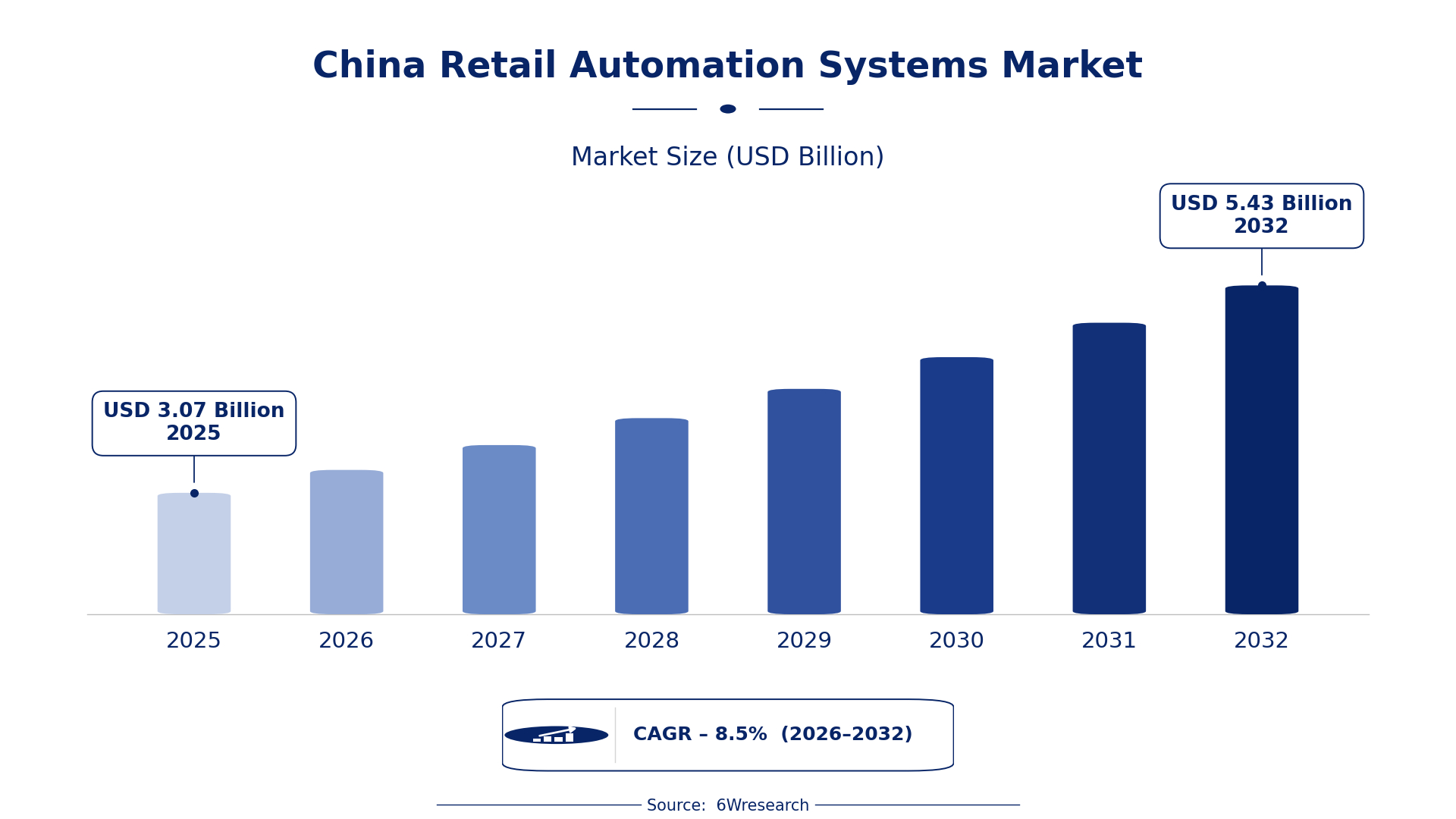
According to 6Wresearch internal database and industry insights, the China Retail Automation Systems Market was valued at USD 3.07 billion in 2025 and is projected to reach USD 5.43 billion by 2032, growing at a CAGR of approximately 8.5% during 2026–2032.
China Retail Automation Systems Market Highlights
| Report Metric | Details |
| Report Name | China Retail Automation Systems Market |
| Market Size 2025 | USD 3.07 billion |
| Market Size 2032 | USD 5.43 billion |
| Absolute Growth 2025–2032 | USD 2.36 billion |
| CAGR 2026–2032 | 8.5% |
| Peak Annual Growth | 10.8% in 2031 |
| Forecast Period | 2026–2032 |
| Historical Data | 2022–2025 |
| Base Year | 2025 |
| Leading System Type, 2025 | Self-checkout Kiosks (46% share) |
| Leading Automation Focus, 2025 | Payment & Scanning (40% share) |
| Leading Integration Level, 2025 | RFID/Barcode + POS (49% share) |
| Leading End User, 2025 | Supermarkets & Retail Chains (51% share) |
| Fastest-Growing System Type | Robotic Shelf Replenishment (10.8% CAGR) |
| Fastest-Growing Automation Focus | Picking Automation (10.0% CAGR) |
| Fastest-Growing Integration Level | AI/Robotics (9.7% CAGR) |
| Fastest-Growing End User | Warehouses & Retail Stores (10.8% CAGR) |
| Growing Sector | supermarkets and retail chains |
| Key End Users | supermarkets, retail chains, large format retailers, warehouses |
China Retail Automation Systems Market Year-wise Growth Rate and Key Drivers (2022–2032)
This graph illustrates the annual growth rates of the market from 2022 to 2032, highlighting a steady upward trajectory and projected market expansion over the forecast period.
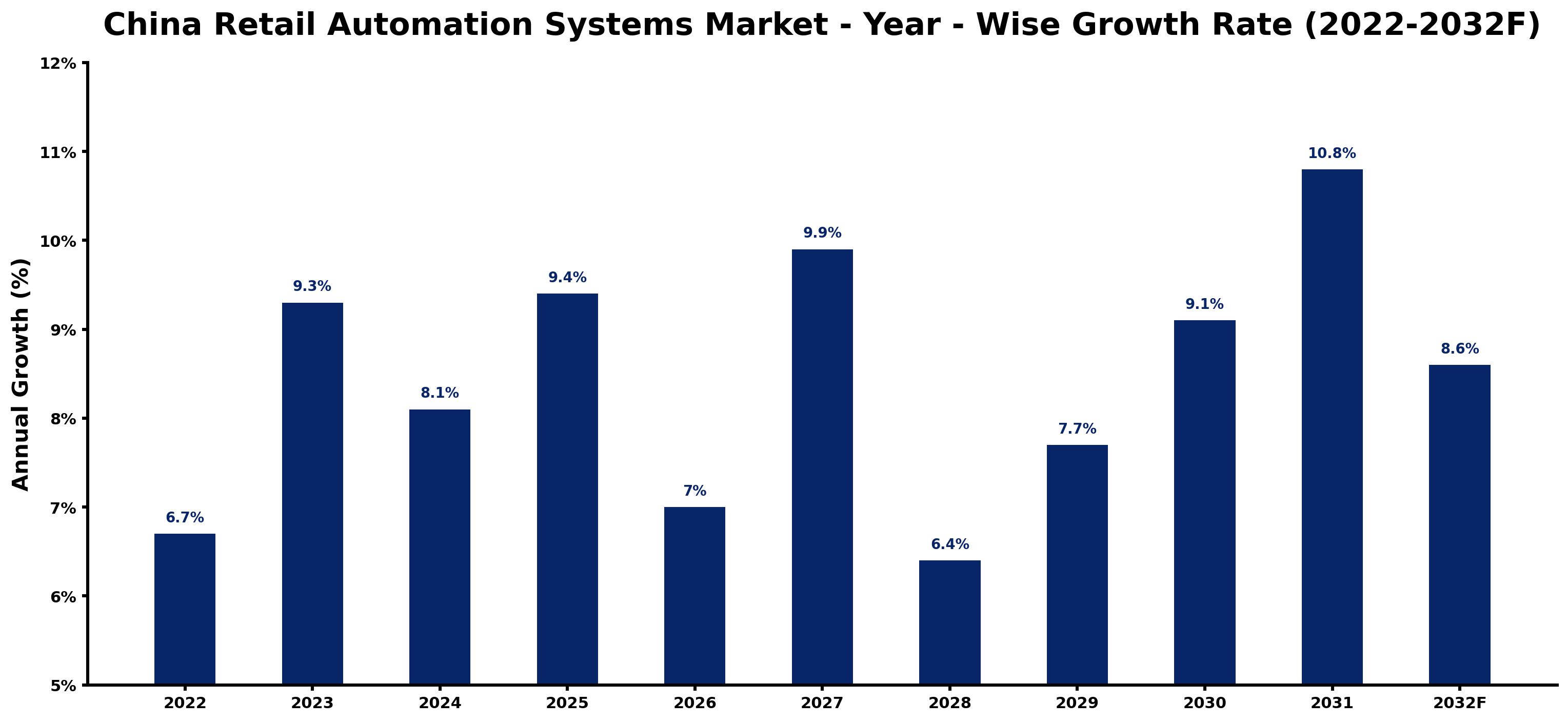
Below, each year's estimated growth is shown next to the factor that most influenced it.
| Year | Estimated Annual Growth (%) | Market Rationale |
| 2022 | 6.7 | The market experienced steady activity with increasing automation adoption across retail sectors. |
| 2023 | 9.3 | Demand surged due to the widespread implementation of self-checkout kiosks in urban supermarkets. |
| 2024 | 8.1 | Growth moderated as retailers adjusted to previous investments in automation technologies. |
| 2025 | 9.4 | The market rebounded with increased adoption of robotic shelf replenishment systems in major cities. |
| 2026 | 7.0 | A slowdown occurred as retailers focused on optimising existing automation systems. |
| 2027 | 9.9 | Demand accelerated with a rise in AI-driven payment systems among large format retailers. |
| 2028 | 6.4 | Growth slowed as retailers faced challenges in integrating new technologies effectively. |
| 2029 | 7.7 | Increased demand for digital price labels contributed to a rise in automation adoption. |
| 2030 | 9.1 | The market saw renewed interest in payment and scanning technologies among retail chains. |
| 2031 | 10.8 | A peak in growth was driven by the successful rollout of dynamic pricing strategies. |
| 2032 | 8.6 | Growth decelerated as the market stabilised following the 'Digital Economy Development Plan'. |
Note: Market size estimations and growth projections presented in this report are based on 6Wresearch's proprietary forecasting methodology, utilizing the latest available industry data, government publications, and primary research inputs.
China Retail Automation Systems Market Synopsis
The China Retail Automation Systems Market includes technologies that streamline retail operations, such as self-checkout kiosks and robotic systems for inventory management. These systems enhance customer experience, improve operational efficiency, and lower labour costs. The market is expanding due to increasing demand from supermarkets and retail chains, spurred by continuous investments in automation technologies. In 2022, the market reached a value of approximately 10 billion USD, with initiatives like the 'Smart Retail Development Plan' further encouraging automation adoption.
Market Dynamics Impact Analysis (2026–2032)
| Factor | Type | Impact | Primary Segment Affected |
| Increasing adoption of self-checkout kiosks in urban supermarkets | Driver | High | Self-checkout Kiosks |
| Growing demand for robotic shelf replenishment systems | Driver | High | Robotic Shelf Replenishment |
| Opportunity in enhancing inventory management through automation | Opportunity | Medium | Back-store Fulfillment Robots |
| Rising interest in digital price labels for dynamic pricing | Opportunity | Medium | Digital Price Labels |
| Challenges in integrating advanced technologies | Restraint | High | AI/Robotics |
| High costs associated with implementing automation systems | Restraint | Medium | Payment & Scanning |
| Limited skilled workforce for advanced automation solutions | Challenge | High | Robotic Shelf Replenishment |
| Regulatory hurdles in technology integration | Challenge | Medium | Digital Price Labels |
Evaluation of Drivers in China Retail Automation Systems Market (2026–2032)
The table below links each growth driver to the segment it affects and the evidence for it.
| Drivers | Primary Segment Affected | Why It Matters (Evidence) |
| Widespread adoption of self-checkout kiosks | Self-checkout Kiosks | Over 70% of major supermarket chains in urban areas have adopted these systems, improving customer service. |
| Increased efficiency from robotic shelf replenishment | Robotic Shelf Replenishment | Primarily used in Beijing and Shanghai, these systems improve inventory management and reduce labor costs. |
| Growing demand for digital price labels | Digital Price Labels | Retail chains are increasingly adopting these labels to facilitate dynamic pricing and enhance operational efficiency. |
| Integration of AI technologies in payment systems | Payment & Scanning | AI-driven payment systems are becoming standard in large format retailers, improving transaction efficiency. |
| Rising investment in automation technologies | Back-store Fulfillment Robots | The government allocated 500 million RMB to support the adoption of retail automation technologies. |
Market growth in China for Retail Automation Systems rests on rising investments in automation technologies, increasing end-use demand from supermarkets and retail chains, and the integration of AI in payment systems. The retail automation market reached approximately 10 billion USD in 2022, with over 30% of retail stores implementing automation technologies by 2023. The 'Smart Retail Development Plan' launched in 2021 has further accelerated this trend, promoting the adoption of self-checkout kiosks and robotic systems. The demand for digital price labels surged last year, reflecting a shift towards dynamic pricing strategies. Retailers are increasingly investing in robotic shelf replenishment systems to improve operational efficiency and customer satisfaction.
Evaluation of Restraints in China Retail Automation Systems Market
The main factors holding the market back are set out below.
| Market Restraint | Primary Segment Affected | Why It Matters (Evidence) |
| Integration challenges with existing systems | AI/Robotics | Many retailers struggle to integrate AI technologies into their operations, delaying automation benefits. |
| High initial costs of automation systems | Payment & Scanning | The investment required for advanced payment systems can deter smaller retailers. |
| Limited availability of skilled workforce | Robotic Shelf Replenishment | A shortage of skilled workers hampers the effective implementation of robotic systems. |
| Regulatory compliance costs | Digital Price Labels | Compliance with updated regulations on electronic shelf labels can increase operational expenses. |
| Market saturation in urban areas | Self-checkout Kiosks | Increased competition among retailers in urban areas limits growth opportunities for new entrants. |
China Retail Automation Systems Market Challenges
The China Retail Automation Systems market encounters several practical issues, with high initial investment costs being a primary concern for buyers. Many retailers struggle to justify upfront expenses, which can exceed 1 million USD for automation setups, delaying their transition to modern operations. Skills shortages pose additional challenges, as the rapid adoption of advanced technologies has outpaced the availability of trained personnel, leading to operational inefficiencies for suppliers. Rising component costs have increased prices by approximately 15%, squeezing profit margins for producers. Frequent technological advancements require retailers to upgrade systems regularly, resulting in potential downtime and lost sales opportunities.
Trends in the China Retail Automation Systems Market
The trends below show where the China Retail Automation Systems Market is heading.
- Shift towards AI-driven Payment Systems: Large format retailers are increasingly adopting AI-driven payment systems to improve customer experience. In 2023, these systems became standard in many stores, reflecting a shift in consumer expectations.
- Transition to Dynamic Pricing Strategies: Retailers are adopting dynamic pricing strategies, with 40% of large retailers implementing these practices. This trend is driven by the need for real-time price adjustments based on market conditions.
- Emergence of Robotic Shelf Replenishment: Robotic shelf replenishment is gaining traction, particularly in major cities like Beijing and Shanghai. These systems are expected to grow at a CAGR of 10.8% from 2026 to 2032.
- Increased Adoption of Digital Price Labels: The use of digital price labels is on the rise, with a notable increase in demand among retail chains last year. This trend is supported by regulatory mandates for new retail establishments.
Investment Opportunities in the China Retail Automation Systems Market
The following opportunities in the China Retail Automation Systems Market pair current demand with a clear way in.
- Guangdong Province's Supermarkets: Supermarkets in Guangdong province are leading in automation adoption, with a 60% implementation rate of self-checkout systems. Investing in these technologies can streamline operations and improve customer service.
- Supply of Robotic Shelf Replenishment Systems: The demand for robotic shelf replenishment systems is growing, particularly in urban areas. Suppliers can target large retailers looking to improve inventory management efficiency.
- Support for Digital Price Labels: Retail chains are increasingly interested in digital price labels to facilitate dynamic pricing. Local partnerships can help suppliers navigate regulatory requirements and enter the market.
- Investment in Payment & Scanning Technologies: The rise of AI-driven payment systems presents an opportunity for suppliers. Collaborating with large format retailers can facilitate market entry and technology adoption.
Government Initiatives in the China Retail Automation Systems Market
The 'Smart Retail Development Plan' launched by the Ministry of Commerce in 2021 aims to promote automation in retail with a budget of 500 million RMB. This initiative supports the integration of advanced technologies, encouraging retailers to adopt automation solutions. Additionally, the National Standards for Retail Automation were revised in 2022 to include AI technologies, ensuring compliance with modern operational needs. This update mandates that producers adhere to new guidelines, fostering innovation in the sector.
In 2023, the Shanghai Municipal Government approved a subsidy program for retailers implementing automation technologies, targeting urban areas. This program aims to alleviate financial barriers for small and medium-sized enterprises, promoting widespread adoption of retail automation. The Ministry of Industry and Information Technology also supports the use of RFID technology in retail, improving inventory management efficiency. These initiatives collectively aim to modernise the retail environment in China, encouraging investment in automation technologies.
Future Insight of the China Retail Automation Systems Market
By 2032, buyers and suppliers in the China Retail Automation Systems market can expect significant changes due to government initiatives and technological integration. The 'Smart Retail Development Plan' will continue to promote automation, encouraging widespread adoption across various retail formats. The number of automated retail stores is projected to rise to over 50%, improving customer experiences and operational efficiencies. The integration of AI technologies will streamline inventory management, enabling suppliers to respond more swiftly to market demands. Ongoing government subsidies will further facilitate the transition to digital systems.
Market Segmentation Analysis
The analysis below covers each segmentation, its leading category in 2025 and its fastest-growing category through 2032.
By System Type – Self-checkout Kiosks Dominated, Robotic Shelf Replenishment Expected to Grow Fastest
According to Ravi Bhandari, Research Head at 6Wresearch, in 2025, Self-checkout Kiosks led the system type split with a 46% share. Self-checkout kiosks dominate the market share as they are found in over 70% of major supermarket chains in urban areas, effectively enhancing customer service and reducing wait times. Their extensive implementation demonstrates their critical role in improving operational efficiency across the retail sector. Robotic Shelf Replenishment is set to record the highest CAGR in this split, 10.8% over 2026–2032. Robotic shelf replenishment systems are experiencing rapid growth due to their efficiency in automating inventory management, particularly in cities like Beijing and Shanghai. This trend is likely to continue as retailers aim to optimise restocking processes and reduce labour costs. Suppliers should focus on enhancing the capabilities of robotic systems to cater to the rising demand for efficient inventory management solutions.
By Automation Focus – Payment & Scanning Dominated, Picking Automation Expected to Grow Fastest
The largest automation focus category in 2025 was Payment & Scanning, with a 40% share of total revenue. Payment and scanning technologies are essential for transaction processes in retail environments, ensuring smooth customer experiences and operational efficiency. Their critical role in facilitating purchases establishes them as the leading focus area for automation in the retail sector. Over 2026–2032, Picking Automation is expected to post the fastest growth, at a CAGR of 10.0%. Picking automation is gaining momentum as it becomes vital for order fulfillment in both retail and warehouse settings, especially with the rise of e-commerce. The demand for faster and more accurate order processing drives growth in this segment. Buyers should invest in advanced picking solutions to streamline operations and meet the growing demands of consumers.
By Integration Level – RFID/Barcode + POS Dominated, AI/Robotics Expected to Grow Fastest
RFID/Barcode + POS accounted for a 49% market share by integration level in 2025. RFID and barcode systems combined with point-of-sale technologies hold the largest market share as they are essential for effective inventory tracking and sales processes, providing real-time data to retailers. This integration is widely adopted, establishing it as a key focus area in retail automation. AI/Robotics are projected to grow fastest, at a CAGR of 9.7% during 2026–2032. The integration of robotics is rapidly advancing, improving operational efficiency through enhanced automation in retail environments. As retailers increasingly embrace these technologies, their market share is expected to grow significantly. Suppliers must prioritise the development of advanced solutions to remain competitive in the changing retail automation sector.
By End User – Supermarkets & Retail Chains Dominated, Warehouses & Retail Stores Expected to Grow Fastest
With a 51% revenue share in 2025, Supermarkets & Retail Chains was the largest end user category. Supermarkets and retail chains represent the largest market share as they are the primary users of retail automation systems, utilising these technologies to improve operational efficiency and customer satisfaction. Their widespread adoption underscores their substantial influence in the retail automation market. The quickest growth will come from Warehouses & Retail Stores, forecast to expand at a CAGR of 10.8% between 2026 and 2032. Warehouses and retail stores are increasingly adopting automation for effective inventory management and order fulfillment, driven by the demands of e-commerce. This shift indicates strong growth potential in this segment as retailers adapt to evolving market conditions. Suppliers should tailor their products to address the specific needs of warehouses and retail stores to leverage this emerging trend.
Key Attractiveness of the Report
- 10 Years of Market Numbers
- Historical Data Starting from 2022 to 2025
- Base Year 2025
- Forecast Data until 2032
- Key Performance Indicators Impacting the Market
- Major Upcoming Developments and Projects
Key Highlights of the Report:
- China Retail Automation Systems Market Outlook
- Market Size of China Retail Automation Systems Market, 2025
- Forecast of China Retail Automation Systems Market, 2032
- Historical Data and Forecast of China Retail Automation Systems Revenues & Volume for the Period 2022 - 2032F
- China Retail Automation Systems Market Trend Evolution
- China Retail Automation Systems Market Drivers and Challenges
- China Retail Automation Systems Price Trends
- China Retail Automation Systems Porter's Five Forces
- China Retail Automation Systems Industry Life Cycle
- Historical Data and Forecast of China Retail Automation Systems Market Revenues & Volume By System Type for the Period 2022 - 2032F
- Historical Data and Forecast of China Retail Automation Systems Market Revenues & Volume By Self-checkout Kiosks for the Period 2022 - 2032F
- Historical Data and Forecast of China Retail Automation Systems Market Revenues & Volume By Robotic Shelf Replenishment for the Period 2022 - 2032F
- Historical Data and Forecast of China Retail Automation Systems Market Revenues & Volume By Back-store Fulfillment Robots for the Period 2022 - 2032F
- Historical Data and Forecast of China Retail Automation Systems Market Revenues & Volume By Digital Price Labels for the Period 2022 - 2032F
- Historical Data and Forecast of China Retail Automation Systems Market Revenues & Volume By Automation Focus for the Period 2022 - 2032F
- Historical Data and Forecast of China Retail Automation Systems Market Revenues & Volume By Payment & Scanning for the Period 2022 - 2032F
- Historical Data and Forecast of China Retail Automation Systems Market Revenues & Volume By Restocking Tasks for the Period 2022 - 2032F
- Historical Data and Forecast of China Retail Automation Systems Market Revenues & Volume By Picking Automation for the Period 2022 - 2032F
- Historical Data and Forecast of China Retail Automation Systems Market Revenues & Volume By Dynamic Pricing for the Period 2022 - 2032F
- Historical Data and Forecast of China Retail Automation Systems Market Revenues & Volume By Integration Level for the Period 2022 - 2032F
- Historical Data and Forecast of China Retail Automation Systems Market Revenues & Volume By RFID/Barcode + POS for the Period 2022 - 2032F
- Historical Data and Forecast of China Retail Automation Systems Market Revenues & Volume By AI/Robotics for the Period 2022 - 2032F
- Historical Data and Forecast of China Retail Automation Systems Market Revenues & Volume By In-Store/Warehouse for the Period 2022 - 2032F
- Historical Data and Forecast of China Retail Automation Systems Market Revenues & Volume By Electronic Shelf Labels for the Period 2022 - 2032F
- Historical Data and Forecast of China Retail Automation Systems Market Revenues & Volume By End User for the Period 2022 - 2032F
- Historical Data and Forecast of China Retail Automation Systems Market Revenues & Volume By Supermarkets & Retail Chains for the Period 2022 - 2032F
- Historical Data and Forecast of China Retail Automation Systems Market Revenues & Volume By Warehouses & Retail Stores for the Period 2022 - 2032F
- Historical Data and Forecast of China Retail Automation Systems Market Revenues & Volume By Large Format Retailers for the Period 2022 - 2032F
- Historical Data and Forecast of China Retail Automation Systems Market Revenues & Volume By Supermarket Chains for the Period 2022 - 2032F
- China Retail Automation Systems Import Export Trade Statistics
- Market Opportunity Assessment By System Type
- Market Opportunity Assessment By Automation Focus
- Market Opportunity Assessment By Integration Level
- Market Opportunity Assessment By End User
- China Retail Automation Systems Top Companies Market Share
- China Retail Automation Systems Competitive Benchmarking By Technical and Operational Parameters
- China Retail Automation Systems Company Profiles
- China Retail Automation Systems Key Strategic Recommendations
Market Covered
Segments analysed in this report are listed below.
By System Type
- Self-checkout Kiosks
- Robotic Shelf Replenishment
- Back-store Fulfillment Robots
- Digital Price Labels
By Automation Focus
- Payment & Scanning
- Restocking Tasks
- Picking Automation
- Dynamic Pricing
By Integration Level
- RFID/Barcode + POS
- AI/Robotics
- In-Store/Warehouse
- Electronic Shelf Labels
By End User
- Supermarkets & Retail Chains
- Warehouses & Retail Stores
- Large Format Retailers
- Supermarket Chains































