India Retail ERP Market Size & Growth Rate
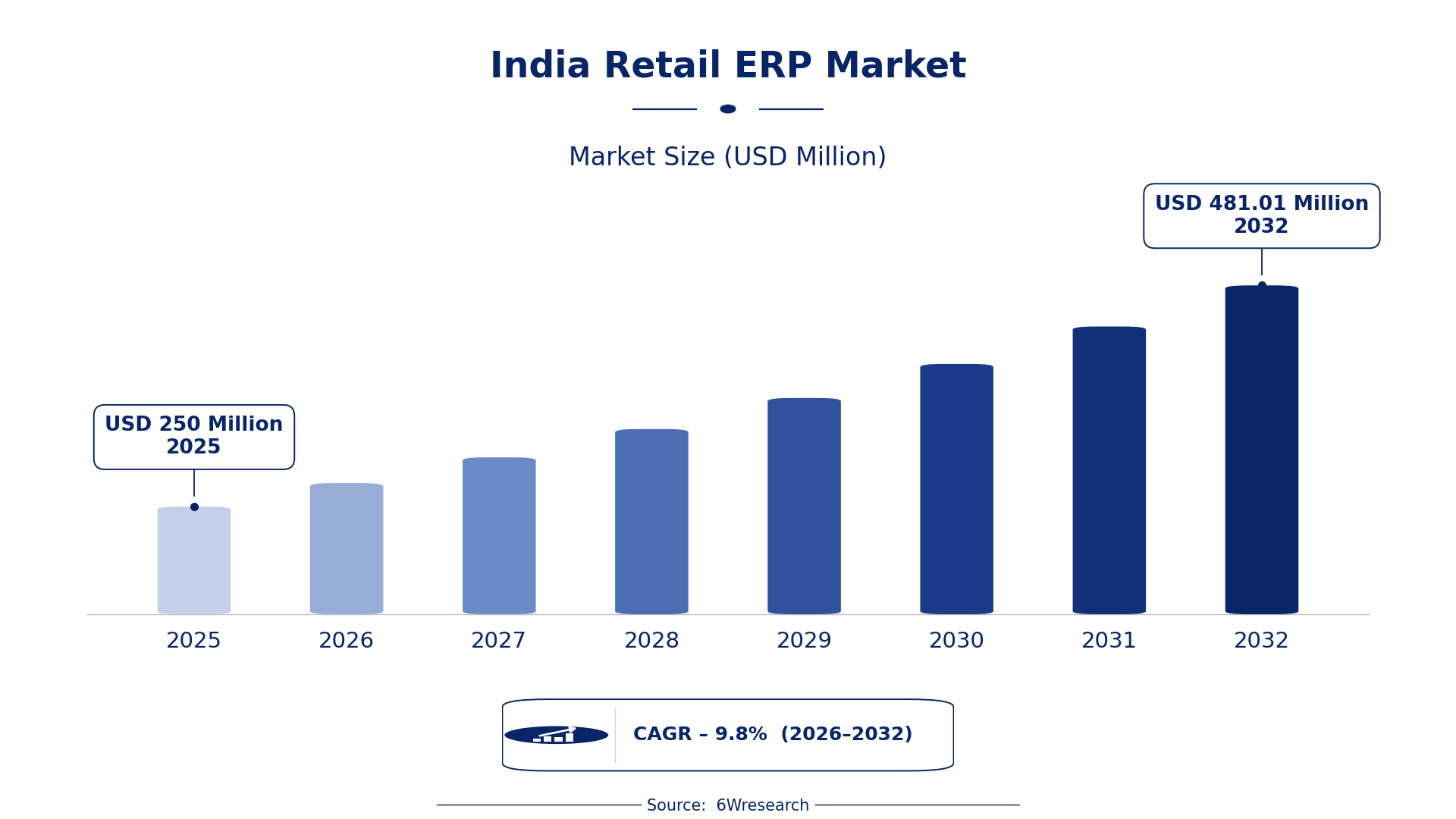
According to 6Wresearch internal database and industry insights, the India Retail ERP Market was valued at USD 250 million in 2025 and is projected to reach USD 481.01 million by 2032, growing at a CAGR of approximately 9.8% during 2026–2032.
India Retail ERP Market Highlights
| Report Metric | Details |
| Report Name | India Retail ERP Market |
| Market Size 2025 | USD 250 million |
| Market Size 2032 | USD 481.01 million |
| Absolute Growth 2025–2032 | USD 231.01 million |
| CAGR 2026–2032 | 9.8% |
| Peak Annual Growth | 12.1% in 2030 |
| Forecast Period | 2026–2032 |
| Historical Data | 2022–2025 |
| Base Year | 2025 |
| Leading Module, 2025 | Inventory Management (50% share) |
| Leading Platform Type, 2025 | SaaS/Cloud (46% share) |
| Leading Deployment Mode, 2025 | Cloud-Based (39% share) |
| Leading End User, 2025 | Retail Chains (39% share) |
| Fastest-Growing Module | CRM & Loyalty (10.9% CAGR) |
| Fastest-Growing Platform Type | Analytics Module (11.2% CAGR) |
| Fastest-Growing End User | Franchise Stores (11.1% CAGR) |
| Growing Sector | Franchise Stores |
| Key End Users | Retail Chains, Franchise Stores, Brand Retailers, Retail Headquarters |
India Retail ERP Market Year-wise Growth Rate and Key Drivers (2022–2032)
This graph illustrates the annual growth rates of the market from 2022 to 2032, highlighting a steady upward trajectory and projected market expansion over the forecast period.
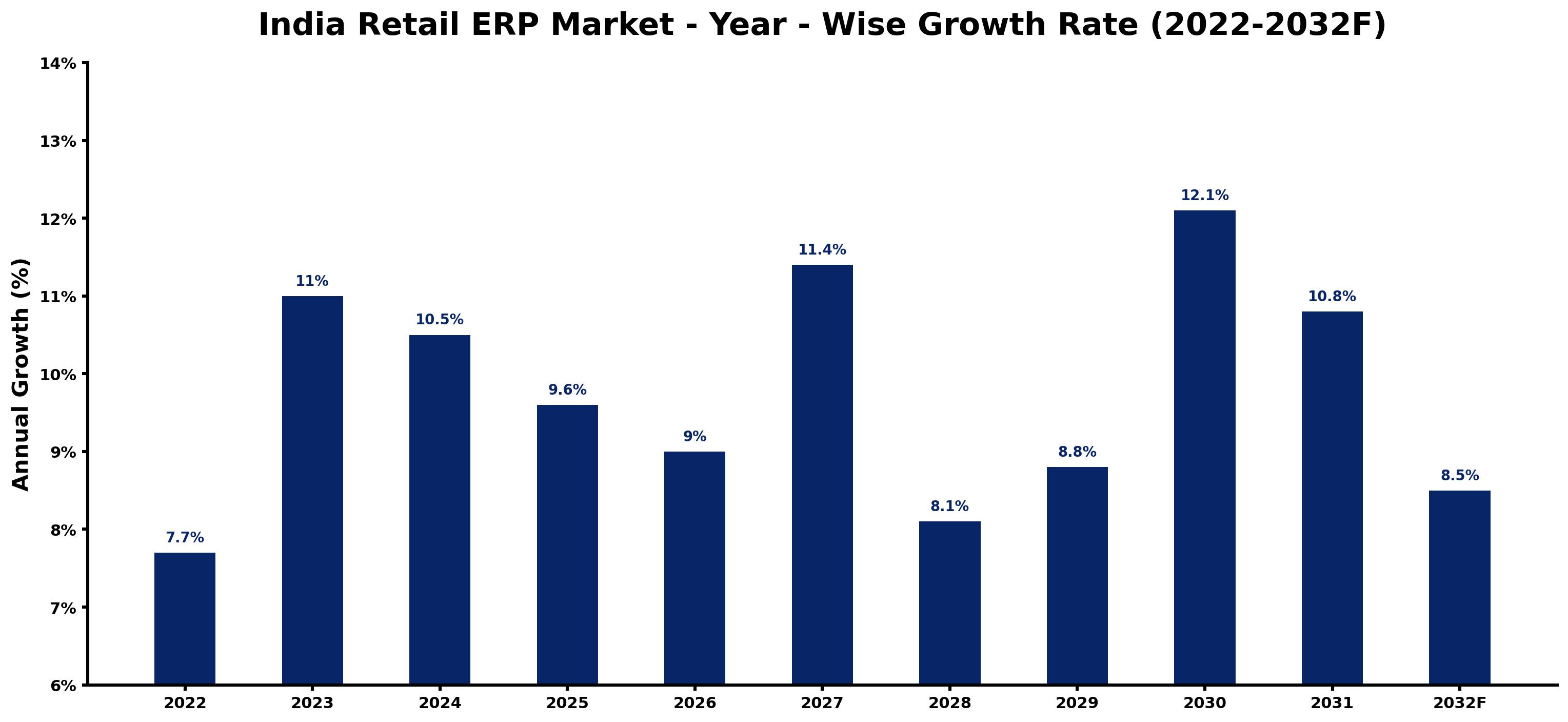
Annual growth estimates for each year appear below with the principal reason behind them, explaining the shifts that set the pace of the market.
| Year | Estimated Annual Growth (%) | Market Rationale |
| 2022 | 7.7 | The retail sector showed strong activity, with many retailers adopting digital solutions to enhance operations. |
| 2023 | 11.0 | The market experienced a surge in demand as retailers focused on integrating ERP systems for efficiency. |
| 2024 | 10.5 | Growth slowed as retailers evaluated their ERP investments and optimised existing solutions. |
| 2025 | 9.6 | Demand continued to grow, driven by the expansion of retail outlets across the country. |
| 2026 | 9.0 | The market faced a slowdown as retailers reassessed their technology strategies amidst evolving needs. |
| 2027 | 11.4 | Growth accelerated again as more retailers adopted cloud-based ERP solutions for better management. |
| 2028 | 8.1 | Market growth slowed as retailers concentrated on optimising their existing ERP systems and processes. |
| 2029 | 8.8 | A rise in demand occurred as retailers sought advanced analytics capabilities to enhance decision-making. |
| 2030 | 12.1 | The market peaked with strong demand for innovative ERP solutions tailored for retail operations. |
| 2031 | 10.8 | Growth slowed as the market matured and competition intensified among ERP providers. |
| 2032 | 8.5 | The market continues to grow, driven by ongoing digital transformation efforts and technology upgrades. |
Note: Market size estimations and growth projections presented in this report are based on 6Wresearch's proprietary forecasting methodology, utilizing the latest available industry data, government publications, and primary research inputs.
India Retail ERP Market Synopsis
The India Retail ERP Market encompasses technology solutions that integrate core business processes in retail, such as inventory management and customer relationship management. This market is experiencing growth due to the thriving retail sector, which is expected to exceed 12 million outlets by 2025. Demand is primarily driven by retail chains and franchise stores seeking operational efficiency through digital solutions. The 'Digital India' initiative supports this trend by promoting digital infrastructure in retail. Consequently, the Retail ERP market is set to expand in the coming years as retailers increasingly adopt these solutions.
Market Dynamics Impact Analysis (2026–2032)
| Factor | Type | Impact | Primary Segment Affected |
| Growing adoption of cloud-based solutions among retailers | Driver | High | Cloud-Based |
| Increased demand for real-time data analytics in retail | Driver | High | Analytics Module |
| Rising need for operational efficiency in retail chains | Opportunity | High | Retail Chains |
| Expansion of retail outlets across India | Opportunity | High | Franchise Stores |
| Challenges in integrating legacy systems with new ERP solutions | Restraint | Medium | Inventory Management |
| High costs associated with ERP implementation for small retailers | Restraint | Medium | Finance & Reporting |
| Retailers face difficulties in adapting to new technologies | Challenge | High | Retail Chains |
| Supply chain disruptions affecting ERP implementation timelines | Challenge | High | POS Integration |
Evaluation of Drivers in India Retail ERP Market (2026–2032)
The factors lifting demand, and the evidence behind each, are summarised below.
| Drivers | Primary Segment Affected | Why It Matters (Evidence) |
| Increased investment in digital retail solutions | Retail Chains | Over 60% of Indian retailers are adopting cloud-based ERP solutions to improve operational efficiency. |
| Growing emphasis on data-driven decision-making | Analytics Module | Retailers are investing in analytics modules to optimise their strategies and enhance performance. |
| Expansion of retail infrastructure in urban areas | Franchise Stores | The number of retail outlets in India is expected to exceed 12 million by 2025, driving ERP demand. |
| Focus on customer relationship management improvements | CRM & Loyalty | Retailers are prioritising CRM systems to strengthen customer loyalty and engagement initiatives. |
| Government initiatives supporting digital transformation | Cloud-Based | The 'Digital India' initiative promotes digital solutions in retail, encouraging widespread ERP adoption. |
The Retail ERP market in India is growing on the back of increasing demand from retail chains and franchise stores seeking operational efficiency. Retailers are adopting cloud-based ERP solutions, improving their ability to manage inventory and customer relationships. The number of retail outlets is projected to exceed 12 million by 2025, driving further investments in ERP systems. A growing emphasis on data-driven decision-making is pushing retailers to integrate advanced analytics modules into their operations.
Evaluation of Restraints in India Retail ERP Market
The table below lists the restraints and the evidence behind each.
| Market Restraint | Primary Segment Affected | Why It Matters (Evidence) |
| Integration challenges with existing legacy systems | Inventory Management | Many retailers struggle to integrate new ERP solutions with outdated systems, delaying implementation timelines. |
| High implementation costs for small retailers | Finance & Reporting | Small retailers find it difficult to afford the initial costs associated with ERP adoption, limiting their options. |
| Limited technical expertise among retail staff | POS Integration | Retailers often lack the necessary skills to effectively implement and manage ERP systems, hindering progress. |
| Supply chain disruptions impacting ERP deployment | CRM & Loyalty | Unforeseen disruptions can delay the rollout of new ERP systems, affecting customer engagement and satisfaction. |
| Regulatory compliance requirements complicating ERP use | Cloud-Based | Retailers must navigate complex regulations, which can hinder the adoption of cloud solutions and increase costs. |
India Retail ERP Market Challenges
In India, buyers and suppliers in the Retail ERP market face intense competition, as the number of retail outlets is projected to surpass 12 million by 2025, leading to price pressures that may affect margins for smaller retailers. Regulatory challenges can impede ERP adoption; for instance, compliance with ISO 9001 standards may add costs that delay implementation by up to six months for many businesses. Buyers encounter difficulties due to rapid technological advancements, with over 60% of retailers transitioning to cloud-based solutions, which can inflate budgets by 15% due to ongoing upgrade needs. Limited digital literacy among some retailers restricts effective ERP system utilisation, resulting in inefficiencies that negatively impact sales tracking and inventory management.
Trends in the India Retail ERP Market
The trends below show where the India Retail ERP Market is heading.
- Shift Towards Cloud-Based ERP Solutions: India is experiencing a shift towards cloud-based ERP solutions, driven by the need for flexibility and scalability. As of 2023, over 60% of retailers are adopting these solutions, which improve their operational capabilities.
- Increased Focus on Customer Relationship Management: Retail chains are placing greater emphasis on customer relationship management systems to enhance loyalty programs. This trend is evident as retailers invest in CRM solutions to better understand customer preferences and improve engagement.
- Growth of Mobile ERP Solutions: Mobile ERP solutions are gaining traction among retailers for on-the-go management. With a notable rise in mobile ERP adoption, retailers can now manage operations more efficiently from anywhere, boosting productivity.
- Rising Demand for Analytics Modules: The demand for advanced analytics modules is increasing as retailers seek to make data-driven decisions. This trend is backed by a CAGR of 11.2% for analytics modules in the coming years, highlighting the need for better insights.
Investment Opportunities in the India Retail ERP Market
Several openings in the India Retail ERP Market merit attention from investors.
- Retail Chains Seeking Operational Efficiency: With the retail market projected to exceed $1 trillion by 2025, there is an opportunity for ERP providers to offer tailored solutions that improve operational efficiency for retail chains.
- Franchise Stores Expanding Operations: As franchise stores grow, they require consistent ERP solutions to effectively manage multiple locations. Investing in cloud-based ERP systems can streamline their operations and enhance performance.
- Investment in Mobile ERP Solutions: The rising adoption of mobile ERP solutions presents an opportunity for suppliers to cater to retailers needing on-the-go management capabilities. Collaborating with local firms can facilitate market entry.
- Advanced Analytics for Retail Decision-Making: Retailers are increasingly focusing on data-driven strategies, creating a demand for advanced analytics modules. Suppliers can enter this market by providing tailored analytics solutions to meet specific needs.
Government Initiatives in the India Retail ERP Market
The 'Digital India' initiative by the Ministry of Electronics and Information Technology aims to improve digital infrastructure for retail businesses, launched in 2020. This initiative encourages the adoption of digital technologies, including ERP systems, to improve operational efficiency. The 'Startup India' program promotes innovation in retail technology, providing funding and support since 2021. This programme assists startups in developing and implementing ERP solutions tailored to the retail sector. Additionally, the Ministry of Commerce's 'Retail Policy', updated in 2022, seeks to streamline regulations for retail businesses, facilitating smoother ERP adoption.
The 'Skill India' mission focuses on training individuals in digital retail skills, initiated in 2020. This program enhances the workforce's ability to implement and manage ERP systems effectively. The Ministry of Commerce and Industry supports retail digitisation through various programs, including funding for technology upgrades. The 'Atmanirbhar Bharat' initiative promotes self-reliance in manufacturing, including retail technology, launched in 2020, encouraging local production of ERP solutions.
Future Insight of the India Retail ERP Market
The Retail ERP market in India is set to transform by 2032, driven by the government's 'Digital India' initiative, which promotes digital solutions across various sectors. The adoption of mobile ERP solutions will empower retailers to manage operations remotely, improving their responsiveness to market needs. The 'Make in India' program will stimulate local manufacturing of ERP systems, reducing reliance on imports and encouraging innovation.
Market Segmentation Analysis
Each segment group is reviewed below, with the leader by share and the fastest grower by CAGR.
By Module – Inventory Management Dominated, CRM & Loyalty Expected to Grow Fastest
According to Ravi Bhandari, Research Head at 6Wresearch, Inventory Management took a 50% share of module in 2025, more than any other category. Inventory Management commands the largest share in the India Retail ERP Market due to its critical function in tracking stock levels and optimising supply chains. The demand for effective inventory solutions is further propelled by the anticipated growth of retail outlets, projected to surpass 12 million by 2025. The quickest growth will come from CRM & Loyalty, forecast to expand at a CAGR of 10.9% between 2026 and 2032. The CRM & Loyalty module is experiencing rapid growth as retailers increasingly prioritise customer relationships and loyalty initiatives. This trend is evident as more retailers adopt customer-centric strategies aimed at boosting retention rates. Suppliers should focus on enhancing CRM solutions to align with the growing needs of retailers.
By Platform Type – SaaS/Cloud Dominated, Analytics Module Expected to Grow Fastest
SaaS/Cloud held a 46% share of the India Retail ERP Market by platform type in 2025. SaaS/Cloud solutions lead the India Retail ERP Market, offering flexibility and scalability that are essential for contemporary retail operations. This widespread adoption is in line with the government's 'Digital India' initiative, which promotes digital solutions in the retail sector. Over 2026–2032, Analytics Module is expected to post the fastest growth, at a CAGR of 11.2%. The Analytics Module is the fastest-growing segment, fuelled by the rising demand for data-driven decision-making in retail strategies. Retailers are increasingly leveraging analytics to gain operational insights, driving substantial growth in this module. Buyers should invest in analytics capabilities to strengthen their market position.
By Deployment Mode – Cloud-Based Dominated and Is Expected to Record the Fastest Growth
The largest deployment mode category in 2025 was Cloud-Based, with a 39% share of total revenue. Cloud-Based deployment dominates the market due to its growing preference for ease of use and low maintenance among retailers. This deployment mode enables businesses to streamline operations without the need for extensive IT infrastructure, appealing to a diverse range of retail companies. Its lead should widen, with a projected CAGR of 10.9% during 2026–2032, the highest in this split. As Cloud-Based solutions are also the fastest segment, their lead will continue to expand as more retailers recognise the advantages of cloud technology for operational efficiency. The integration and accessibility provided by cloud solutions are significant growth drivers. Suppliers must ensure their cloud offerings are robust and user-friendly to capture this expanding market.
By End User – Retail Chains Dominated, Franchise Stores Expected to Grow Fastest
Retail Chains accounted for a 39% market share by end user in 2025. Retail Chains hold the largest market share as they are the primary users of ERP systems, utilising these solutions to enhance operational efficiency across multiple locations. Their substantial presence in the retail sector drives the demand for comprehensive ERP functionalities. Franchise Stores are set to record the highest CAGR in this split, 11.1% over 2026–2032. Franchise Stores represent the fastest-growing end user segment, using ERP systems to ensure consistency across their various locations. This growth highlights the increasing need for standardised operations within franchise models. Suppliers should customise their ERP solutions to address the specific requirements of franchise operations.
Key Attractiveness of the Report
- 10 Years of Market Numbers
- Historical Data Starting from 2022 to 2025
- Base Year 2025
- Forecast Data until 2032
- Key Performance Indicators Impacting the Market
- Major Upcoming Developments and Projects
Key Highlights of the Report:
- India Retail ERP Market Outlook
- Market Size of India Retail ERP Market, 2025
- Forecast of India Retail ERP Market, 2032
- Historical Data and Forecast of India Retail ERP Revenues & Volume for the Period 2022 - 2032F
- India Retail ERP Market Trend Evolution
- India Retail ERP Market Drivers and Challenges
- India Retail ERP Price Trends
- India Retail ERP Porter's Five Forces
- India Retail ERP Industry Life Cycle
- Historical Data and Forecast of India Retail ERP Market Revenues & Volume By Module for the Period 2022 - 2032F
- Historical Data and Forecast of India Retail ERP Market Revenues & Volume By Inventory Management for the Period 2022 - 2032F
- Historical Data and Forecast of India Retail ERP Market Revenues & Volume By POS Integration for the Period 2022 - 2032F
- Historical Data and Forecast of India Retail ERP Market Revenues & Volume By CRM & Loyalty for the Period 2022 - 2032F
- Historical Data and Forecast of India Retail ERP Market Revenues & Volume By Finance & Reporting for the Period 2022 - 2032F
- Historical Data and Forecast of India Retail ERP Market Revenues & Volume By Platform Type for the Period 2022 - 2032F
- Historical Data and Forecast of India Retail ERP Market Revenues & Volume By SaaS/Cloud for the Period 2022 - 2032F
- Historical Data and Forecast of India Retail ERP Market Revenues & Volume By Mobile/Desktop for the Period 2022 - 2032F
- Historical Data and Forecast of India Retail ERP Market Revenues & Volume By Customer Data Mgmt for the Period 2022 - 2032F
- Historical Data and Forecast of India Retail ERP Market Revenues & Volume By Analytics Module for the Period 2022 - 2032F
- Historical Data and Forecast of India Retail ERP Market Revenues & Volume By Deployment Mode for the Period 2022 - 2032F
- Historical Data and Forecast of India Retail ERP Market Revenues & Volume By Modular/Suite for the Period 2022 - 2032F
- Historical Data and Forecast of India Retail ERP Market Revenues & Volume By On-Premise or Cloud for the Period 2022 - 2032F
- Historical Data and Forecast of India Retail ERP Market Revenues & Volume By Cloud-Based for the Period 2022 - 2032F
- Historical Data and Forecast of India Retail ERP Market Revenues & Volume By Hybrid for the Period 2022 - 2032F
- Historical Data and Forecast of India Retail ERP Market Revenues & Volume By End User for the Period 2022 - 2032F
- Historical Data and Forecast of India Retail ERP Market Revenues & Volume By Retail Chains for the Period 2022 - 2032F
- Historical Data and Forecast of India Retail ERP Market Revenues & Volume By Franchise Stores for the Period 2022 - 2032F
- Historical Data and Forecast of India Retail ERP Market Revenues & Volume By Brand Retailers for the Period 2022 - 2032F
- Historical Data and Forecast of India Retail ERP Market Revenues & Volume By Retail Headquarters for the Period 2022 - 2032F
- India Retail ERP Import Export Trade Statistics
- Market Opportunity Assessment By Module
- Market Opportunity Assessment By Platform Type
- Market Opportunity Assessment By Deployment Mode
- Market Opportunity Assessment By End User
- India Retail ERP Top Companies Market Share
- India Retail ERP Competitive Benchmarking By Technical and Operational Parameters
- India Retail ERP Company Profiles
- India Retail ERP Key Strategic Recommendations
Market Covered
This report examines the market across the segments below.
By Module
- Inventory Management
- POS Integration
- CRM & Loyalty
- Finance & Reporting
By Platform Type
- SaaS/Cloud
- Mobile/Desktop
- Customer Data Mgmt
- Analytics Module
By Deployment Mode
- Modular/Suite
- On-Premise or Cloud
- Cloud-Based
- Hybrid
By End User
- Retail Chains
- Franchise Stores
- Brand Retailers
- Retail Headquarters































