China Retail ERP Market Size & Growth Rate
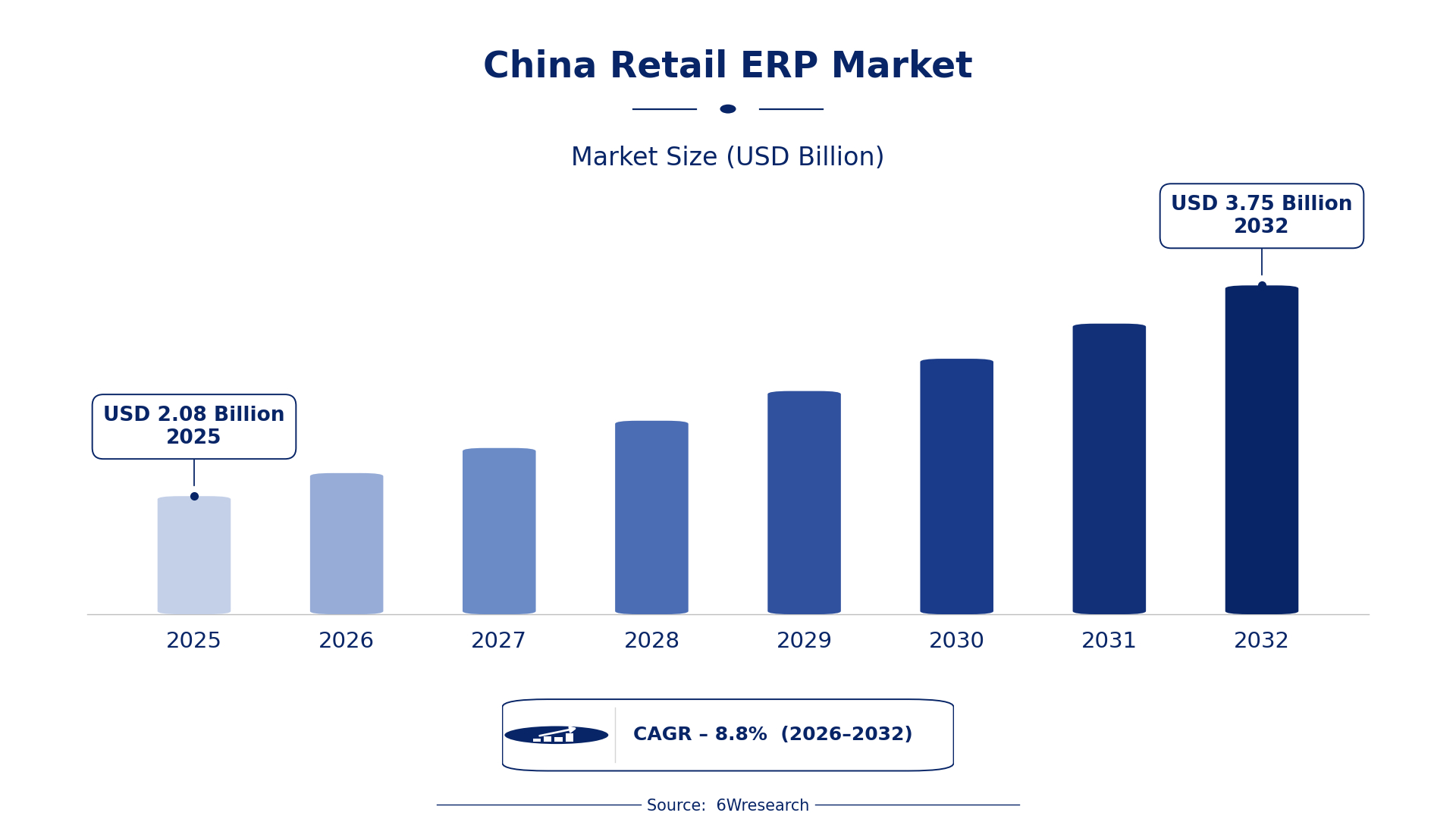
According to 6Wresearch internal database and industry insights, the China Retail ERP Market was valued at USD 2.08 billion in 2025 and is projected to reach USD 3.75 billion by 2032, growing at a CAGR of approximately 8.8% during 2026–2032.
China Retail ERP Market Highlights
| Report Metric | Details |
| Report Name | China Retail ERP Market |
| Market Size 2025 | USD 2.08 billion |
| Market Size 2032 | USD 3.75 billion |
| Absolute Growth 2025–2032 | USD 1.67 billion |
| CAGR 2026–2032 | 8.8% |
| Peak Annual Growth | 11.0% in 2027 |
| Forecast Period | 2026–2032 |
| Historical Data | 2022–2025 |
| Base Year | 2025 |
| Leading Module, 2025 | Inventory Management (41% share) |
| Leading Platform Type, 2025 | SaaS/Cloud (43% share) |
| Leading Deployment Mode, 2025 | Cloud-Based (40% share) |
| Leading End User, 2025 | Retail Chains (44% share) |
| Fastest-Growing Module | CRM & Loyalty (11.3% CAGR) |
| Fastest-Growing Platform Type | Analytics Module (10.5% CAGR) |
| Fastest-Growing End User | Franchise Stores (11.6% CAGR) |
| Growing Sector | Retail Chains |
| Key End Users | Retail Chains, Franchise Stores, Brand Retailers, Retail Headquarters |
China Retail ERP Market Year-wise Growth Rate and Key Drivers (2022–2032)
This graph illustrates the annual growth rates of the market from 2022 to 2032, highlighting a steady upward trajectory and projected market expansion over the forecast period.
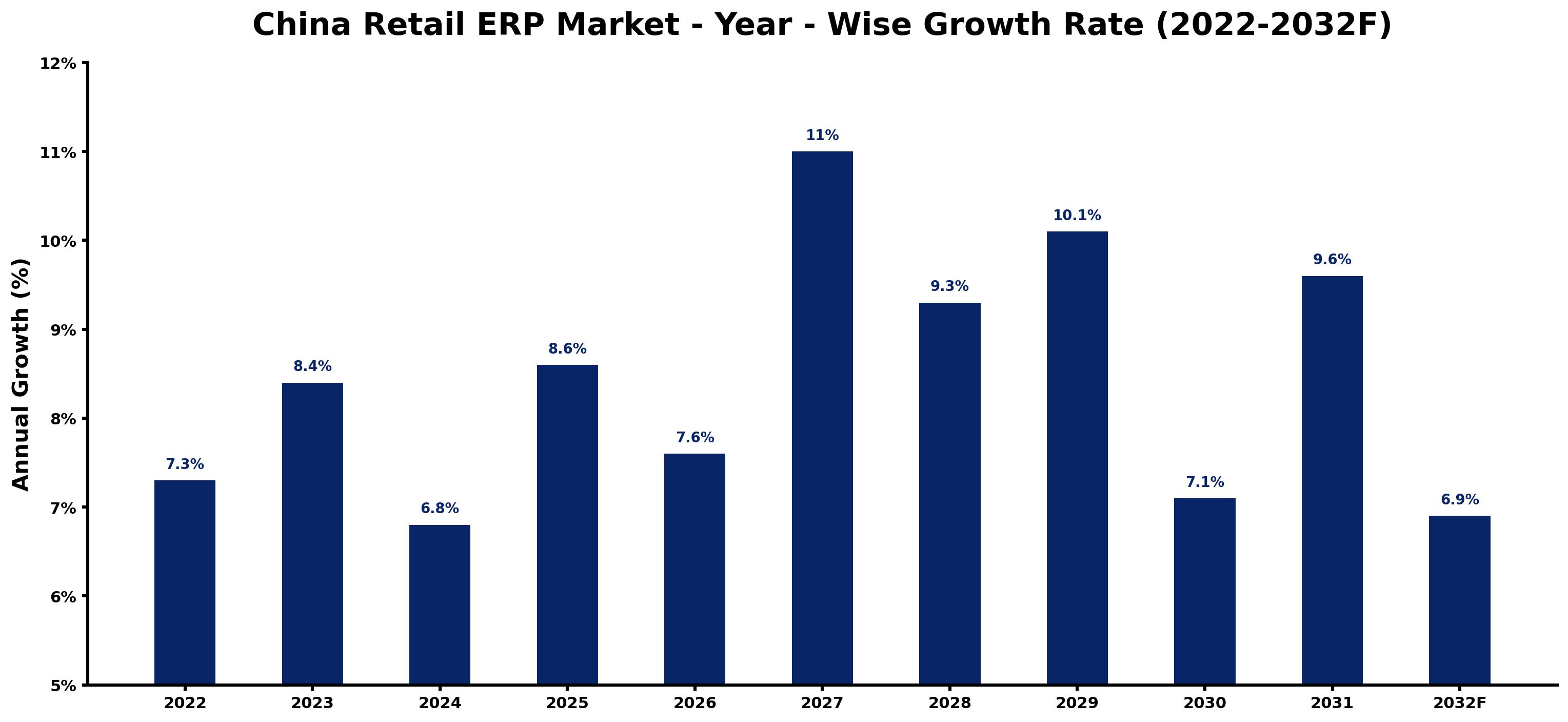
Each row of the following table gives one year's estimated growth and the event or demand shift that explains it.
| Year | Estimated Annual Growth (%) | Market Rationale |
| 2022 | 7.3 | The retail sector was valued at approximately 5.6 trillion USD, indicating strong market activity. |
| 2023 | 8.4 | A 10% increase in retail sales highlighted growing consumer spending and demand for ERP solutions. |
| 2024 | 6.8 | The market experienced slower growth as retailers adjusted to evolving technology needs. |
| 2025 | 8.6 | Retail chains accelerated ERP investments, driven by the need for improved inventory management. |
| 2026 | 7.6 | Cloud ERP adoption is expected to reach 70% by 2025, as businesses optimise operations. |
| 2027 | 11.0 | The market peaked due to heightened demand for integrated retail solutions and analytics modules. |
| 2028 | 9.3 | Growth decelerated as the 'Retail Digital Transformation Initiative' began to show effects in urban areas. |
| 2029 | 10.1 | Retail chains increased ERP spending, focusing on CRM systems for customer engagement. |
| 2030 | 7.1 | A slowdown occurred as market players consolidated their technology investments in response to evolving needs. |
| 2031 | 9.6 | Retailers invested more in analytics modules, which improved decision-making capabilities across the sector. |
| 2032 | 6.9 | The market continues to grow, supported by ongoing digital transformation initiatives and the Smart Retail Promotion Program. |
Note: Market size estimations and growth projections presented in this report are based on 6Wresearch's proprietary forecasting methodology, utilizing the latest available industry data, government publications, and primary research inputs.
China Retail ERP Market Synopsis
Retail ERP in China encompasses software solutions that manage retail operations, including inventory, sales, and customer relationships. These systems are typically cloud-based, integrating various business functions into a single platform. The China Retail ERP Market is expanding due to rising demand from urban retail chains and substantial investments in technology. The retail sector, valued at around 5.6 trillion USD in 2022, is a major driver of this growth, with a projected cloud ERP adoption rate of 70% by 2025. Urban areas with high retail activity are particularly influential in shaping this market.
Market Dynamics Impact Analysis (2026–2032)
| Factor | Type | Impact | Primary Segment Affected |
| Growing urban population and retail activity drive demand for efficient ERP systems. | Driver | High | Retail Chains |
| Increased investment in CRM systems enhances customer engagement and retention. | Driver | High | CRM & Loyalty |
| Rising adoption of cloud-based solutions presents opportunities for new entrants. | Opportunity | High | SaaS/Cloud |
| Investment in analytics modules is essential for data-driven decision-making. | Opportunity | Medium | Analytics Module |
| High initial costs of ERP implementation can deter small retailers from adoption. | Restraint | High | Retail Chains |
| Limited awareness of ERP benefits among small and medium-sized enterprises hinders growth. | Restraint | Medium | Franchise Stores |
| Integration challenges with existing systems can complicate ERP deployment. | Challenge | High | Retail Headquarters |
| Rapid technological changes require continuous updates, straining resources for retailers. | Challenge | Medium | Brand Retailers |
Evaluation of Drivers in China Retail ERP Market (2026–2032)
Below mentioned are some major drivers and their influence on market dynamics.
| Drivers | Primary Segment Affected | Why It Matters (Evidence) |
| Increasing urban population drives retail activity and demand for ERP solutions. | Retail Chains | China's urban population reached 1.4 billion in 2023, driving retail demand. |
| Retail chains are investing heavily in CRM systems to improve customer engagement. | CRM & Loyalty | Retail chains are increasingly investing in CRM systems for customer engagement. |
| Cloud ERP adoption is growing as retailers seek flexibility and scalability. | SaaS/Cloud | Cloud ERP adoption in China is projected to reach 70% by 2025. |
| Investment in analytics modules supports data-driven decision-making in retail. | Analytics Module | Over 60% of retailers reported using analytics modules for decision-making. |
| Retail technology spending is rising, leading to greater ERP investments. | Finance & Reporting | The average annual spending on retail technology per store is around 50,000 USD. |
Growth across the Retail ERP market in China is anchored in rising urban population, increased investment in CRM systems, and growing adoption of cloud-based solutions. In 2023, China's urban population reached 1.4 billion, which drives retail activity and demand for ERP solutions. Retail chains are investing heavily in CRM systems for customer engagement, reflecting a strategic focus on retention. The average annual spending on retail technology per store is around 50,000 USD, which encourages further ERP investments. Investment in analytics modules supports data-driven decision-making, with over 60% of retailers utilising these tools to enhance operational efficiency.
Evaluation of Restraints in China Retail ERP Market
Below mentioned are some major restraints and their influence on market dynamics.
| Market Restraint | Primary Segment Affected | Why It Matters (Evidence) |
| High initial costs of ERP implementation can deter small retailers from adoption. | Retail Chains | The average annual spending on retail technology per store is around 50,000 USD. |
| Limited awareness of ERP benefits among small and medium-sized enterprises hinders growth. | Franchise Stores | Many SMEs are still unfamiliar with the advantages of ERP systems. |
| Integration challenges with existing systems can complicate ERP deployment. | Retail Headquarters | Retailers often face difficulties in integrating new ERP systems with legacy infrastructure. |
| Rapid technological changes require continuous updates, straining resources for retailers. | Brand Retailers | Retailers must allocate resources for ongoing software updates and training. |
| The competitive environment in retail technology can limit market entry for new providers. | SaaS/Cloud | Established providers dominate the market, making it challenging for newcomers. |
China Retail ERP Market Challenges
The China Retail ERP market faces a few practical problems, and the first is cost. Many producers incur high software development expenses, which can reach 50,000 USD annually per store, limiting their ability to invest in robust ERP solutions. A skills gap persists, as the retail workforce of approximately 40 million often lacks the necessary expertise in ERP systems, delaying implementation and reducing efficiency for retailers. Regulatory hurdles arise from the updated National Standard for Retail ERP Systems in 2021, which requires additional resources for compliance, straining smaller retailers. Supply chain disruptions further complicate the timely delivery of ERP solutions, impacting buyers who rely on these systems for effective operations.
Trends in the China Retail ERP Market
Several trends are reshaping the China Retail ERP Market; the most important are set out below.
- Shift Towards Cloud-Based Solutions: Retail chains in China are increasingly adopting cloud-based ERP solutions to improve operational efficiency. In 2023, cloud ERP adoption is projected to reach 70%, allowing for greater flexibility and scalability.
- Growing Use of Analytics Modules: Retailers are prioritising analytics modules to drive data-driven decision-making. In 2023, over 60% of retailers reported using these modules, reflecting a shift towards informed strategies.
- Increased Investment in CRM Systems: Retail chains are investing more in CRM systems to improve customer engagement. In 2023, significant investments were noted, showcasing a trend towards better customer relationships.
- Focus on Digital Transformation Initiatives: The 'Retail Digital Transformation Initiative' launched in 2021 is driving technology integration in the retail sector. With a budget of 500 million CNY, it supports the adoption of modern ERP solutions.
Investment Opportunities in the China Retail ERP Market
Several openings in the China Retail ERP Market merit attention from investors.
- Partnerships for Cloud ERP Solutions: Retailers can enter the cloud ERP market through partnerships with established providers. The projected cloud ERP adoption rate of 70% by 2025 indicates a strong opportunity for collaboration.
- Supply of Analytics Modules: There is a growing demand for analytics modules among retailers seeking to improve decision-making. Retail chains are increasingly looking for suppliers of advanced analytics solutions.
- Investment in CRM Technologies: The rise in CRM system investments presents opportunities for technology providers. Retail chains are actively seeking innovative CRM solutions to improve customer engagement.
- Expansion in Urban Areas: The rapid growth of urban areas in China creates demand for efficient ERP solutions. Retail chains in cities like Shanghai are prime targets for new ERP implementations.
Government Initiatives in the China Retail ERP Market
The Ministry of Commerce's 'Retail Digital Transformation Initiative' launched in 2021 with a budget of 500 million CNY aims to support technology integration in retail. This initiative promotes the adoption of modern ERP systems, improving the operational capabilities of retailers. The '14th Five-Year Plan for Digital Economy Development' approved in 2022 focuses on improving digital infrastructure for the retail sector, facilitating better access to ERP solutions. Additionally, the updated 'Guidelines for the Development of the Software Industry' in 2022 emphasise ERP software standards, ensuring compliance and quality in the market.
Retail chains benefit from the 'Smart Retail Promotion Program' introduced by the National Development and Reform Commission in 2023, which encourages ERP adoption among small retailers. This program provides funding and resources to support the integration of ERP systems, enabling retailers to improve their operational efficiency. The 'Retail Innovation Fund' established by the Ministry of Commerce in 2020 also offers financial support for technology upgrades, helping retailers invest in modern ERP solutions. These initiatives aim to create a more technologically advanced retail environment in China.
Future Insight of the China Retail ERP Market
The Retail ERP market in China will experience transformative changes by 2032, primarily driven by a surge in cloud ERP adoption, projected to reach 80% by 2025. This shift will enable retailers to streamline operations and enhance customer engagement through integrated platforms. As the Shanghai region continues to spearhead retail technology innovation, suppliers will benefit from expanded product offerings. The increasing emphasis on data analytics will empower buyers to make data-driven decisions, leading to more efficient retail operations.
Market Segmentation Analysis
Each segment group is reviewed below, with the leader by share and the fastest grower by CAGR.
By Module – Inventory Management Dominated, CRM & Loyalty Expected to Grow Fastest
According to Ravi Bhandari, Research Head at 6Wresearch, with a 41% revenue share in 2025, Inventory Management was the largest module category. Inventory Management holds the largest share in the China Retail ERP market as it is crucial for tracking stock levels and optimising supply chain efficiency. With over 300,000 retail chains, effective inventory management is vital for maintaining competitive operations across the sector. Over 2026–2032, CRM & Loyalty is expected to post the fastest growth, at a CAGR of 11.3%. The CRM & Loyalty module is witnessing rapid growth due to its ability to enhance customer engagement and retention through effective data management. As over 60% of retailers utilise analytics for decision-making, the importance of this module continues to rise. Suppliers should prioritise the development of robust CRM solutions to cater to the increasing demand from retailers.
By Platform Type – SaaS/Cloud Dominated, Analytics Module Expected to Grow Fastest
SaaS/Cloud took a 43% share of platform type in 2025, more than any other category. SaaS/Cloud solutions dominate the market share as they provide flexibility and scalability, essential for retailers adapting to changing demands. The projected 70% adoption of cloud ERP by 2025 highlights a strong preference for this platform type among businesses. The quickest growth will come from Analytics Module, forecast to expand at a CAGR of 10.5% between 2026 and 2032. The Analytics Module is the fastest-growing segment as it supports data-driven decision-making, crucial for retailers aiming to stay competitive. The heightened focus on analytics by over 60% of retailers is driving this growth. Buyers should emphasise analytics capabilities in their ERP solutions to effectively leverage data for strategic advantages.
By Deployment Mode – Cloud-Based Dominated and Is Expected to Record the Fastest Growth
In 2025, Cloud-Based led the deployment mode split with a 40% share. Cloud-Based deployment leads the market share because it enables remote access and collaboration, which are essential for modern retail operations. This trend aligns with the increasing urban population and retail activity in China, reinforcing the demand for cloud solutions. Its lead should widen, with a projected CAGR of 10.0% during 2026–2032, the highest in this split. Cloud-Based deployment is also the fastest-growing mode, as its benefits of accessibility and collaboration are becoming more recognised by retailers. This trend is expected to widen the lead of cloud solutions in the market. Suppliers must ensure their offerings are cloud-compatible to meet the demands of a rapidly evolving retail landscape.
By End User – Retail Chains Dominated, Franchise Stores Expected to Grow Fastest
Retail Chains accounted for a 44% market share by end user in 2025. Retail Chains account for the largest market share as they are the primary users of ERP systems, which are crucial for streamlining operations across multiple locations. Their significant presence in the retail sector drives the demand for comprehensive ERP solutions. Franchise Stores are set to record the highest CAGR in this split, 11.6% over 2026–2032. Franchise Stores represent the fastest-growing segment as they utilise ERP systems to maintain consistency across various locations, which is vital for brand integrity. This growth reflects the increasing number of franchise operations in urban areas. Suppliers should customise their ERP solutions to meet the specific needs of franchise operations to capture this expanding market.
Key Attractiveness of the Report
- 10 Years of Market Numbers
- Historical Data Starting from 2022 to 2025
- Base Year 2025
- Forecast Data until 2032
- Key Performance Indicators Impacting the Market
- Major Upcoming Developments and Projects
Key Highlights of the Report:
- China Retail ERP Market Outlook
- Market Size of China Retail ERP Market, 2025
- Forecast of China Retail ERP Market, 2032
- Historical Data and Forecast of China Retail ERP Revenues & Volume for the Period 2022 - 2032F
- China Retail ERP Market Trend Evolution
- China Retail ERP Market Drivers and Challenges
- China Retail ERP Price Trends
- China Retail ERP Porter's Five Forces
- China Retail ERP Industry Life Cycle
- Historical Data and Forecast of China Retail ERP Market Revenues & Volume By Module for the Period 2022 - 2032F
- Historical Data and Forecast of China Retail ERP Market Revenues & Volume By Inventory Management for the Period 2022 - 2032F
- Historical Data and Forecast of China Retail ERP Market Revenues & Volume By POS Integration for the Period 2022 - 2032F
- Historical Data and Forecast of China Retail ERP Market Revenues & Volume By CRM & Loyalty for the Period 2022 - 2032F
- Historical Data and Forecast of China Retail ERP Market Revenues & Volume By Finance & Reporting for the Period 2022 - 2032F
- Historical Data and Forecast of China Retail ERP Market Revenues & Volume By Platform Type for the Period 2022 - 2032F
- Historical Data and Forecast of China Retail ERP Market Revenues & Volume By SaaS/Cloud for the Period 2022 - 2032F
- Historical Data and Forecast of China Retail ERP Market Revenues & Volume By Mobile/Desktop for the Period 2022 - 2032F
- Historical Data and Forecast of China Retail ERP Market Revenues & Volume By Customer Data Mgmt for the Period 2022 - 2032F
- Historical Data and Forecast of China Retail ERP Market Revenues & Volume By Analytics Module for the Period 2022 - 2032F
- Historical Data and Forecast of China Retail ERP Market Revenues & Volume By Deployment Mode for the Period 2022 - 2032F
- Historical Data and Forecast of China Retail ERP Market Revenues & Volume By Modular/Suite for the Period 2022 - 2032F
- Historical Data and Forecast of China Retail ERP Market Revenues & Volume By On-Premise or Cloud for the Period 2022 - 2032F
- Historical Data and Forecast of China Retail ERP Market Revenues & Volume By Cloud-Based for the Period 2022 - 2032F
- Historical Data and Forecast of China Retail ERP Market Revenues & Volume By Hybrid for the Period 2022 - 2032F
- Historical Data and Forecast of China Retail ERP Market Revenues & Volume By End User for the Period 2022 - 2032F
- Historical Data and Forecast of China Retail ERP Market Revenues & Volume By Retail Chains for the Period 2022 - 2032F
- Historical Data and Forecast of China Retail ERP Market Revenues & Volume By Franchise Stores for the Period 2022 - 2032F
- Historical Data and Forecast of China Retail ERP Market Revenues & Volume By Brand Retailers for the Period 2022 - 2032F
- Historical Data and Forecast of China Retail ERP Market Revenues & Volume By Retail Headquarters for the Period 2022 - 2032F
- China Retail ERP Import Export Trade Statistics
- Market Opportunity Assessment By Module
- Market Opportunity Assessment By Platform Type
- Market Opportunity Assessment By Deployment Mode
- Market Opportunity Assessment By End User
- China Retail ERP Top Companies Market Share
- China Retail ERP Competitive Benchmarking By Technical and Operational Parameters
- China Retail ERP Company Profiles
- China Retail ERP Key Strategic Recommendations
Market Covered
Segments analysed in this report are listed below.
By Module
- Inventory Management
- POS Integration
- CRM & Loyalty
- Finance & Reporting
By Platform Type
- SaaS/Cloud
- Mobile/Desktop
- Customer Data Mgmt
- Analytics Module
By Deployment Mode
- Modular/Suite
- On-Premise or Cloud
- Cloud-Based
- Hybrid
By End User
- Retail Chains
- Franchise Stores
- Brand Retailers
- Retail Headquarters































