India Retail Supply Chain Market Size & Growth Rate
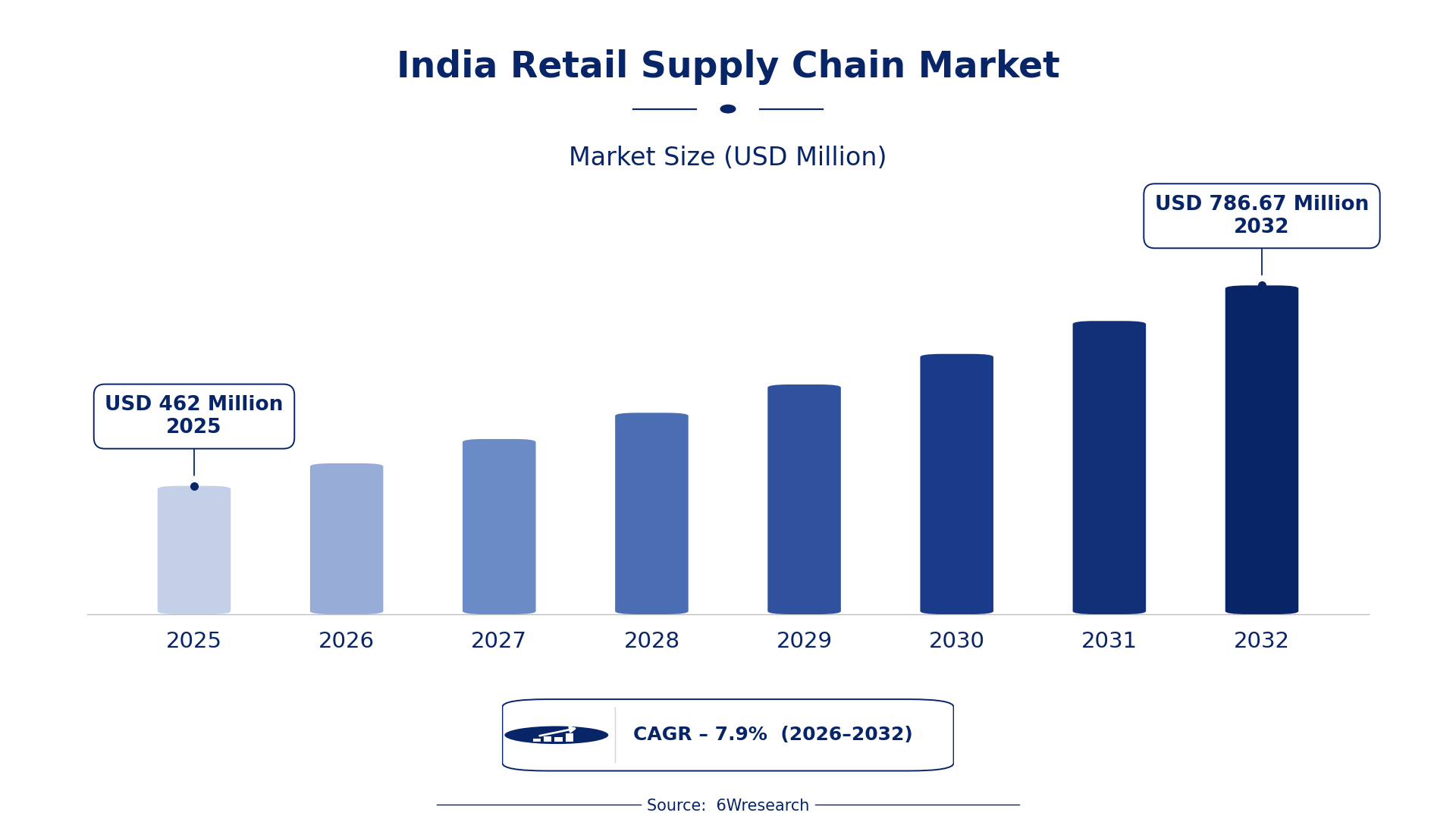
According to 6Wresearch internal database and industry insights, the India Retail Supply Chain Market was valued at USD 462.0 million in 2025 and is projected to reach USD 786.67 million by 2032, growing at a CAGR of approximately 7.9% during 2026–2032.
India Retail Supply Chain Market Highlights
| Report Metric | Details |
| Report Name | India Retail Supply Chain Market |
| Market Size 2025 | USD 462.0 million |
| Market Size 2032 | USD 786.67 million |
| Absolute Growth 2025–2032 | USD 324.67 million |
| CAGR 2026–2032 | 7.9% |
| Peak Annual Growth | 10.1% in 2031 |
| Forecast Period | 2026–2032 |
| Historical Data | 2022–2025 |
| Base Year | 2025 |
| Leading Supply Chain Component, 2025 | Last-Mile Delivery (44% share) |
| Leading Technology Platform, 2025 | WMS Software (38% share) |
| Leading Integration Format, 2025 | Cloud-Hosted (38% share) |
| Leading End User, 2025 | E-commerce Retailers (46% share) |
| Fastest-Growing Supply Chain Component | Demand Forecasting (10.3% CAGR) |
| Fastest-Growing Technology Platform | AI/ML Analytics (9.7% CAGR) |
| Fastest-Growing End User | Retail Distribution Centers (9.3% CAGR) |
| Growing Sector | E-commerce |
| Key End Users | E-commerce Retailers, Logistics Providers, Retail Distribution Centers |
India Retail Supply Chain Market Year-wise Growth Rate and Key Drivers (2022–2032)
This graph illustrates the annual growth rates of the market from 2022 to 2032, highlighting a steady upward trajectory and projected market expansion over the forecast period.
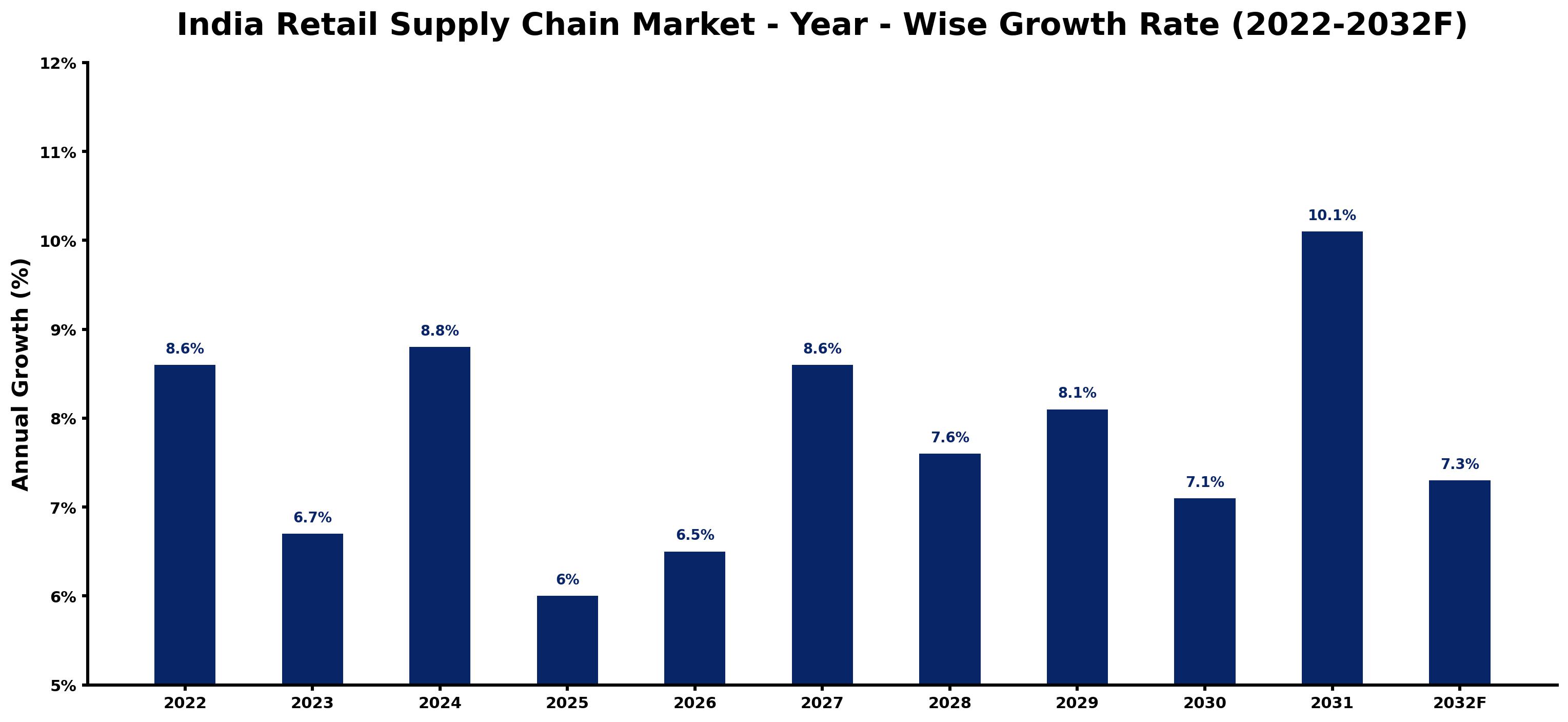
The following table presents the estimated annual growth rate for each year together with the principal factor influencing market performance.
| Year | Estimated Annual Growth (%) | Market Rationale |
| 2022 | 8.6 | The market experienced steady growth due to ongoing investments in logistics infrastructure. |
| 2023 | 6.7 | Growth slowed as the market adjusted to changes in consumer behaviour and spending patterns. |
| 2024 | 8.8 | The market rebounded with increased demand from e-commerce retailers and improved logistics capabilities. |
| 2025 | 6.0 | Growth slowed again as companies focused on optimising existing supply chain processes. |
| 2026 | 6.5 | The market is expected to grow as technology adoption continues to rise among retailers. |
| 2027 | 8.6 | Demand increases with the expansion of e-commerce platforms and improved delivery services. |
| 2028 | 7.6 | Growth slows as the market stabilises following rapid technological advancements. |
| 2029 | 8.1 | The market sees renewed growth driven by rising consumer expectations for faster deliveries. |
| 2030 | 7.1 | Growth slows due to market saturation and a focus on efficiency over expansion. |
| 2031 | 10.1 | The market peaks with significant investments in AI technologies for supply chain management. |
| 2032 | 7.3 | Growth slows as the market matures, but demand remains strong from e-commerce retailers. |
Note: Market size estimations and growth projections presented in this report are based on 6Wresearch's proprietary forecasting methodology, utilizing the latest available industry data, government publications, and primary research inputs.
India Retail Supply Chain Market Synopsis
The Retail Supply Chain market in India encompasses warehousing, logistics, and inventory management. It optimises inventory levels, improves delivery speed, and strengthens supplier relationships. The India Retail Supply Chain Market is growing due to advancements in technology and the booming e-commerce sector, projected to reach $200 billion by 2026. Over 60% of solutions are cloud-based, driving efficiency and scalability in operations. This growth is largely supported by the Digital India initiative, which promotes technology adoption across various sectors.
Market Dynamics Impact Analysis (2026–2032)
| Factor | Type | Impact | Primary Segment Affected |
| Advancements in technology and data analytics improve operational efficiency. | Driver | High | WMS Software |
| The rapid growth of e-commerce increases demand for efficient supply chain solutions. | Driver | High | Last-Mile Delivery |
| The logistics sector's growth to $215 billion by 2025 creates new investment opportunities. | Opportunity | High | Retail Distribution Centers |
| The increasing adoption of AI technologies among retailers opens avenues for innovation. | Opportunity | High | AI/ML Analytics |
| High logistics costs can hinder profitability for retailers. | Restraint | High | Last-Mile Delivery |
| Limited infrastructure in certain regions affects supply chain efficiency. | Restraint | Medium | Warehouse Mgmt Systems |
| Talent shortages in logistics can delay operational improvements. | Challenge | High | Last-Mile Delivery |
| Regulatory compliance can increase operational costs for retailers. | Challenge | Medium | Last-Mile Delivery |
Evaluation of Drivers in India Retail Supply Chain Market (2026–2032)
Key forces behind demand, with the segment each one moves most, are listed below.
| Drivers | Primary Segment Affected | Why It Matters (Evidence) |
| Increased investments in logistics infrastructure drive supply chain capabilities. | Last-Mile Delivery | India's logistics sector is expected to grow to $215 billion by 2025, driving demand for efficient delivery solutions. |
| Growing e-commerce sector boosts demand for supply chain solutions. | WMS Software | The e-commerce sector in India is projected to grow to $200 billion by 2026, increasing the need for effective inventory management. |
| Cloud-based solutions offer scalability and accessibility to retailers. | Cloud-Hosted | Over 60% of retail supply chain solutions are cloud-based, allowing for more efficient operations. |
| AI technologies improve decision-making in supply chain management. | AI/ML Analytics | Over 70% of retailers in India are adopting AI technologies, improving their operational efficiency. |
| Demand forecasting tools help retailers optimise inventory levels. | Demand Forecasting | Accurate demand forecasting is vital for predicting inventory needs and trends, driving investment in such technologies. |
Growth in the Retail Supply Chain market in India comes from increased investments in logistics infrastructure, expanding e-commerce demand, and the adoption of advanced technologies. The logistics sector will grow to $215 billion by 2025, prompting retailers to upgrade their supply chain capabilities. As the e-commerce sector grows to $200 billion by 2026, the need for efficient inventory management solutions rises. More than 70% of retailers are implementing AI technologies, which improve operational processes. Demand forecasting tools are increasingly sought after, as they are essential for predicting inventory needs and trends, driving further investments.
Evaluation of Restraints in India Retail Supply Chain Market
The table below lists the restraints and the evidence behind each.
| Market Restraint | Primary Segment Affected | Why It Matters (Evidence) |
| High logistics costs can impact profitability for retailers. | Last-Mile Delivery | Logistics costs in India are currently high, affecting the pricing strategies of retailers. |
| Limited infrastructure in certain regions affects supply chain efficiency. | Warehouse Mgmt Systems | Some regions lack adequate infrastructure, hindering effective supply chain operations. |
| Talent shortages in logistics can delay operational improvements. | Last-Mile Delivery | The logistics sector faces a talent gap, which can slow down the implementation of new technologies. |
| Regulatory compliance can increase operational costs for retailers. | Last-Mile Delivery | Compliance with various regulations can add to the operational expenses of supply chain management. |
| Inconsistent service quality from logistics providers can affect customer satisfaction. | Last-Mile Delivery | Variability in service quality can lead to delays and impact the overall customer experience. |
India Retail Supply Chain Market Challenges
The India Retail Supply Chain market still has to solve a few problems, and one major issue is regulatory compliance. The Ministry of Commerce and Industry enforces strict regulations that can delay operations for producers, costing them up to 15% in potential revenue. Skills shortages are prevalent, as over 60% of retailers struggle to find qualified personnel, which results in slower implementation of advanced technologies. Supply chain disruptions frequently arise due to inadequate infrastructure, affecting importers and distributors, leading to delivery delays of 2-3 days for buyers. Competition from e-commerce giants pressures smaller retailers, forcing them to reduce prices and negatively impacting their profit margins.
Trends in the India Retail Supply Chain Market
Four trends stand out in the India Retail Supply Chain Market.
- Shift to Cloud-Based Solutions: India is transitioning towards cloud-hosted supply chain solutions, improving operational efficiency. Over 60% of retail supply chain solutions are now cloud-based, allowing for scalable and flexible operations.
- Increased Adoption of AI Technologies: The retail sector is increasingly adopting AI technologies for supply chain management. Over 70% of retailers are implementing AI, which improves decision-making and operational efficiency.
- Focus on Last-Mile Delivery Innovations: Innovations in last-mile delivery are transforming logistics in India. The last-mile delivery segment is expected to hold a 44% share by 2025, driven by the growing e-commerce sector.
- Emphasis on Demand Forecasting: Demand forecasting is becoming a priority for retailers to optimise inventory levels. The demand forecasting segment is projected to grow at a CAGR of 10.3% from 2026 to 2032.
Investment Opportunities in the India Retail Supply Chain Market
Investors looking at the India Retail Supply Chain Market should consider the following areas.
- Investment in E-commerce Fulfilment Centers: With the e-commerce sector projected to reach $200 billion by 2026, there is an opportunity to invest in fulfilment centers. E-commerce retailers are the primary buyers, and partnerships with local logistics providers can facilitate entry.
- Expansion of AI-Driven Solutions: The increasing adoption of AI technologies among retailers creates opportunities for suppliers of AI-driven solutions. With over 70% of retailers implementing AI, collaboration with technology firms can improve market presence.
- Development of Efficient Last-Mile Delivery Systems: As last-mile delivery is vital for customer satisfaction, investing in innovative delivery solutions presents a strong opportunity. Logistics providers can target e-commerce retailers to improve service offerings.
- Cloud-Based Supply Chain Solutions: The shift towards cloud-based solutions offers a significant investment opportunity. With over 60% of supply chain solutions being cloud-hosted, technology firms can partner with retailers to provide scalable solutions.
Government Initiatives in the India Retail Supply Chain Market
The Ministry of Commerce and Industry oversees various initiatives aimed at improving supply chain efficiency. The National Logistics Policy, announced in 2022, aims to reduce logistics costs to under 10% of GDP by 2024, facilitating better infrastructure and operational capabilities for retailers. The Logistics Skill Sector Council, established in 2020, focuses on skill development in the logistics sector, ensuring a skilled workforce for supply chain operations. These measures support the growth of the Retail Supply Chain market by improving logistics capabilities.
E-commerce retailers benefit from the Digital India programme, which promotes technology adoption in supply chain management. This initiative has led to increased investment in logistics infrastructure, enabling faster and more efficient delivery services. The government also supports the implementation of the National Logistics Policy, which aims to improve overall supply chain efficiency. These efforts ensure that retailers can meet rising consumer demands effectively, with an emphasis on technology and infrastructure development.
Future Insight of the India Retail Supply Chain Market
Buyers and suppliers in the India Retail Supply Chain market can expect substantial changes by 2032, driven by advancements in technology and supportive government policies. The National Logistics Policy will streamline logistics processes, while the 'Digital India' initiative will promote widespread technology adoption. Over 1,500 operational warehouses will support improved inventory management, benefiting both retailers and consumers.
Market Segmentation Analysis
The analysis below covers each segmentation, its leading category in 2025 and its fastest-growing category through 2032.
By Supply Chain Component – Last-Mile Delivery Dominated, Demand Forecasting Expected to Grow Fastest
According to Ravi Bhandari, Research Head at 6Wresearch, Last-Mile Delivery took a 44% share of supply chain component in 2025, more than any other category. Last-Mile Delivery holds the largest share in India because it is essential for ensuring timely delivery to customers, which directly impacts customer satisfaction. The projected growth of the e-commerce sector to $200 billion by 2026 further amplifies the demand for efficient last-mile solutions. Demand Forecasting is set to record the highest CAGR in this split, 10.3% over 2026–2032. Demand Forecasting is experiencing rapid growth as retailers strive to enhance their ability to predict inventory needs and trends accurately. This segment's expansion is fuelled by the increasing emphasis on optimising inventory levels to meet consumer demand effectively. Suppliers should focus on developing advanced last-mile and forecasting solutions to meet the growing demands of the retail supply chain.
By Technology Platform – WMS Software Dominated, AI/ML Analytics Expected to Grow Fastest
The largest technology platform category in 2025 was WMS Software, with a 38% share of total revenue. WMS Software dominates the market share as it is crucial for warehouse operations and management, facilitating effective inventory control and order fulfilment. The existence of over 1,500 operational warehouses in India underscores the reliance on robust WMS solutions for efficient supply chain operations. Over 2026–2032, AI/ML Analytics is expected to post the fastest growth, at a CAGR of 9.7%. AI/ML Analytics is rapidly growing as it is increasingly adopted for informed decision making, enabling retailers to refine their supply chain processes. The ongoing push for improved operational efficiency is driving the growth of this segment. Buyers should consider investing in advanced WMS and analytics solutions to enhance their operational efficiency and sustain a competitive advantage in the retail supply chain.
By Integration Format – Cloud-Hosted Dominated and Is Expected to Record the Fastest Growth
Cloud-Hosted accounted for a 38% market share by integration format in 2025. Cloud-Hosted solutions dominate the market share due to their popularity for scalability and accessibility, enabling retailers to manage their supply chains effectively. The shift towards cloud technology aligns with the Government of India's 'Digital India' initiative. Cloud-Hosted is also forecast to expand faster than any other category, at a CAGR of 10.1% over 2026–2032. Cloud-Hosted solutions are also the fastest-growing format as more retailers recognise the benefits of flexible and scalable systems. This trend is likely to continue as businesses increasingly prioritise technology adoption in their operations. Suppliers must prioritise cloud-hosted solutions to cater to the increasing demand for scalable and accessible retail supply chain technologies.
By End User – E-commerce Retailers Dominated, Retail Distribution Centers Expected to Grow Fastest
E-commerce Retailers held a 46% share of the India Retail Supply Chain Market by end user in 2025. E-commerce Retailers represent the largest share in the retail supply chain market as they are major users of supply chain solutions, driven by the rapid growth of online shopping. Their need for efficient logistics and inventory management is paramount to meet customer expectations. Retail Distribution Centers are projected to grow fastest, at a CAGR of 9.3% during 2026–2032. Retail Distribution Centers are the fastest-growing end user as they play a key role in supply chain operations, facilitating the movement of goods to retailers. The expansion of e-commerce is driving the need for more distribution centres to support increased demand. Suppliers should tailor their offerings to meet the specific needs of e-commerce retailers and distribution centres, ensuring they remain relevant in a competitive market.
Key Attractiveness of the Report
- 10 Years of Market Numbers
- Historical Data Starting from 2022 to 2025
- Base Year 2025
- Forecast Data until 2032
- Key Performance Indicators Impacting the Market
- Major Upcoming Developments and Projects
Key Highlights of the Report:
- India Retail Supply Chain Market Outlook
- Market Size of India Retail Supply Chain Market, 2025
- Forecast of India Retail Supply Chain Market, 2032
- Historical Data and Forecast of India Retail Supply Chain Revenues & Volume for the Period 2022 - 2032F
- India Retail Supply Chain Market Trend Evolution
- India Retail Supply Chain Market Drivers and Challenges
- India Retail Supply Chain Price Trends
- India Retail Supply Chain Porter's Five Forces
- India Retail Supply Chain Industry Life Cycle
- Historical Data and Forecast of India Retail Supply Chain Market Revenues & Volume By Supply Chain Component for the Period 2022 - 2032F
- Historical Data and Forecast of India Retail Supply Chain Market Revenues & Volume By Warehouse Mgmt Systems for the Period 2022 - 2032F
- Historical Data and Forecast of India Retail Supply Chain Market Revenues & Volume By Last-Mile Delivery for the Period 2022 - 2032F
- Historical Data and Forecast of India Retail Supply Chain Market Revenues & Volume By Supplier Collaboration for the Period 2022 - 2032F
- Historical Data and Forecast of India Retail Supply Chain Market Revenues & Volume By Demand Forecasting for the Period 2022 - 2032F
- Historical Data and Forecast of India Retail Supply Chain Market Revenues & Volume By Technology Platform for the Period 2022 - 2032F
- Historical Data and Forecast of India Retail Supply Chain Market Revenues & Volume By WMS Software for the Period 2022 - 2032F
- Historical Data and Forecast of India Retail Supply Chain Market Revenues & Volume By Route Optimization for the Period 2022 - 2032F
- Historical Data and Forecast of India Retail Supply Chain Market Revenues & Volume By Vendor Portal Systems for the Period 2022 - 2032F
- Historical Data and Forecast of India Retail Supply Chain Market Revenues & Volume By AI/ML Analytics for the Period 2022 - 2032F
- Historical Data and Forecast of India Retail Supply Chain Market Revenues & Volume By Integration Format for the Period 2022 - 2032F
- Historical Data and Forecast of India Retail Supply Chain Market Revenues & Volume By SaaS/On-Premise for the Period 2022 - 2032F
- Historical Data and Forecast of India Retail Supply Chain Market Revenues & Volume By Mobile Apps for the Period 2022 - 2032F
- Historical Data and Forecast of India Retail Supply Chain Market Revenues & Volume By Cloud-Hosted for the Period 2022 - 2032F
- Historical Data and Forecast of India Retail Supply Chain Market Revenues & Volume By Dashboard Platforms for the Period 2022 - 2032F
- Historical Data and Forecast of India Retail Supply Chain Market Revenues & Volume By End User for the Period 2022 - 2032F
- Historical Data and Forecast of India Retail Supply Chain Market Revenues & Volume By Retail Distribution Centers for the Period 2022 - 2032F
- Historical Data and Forecast of India Retail Supply Chain Market Revenues & Volume By E-commerce Retailers for the Period 2022 - 2032F
- Historical Data and Forecast of India Retail Supply Chain Market Revenues & Volume By Procurement Teams for the Period 2022 - 2032F
- Historical Data and Forecast of India Retail Supply Chain Market Revenues & Volume By Category/Product Managers for the Period 2022 - 2032F
- India Retail Supply Chain Import Export Trade Statistics
- Market Opportunity Assessment By Supply Chain Component
- Market Opportunity Assessment By Technology Platform
- Market Opportunity Assessment By Integration Format
- Market Opportunity Assessment By End User
- India Retail Supply Chain Top Companies Market Share
- India Retail Supply Chain Competitive Benchmarking By Technical and Operational Parameters
- India Retail Supply Chain Company Profiles
- India Retail Supply Chain Key Strategic Recommendations
Market Covered
The report offers an extensive study of the following market segments.
By Supply Chain Component
- Warehouse Mgmt Systems
- Last-Mile Delivery
- Supplier Collaboration
- Demand Forecasting
By Technology Platform
- WMS Software
- Route Optimization
- Vendor Portal Systems
- AI/ML Analytics
By Integration Format
- SaaS/On-Premise
- Mobile Apps
- Cloud-Hosted
- Dashboard Platforms
By End User
- Retail Distribution Centers
- E-commerce Retailers
- Procurement Teams
- Category/Product Managers































