China Retail Supply Chain Market Size & Growth Rate
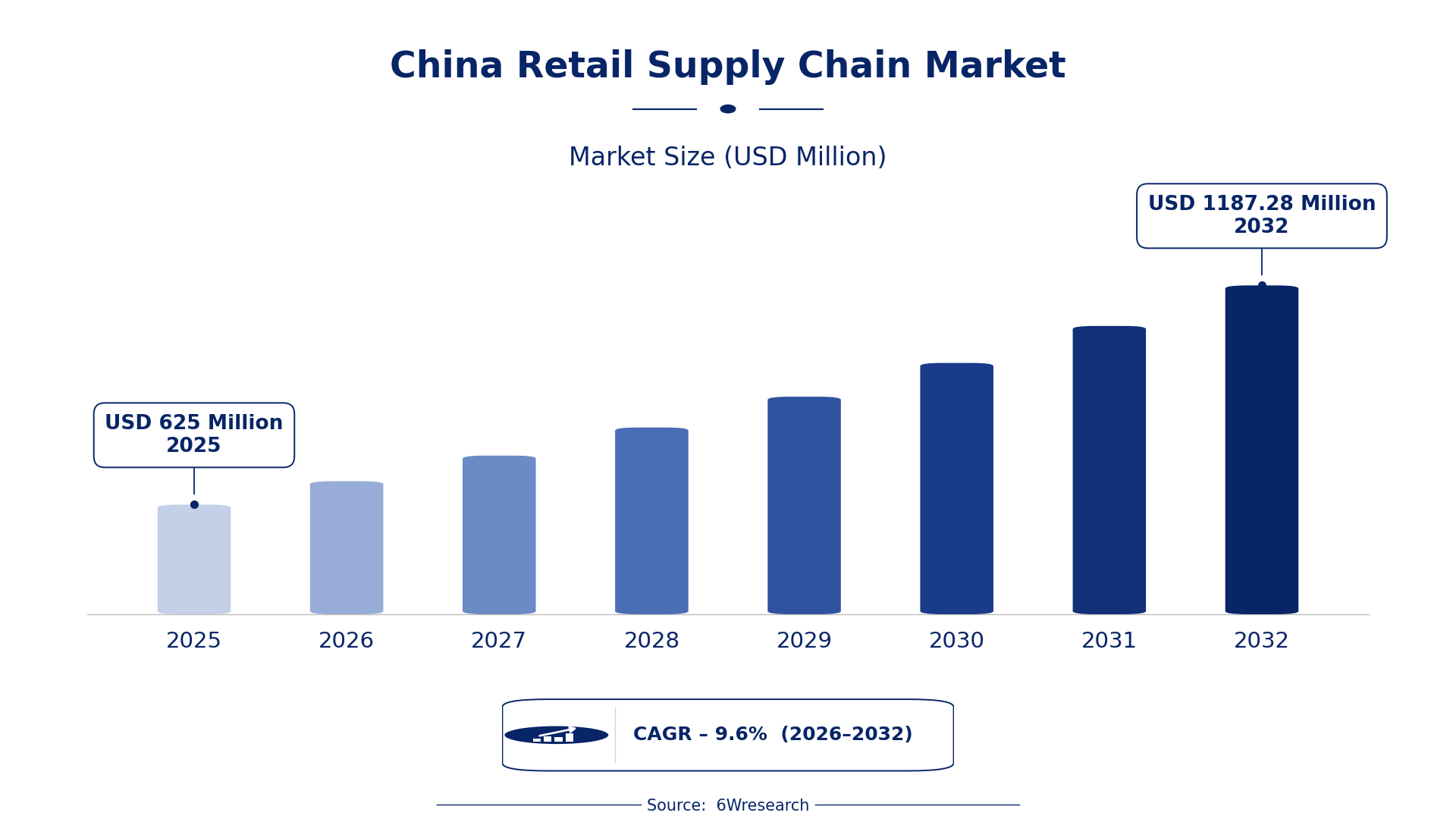
According to 6Wresearch internal database and industry insights, the China Retail Supply Chain Market was valued at USD 625.0 million in 2025 and is projected to reach USD 1,187.28 million by 2032, growing at a CAGR of approximately 9.6% during 2026–2032.
China Retail Supply Chain Market Highlights
| Report Metric | Details |
| Report Name | China Retail Supply Chain Market |
| Market Size 2025 | USD 625.0 million |
| Market Size 2032 | USD 1,187.28 million |
| Absolute Growth 2025–2032 | USD 562.28 million |
| CAGR 2026–2032 | 9.6% |
| Peak Annual Growth | 11.6% in 2027 |
| Forecast Period | 2026–2032 |
| Historical Data | 2022–2025 |
| Base Year | 2025 |
| Leading Supply Chain Component, 2025 | Warehouse Mgmt Systems (49% share) |
| Leading Technology Platform, 2025 | WMS Software (48% share) |
| Leading Integration Format, 2025 | SaaS/On-Premise (44% share) |
| Leading End User, 2025 | Retail Distribution Centers (50% share) |
| Fastest-Growing Supply Chain Component | Last-Mile Delivery (11.5% CAGR) |
| Fastest-Growing Technology Platform | Route Optimization (11.0% CAGR) |
| Fastest-Growing Integration Format | Mobile Apps (11.0% CAGR) |
| Fastest-Growing End User | E-commerce Retailers (11.5% CAGR) |
| Growing Sector | E-commerce |
| Key End Users | E-commerce Retailers, Retail Distribution Centers, Logistics Providers |
China Retail Supply Chain Market Year-wise Growth Rate and Key Drivers (2022–2032)
This graph illustrates the annual growth rates of the market from 2022 to 2032, highlighting a steady upward trajectory and projected market expansion over the forecast period.
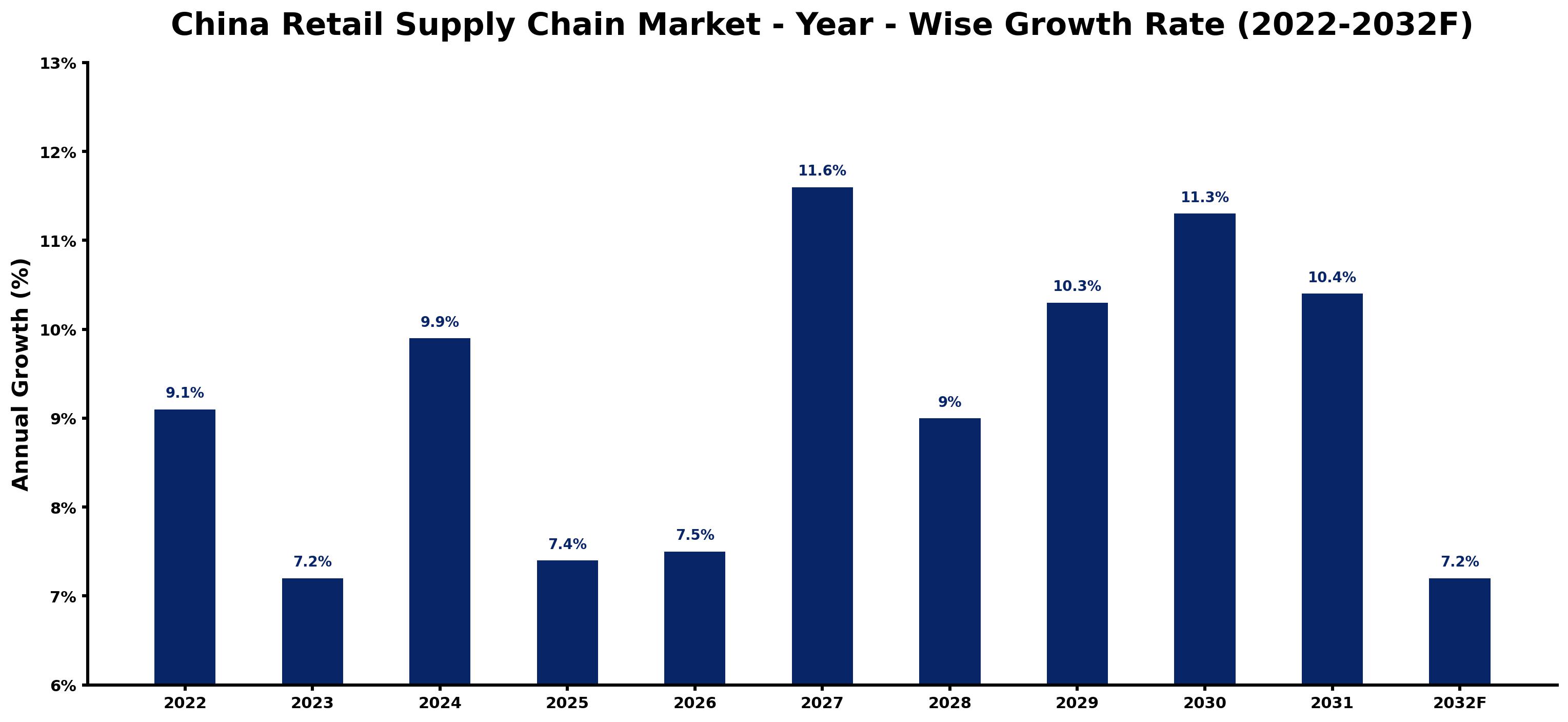
Year by year, the estimates below pair each growth rate with the development that shaped it.
| Year | Estimated Annual Growth (%) | Market Rationale |
| 2022 | 9.1 | The market experienced solid growth driven by increasing e-commerce sales and urbanisation. |
| 2023 | 7.2 | Growth slowed due to adjustments following the rapid expansion of the previous year, particularly in logistics operations. |
| 2024 | 9.9 | A resurgence in demand for logistics solutions led to faster growth as e-commerce continued to thrive, supported by the Digital Trade Development Plan. |
| 2025 | 7.4 | Growth slowed again as companies adjusted to the logistics demands of a maturing market, focusing on efficiency improvements. |
| 2026 | 7.5 | An uptick in investment in technology solutions is expected to spur growth as efficiency becomes a priority in logistics operations. |
| 2027 | 11.6 | The peak growth year will see advancements in AI integration within logistics operations, enhancing overall efficiency. |
| 2028 | 9.0 | Growth is projected to slow as the market stabilises after reaching peak demand levels, influenced by urbanisation trends. |
| 2029 | 10.3 | A renewed focus on last-mile delivery solutions will drive faster growth as consumer expectations increase, particularly in urban centres. |
| 2030 | 11.3 | Growth will continue as companies adopt innovative technologies to enhance supply chain operations, responding to e-commerce demands. |
| 2031 | 10.4 | The market is expected to see a slowdown as logistics companies face challenges in meeting rising demand for efficiency. |
| 2032 | 7.2 | Growth will slow further as the market reaches a more mature phase with stabilised demand, influenced by ongoing urbanisation. |
Note: Market size estimations and growth projections presented in this report are based on 6Wresearch's proprietary forecasting methodology, utilizing the latest available industry data, government publications, and primary research inputs.
China Retail Supply Chain Market Synopsis
Retail Supply Chain in China includes logistics, inventory management, and technology solutions that facilitate the movement of goods from suppliers to consumers. It focuses on optimising inventory and improving delivery efficiency, particularly in light of e-commerce growth and urbanisation. The China Retail Supply Chain Market is growing due to rising domestic demand, with retail e-commerce sales hitting 13.1 trillion yuan in 2022. The Digital Trade Development Plan, initiated in 2021, supports this growth by enhancing digital supply chain capabilities and integration with e-commerce.
Market Dynamics Impact Analysis (2026–2032)
| Factor | Type | Impact | Primary Segment Affected |
| Increasing e-commerce sales drive demand for efficient logistics solutions. | Driver | High | Last-Mile Delivery |
| Growing urban population necessitates improved supply chain operations. | Driver | High | Warehouse Mgmt Systems |
| Investment in AI technologies presents opportunities for enhanced logistics efficiency. | Opportunity | High | AI/ML Analytics |
| Rising demand for real-time inventory management solutions creates market potential. | Opportunity | High | WMS Software |
| High competition among logistics providers can lead to pricing pressures. | Restraint | Medium | Last-Mile Delivery |
| Regulatory compliance costs can burden logistics operations. | Restraint | Medium | Warehouse Mgmt Systems |
| Buyers face challenges in adapting to rapid technological changes in logistics. | Challenge | High | E-commerce Retailers |
| Suppliers struggle with meeting the increasing demand for fast delivery times. | Challenge | High | Retail Distribution Centers |
Evaluation of Drivers in China Retail Supply Chain Market (2026–2032)
The table below links each growth driver to the segment it affects and the evidence for it.
| Drivers | Primary Segment Affected | Why It Matters (Evidence) |
| Rising e-commerce sales drive demand for efficient logistics solutions. | Last-Mile Delivery | In 2022, China's retail e-commerce sales reached 13.1 trillion yuan, pushing companies to improve delivery efficiency. |
| Growing urban population necessitates improved supply chain operations. | Warehouse Mgmt Systems | China's urban population reached 64.7% in 2021, prompting retailers to optimise inventory management. |
| Investment in AI technologies improves logistics efficiency. | AI/ML Analytics | Over 60% of logistics companies reported using AI technologies in 2023, improving operational decision-making. |
| Increased demand for real-time inventory management solutions. | WMS Software | More than 80% of retail companies in China utilise WMS, streamlining their inventory processes. |
| Focus on reducing delivery times drives logistics investments. | Last-Mile Delivery | The average delivery time for e-commerce orders in China is under 24 hours, necessitating efficient logistics. |
The Retail Supply Chain market in China is expanding as rising e-commerce sales, growing urbanisation, and increased investment in technology drive demand. In 2022, retail e-commerce sales reached 13.1 trillion yuan, pushing companies to improve logistics efficiency. The urban population, which reached 64.7% in 2021, necessitates better supply chain operations, leading to a greater reliance on Warehouse Management Systems. Over 60% of logistics companies reported using AI technologies in 2023, significantly improving operational decision-making. The average delivery time for e-commerce orders in China is under 24 hours, prompting a focus on efficient Last-Mile Delivery solutions to meet consumer expectations.
Evaluation of Restraints in China Retail Supply Chain Market
The key brakes on demand, and where they bite hardest, are shown below.
| Market Restraint | Primary Segment Affected | Why It Matters (Evidence) |
| High competition among logistics providers can lead to pricing pressures. | Last-Mile Delivery | As more players enter the market, logistics companies face challenges in maintaining profitability, which can pressure pricing strategies. |
| Regulatory compliance costs can burden logistics operations. | Warehouse Mgmt Systems | Compliance with the National Standard for Logistics Management increases operational costs for providers, impacting profitability. |
| Technological adaptation challenges hinder operational efficiency. | AI/ML Analytics | Logistics companies struggle to keep pace with rapid technological advancements, affecting service delivery and competitiveness. |
| Supply chain disruptions can impact delivery timelines. | Last-Mile Delivery | External factors, such as traffic and weather, can delay deliveries, affecting customer satisfaction and sales for retailers. |
| Limited infrastructure in certain regions may restrict logistics capabilities. | Warehouse Mgmt Systems | Some areas lack the necessary infrastructure for efficient supply chain operations, hindering growth and service delivery. |
China Retail Supply Chain Market Challenges
Buyers in the China Retail Supply Chain market face escalating logistics costs, which can rise by 15% due to increasing urbanisation and e-commerce demand. Suppliers encounter significant hurdles with outdated technology, as over 80% of retail companies rely on legacy systems, causing order fulfilment delays averaging 48 hours. Supply chain disruptions are prevalent, with logistics firms reporting that 30% of deliveries experience delays, leading to decreased customer satisfaction and lost sales for retailers. Regulatory compliance is burdensome, as evolving laws like the 'E-commerce Law' necessitate constant adjustments, raising operational costs for both suppliers and retailers.
Trends in the China Retail Supply Chain Market
Several trends are reshaping the China Retail Supply Chain Market; the most important are set out below.
- Shift towards AI-Driven Logistics Solutions: Since 2022, logistics companies have increasingly adopted AI technologies to streamline operations. Over 60% of logistics firms reported using AI, improving efficiency and decision-making processes.
- Transition to Real-Time Inventory Management: Retailers are moving towards real-time inventory management systems to meet consumer demands. In 2023, more than 80% of retail companies employed WMS, improving inventory accuracy and responsiveness.
- Emergence of Last-Mile Delivery Innovations: Innovative last-mile delivery solutions have gained traction in urban areas. The average delivery time for e-commerce orders is now under 24 hours, pushing companies to improve their logistics capabilities.
- Growth of E-commerce Retailers as Key End Users: E-commerce retailers have become the primary users of retail supply chain solutions. With 900 million online shoppers in 2023, demand for efficient logistics continues to rise.
Investment Opportunities in the China Retail Supply Chain Market
The following opportunities in the China Retail Supply Chain Market pair current demand with a clear way in.
- Partnerships with Technology Providers: Now is the time to invest in AI-driven logistics solutions, with a projected 30% increase in AI adoption by 2025. Collaborating with tech firms can improve operational efficiency for logistics providers.
- Supply Chain Software Development: With the logistics market projected to reach 12 trillion yuan by 2025, there is a chance to develop software solutions. Targeting retail distribution centers can yield high returns on investment.
- Investment in Last-Mile Delivery Solutions: The demand for last-mile delivery is growing, with a projected increase of 11.5% through 2032. Focusing on urban logistics can provide opportunities for suppliers to meet consumer needs.
- Expansion of E-commerce Platforms: With 900 million online shoppers in 2023, there is a need for improved logistics solutions. Investing in partnerships with e-commerce retailers can facilitate market entry and growth.
Government Initiatives in the China Retail Supply Chain Market
The 'Digital Trade Development Plan' launched by the Ministry of Commerce in 2021 aims to improve China's digital supply chain capabilities. This initiative focuses on integrating e-commerce with logistics, enabling retailers to streamline operations and boost efficiency. The '14th Five-Year Plan for the Development of Logistics', approved by the State Council in 2021, targets a 15% increase in logistics efficiency by 2025, further supporting the retail supply chain sector. Additionally, the 'Smart Logistics' initiative introduced in 2022 aims to incorporate AI technologies into logistics operations, improving overall supply chain performance.
The National Development and Reform Commission supports the 'Smart Logistics' initiative, approving funding for AI integration projects that enhance operational capabilities. The Ministry of Commerce oversees the implementation of the 'Digital Trade Development Plan', which funds projects aimed at improving digital infrastructure in logistics. These measures enable logistics companies to adopt new technologies, improving their operational capabilities. Furthermore, the China Federation of Logistics & Purchasing promotes industry standards, ensuring compliance and operational excellence across the sector.
Future Insight of the China Retail Supply Chain Market
The China Retail Supply Chain market will undergo significant changes by 2032, driven by the 'Digital Trade Development Plan' and the 'Smart Logistics' initiative, which will streamline operations across the sector. AI adoption in logistics is expected to increase by 30% by 2025, allowing suppliers to improve efficiency and service levels. Enhanced delivery systems will contribute to reduced average delivery times, benefiting consumers and retailers alike. The logistics market is projected to reach 12 trillion yuan by 2025, offering new growth avenues for buyers and suppliers.
Market Segmentation Analysis
The report offers a comprehensive study of the following market segments and their leading categories in the market.
By Supply Chain Component – Warehouse Mgmt Systems Dominated, Last-Mile Delivery Expected to Grow Fastest
According to Ravi Bhandari, Research Head at 6Wresearch, with a 49% revenue share in 2025, Warehouse Mgmt Systems was the largest supply chain component category. Warehouse Management Systems hold the largest share due to their essential role in managing inventory and storage efficiency. Their use by over 80% of retail companies in China demonstrates their critical importance in optimising operations within a competitive retail environment. The quickest growth will come from Last-Mile Delivery, forecast to expand at a CAGR of 11.5% between 2026 and 2032. Last-Mile Delivery is growing rapidly as it is crucial for fulfilling customer orders promptly, reflecting the rising demand for fast delivery services. The average delivery time for e-commerce orders being under 24 hours showcases the shift towards quicker logistics solutions, further solidifying the leader's position. Suppliers should prioritise enhancing last-mile delivery capabilities to meet the increasing expectations of consumers.
By Technology Platform – WMS Software Dominated, Route Optimization Expected to Grow Fastest
WMS Software took a 48% share of technology platform in 2025, more than any other category. WMS Software commands a significant share because it is integral for effective warehouse operations management. Its widespread adoption across retail distribution centres highlights its vital role in streamlining supply chain processes and ensuring operational effectiveness. Over 2026–2032, Route Optimization is expected to post the fastest growth, at a CAGR of 11.0%. Route Optimization is experiencing quick growth as it directly improves delivery efficiency, which is essential in a competitive market. The increasing e-commerce penetration rate of 25.6% in 2022 drives demand for more effective routing solutions, indicating that the leader will continue to expand its share. Buyers should invest in advanced route optimisation technologies to enhance their logistics performance.
By Integration Format – SaaS/On-Premise Dominated, Mobile Apps Expected to Grow Fastest
SaaS/On-Premise held a 44% share of the China Retail Supply Chain Market by integration format in 2025. SaaS/On-Premise solutions dominate the market as they are common deployment methods for supply chain solutions, offering flexibility and control for users. This widespread adoption reflects the necessity for robust systems to manage complex supply chains effectively. Mobile Apps are projected to grow fastest, at a CAGR of 11.0% during 2026–2032. Mobile Apps are rapidly gaining traction as they improve user access to supply chain solutions, catering to the growing need for on-the-go management. The rise of mobile technology in logistics indicates a shift towards convenience and immediate access to information, suggesting that the leader's share may continue to grow. Suppliers need to develop mobile-friendly solutions to attract a tech-savvy user base.
By End User – Retail Distribution Centers Dominated, E-commerce Retailers Expected to Grow Fastest
Retail Distribution Centers accounted for a 50% market share by end user in 2025. Retail Distribution Centers lead the market share as they are central to supply chain operations, facilitating the efficient movement of goods. Their pivotal role in managing inventory and distribution underscores their importance in the success of the retail sector. E-commerce Retailers are set to record the highest CAGR in this split, 11.5% over 2026–2032. E-commerce Retailers are the fastest-growing segment, being the primary users of retail supply chain solutions, driven by the surge in online shopping. The total number of online shoppers in China reaching 900 million exemplifies this rapid growth and the increasing reliance on effective supply chain management. Suppliers must tailor their offerings to meet the specific needs of e-commerce retailers to capitalise on this growth.
Key Attractiveness of the Report
- 10 Years of Market Numbers
- Historical Data Starting from 2022 to 2025
- Base Year 2025
- Forecast Data until 2032
- Key Performance Indicators Impacting the Market
- Major Upcoming Developments and Projects
Key Highlights of the Report:
- China Retail Supply Chain Market Outlook
- Market Size of China Retail Supply Chain Market, 2025
- Forecast of China Retail Supply Chain Market, 2032
- Historical Data and Forecast of China Retail Supply Chain Revenues & Volume for the Period 2022 - 2032F
- China Retail Supply Chain Market Trend Evolution
- China Retail Supply Chain Market Drivers and Challenges
- China Retail Supply Chain Price Trends
- China Retail Supply Chain Porter's Five Forces
- China Retail Supply Chain Industry Life Cycle
- Historical Data and Forecast of China Retail Supply Chain Market Revenues & Volume By Supply Chain Component for the Period 2022 - 2032F
- Historical Data and Forecast of China Retail Supply Chain Market Revenues & Volume By Warehouse Mgmt Systems for the Period 2022 - 2032F
- Historical Data and Forecast of China Retail Supply Chain Market Revenues & Volume By Last-Mile Delivery for the Period 2022 - 2032F
- Historical Data and Forecast of China Retail Supply Chain Market Revenues & Volume By Supplier Collaboration for the Period 2022 - 2032F
- Historical Data and Forecast of China Retail Supply Chain Market Revenues & Volume By Demand Forecasting for the Period 2022 - 2032F
- Historical Data and Forecast of China Retail Supply Chain Market Revenues & Volume By Technology Platform for the Period 2022 - 2032F
- Historical Data and Forecast of China Retail Supply Chain Market Revenues & Volume By WMS Software for the Period 2022 - 2032F
- Historical Data and Forecast of China Retail Supply Chain Market Revenues & Volume By Route Optimization for the Period 2022 - 2032F
- Historical Data and Forecast of China Retail Supply Chain Market Revenues & Volume By Vendor Portal Systems for the Period 2022 - 2032F
- Historical Data and Forecast of China Retail Supply Chain Market Revenues & Volume By AI/ML Analytics for the Period 2022 - 2032F
- Historical Data and Forecast of China Retail Supply Chain Market Revenues & Volume By Integration Format for the Period 2022 - 2032F
- Historical Data and Forecast of China Retail Supply Chain Market Revenues & Volume By SaaS/On-Premise for the Period 2022 - 2032F
- Historical Data and Forecast of China Retail Supply Chain Market Revenues & Volume By Mobile Apps for the Period 2022 - 2032F
- Historical Data and Forecast of China Retail Supply Chain Market Revenues & Volume By Cloud-Hosted for the Period 2022 - 2032F
- Historical Data and Forecast of China Retail Supply Chain Market Revenues & Volume By Dashboard Platforms for the Period 2022 - 2032F
- Historical Data and Forecast of China Retail Supply Chain Market Revenues & Volume By End User for the Period 2022 - 2032F
- Historical Data and Forecast of China Retail Supply Chain Market Revenues & Volume By Retail Distribution Centers for the Period 2022 - 2032F
- Historical Data and Forecast of China Retail Supply Chain Market Revenues & Volume By E-commerce Retailers for the Period 2022 - 2032F
- Historical Data and Forecast of China Retail Supply Chain Market Revenues & Volume By Procurement Teams for the Period 2022 - 2032F
- Historical Data and Forecast of China Retail Supply Chain Market Revenues & Volume By Category/Product Managers for the Period 2022 - 2032F
- China Retail Supply Chain Import Export Trade Statistics
- Market Opportunity Assessment By Supply Chain Component
- Market Opportunity Assessment By Technology Platform
- Market Opportunity Assessment By Integration Format
- Market Opportunity Assessment By End User
- China Retail Supply Chain Top Companies Market Share
- China Retail Supply Chain Competitive Benchmarking By Technical and Operational Parameters
- China Retail Supply Chain Company Profiles
- China Retail Supply Chain Key Strategic Recommendations
Market Covered
Segments analysed in this report are listed below.
By Supply Chain Component
- Warehouse Mgmt Systems
- Last-Mile Delivery
- Supplier Collaboration
- Demand Forecasting
By Technology Platform
- WMS Software
- Route Optimization
- Vendor Portal Systems
- AI/ML Analytics
By Integration Format
- SaaS/On-Premise
- Mobile Apps
- Cloud-Hosted
- Dashboard Platforms
By End User
- Retail Distribution Centers
- E-commerce Retailers
- Procurement Teams
- Category/Product Managers































