India Retail Tech Market Size & Growth Rate
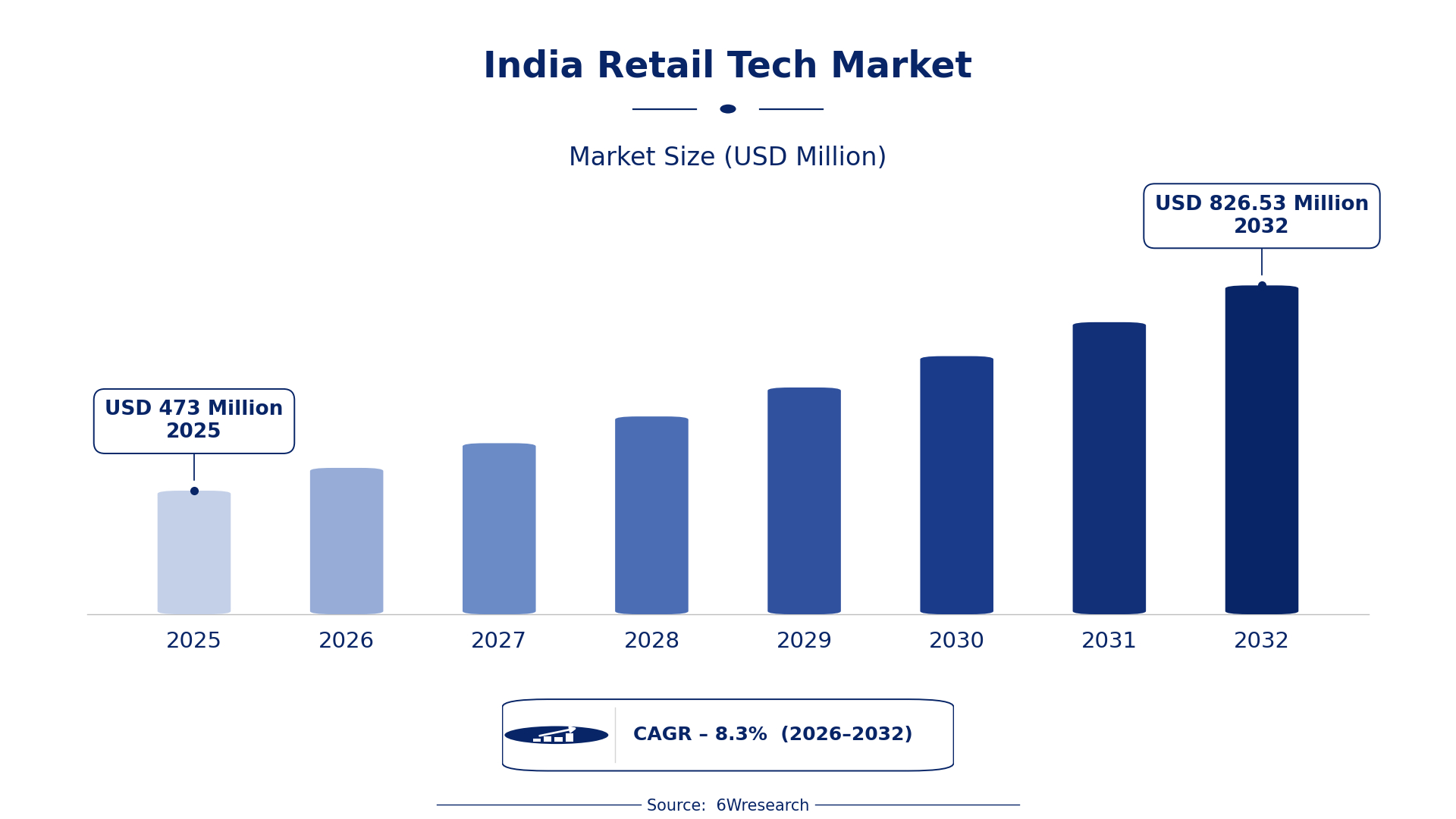
According to 6Wresearch internal database and industry insights, the India Retail Tech Market was valued at USD 473.0 million in 2025 and is projected to reach USD 826.53 million by 2032, growing at a CAGR of approximately 8.3% during 2026–2032.
India Retail Tech Market Highlights
| Report Metric | Details |
| Report Name | India Retail Tech Market |
| Market Size 2025 | USD 473.0 million |
| Market Size 2032 | USD 826.53 million |
| Absolute Growth 2025–2032 | USD 353.53 million |
| CAGR 2026–2032 | 8.3% |
| Peak Annual Growth | 10.3% in 2031 |
| Forecast Period | 2026–2032 |
| Historical Data | 2022–2025 |
| Base Year | 2025 |
| Leading Segment, 2025 | POS & Payment Systems (40% share) |
| Leading Technology Type, 2025 | Contactless/Digital (47% share) |
| Leading Deployment Mode, 2025 | SaaS Platforms (43% share) |
| Leading End User, 2025 | Retail Chains (44% share) |
| Fastest-Growing Segment | Customer Analytics (10.2% CAGR) |
| Fastest-Growing Technology Type | AI/ML Engines (10.2% CAGR) |
| Fastest-Growing End User | Omnichannel Retailers (11.0% CAGR) |
| Growing Sector | Retail Technology |
| Key End Users | Retail Chains, Warehouse Teams, Marketing Teams, Omnichannel Retailers |
India Retail Tech Market Year-wise Growth Rate and Key Drivers (2022–2032)
This graph illustrates the annual growth rates of the market from 2022 to 2032, highlighting a steady upward trajectory and projected market expansion over the forecast period.
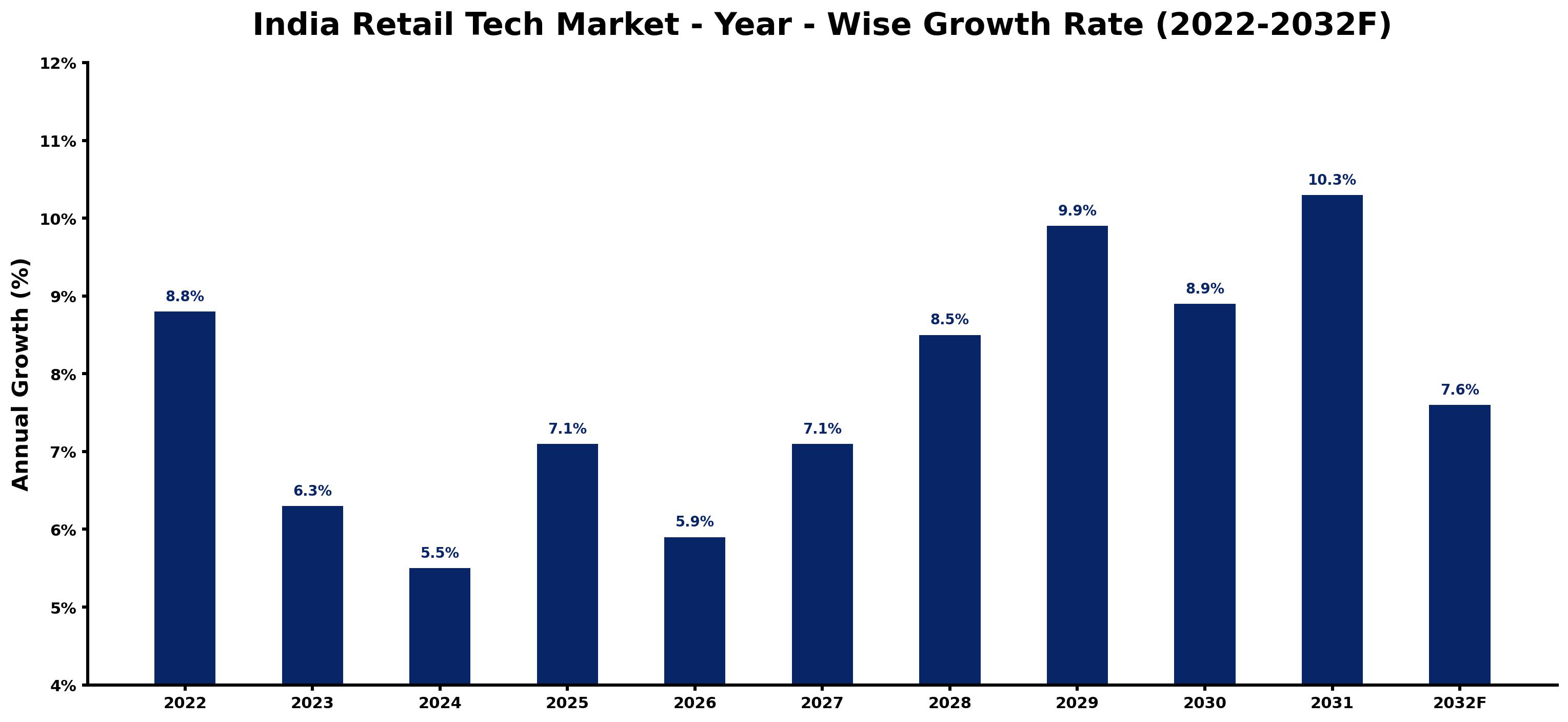
The table below sets out the estimated growth rate for each year and the main factor behind it.
| Year | Estimated Annual Growth (%) | Market Rationale |
| 2022 | 8.8 | The market experienced strong growth due to the increasing adoption of digital payment systems. |
| 2023 | 6.3 | Growth slowed as retailers adjusted to new technologies and consumer preferences. |
| 2024 | 5.5 | The market continued to grow, but at a slower pace due to market saturation in urban areas. |
| 2025 | 7.1 | Growth accelerated as more retailers adopted integrated solutions for efficiency. |
| 2026 | 5.9 | The market saw a slowdown as competition intensified among technology providers. |
| 2027 | 7.1 | Demand picked up again as retailers sought innovative solutions to enhance customer experience. |
| 2028 | 8.5 | Growth continued to rise as omnichannel strategies became essential for retailers. |
| 2029 | 9.9 | The market experienced robust growth driven by advancements in customer analytics. |
| 2030 | 8.9 | Growth slowed as retailers focused on optimising existing technologies rather than new investments. |
| 2031 | 10.3 | The market peaked with strong demand for advanced retail tech solutions. |
| 2032 | 7.6 | Growth slowed as the market stabilised and matured, with a focus on efficiency. |
Note: Market size estimations and growth projections presented in this report are based on 6Wresearch's proprietary forecasting methodology, utilizing the latest available industry data, government publications, and primary research inputs.
India Retail Tech Market Synopsis
Retail Tech in India includes technologies that optimise retail operations, such as POS systems, inventory management, and customer analytics. These solutions streamline transactions and enhance stock management. The India Retail Tech Market is expanding due to the growing digitalisation of retail transactions and the rise of the e-commerce sector. By 2025, over 80% of retail transactions are expected to be digital, which will increase the demand for effective solutions. Retail chains are the main users, aiming to improve operational efficiency and customer engagement.
Market Dynamics Impact Analysis (2026–2032)
| Factor | Type | Impact | Primary Segment Affected |
| Increasing digital payment adoption | Driver | High | POS & Payment Systems |
| Growing demand for inventory management solutions | Driver | High | Inventory Automation |
| Rising need for integrated retail solutions | Opportunity | High | Omnichannel Integration |
| Expansion of e-commerce platforms | Opportunity | High | Customer Analytics |
| High competition among technology providers | Restraint | Medium | Customer Analytics |
| Limited adoption of advanced technologies in rural areas | Restraint | Medium | Inventory Automation |
| The Retail Tech market in India faces challenges with technology integration | Challenge | High | POS & Payment Systems |
| Regulatory compliance and standards can hinder market growth | Challenge | Medium | Inventory Automation |
Evaluation of Drivers in India Retail Tech Market (2026–2032)
The table below links each growth driver to the segment it affects and the evidence for it.
| Drivers | Primary Segment Affected | Why It Matters (Evidence) |
| Increased digital payment transactions drive demand for POS systems | POS & Payment Systems | Over 80% of retail transactions are expected to be digital by 2025, prompting retailers to upgrade their systems. |
| Retailers seek efficient inventory management solutions to reduce costs | Inventory Automation | The Indian e-commerce market is projected to grow to $200 billion by 2026, increasing demand for inventory solutions. |
| Omnichannel strategies require integrated tech solutions for customer experiences | Omnichannel Integration | Integrated retail solutions are increasingly sought by omnichannel retailers in India, improving customer engagement. |
| Customer analytics tools are essential for understanding consumer behaviour | Customer Analytics | AI in retail analytics is being adopted by 30% of retailers in India as of 2023, driving demand for analytics solutions. |
| Cloud-based solutions offer flexibility for small retailers | SaaS Platforms | Cloud-based retail solutions are being adopted by 50% of small retailers in 2023, improving operational efficiency. |
The Retail Tech market in India is expanding due to the rise in digital payment adoption, the growing demand for integrated solutions, and the expansion of e-commerce platforms. With over 80% of retail transactions projected to be digital by 2025, there is a strong push for upgrades to POS systems. The use of AI in retail analytics is on the rise, with 30% of retailers employing these tools as of 2023, providing deeper insights into consumer behaviour. In addition, 50% of small retailers are adopting cloud-based solutions in 2023, which helps improve operational efficiency and reduce costs.
Evaluation of Restraints in India Retail Tech Market
The table below lists the restraints and the evidence behind each.
| Market Restraint | Primary Segment Affected | Why It Matters (Evidence) |
| High competition among technology providers can limit pricing power | Customer Analytics | Intense competition leads to lower margins, affecting profitability for technology providers. |
| Limited adoption of advanced technologies in rural areas restricts market reach | Inventory Automation | Many rural retailers lack the resources to invest in modern inventory management solutions. |
| Integration challenges with existing systems can delay implementation | POS & Payment Systems | Retailers face difficulties in integrating new technologies with legacy systems, causing delays. |
| Regulatory compliance can increase operational costs | Inventory Automation | Compliance with standards set by the Bureau of Indian Standards adds to the cost for retailers. |
| Market saturation in urban areas may slow growth rates | Customer Analytics | As urban markets become saturated, growth opportunities diminish for new entrants. |
India Retail Tech Market Challenges
The India Retail Tech Market encounters integration challenges, as many small retailers find it difficult to adopt advanced POS systems, leading to a 20% loss in potential sales. This situation limits their competitiveness against larger chains, resulting in decreased market share. Supply chain disruptions are also a concern, with over 30% of retailers facing delays in inventory management due to insufficient use of RFID technology. Compliance with the Bureau of Indian Standards complicates operations, causing delays in tech upgrades that cost retailers valuable time and resources. Rising costs linked to local manufacturing under the 'Make in India' initiative further strain budgets, ultimately raising prices for consumers.
Trends in the India Retail Tech Market
Several trends are reshaping the India Retail Tech Market; the most important are set out below.
- Retail Chains Embracing Omnichannel Strategies: Retail chains are increasingly adopting omnichannel strategies to improve customer experiences. In 2023, 30% of retailers reported integrating online and offline channels, reflecting a shift towards integrated shopping experiences.
- Rise of Contactless Payment Solutions: Contactless payment solutions are gaining traction in urban areas, with 47% of transactions expected to be contactless by 2025. This trend is driven by consumer demand for convenience and safety.
- Growth in AI-Driven Customer Analytics: AI-driven customer analytics tools are becoming essential for retailers, with 30% adoption among retailers in 2023. This shift enables better understanding of consumer behaviour and targeted marketing.
- Cloud Solutions Gaining Popularity Among Small Retailers: Cloud-based retail solutions are being adopted by 50% of small retailers in 2023, allowing them to improve operational efficiency and reduce costs.
Investment Opportunities in the India Retail Tech Market
Several openings in the India Retail Tech Market merit attention from investors.
- Timing for Investment in Integrated Solutions: With the e-commerce market expanding rapidly, there is a chance to invest in integrated retail solutions. Retail chains are actively seeking these technologies to boost efficiency.
- Urban Areas as Growth Hubs for Retail Tech: Urban areas like Mumbai and Delhi represent prime markets for retail tech solutions, with over 80% of transactions expected to be digital by 2025. Suppliers can enter through partnerships with local retailers.
- Entry into the SaaS Market for Retail Tech: The SaaS market for retail tech is growing quickly, with a 43% share expected in 2025. Firms can enter by forming joint ventures with established tech providers.
- Gap in Advanced Analytics Solutions: As AI in retail analytics is adopted by 30% of retailers, there is a gap for advanced analytics solutions. Companies can target this gap by developing tailored solutions for retailers.
Government Initiatives in the India Retail Tech Market
The 'Digital India' programme, initiated by the Ministry of Electronics and Information Technology in 2020, aims to promote digital transactions and enhance the digital infrastructure in the country. This initiative encourages the adoption of retail technology, enabling retailers to streamline operations and improve customer experiences. The 'Startup India' initiative, launched in 2020, supports tech startups, including those in retail technology, through funding and mentorship, encouraging innovation in the sector. Furthermore, the 'Retail Policy' launched by the Ministry of Commerce and Industry in 2021 focuses on improving the retail ecosystem through technology adoption and innovation, creating a favourable environment for retail tech growth.
The 'National Policy for Electronics' aims to promote the manufacturing of electronic components, including retail tech devices, with a target of $400 billion by 2025. The Ministry of Electronics and Information Technology oversees this initiative, which encourages local production and reduces dependency on imports. Additionally, the 'Atmanirbhar Bharat' initiative launched in 2020 promotes self-reliance in technology development for the retail sector, supporting local manufacturers and improving the domestic supply chain.
Future Insight of the India Retail Tech Market
By 2032, buyers and suppliers in the India Retail Tech Market can expect a notable shift towards digital transactions, with over 80% projected to be digital by 2025. The government's 'Digital India' initiative will continue to create a supportive environment for digital solutions. The e-commerce market, expected to reach $200 billion by 2026, will drive the demand for advanced retail technologies. Additionally, cloud-based solutions will become standard, as 50% of small retailers are anticipated to adopt them, improving operational efficiency and customer engagement.
Market Segmentation Analysis
The report offers a comprehensive study of the following market segments and their leading categories in the market.
By Segment – POS & Payment Systems Dominated, Customer Analytics Expected to Grow Fastest
According to Ravi Bhandari, Research Head at 6Wresearch, POS & Payment Systems held a 40% share of the India Retail Tech Market by segment in 2025. POS and Payment Systems hold the largest market share as they are essential for transaction processing, particularly in urban retail chains in major cities like Mumbai and Delhi. This reliance on effective payment solutions ensures a strong installed base and widespread acceptance among retailers. Over 2026–2032, Customer Analytics is expected to post the fastest growth, at a CAGR of 10.2%. Customer Analytics is experiencing rapid growth as retailers increasingly recognise the need to understand consumer behaviour, with 30% of retailers adopting these technologies as of 2023. This growing focus on data-driven insights will likely widen the gap with other segments, reinforcing the demand for analytics solutions. Suppliers should prioritise the development of advanced customer analytics solutions to meet the rising demand from retailers.
By Technology Type – Contactless/Digital Dominated, AI/ML Engines Expected to Grow Fastest
Contactless/Digital accounted for a 47% market share by technology type in 2025. Contactless/Digital technologies dominate the market share due to their widespread adoption for convenience and safety, especially as the trend towards digital transactions accelerates. Their integration into retail operations is essential for enhancing customer experiences and driving sales growth. AI/ML Engines are projected to grow fastest, at a CAGR of 10.2% during 2026–2032. AI/ML Engines are witnessing the fastest growth as retailers increasingly acknowledge the importance of data-driven insights in analytics. This heightened focus on understanding consumer patterns will likely propel demand for these technologies further, solidifying their position in the market. Suppliers must prioritise the development of AI/ML solutions to capitalise on the growing interest in advanced analytics.
By Deployment Mode – SaaS Platforms Dominated and Is Expected to Record the Fastest Growth
With a 43% revenue share in 2025, SaaS Platforms was the largest deployment mode category. SaaS Platforms lead the deployment mode segment due to their popularity for ease of use and scalability, making them suitable for a diverse range of retailers. This model allows businesses to adapt quickly to market changes without significant upfront costs, securing a strong market share. The same category are also set to grow fastest, at a CAGR of 10.4% during 2026–2032. SaaS Platforms are also the fastest-growing deployment mode as their flexibility and cost-effectiveness attract more retailers. The ability to provide seamless updates and integrations will further enhance their appeal and solidify their leading position in the market. Suppliers should enhance their SaaS offerings to attract more retailers seeking scalable solutions.
By End User – Retail Chains Dominated, Omnichannel Retailers Expected to Grow Fastest
The largest end user category in 2025 was Retail Chains, with a 44% share of total revenue. Retail Chains hold the largest market share as they are the primary users of retail tech solutions, driving demand for systems that optimise operations. Their extensive networks and high transaction volumes position them as key players in the retail tech market. The quickest growth will come from Omnichannel Retailers, forecast to expand at a CAGR of 11.0% between 2026 and 2032. Omnichannel Retailers are the fastest-growing end user group, driven by the need for integrated customer experiences across multiple platforms. The rapid growth of the e-commerce market, projected to reach $200 billion by 2026, fuels this demand. Suppliers should tailor their solutions to meet the specific needs of omnichannel retailers to capture this expanding segment.
Key Attractiveness of the Report
- 10 Years of Market Numbers
- Historical Data Starting from 2022 to 2025
- Base Year 2025
- Forecast Data until 2032
- Key Performance Indicators Impacting the Market
- Major Upcoming Developments and Projects
Key Highlights of the Report:
- India Retail Tech Market Outlook
- Market Size of India Retail Tech Market, 2025
- Forecast of India Retail Tech Market, 2032
- Historical Data and Forecast of India Retail Tech Revenues & Volume for the Period 2022 - 2032F
- India Retail Tech Market Trend Evolution
- India Retail Tech Market Drivers and Challenges
- India Retail Tech Price Trends
- India Retail Tech Porter's Five Forces
- India Retail Tech Industry Life Cycle
- Historical Data and Forecast of India Retail Tech Market Revenues & Volume By Segment for the Period 2022 - 2032F
- Historical Data and Forecast of India Retail Tech Market Revenues & Volume By POS & Payment Systems for the Period 2022 - 2032F
- Historical Data and Forecast of India Retail Tech Market Revenues & Volume By Inventory Automation for the Period 2022 - 2032F
- Historical Data and Forecast of India Retail Tech Market Revenues & Volume By Customer Analytics for the Period 2022 - 2032F
- Historical Data and Forecast of India Retail Tech Market Revenues & Volume By Omnichannel Integration for the Period 2022 - 2032F
- Historical Data and Forecast of India Retail Tech Market Revenues & Volume By Technology Type for the Period 2022 - 2032F
- Historical Data and Forecast of India Retail Tech Market Revenues & Volume By Contactless/Digital for the Period 2022 - 2032F
- Historical Data and Forecast of India Retail Tech Market Revenues & Volume By RFID/IoT Sensors for the Period 2022 - 2032F
- Historical Data and Forecast of India Retail Tech Market Revenues & Volume By AI/ML Engines for the Period 2022 - 2032F
- Historical Data and Forecast of India Retail Tech Market Revenues & Volume By ERP/WMS Integration for the Period 2022 - 2032F
- Historical Data and Forecast of India Retail Tech Market Revenues & Volume By Deployment Mode for the Period 2022 - 2032F
- Historical Data and Forecast of India Retail Tech Market Revenues & Volume By On-Premise/Cloud for the Period 2022 - 2032F
- Historical Data and Forecast of India Retail Tech Market Revenues & Volume By Edge-Enabled for the Period 2022 - 2032F
- Historical Data and Forecast of India Retail Tech Market Revenues & Volume By SaaS Platforms for the Period 2022 - 2032F
- Historical Data and Forecast of India Retail Tech Market Revenues & Volume By Integrated Suites for the Period 2022 - 2032F
- Historical Data and Forecast of India Retail Tech Market Revenues & Volume By End User for the Period 2022 - 2032F
- Historical Data and Forecast of India Retail Tech Market Revenues & Volume By Retail Chains for the Period 2022 - 2032F
- Historical Data and Forecast of India Retail Tech Market Revenues & Volume By Warehouse & Store Teams for the Period 2022 - 2032F
- Historical Data and Forecast of India Retail Tech Market Revenues & Volume By Marketing & CX Teams for the Period 2022 - 2032F
- Historical Data and Forecast of India Retail Tech Market Revenues & Volume By Omnichannel Retailers for the Period 2022 - 2032F
- India Retail Tech Import Export Trade Statistics
- Market Opportunity Assessment By Segment
- Market Opportunity Assessment By Technology Type
- Market Opportunity Assessment By Deployment Mode
- Market Opportunity Assessment By End User
- India Retail Tech Top Companies Market Share
- India Retail Tech Competitive Benchmarking By Technical and Operational Parameters
- India Retail Tech Company Profiles
- India Retail Tech Key Strategic Recommendations
Market Covered
This report examines the market across the segments below.
By Segment
- POS & Payment Systems
- Inventory Automation
- Customer Analytics
- Omnichannel Integration
By Technology Type
- Contactless/Digital
- RFID/IoT Sensors
- AI/ML Engines
- ERP/WMS Integration
By Deployment Mode
- On-Premise/Cloud
- Edge-Enabled
- SaaS Platforms
- Integrated Suites
By End User
- Retail Chains
- Warehouse & Store Teams
- Marketing & CX Teams
- Omnichannel Retailers































