China Retail Tech Market Size & Growth Rate
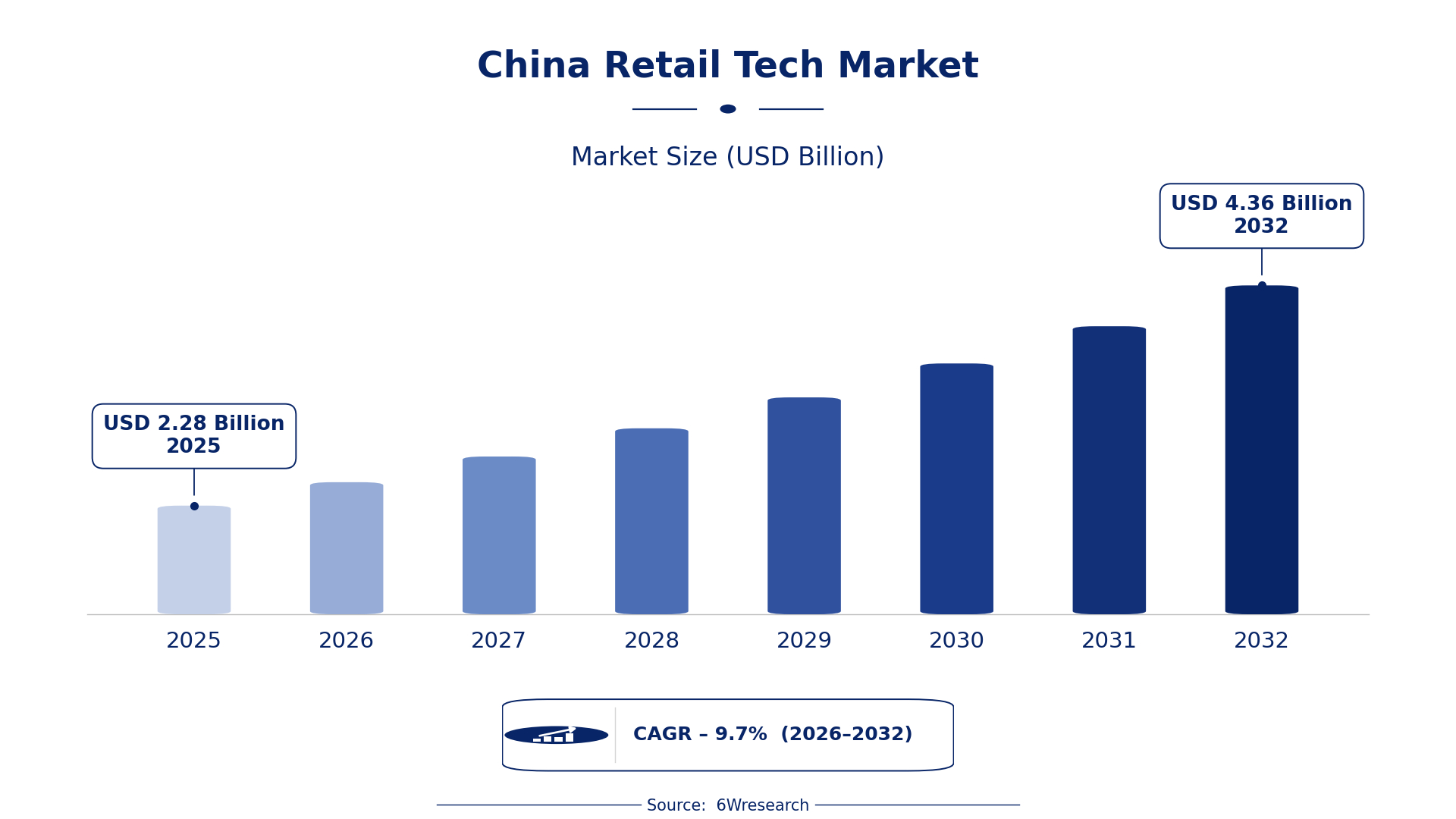
According to 6Wresearch internal database and industry insights, the China Retail Tech Market was valued at USD 2.28 billion in 2025 and is projected to reach USD 4.36 billion by 2032, growing at a CAGR of approximately 9.7% during 2026–2032.
China Retail Tech Market Highlights
| Report Metric | Details |
| Report Name | China Retail Tech Market |
| Market Size 2025 | USD 2.28 billion |
| Market Size 2032 | USD 4.36 billion |
| Absolute Growth 2025–2032 | USD 2.08 billion |
| CAGR 2026–2032 | 9.7% |
| Peak Annual Growth | 11.9% in 2031 |
| Forecast Period | 2026–2032 |
| Historical Data | 2022–2025 |
| Base Year | 2025 |
| Leading Segment, 2025 | POS & Payment Systems (40% share) |
| Leading Technology Type, 2025 | AI/ML Engines (45% share) |
| Leading Deployment Mode, 2025 | SaaS Platforms (40% share) |
| Leading End User, 2025 | Retail Chains (43% share) |
| Fastest-Growing Segment | Customer Analytics (12.4% CAGR) |
| Fastest-Growing Deployment Mode | On-Premise/Cloud (10.7% CAGR) |
| Fastest-Growing End User | Warehouse & Store Teams (11.9% CAGR) |
| Growing Sector | Warehouse & Store Teams |
| Key End Users | retail chains, warehouse teams, marketing teams, omnichannel retailers |
China Retail Tech Market Year-wise Growth Rate and Key Drivers (2022–2032)
This graph illustrates the annual growth rates of the market from 2022 to 2032, highlighting a steady upward trajectory and projected market expansion over the forecast period.
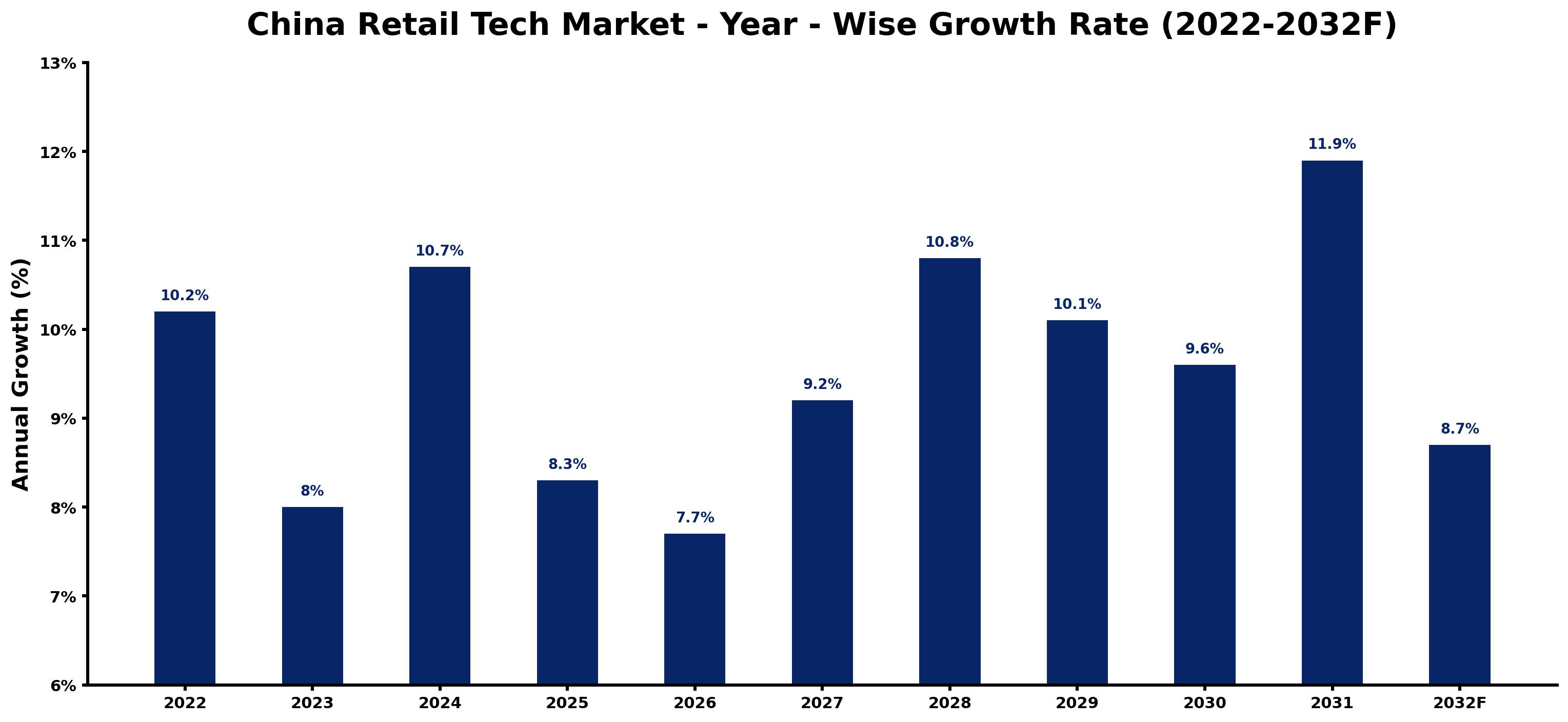
Annual growth estimates for each year appear below with the principal reason behind them, explaining the shifts that set the pace of the market.
| Year | Estimated Annual Growth (%) | Market Rationale |
| 2022 | 10.2 | The retail sector generated over 44 trillion CNY in revenue, indicating strong market activity. |
| 2023 | 8.0 | Growth slowed as the number of retail chains reached approximately 1.5 million, reflecting market maturation. |
| 2024 | 10.7 | Increased adoption of inventory automation technology drove faster growth in retail tech. |
| 2025 | 8.3 | E-commerce transactions rose by 15%, contributing to a steady demand for retail technology. |
| 2026 | 7.7 | The market is expected to experience a slowdown as urbanisation continues to drive retail tech demand. |
| 2027 | 9.2 | Growing AI adoption in retail analytics is projected to spur demand for advanced solutions. |
| 2028 | 10.8 | The introduction of new technologies will lead to faster growth in the retail tech market. |
| 2029 | 10.1 | Retailers are expected to report using customer analytics tools, sustaining demand for tech solutions. |
| 2030 | 9.6 | The market is projected to slow as the average consumer makes 3.5 online purchases per month. |
| 2031 | 11.9 | The peak growth year will be driven by substantial investments in retail technology. |
| 2032 | 8.7 | Growth is expected to slow as the integration of smart technologies in retail reaches 50%. |
Note: Market size estimations and growth projections presented in this report are based on 6Wresearch's proprietary forecasting methodology, utilizing the latest available industry data, government publications, and primary research inputs.
China Retail Tech Market Synopsis
Retail Tech in China encompasses technologies designed to improve shopping experiences and streamline operations. This includes point-of-sale systems, inventory management, and customer engagement tools. The China Retail Tech Market is expanding due to urbanisation, e-commerce growth, and increased investment in technology. In 2022, the retail sector generated over 44 trillion CNY in revenue, reflecting strong demand for these solutions. Ongoing digital transformation initiatives are further driving technology adoption across the retail sector.
Market Dynamics Impact Analysis (2026–2032)
| Factor | Type | Impact | Primary Segment Affected |
| Urbanisation drives demand for retail technology solutions. | Driver | High | Inventory Automation |
| Growing e-commerce transactions lead to increased technology investments. | Driver | High | POS & Payment Systems |
| Shanghai is emerging as a major hub for retail technology adoption. | Opportunity | Medium | Customer Analytics |
| Retail chains are increasingly seeking integrated solutions to enhance efficiency. | Opportunity | High | Omnichannel Integration |
| High competition among retailers may limit technology investments. | Restraint | Medium | POS & Payment Systems |
| The rapid pace of technological change can lead to obsolescence. | Restraint | High | Inventory Automation |
| Retailers face challenges in integrating new technologies effectively. | Challenge | High | Customer Analytics |
| Limited skilled workforce in retail tech hampers growth potential. | Challenge | Medium | Omnichannel Integration |
Evaluation of Drivers in China Retail Tech Market (2026–2032)
Below mentioned are some major drivers and their influence on market dynamics.
| Drivers | Primary Segment Affected | Why It Matters (Evidence) |
| Urbanisation increases the need for efficient inventory management systems. | Inventory Automation | Over 60% of retailers in China utilize inventory automation technology. |
| E-commerce growth drives demand for advanced payment systems. | POS & Payment Systems | The retail sector generated over 44 trillion CNY in revenue in 2022. |
| AI adoption improves customer analytics capabilities. | Customer Analytics | AI adoption in retail analytics is projected to reach 70% by 2025. |
| Cloud solutions provide flexibility for retail operations. | SaaS Platforms | Over 80% of retail businesses in China have adopted cloud-based solutions. |
| Integration of smart technologies improves operational efficiency. | Omnichannel Integration | The 'Smart Retail Development Plan' targets a 50% integration of smart technologies by 2025. |
Growth across the Retail Tech market in China is anchored in urbanisation, e-commerce expansion, and technological advancements. In 2022, the retail sector generated over 44 trillion CNY in revenue, driving demand for efficient inventory management systems. The adoption of AI in retail analytics is projected to reach 70% by 2025, providing deeper customer insights. Over 80% of retail businesses have embraced cloud solutions, which offer flexibility in operations. The 'Digital Economy Development Plan' aims for a 30% increase in digital transactions by 2025, further boosting market growth.
Evaluation of Restraints in China Retail Tech Market
Below mentioned are some major restraints and their influence on market dynamics.
| Market Restraint | Primary Segment Affected | Why It Matters (Evidence) |
| High competition among retailers limits investment in new technologies. | POS & Payment Systems | Retailers face pressure to maintain low prices, affecting technology budgets. |
| Rapid technological advancements lead to potential obsolescence. | Inventory Automation | Retailers must continuously upgrade systems to remain competitive, risking budget constraints. |
| Integration challenges hinder effective technology implementation. | Customer Analytics | Many retailers struggle with aligning new systems with existing operations, delaying technology adoption. |
| Limited skilled workforce affects technology adoption rates. | Omnichannel Integration | A shortage of trained professionals delays implementation of advanced solutions, impacting efficiency. |
| Regulatory compliance can increase operational costs. | POS & Payment Systems | The 'E-commerce Law' mandates strict adherence to consumer protection standards, raising operational expenses. |
China Retail Tech Market Challenges
China's retail tech market still has to solve a few problems, starting with high implementation costs. In 2023, the total investment in retail technology was estimated at 500 billion CNY, which can strain budgets for smaller retailers. Next, competition among approximately 1.5 million retail chains intensifies the pressure to adopt new technologies quickly, leading to rushed decisions that may not align with long-term strategies. Supply chain issues arise as over 60% of businesses rely on inventory automation, which can falter without reliable hardware support, risking stock shortages. Technology adoption also lags in some areas; for instance, only 40% of businesses reported using customer analytics tools, limiting their ability to engage effectively with consumers.
Trends in the China Retail Tech Market
Buyers and suppliers in the China Retail Tech Market are adjusting to the following trends.
- Digital Touchpoints Expanding in Retail Spaces: Shanghai is experiencing a surge in digital touchpoints, with the average retail space equipped with at least 5 as of 2023. This trend improves customer engagement and streamlines operations.
- Rise of AI in Retail Analytics: AI/ML Engines are increasingly adopted, with an expected 70% usage in retail analytics by 2025. This shift allows retailers to gain deeper insights into consumer behaviour.
- Growth of Contactless Payment Methods: Contactless payment methods have reached 75% adoption in urban areas by 2023. This trend facilitates quicker transactions and improves customer satisfaction.
- Integration of Cloud Solutions: Over 80% of retail businesses in China have adopted cloud-based solutions as of 2023. This shift enables greater flexibility and scalability in retail operations.
Investment Opportunities in the China Retail Tech Market
Investors looking at the China Retail Tech Market should consider the following areas.
- Shanghai as a Retail Tech Hub: Shanghai's retail sector is experiencing rapid technology adoption, with over 60% of retailers using inventory automation. This presents an opportunity for suppliers to invest in advanced solutions.
- Investment Gap in Customer Analytics: With 40% of retailers using customer analytics tools, there is an opportunity to supply advanced analytics solutions. Retail chains are eager to enhance their capabilities and improve customer engagement.
- Demand for Omnichannel Solutions: Retail chains are increasingly seeking integrated solutions for customer experiences. This presents an opportunity for suppliers to provide comprehensive omnichannel platforms that cater to evolving consumer preferences.
- Growth in E-commerce Technology: The 15% increase in e-commerce transactions in 2023 highlights a demand for advanced retail tech solutions. Suppliers can enter this market by partnering with local retailers to meet growing needs.
Government Initiatives in the China Retail Tech Market
In 2021, the Chinese government launched the 'E-commerce Law' to regulate online retail practices, promoting consumer protection and fair competition. This law ensures that retailers comply with standards, impacting their operational strategies. The 'Digital Economy Development Plan' was also initiated in 2021, aiming for a 30% increase in digital transactions by 2025. This initiative supports the adoption of retail technologies, driving growth in the sector. Additionally, the 'Smart Retail Development Strategy' was introduced in 2021, targeting a 50% integration of smart technologies in retail by 2025, enhancing operational efficiency.
The Ministry of Commerce oversees the 'Digital Economy Development Plan', which funds pilot projects to support technology adoption. This initiative allocates resources to help businesses integrate new technologies effectively. The 'Retail Digital Transformation Initiative' also provides resources for retailers to adopt advanced solutions, with a budget of 200 million CNY for projects. These measures collectively aim to modernise the retail sector and improve operational efficiency, enabling retailers to enhance their service offerings.
Future Insight of the China Retail Tech Market
The retail tech market in China will experience significant shifts by 2032, primarily driven by advancements in digital integration. The 'Digital Economy Development Plan' will support technology adoption across retail sectors, resulting in improved customer engagement. AI integration in retail analytics is expected to reach 70% by 2025, enabling data-driven marketing strategies. With urbanisation pushing the urban population to 64% in 2023, buyers will increasingly demand more interactive shopping experiences, compelling suppliers to innovate continuously.
Market Segmentation Analysis
Each segment group is reviewed below, with the leader by share and the fastest grower by CAGR.
By Segment – POS & Payment Systems Dominated, Customer Analytics Expected to Grow Fastest
According to Ravi Bhandari, Research Head at 6Wresearch, in 2025, POS & Payment Systems led the segment split with a 40% share. POS and payment systems hold a substantial share in China's retail tech market because they are vital for executing transactions across various retail environments. With around 1.5 million retail chains in operation, these systems are crucial for maintaining efficient operations. The quickest growth will come from Customer Analytics, forecast to expand at a CAGR of 12.4% between 2026 and 2032. Customer analytics is witnessing rapid growth as retailers aim to gain deeper insights into consumer behaviour and preferences. In 2023, approximately 40% of retailers reported using customer analytics tools, signalling a strong demand for data-driven decision-making. This trend indicates that suppliers should enhance customer analytics solutions to better meet the evolving needs of retailers.
By Technology Type – AI/ML Engines Dominated and Is Expected to Record the Fastest Growth
With a 45% revenue share in 2025, AI/ML Engines was the largest technology type category. AI and machine learning engines dominate the market share as they are essential for predictive analytics and personalised marketing strategies. The expected 70% adoption of AI in retail analytics by 2025 highlights their critical role in the sector. Its lead should widen, with a projected CAGR of 10.8% during 2026–2032, the highest in this split. The growth of AI and machine learning engines will continue to accelerate as retailers increasingly rely on these technologies for enhanced decision-making and customer engagement. Their foundational importance in retail tech ensures that their market lead will expand further. Suppliers should prioritise the development of advanced AI and machine learning solutions to maintain a competitive edge in the retail tech sector.
By Deployment Mode – SaaS Platforms Dominated, On-Premise/Cloud Expected to Grow Fastest
SaaS Platforms accounted for a 40% market share by deployment mode in 2025. SaaS platforms capture the largest share due to their flexibility and scalability, making them highly suitable for retail solutions. Retailers prefer SaaS for its seamless integration and cost-effectiveness, aligning with the growing number of retail chains. On-Premise/Cloud is set to record the highest CAGR in this split, 10.7% over 2026–2032. On-premise and cloud deployment modes are gaining traction as businesses seek tailored solutions that cater to specific operational needs, driving their rapid growth in the market. This shift underscores the necessity for adaptable technology solutions. This trend suggests that suppliers should offer a variety of deployment options to address the diverse needs of retailers.
By End User – Retail Chains Dominated, Warehouse & Store Teams Expected to Grow Fastest
Retail Chains held a 43% share of the China Retail Tech Market by end user in 2025. Retail chains account for the largest share in the end-user segment as they are the primary adopters of retail tech aimed at enhancing operational efficiency. Their significant presence in the market underscores the critical role of technology in streamlining retail operations. Over 2026–2032, Warehouse & Store Teams are expected to post the fastest growth, at a CAGR of 11.9%. Warehouse and store teams are emerging as the fastest-growing end-user group as they increasingly utilise technology to boost operational efficiency. This trend reflects a rising demand for solutions that improve logistics and inventory management capabilities. Suppliers should focus on developing targeted solutions for warehouse and store teams to capitalise on this growth opportunity.
Key Attractiveness of the Report
- 10 Years of Market Numbers
- Historical Data Starting from 2022 to 2025
- Base Year 2025
- Forecast Data until 2032
- Key Performance Indicators Impacting the Market
- Major Upcoming Developments and Projects
Key Highlights of the Report:
- China Retail Tech Market Outlook
- Market Size of China Retail Tech Market, 2025
- Forecast of China Retail Tech Market, 2032
- Historical Data and Forecast of China Retail Tech Revenues & Volume for the Period 2022 - 2032F
- China Retail Tech Market Trend Evolution
- China Retail Tech Market Drivers and Challenges
- China Retail Tech Price Trends
- China Retail Tech Porter's Five Forces
- China Retail Tech Industry Life Cycle
- Historical Data and Forecast of China Retail Tech Market Revenues & Volume By Segment for the Period 2022 - 2032F
- Historical Data and Forecast of China Retail Tech Market Revenues & Volume By POS & Payment Systems for the Period 2022 - 2032F
- Historical Data and Forecast of China Retail Tech Market Revenues & Volume By Inventory Automation for the Period 2022 - 2032F
- Historical Data and Forecast of China Retail Tech Market Revenues & Volume By Customer Analytics for the Period 2022 - 2032F
- Historical Data and Forecast of China Retail Tech Market Revenues & Volume By Omnichannel Integration for the Period 2022 - 2032F
- Historical Data and Forecast of China Retail Tech Market Revenues & Volume By Technology Type for the Period 2022 - 2032F
- Historical Data and Forecast of China Retail Tech Market Revenues & Volume By Contactless/Digital for the Period 2022 - 2032F
- Historical Data and Forecast of China Retail Tech Market Revenues & Volume By RFID/IoT Sensors for the Period 2022 - 2032F
- Historical Data and Forecast of China Retail Tech Market Revenues & Volume By AI/ML Engines for the Period 2022 - 2032F
- Historical Data and Forecast of China Retail Tech Market Revenues & Volume By ERP/WMS Integration for the Period 2022 - 2032F
- Historical Data and Forecast of China Retail Tech Market Revenues & Volume By Deployment Mode for the Period 2022 - 2032F
- Historical Data and Forecast of China Retail Tech Market Revenues & Volume By On-Premise/Cloud for the Period 2022 - 2032F
- Historical Data and Forecast of China Retail Tech Market Revenues & Volume By Edge-Enabled for the Period 2022 - 2032F
- Historical Data and Forecast of China Retail Tech Market Revenues & Volume By SaaS Platforms for the Period 2022 - 2032F
- Historical Data and Forecast of China Retail Tech Market Revenues & Volume By Integrated Suites for the Period 2022 - 2032F
- Historical Data and Forecast of China Retail Tech Market Revenues & Volume By End User for the Period 2022 - 2032F
- Historical Data and Forecast of China Retail Tech Market Revenues & Volume By Retail Chains for the Period 2022 - 2032F
- Historical Data and Forecast of China Retail Tech Market Revenues & Volume By Warehouse & Store Teams for the Period 2022 - 2032F
- Historical Data and Forecast of China Retail Tech Market Revenues & Volume By Marketing & CX Teams for the Period 2022 - 2032F
- Historical Data and Forecast of China Retail Tech Market Revenues & Volume By Omnichannel Retailers for the Period 2022 - 2032F
- China Retail Tech Import Export Trade Statistics
- Market Opportunity Assessment By Segment
- Market Opportunity Assessment By Technology Type
- Market Opportunity Assessment By Deployment Mode
- Market Opportunity Assessment By End User
- China Retail Tech Top Companies Market Share
- China Retail Tech Competitive Benchmarking By Technical and Operational Parameters
- China Retail Tech Company Profiles
- China Retail Tech Key Strategic Recommendations
Market Covered
Segments analysed in this report are listed below.
By Segment
- POS & Payment Systems
- Inventory Automation
- Customer Analytics
- Omnichannel Integration
By Technology Type
- Contactless/Digital
- RFID/IoT Sensors
- AI/ML Engines
- ERP/WMS Integration
By Deployment Mode
- On-Premise/Cloud
- Edge-Enabled
- SaaS Platforms
- Integrated Suites
By End User
- Retail Chains
- Warehouse & Store Teams
- Marketing & CX Teams
- Omnichannel Retailers































