India Reverse Engineering Market Size & Growth Rate
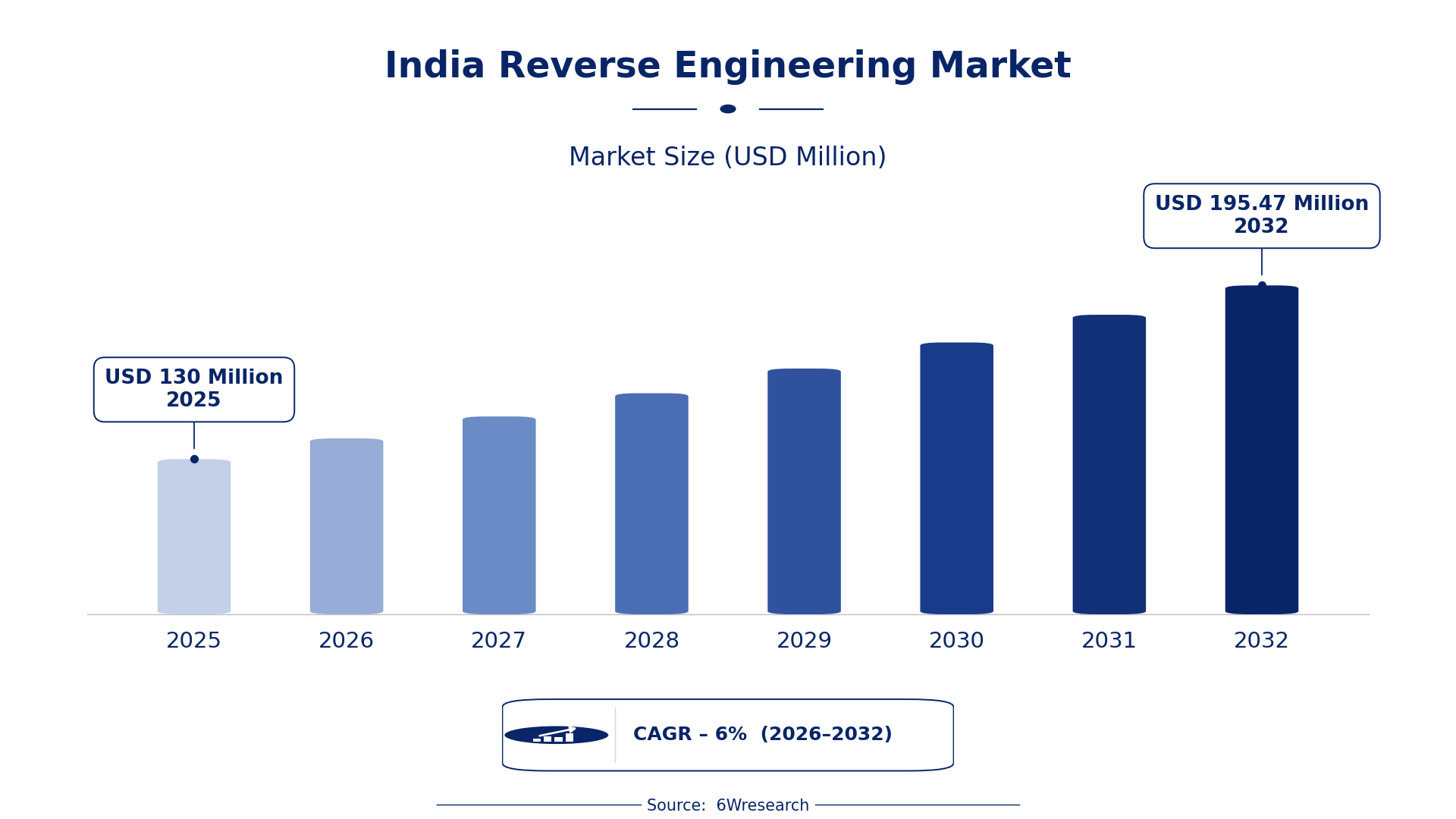
According to 6Wresearch internal database and industry insights, the India Reverse Engineering Market was valued at USD 130.0 million in 2025 and is projected to reach USD 195.47 million by 2032, growing at a CAGR of approximately 6% during 2026–2032.
India Reverse Engineering Market Highlights
| Report Metric | Details |
| Report Name | India Reverse Engineering Market |
| Market Size 2025 | USD 130.0 million |
| Market Size 2032 | USD 195.47 million |
| Absolute Growth 2025–2032 | USD 65.47 million |
| CAGR 2026–2032 | 6% |
| Peak Annual Growth | 8.1% in 2026 |
| Forecast Period | 2026–2032 |
| Historical Data | 2022–2025 |
| Base Year | 2025 |
| Leading Application, 2025 | CAD Model Creation (35% share) |
| Leading Tool Type, 2025 | 3D Scanners (39% share) |
| Leading Output Format, 2025 | Solid/Surface Models (46% share) |
| Leading End User, 2025 | Electronics Manufacturers (47% share) |
| Fastest-Growing Application | Software Reverse Analysis (8.4% CAGR) |
| Fastest-Growing Tool Type | Decompilers (7.6% CAGR) |
| Fastest-Growing Output Format | Decompiled Code (7.6% CAGR) |
| Fastest-Growing End User | Cybersecurity Teams (8.0% CAGR) |
| Growing Sector | Electronics Manufacturing |
| Key End Users | Electronics Manufacturers, Product Design Firms, Cybersecurity Teams, Enterprise IT |
India Reverse Engineering Market Year-wise Growth Rate and Key Drivers (2022–2032)
This graph illustrates the annual growth rates of the market from 2022 to 2032, highlighting a steady upward trajectory and projected market expansion over the forecast period.
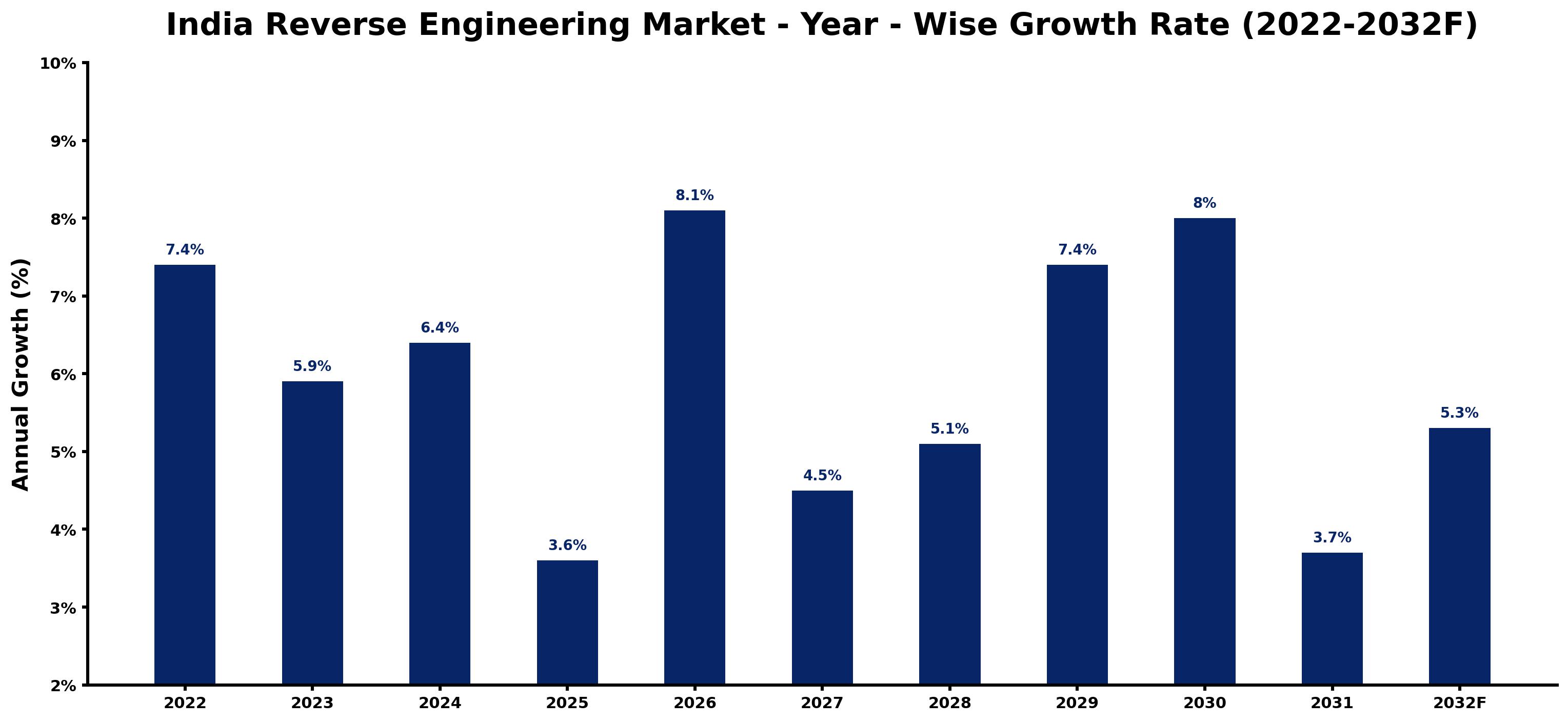
Year by year, the estimates below pair each growth rate with the development that shaped it.
| Year | Estimated Annual Growth (%) | Market Rationale |
| 2022 | 7.4 | The market experienced strong demand driven by the Electronics Manufacturing sector's growth. |
| 2023 | 5.9 | Growth slowed as the market adjusted to previous high demand levels in electronics. |
| 2024 | 6.4 | Increased investments in CAD model creation boosted growth in reverse engineering applications. |
| 2025 | 3.6 | Growth slowed again as the market began to stabilise after rapid expansion. |
| 2026 | 8.1 | A surge in software reverse analysis drove growth in the market. |
| 2027 | 4.5 | Growth slowed as the market faced challenges in integrating new technologies. |
| 2028 | 5.1 | Increased focus on legacy system modernization contributed to a rise in demand. |
| 2029 | 7.4 | Electronics manufacturers expanded their product lines, accelerating growth. |
| 2030 | 8.0 | Continued investments in cybersecurity measures stimulated market demand. |
| 2031 | 3.7 | Growth slowed as the market matured and faced increasing competition. |
| 2032 | 5.3 | A renewed focus on advanced manufacturing technologies spurred growth in reverse engineering. |
Note: Market size estimations and growth projections presented in this report are based on 6Wresearch's proprietary forecasting methodology, utilizing the latest available industry data, government publications, and primary research inputs.
India Reverse Engineering Market Synopsis
Reverse Engineering in India involves analysing products to grasp their design and functionality. This technology employs specialised tools such as 3D scanners and software decompilers, primarily for creating CAD models and updating legacy systems. The India Reverse Engineering Market is growing due to heightened demand from the electronics sector, which employs over 1.5 million individuals. The 'Make in India' initiative and rising investments in cybersecurity are primary drivers of this expansion.
Market Dynamics Impact Analysis (2026–2032)
| Factor | Type | Impact | Primary Segment Affected |
| Growing demand for CAD model creation in product design. | Driver | High | CAD Model Creation |
| Increased focus on software reverse analysis for cybersecurity. | Driver | High | Software Reverse Analysis |
| Rising investments in advanced manufacturing technologies. | Opportunity | High | 3D Scanners |
| Expanding electronics manufacturing sector seeking innovation. | Opportunity | High | Electronics Manufacturers |
| Challenges in integrating new technologies into existing systems. | Restraint | Medium | Legacy System Modernization |
| Limited awareness of reverse engineering practices among new users. | Restraint | Medium | Hardware Analysis |
| High costs associated with advanced reverse engineering tools. | Challenge | Medium | Decompilers |
| Competition from alternative technologies in product design. | Challenge | Medium | Solid/Surface Models |
Evaluation of Drivers in India Reverse Engineering Market (2026–2032)
The main growth drivers and the segments they affect most are set out below.
| Drivers | Primary Segment Affected | Why It Matters (Evidence) |
| Increasing demand for CAD models in product design. | CAD Model Creation | The CAD model creation segment is projected to dominate the market, with a 35% share in 2025. |
| Growing need for software reverse analysis in cybersecurity. | Software Reverse Analysis | Cybersecurity teams are increasingly using software reverse analysis to combat threats, driving demand. |
| Expansion of the electronics manufacturing sector. | Electronics Manufacturers | The sector employs over 1.5 million people, boosting reverse engineering demand. |
| Rising investments in legacy system modernization. | Legacy System Modernization | Many enterprises seek to upgrade outdated technologies, increasing the need for reverse engineering. |
| Adoption of 3D scanning technology for hardware analysis. | 3D Scanners | In 2022, the installed base of 3D scanners in India was estimated at over 5,000 units. |
Market growth for Reverse Engineering in India is driven by the rising need for CAD models, the growth of the electronics manufacturing sector, and investments in modernising legacy systems. The CAD model creation segment is expected to capture a 35% market share by 2025. The electronics sector, employing over 1.5 million people, is a key contributor to reverse engineering demand. In 2022, the installed base of 3D scanners was estimated at over 5,000 units, aiding hardware analysis. Companies are keen to upgrade outdated technologies, which fuels the demand for reverse engineering tools.
Evaluation of Restraints in India Reverse Engineering Market
Below mentioned are some major restraints and their influence on market dynamics.
| Market Restraint | Primary Segment Affected | Why It Matters (Evidence) |
| High costs associated with advanced reverse engineering tools. | Decompilers | The investment required for advanced tools can limit adoption among smaller firms. |
| Limited awareness of reverse engineering practices among new users. | Hardware Analysis | Many potential users lack knowledge of reverse engineering benefits, hindering market growth. |
| Challenges in integrating new technologies into existing systems. | Legacy System Modernization | Integration issues can delay modernization efforts, affecting overall market performance. |
| Competition from alternative technologies in product design. | Solid/Surface Models | Alternative methods may be preferred by some manufacturers, limiting reverse engineering's market share. |
| Regulatory hurdles in software reverse analysis. | Software Reverse Analysis | Compliance with cybersecurity regulations can complicate reverse engineering processes. |
India Reverse Engineering Market Challenges
Buyers in the India reverse engineering market face a shortage of advanced technology, limiting their ability to create accurate CAD models and extending product design timelines. This problem stems from the high costs associated with importing specialised tools, which can delay projects for electronics manufacturers. Suppliers struggle with regulatory compliance, as the guidelines set by the Bureau of Indian Standards are often misunderstood, leading to potential fines and project delays. Additionally, rising operational costs for reverse engineering tools can inflate prices by up to 15%, straining budgets for domestic users and reducing their purchasing capacity.
Trends in the India Reverse Engineering Market
Four trends stand out in the India Reverse Engineering Market.
- Launch of the 'Digital India' Initiative: The 'Digital India' initiative, introduced in 2022 with a budget of ₹1,500 crores, aims to enhance technology adoption. This programme supports the integration of reverse engineering tools, boosting demand among electronics manufacturers.
- Rise in Cybersecurity Measures: In 2023, the Indian IT Ministry unveiled a programme to strengthen cybersecurity through reverse engineering techniques. This initiative is set to increase demand for software reverse analysis tools.
- Focus on Legacy System Modernization: The increasing need for legacy system modernisation is clear as enterprises strive to upgrade outdated technologies. This trend is driving demand for reverse engineering tools and services across various sectors.
- Increased Adoption of 3D Scanners: The installed base of 3D scanners in India surpassed 5,000 units in 2022. This widespread adoption is facilitating hardware analysis and CAD model creation across multiple industries.
Investment Opportunities in the India Reverse Engineering Market
Investors looking at the India Reverse Engineering Market should consider the following areas.
- Electronics Manufacturing Sector Expansion: The electronics manufacturing sector, employing over 1.5 million people, presents opportunities for reverse engineering tools. The government allocated funds in 2023 for technology upgrades, creating openings for suppliers.
- Investment in Cybersecurity Solutions: With increasing cybersecurity threats, there is a growing need for reverse engineering tools. The government allocated funds in 2023 for technology upgrades, creating opportunities for suppliers in this space.
- Growth in Legacy System Modernization: As many enterprises seek to upgrade outdated technologies, there is a substantial gap in reverse engineering services. Suppliers can target this need by forming joint ventures with local firms.
- Development of Advanced Manufacturing Technologies: The government's scheme in 2023 to promote advanced manufacturing technologies offers a chance for investment in reverse engineering tools. Collaborating with local manufacturers can facilitate market entry.
Government Initiatives in the India Reverse Engineering Market
In 2022, the Ministry of Electronics and Information Technology launched the 'Digital India' initiative with a budget of ₹1,500 crores to improve technology adoption, including reverse engineering tools. This initiative supports the integration of advanced tools across various sectors, boosting productivity and innovation.
The Department of Science and Technology approved a new framework for promoting reverse engineering in R&D projects in 2021. This framework aims to stimulate innovation and is backed by ongoing support from the 'Make in India' programme, which continues to fund reverse engineering initiatives, benefiting local manufacturers.
Future Insight of the India Reverse Engineering Market
The reverse engineering market in India is set for substantial changes by 2032, driven by several key factors. The 'Make in India' initiative will continue to strengthen local manufacturing capabilities, increasing the demand for reverse engineering tools. By 2032, the installed base of 3D scanners is expected to exceed 10,000 units, enabling more efficient CAD model creation. Additionally, the Indian IT Ministry's emphasis on cybersecurity will encourage the use of software reverse analysis, equipping enterprises to effectively tackle emerging threats.
Market Segmentation Analysis
Each segment group is reviewed below, with the leader by share and the fastest grower by CAGR.
By Application – CAD Model Creation Dominated, Software Reverse Analysis Expected to Grow Fastest
According to Ravi Bhandari, Research Head at 6Wresearch, CAD Model Creation took a 35% share of application in 2025, more than any other category. The CAD model creation segment holds the largest share due to its critical role in product design, particularly in the electronics sector. As manufacturers increasingly rely on CAD models for innovative designs, the segment's dominance is reinforced by the growing installed base of reverse engineering tools. Over 2026–2032, Software Reverse Analysis is expected to post the fastest growth, at a CAGR of 8.4%. Software reverse analysis is rapidly gaining traction as cybersecurity teams adopt it to combat emerging threats. The Indian IT Ministry's initiative in 2023 to enhance cybersecurity measures is expected to further drive this segment's growth. Suppliers should focus on developing advanced software reverse analysis tools to meet the rising demands of cybersecurity teams.
By Tool Type – 3D Scanners Dominated, Decompilers Expected to Grow Fastest
3D Scanners held a 39% share of the India Reverse Engineering Market by tool type in 2025. 3D scanners lead the market share as they are essential for accurately capturing the dimensions of physical objects, which is vital for various reverse engineering applications. The installed base of over 5,000 units in India highlights their widespread use and importance in the industry. Decompilers are projected to grow fastest, at a CAGR of 7.6% during 2026–2032. Decompilers are experiencing the fastest growth, primarily due to their increasing necessity in software analysis and debugging tasks. As software complexity escalates, the demand for effective decompilation tools is projected to rise significantly. Buyers should invest in advanced decompilers to improve their software analysis capabilities and maintain a competitive advantage.
By Output Format – Solid/Surface Models Dominated, Decompiled Code Expected to Grow Fastest
Solid/Surface Models accounted for a 46% market share by output format in 2025. Solid/surface models dominate the market share as they are the standard output format for CAD applications in reverse engineering, widely used across various industries. Their consistent relevance in product design ensures a steady demand within the reverse engineering market. Decompiled Code is set to record the highest CAGR in this split, 7.6% over 2026–2032. Decompiled code is the fastest-growing output format, driven by the escalating need for software analysis and debugging in cybersecurity. As organisations prioritise security, demand for this output format is anticipated to increase significantly. Suppliers must ensure their offerings include robust solutions for generating decompiled code to address the growing needs of cybersecurity teams.
By End User – Electronics Manufacturers Dominated, Cybersecurity Teams Expected to Grow Fastest
In 2025, Electronics Manufacturers led the end user split with a 47% share. Electronics manufacturers represent the largest share of end users, heavily relying on reverse engineering for product innovation and development. With over 1.5 million people employed in this sector, their sustained demand for reverse engineering tools remains strong. The quickest growth will come from Cybersecurity Teams, forecast to expand at a CAGR of 8.0% between 2026 and 2032. Cybersecurity teams are the fastest-growing end users, utilising reverse engineering to identify and mitigate vulnerabilities in software systems. The heightened focus on cybersecurity measures is driving this segment's rapid expansion, indicating a shift in market priorities. Suppliers should tailor their products to address the specific needs of cybersecurity teams, ensuring competitiveness in this expanding market.
Key Attractiveness of the Report
- 10 Years of Market Numbers
- Historical Data Starting from 2022 to 2025
- Base Year 2025
- Forecast Data until 2032
- Key Performance Indicators Impacting the Market
- Major Upcoming Developments and Projects
Key Highlights of the Report:
- India Reverse Engineering Market Outlook
- Market Size of India Reverse Engineering Market, 2025
- Forecast of India Reverse Engineering Market, 2032
- Historical Data and Forecast of India Reverse Engineering Revenues & Volume for the Period 2022 - 2032F
- India Reverse Engineering Market Trend Evolution
- India Reverse Engineering Market Drivers and Challenges
- India Reverse Engineering Price Trends
- India Reverse Engineering Porter's Five Forces
- India Reverse Engineering Industry Life Cycle
- Historical Data and Forecast of India Reverse Engineering Market Revenues & Volume By Application for the Period 2022 - 2032F
- Historical Data and Forecast of India Reverse Engineering Market Revenues & Volume By CAD Model Creation for the Period 2022 - 2032F
- Historical Data and Forecast of India Reverse Engineering Market Revenues & Volume By Hardware Analysis for the Period 2022 - 2032F
- Historical Data and Forecast of India Reverse Engineering Market Revenues & Volume By Software Reverse Analysis for the Period 2022 - 2032F
- Historical Data and Forecast of India Reverse Engineering Market Revenues & Volume By Legacy System Modernization for the Period 2022 - 2032F
- Historical Data and Forecast of India Reverse Engineering Market Revenues & Volume By Tool Type for the Period 2022 - 2032F
- Historical Data and Forecast of India Reverse Engineering Market Revenues & Volume By 3D Scanners for the Period 2022 - 2032F
- Historical Data and Forecast of India Reverse Engineering Market Revenues & Volume By Microscopy + Imaging for the Period 2022 - 2032F
- Historical Data and Forecast of India Reverse Engineering Market Revenues & Volume By Decompilers for the Period 2022 - 2032F
- Historical Data and Forecast of India Reverse Engineering Market Revenues & Volume By Reverse ETL for the Period 2022 - 2032F
- Historical Data and Forecast of India Reverse Engineering Market Revenues & Volume By Output Format for the Period 2022 - 2032F
- Historical Data and Forecast of India Reverse Engineering Market Revenues & Volume By Solid/Surface Models for the Period 2022 - 2032F
- Historical Data and Forecast of India Reverse Engineering Market Revenues & Volume By Schematic Reproduction for the Period 2022 - 2032F
- Historical Data and Forecast of India Reverse Engineering Market Revenues & Volume By Decompiled Code for the Period 2022 - 2032F
- Historical Data and Forecast of India Reverse Engineering Market Revenues & Volume By Data Integration for the Period 2022 - 2032F
- Historical Data and Forecast of India Reverse Engineering Market Revenues & Volume By End User for the Period 2022 - 2032F
- Historical Data and Forecast of India Reverse Engineering Market Revenues & Volume By Product Design Firms for the Period 2022 - 2032F
- Historical Data and Forecast of India Reverse Engineering Market Revenues & Volume By Electronics Manufacturers for the Period 2022 - 2032F
- Historical Data and Forecast of India Reverse Engineering Market Revenues & Volume By Cybersecurity Teams for the Period 2022 - 2032F
- Historical Data and Forecast of India Reverse Engineering Market Revenues & Volume By Enterprise IT for the Period 2022 - 2032F
- India Reverse Engineering Import Export Trade Statistics
- Market Opportunity Assessment By Application
- Market Opportunity Assessment By Tool Type
- Market Opportunity Assessment By Output Format
- Market Opportunity Assessment By End User
- India Reverse Engineering Top Companies Market Share
- India Reverse Engineering Competitive Benchmarking By Technical and Operational Parameters
- India Reverse Engineering Company Profiles
- India Reverse Engineering Key Strategic Recommendations
Market Covered
Segments analysed in this report are listed below.
By Application
- CAD Model Creation
- Hardware Analysis
- Software Reverse Analysis
- Legacy System Modernization
By Tool Type
- 3D Scanners
- Microscopy + Imaging
- Decompilers
- Reverse ETL
By Output Format
- Solid/Surface Models
- Schematic Reproduction
- Decompiled Code
- Data Integration
By End User
- Product Design Firms
- Electronics Manufacturers
- Cybersecurity Teams
- Enterprise IT































