China Reverse Engineering Market Size & Growth Rate
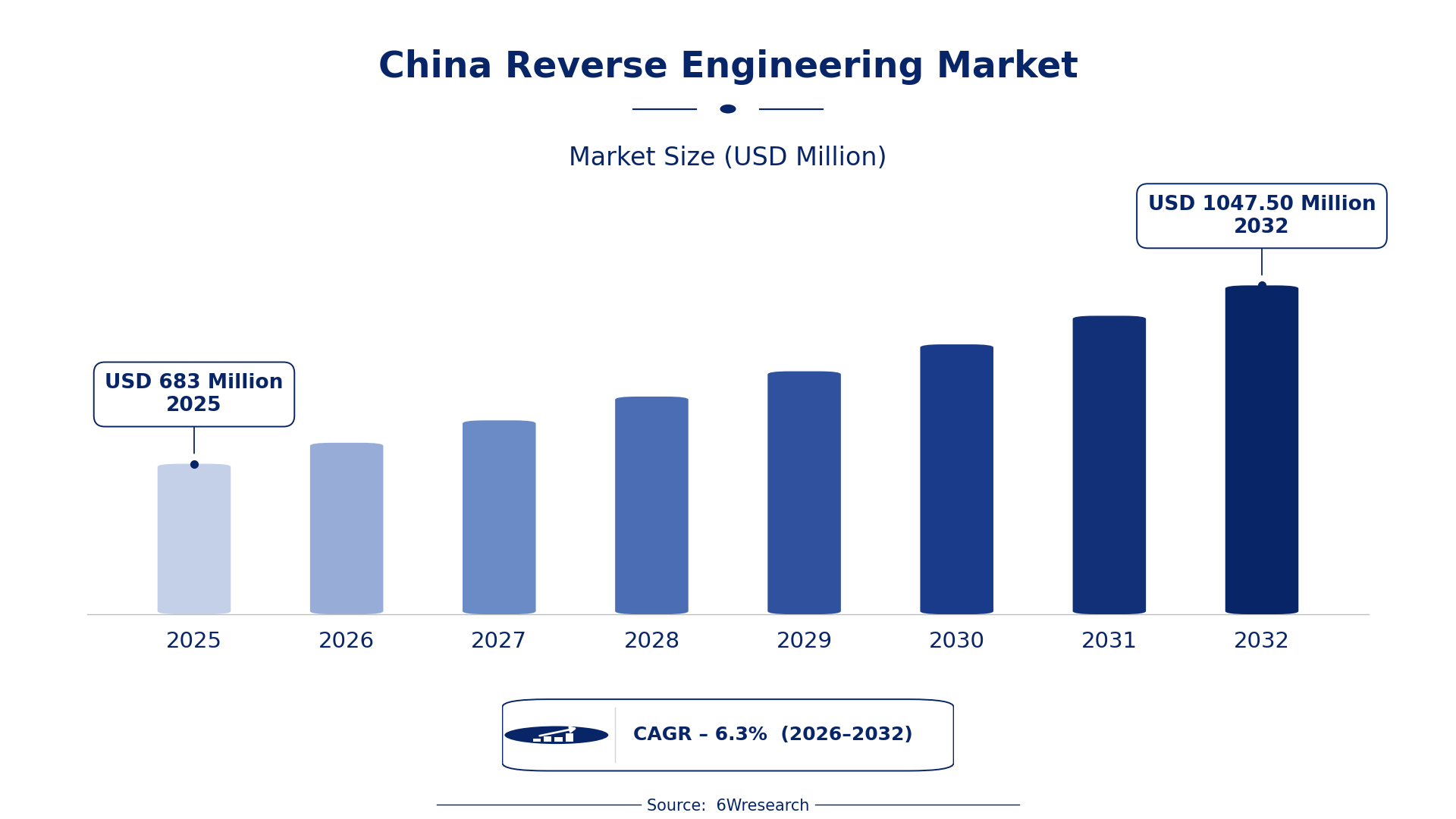
According to 6Wresearch internal database and industry insights, the China Reverse Engineering Market was valued at USD 683.0 million in 2025 and is projected to reach USD 1,047.50 million by 2032, growing at a CAGR of approximately 6.3% during 2026–2032.
China Reverse Engineering Market Highlights
| Report Metric | Details |
| Report Name | China Reverse Engineering Market |
| Market Size 2025 | USD 683.0 million |
| Market Size 2032 | USD 1,047.50 million |
| Absolute Growth 2025–2032 | USD 364.50 million |
| CAGR 2026–2032 | 6.3% |
| Peak Annual Growth | 8.3% in 2026 |
| Forecast Period | 2026–2032 |
| Historical Data | 2022–2025 |
| Base Year | 2025 |
| Leading Application, 2025 | CAD Model Creation (42% share) |
| Leading Tool Type, 2025 | 3D Scanners (45% share) |
| Leading Output Format, 2025 | Solid/Surface Models (43% share) |
| Leading End User, 2025 | Electronics Manufacturers (36% share) |
| Fastest-Growing Application | Legacy System Modernization (7.6% CAGR) |
| Fastest-Growing Tool Type | Decompilers (9.0% CAGR) |
| Fastest-Growing Output Format | Schematic Reproduction (8.4% CAGR) |
| Fastest-Growing End User | Cybersecurity Teams (8.3% CAGR) |
| Growing Sector | Electronics Manufacturing |
| Key End Users | Electronics Manufacturers, Product Design Firms, Cybersecurity Teams, Enterprise IT |
China Reverse Engineering Market Year-wise Growth Rate and Key Drivers (2022–2032)
This graph illustrates the annual growth rates of the market from 2022 to 2032, highlighting a steady upward trajectory and projected market expansion over the forecast period.
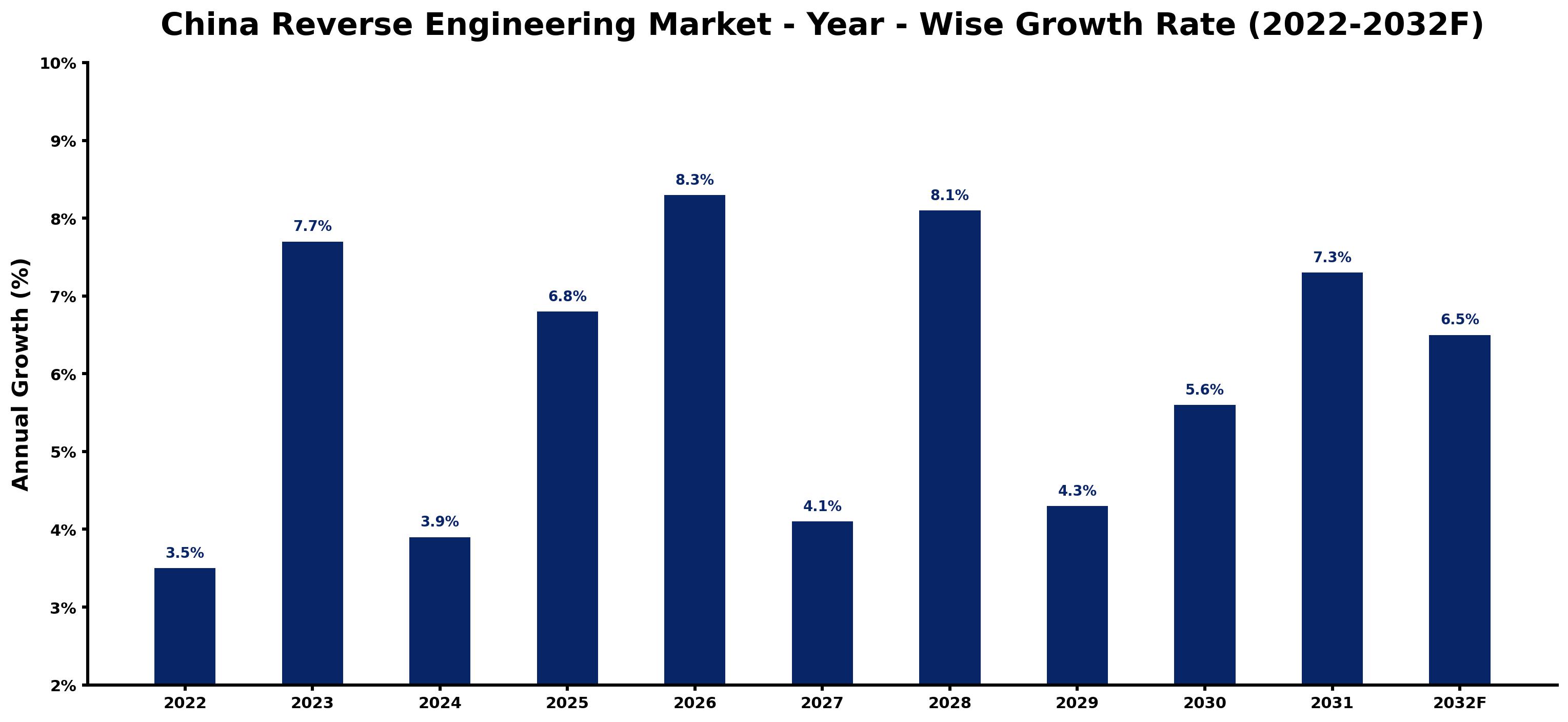
Annual growth estimates for each year appear below with the principal reason behind them, explaining the shifts that set the pace of the market.
| Year | Estimated Annual Growth (%) | Market Rationale |
| 2022 | 3.5 | The market experienced steady demand from various sectors, including electronics and IT. |
| 2023 | 7.7 | Growth accelerated due to increased investments in reverse engineering technologies. |
| 2024 | 3.9 | The growth rate slowed as the National Reverse Engineering Development Plan began to take effect. |
| 2025 | 6.8 | Demand surged as more electronics manufacturers adopted reverse engineering practices. |
| 2026 | 8.3 | The peak growth is expected to be driven by investments in legacy system modernization initiatives. |
| 2027 | 4.1 | A slowdown is projected as the market adjusts after peak growth in the previous year. |
| 2028 | 8.1 | Growth is anticipated to rebound with rising demand for cybersecurity solutions in reverse engineering. |
| 2029 | 4.3 | The market is expected to see a slight slowdown as demand begins to normalise. |
| 2030 | 5.6 | Growth is projected to pick up again as more firms integrate reverse engineering into product development. |
| 2031 | 7.3 | Demand is expected to strengthen as the electronics sector continues to invest heavily in reverse engineering. |
| 2032 | 6.5 | The market growth rate is projected to slow as it approaches maturity. |
Note: Market size estimations and growth projections presented in this report are based on 6Wresearch's proprietary forecasting methodology, utilizing the latest available industry data, government publications, and primary research inputs.
China Reverse Engineering Market Synopsis
The China Reverse Engineering Market encompasses the analysis and recreation of product designs through methods like 3D scanning and software analysis. This technology is essential for CAD model creation, hardware analysis, and software reverse analysis. The market is expanding due to strong domestic demand from over 1,000 product design firms and approximately 200 electronics manufacturers. With an expected investment of over 10 billion RMB in reverse engineering technologies by 2025, the market is set for continued growth driven by advancements in legacy system modernization and cybersecurity assessments.
Market Dynamics Impact Analysis (2026–2032)
| Factor | Type | Impact | Primary Segment Affected |
| Increased investment in CAD model creation by product design firms | Driver | High | CAD Model Creation |
| Rising demand for 3D scanners in various industries | Driver | High | 3D Scanners |
| Growing need for legacy system modernization in electronics | Opportunity | High | Legacy System Modernization |
| Surge in cybersecurity threats driving software reverse analysis | Opportunity | Medium | Software Reverse Analysis |
| Challenges in standardizing reverse engineering practices | Restraint | High | CAD Model Creation |
| Limited awareness of compliance guidelines among manufacturers | Restraint | Medium | CAD Model Creation |
| Shortage of skilled professionals in reverse engineering | Challenge | High | CAD Model Creation |
| High initial investment costs for advanced reverse engineering tools | Challenge | Medium | CAD Model Creation |
Evaluation of Drivers in China Reverse Engineering Market (2026–2032)
The factors lifting demand, and the evidence behind each, are summarised below.
| Drivers | Primary Segment Affected | Why It Matters (Evidence) |
| Strong domestic demand from product design firms | CAD Model Creation | This demand drives the need for accurate digital representations, with over 1,000 firms actively engaging in CAD model creation. |
| Growing installed base of 3D scanners | 3D Scanners | With an estimated 5,000 units in use, this technology is essential for capturing precise dimensions of physical objects. |
| Increased focus on cybersecurity assessments | Software Reverse Analysis | Cybersecurity teams have ramped up their use of software reverse analysis by 30% since 2020 to identify vulnerabilities. |
| Investment in legacy system modernization | Legacy System Modernization | The Ministry of Industry and Information Technology launched a program in 2023 to promote modernization, increasing demand. |
| Rising adoption of compliance standards | CAD Model Creation | The ISO/IEC 27001 standard is increasingly adopted, ensuring better practices in reverse engineering processes. |
Growth in the Reverse Engineering market in China is underpinned by increasing end-use demand from product design firms, electronics manufacturers, and cybersecurity teams. The market is addressing the needs of over 1,000 product design firms focused on CAD model creation, which heightens the demand for precise digital representations. The installed base of 3D scanners has reached about 5,000 units, enabling accurate measurements for various applications. Cybersecurity teams have ramped up their software reverse analysis usage by 30% since 2020, reflecting heightened security concerns. The push for legacy system modernisation is expected to significantly elevate demand for reverse engineering services.
Evaluation of Restraints in China Reverse Engineering Market
The table below lists the restraints and the evidence behind each.
| Market Restraint | Primary Segment Affected | Why It Matters (Evidence) |
| Lack of standardization in reverse engineering practices | CAD Model Creation | The introduction of compliance guidelines in 2022 has not yet achieved widespread adoption among manufacturers, affecting consistency. |
| Insufficient awareness of compliance requirements | CAD Model Creation | Many manufacturers are still unaware of the Reverse Engineering Compliance Guidelines, leading to inconsistent practices and potential legal issues. |
| Limited availability of skilled professionals | CAD Model Creation | The shortage of trained personnel hampers the ability of firms to effectively implement reverse engineering processes, impacting productivity. |
| High costs associated with advanced tools | CAD Model Creation | The initial investment for sophisticated reverse engineering tools can be prohibitive for smaller firms, limiting their competitiveness. |
| Regulatory complexities in reverse engineering | CAD Model Creation | Navigating the regulatory environment can be challenging, affecting operational efficiency and compliance. |
China Reverse Engineering Market Challenges
The China Reverse Engineering Market encounters several practical challenges, starting with outdated technology. Many producers depend on legacy systems, which hinder their efficiency and slow down product development for over 200 electronics manufacturers. A shortage of suppliers for advanced reverse engineering tools creates supply chain difficulties, resulting in longer lead times for buyers requiring timely access to these technologies. Rising costs of reverse engineering technologies, projected to surpass 10 billion RMB by 2025, strain budgets for producers and ultimately increase prices for buyers seeking competitive products.
Trends in the China Reverse Engineering Market
Below mentioned are some of the trends shaping the China Reverse Engineering Market growth.
- Electronics Manufacturers Increasing Adoption of Reverse Engineering: Electronics manufacturers in Guangdong province have ramped up their use of reverse engineering, with over 50% reporting its application in new product development. This trend reflects the growing need for competitive analysis in the sector.
- Shift Towards Legacy System Modernization: In 2023, the Ministry of Industry and Information Technology launched a programme to promote legacy system modernisation, addressing outdated technologies in various sectors. This initiative is projected to drive demand for reverse engineering services.
- Cybersecurity Teams Embracing Software Reverse Analysis: Since 2020, cybersecurity teams have intensified their software reverse analysis efforts by 30%, reflecting a heightened focus on identifying vulnerabilities in systems. This trend highlights the role of reverse engineering in improving security measures.
- Growing Use of 3D Scanners in Manufacturing: The demand for 3D scanners has surged in recent years, with an estimated installed base of 5,000 units across various industries. This increase is transforming how manufacturers capture and analyse physical object dimensions.
Investment Opportunities in the China Reverse Engineering Market
Some of the investment opportunities in the China Reverse Engineering Market are mentioned below.
- Investment Gap in Legacy System Modernization: With over 10 billion RMB expected to be invested by 2025 in reverse engineering technologies, there is an opportunity for suppliers to provide modernisation solutions to electronics manufacturers and IT firms.
- Rising Demand for Cybersecurity Solutions: The increasing focus on cybersecurity presents an opportunity for firms to supply software reverse analysis tools, especially as cybersecurity teams expand their capabilities in response to threats.
- Growing Market for 3D Scanners: The estimated 5,000 units of 3D scanners in use indicate a strong demand for advanced scanning technologies. Suppliers can enter this market by partnering with electronics manufacturers in urban areas.
- Educational Resources in Reverse Engineering: The implementation of the 'Reverse Engineering Curriculum Development Programme' by the Ministry of Education in 2022 creates opportunities for educational institutions to develop training programmes, addressing the skills gap in the industry.
Government Initiatives in the China Reverse Engineering Market
The 'National Reverse Engineering Development Plan' launched in 2021 by the Ministry of Industry and Information Technology aims to improve technological capabilities in reverse engineering. This plan focuses on enhancing the industry's overall standards and practices, benefiting both producers and buyers. The 'Reverse Engineering Compliance Guidelines' introduced in 2022 by the State Administration for Market Regulation standardise practices, ensuring that manufacturers adhere to established norms, which can improve product quality and safety. Additionally, the 'Reverse Engineering Innovation Fund' initiated by the National Development and Reform Commission in 2023 supports R&D initiatives with a budget of 500 million RMB, promoting innovation within the reverse engineering sector.
The 'Reverse Engineering Curriculum Development Programme' by the Ministry of Education enhances educational resources, enabling a new generation of engineers to enter the field, thereby addressing the skills shortage. This programme is designed to improve the quality of education and training in reverse engineering, allowing firms to access a better-skilled workforce. Furthermore, the National Development and Reform Commission's funding for R&D initiatives will allow firms to develop new technologies and improve existing processes, providing them with a competitive edge.
Future Insight of the China Reverse Engineering Market
The China Reverse Engineering Market will undergo substantial changes by 2032, primarily driven by technological advancements. The updated National Standard for Reverse Engineering will improve practices and elevate quality across the sector. Increased investment in modernisation initiatives will enable the adoption of new tools and techniques, benefiting both producers and buyers. By 2030, urban areas with a population of around 300 million are projected to see widespread integration of reverse engineering technologies, stimulating innovation in product development.
Market Segmentation Analysis
Each segment group is reviewed below, with the leader by share and the fastest grower by CAGR.
By Application – CAD Model Creation Dominated, Legacy System Modernization Expected to Grow Fastest
According to Ravi Bhandari, Research Head at 6Wresearch, the largest application category in 2025 was CAD Model Creation, with a 42% share of total revenue. The CAD model creation segment leads the market due to over 1,000 product design firms in China that depend on this technology for precise digital representations. This strong buyer base ensures a substantial market share as these firms consistently seek to innovate their designs. Legacy System Modernization is set to record the highest CAGR in this split, 7.6% over 2026–2032. Legacy system modernization is rapidly growing, driven by the Ministry of Industry and Information Technology's initiative to update outdated systems. This programme is expected to attract increased investments and boost the adoption of reverse engineering technologies across various sectors. Suppliers should enhance their offerings for CAD model creation to capture the rising demand in the reverse engineering market.
By Tool Type – 3D Scanners Dominated, Decompilers Expected to Grow Fastest
With a 45% revenue share in 2025, 3D Scanners was the largest tool type category. 3D scanners dominate the tool type segment with an estimated installed base of 5,000 units in China, highlighting their crucial role in capturing accurate dimensions of physical objects. Their extensive use across multiple industries contributes significantly to their leading market share. Decompilers are projected to grow fastest, at a CAGR of 9.0% during 2026–2032. Decompilers are experiencing the fastest growth due to the rising demand for software analysis as cybersecurity teams adopt the ISO/IEC 27001 standard. This trend indicates an increasing focus on software security, driving demand for decompilation tools. Buyers should invest in advanced decompilers to stay competitive in software analysis and cybersecurity.
By Output Format – Solid/Surface Models Dominated, Schematic Reproduction Expected to Grow Fastest
Solid/Surface Models took a 43% share of output format in 2025, more than any other category. Solid/surface models are the leading output format, commonly used in design and manufacturing processes, providing essential representations for product development. Their widespread acceptance among manufacturers solidifies their market share in reverse engineering. The quickest growth will come from Schematic Reproduction, forecast to expand at a CAGR of 8.4% between 2026 and 2032. Schematic reproduction is growing swiftly, as it is vital for creating detailed electronic schematics that support modern manufacturing needs. This growth reflects the increasing complexity of electronic products and the demand for precise documentation. Suppliers must ensure their offerings include schematic reproduction capabilities to meet the evolving requirements of the electronics sector.
By End User – Electronics Manufacturers Dominated, Cybersecurity Teams Expected to Grow Fastest
In 2025, Electronics Manufacturers led the end user split with a 36% share. Electronics manufacturers hold the largest share in the end user segment, relying heavily on reverse engineering for competitive analysis and product development. Their significant investments in reverse engineering technologies reinforce this leadership position. Over 2026–2032, Cybersecurity Teams are expected to post the fastest growth, at a CAGR of 8.3%. Cybersecurity teams are the fastest-growing end user group, with a 30% increase in software reverse analysis since 2020, highlighting the urgent need to identify and mitigate vulnerabilities. This surge underscores the critical role of reverse engineering in enhancing cybersecurity measures. Suppliers should tailor their solutions to meet the specific needs of cybersecurity teams to capitalise on this rapid growth.
Key Attractiveness of the Report
- 10 Years of Market Numbers
- Historical Data Starting from 2022 to 2025
- Base Year 2025
- Forecast Data until 2032
- Key Performance Indicators Impacting the Market
- Major Upcoming Developments and Projects
Key Highlights of the Report:
- China Reverse Engineering Market Outlook
- Market Size of China Reverse Engineering Market, 2025
- Forecast of China Reverse Engineering Market, 2032
- Historical Data and Forecast of China Reverse Engineering Revenues & Volume for the Period 2022 - 2032F
- China Reverse Engineering Market Trend Evolution
- China Reverse Engineering Market Drivers and Challenges
- China Reverse Engineering Price Trends
- China Reverse Engineering Porter's Five Forces
- China Reverse Engineering Industry Life Cycle
- Historical Data and Forecast of China Reverse Engineering Market Revenues & Volume By Application for the Period 2022 - 2032F
- Historical Data and Forecast of China Reverse Engineering Market Revenues & Volume By CAD Model Creation for the Period 2022 - 2032F
- Historical Data and Forecast of China Reverse Engineering Market Revenues & Volume By Hardware Analysis for the Period 2022 - 2032F
- Historical Data and Forecast of China Reverse Engineering Market Revenues & Volume By Software Reverse Analysis for the Period 2022 - 2032F
- Historical Data and Forecast of China Reverse Engineering Market Revenues & Volume By Legacy System Modernization for the Period 2022 - 2032F
- Historical Data and Forecast of China Reverse Engineering Market Revenues & Volume By Tool Type for the Period 2022 - 2032F
- Historical Data and Forecast of China Reverse Engineering Market Revenues & Volume By 3D Scanners for the Period 2022 - 2032F
- Historical Data and Forecast of China Reverse Engineering Market Revenues & Volume By Microscopy + Imaging for the Period 2022 - 2032F
- Historical Data and Forecast of China Reverse Engineering Market Revenues & Volume By Decompilers for the Period 2022 - 2032F
- Historical Data and Forecast of China Reverse Engineering Market Revenues & Volume By Reverse ETL for the Period 2022 - 2032F
- Historical Data and Forecast of China Reverse Engineering Market Revenues & Volume By Output Format for the Period 2022 - 2032F
- Historical Data and Forecast of China Reverse Engineering Market Revenues & Volume By Solid/Surface Models for the Period 2022 - 2032F
- Historical Data and Forecast of China Reverse Engineering Market Revenues & Volume By Schematic Reproduction for the Period 2022 - 2032F
- Historical Data and Forecast of China Reverse Engineering Market Revenues & Volume By Decompiled Code for the Period 2022 - 2032F
- Historical Data and Forecast of China Reverse Engineering Market Revenues & Volume By Data Integration for the Period 2022 - 2032F
- Historical Data and Forecast of China Reverse Engineering Market Revenues & Volume By End User for the Period 2022 - 2032F
- Historical Data and Forecast of China Reverse Engineering Market Revenues & Volume By Product Design Firms for the Period 2022 - 2032F
- Historical Data and Forecast of China Reverse Engineering Market Revenues & Volume By Electronics Manufacturers for the Period 2022 - 2032F
- Historical Data and Forecast of China Reverse Engineering Market Revenues & Volume By Cybersecurity Teams for the Period 2022 - 2032F
- Historical Data and Forecast of China Reverse Engineering Market Revenues & Volume By Enterprise IT for the Period 2022 - 2032F
- China Reverse Engineering Import Export Trade Statistics
- Market Opportunity Assessment By Application
- Market Opportunity Assessment By Tool Type
- Market Opportunity Assessment By Output Format
- Market Opportunity Assessment By End User
- China Reverse Engineering Top Companies Market Share
- China Reverse Engineering Competitive Benchmarking By Technical and Operational Parameters
- China Reverse Engineering Company Profiles
- China Reverse Engineering Key Strategic Recommendations
Market Covered
Segments analysed in this report are listed below.
By Application
- CAD Model Creation
- Hardware Analysis
- Software Reverse Analysis
- Legacy System Modernization
By Tool Type
- 3D Scanners
- Microscopy + Imaging
- Decompilers
- Reverse ETL
By Output Format
- Solid/Surface Models
- Schematic Reproduction
- Decompiled Code
- Data Integration
By End User
- Product Design Firms
- Electronics Manufacturers
- Cybersecurity Teams
- Enterprise IT































