India RFID Apparel Tags Market Size & Growth Rate
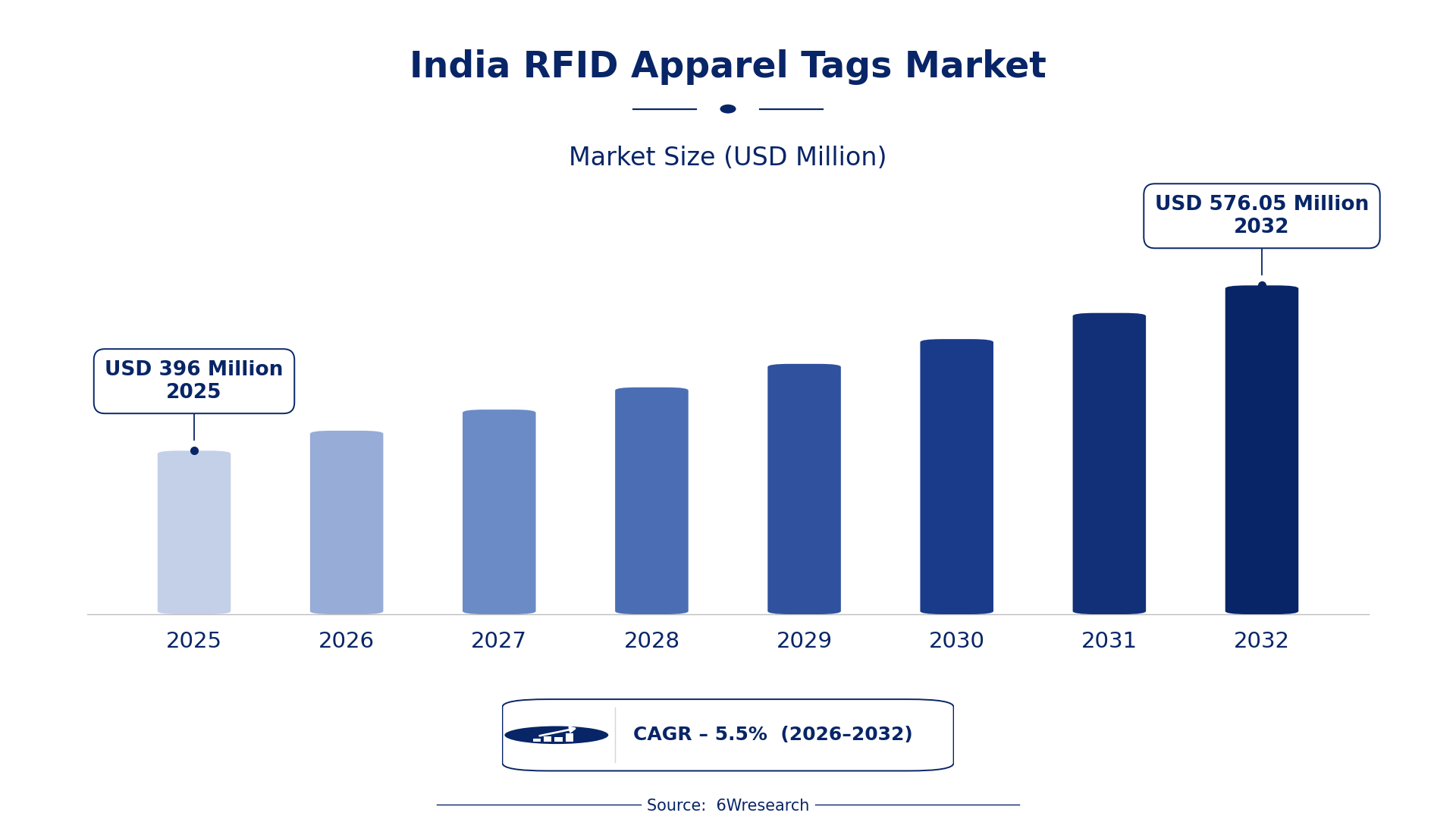
According to 6Wresearch internal database and industry insights, the India RFID Apparel Tags Market was valued at USD 396.0 million in 2025 and is projected to reach USD 576.05 million by 2032, growing at a CAGR of approximately 5.5% during 2026–2032.
India RFID Apparel Tags Market Highlights
| Report Metric | Details |
| Report Name | India RFID Apparel Tags Market |
| Market Size 2025 | USD 396.0 million |
| Market Size 2032 | USD 576.05 million |
| Absolute Growth 2025–2032 | USD 180.05 million |
| CAGR 2026–2032 | 5.5% |
| Peak Annual Growth | 7.8% in 2029 |
| Forecast Period | 2026–2032 |
| Historical Data | 2022–2025 |
| Base Year | 2025 |
| Leading Tag Type, 2025 | Roll Tell Tags (47% share) |
| Leading Frequency & Range, 2025 | UHF EPC Gen2 (55% share) |
| Leading Form Factor, 2025 | Sew-in Hang Tags (49% share) |
| Leading End User, 2025 | Apparel Manufacturers (58% share) |
| Fastest-Growing Tag Type | Laundry-Resistant Tags (6.8% CAGR) |
| Fastest-Growing Form Factor | Embedded Textile Tags (6.8% CAGR) |
| Fastest-Growing End User | Retail Store Chains (7.0% CAGR) |
| Growing Sector | Apparel Manufacturing |
| Key End Users | Apparel Manufacturers, Retail Store Chains, Uniform/Linen Manufacturers |
India RFID Apparel Tags Market Year-wise Growth Rate and Key Drivers (2022–2032)
This graph illustrates the annual growth rates of the market from 2022 to 2032, highlighting a steady upward trajectory and projected market expansion over the forecast period.
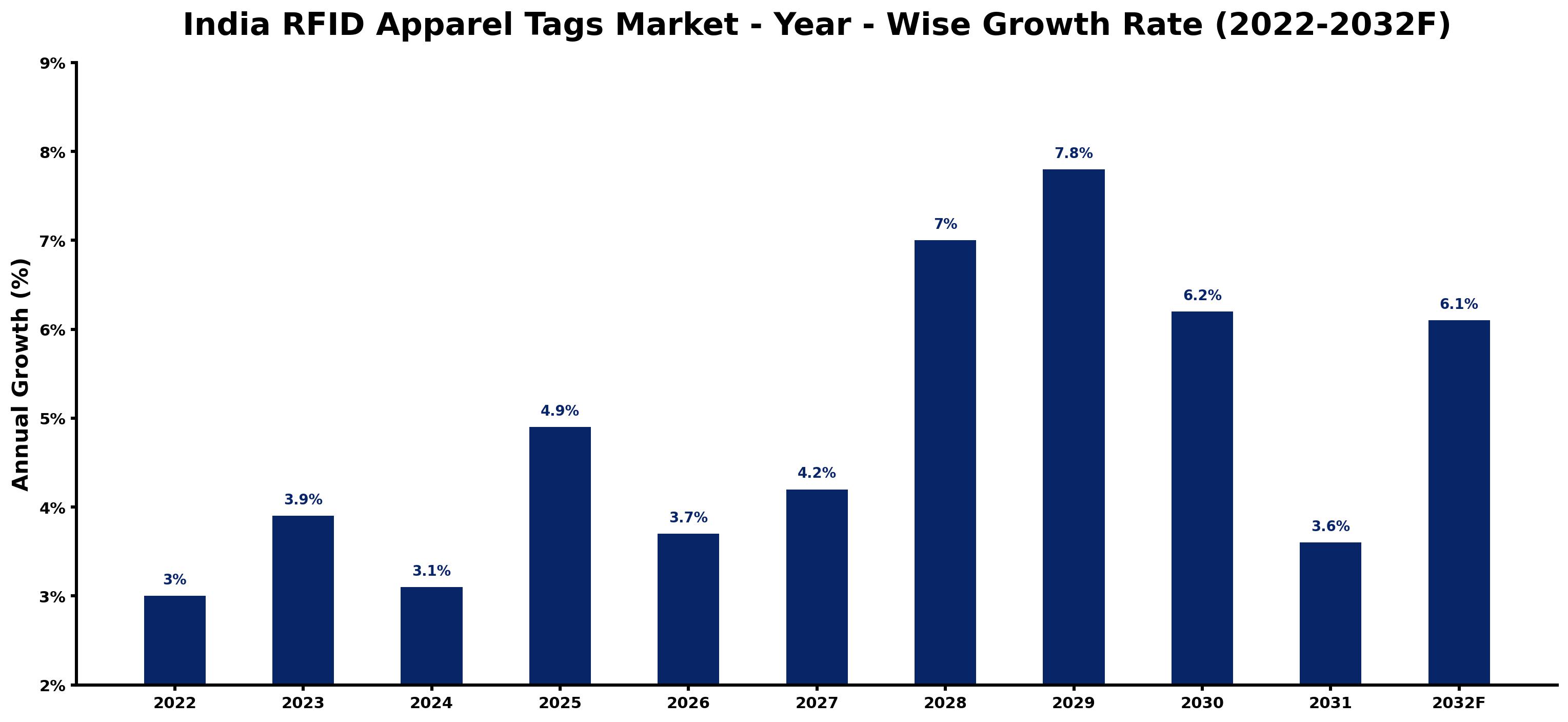
Year by year, the estimates below pair each growth rate with the development that shaped it.
| Year | Estimated Annual Growth (%) | Market Rationale |
| 2022 | 3.0 | The market experienced steady growth as RFID technology began to gain traction among manufacturers. |
| 2023 | 3.9 | Adoption accelerated due to increased demand from retail store chains for inventory management solutions. |
| 2024 | 3.1 | Growth slowed slightly as manufacturers adjusted to new technology integration processes. |
| 2025 | 4.9 | Efficiency in inventory management led to a rise in RFID usage among apparel manufacturers. |
| 2026 | 3.7 | A slight slowdown occurred as manufacturers faced challenges in scaling up RFID implementation. |
| 2027 | 4.2 | Demand surged again as retail store chains expanded their operations and technology investments. |
| 2028 | 7.0 | The market saw rapid growth driven by increased adoption of UHF EPC Gen2 standards in retail. |
| 2029 | 7.8 | Peak growth is expected as the apparel sector fully embraces RFID technology for operational efficiency. |
| 2030 | 6.2 | A slowdown is anticipated as the market begins to stabilise after the peak growth period. |
| 2031 | 3.6 | Growth is projected to decelerate as the market matures and competition intensifies. |
| 2032 | 6.1 | A resurgence in demand is expected as new applications for RFID technology emerge in the apparel sector. |
Note: Market size estimations and growth projections presented in this report are based on 6Wresearch's proprietary forecasting methodology, utilizing the latest available industry data, government publications, and primary research inputs.
India RFID Apparel Tags Market Synopsis
RFID Apparel Tags in India represent a sophisticated technology for tracking and managing inventory within the apparel sector. These tags incorporate chips that can be sewn into clothing items, facilitating efficient inventory oversight. The market is growing as apparel manufacturers and retail chains increasingly embrace this technology, with over 60% already implementing RFID solutions. Initiatives such as the 'Textiles Policy 2020' further encourage technology adoption, driving both investment and demand. The rising focus on operational efficiency and effective inventory management propels this market forward.
Market Dynamics Impact Analysis (2026–2032)
| Factor | Type | Impact | Primary Segment Affected |
| Increased adoption of RFID technology by apparel manufacturers for inventory management. | Driver | High | Apparel Manufacturers |
| Growing demand for efficient inventory tracking solutions among retail store chains. | Driver | High | Retail Store Chains |
| Expansion of retail store chains in urban areas creates demand for RFID solutions. | Opportunity | High | Retail Store Chains |
| Government initiatives supporting technology integration in textiles provide investment opportunities. | Opportunity | High | Apparel Manufacturers |
| High initial costs of RFID technology can deter smaller manufacturers from adoption. | Restraint | Medium | Apparel Manufacturers |
| Limited awareness of the benefits of RFID technology among some manufacturers hampers growth. | Restraint | Medium | Apparel Manufacturers |
| Supply chain disruptions can delay RFID technology implementation for manufacturers. | Challenge | Medium | Apparel Manufacturers |
| Competition from alternative inventory management solutions poses a risk to RFID adoption. | Challenge | Medium | Retail Store Chains |
Evaluation of Drivers in India RFID Apparel Tags Market (2026–2032)
The main growth drivers and the segments they affect most are set out below.
| Drivers | Primary Segment Affected | Why It Matters (Evidence) |
| Increased efficiency in inventory management drives demand for RFID tags. | Apparel Manufacturers | Over 60% of apparel manufacturers in India use RFID technology for inventory management. |
| Retail chains are expanding their operations, increasing demand for RFID solutions. | Retail Store Chains | The average population of retail stores in urban areas is around 1,000 per city. |
| The adoption of UHF EPC Gen2 standards improves scanning capabilities. | UHF EPC Gen2 | This standard is widely adopted in Indian retail for RFID applications. |
| Government initiatives promote technology integration in textiles, boosting demand. | Apparel Manufacturers | The 'Textiles Policy 2020' encourages manufacturers to adopt advanced technologies. |
| Growing consumer expectations for improved shopping experiences drive RFID use. | Retail Store Chains | NFC-enabled tags are increasingly popular for customer interaction in retail. |
The RFID Apparel Tags market in India is expanding as apparel manufacturers and retail store chains increasingly adopt advanced inventory management solutions. Over 60% of apparel manufacturers utilise RFID technology, significantly improving inventory control. The average population of retail stores in urban areas creates a substantial market for RFID applications, with approximately 1,000 stores per city. The widespread adoption of UHF EPC Gen2 standards in retail environments further drives demand, enabling long-range scanning capabilities.
Evaluation of Restraints in India RFID Apparel Tags Market
The main factors holding the market back are set out below.
| Market Restraint | Primary Segment Affected | Why It Matters (Evidence) |
| High initial costs of RFID technology can deter smaller manufacturers from adoption. | Apparel Manufacturers | The average investment required for RFID implementation can be substantial, limiting access for smaller players. |
| Limited awareness of the benefits of RFID technology among some manufacturers hampers growth. | Apparel Manufacturers | Some manufacturers remain unaware of how RFID can improve efficiency and reduce losses. |
| Supply chain disruptions can delay RFID technology implementation for manufacturers. | Apparel Manufacturers | Unforeseen disruptions can lead to delays in acquiring necessary components for RFID systems. |
| Competition from alternative inventory management solutions poses a risk to RFID adoption. | Retail Store Chains | Retailers may opt for less expensive or simpler inventory management systems instead. |
| Regulatory hurdles can slow down the integration of RFID technology in some sectors. | Apparel Manufacturers | Compliance with various standards can complicate RFID implementation processes. |
India RFID Apparel Tags Market Challenges
The India RFID Apparel Tags market encounters high production costs due to the expensive technology needed for tag manufacturing. This issue arises from the reliance on specialised components, inflating prices by approximately 25% for producers, which in turn raises costs for retailers. Regulatory compliance with standards like ISO/IEC 18000-63 complicates market entry, causing delays that can cost manufacturers valuable time and limit their market opportunities. A skills gap persists, as only 60% of apparel manufacturers currently use RFID technology, restricting effective implementation and hindering overall market growth.
Trends in the India RFID Apparel Tags Market
Buyers and suppliers in the India RFID Apparel Tags Market are adjusting to the following trends.
- Increase in UHF EPC Gen2 Adoption: Over 55% of RFID applications in Indian retail are now using UHF EPC Gen2 standards. This shift improves inventory tracking capabilities and operational efficiency for retailers.
- Retail Store Chains Embracing RFID: Retail store chains are increasingly integrating RFID technology into their operations, with a projected 30% increase in RFID adoption by 2025. This trend is driven by the need for improved inventory management and customer experience.
- Government Support for RFID Implementation: The 'Textiles Policy 2020' promotes the integration of RFID technology in the textile sector, encouraging manufacturers to adopt advanced solutions. This initiative aims to improve competitiveness and efficiency in the industry.
- Rise of NFC-Enabled Tags in Retail: NFC-enabled tags are becoming popular in Indian retail for customer interaction, with a notable increase in usage. This trend supports retailers in providing a more engaging shopping experience.
Investment Opportunities in the India RFID Apparel Tags Market
Investors looking at the India RFID Apparel Tags Market should consider the following areas.
- Investment in Textile Manufacturing Facilities: The textile industry in Tamil Nadu is a major hub for RFID adoption, presenting opportunities for investment in local manufacturing facilities. With an expected growth in RFID adoption by 30% by 2025, local partnerships can facilitate entry.
- Collaborative Ventures for RFID Development: With the 'Make in India' initiative supporting local production, there is an opportunity for collaborative ventures in RFID technology development. This approach can improve capabilities and reduce costs for manufacturers.
- Expansion of Retail Store Chains: The growth of retail store chains in urban areas creates a demand for RFID solutions. Investing in RFID technology can help these chains improve inventory management and customer experiences.
- Government Grants for Technology Integration: Government initiatives like the 'Digital India Programme' offer funding opportunities for technology integration in textiles. Manufacturers can apply for grants to support RFID implementation.
Government Initiatives in the India RFID Apparel Tags Market
The 'Textiles Policy 2020' from the Ministry of Textiles aims to enhance technology adoption in the textile sector, promoting RFID usage among manufacturers. This policy encourages investment in modern inventory management solutions, aiding the integration of RFID technology into production processes. By assisting manufacturers in upgrading their systems, the policy seeks to improve overall efficiency and competitiveness in the textile industry. It also aligns with broader government goals to modernise the sector and stimulate economic growth. The initiative is projected to boost RFID adoption by 30% by 2025, improving operational capabilities.
The Ministry of Electronics and Information Technology oversees the 'National Policy on Electronics 2019', which supports RFID technology development. This policy aims to foster growth in the electronics sector, including RFID applications in textiles. It provides funding for research and development projects centred on RFID technology, enabling manufacturers to enhance their capabilities. Additionally, the policy backs initiatives that promote the adoption of digital technologies across various industries, including textiles, facilitating innovation and efficiency.
Future Insight of the India RFID Apparel Tags Market
By 2032, participants in the India RFID Apparel Tags market can anticipate substantial advancements driven by initiatives like 'Digital India' and 'Make in India', which will strengthen local production capabilities. RFID adoption is expected to surge, with a projected increase of 30% by 2025, resulting in improved inventory management systems. The integration of the UHF EPC Gen2 standard across retail will streamline operations. Furthermore, the rising interest in customer engagement technologies will foster more interactive shopping experiences.
Market Segmentation Analysis
The report offers a comprehensive study of the following market segments and their leading categories in the market.
By Tag Type – Roll Tell Tags Dominated, Laundry-Resistant Tags Expected to Grow Fastest
According to Ravi Bhandari, Research Head at 6Wresearch, with a 47% revenue share in 2025, Roll Tell Tags was the largest tag type category. Roll Tell Tags dominate the market share because they are extensively used for inventory management in retail, with over 60% of apparel manufacturers employing RFID technology. Their effectiveness in tracking garments is particularly crucial in urban areas where retail density is high. Laundry-Resistant Tags are set to record the highest CAGR in this split, 6.8% over 2026–2032. Laundry-Resistant Tags are experiencing rapid growth as they are essential for tracking garments through industrial laundering, a process that is increasingly vital for inventory accuracy. With RFID adoption in the apparel sector projected to rise by 30% by 2025, this segment is set for swift expansion. Suppliers should focus on developing advanced Laundry-Resistant Tags to meet the increasing demand in the apparel sector.
By Frequency & Range – UHF EPC Gen2 Dominated and Is Expected to Record the Fastest Growth
UHF EPC Gen2 held a 55% share of the India RFID Apparel Tags Market by frequency & range in 2025. UHF EPC Gen2 holds the largest share due to its extensive adoption for long-range scanning in retail environments, making it the preferred choice for inventory management. This standard's compatibility with existing systems further solidifies its position among apparel manufacturers. UHF EPC Gen2 is also forecast to expand faster than any other category, at a CAGR of 7.1% over 2026–2032. The UHF EPC Gen2 standard is also the fastest-growing segment, as its efficiency in tracking and managing inventory aligns perfectly with the increasing demand for technology integration in the textile sector. As RFID adoption rises, this standard will likely maintain its lead and accelerate its growth. Suppliers should prioritise UHF EPC Gen2 solutions to capitalise on the increasing demand for efficient inventory management in retail.
By Form Factor – Sew-in Hang Tags Dominated, Embedded Textile Tags Expected to Grow Fastest
Sew-in Hang Tags accounted for a 49% market share by form factor in 2025. Sew-in Hang Tags lead the market share because they provide permanent identification for garments, making them essential for apparel manufacturers. Their integration into production processes ensures effective tracking throughout the supply chain, reinforcing their dominant position. The quickest growth will come from Embedded Textile Tags, forecast to expand at a CAGR of 6.8% between 2026 and 2032. Embedded Textile Tags are rapidly gaining traction due to their seamless integration into clothing, which enhances tracking capabilities while preserving garment aesthetics. As the demand for discreet tracking solutions grows, this segment is expected to expand quickly. Manufacturers should explore options for Embedded Textile Tags to align with the evolving preferences of consumers and retailers.
By End User – Apparel Manufacturers Dominated, Retail Store Chains Expected to Grow Fastest
Apparel Manufacturers took a 58% share of end user in 2025, more than any other category. Apparel Manufacturers hold the largest market share as they are the primary users of RFID technology for production and inventory management. Their significant investments in technology integration stem from the need for efficiency and accuracy in managing large inventories. Over 2026–2032, Retail Store Chains are expected to post the fastest growth, at a CAGR of 7.0%. Retail Store Chains are the fastest-growing end user segment, increasingly adopting RFID for improved inventory control and enhanced customer experiences. The trend towards technology-driven retail solutions is likely to further accelerate this growth. Suppliers must tailor their offerings to meet the specific needs of Retail Store Chains to take advantage of the rapid growth in this segment.
Key Attractiveness of the Report
- 10 Years of Market Numbers
- Historical Data Starting from 2022 to 2025
- Base Year 2025
- Forecast Data until 2032
- Key Performance Indicators Impacting the Market
- Major Upcoming Developments and Projects
Key Highlights of the Report:
- India RFID Apparel Tags Market Outlook
- Market Size of India RFID Apparel Tags Market, 2025
- Forecast of India RFID Apparel Tags Market, 2032
- Historical Data and Forecast of India RFID Apparel Tags Revenues & Volume for the Period 2022 - 2032F
- India RFID Apparel Tags Market Trend Evolution
- India RFID Apparel Tags Market Drivers and Challenges
- India RFID Apparel Tags Price Trends
- India RFID Apparel Tags Porter's Five Forces
- India RFID Apparel Tags Industry Life Cycle
- Historical Data and Forecast of India RFID Apparel Tags Market Revenues & Volume By Tag Type for the Period 2022 - 2032F
- Historical Data and Forecast of India RFID Apparel Tags Market Revenues & Volume By Roll Tell Tags for the Period 2022 - 2032F
- Historical Data and Forecast of India RFID Apparel Tags Market Revenues & Volume By Laundry-Resistant Tags for the Period 2022 - 2032F
- Historical Data and Forecast of India RFID Apparel Tags Market Revenues & Volume By Detach/Reusable Tags for the Period 2022 - 2032F
- Historical Data and Forecast of India RFID Apparel Tags Market Revenues & Volume By Frequency & Range for the Period 2022 - 2032F
- Historical Data and Forecast of India RFID Apparel Tags Market Revenues & Volume By UHF EPC Gen2 for the Period 2022 - 2032F
- Historical Data and Forecast of India RFID Apparel Tags Market Revenues & Volume By LF/HF for the Period 2022 - 2032F
- Historical Data and Forecast of India RFID Apparel Tags Market Revenues & Volume By NFC-Enabled for the Period 2022 - 2032F
- Historical Data and Forecast of India RFID Apparel Tags Market Revenues & Volume By Form Factor for the Period 2022 - 2032F
- Historical Data and Forecast of India RFID Apparel Tags Market Revenues & Volume By Sew-in Hang Tags for the Period 2022 - 2032F
- Historical Data and Forecast of India RFID Apparel Tags Market Revenues & Volume By Embedded Textile Tags for the Period 2022 - 2032F
- Historical Data and Forecast of India RFID Apparel Tags Market Revenues & Volume By On-Item Security Tags for the Period 2022 - 2032F
- Historical Data and Forecast of India RFID Apparel Tags Market Revenues & Volume By End User for the Period 2022 - 2032F
- Historical Data and Forecast of India RFID Apparel Tags Market Revenues & Volume By Apparel Manufacturers for the Period 2022 - 2032F
- Historical Data and Forecast of India RFID Apparel Tags Market Revenues & Volume By Uniform/Linen Manufacturers for the Period 2022 - 2032F
- Historical Data and Forecast of India RFID Apparel Tags Market Revenues & Volume By Retail Store Chains for the Period 2022 - 2032F
- India RFID Apparel Tags Import Export Trade Statistics
- Market Opportunity Assessment By Tag Type
- Market Opportunity Assessment By Frequency & Range
- Market Opportunity Assessment By Form Factor
- Market Opportunity Assessment By End User
- India RFID Apparel Tags Top Companies Market Share
- India RFID Apparel Tags Competitive Benchmarking By Technical and Operational Parameters
- India RFID Apparel Tags Company Profiles
- India RFID Apparel Tags Key Strategic Recommendations
Market Covered
This report examines the market across the segments below.
By Tag Type
- Roll Tell Tags
- Laundry-Resistant Tags
- Detach/Reusable Tags
By Frequency & Range
- UHF EPC Gen2
- LF/HF
- NFC-Enabled
By Form Factor
- Sew-in Hang Tags
- Embedded Textile Tags
- On-Item Security Tags
By End User
- Apparel Manufacturers
- Uniform/Linen Manufacturers
- Retail Store Chains































