China RFID Apparel Tags Market Size & Growth Rate
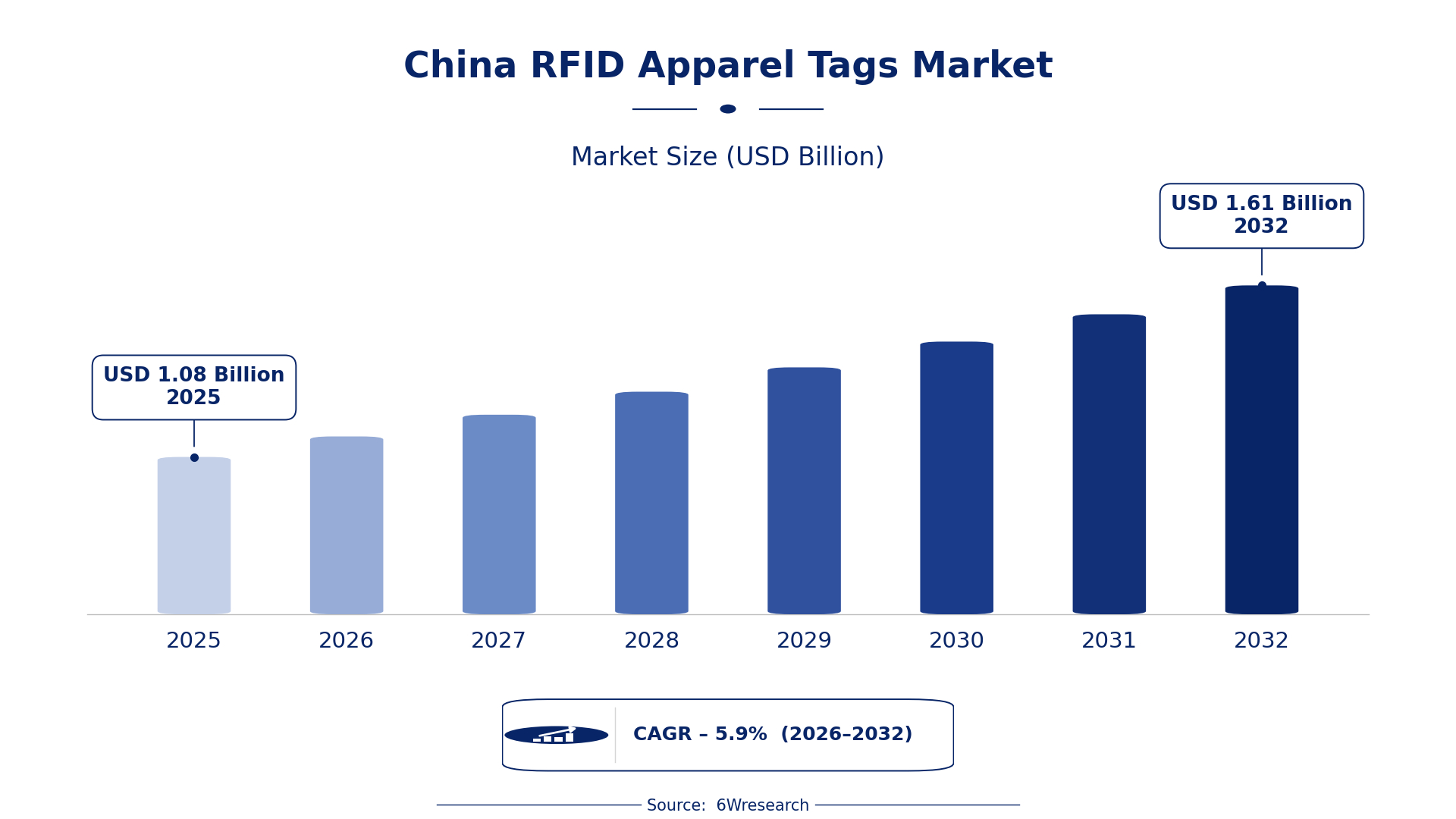
According to 6Wresearch internal database and industry insights, the China RFID Apparel Tags Market was valued at USD 1.08 billion in 2025 and is projected to reach USD 1.61 billion by 2032, growing at a CAGR of approximately 5.9% during 2026–2032.
China RFID Apparel Tags Market Highlights
| Report Metric | Details |
| Report Name | China RFID Apparel Tags Market |
| Market Size 2025 | USD 1.08 billion |
| Market Size 2032 | USD 1.61 billion |
| Absolute Growth 2025–2032 | USD 0.53 billion |
| CAGR 2026–2032 | 5.9% |
| Peak Annual Growth | 8.2% in 2031 |
| Forecast Period | 2026–2032 |
| Historical Data | 2022–2025 |
| Base Year | 2025 |
| Leading Tag Type, 2025 | Roll Tell Tags (54% share) |
| Leading Frequency & Range, 2025 | UHF EPC Gen2 (46% share) |
| Leading Form Factor, 2025 | Sew-in Hang Tags (56% share) |
| Leading End User, 2025 | Apparel Manufacturers (42% share) |
| Fastest-Growing Tag Type | Detach/Reusable Tags (7.0% CAGR) |
| Fastest-Growing Frequency & Range | NFC-Enabled (7.2% CAGR) |
| Fastest-Growing Form Factor | Embedded Textile Tags (8.0% CAGR) |
| Fastest-Growing End User | Uniform/Linen Manufacturers (8.4% CAGR) |
| Growing Sector | Apparel Manufacturing |
| Key End Users | Apparel Manufacturers, Retail Store Chains, Uniform/Linen Manufacturers |
China RFID Apparel Tags Market Year-wise Growth Rate and Key Drivers (2022–2032)
This graph illustrates the annual growth rates of the market from 2022 to 2032, highlighting a steady upward trajectory and projected market expansion over the forecast period.
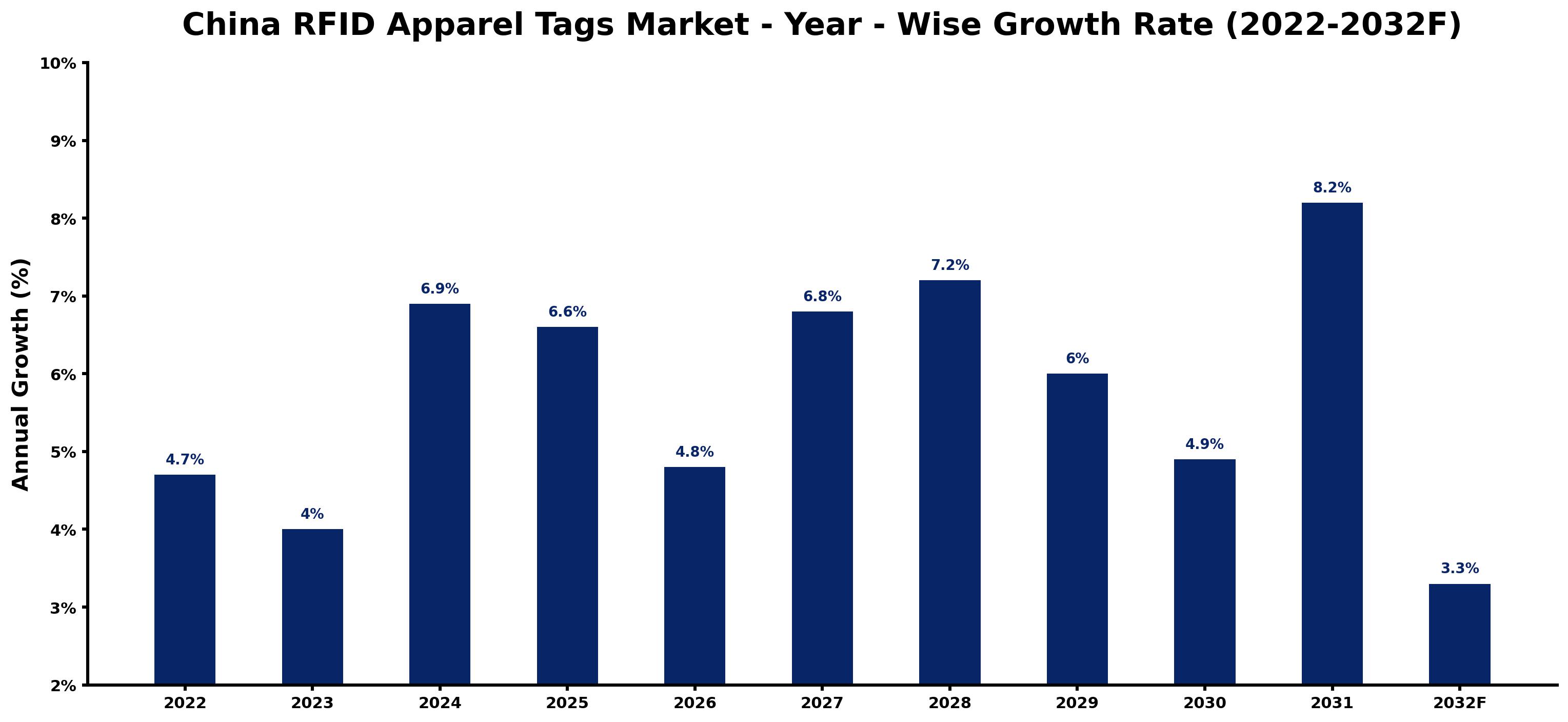
Below, each year's estimated growth is shown next to the factor that most influenced it.
| Year | Estimated Annual Growth (%) | Market Rationale |
| 2022 | 4.7 | The market saw steady growth, driven by increased RFID adoption in retail environments. |
| 2023 | 4.0 | Growth slowed as the retail sector adjusted to the 'Smart Manufacturing Initiative' launched by the Ministry of Industry and Information Technology. |
| 2024 | 6.9 | A surge in demand occurred due to heightened inventory management needs among apparel manufacturers. |
| 2025 | 6.6 | Growth decelerated slightly as the market stabilised after rapid advancements in RFID technology. |
| 2026 | 4.8 | The market is expected to experience a slowdown as RFID adoption faces challenges in certain segments. |
| 2027 | 6.8 | Demand is projected to rise again with improved integration of RFID in manufacturing processes. |
| 2028 | 7.2 | Growth is expected to accelerate as more apparel manufacturers embrace smart technologies for efficiency. |
| 2029 | 6.0 | A slowdown is projected as the market adjusts to the saturation of RFID tags in retail. |
| 2030 | 4.9 | The market will continue to grow slowly as manufacturers focus on optimising existing technologies. |
| 2031 | 8.2 | A peak in growth is expected due to the successful implementation of new RFID standards. |
| 2032 | 3.3 | Growth is projected to slow again as the market begins to stabilise after rapid advancements. |
Note: Market size estimations and growth projections presented in this report are based on 6Wresearch's proprietary forecasting methodology, utilizing the latest available industry data, government publications, and primary research inputs.
China RFID Apparel Tags Market Synopsis
RFID Apparel Tags in China are technology-based devices used for tracking and managing inventory in the apparel industry. These tags combine RFID chips and antennas, primarily serving inventory management, theft prevention, and supply chain efficiency. The China RFID Apparel Tags Market is expanding due to rising demand from apparel manufacturers and retail chains. In 2022, the apparel industry was valued at approximately 1.7 trillion CNY, driving the need for efficient inventory solutions. The adoption of the 'Smart Manufacturing Initiative' in 2023 further promotes RFID technology integration.
Market Dynamics Impact Analysis (2026–2032)
| Factor | Type | Impact | Primary Segment Affected |
| Increased demand for efficient inventory management solutions | Driver | High | Apparel Manufacturers |
| Growing retail sector adopting smart technologies | Driver | High | Retail Store Chains |
| Investment in smart technology integration | Opportunity | High | Apparel Manufacturers |
| Rising demand for enhanced customer engagement solutions | Opportunity | Medium | Retail Store Chains |
| Challenges in standardisation of RFID technology | Restraint | High | UHF EPC Gen2 |
| High initial costs of RFID implementation | Restraint | Medium | Sew-in Hang Tags |
| Supply chain disruptions affecting tag availability | Challenge | High | Laundry-Resistant Tags |
| Technological integration issues within existing systems | Challenge | Medium | Embedded Textile Tags |
Evaluation of Drivers in China RFID Apparel Tags Market (2026–2032)
Below mentioned are some major drivers and their influence on market dynamics.
| Drivers | Primary Segment Affected | Why It Matters (Evidence) |
| Increased adoption of RFID technology for inventory management | UHF EPC Gen2 | This type accounts for over 60% of the market share, driving demand from apparel manufacturers for efficient tracking solutions. |
| Growth of the retail sector focusing on loss prevention | On-Item Security Tags | The retail sector has seen a 15% increase in RFID usage, leading to a surge in demand for security tags. |
| Government initiatives promoting smart manufacturing | Laundry-Resistant Tags | The 'Smart Manufacturing Initiative' launched in 2023 supports RFID integration, boosting demand for durable tags among manufacturers. |
| Expansion of the textile industry in Jiangsu province | Embedded Textile Tags | This region's numerous apparel manufacturers are increasingly adopting RFID for efficient tracking and management. |
| Rising middle class increasing retail consumption | NFC-Enabled | The growing urban population drives demand for customer engagement solutions, increasing the use of NFC-enabled tags. |
The RFID Apparel Tags market in China is growing on the back of increased adoption of RFID technology for inventory management, particularly among apparel manufacturers. In 2022, the apparel industry was valued at approximately 1.7 trillion CNY, leading to a demand for efficient tracking solutions. The retail sector has seen a 15% increase in RFID usage for inventory management, resulting in higher demand for security tags. The expansion of the textile industry in Jiangsu province is projected to increase the adoption of RFID solutions among local manufacturers, further driving growth in this sector.
Evaluation of Restraints in China RFID Apparel Tags Market
The main factors holding the market back are set out below.
| Market Restraint | Primary Segment Affected | Why It Matters (Evidence) |
| Challenges in standardisation of RFID technology | UHF EPC Gen2 | The updated 'National Standard for RFID Tags' in 2021 has created inconsistencies in tag performance across manufacturers. |
| High initial costs of RFID implementation | Sew-in Hang Tags | Many manufacturers face upfront investments of over 1 million CNY, limiting their ability to adopt RFID solutions. |
| Supply chain disruptions affecting tag availability | Laundry-Resistant Tags | Recent global supply chain issues have delayed the production and distribution of essential RFID tags, impacting over 300 million units annually. |
| Technological integration issues within existing systems | Embedded Textile Tags | Manufacturers struggle to integrate new RFID technologies with their legacy systems, slowing adoption and affecting operational efficiency. |
| Limited awareness of RFID benefits among smaller retailers | NFC-Enabled | Smaller retail chains often lack the resources to understand and implement RFID solutions effectively, hindering growth. |
China RFID Apparel Tags Market Challenges
In China, buyers and suppliers of RFID apparel tags face a pressing supply challenge, with over 300 million tags required annually, leading to potential stock shortages for retailers. Producers struggle with technology adoption, as the average RFID integration rate in retail remains at only 30%, hindering operational efficiency. Buyers deal with limitations in tag functionality, as many existing tags lack NFC capabilities, restricting customer engagement in urban retail settings. Rising costs pose a threat, as the government's 500 million CNY investment in smart technologies may drive up prices for manufacturers and retailers alike.
Trends in the China RFID Apparel Tags Market
Buyers and suppliers in the China RFID Apparel Tags Market are adjusting to the following trends.
- Shift from Traditional to Smart Inventory Management: In 2022, the apparel industry began shifting towards smart inventory management solutions. The 'Smart Manufacturing Initiative' has led to a 15% increase in RFID technology use in retail, promoting efficiency and accuracy.
- NFC-Enabled Tags Gaining Popularity: NFC-Enabled Tags are increasingly being adopted in urban retail environments, with a 30% adoption rate in 2023. This shift allows retailers to engage customers directly, improving sales opportunities.
- Focus on Theft Prevention: In 2023, retail chains have prioritised on-item security with RFID tags, resulting in a 15% increase in usage. This trend reflects a growing need for effective loss prevention strategies in the retail sector.
- Integration of RFID in Textile Manufacturing: The textile industry in Jiangsu province has increasingly integrated RFID technology, with over 300 million tags used annually. This integration supports efficient inventory management and tracking processes.
Investment Opportunities in the China RFID Apparel Tags Market
Investors looking at the China RFID Apparel Tags Market should consider the following areas.
- Supply of RFID Apparel Tags: With over 300 million RFID tags used annually, there is a notable gap for suppliers. Apparel manufacturers in Jiangsu province are seeking local partners to meet this growing demand.
- Investment in Smart Manufacturing Solutions: The government has allocated 500 million CNY for the 'Digital Textile Industry Development Plan' in 2023. This funding presents opportunities for suppliers of RFID technology to engage with manufacturers effectively.
- Development of NFC-Enabled Tags: As urban retail environments increasingly adopt NFC technology, suppliers can fill the gap in demand. Retail chains are looking for solutions to enhance customer engagement and drive sales.
- Expansion of Laundry-Resistant Tags: With a growing focus on durable RFID solutions, suppliers can target the apparel manufacturing sector. The current adoption rate of 30% presents a timely opportunity for investment in this area.
Government Initiatives in the China RFID Apparel Tags Market
The Ministry of Industry and Information Technology launched the 'Smart Manufacturing Initiative' in 2022, with a budget of 1 billion CNY to promote RFID technology in manufacturing. This initiative encourages manufacturers to adopt RFID solutions, enhancing operational efficiency and reducing costs. The State Administration for Market Regulation updated the 'National Standard for RFID Tags' in 2021 to improve quality and interoperability in the market. Additionally, the National Development and Reform Commission initiated the 'Innovation in Supply Chain Management Program' focusing on RFID technology to enhance efficiency in logistics.
The China National Textile and Apparel Council supports initiatives for RFID integration in supply chains, helping manufacturers improve efficiency and reduce costs. The Ministry of Commerce introduced the 'Retail Technology Upgrade Program' in 2023, aimed at increasing RFID adoption among retail chains with a target of 20% by 2025. This program provides financial support and resources to retailers looking to implement RFID technology.
Future Insight of the China RFID Apparel Tags Market
Several forward-looking factors should support the RFID apparel tags market in China over the coming years. The 'Smart Manufacturing Initiative' by the Ministry of Industry and Information Technology will promote broader technology adoption, streamlining supply chain processes. The National Standard for RFID Tags is expected to evolve, improving quality and performance across the sector. Additionally, the growing middle class will increase demand for efficient inventory management solutions, creating opportunities for both buyers and suppliers in the apparel industry.
Market Segmentation Analysis
The analysis below covers each segmentation, its leading category in 2025 and its fastest-growing category through 2032.
By Tag Type – Roll Tell Tags Dominated, Detach/Reusable Tags Expected to Grow Fastest
According to Ravi Bhandari, Research Head at 6Wresearch, Roll Tell Tags accounted for a 54% market share by tag type in 2025. Roll Tell Tags dominate the market share as they are crucial for tracking inventory in retail environments, ensuring efficient supply chain management. Their widespread use among apparel manufacturers, especially in Jiangsu province, solidifies their leading position in the China RFID Apparel Tags Market. Over 2026–2032, Detach/Reusable Tags are expected to post the fastest growth, at a CAGR of 7.0%. Detach/Reusable Tags are experiencing rapid growth as retailers increasingly adopt them for temporary tagging and promotional events, meeting the demand for flexible solutions. The rise in promotional activities in urban areas is driving their adoption rates significantly. This trend indicates that suppliers should focus on developing versatile tagging solutions to meet the diverse needs of retailers.
By Frequency & Range – UHF EPC Gen2 Dominated, NFC-Enabled Expected to Grow Fastest
With a 46% revenue share in 2025, UHF EPC Gen2 was the largest frequency & range category. UHF EPC Gen2 tags hold the largest market share due to their effectiveness in long-range scanning, making them ideal for retail inventory management. Their compliance with the National Standard for RFID Tags ensures reliability, making them a preferred choice among manufacturers in the apparel sector. NFC-Enabled is set to record the highest CAGR in this split, 7.2% over 2026–2032. NFC-Enabled tags are rapidly gaining popularity as they facilitate customer engagement through interactive experiences, particularly in urban retail settings. The growing focus on enhancing customer interactions is significantly boosting their market adoption. Suppliers should consider investing in NFC technology to address the increasing demand for customer engagement solutions.
By Form Factor – Sew-in Hang Tags Dominated, Embedded Textile Tags Expected to Grow Fastest
Sew-in Hang Tags held a 56% share of the China RFID Apparel Tags Market by form factor in 2025. Sew-in Hang Tags are preferred by apparel manufacturers as they provide permanent identification that integrates seamlessly into garments, ensuring effective inventory management. Their established role in the industry contributes to their leading market share within the China RFID Apparel Tags Market. The quickest growth will come from Embedded Textile Tags, forecast to expand at a CAGR of 8.0% between 2026 and 2032. Embedded Textile Tags are gaining traction due to their seamless integration into fabrics, allowing for efficient tracking without compromising garment aesthetics. This growing preference for discreet solutions is driving their rapid market expansion. Manufacturers should explore opportunities for innovation in embedded tagging to align with evolving customer preferences.
By End User – Apparel Manufacturers Dominated, Uniform/Linen Manufacturers Expected to Grow Fastest
The largest end user category in 2025 was Apparel Manufacturers, with a 42% share of total revenue. Apparel Manufacturers represent the largest share of the market as they are the primary users of RFID tags for effective inventory management in their operations. Their ongoing demand for efficiency in supply chain processes solidifies their leading position. Uniform/Linen Manufacturers are projected to grow fastest, at a CAGR of 8.4% during 2026–2032. Uniform/Linen Manufacturers are experiencing the fastest growth as they increasingly adopt RFID technology for tracking uniforms and linens, reflecting the broader trend towards automation in various sectors. This shift is indicative of a growing recognition of the benefits of RFID in diverse applications. This suggests that suppliers should tailor their offerings to meet the specific needs of uniform and linen manufacturers.
Key Attractiveness of the Report
- 10 Years of Market Numbers
- Historical Data Starting from 2022 to 2025
- Base Year 2025
- Forecast Data until 2032
- Key Performance Indicators Impacting the Market
- Major Upcoming Developments and Projects
Key Highlights of the Report:
- China RFID Apparel Tags Market Outlook
- Market Size of China RFID Apparel Tags Market, 2025
- Forecast of China RFID Apparel Tags Market, 2032
- Historical Data and Forecast of China RFID Apparel Tags Revenues & Volume for the Period 2022 - 2032F
- China RFID Apparel Tags Market Trend Evolution
- China RFID Apparel Tags Market Drivers and Challenges
- China RFID Apparel Tags Price Trends
- China RFID Apparel Tags Porter's Five Forces
- China RFID Apparel Tags Industry Life Cycle
- Historical Data and Forecast of China RFID Apparel Tags Market Revenues & Volume By Tag Type for the Period 2022 - 2032F
- Historical Data and Forecast of China RFID Apparel Tags Market Revenues & Volume By Roll Tell Tags for the Period 2022 - 2032F
- Historical Data and Forecast of China RFID Apparel Tags Market Revenues & Volume By Laundry-Resistant Tags for the Period 2022 - 2032F
- Historical Data and Forecast of China RFID Apparel Tags Market Revenues & Volume By Detach/Reusable Tags for the Period 2022 - 2032F
- Historical Data and Forecast of China RFID Apparel Tags Market Revenues & Volume By Frequency & Range for the Period 2022 - 2032F
- Historical Data and Forecast of China RFID Apparel Tags Market Revenues & Volume By UHF EPC Gen2 for the Period 2022 - 2032F
- Historical Data and Forecast of China RFID Apparel Tags Market Revenues & Volume By LF/HF for the Period 2022 - 2032F
- Historical Data and Forecast of China RFID Apparel Tags Market Revenues & Volume By NFC-Enabled for the Period 2022 - 2032F
- Historical Data and Forecast of China RFID Apparel Tags Market Revenues & Volume By Form Factor for the Period 2022 - 2032F
- Historical Data and Forecast of China RFID Apparel Tags Market Revenues & Volume By Sew-in Hang Tags for the Period 2022 - 2032F
- Historical Data and Forecast of China RFID Apparel Tags Market Revenues & Volume By Embedded Textile Tags for the Period 2022 - 2032F
- Historical Data and Forecast of China RFID Apparel Tags Market Revenues & Volume By On-Item Security Tags for the Period 2022 - 2032F
- Historical Data and Forecast of China RFID Apparel Tags Market Revenues & Volume By End User for the Period 2022 - 2032F
- Historical Data and Forecast of China RFID Apparel Tags Market Revenues & Volume By Apparel Manufacturers for the Period 2022 - 2032F
- Historical Data and Forecast of China RFID Apparel Tags Market Revenues & Volume By Uniform/Linen Manufacturers for the Period 2022 - 2032F
- Historical Data and Forecast of China RFID Apparel Tags Market Revenues & Volume By Retail Store Chains for the Period 2022 - 2032F
- China RFID Apparel Tags Import Export Trade Statistics
- Market Opportunity Assessment By Tag Type
- Market Opportunity Assessment By Frequency & Range
- Market Opportunity Assessment By Form Factor
- Market Opportunity Assessment By End User
- China RFID Apparel Tags Top Companies Market Share
- China RFID Apparel Tags Competitive Benchmarking By Technical and Operational Parameters
- China RFID Apparel Tags Company Profiles
- China RFID Apparel Tags Key Strategic Recommendations
Market Covered
The report offers an extensive study of the following market segments.
By Tag Type
- Roll Tell Tags
- Laundry-Resistant Tags
- Detach/Reusable Tags
By Frequency & Range
- UHF EPC Gen2
- LF/HF
- NFC-Enabled
By Form Factor
- Sew-in Hang Tags
- Embedded Textile Tags
- On-Item Security Tags
By End User
- Apparel Manufacturers
- Uniform/Linen Manufacturers
- Retail Store Chains































