India Robotic Assembly Systems Market Size & Growth Rate
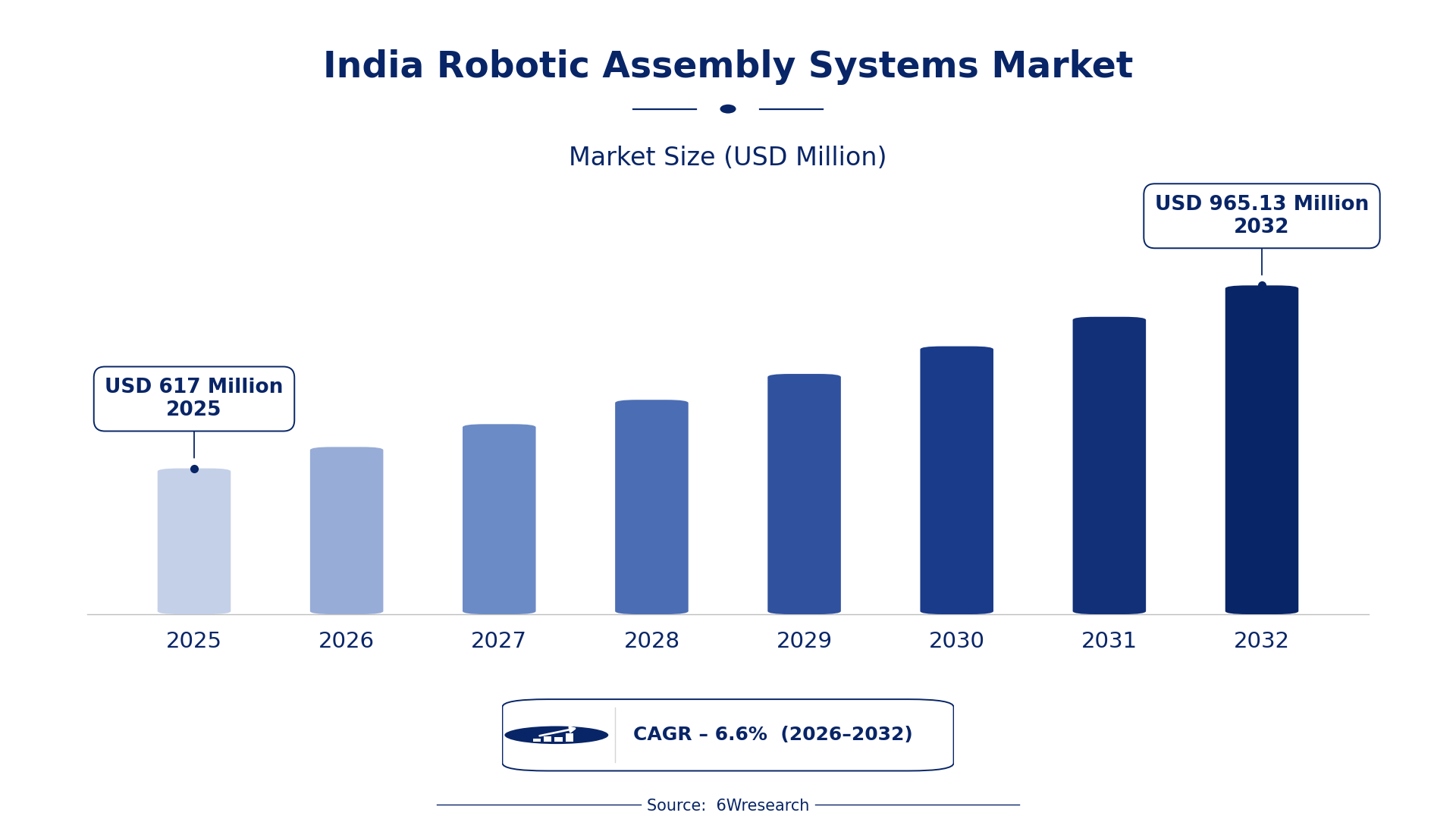
According to 6Wresearch internal database and industry insights, the India Robotic Assembly Systems Market was valued at USD 617.0 million in 2025 and is projected to reach USD 965.13 million by 2032, growing at a CAGR of approximately 6.6% during 2026–2032.
India Robotic Assembly Systems Market Highlights
| Report Metric | Details |
| Report Name | India Robotic Assembly Systems Market |
| Market Size 2025 | USD 617.0 million |
| Market Size 2032 | USD 965.13 million |
| Absolute Growth 2025–2032 | USD 348.13 million |
| CAGR 2026–2032 | 6.6% |
| Peak Annual Growth | 8.1% in 2032 |
| Forecast Period | 2026–2032 |
| Historical Data | 2022–2025 |
| Base Year | 2025 |
| Leading Assembly Type, 2025 | Electronics Assembly (34% share) |
| Leading Robot Type, 2025 | SCARA Robots (42% share) |
| Leading Automation Level, 2025 | Semi-Automated (51% share) |
| Leading End User, 2025 | Consumer Electronics (39% share) |
| Fastest-Growing Assembly Type | Automotive Assembly (8.7% CAGR) |
| Fastest-Growing Robot Type | Articulated Arms (9.2% CAGR) |
| Fastest-Growing Automation Level | Fully Automated (9.0% CAGR) |
| Fastest-Growing End User | Auto OEMs (8.1% CAGR) |
| Growing Sector | Automotive Assembly |
| Key End Users | Automotive Manufacturers, Electronics Manufacturers, Appliance Manufacturers, EMS Providers |
India Robotic Assembly Systems Market Year-wise Growth Rate and Key Drivers (2022–2032)
This graph illustrates the annual growth rates of the market from 2022 to 2032, highlighting a steady upward trajectory and projected market expansion over the forecast period.
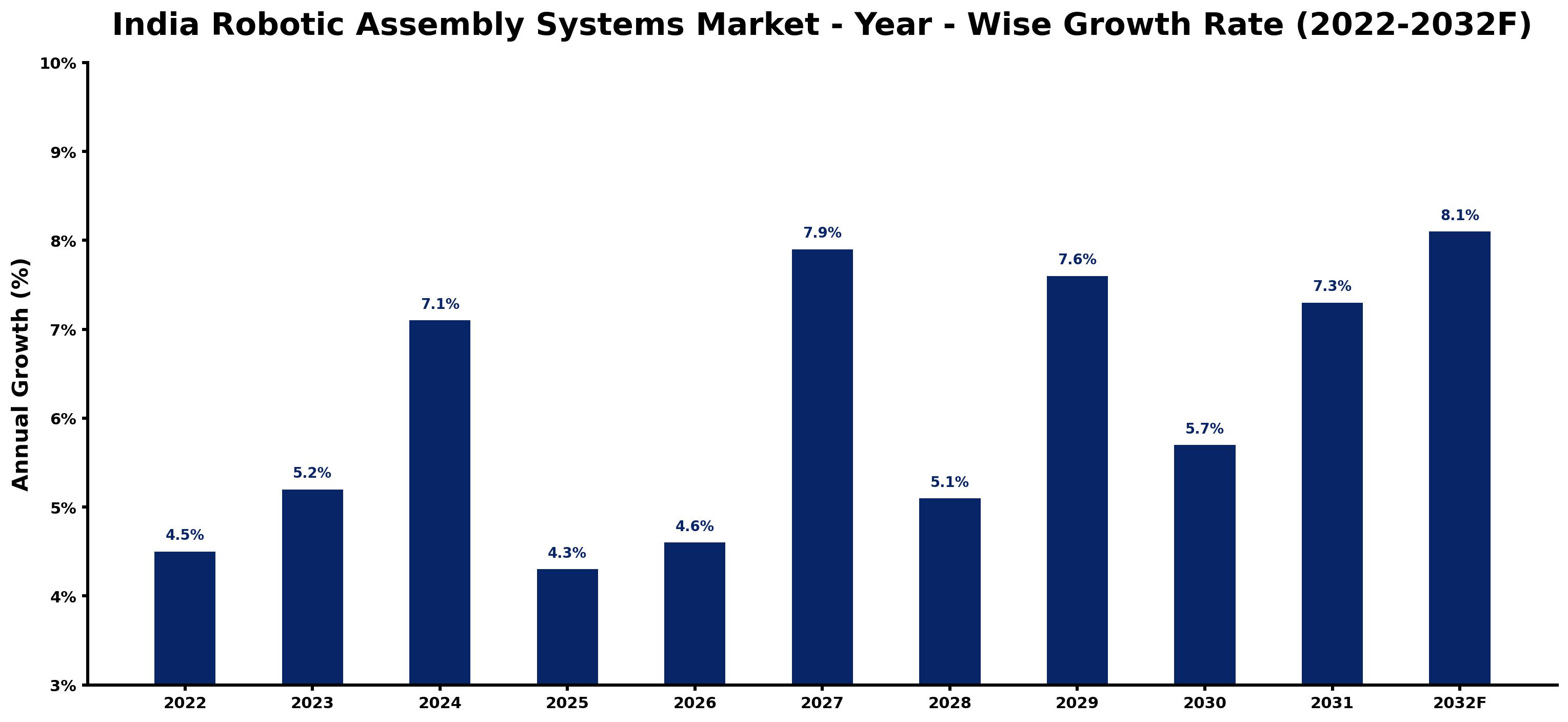
The following table presents the estimated annual growth rate for each year together with the principal factor influencing market performance.
| Year | Estimated Annual Growth (%) | Market Rationale |
| 2022 | 4.5 | The market experienced steady growth due to initial investments in the 'Make in India' initiative. |
| 2023 | 5.2 | Demand increased as manufacturers sought to improve production efficiency through robotics adoption. |
| 2024 | 7.1 | The automotive sector's expansion significantly boosted the adoption of robotic assembly systems. |
| 2025 | 4.3 | Growth slowed as manufacturers adjusted to market conditions and investment cycles. |
| 2026 | 4.6 | A renewed focus on automation is expected to lead to increased investments in robotic systems. |
| 2027 | 7.9 | The automotive assembly segment will see a surge in demand for advanced robotics. |
| 2028 | 5.1 | Market growth is projected to slow as companies face challenges in integrating new technologies. |
| 2029 | 7.6 | Demand is expected to accelerate as the electronics sector expands its automation efforts. |
| 2030 | 5.7 | Growth will decelerate as manufacturers face supply chain constraints and rising costs. |
| 2031 | 7.3 | Increased adoption of robotics in manufacturing will drive demand higher again. |
| 2032 | 8.1 | The market is projected to peak as significant investments in robotics transform production capabilities. |
Note: Market size estimations and growth projections presented in this report are based on 6Wresearch's proprietary forecasting methodology, utilizing the latest available industry data, government publications, and primary research inputs.
India Robotic Assembly Systems Market Synopsis
Robotic Assembly Systems Market in India covers advanced automation technologies that use robotic arms for assembly tasks in manufacturing. These systems improve productivity, quality control, and reduce labor costs across various industries. The market is driven by the automotive sector's growth and the electronics industry's expansion. The 'Make in India' initiative and the National Policy on Robotics are key factors promoting this growth, with the automotive sector projected to produce 30 million vehicles by 2026.
Market Dynamics Impact Analysis (2026–2032)
| Factor | Type | Impact | Primary Segment Affected |
| Rising automotive production targets drive demand for efficient assembly solutions. | Driver | High | Automotive Assembly |
| The electronics sector's growth necessitates increased automation in manufacturing processes. | Driver | High | Electronics Assembly |
| Investment in robotics integration offers opportunities for manufacturers to enhance efficiency. | Opportunity | High | Electronics Assembly |
| The growing EMS market presents a chance for suppliers to provide advanced robotic systems. | Opportunity | High | EMS Providers |
| High initial investment costs can deter smaller manufacturers from adopting robotics. | Restraint | Medium | Automotive Assembly |
| Limited skilled workforce hampers the effective implementation of robotic systems. | Restraint | Medium | Electronics Assembly |
| Integration challenges with existing systems slow down the adoption of new technologies. | Challenge | High | Automotive Assembly |
| Supply chain disruptions can delay the procurement of robotic systems and components. | Challenge | Medium | Electronics Assembly |
Evaluation of Drivers in India Robotic Assembly Systems Market (2026–2032)
Below mentioned are some major drivers and their influence on market dynamics.
| Drivers | Primary Segment Affected | Why It Matters (Evidence) |
| Increased vehicle production targets necessitate automation in assembly lines. | Automotive Assembly | India's automotive sector aims to produce 30 million vehicles by 2026, driving demand for robotic systems. |
| Growing electronics market demands precision and efficiency in assembly processes. | Electronics Assembly | The electronics industry is expected to reach $300 billion by 2026, increasing automation needs. |
| Government initiatives incentivise manufacturers to adopt robotics for competitive advantage. | Electronics Assembly | The 'Production Linked Incentive' scheme promotes automation adoption with a budget of $1.5 billion. |
| Rising demand for high-quality manufacturing drives robotic integration. | PCB Mounting | The need for precision in PCB assembly is leading to greater use of robotic systems. |
| The expansion of EMS providers increases the need for robotic assembly solutions. | EMS Providers | The EMS market is expected to grow to $100 billion by 2025, driving robotic adoption. |
Growth in the Robotic Assembly Systems market in India comes from rising end-use demand in the automotive and electronics sectors, alongside a strong supply response. The automotive sector aims to produce 30 million vehicles by 2026, driving demand for automation technologies. The electronics industry is expected to reach $300 billion by 2026, necessitating increased automation for efficiency. Consequently, manufacturers are increasingly investing in robotic systems to improve productivity and quality control.
Evaluation of Restraints in India Robotic Assembly Systems Market
The table below lists the restraints and the evidence behind each.
| Market Restraint | Primary Segment Affected | Why It Matters (Evidence) |
| High initial investment costs deter smaller manufacturers from adopting robotics. | Automotive Assembly | The average cost of implementing robotic systems can exceed $100,000, limiting access for smaller firms. |
| Limited skilled workforce hampers effective implementation of robotic systems. | Electronics Assembly | The 'Skill India Mission' aims to train 400 million people, but many lack robotics expertise. |
| Integration challenges with existing systems slow down the adoption of new technologies. | Automotive Assembly | Many manufacturers face difficulties in integrating advanced robotics with legacy systems, affecting productivity. |
| Supply chain disruptions can delay the procurement of robotic systems and components. | Electronics Assembly | Recent global supply chain issues have led to delays in robotic system deliveries, impacting production timelines. |
| Regulatory compliance can increase implementation timelines and costs. | PCB Mounting | The Bureau of Indian Standards has established guidelines that manufacturers must meet, extending project timelines. |
India Robotic Assembly Systems Market Challenges
The India robotic assembly systems market still has to solve a few problems, beginning with intense competition among producers. This competition leads to price reductions, which can squeeze profit margins for manufacturers and hinder their ability to invest in technology upgrades. Supply chain disruptions are another challenge; delays in component availability can halt production lines, costing buyers up to 15% in lost productivity. Rapid technological advancements necessitate constant updates, but without skilled workers, producers struggle to implement these changes, limiting operational efficiency and affecting their competitive edge.
Trends in the India Robotic Assembly Systems Market
Buyers and suppliers in the India Robotic Assembly Systems Market are adjusting to the following trends.
- Shift from Manual to Automated Assembly: India's manufacturing sector is increasingly shifting towards automated assembly processes, particularly in Tamil Nadu, where automotive production is rising. In 2023, the average installed base of industrial robots is projected to reach 50,000 units.
- Increase in Collaborative Robotics: Collaborative robots are gaining traction in Indian manufacturing, especially among appliance manufacturers. The growing need for flexibility in production lines is driving this trend, with a 20% increase in robotics adoption reported in 2023.
- Focus on Fully Automated Systems: Manufacturers are prioritising fully automated systems to improve efficiency, particularly in the electronics sector. The fastest-growing segment is projected to see a CAGR of 9.0% from 2026 to 2032.
- Adoption of Robotics in White Goods Assembly: The white goods assembly sector is increasingly adopting robotic systems for efficiency. This trend is supported by the growing demand for appliances, with substantial investments in automation technologies.
Investment Opportunities in the India Robotic Assembly Systems Market
The following opportunities in the India Robotic Assembly Systems Market pair current demand with a clear way in.
- Partnerships with Local Manufacturers: Now is an ideal time to collaborate with local manufacturers to supply robotic systems, especially in Tamil Nadu, a hub for automotive production. This region is seeing increased investments in automation technologies.
- Investment in Robotics Training Programs: Investing in training programs for robotics can improve workforce capabilities, especially as the 'Skill India Mission' aims to train millions. This presents a valuable opportunity for educational institutions and training providers.
- Supply of Advanced Robotic Solutions: There is a growing need for advanced robotic solutions in the automotive sector, which aims to produce 30 million vehicles by 2026. Suppliers can enter this market through joint ventures with local firms.
- Expansion into Electronics Manufacturing: The electronics manufacturing sector is expanding rapidly, with substantial growth expected by 2026. Suppliers can benefit by establishing partnerships with EMS providers to meet rising demand.
Government Initiatives in the India Robotic Assembly Systems Market
The 'National Robotics Policy' approved in 2022 aims to promote robotics innovation and development in India, targeting a 30% increase in automation by 2025. This policy builds on the earlier 'Make in India' initiative, which continues to support robotics integration in manufacturing through ongoing funding for technology development and innovation.
The Ministry of Electronics and Information Technology oversees the 'Production Linked Incentive Scheme', which incentivises manufacturers adopting robotics. This scheme allocates $1.5 billion to support automation, enabling manufacturers to improve their production capabilities and efficiency.
Future Insight of the India Robotic Assembly Systems Market
The India robotic assembly systems market will undergo significant changes by 2032, driven by several key factors. The automotive sector is set to produce 30 million vehicles by 2026, generating substantial demand for automation solutions. The government's 'Make in India' initiative will stimulate investments in robotics, fostering innovation across industries. By 2025, the average installed base of industrial robots is expected to reach 50,000 units, reflecting a strong commitment to automation that will benefit both buyers and suppliers.
Market Segmentation Analysis
The analysis below covers each segmentation, its leading category in 2025 and its fastest-growing category through 2032.
By Assembly Type – Electronics Assembly Dominated, Automotive Assembly Expected to Grow Fastest
According to Shubham Padhi, Research Analyst at 6Wresearch, with a 34% revenue share in 2025, Electronics Assembly was the largest assembly type category. Electronics Assembly holds the largest market share due to its extensive use of robotic systems for the efficient assembly of electronic components. The projected growth of India's electronics industry to $300 billion by 2026 significantly drives the demand for these advanced automation technologies. Automotive Assembly is projected to grow fastest, at a CAGR of 8.7% during 2026–2032. Automotive Assembly is experiencing rapid growth, propelled by the automotive sector's aim to produce 30 million vehicles by 2026, which greatly increases the need for robotic assembly systems. As the leader in this segment, the automotive assembly's demand will continue to rise, further widening its market share. Suppliers should focus on enhancing their offerings in the automotive sector to capitalise on this growing demand.
By Robot Type – SCARA Robots Dominated, Articulated Arms Expected to Grow Fastest
In 2025, SCARA Robots led the robot type split with a 42% share. SCARA Robots dominate the market share as they are directly employed for tasks requiring high speed and precision in assembly processes. Their effectiveness in sectors such as electronics and automotive solidifies their prominent position in the robotic assembly systems market. Over 2026–2032, Articulated Arms are expected to post the fastest growth, at a CAGR of 9.2%. Articulated Arms are witnessing rapid growth due to their application in complex assembly tasks across various industries. As SCARA Robots cater to high-demand sectors, their growth will further reinforce their market leadership. Buyers should consider investing in articulated arms to maintain competitiveness in evolving assembly processes.
By Automation Level – Semi-Automated Dominated, Fully Automated Expected to Grow Fastest
Semi-Automated held a 51% share of the India Robotic Assembly Systems Market by automation level in 2025. Semi-Automated systems capture the largest market share as they provide a balance between human involvement and robotic assistance, appealing to manufacturers transitioning to automation. This approach is particularly relevant in sectors where full automation is not yet feasible, ensuring continued relevance. Fully Automated is set to record the highest CAGR in this split, 9.0% over 2026–2032. Fully Automated systems are growing quickly as industries increasingly adopt complete automation solutions to enhance efficiency. The prevalence of semi-automated systems indicates that the shift towards fully automated solutions will likely accelerate, expanding their market share. Suppliers should prepare for a transition towards fully automated solutions as industries seek greater efficiency.
By End User – Consumer Electronics Dominated, Auto OEMs Expected to Grow Fastest
Consumer Electronics took a 39% share of end user in 2025, more than any other category. Consumer Electronics commands the largest market share as this segment directly employs robotic systems for assembly processes, driven by the increasing demand for electronic devices. The sector's reliance on automation for productivity and quality control solidifies its leading position. The quickest growth will come from Auto OEMs, forecast to expand at a CAGR of 8.1% between 2026 and 2032. Auto OEMs are experiencing the fastest growth, directly utilising robotic assembly systems to meet the rising production demands of the automotive industry. The rapid growth of the automotive segment will likely enhance its market share as the consumer electronics sector also expands. Manufacturers should align their strategies to cater to the growing needs of auto OEMs in robotic assembly.
Key Attractiveness of the Report
- 10 Years of Market Numbers
- Historical Data Starting from 2022 to 2025
- Base Year 2025
- Forecast Data until 2032
- Key Performance Indicators Impacting the Market
- Major Upcoming Developments and Projects
Key Highlights of the Report:
- India Robotic Assembly Systems Market Outlook
- Market Size of India Robotic Assembly Systems Market, 2025
- Forecast of India Robotic Assembly Systems Market, 2032
- Historical Data and Forecast of India Robotic Assembly Systems Revenues & Volume for the Period 2022 - 2032F
- India Robotic Assembly Systems Market Trend Evolution
- India Robotic Assembly Systems Market Drivers and Challenges
- India Robotic Assembly Systems Price Trends
- India Robotic Assembly Systems Porter's Five Forces
- India Robotic Assembly Systems Industry Life Cycle
- Historical Data and Forecast of India Robotic Assembly Systems Market Revenues & Volume By Assembly Type for the Period 2022 - 2032F
- Historical Data and Forecast of India Robotic Assembly Systems Market Revenues & Volume By Electronics Assembly for the Period 2022 - 2032F
- Historical Data and Forecast of India Robotic Assembly Systems Market Revenues & Volume By Automotive Assembly for the Period 2022 - 2032F
- Historical Data and Forecast of India Robotic Assembly Systems Market Revenues & Volume By PCB Mounting for the Period 2022 - 2032F
- Historical Data and Forecast of India Robotic Assembly Systems Market Revenues & Volume By White Goods Assembly for the Period 2022 - 2032F
- Historical Data and Forecast of India Robotic Assembly Systems Market Revenues & Volume By Robot Type for the Period 2022 - 2032F
- Historical Data and Forecast of India Robotic Assembly Systems Market Revenues & Volume By SCARA Robots for the Period 2022 - 2032F
- Historical Data and Forecast of India Robotic Assembly Systems Market Revenues & Volume By Articulated Arms for the Period 2022 - 2032F
- Historical Data and Forecast of India Robotic Assembly Systems Market Revenues & Volume By Pick & Place Robots for the Period 2022 - 2032F
- Historical Data and Forecast of India Robotic Assembly Systems Market Revenues & Volume By Cobot Solutions for the Period 2022 - 2032F
- Historical Data and Forecast of India Robotic Assembly Systems Market Revenues & Volume By Automation Level for the Period 2022 - 2032F
- Historical Data and Forecast of India Robotic Assembly Systems Market Revenues & Volume By Semi-Automated for the Period 2022 - 2032F
- Historical Data and Forecast of India Robotic Assembly Systems Market Revenues & Volume By Fully Automated for the Period 2022 - 2032F
- Historical Data and Forecast of India Robotic Assembly Systems Market Revenues & Volume By Programmable for the Period 2022 - 2032F
- Historical Data and Forecast of India Robotic Assembly Systems Market Revenues & Volume By Collaborative for the Period 2022 - 2032F
- Historical Data and Forecast of India Robotic Assembly Systems Market Revenues & Volume By End User for the Period 2022 - 2032F
- Historical Data and Forecast of India Robotic Assembly Systems Market Revenues & Volume By Consumer Electronics for the Period 2022 - 2032F
- Historical Data and Forecast of India Robotic Assembly Systems Market Revenues & Volume By Auto OEMs for the Period 2022 - 2032F
- Historical Data and Forecast of India Robotic Assembly Systems Market Revenues & Volume By EMS Providers for the Period 2022 - 2032F
- Historical Data and Forecast of India Robotic Assembly Systems Market Revenues & Volume By Appliance Manufacturers for the Period 2022 - 2032F
- India Robotic Assembly Systems Import Export Trade Statistics
- Market Opportunity Assessment By Assembly Type
- Market Opportunity Assessment By Robot Type
- Market Opportunity Assessment By Automation Level
- Market Opportunity Assessment By End User
- India Robotic Assembly Systems Top Companies Market Share
- India Robotic Assembly Systems Competitive Benchmarking By Technical and Operational Parameters
- India Robotic Assembly Systems Company Profiles
- India Robotic Assembly Systems Key Strategic Recommendations
Market Covered
The report offers an extensive study of the following market segments.
By Assembly Type
- Electronics Assembly
- Automotive Assembly
- PCB Mounting
- White Goods Assembly
By Robot Type
- SCARA Robots
- Articulated Arms
- Pick & Place Robots
- Cobot Solutions
By Automation Level
- Semi-Automated
- Fully Automated
- Programmable
- Collaborative
By End User
- Consumer Electronics
- Auto OEMs
- EMS Providers
- Appliance Manufacturers































