China Robotic Assembly Systems Market Size & Growth Rate
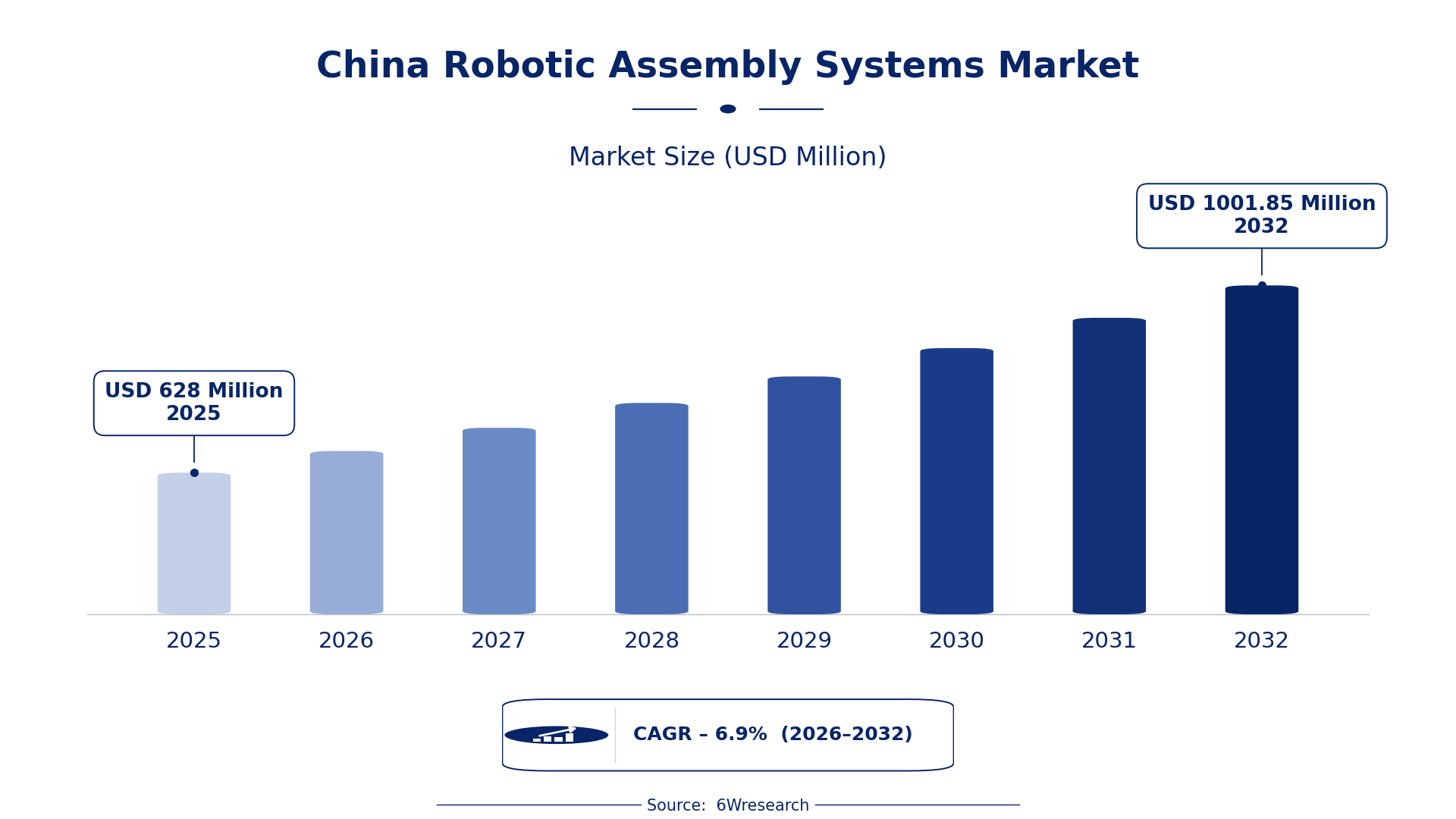
According to 6Wresearch internal database and industry insights, the China Robotic Assembly Systems Market was valued at USD 628.0 million in 2025 and is projected to reach USD 1,001.85 million by 2032, growing at a CAGR of approximately 6.9% during 2026–2032.
China Robotic Assembly Systems Market Highlights
| Report Metric | Details |
| Report Name | China Robotic Assembly Systems Market |
| Market Size 2025 | USD 628.0 million |
| Market Size 2032 | USD 1,001.85 million |
| Absolute Growth 2025–2032 | USD 373.85 million |
| CAGR 2026–2032 | 6.9% |
| Peak Annual Growth | 9.8% in 2032 |
| Forecast Period | 2026–2032 |
| Historical Data | 2022–2025 |
| Base Year | 2025 |
| Leading Assembly Type, 2025 | Electronics Assembly (38% share) |
| Leading Robot Type, 2025 | Articulated Arms (38% share) |
| Leading Automation Level, 2025 | Fully Automated (41% share) |
| Leading End User, 2025 | Auto OEMs (49% share) |
| Fastest-Growing Assembly Type | Automotive Assembly (9.2% CAGR) |
| Fastest-Growing Robot Type | Cobot Solutions (9.5% CAGR) |
| Fastest-Growing Automation Level | Collaborative (8.6% CAGR) |
| Fastest-Growing End User | EMS Providers (9.5% CAGR) |
| Growing Sector | automotive |
| Key End Users | auto OEMs, electronics manufacturers, EMS providers |
China Robotic Assembly Systems Market Year-wise Growth Rate and Key Drivers (2022–2032)
This graph illustrates the annual growth rates of the market from 2022 to 2032, highlighting a steady upward trajectory and projected market expansion over the forecast period.
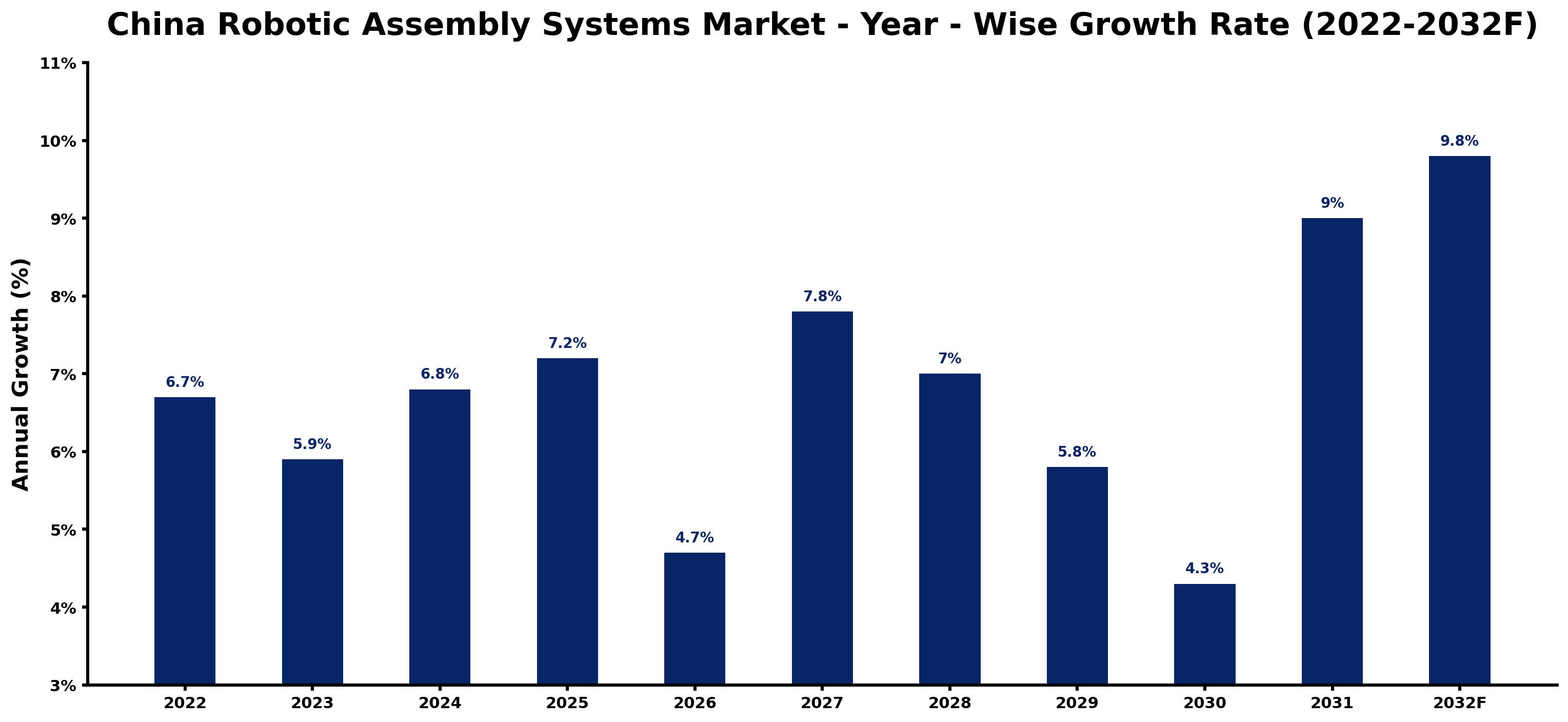
The table below sets out the estimated growth rate for each year and the main factor behind it.
| Year | Estimated Annual Growth (%) | Market Rationale |
| 2022 | 6.7 | The market experienced steady growth due to high demand from domestic manufacturers in the automotive sector. |
| 2023 | 5.9 | Growth slowed as manufacturers adjusted to supply chain challenges and the impact of economic conditions. |
| 2024 | 6.8 | An increase in automation investments spurred faster growth in robotic assembly systems, particularly in electronics. |
| 2025 | 7.2 | The automotive sector's expansion contributed to a notable rise in demand for robotic systems, driven by increased vehicle production. |
| 2026 | 4.7 | Growth is expected to slow as companies reassess automation strategies in light of economic conditions. |
| 2027 | 7.8 | Rising production rates in automotive assembly will lead to increased adoption of robotic systems. |
| 2028 | 7.0 | A slight slowdown is projected as manufacturers focus on efficiency improvements and cost management. |
| 2029 | 5.8 | Demand growth is expected to slow as market saturation begins to affect purchasing decisions. |
| 2030 | 4.3 | Continued economic pressures will lead to a further slowdown in growth rates for robotic systems. |
| 2031 | 9.0 | A resurgence in demand is projected, driven by new automotive production initiatives and technology advancements. |
| 2032 | 9.8 | Peak growth is expected as manufacturers fully embrace automation and robotics in their operations. |
Note: Market size estimations and growth projections presented in this report are based on 6Wresearch's proprietary forecasting methodology, utilizing the latest available industry data, government publications, and primary research inputs.
China Robotic Assembly Systems Market Synopsis
Robotic Assembly Systems in China represent sophisticated technologies utilised for assembling components across diverse industries. These systems improve efficiency and precision in manufacturing processes, with a primary focus on the electronics and automotive sectors. The China Robotic Assembly Systems Market is expanding due to considerable investments in automation, particularly from local manufacturers. In 2023, the electronics manufacturing sector in China was valued at over 1 trillion USD, driving the demand for robotic solutions. The automotive industry also contributed, producing 26 million vehicles in 2022, which further stimulated market growth.
Market Dynamics Impact Analysis (2026–2032)
| Factor | Type | Impact | Primary Segment Affected |
| High demand from the automotive sector drives investments in robotic assembly systems. | Driver | High | Automotive Assembly |
| The electronics industry's expansion creates a strong need for efficient assembly solutions. | Driver | High | Electronics Assembly |
| The Guangdong province is emerging as a hub for advanced robotic technologies. | Opportunity | High | Electronics Assembly |
| Growing demand for automation in small and medium-sized enterprises presents investment opportunities. | Opportunity | Medium | Automotive Assembly |
| High initial costs of robotic systems may deter small manufacturers from investing. | Restraint | High | Automotive Assembly |
| Limited skilled workforce in robotics affects operational efficiency and adoption rates. | Restraint | Medium | Electronics Assembly |
| Supply chain disruptions can delay the procurement of robotic systems. | Challenge | High | Electronics Assembly |
| Rapid technological advancements require continuous investment in upgrades. | Challenge | Medium | Automotive Assembly |
Evaluation of Drivers in China Robotic Assembly Systems Market (2026–2032)
The main growth drivers and the segments they affect most are set out below.
| Drivers | Primary Segment Affected | Why It Matters (Evidence) |
| Increased vehicle production drives demand for robotic assembly systems. | Automotive Assembly | The automotive industry produced 26 million vehicles in 2022, leading to higher investments in robotic systems. |
| Expanding electronics manufacturing necessitates efficient assembly solutions. | Electronics Assembly | China's electronics manufacturing sector is valued at over 1 trillion USD in 2023, boosting demand for automation. |
| Government initiatives promote automation in manufacturing processes. | Automotive Assembly | The 'Robotics Industry Development Plan' aims for a 30% increase in automation by 2025. |
| Rising consumer electronics production increases the need for robotic systems. | Electronics Assembly | With over 1,500 electronics assembly plants in China, demand for robotic solutions continues to grow. |
| Technological advancements in robotics enhance operational efficiency. | Automotive Assembly | The installed base of industrial robots in China exceeded 1 million units in 2023, improving production capabilities. |
Growth across the Robotic Assembly Systems market in China is anchored in strong end-use demand from the automotive and electronics sectors. The automotive industry produced 26 million vehicles in 2022, leading to higher investments in robotic assembly systems to improve production efficiency. In 2023, the electronics manufacturing sector was valued at over 1 trillion USD, further driving the need for automation solutions. Advancements in robotics technology have improved operational efficiency, resulting in increased purchases from manufacturers seeking to streamline their processes.
Evaluation of Restraints in China Robotic Assembly Systems Market
The main factors holding the market back are set out below.
| Market Restraint | Primary Segment Affected | Why It Matters (Evidence) |
| High initial costs of robotic systems may deter small manufacturers from investing. | Automotive Assembly | The average investment for robotic systems can exceed several hundred thousand USD, limiting access for smaller firms. |
| Limited skilled workforce in robotics affects operational efficiency and adoption rates. | Electronics Assembly | A shortage of trained personnel in robotics leads to operational delays and increased training costs. |
| Supply chain disruptions can delay the procurement of robotic systems. | Automotive Assembly | Recent global supply chain issues have led to longer lead times for robotic system components, impacting production schedules. |
| Technological advancements require continuous investment in upgrades. | Electronics Assembly | Rapid changes in technology necessitate ongoing investments, which can strain budgets for manufacturers and limit their competitiveness. |
| Market saturation may limit growth opportunities for new entrants. | Automotive Assembly | As established players dominate the market, new entrants face challenges in gaining market share and attracting customers. |
China Robotic Assembly Systems Market Challenges
Buyers in the China robotic assembly systems market face high initial costs, with systems averaging over 100,000 USD, which can delay project approvals and limit adoption. Regulatory compliance with the national standard GB/T 19001-2016 complicates operations, as manufacturers must navigate increased administrative tasks that can extend production timelines by several weeks. Supply chain disruptions are common, particularly for internationally sourced components, leading to lead times that can rise by 20% for manufacturers. Rapid technological advancements require suppliers to invest continuously, straining budgets and impacting their ability to remain competitive in the market.
Trends in the China Robotic Assembly Systems Market
Four trends stand out in the China Robotic Assembly Systems Market.
- Shift from Traditional to Collaborative Robots: Since 2021, there has been a notable shift towards collaborative robots in the Beijing-Tianjin-Hebei region, with installations increasing by 20%. This reflects a growing trend in automation that improves safety and efficiency in shared workspaces.
- Emergence of Fully Automated Production Lines: Beginning in 2023, fully automated production lines have gained traction in the automotive sector, particularly in Shanghai, with a 15% increase in adoption. This shift has led to increased efficiency and reduced labour costs.
- Growth in Demand for SCARA Robots: In 2022, SCARA robots became increasingly popular among electronics manufacturers in Guangdong, with a 25% rise in installations driven by their high-speed assembly capabilities. This trend is expected to continue as production demands rise.
- Rise of International Robotics Standards: In 2023, the 'China Standards 2035' initiative was announced to establish international standards for robotic technologies, aiming for a 10% improvement in quality and interoperability across the industry.
Investment Opportunities in the China Robotic Assembly Systems Market
Several openings in the China Robotic Assembly Systems Market merit attention from investors.
- Guangdong Province as a Robotics Hub: With over 1,500 electronics assembly plants, Guangdong province presents opportunities for robotic system suppliers. The region's electronics manufacturing sector is valued at over 1 trillion USD, making it an attractive market for investment.
- Investment in Automation for SMEs: The National Development and Reform Commission's funding program supports automation in small and medium-sized enterprises, providing 500 million USD in 2022. This initiative encourages investments in robotic systems, creating opportunities for suppliers.
- Collaborative Robots for Improved Efficiency: As demand for collaborative robots rises, suppliers can focus on providing these systems to manufacturers. The growing trend in the Beijing-Tianjin-Hebei region highlights the need for efficient automation solutions, with a projected 30% increase in installations.
- Expansion of Automotive Production Facilities: With the automotive sector projected to produce 26 million vehicles in 2022, there is a growing opportunity for robotic assembly systems. Suppliers can enter this market by partnering with local manufacturers to meet rising demand.
Government Initiatives in the China Robotic Assembly Systems Market
The 'Robotics Industry Development Plan' by the Ministry of Industry and Information Technology, launched in 2021, aims to increase automation in manufacturing by 30% by 2025. This measure builds on the 'Made in China 2025' initiative, which focuses on advancing robotics and automation technologies in key industries, creating a framework for increased investment in automation. The plan encourages manufacturers to adopt robotic assembly systems to enhance production efficiency and competitiveness.
In 2022, the National Development and Reform Commission introduced a funding program to support automation in small and medium-sized enterprises, allocating 500 million USD to help these businesses invest in robotic technologies. The Ministry of Science and Technology's 'National Key R&D Program' for Intelligent Manufacturing, launched in 2020, provides funding for robotics research and development, promoting innovation and improving production capabilities for manufacturers.
Future Insight of the China Robotic Assembly Systems Market
By 2032, buyers and suppliers in the China robotic assembly systems market can anticipate significant advancements driven by the 'Robotics Industry Development Plan' and the 'Made in China 2025' initiative. The government aims to boost automation in manufacturing, which will enhance operational efficiency across various sectors. The installed base of industrial robots is projected to exceed 2 million units, creating a more competitive landscape. Events like the annual 'China International Robot Show' will continue to showcase innovations, fostering collaboration and technological progress in the industry.
Market Segmentation Analysis
The report offers a comprehensive study of the following market segments and their leading categories in the market.
By Assembly Type – Electronics Assembly Dominated, Automotive Assembly Expected to Grow Fastest
According to Shubham Padhi, Research Analyst at 6Wresearch, Electronics Assembly held a 38% share of the China Robotic Assembly Systems Market by assembly type in 2025. Electronics assembly commands the largest share due to its critical role in over 1,500 electronics assembly plants throughout China. This sector thrives on robust demand from the electronics manufacturing industry, which is valued at over 1 trillion USD in 2023. Automotive Assembly is set to record the highest CAGR in this split, 9.2% over 2026–2032. Automotive assembly is poised for rapid growth, driven by the production of 26 million vehicles in 2022, necessitating advanced robotic systems for streamlined operations. As automotive manufacturers increasingly adopt automation, this segment's growth will likely accelerate further. Suppliers should prioritise the development of solutions tailored for automotive assembly to capitalise on this expanding market.
By Robot Type – Articulated Arms Dominated, Cobot Solutions Expected to Grow Fastest
Articulated Arms took a 38% share of robot type in 2025, more than any other category. Articulated arms hold the largest market share due to their versatility in executing complex assembly tasks across diverse industries. Their adaptability makes them a preferred choice for manufacturers aiming for efficiency and precision in robotic assembly systems. Cobot Solutions are projected to grow fastest, at a CAGR of 9.5% during 2026–2032. Cobot solutions are experiencing the fastest growth as they are increasingly integrated into collaborative tasks, enabling safe interaction between human workers and robots. This trend is supported by initiatives that promote automation, enhancing both productivity and workplace safety. Buyers should explore investments in cobot solutions to boost operational efficiency and ensure a safer work environment.
By Automation Level – Fully Automated Dominated, Collaborative Expected to Grow Fastest
Fully Automated accounted for a 41% market share by automation level in 2025. Fully automated systems capture the largest share as they are essential for high-volume production environments, ensuring consistent quality and efficiency. Manufacturers are increasingly adopting these systems to meet rising production demands. The quickest growth will come from Collaborative, forecast to expand at a CAGR of 8.6% between 2026 and 2032. Collaborative automation is growing rapidly, driven by the need for safer and more efficient shared workspaces in manufacturing. This growth is supported by government initiatives aiming to increase automation by 30% by 2025. Suppliers must innovate in collaborative solutions to meet the evolving needs of manufacturers.
By End User – Auto OEMs Dominated, EMS Providers Expected to Grow Fastest
In 2025, Auto OEMs led the end user split with a 49% share. Auto OEMs account for the largest market share as they are significant consumers of robotic assembly systems, crucial for their production processes. The extensive scale of automotive manufacturing in China drives substantial demand for these systems, particularly in the automotive assembly sector. Over 2026–2032, EMS Providers are expected to post the fastest growth, at a CAGR of 9.5%. EMS providers are the fastest-growing segment, utilising robotic systems to improve production efficiency and service delivery. This growth reflects the increasing dependence on outsourced manufacturing services within the electronics sector, particularly as demand for efficiency rises. Suppliers should focus on offering solutions that enhance production efficiency and flexibility specifically for EMS providers.
Key Attractiveness of the Report
- 10 Years of Market Numbers
- Historical Data Starting from 2022 to 2025
- Base Year 2025
- Forecast Data until 2032
- Key Performance Indicators Impacting the Market
- Major Upcoming Developments and Projects
Key Highlights of the Report:
- China Robotic Assembly Systems Market Outlook
- Market Size of China Robotic Assembly Systems Market, 2025
- Forecast of China Robotic Assembly Systems Market, 2032
- Historical Data and Forecast of China Robotic Assembly Systems Revenues & Volume for the Period 2022 - 2032F
- China Robotic Assembly Systems Market Trend Evolution
- China Robotic Assembly Systems Market Drivers and Challenges
- China Robotic Assembly Systems Price Trends
- China Robotic Assembly Systems Porter's Five Forces
- China Robotic Assembly Systems Industry Life Cycle
- Historical Data and Forecast of China Robotic Assembly Systems Market Revenues & Volume By Assembly Type for the Period 2022 - 2032F
- Historical Data and Forecast of China Robotic Assembly Systems Market Revenues & Volume By Electronics Assembly for the Period 2022 - 2032F
- Historical Data and Forecast of China Robotic Assembly Systems Market Revenues & Volume By Automotive Assembly for the Period 2022 - 2032F
- Historical Data and Forecast of China Robotic Assembly Systems Market Revenues & Volume By PCB Mounting for the Period 2022 - 2032F
- Historical Data and Forecast of China Robotic Assembly Systems Market Revenues & Volume By White Goods Assembly for the Period 2022 - 2032F
- Historical Data and Forecast of China Robotic Assembly Systems Market Revenues & Volume By Robot Type for the Period 2022 - 2032F
- Historical Data and Forecast of China Robotic Assembly Systems Market Revenues & Volume By SCARA Robots for the Period 2022 - 2032F
- Historical Data and Forecast of China Robotic Assembly Systems Market Revenues & Volume By Articulated Arms for the Period 2022 - 2032F
- Historical Data and Forecast of China Robotic Assembly Systems Market Revenues & Volume By Pick & Place Robots for the Period 2022 - 2032F
- Historical Data and Forecast of China Robotic Assembly Systems Market Revenues & Volume By Cobot Solutions for the Period 2022 - 2032F
- Historical Data and Forecast of China Robotic Assembly Systems Market Revenues & Volume By Automation Level for the Period 2022 - 2032F
- Historical Data and Forecast of China Robotic Assembly Systems Market Revenues & Volume By Semi-Automated for the Period 2022 - 2032F
- Historical Data and Forecast of China Robotic Assembly Systems Market Revenues & Volume By Fully Automated for the Period 2022 - 2032F
- Historical Data and Forecast of China Robotic Assembly Systems Market Revenues & Volume By Programmable for the Period 2022 - 2032F
- Historical Data and Forecast of China Robotic Assembly Systems Market Revenues & Volume By Collaborative for the Period 2022 - 2032F
- Historical Data and Forecast of China Robotic Assembly Systems Market Revenues & Volume By End User for the Period 2022 - 2032F
- Historical Data and Forecast of China Robotic Assembly Systems Market Revenues & Volume By Consumer Electronics for the Period 2022 - 2032F
- Historical Data and Forecast of China Robotic Assembly Systems Market Revenues & Volume By Auto OEMs for the Period 2022 - 2032F
- Historical Data and Forecast of China Robotic Assembly Systems Market Revenues & Volume By EMS Providers for the Period 2022 - 2032F
- Historical Data and Forecast of China Robotic Assembly Systems Market Revenues & Volume By Appliance Manufacturers for the Period 2022 - 2032F
- China Robotic Assembly Systems Import Export Trade Statistics
- Market Opportunity Assessment By Assembly Type
- Market Opportunity Assessment By Robot Type
- Market Opportunity Assessment By Automation Level
- Market Opportunity Assessment By End User
- China Robotic Assembly Systems Top Companies Market Share
- China Robotic Assembly Systems Competitive Benchmarking By Technical and Operational Parameters
- China Robotic Assembly Systems Company Profiles
- China Robotic Assembly Systems Key Strategic Recommendations
Market Covered
Segments analysed in this report are listed below.
By Assembly Type
- Electronics Assembly
- Automotive Assembly
- PCB Mounting
- White Goods Assembly
By Robot Type
- SCARA Robots
- Articulated Arms
- Pick & Place Robots
- Cobot Solutions
By Automation Level
- Semi-Automated
- Fully Automated
- Programmable
- Collaborative
By End User
- Consumer Electronics
- Auto OEMs
- EMS Providers
- Appliance Manufacturers































