India Robotic Cooking Market Size & Growth Rate
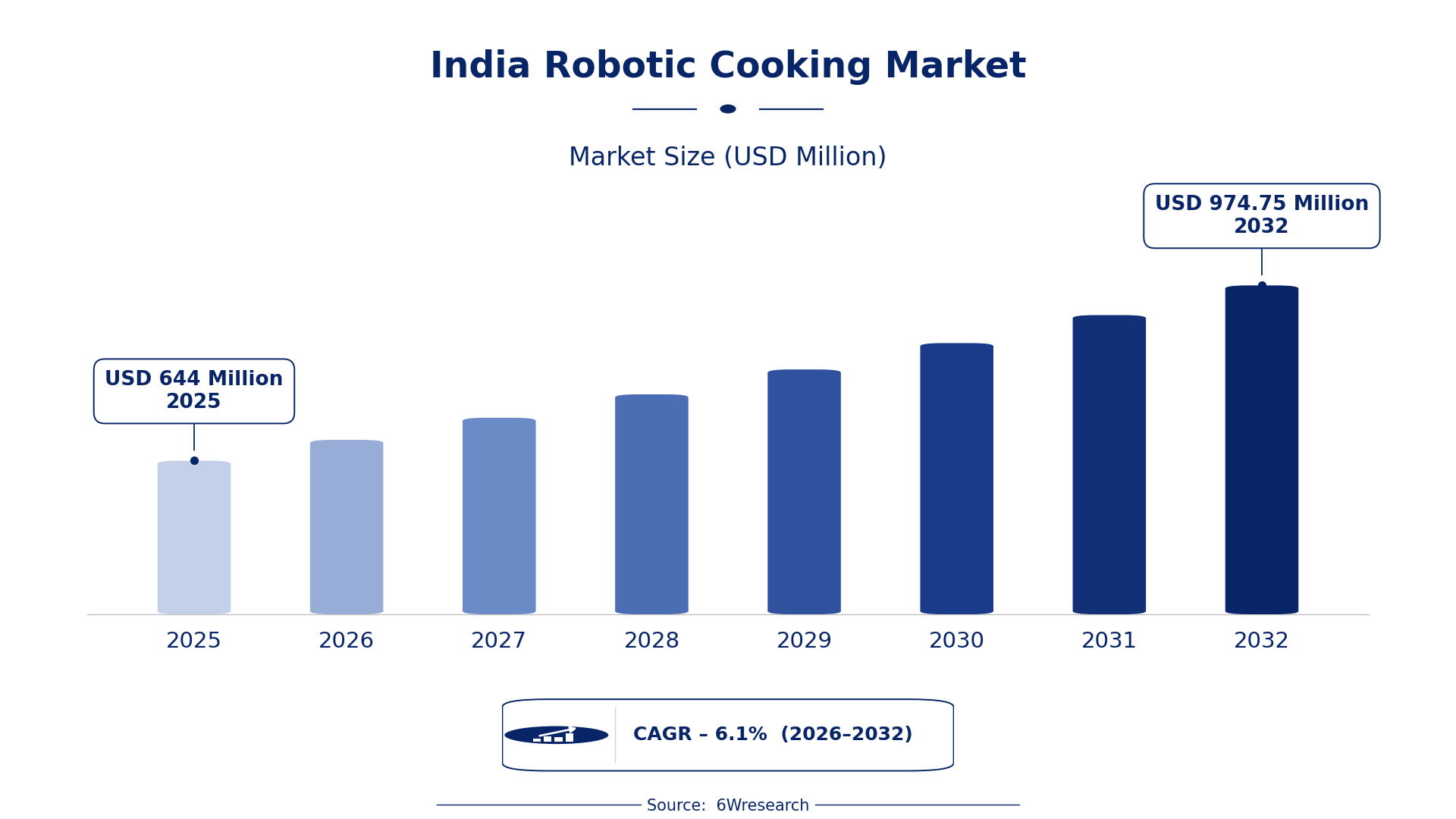
According to 6Wresearch internal database and industry insights, the India Robotic Cooking Market was valued at USD 644.0 million in 2025 and is projected to reach USD 974.75 million by 2032, growing at a CAGR of approximately 6.1% during 2026–2032.
India Robotic Cooking Market Highlights
| Report Metric | Details |
| Report Name | India Robotic Cooking Market |
| Market Size 2025 | USD 644.0 million |
| Market Size 2032 | USD 974.75 million |
| Absolute Growth 2025–2032 | USD 330.75 million |
| CAGR 2026–2032 | 6.1% |
| Peak Annual Growth | 8.5% in 2030 |
| Forecast Period | 2026–2032 |
| Historical Data | 2022–2025 |
| Base Year | 2025 |
| Leading System Type, 2025 | Robotic Arms (35% share) |
| Leading Operation Mode, 2025 | Preprogrammed Recipes (47% share) |
| Leading Cuisine Application, 2025 | Indian/Asian Cuisine (37% share) |
| Leading End User, 2025 | QSR Chains (38% share) |
| Fastest-Growing System Type | AI-Based Chef Systems (8.5% CAGR) |
| Fastest-Growing Operation Mode | IoT Integrated (7.3% CAGR) |
| Fastest-Growing Cuisine Application | Home Cooking (8.6% CAGR) |
| Fastest-Growing End User | Cloud Kitchens (8.6% CAGR) |
| Growing Sector | Home Cooking |
| Key End Users | Indian/Asian Cuisine, Fast Food, Home Cooking, International Cuisine |
India Robotic Cooking Market Year-wise Growth Rate and Key Drivers (2022–2032)
This graph illustrates the annual growth rates of the market from 2022 to 2032, highlighting a steady upward trajectory and projected market expansion over the forecast period.
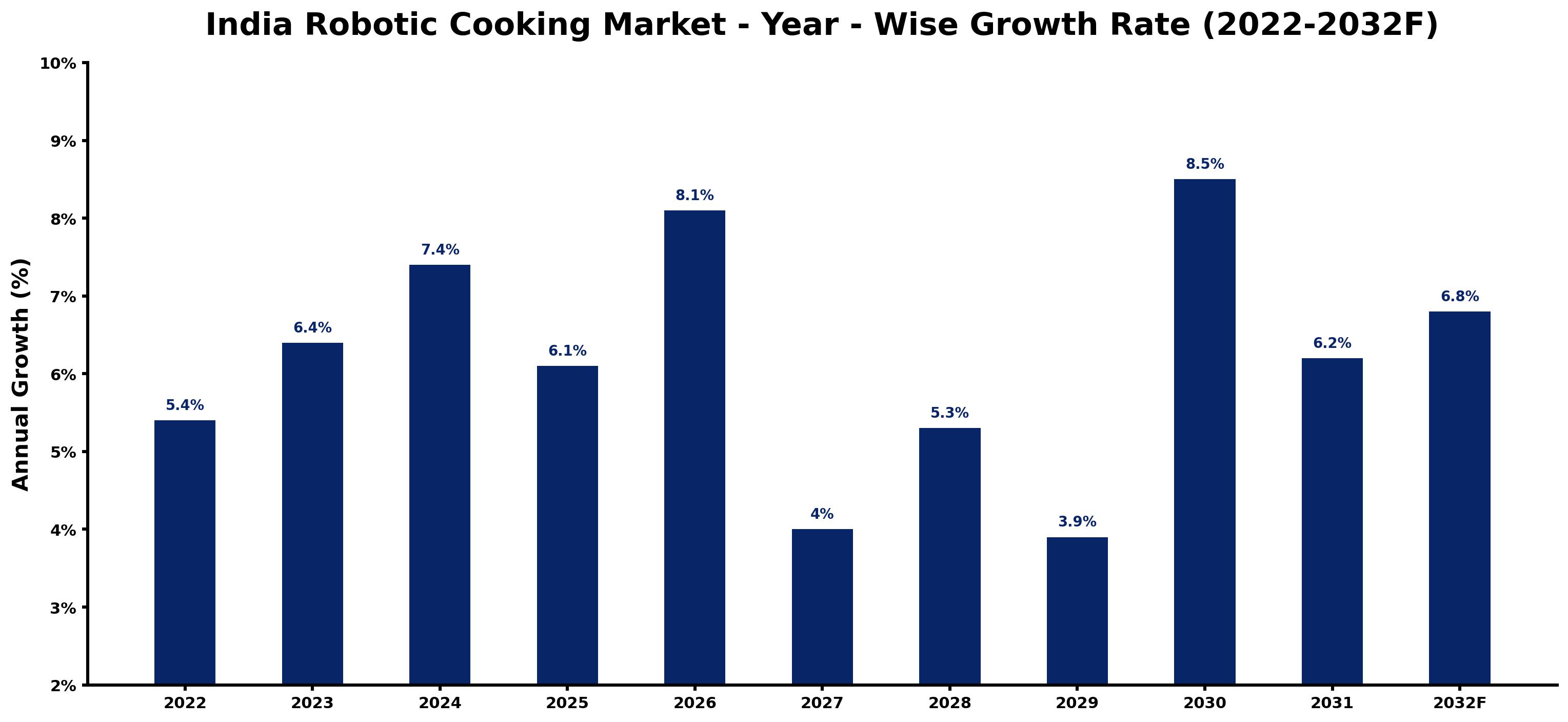
Below, each year's estimated growth is shown next to the factor that most influenced it.
| Year | Estimated Annual Growth (%) | Market Rationale |
| 2022 | 5.4 | The market recorded steady growth, driven by urbanisation and consumer interest in automation. |
| 2023 | 6.4 | Adoption of robotic solutions in quick-service restaurants surged, reflecting changing consumer preferences. |
| 2024 | 7.4 | The market experienced accelerated growth as more food outlets embraced automation technologies. |
| 2025 | 6.1 | Growth slowed as market maturity set in, yet demand for efficiency remained strong. |
| 2026 | 8.1 | The market is expected to rebound with renewed interest in AI-based cooking systems improving operational efficiency. |
| 2027 | 4.0 | Growth is projected to slow again as market saturation begins to affect new investments in robotic cooking. |
| 2028 | 5.3 | A slight uptick in growth is expected as innovative cooking solutions gain traction among households. |
| 2029 | 3.9 | Growth is projected to slow further as competition increases and buyers become more selective. |
| 2030 | 8.5 | The market is expected to peak with a surge in demand for advanced robotic cooking solutions in urban areas. |
| 2031 | 6.2 | A slowdown in growth is projected as the market stabilises after reaching its peak. |
| 2032 | 6.8 | Growth is expected to resume as new technologies and consumer preferences shift towards automation. |
Note: Market size estimations and growth projections presented in this report are based on 6Wresearch's proprietary forecasting methodology, utilizing the latest available industry data, government publications, and primary research inputs.
India Robotic Cooking Market Synopsis
India Robotic Cooking Market includes automated systems that prepare food with minimal human intervention. These systems guarantee consistent quality and efficiency, primarily in food service environments. The market is experiencing robust growth, driven by urbanisation and evolving consumer preferences. In 2023, over 1 million smart kitchens were reported, highlighting a growing trend towards automation. The National Restaurant Association of India recorded a 30% rise in the adoption of robotic solutions within quick-service restaurants, further accelerating market expansion.
Market Dynamics Impact Analysis (2026–2032)
| Factor | Type | Impact | Primary Segment Affected |
| Urbanisation is driving demand for automated cooking solutions in urban households. | Driver | High | Households |
| The integration of AI-based chef systems enhances operational efficiency in cloud kitchens. | Driver | High | Cloud Kitchens |
| The increasing number of smart kitchens presents a significant opportunity for suppliers. | Opportunity | High | Smart Kitchens |
| The growing interest in home cooking solutions opens new market avenues for innovation. | Opportunity | High | Home Cooking |
| Safety standards for robotic cooking appliances are still under development, limiting market expansion. | Restraint | Medium | Robotic Arms |
| High initial investment costs deter some potential buyers from adopting robotic cooking systems. | Restraint | Medium | Automated Stations |
| The Robotic Cooking market in India faces challenges from high initial costs and limited consumer awareness. | Challenge | High | Multi-Cooker Robots |
| Competition from traditional cooking methods poses a challenge to market penetration. | Challenge | Medium | AI-Based Chef Systems |
Evaluation of Drivers in India Robotic Cooking Market (2026–2032)
The table below links each growth driver to the segment it affects and the evidence for it.
| Drivers | Primary Segment Affected | Why It Matters (Evidence) |
| Urbanisation drives demand for robotic cooking solutions in urban households, with over 60% considering such appliances. | Households | This shift leads to increased purchases of robotic cooking systems for convenience. |
| The integration of AI-based chef systems in cloud kitchens improves operational efficiency, reported to increase productivity by 30%. | Cloud Kitchens | This efficiency encourages more cloud kitchens to adopt robotic cooking technology. |
| The Smart Cities Mission promotes smart kitchen technologies, with over 1 million smart kitchens established in 2023. | Smart Kitchens | This initiative boosts demand for automated cooking solutions in urban areas. |
| Investment in food tech startups focusing on robotic cooking reached $500 million in 2023, showcasing investor confidence. | Robotic Arms | This funding supports the development of new cooking technologies. |
| The National Restaurant Association of India reported a 30% increase in robotic solutions adoption in QSRs in 2023. | QSR Chains | This trend reflects a growing demand for automation in food service operations. |
The Robotic Cooking market in India is expanding as urbanisation, technological advancements, and changing consumer preferences drive demand. In 2023, over 60% of urban households considered robotic cooking appliances, reflecting a growing interest in convenience. The Smart Cities Mission has led to the establishment of over 1 million smart kitchens, boosting demand for automated solutions. Investment in food tech startups reached $500 million, indicating strong investor confidence in this sector. The adoption of robotic solutions in quick-service restaurants increased by 30%, highlighting the shift towards automation in food service operations.
Evaluation of Restraints in India Robotic Cooking Market
The table below lists the restraints and the evidence behind each.
| Market Restraint | Primary Segment Affected | Why It Matters (Evidence) |
| Safety standards for robotic cooking appliances are still under development, affecting market growth. | Robotic Arms | This uncertainty limits consumer confidence and slows adoption rates. |
| High initial investment costs deter some potential buyers from adopting robotic cooking systems. | Automated Stations | This financial barrier restricts market penetration among smaller food outlets. |
| Limited consumer awareness of robotic cooking benefits hampers broader acceptance. | Multi-Cooker Robots | This lack of understanding slows down potential sales and market growth. |
| Competition from traditional cooking methods poses a challenge to market penetration. | AI-Based Chef Systems | Many consumers prefer familiar cooking techniques over automated systems. |
| Supply chain disruptions impact the availability of robotic cooking components, delaying production. | Preprogrammed Recipes | These delays hinder timely market entry for new products. |
India Robotic Cooking Market Challenges
The India robotic cooking market encounters a significant technological challenge, as many robotic cooking systems still lack the necessary AI capabilities for diverse food preparation, limiting their appeal to urban restaurants. Skills shortages in robotics and AI restrict food service operators from effectively implementing these systems, delaying automation across kitchens. Supply chain disruptions for critical components like sensors have increased costs by about 15%, which forces producers to raise prices and impacts affordability for buyers. Regulatory uncertainties surrounding safety standards for robotic cooking appliances create hesitation among investors, stalling innovation and development in the market.
Trends in the India Robotic Cooking Market
Several trends are reshaping the India Robotic Cooking Market; the most important are set out below.
- Shift towards AI-Based Chef Systems: The integration of AI in cooking technology is gaining traction, with AI-based chef systems increasingly utilised in cloud kitchens. In 2023, these systems enhanced operational efficiency by 30%, enabling quicker meal preparation.
- Transition to Smart Kitchens: The Smart Cities Mission has accelerated the uptake of smart kitchen technologies in urban regions. By 2023, over 1 million smart kitchens were established, encouraging automation in food preparation.
- Emergence of Home Cooking Solutions: A growing trend towards home cooking solutions is evident, driven by consumer interest in convenience and automation. In 2023, households demonstrated a 60% consideration rate for robotic cooking appliances.
- Increased Adoption in QSR Chains: Quick-service restaurants are swiftly adopting robotic cooking solutions to enhance efficiency. The National Restaurant Association of India reported a 30% increase in adoption in 2023.
Investment Opportunities in the India Robotic Cooking Market
Some of the investment opportunities in the India Robotic Cooking Market are mentioned below.
- Market Gap in Home Cooking: With over 60% of urban households considering robotic cooking appliances, there is a notable market gap. Suppliers can focus on developing affordable, user-friendly solutions for families looking to improve cooking efficiency.
- Timing for Cloud Kitchens: The rise of cloud kitchens presents a timely opportunity for investment in robotic cooking systems. As these kitchens aim for efficiency, suppliers can partner with them to provide advanced automation solutions.
- Investment in Smart Kitchens: The establishment of over 1 million smart kitchens in India indicates a strong demand for automation. Suppliers can enter this market by collaborating with local manufacturers to provide robotic cooking devices.
- Focus on QSR Chains: The quick-service restaurant sector is increasingly adopting robotic cooking solutions, with a 30% increase noted in 2023. Suppliers can target this segment by offering tailored solutions that improve operational efficiency.
Government Initiatives in the India Robotic Cooking Market
The 'Make in India' programme promotes local manufacturing of robotic cooking devices, aiming to boost domestic production and reduce imports. This initiative supports local manufacturers and ensures that buyers have access to high-quality, locally produced appliances. The Food Safety and Standards Authority of India is developing regulations for automated food preparation systems, ensuring compliance with safety standards. These regulations provide a framework for producers to follow, increasing consumer confidence in robotic cooking technologies.
The Ministry of Food Processing Industries launched the 'Pradhan Mantri Kisan Sampada Yojana' in 2021 to promote food processing, including automation in kitchens, with a budget of ₹600 crore. This scheme benefits food service operators by facilitating access to advanced cooking technologies and improving operational efficiency. The 'Digital India' initiative, launched in 2020, aims to enhance the adoption of IoT technologies in food preparation, benefitting robotic cooking systems.
Future Insight of the India Robotic Cooking Market
The India robotic cooking market is set to evolve significantly by 2032, driven by urbanisation and advancements in technology. The Smart Cities Mission will promote the integration of smart kitchen technologies, enhancing operational efficiency in food service. Investment in food tech startups focusing on robotic cooking is projected to reach $1 billion by 2025, reflecting strong investor confidence. The Bureau of Indian Standards is developing safety regulations, which will facilitate smoother market entry for new robotic cooking solutions, benefiting both buyers and suppliers.
Market Segmentation Analysis
Each segment group is reviewed below, with the leader by share and the fastest grower by CAGR.
By System Type – Robotic Arms Dominated, AI-Based Chef Systems Expected to Grow Fastest
According to Shubham Padhi, Research Analyst at 6Wresearch, the largest system type category in 2025 was Robotic Arms, with a 35% share of total revenue. Robotic Arms command a large market share in India as they are crucial for precise cooking tasks and food handling, particularly in restaurants and food service operations. Their integration into over 1 million smart kitchens illustrates their widespread acceptance and preference in urban environments. The quickest growth will come from AI-Based Chef Systems, forecast to expand at a CAGR of 8.5% between 2026 and 2032. AI-Based Chef Systems are rapidly gaining popularity as they optimise recipes and enhance cooking efficiency, particularly in cloud kitchens. The 30% increase in robotic solutions adoption in quick-service restaurants this year signals a growing demand for these advanced systems. Suppliers should focus on developing robotic arms, while buyers can improve kitchen efficiency by investing in AI-based systems.
By Operation Mode – Preprogrammed Recipes Dominated, IoT Integrated Expected to Grow Fastest
With a 47% revenue share in 2025, Preprogrammed Recipes was the largest operation mode category. Preprogrammed Recipes dominate the market due to their ability to simplify meal preparation with clear instructions, appealing to both restaurants and households seeking convenience. Their extensive use in smart kitchens, which surpassed 1 million in 2023, highlights their importance in the robotic cooking market. IoT Integrated is projected to grow fastest, at a CAGR of 7.3% during 2026–2032. IoT Integrated systems are experiencing rapid growth, driven by the increasing demand for connectivity and monitoring in cooking appliances. Initiatives like the Smart Cities Mission, which promotes smart kitchen technologies, further accelerate this segment's expansion. Suppliers focusing on IoT integration can gain a competitive edge, while buyers can utilise these systems to enhance cooking efficiency.
By Cuisine Application – Indian/Asian Cuisine Dominated, Home Cooking Expected to Grow Fastest
Indian/Asian Cuisine accounted for a 37% market share by cuisine application in 2025. Indian/Asian Cuisine holds the largest market share as it is predominantly used in local restaurants and homes, aligning with the culinary preferences of the Indian population. The diversification of the culinary landscape has led to a greater adoption of robotic cooking systems within this segment. Over 2026–2032, Home Cooking is expected to post the fastest growth, at a CAGR of 8.6%. Home Cooking is the fastest-growing segment, driven by tech-savvy households seeking convenience and efficiency in meal preparation. The fact that over 60% of urban households are considering robotic cooking appliances indicates a significant shift towards automated solutions in domestic kitchens. Suppliers should target home cooking solutions, while buyers can explore robotic systems to modernise their cooking practices.
By End User – QSR Chains Dominated, Cloud Kitchens Expected to Grow Fastest
QSR Chains held a 38% share of the India Robotic Cooking Market by end user in 2025. QSR Chains represent the largest market share due to their high demand for automation, which streamlines operations and enhances service speed. The significant adoption of robotic solutions in these establishments reflects their reliance on technology to effectively meet consumer expectations. Cloud Kitchens are set to record the highest CAGR in this split, 8.6% over 2026–2032. Cloud Kitchens are rapidly expanding, propelled by the rise of delivery-focused food businesses that require efficient cooking solutions. The investment of $500 million in food tech startups centred on robotic cooking highlights the growing interest in this operational model. Suppliers should tailor their offerings to meet the specific needs of cloud kitchens, while buyers can leverage automation to optimise their delivery services.
Key Attractiveness of the Report
- 10 Years of Market Numbers
- Historical Data Starting from 2022 to 2025
- Base Year 2025
- Forecast Data until 2032
- Key Performance Indicators Impacting the Market
- Major Upcoming Developments and Projects
Key Highlights of the Report:
- India Robotic Cooking Market Outlook
- Market Size of India Robotic Cooking Market, 2025
- Forecast of India Robotic Cooking Market, 2032
- Historical Data and Forecast of India Robotic Cooking Revenues & Volume for the Period 2022 - 2032F
- India Robotic Cooking Market Trend Evolution
- India Robotic Cooking Market Drivers and Challenges
- India Robotic Cooking Price Trends
- India Robotic Cooking Porter's Five Forces
- India Robotic Cooking Industry Life Cycle
- Historical Data and Forecast of India Robotic Cooking Market Revenues & Volume By System Type for the Period 2022 - 2032F
- Historical Data and Forecast of India Robotic Cooking Market Revenues & Volume By Robotic Arms for the Period 2022 - 2032F
- Historical Data and Forecast of India Robotic Cooking Market Revenues & Volume By Automated Stations for the Period 2022 - 2032F
- Historical Data and Forecast of India Robotic Cooking Market Revenues & Volume By Multi-Cooker Robots for the Period 2022 - 2032F
- Historical Data and Forecast of India Robotic Cooking Market Revenues & Volume By AI-Based Chef Systems for the Period 2022 - 2032F
- Historical Data and Forecast of India Robotic Cooking Market Revenues & Volume By Operation Mode for the Period 2022 - 2032F
- Historical Data and Forecast of India Robotic Cooking Market Revenues & Volume By Preprogrammed Recipes for the Period 2022 - 2032F
- Historical Data and Forecast of India Robotic Cooking Market Revenues & Volume By Conveyor + AI for the Period 2022 - 2032F
- Historical Data and Forecast of India Robotic Cooking Market Revenues & Volume By IoT Integrated for the Period 2022 - 2032F
- Historical Data and Forecast of India Robotic Cooking Market Revenues & Volume By Adaptive Cooking for the Period 2022 - 2032F
- Historical Data and Forecast of India Robotic Cooking Market Revenues & Volume By Cuisine Application for the Period 2022 - 2032F
- Historical Data and Forecast of India Robotic Cooking Market Revenues & Volume By Indian/Asian Cuisine for the Period 2022 - 2032F
- Historical Data and Forecast of India Robotic Cooking Market Revenues & Volume By Fast Food for the Period 2022 - 2032F
- Historical Data and Forecast of India Robotic Cooking Market Revenues & Volume By Home Cooking for the Period 2022 - 2032F
- Historical Data and Forecast of India Robotic Cooking Market Revenues & Volume By International Cuisine for the Period 2022 - 2032F
- Historical Data and Forecast of India Robotic Cooking Market Revenues & Volume By End User for the Period 2022 - 2032F
- Historical Data and Forecast of India Robotic Cooking Market Revenues & Volume By Smart Kitchens for the Period 2022 - 2032F
- Historical Data and Forecast of India Robotic Cooking Market Revenues & Volume By QSR Chains for the Period 2022 - 2032F
- Historical Data and Forecast of India Robotic Cooking Market Revenues & Volume By Households for the Period 2022 - 2032F
- Historical Data and Forecast of India Robotic Cooking Market Revenues & Volume By Cloud Kitchens for the Period 2022 - 2032F
- India Robotic Cooking Import Export Trade Statistics
- Market Opportunity Assessment By System Type
- Market Opportunity Assessment By Operation Mode
- Market Opportunity Assessment By Cuisine Application
- Market Opportunity Assessment By End User
- India Robotic Cooking Top Companies Market Share
- India Robotic Cooking Competitive Benchmarking By Technical and Operational Parameters
- India Robotic Cooking Company Profiles
- India Robotic Cooking Key Strategic Recommendations
Market Covered
The report offers an extensive study of the following market segments.
By System Type
- Robotic Arms
- Automated Stations
- Multi-Cooker Robots
- AI-Based Chef Systems
By Operation Mode
- Preprogrammed Recipes
- Conveyor + AI
- IoT Integrated
- Adaptive Cooking
By Cuisine Application
- Indian/Asian Cuisine
- Fast Food
- Home Cooking
- International Cuisine
By End User
- Smart Kitchens
- QSR Chains
- Households
- Cloud Kitchens































