China Robotic Cooking Market Size & Growth Rate
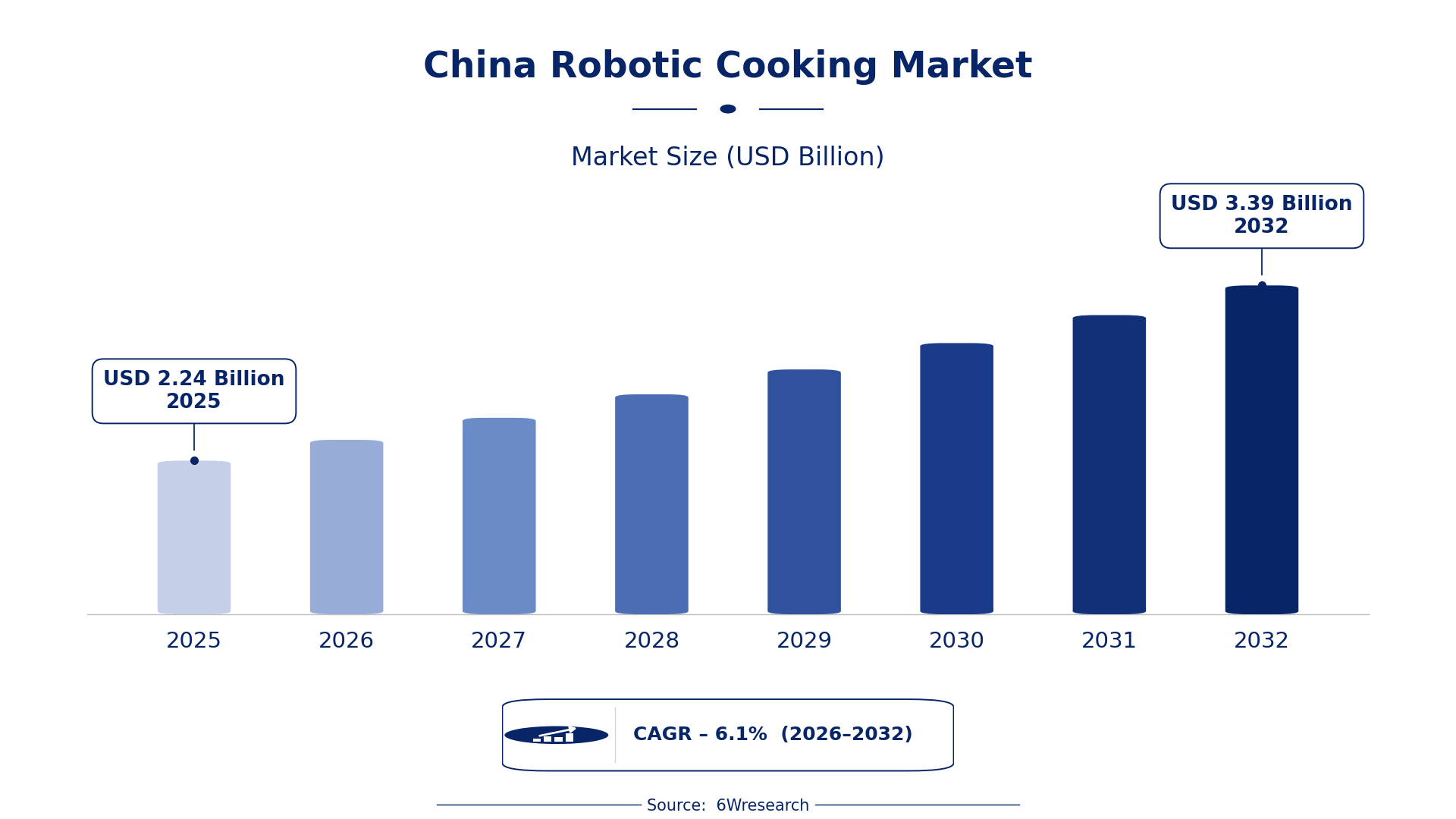
According to 6Wresearch internal database and industry insights, the China Robotic Cooking Market was valued at USD 2.24 billion in 2025 and is projected to reach USD 3.39 billion by 2032, growing at a CAGR of approximately 6.1% during 2026–2032.
China Robotic Cooking Market Highlights
| Report Metric | Details |
| Report Name | China Robotic Cooking Market |
| Market Size 2025 | USD 2.24 billion |
| Market Size 2032 | USD 3.39 billion |
| Absolute Growth 2025–2032 | USD 1.15 billion |
| CAGR 2026–2032 | 6.1% |
| Peak Annual Growth | 8.5% in 2028 |
| Forecast Period | 2026–2032 |
| Historical Data | 2022–2025 |
| Base Year | 2025 |
| Leading System Type, 2025 | Robotic Arms (49% share) |
| Leading Operation Mode, 2025 | Preprogrammed Recipes (41% share) |
| Leading Cuisine Application, 2025 | Fast Food (38% share) |
| Leading End User, 2025 | QSR Chains (45% share) |
| Fastest-Growing System Type | AI-Based Chef Systems (7.2% CAGR) |
| Fastest-Growing Operation Mode | IoT Integrated (7.2% CAGR) |
| Fastest-Growing Cuisine Application | Home Cooking (7.5% CAGR) |
| Fastest-Growing End User | Cloud Kitchens (7.4% CAGR) |
| Growing Sector | QSR Chains |
| Key End Users | QSR Chains, Households, Cloud Kitchens, Smart Kitchens |
China Robotic Cooking Market Year-wise Growth Rate and Key Drivers (2022–2032)
This graph illustrates the annual growth rates of the market from 2022 to 2032, highlighting a steady upward trajectory and projected market expansion over the forecast period.
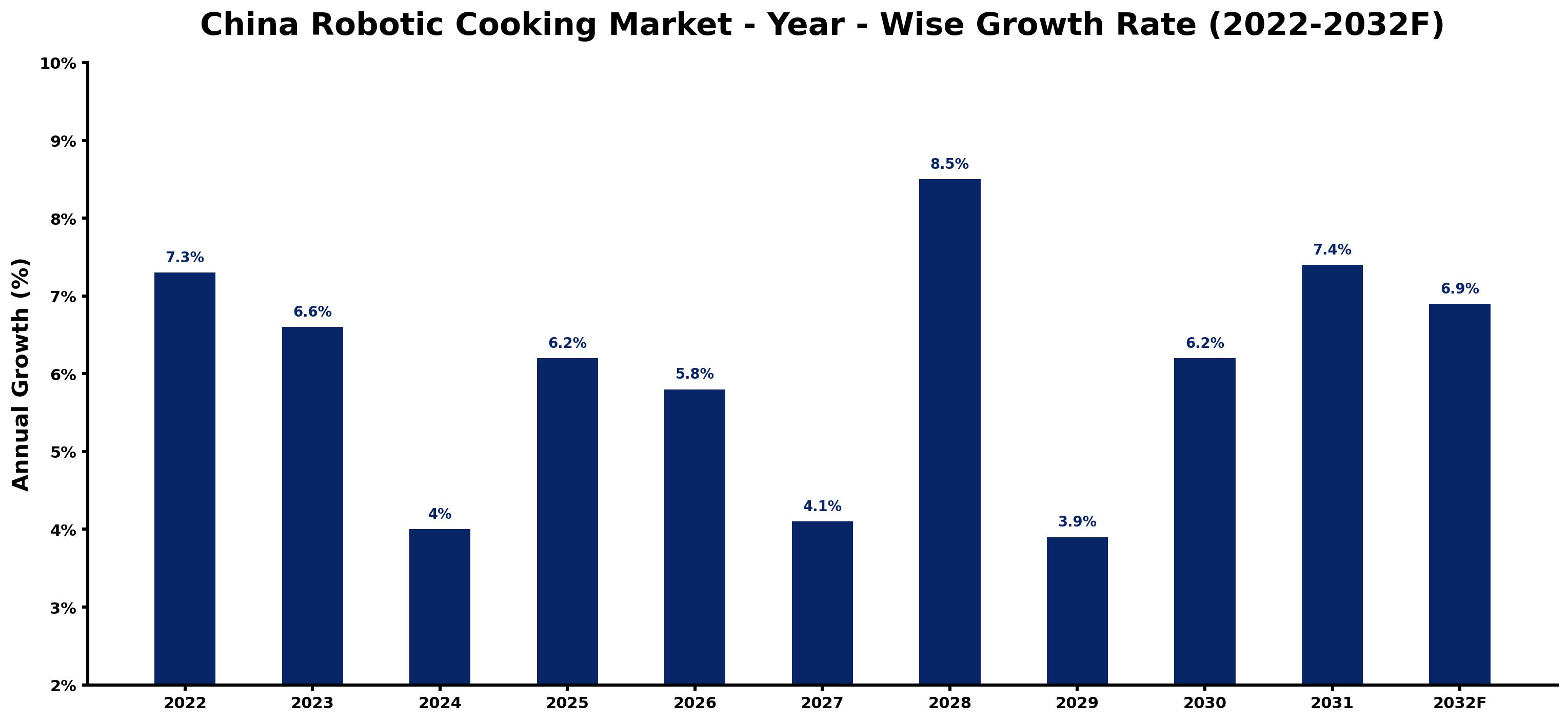
Below, each year's estimated growth is shown next to the factor that most influenced it.
| Year | Estimated Annual Growth (%) | Market Rationale |
| 2022 | 7.3 | The market experienced strong demand from urban households adopting robotic cooking solutions. |
| 2023 | 6.6 | Growth slowed as the market adjusted to the "National Standard for Kitchen Appliances" updated in 2021. |
| 2024 | 4.0 | A further slowdown occurred due to market saturation in major urban areas, particularly in QSR chains. |
| 2025 | 6.2 | Demand increased as QSR chains expanded their automation efforts to improve efficiency. |
| 2026 | 5.8 | Growth slowed again as consumer interest shifted towards IoT Integrated cooking devices. |
| 2027 | 4.1 | The market continued to grow slowly as urbanisation increased the need for efficient cooking solutions. |
| 2028 | 8.5 | A surge in demand was driven by innovations in AI-Based Chef Systems and smart kitchens. |
| 2029 | 3.9 | Growth slowed as the market began to stabilise after rapid expansion in previous years. |
| 2030 | 6.2 | Demand increased again as households sought convenience in Multi-Cooker Robots. |
| 2031 | 7.4 | The market saw a rise in growth as more households adopted robotic cooking devices. |
| 2032 | 6.9 | Growth slowed slightly as the market matured and competition intensified. |
Note: Market size estimations and growth projections presented in this report are based on 6Wresearch's proprietary forecasting methodology, utilizing the latest available industry data, government publications, and primary research inputs.
China Robotic Cooking Market Synopsis
Robotic Cooking in China involves automated systems that prepare meals using programmed instructions and AI. These systems improve efficiency in both commercial kitchens and home cooking. The China Robotic Cooking Market is expanding due to rising demand from quick service restaurants and households. Urbanisation and a growing interest in smart kitchen solutions are key factors behind this growth, with over 1,000 new smart kitchen products launched in 2023.
Market Dynamics Impact Analysis (2026–2032)
| Factor | Type | Impact | Primary Segment Affected |
| Increased adoption of robotic cooking systems in quick service restaurants enhances operational efficiency. | Driver | High | QSR Chains |
| The growing number of urban households investing in smart kitchen technologies creates new demand. | Driver | High | Households |
| The rise of cloud kitchens presents an opportunity for suppliers of robotic cooking devices to meet demand. | Opportunity | High | Cloud Kitchens |
| The increasing trend of home cooking encourages investment in Multi-Cooker Robots for convenience. | Opportunity | High | Home Cooking |
| High initial costs of robotic cooking systems can deter small restaurant owners from adoption. | Restraint | Medium | QSR Chains |
| Limited consumer awareness about the benefits of robotic cooking technology may restrict market growth. | Restraint | Medium | Households |
| The market still has to solve a few problems, such as integration challenges with existing kitchen setups. | Challenge | Medium | Smart Kitchens |
| Competition from traditional cooking methods remains a challenge for robotic cooking adoption. | Challenge | Medium | Home Cooking |
Evaluation of Drivers in China Robotic Cooking Market (2026–2032)
Below mentioned are some major drivers and their influence on market dynamics.
| Drivers | Primary Segment Affected | Why It Matters (Evidence) |
| Growing demand for efficiency in commercial kitchens boosts the adoption of robotic arms. | Robotic Arms | Over 70% of automated cooking stations in commercial kitchens use robotic arms to improve productivity. |
| Increasing consumer preference for convenience raises the demand for Multi-Cooker Robots. | Multi-Cooker Robots | In 2023, demand surged by 25% in urban areas as households sought versatile cooking solutions. |
| The rise of smart kitchens encourages the integration of IoT in cooking devices. | IoT Integrated | The adoption rate is projected to reach 15% by 2025, driven by urbanisation and tech-savvy consumers. |
| The popularity of fast food increases the need for automated cooking solutions in QSR chains. | Fast Food | Robotic cooking systems are used in over 60% of QSR chains in major cities, ensuring consistency. |
| The trend towards home cooking is leading to increased sales of AI-Based Chef Systems. | AI-Based Chef Systems | These systems are gaining traction in urban areas with high disposable income, improving cooking experiences. |
Market growth in China for Robotic Cooking rests on rising end-use demand from households and quick service restaurants. The increasing adoption of robotic arms in commercial kitchens improves productivity, with over 70% of automated cooking stations utilising this technology. Urban households are increasingly investing in Multi-Cooker Robots, with demand surging by 25% in 2023. The rise of smart kitchens is fuelling the integration of IoT in cooking devices, projected to reach a 15% adoption rate by 2025. The popularity of fast food drives the need for automated solutions in QSR chains, ensuring consistency and efficiency.
Evaluation of Restraints in China Robotic Cooking Market
The main factors holding the market back are set out below.
| Market Restraint | Primary Segment Affected | Why It Matters (Evidence) |
| High initial costs of robotic cooking systems can deter small restaurant owners from adoption. | QSR Chains | Many small operators struggle with the upfront investment required for robotic cooking technology. |
| Limited consumer awareness about the benefits of robotic cooking technology may restrict market growth. | Households | Many potential users remain unaware of the efficiency and convenience offered by robotic cooking. |
| Integration challenges with existing kitchen setups can hinder the adoption of robotic cooking systems. | Smart Kitchens | Many households find it difficult to incorporate new technology into their traditional cooking environments. |
| Competition from traditional cooking methods remains a challenge for robotic cooking adoption. | Home Cooking | Consumers often prefer familiar cooking techniques over adopting new automated solutions. |
| Regulatory compliance for safety and efficiency can complicate the introduction of new robotic cooking devices. | Automated Stations | Manufacturers must navigate complex standards to ensure their products meet national guidelines. |
China Robotic Cooking Market Challenges
The China robotic cooking market still has to solve a few problems, starting with skills shortages among producers. Many manufacturers struggle to find qualified engineers familiar with advanced robotics, which delays product development and raises costs for producers. Regulatory hurdles also pose a challenge; compliance with the National Standards of China can take up to six months, impacting the speed at which new products reach the market. Supply chain issues arise as over 60% of robotic cooking systems rely on imported components, leading to potential delays and increased costs for distributors. Buyers face high prices; the average urban household spends around 30% of their income on food, making robotic cooking devices a considerable investment that not all can afford.
Trends in the China Robotic Cooking Market
The trends below show where the China Robotic Cooking Market is heading.
- Shift Towards Smart Kitchens: Urban areas in China are increasingly adopting smart kitchen technologies, improving cooking efficiency. In 2023, over 1,000 new smart kitchen products were launched, reflecting this trend.
- Growing Demand for Multi-Cooker Robots: In 2023, demand for Multi-Cooker Robots surged by 25% in urban households. This trend highlights the shift towards convenience in meal preparation.
- Rise of Cloud Kitchens: Cloud kitchens are projected to grow by 20% annually, driven by the increasing demand for delivery services. This shift is changing how food is prepared and served.
- Increased Use of AI-Based Chef Systems: AI-Based Chef Systems are gaining traction in urban areas, particularly among consumers aged 25-40. Their popularity is expected to grow as disposable incomes rise.
Investment Opportunities in the China Robotic Cooking Market
Some of the investment opportunities in the China Robotic Cooking Market are mentioned below.
- Expansion of Cloud Kitchens: Cloud kitchens are projected to grow by 20% annually, creating a demand for automated cooking solutions. Suppliers can enter this market by partnering with local delivery services.
- Investment in Smart Kitchen Technologies: With the smart kitchen market expanding, there is a significant opportunity for suppliers of robotic cooking devices. Collaborating with QSR chains can facilitate entry.
- Development of AI-Based Chef Systems: The increasing interest in AI-Based Chef Systems presents an opportunity for innovation in the market. Targeting urban consumers with high disposable income can enhance market penetration.
- Supply of Multi-Cooker Robots: The demand for Multi-Cooker Robots surged by 25% in urban areas, indicating a gap in the market. Suppliers can capitalize on this trend by focusing on versatile cooking solutions.
Government Initiatives in the China Robotic Cooking Market
In 2022, the "Smart Kitchen Development Plan" was launched by the Ministry of Industry and Information Technology to enhance automation in kitchens nationwide. This initiative builds on the "National Standard for Kitchen Appliances" updated in 2021 to include guidelines for robotic cooking systems, ensuring safety and efficiency in production. The plan aims to increase domestic production of smart kitchen devices by 30% by 2025, fostering innovation in the sector.
The "Innovation and Entrepreneurship Program" provides grants up to 5 million RMB to support startups in the robotic cooking sector. The Ministry of Science and Technology oversees this program, aiming to foster innovation and growth in the culinary industry. This initiative has funded numerous projects, allowing producers to develop advanced robotic cooking solutions that meet market demands.
Future Insight of the China Robotic Cooking Market
Several forward-looking factors should support the China robotic cooking market over the coming years. The government's "Made in China 2025" initiative will drive innovation, promoting the adoption of smart kitchen technology across urban households. The demand for Multi-Cooker Robots surged by 25% in urban areas, indicating a growing interest in automated cooking solutions. The Ministry of Industry and Information Technology's support for culinary innovation will further stimulate growth. Additionally, the adoption rate of IoT Integrated cooking devices is expected to reach 15% by 2025, enhancing efficiency in kitchens.
Market Segmentation Analysis
Each segment group is reviewed below, with the leader by share and the fastest grower by CAGR.
By System Type – Robotic Arms Dominated, AI-Based Chef Systems Expected to Grow Fastest
According to Shubham Padhi, Research Analyst at 6Wresearch, the largest system type category in 2025 was Robotic Arms, with a 49% share of total revenue. Robotic arms hold the largest share in the market due to their precision in executing cooking tasks, making them essential in commercial kitchens. They are used in over 70% of automated cooking stations, demonstrating their importance in food preparation efficiency. The quickest growth will come from AI-Based Chef Systems, forecast to expand at a CAGR of 7.2% between 2026 and 2032. AI-Based Chef Systems are experiencing rapid growth as they cater to a tech-savvy audience seeking enhanced cooking experiences. The demand for these systems surged by 25% in urban areas in 2023, indicating their rising popularity. Suppliers should focus on enhancing robotic arm functionalities while integrating advanced cooking technologies to meet market demands.
By Operation Mode – Preprogrammed Recipes Dominated, IoT Integrated Expected to Grow Fastest
Preprogrammed Recipes accounted for a 41% market share by operation mode in 2025. Preprogrammed recipes lead the market as they offer users a straightforward way to select from a diverse range of meal options. This simplicity appeals to both home cooks and commercial kitchens looking to streamline their cooking processes. IoT Integrated is set to record the highest CAGR in this split, 7.2% over 2026–2032. The IoT Integrated segment is growing quickly, driven by urbanisation that allows users to remotely monitor and control their cooking activities. This capability resonates with the increasing demand for smart kitchen solutions among consumers. Manufacturers should concentrate on developing IoT features to stay competitive in the advancing smart kitchen market.
By Cuisine Application – Fast Food Dominated, Home Cooking Expected to Grow Fastest
Fast Food held a 38% share of the China Robotic Cooking Market by cuisine application in 2025. Fast food applications lead the market as they require quick service and consistency, making robotic cooking essential for QSR chains. The high demand for efficiency in these establishments drives the adoption of robotic solutions. Home Cooking is projected to grow fastest, at a CAGR of 7.5% during 2026–2032. Home cooking is emerging as the fastest-growing segment, reflecting a trend towards automation in domestic kitchens. This shift is particularly pronounced among younger consumers aged 25-40, who seek convenience in meal preparation. Suppliers should consider developing products tailored for home cooking to capitalise on this growing consumer interest.
By End User – QSR Chains Dominated, Cloud Kitchens Expected to Grow Fastest
In 2025, QSR Chains led the end user split with a 45% share. QSR chains capture the largest market share as they increasingly adopt automation to enhance operational efficiency and meet customer demands. The widespread use of robotic cooking systems in these establishments highlights their crucial role in the industry. Over 2026–2032, Cloud Kitchens are expected to post the fastest growth, at a CAGR of 7.4%. Cloud kitchens are rapidly emerging as a key trend, utilising robotic cooking systems to improve delivery services. This segment is set for significant growth, driven by the rising consumer preference for food delivery options. Investing in solutions tailored for cloud kitchens presents substantial opportunities for suppliers in the growing delivery market.
Key Attractiveness of the Report
- 10 Years of Market Numbers
- Historical Data Starting from 2022 to 2025
- Base Year 2025
- Forecast Data until 2032
- Key Performance Indicators Impacting the Market
- Major Upcoming Developments and Projects
Key Highlights of the Report:
- China Robotic Cooking Market Outlook
- Market Size of China Robotic Cooking Market, 2025
- Forecast of China Robotic Cooking Market, 2032
- Historical Data and Forecast of China Robotic Cooking Revenues & Volume for the Period 2022 - 2032F
- China Robotic Cooking Market Trend Evolution
- China Robotic Cooking Market Drivers and Challenges
- China Robotic Cooking Price Trends
- China Robotic Cooking Porter's Five Forces
- China Robotic Cooking Industry Life Cycle
- Historical Data and Forecast of China Robotic Cooking Market Revenues & Volume By System Type for the Period 2022 - 2032F
- Historical Data and Forecast of China Robotic Cooking Market Revenues & Volume By Robotic Arms for the Period 2022 - 2032F
- Historical Data and Forecast of China Robotic Cooking Market Revenues & Volume By Automated Stations for the Period 2022 - 2032F
- Historical Data and Forecast of China Robotic Cooking Market Revenues & Volume By Multi-Cooker Robots for the Period 2022 - 2032F
- Historical Data and Forecast of China Robotic Cooking Market Revenues & Volume By AI-Based Chef Systems for the Period 2022 - 2032F
- Historical Data and Forecast of China Robotic Cooking Market Revenues & Volume By Operation Mode for the Period 2022 - 2032F
- Historical Data and Forecast of China Robotic Cooking Market Revenues & Volume By Preprogrammed Recipes for the Period 2022 - 2032F
- Historical Data and Forecast of China Robotic Cooking Market Revenues & Volume By Conveyor + AI for the Period 2022 - 2032F
- Historical Data and Forecast of China Robotic Cooking Market Revenues & Volume By IoT Integrated for the Period 2022 - 2032F
- Historical Data and Forecast of China Robotic Cooking Market Revenues & Volume By Adaptive Cooking for the Period 2022 - 2032F
- Historical Data and Forecast of China Robotic Cooking Market Revenues & Volume By Cuisine Application for the Period 2022 - 2032F
- Historical Data and Forecast of China Robotic Cooking Market Revenues & Volume By Indian/Asian Cuisine for the Period 2022 - 2032F
- Historical Data and Forecast of China Robotic Cooking Market Revenues & Volume By Fast Food for the Period 2022 - 2032F
- Historical Data and Forecast of China Robotic Cooking Market Revenues & Volume By Home Cooking for the Period 2022 - 2032F
- Historical Data and Forecast of China Robotic Cooking Market Revenues & Volume By International Cuisine for the Period 2022 - 2032F
- Historical Data and Forecast of China Robotic Cooking Market Revenues & Volume By End User for the Period 2022 - 2032F
- Historical Data and Forecast of China Robotic Cooking Market Revenues & Volume By Smart Kitchens for the Period 2022 - 2032F
- Historical Data and Forecast of China Robotic Cooking Market Revenues & Volume By QSR Chains for the Period 2022 - 2032F
- Historical Data and Forecast of China Robotic Cooking Market Revenues & Volume By Households for the Period 2022 - 2032F
- Historical Data and Forecast of China Robotic Cooking Market Revenues & Volume By Cloud Kitchens for the Period 2022 - 2032F
- China Robotic Cooking Import Export Trade Statistics
- Market Opportunity Assessment By System Type
- Market Opportunity Assessment By Operation Mode
- Market Opportunity Assessment By Cuisine Application
- Market Opportunity Assessment By End User
- China Robotic Cooking Top Companies Market Share
- China Robotic Cooking Competitive Benchmarking By Technical and Operational Parameters
- China Robotic Cooking Company Profiles
- China Robotic Cooking Key Strategic Recommendations
Market Covered
This report examines the market across the segments below.
By System Type
- Robotic Arms
- Automated Stations
- Multi-Cooker Robots
- AI-Based Chef Systems
By Operation Mode
- Preprogrammed Recipes
- Conveyor + AI
- IoT Integrated
- Adaptive Cooking
By Cuisine Application
- Indian/Asian Cuisine
- Fast Food
- Home Cooking
- International Cuisine
By End User
- Smart Kitchens
- QSR Chains
- Households
- Cloud Kitchens































