India Robotic Printing Market Size & Growth Rate
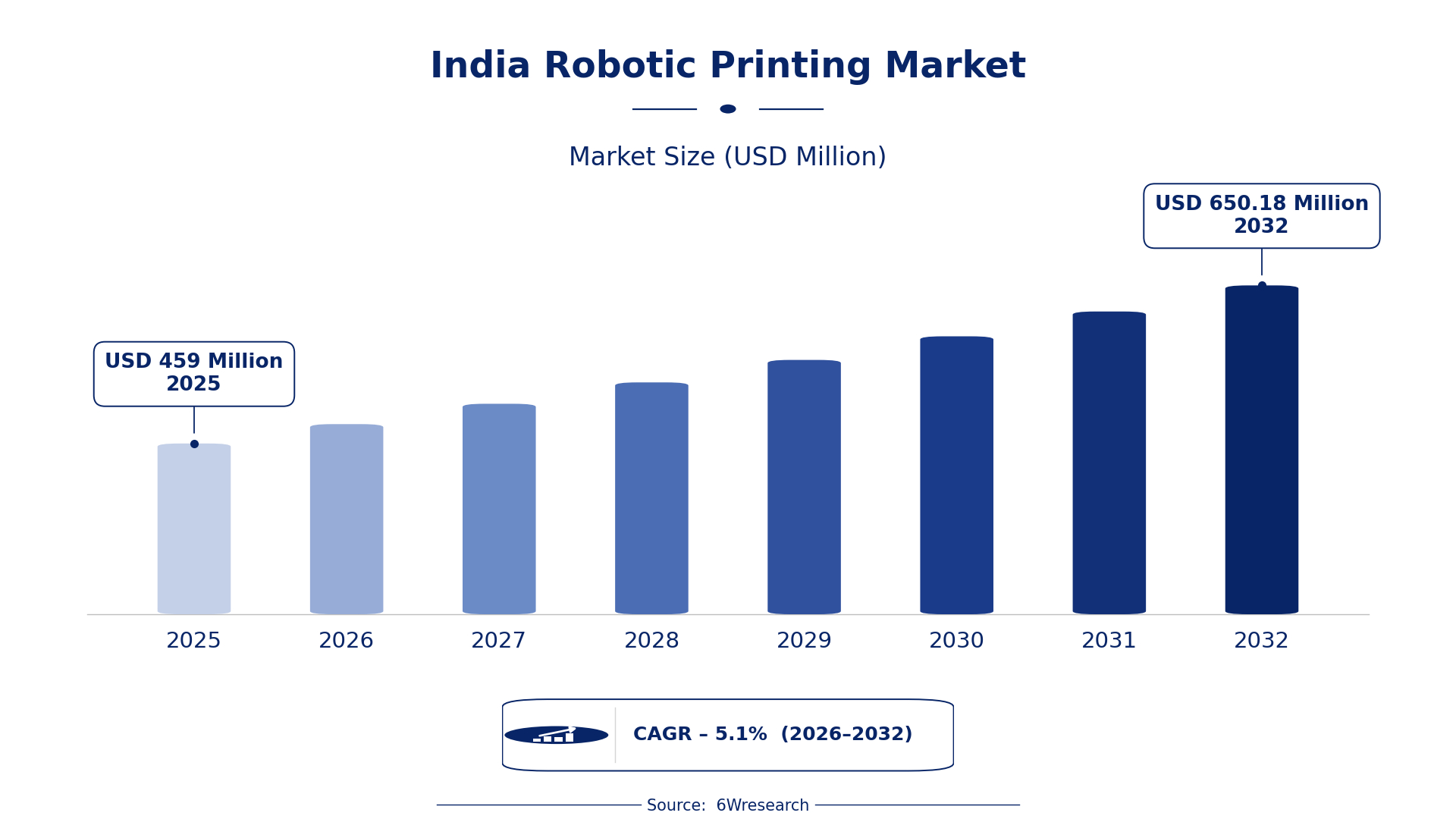
According to 6Wresearch internal database and industry insights, the India Robotic Printing Market was valued at USD 459.0 million in 2025 and is projected to reach USD 650.18 million by 2032, growing at a CAGR of approximately 5.1% during 2026–2032.
India Robotic Printing Market Highlights
| Report Metric | Details |
| Report Name | India Robotic Printing Market |
| Market Size 2025 | USD 459.0 million |
| Market Size 2032 | USD 650.18 million |
| Absolute Growth 2025–2032 | USD 191.18 million |
| CAGR 2026–2032 | 5.1% |
| Peak Annual Growth | 7.4% in 2029 |
| Forecast Period | 2026–2032 |
| Historical Data | 2022–2025 |
| Base Year | 2025 |
| Leading Printing Type, 2025 | 3D Printing (41% share) |
| Leading Robot Integration, 2025 | Robotic Arm Fused (38% share) |
| Leading Application Area, 2025 | Electronics Manufacturing (45% share) |
| Leading End User, 2025 | Manufacturing R&D (51% share) |
| Fastest-Growing Robot Integration | Pick & Place Robotic Head (7.3% CAGR) |
| Fastest-Growing Application Area | Custom Apparel (6.9% CAGR) |
| Fastest-Growing End User | Consumer Goods Firms (6.4% CAGR) |
| Growing Sector | Textile Printing |
| Key End Users | Electronics manufacturers, Textile producers, Fashion manufacturers, Consumer goods firms |
India Robotic Printing Market Year-wise Growth Rate and Key Drivers (2022–2032)
This graph illustrates the annual growth rates of the market from 2022 to 2032, highlighting a steady upward trajectory and projected market expansion over the forecast period.
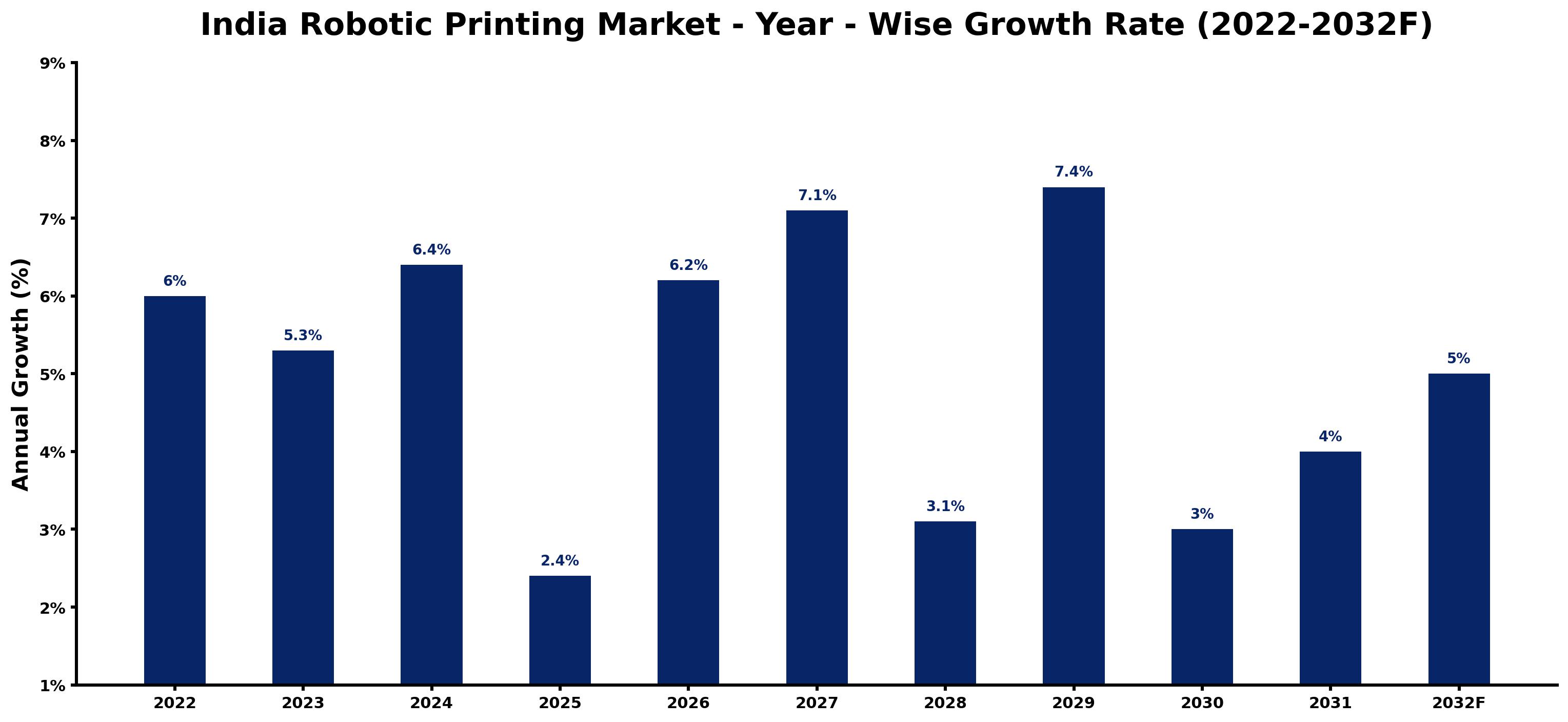
The table below sets out the estimated growth rate for each year and the main factor behind it.
| Year | Estimated Annual Growth (%) | Market Rationale |
| 2022 | 6.0 | The market showed solid demand from electronics manufacturers and textile producers. |
| 2023 | 5.3 | Growth slowed as manufacturers adjusted to supply chain challenges and inflationary pressures. |
| 2024 | 6.4 | Increased investment in 3D printing technologies spurred faster growth in manufacturing. |
| 2025 | 2.4 | Demand from the textile sector faced temporary setbacks due to market fluctuations. |
| 2026 | 6.2 | A resurgence in electronics manufacturing is projected to boost demand for robotic printing solutions. |
| 2027 | 7.1 | Rising exports in textiles and electronics will contribute to accelerated market growth. |
| 2028 | 3.1 | Growth is expected to slow as manufacturers face challenges in scaling up production capabilities. |
| 2029 | 7.4 | A surge in demand for custom apparel will drive the market to its peak growth rate. |
| 2030 | 3.0 | Market growth is anticipated to slow as the focus shifts to efficiency and cost management. |
| 2031 | 4.0 | Increased investment in R&D activities will revitalise demand for robotic printing. |
| 2032 | 5.0 | The market is projected to benefit from ongoing advancements in automation technologies. |
Note: Market size estimations and growth projections presented in this report are based on 6Wresearch's proprietary forecasting methodology, utilizing the latest available industry data, government publications, and primary research inputs.
India Robotic Printing Market Synopsis
India Robotic Printing Market involves automated systems performing printing tasks across various applications, including 3D printing, PCB printing, and textile printing. This market is driven by strong demand from domestic manufacturers and exports, particularly in electronics and textiles. The 'Make in India' initiative has stimulated growth by promoting local manufacturing. With the electronics manufacturing sector employing over 1.5 million people, industries are increasingly adopting advanced printing technologies.
Market Dynamics Impact Analysis (2026–2032)
| Factor | Type | Impact | Primary Segment Affected |
| Growing demand for 3D printing in prototyping and custom products. | Driver | High | 3D Printing |
| The rise in electronics manufacturing is driving PCB printing requirements. | Driver | High | PCB Printing |
| The increasing need for custom apparel creates opportunities in textile printing. | Opportunity | High | Textile Printing |
| The growth of the packaging industry opens avenues for label printing. | Opportunity | Medium | Label Printing |
| High initial investment costs limit market entry for new players. | Restraint | High | Robotic Arm Fused |
| Supply chain disruptions can delay production schedules for manufacturers. | Restraint | Medium | Motion Control Robots |
| Limited skilled workforce hampers the growth of advanced printing technologies. | Challenge | High | Manufacturing R&D |
| Regulatory hurdles in technology adoption slow down market expansion. | Challenge | Medium | Electronics Manufacturing |
Evaluation of Drivers in India Robotic Printing Market (2026–2032)
The main growth drivers and the segments they affect most are set out below.
| Drivers | Primary Segment Affected | Why It Matters (Evidence) |
| Increased investment in 3D printing technologies drives demand for prototyping. | 3D Printing | The electronics manufacturing sector is adopting 3D printing for rapid prototyping, improving production efficiency. |
| Rising production of electronic devices boosts PCB printing. | PCB Printing | With over 20 major PCB foundries operational, demand for efficient manufacturing processes is increasing. |
| The textile industry’s growth fuels demand for custom printing solutions. | Textile Printing | The Indian textile market, valued at approximately $150 billion, seeks advanced printing technologies. |
| The packaging sector's expansion increases label printing requirements. | Label Printing | The packaging industry is projected to reach $73 billion by 2024, driving demand for efficient labeling. |
| The 'Make in India' initiative encourages local manufacturing and automation. | Robotic Arm Fused | This initiative aims to increase manufacturing's contribution to GDP, promoting investment in robotic technologies. |
Expansion of the Robotic Printing market in India is backed by rising end-use demand from various sectors, particularly electronics and textiles. The electronics manufacturing sector is increasingly adopting 3D printing for rapid prototyping, improving production efficiency. The textile industry, valued at approximately $150 billion, is seeking advanced printing solutions to meet customisation needs. The packaging sector is also expanding, with projections indicating it will reach $73 billion by 2024, further increasing demand for label printing.
Evaluation of Restraints in India Robotic Printing Market
Below mentioned are some major restraints and their influence on market dynamics.
| Market Restraint | Primary Segment Affected | Why It Matters (Evidence) |
| High initial investment costs limit market entry for new players. | Robotic Arm Fused | The need for advanced technology integration requires substantial capital, restricting new entrants. |
| Supply chain disruptions can delay production schedules for manufacturers. | Motion Control Robots | Ongoing global supply chain issues impact the timely availability of components. |
| Limited skilled workforce hampers the growth of advanced printing technologies. | Manufacturing R&D | The Electronics Sector Skill Council trains over 100,000 individuals annually, but demand for skilled workers exceeds supply. |
| Regulatory hurdles in technology adoption slow down market expansion. | Electronics Manufacturing | Compliance with standards like ISO 9001 adds complexity and time to the adoption process. |
| Market fluctuations can affect demand stability in the textile sector. | Textile Printing | The textile industry is sensitive to changing consumer preferences and economic conditions. |
India Robotic Printing Market Challenges
Regulatory complexities pose challenges for the robotic printing market in India, with project approvals often taking up to six months, delaying implementation for manufacturers. Buyers in the electronics and textile sectors encounter rising costs due to inconsistent supply chain logistics, which can inflate production expenses by 15%. The high cost of advanced robotic systems, typically exceeding $100,000, restricts access for smaller firms, diminishing their competitiveness. Supply shortages of essential components for robotic systems can prolong production timelines, affecting delivery schedules for buyers and jeopardising valuable contracts in a competitive environment.
Trends in the India Robotic Printing Market
Several trends are reshaping the India Robotic Printing Market; the most important are set out below.
- Shift towards Advanced Textile Printing: India is undergoing a shift towards advanced textile printing technologies, supported by initiatives from the National Institute of Fashion Technology. The textile industry, valued at approximately $150 billion, shows strong growth potential.
- Transition to Automation in Electronics Manufacturing: The 'Digital India' initiative encourages automation in electronics manufacturing, boosting efficiency and productivity. The sector aims for $400 billion in manufacturing by 2025, reflecting a strong push for modernisation.
- Emergence of Custom Apparel Printing: The demand for custom apparel printing is increasing, especially in urban areas. The market for custom apparel is expected to grow, driven by evolving consumer preferences and fashion trends.
- Growth in PCB Printing Capabilities: India's PCB printing capabilities are expanding, with over 20 major foundries in operation. This growth supports the rising demand for electronic devices and components.
Investment Opportunities in the India Robotic Printing Market
Several openings in the India Robotic Printing Market merit attention from investors.
- Joint Ventures for Technology Integration: Now presents a prime opportunity for joint ventures in robotic printing technologies, particularly in electronics manufacturing, which aims for $400 billion by 2025. Local partnerships can facilitate technology adoption and market entry.
- Investment in Custom Apparel Production: With the textile market projected for significant growth, there is a prime opportunity for investment in custom apparel printing solutions. Targeting fashion manufacturers can yield substantial returns.
- Expansion of Label Printing Solutions: The packaging industry, expected to reach $73 billion by 2024, offers opportunities for suppliers of label printing technologies. Engaging with packaging firms can strengthen market presence.
- Focus on Skill Development Initiatives: Investing in skill development initiatives can bridge the workforce gap in robotic printing. Collaborating with the Electronics Sector Skill Council can improve training programs for new technologies.
Government Initiatives in the India Robotic Printing Market
The National Policy on Electronics 2019 aims to elevate electronics manufacturing to $400 billion by 2025, enhancing operational capabilities for robotic printing producers. This policy promotes the adoption of advanced manufacturing practices, encouraging local production and investment in technologies.
The Electronics Sector Skill Council of India is dedicated to enhancing workforce skills in the electronics sector, approving training programs that improve the skill levels of over 100,000 individuals annually. These efforts ensure a skilled workforce is available to meet the growing demands of the robotic printing market.
Future Insight of the India Robotic Printing Market
By 2032, buyers and suppliers in the India robotic printing market can anticipate significant advancements driven by the 'Make in India' and 'Digital India' initiatives. The National Policy on Electronics aims to elevate manufacturing to $400 billion, enhancing capabilities across various sectors. The textile industry is projected to grow at a CAGR of 9%, leading to increased adoption of robotic printing technologies. Investments in smart manufacturing technologies will optimise operations, allowing manufacturers to improve efficiency and respond effectively to rising demand.
Market Segmentation Analysis
Each segment group is reviewed below, with the leader by share and the fastest grower by CAGR.
By Printing Type – 3D Printing Dominated and Is Expected to Record the Fastest Growth
According to Shubham Padhi, Research Analyst at 6Wresearch, 3D Printing held a 41% share of the India Robotic Printing Market by printing type in 2025. 3D printing commands the largest market share in India due to its widespread use in creating prototypes and custom products. This technology is particularly valued in sectors like electronics and textiles, which are experiencing substantial growth driven by initiatives such as 'Make in India'. Its lead should widen, with a projected CAGR of 7.6% during 2026–2032, the highest in this split. The 3D printing segment is poised for rapid growth as it is increasingly utilised for R&D activities, which account for over 60% of the market. This trend will likely continue as manufacturers pursue innovative solutions, solidifying 3D printing's position at the forefront of technological advancements. Suppliers should enhance their 3D printing capabilities to cater to the rising demand across various industries.
By Robot Integration – Robotic Arm Fused Dominated, Pick & Place Robotic Head Expected to Grow Fastest
With a 38% revenue share in 2025, Robotic Arm Fused was the largest robot integration category. Robotic arm fused systems dominate the market because they are essential for performing precision tasks in printing, particularly in the electronics sector. Their reliability and accuracy make them the preferred choice among manufacturers. The quickest growth will come from Pick & Place Robotic Head, forecast to expand at a CAGR of 7.3% between 2026 and 2032. The pick & place robotic head segment is experiencing the fastest growth as it is increasingly utilised for the accurate placement of printing materials, which is critical for quality assurance. This trend reflects a broader shift towards automation in manufacturing. Buyers should consider investing in advanced robotic integration to improve operational efficiency and product quality.
By Application Area – Electronics Manufacturing Dominated, Custom Apparel Expected to Grow Fastest
In 2025, Electronics Manufacturing led the application area split with a 45% share. Electronics manufacturing commands the largest share in the market as it is integral to the production of electronic devices, which are in high demand. The sector's growth is further supported by government initiatives aimed at boosting electronics production. Custom Apparel is set to record the highest CAGR in this split, 6.9% over 2026–2032. Custom apparel is the fastest-growing application area, driven by increasing consumer demand for personalised fashion items. This trend is likely to continue as brands seek to differentiate themselves in a competitive market. Suppliers should tailor their offerings to cater to the rising trend of customisation in the apparel sector.
By End User – Manufacturing R&D Dominated, Consumer Goods Firms Expected to Grow Fastest
Manufacturing R&D accounted for a 51% market share by end user in 2025. Manufacturing R&D holds the largest market share as it is crucial for fostering innovation within manufacturing processes, especially in high-tech sectors. This emphasis on research and development is vital for maintaining competitiveness in the global market, particularly with initiatives like 'Digital India' promoting advanced technologies. Consumer Goods Firms are projected to grow fastest, at a CAGR of 6.4% during 2026–2032. Consumer goods firms represent the fastest-growing end user segment, increasingly adopting robotic printing for branding and packaging. This shift highlights a broader trend towards enhanced marketing strategies that leverage advanced printing technologies to engage consumers effectively. Suppliers must tailor their solutions to align with the evolving requirements of consumer goods firms in branding and packaging.
Key Attractiveness of the Report
- 10 Years of Market Numbers
- Historical Data Starting from 2022 to 2025
- Base Year 2025
- Forecast Data until 2032
- Key Performance Indicators Impacting the Market
- Major Upcoming Developments and Projects
Key Highlights of the Report:
- India Robotic Printing Market Outlook
- Market Size of India Robotic Printing Market, 2025
- Forecast of India Robotic Printing Market, 2032
- Historical Data and Forecast of India Robotic Printing Revenues & Volume for the Period 2022 - 2032F
- India Robotic Printing Market Trend Evolution
- India Robotic Printing Market Drivers and Challenges
- India Robotic Printing Price Trends
- India Robotic Printing Porter's Five Forces
- India Robotic Printing Industry Life Cycle
- Historical Data and Forecast of India Robotic Printing Market Revenues & Volume By Printing Type for the Period 2022 - 2032F
- Historical Data and Forecast of India Robotic Printing Market Revenues & Volume By 3D Printing for the Period 2022 - 2032F
- Historical Data and Forecast of India Robotic Printing Market Revenues & Volume By PCB Printing for the Period 2022 - 2032F
- Historical Data and Forecast of India Robotic Printing Market Revenues & Volume By Label Printing for the Period 2022 - 2032F
- Historical Data and Forecast of India Robotic Printing Market Revenues & Volume By Textile Printing for the Period 2022 - 2032F
- Historical Data and Forecast of India Robotic Printing Market Revenues & Volume By Robot Integration for the Period 2022 - 2032F
- Historical Data and Forecast of India Robotic Printing Market Revenues & Volume By Robotic Arm Fused for the Period 2022 - 2032F
- Historical Data and Forecast of India Robotic Printing Market Revenues & Volume By Pick & Place Robotic Head for the Period 2022 - 2032F
- Historical Data and Forecast of India Robotic Printing Market Revenues & Volume By Motion Control Robots for the Period 2022 - 2032F
- Historical Data and Forecast of India Robotic Printing Market Revenues & Volume By Multi-Axis Robots for the Period 2022 - 2032F
- Historical Data and Forecast of India Robotic Printing Market Revenues & Volume By Application Area for the Period 2022 - 2032F
- Historical Data and Forecast of India Robotic Printing Market Revenues & Volume By Rapid Prototyping for the Period 2022 - 2032F
- Historical Data and Forecast of India Robotic Printing Market Revenues & Volume By Electronics Manufacturing for the Period 2022 - 2032F
- Historical Data and Forecast of India Robotic Printing Market Revenues & Volume By Packaging & Labeling for the Period 2022 - 2032F
- Historical Data and Forecast of India Robotic Printing Market Revenues & Volume By Custom Apparel for the Period 2022 - 2032F
- Historical Data and Forecast of India Robotic Printing Market Revenues & Volume By End User for the Period 2022 - 2032F
- Historical Data and Forecast of India Robotic Printing Market Revenues & Volume By Manufacturing R&D for the Period 2022 - 2032F
- Historical Data and Forecast of India Robotic Printing Market Revenues & Volume By PCB Foundries for the Period 2022 - 2032F
- Historical Data and Forecast of India Robotic Printing Market Revenues & Volume By Consumer Goods Firms for the Period 2022 - 2032F
- Historical Data and Forecast of India Robotic Printing Market Revenues & Volume By Fashion Manufacturers for the Period 2022 - 2032F
- India Robotic Printing Import Export Trade Statistics
- Market Opportunity Assessment By Printing Type
- Market Opportunity Assessment By Robot Integration
- Market Opportunity Assessment By Application Area
- Market Opportunity Assessment By End User
- India Robotic Printing Top Companies Market Share
- India Robotic Printing Competitive Benchmarking By Technical and Operational Parameters
- India Robotic Printing Company Profiles
- India Robotic Printing Key Strategic Recommendations
Market Covered
Segments analysed in this report are listed below.
By Printing Type
- 3D Printing
- PCB Printing
- Label Printing
- Textile Printing
By Robot Integration
- Robotic Arm Fused
- Pick & Place Robotic Head
- Motion Control Robots
- Multi-Axis Robots
By Application Area
- Rapid Prototyping
- Electronics Manufacturing
- Packaging & Labeling
- Custom Apparel
By End User
- Manufacturing R&D
- PCB Foundries
- Consumer Goods Firms
- Fashion Manufacturers































