China Robotic Printing Market Size & Growth Rate
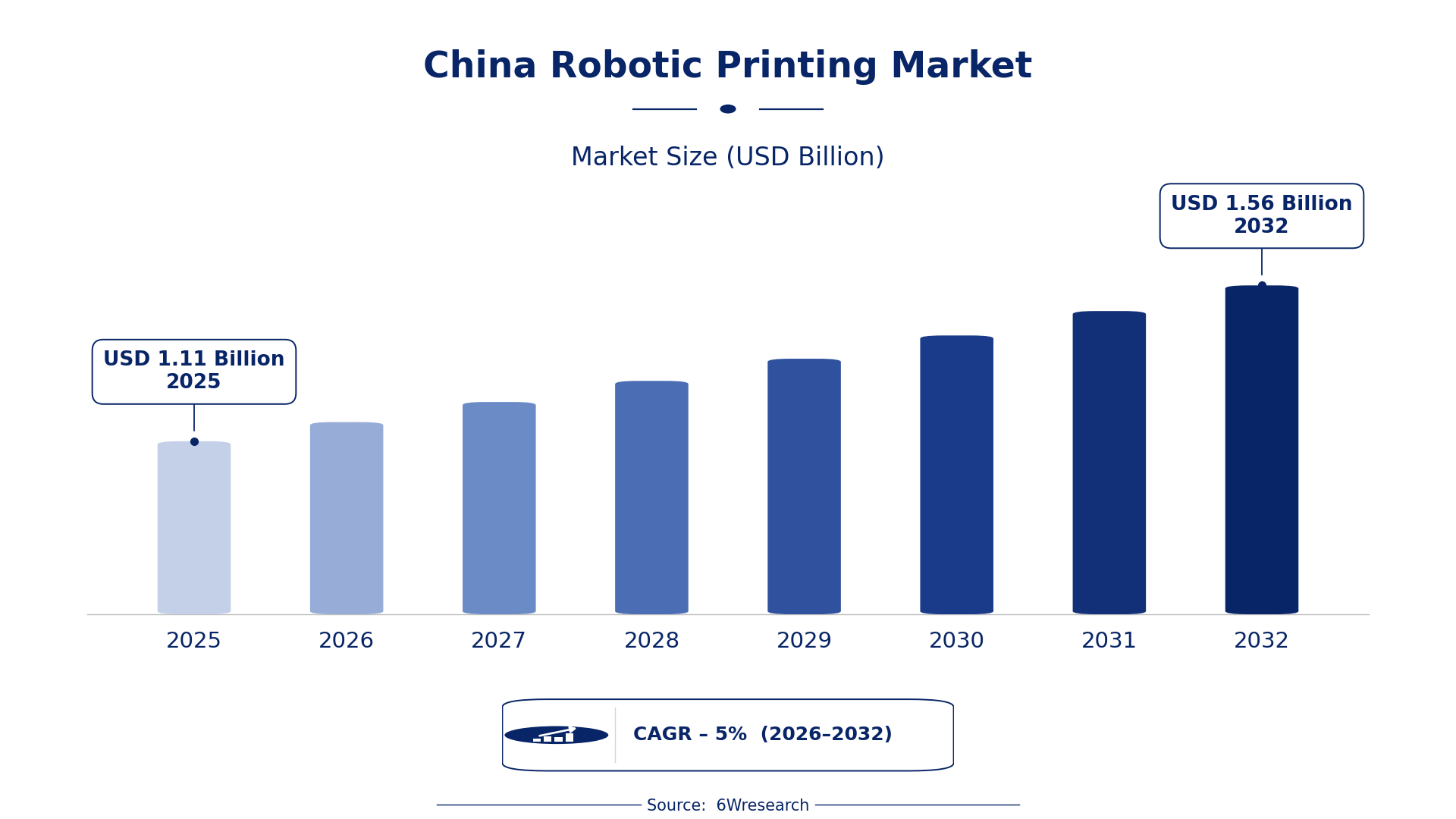
According to 6Wresearch internal database and industry insights, the China Robotic Printing Market was valued at USD 1.11 billion in 2025 and is projected to reach USD 1.56 billion by 2032, growing at a CAGR of approximately 5% during 2026–2032.
China Robotic Printing Market Highlights
| Report Metric | Details |
| Report Name | China Robotic Printing Market |
| Market Size 2025 | USD 1.11 billion |
| Market Size 2032 | USD 1.56 billion |
| Absolute Growth 2025–2032 | USD 0.45 billion |
| CAGR 2026–2032 | 5% |
| Peak Annual Growth | 7.4% in 2032 |
| Forecast Period | 2026–2032 |
| Historical Data | 2022–2025 |
| Base Year | 2025 |
| Leading Printing Type, 2025 | 3D Printing (41% share) |
| Leading Robot Integration, 2025 | Robotic Arm Fused (44% share) |
| Leading Application Area, 2025 | Electronics Manufacturing (37% share) |
| Leading End User, 2025 | PCB Foundries (39% share) |
| Fastest-Growing Printing Type | Textile Printing (6.8% CAGR) |
| Fastest-Growing Robot Integration | Pick & Place Robotic Head (7.0% CAGR) |
| Fastest-Growing Application Area | Custom Apparel (7.0% CAGR) |
| Fastest-Growing End User | Fashion Manufacturers (7.3% CAGR) |
| Growing Sector | Textile Printing |
| Key End Users | Electronics manufacturers, textile producers, fashion manufacturers, PCB foundries |
China Robotic Printing Market Year-wise Growth Rate and Key Drivers (2022–2032)
This graph illustrates the annual growth rates of the market from 2022 to 2032, highlighting a steady upward trajectory and projected market expansion over the forecast period.
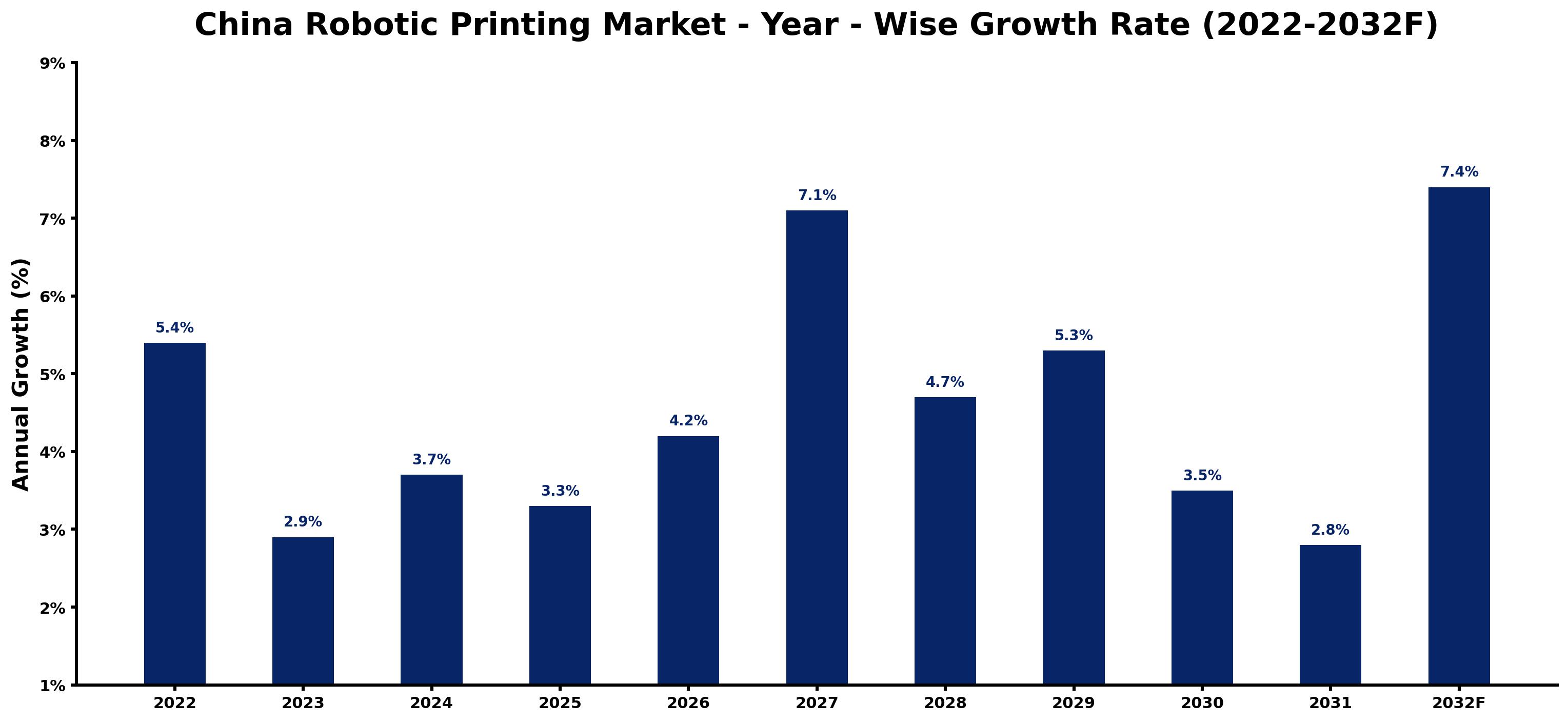
Annual growth estimates for each year appear below with the principal reason behind them, explaining the shifts that set the pace of the market.
| Year | Estimated Annual Growth (%) | Market Rationale |
| 2022 | 5.4 | The market experienced strong demand due to the growing electronics manufacturing sector. |
| 2023 | 2.9 | Growth slowed as companies adjusted to the 'National Intelligent Manufacturing Development Strategy' standards. |
| 2024 | 3.7 | Demand increased as more firms adopted robotic printing for rapid prototyping. |
| 2025 | 3.3 | A slight slowdown occurred as the market stabilised after rapid growth. |
| 2026 | 4.2 | Growth picked up as investments in automation began to yield results. |
| 2027 | 7.1 | Demand surged from the textile printing sector's expansion and innovation. |
| 2028 | 4.7 | A slowdown was noted as the market adjusted to new digital printing standards. |
| 2029 | 5.3 | Demand increased as PCB foundries expanded their production capabilities. |
| 2030 | 3.5 | Growth slowed as the market faced challenges in supply chain management. |
| 2031 | 2.8 | The market continued to grow but at a slower rate due to regulatory adjustments. |
| 2032 | 7.4 | A surge in demand is expected as automation becomes a priority in manufacturing. |
Note: Market size estimations and growth projections presented in this report are based on 6Wresearch's proprietary forecasting methodology, utilizing the latest available industry data, government publications, and primary research inputs.
China Robotic Printing Market Synopsis
Robotic Printing in China encompasses the automation of printing processes using advanced technologies like 3D and inkjet printing. This integration improves precision and efficiency, catering to sectors such as electronics manufacturing and custom apparel production. The China Robotic Printing Market is projected to grow, driven by the booming electronics sector, which employs over 10 million people, and the increasing demand for custom apparel, valued at over 400 billion USD. The 'Robotics Industry Development Plan' launched in 2023 further boosts automation initiatives, creating substantial opportunities for growth.
Market Dynamics Impact Analysis (2026–2032)
| Factor | Type | Impact | Primary Segment Affected |
| Rising demand for automation in electronics manufacturing drives the adoption of robotic printing. | Driver | High | Electronics Manufacturing |
| The textile printing industry's projected 15% annual growth creates a need for advanced printing solutions. | Driver | High | Textile Printing |
| The increasing focus on custom apparel production presents opportunities for suppliers of robotic printing technology. | Opportunity | High | Custom Apparel |
| The expansion of PCB manufacturing facilities in Guangdong province opens new markets for robotic printing. | Opportunity | Medium | PCB Printing |
| High costs associated with robotic printing technology can deter small manufacturers from adoption. | Restraint | High | Robotic Arm Fused |
| Limited availability of skilled labour in robotics can slow down market growth. | Restraint | Medium | Motion Control Robots |
| Supply chain disruptions can delay the availability of robotic printing components. | Challenge | High | Pick & Place Robotic Head |
| Regulatory changes in manufacturing standards can complicate compliance for producers. | Challenge | Medium | 3D Printing |
Evaluation of Drivers in China Robotic Printing Market (2026–2032)
The table below links each growth driver to the segment it affects and the evidence for it.
| Drivers | Primary Segment Affected | Why It Matters (Evidence) |
| Increased automation in electronics manufacturing boosts demand for robotic printing. | Electronics Manufacturing | The electronics sector employs over 10 million people, leading to higher demand for efficient production methods. |
| The textile industry’s growth drives the need for advanced printing technologies. | Textile Printing | With a projected annual growth of 15%, textile manufacturers are investing in robotic printing solutions. |
| The push for rapid prototyping increases demand for robotic printing solutions. | 3D Printing | As companies seek to innovate faster, robotic printing provides the necessary speed and precision. |
| The expansion of PCB manufacturing facilities increases the need for robotic printing. | PCB Printing | China has over 300 PCB manufacturers, many of which are adopting robotic printing technologies. |
| The growing fashion market encourages custom apparel production using robotic printing. | Custom Apparel | The fashion market, valued at over 400 billion USD, is increasingly adopting robotic solutions for unique designs. |
Growth in the Robotic Printing market in China stems from increased automation within the electronics manufacturing sector, which employs over 10 million people. The textile printing industry is expected to expand by 15% annually, driving demand for advanced printing technologies. The need for rapid prototyping is increasing, as companies strive to innovate more quickly. With over 300 PCB manufacturers in China, the expansion of these facilities heightens the demand for robotic printing. The flourishing fashion market encourages custom apparel production through robotic printing technologies, reflecting the rising interest in personalised clothing solutions.
Evaluation of Restraints in China Robotic Printing Market
The main factors holding the market back are set out below.
| Market Restraint | Primary Segment Affected | Why It Matters (Evidence) |
| High costs associated with robotic printing technology limit adoption among smaller firms. | Robotic Arm Fused | Investment in advanced robotic systems can be prohibitive for smaller manufacturers. |
| Limited skilled labour in robotics can hinder market growth. | Motion Control Robots | A shortage of trained professionals can slow down the implementation of robotic printing solutions. |
| Supply chain disruptions affect the availability of essential robotic components. | Pick & Place Robotic Head | Delays in component delivery can stall production timelines for manufacturers. |
| Regulatory changes complicate compliance for robotic printing producers. | 3D Printing | Frequent updates to manufacturing standards can create uncertainty for producers. |
| Market saturation in certain segments limits growth potential. | PCB Printing | Increased competition among PCB manufacturers can lead to price wars, affecting profitability. |
China Robotic Printing Market Challenges
Producers in the China robotic printing market face technological challenges that impede production efficiency, as many existing printing systems are incompatible with advanced robotic arms, leading to operational costs rising by up to 30%. Competition among over 300 PCB manufacturing companies compels smaller firms to reduce prices, causing profit margins to shrink significantly. Supply chain disruptions arise from reliance on specific components, resulting in delays that can extend production timelines by several weeks for electronics manufacturers. Buyers encounter increasing material costs, which can inflate project budgets by as much as 20%, complicating financial planning for their projects.
Trends in the China Robotic Printing Market
Four trends stand out in the China Robotic Printing Market.
- Shift Towards Custom Apparel Production: The trend towards custom apparel production is gaining momentum, particularly in the fashion sector. In 2023, the fashion market in China was valued at over 400 billion USD, reflecting a growing demand for personalised clothing solutions.
- Transition to Advanced Robotics in Electronics: Since 2023, the electronics manufacturing sector has increasingly adopted advanced robotics for efficiency. The 'Robotics Industry Development Plan' aims to boost automation by 30% by 2025, improving production capabilities.
- Emergence of Digital Printing Standards: In 2023, new standards for digital printing were adopted in the textile industry, promoting better quality and efficiency. This shift is expected to improve the competitiveness of textile manufacturers in China.
- Growing Focus on Rapid Prototyping: The emphasis on rapid prototyping has increased, especially in electronics manufacturing. With the total output of the packaging industry valued at 1 trillion CNY in 2022, firms are investing in robotic printing to accelerate product development.
Investment Opportunities in the China Robotic Printing Market
Investors looking at the China Robotic Printing Market should consider the following areas.
- Local Partnerships for Robotic Printing Solutions: Now is an ideal time for local partnerships to develop robotic printing capabilities. The Guangdong province, a hub for electronics manufacturing, offers opportunities for collaboration with PCB foundries to improve production efficiency.
- Investment in Textile Printing Technologies: The textile printing industry is set to grow significantly, presenting an opportunity for investment in advanced printing technologies. Fashion manufacturers are increasingly seeking innovative solutions to meet consumer demands for custom apparel.
- Joint Ventures in PCB Manufacturing: Joint ventures in PCB manufacturing can facilitate the adoption of robotic printing technologies. Given the presence of over 300 PCB companies in China, partnerships can streamline production processes and improve efficiency.
- Approval Pathways for Robotics Innovation: With the Chinese government allocating 2 billion CNY for robotics innovation in 2023, firms can seek funding through government initiatives to develop new robotic printing solutions.
Government Initiatives in the China Robotic Printing Market
The 'Robotics Industry Development Plan' launched in 2021 by the Ministry of Industry and Information Technology aims to increase robotics adoption in manufacturing by 30% by 2025. This plan encourages investment in robotic printing technologies across various sectors, improving productivity. Additionally, the 'National Intelligent Manufacturing Development Strategy' was updated in 2022, promoting smart manufacturing technologies, including robotic printing, to improve overall manufacturing efficiency. These initiatives are vital for supporting the growth of the robotic printing market in China, fostering innovation and competitiveness.
The Ministry of Science and Technology administers the 'Advanced Robotics Technology Program', which provides grants to firms developing robotic printing technologies. This program supports innovation and the implementation of advanced robotics in manufacturing. Furthermore, the Standardization Administration of China oversees the 'National Standard for Industrial Robots', revised in 2023 to improve safety and efficiency in robotic applications. These measures ensure that producers comply with the latest standards while promoting growth in the robotic printing sector.
Future Insight of the China Robotic Printing Market
The China robotic printing market will undergo notable changes by 2032, driven by government initiatives like the 'Robotics Industry Development Plan' that promote automation across industries. Enhanced digital printing standards in textiles will improve production quality and efficiency, benefiting both producers and buyers. The electronics manufacturing sector will expand, increasing the demand for robotic printing technologies, with the textile printing market valued at 20 billion USD in 2023. Advancements in robotics research in regions like Shanghai will encourage new applications, improving overall manufacturing capabilities.
Market Segmentation Analysis
The analysis below covers each segmentation, its leading category in 2025 and its fastest-growing category through 2032.
By Printing Type – 3D Printing Dominated, Textile Printing Expected to Grow Fastest
According to Shubham Padhi, Research Analyst at 6Wresearch, with a 41% revenue share in 2025, 3D Printing was the largest printing type category. 3D printing commands the largest share in China because it is extensively used for creating prototypes and complex structures, particularly in the electronics sector. The market reached a value of 10 billion USD in 2022, showcasing its critical role in manufacturing processes. Textile Printing is projected to grow fastest, at a CAGR of 6.8% during 2026–2032. Textile printing is experiencing rapid growth, driven by the rising demand for custom apparel in China's fashion market, which is valued at over 400 billion USD. This segment is projected to grow by 15% annually until 2025, highlighting its increasing relevance in the industry. Suppliers should focus on enhancing their textile printing capabilities to effectively address the growing demand for custom apparel.
By Robot Integration – Robotic Arm Fused Dominated, Pick & Place Robotic Head Expected to Grow Fastest
In 2025, Robotic Arm Fused led the robot integration split with a 44% share. Robotic arm fused technology commands the largest share as it is essential for precise printing applications across various sectors. Its widespread use in electronics manufacturing highlights its critical role in achieving high-quality results. The quickest growth will come from Pick & Place Robotic Head, forecast to expand at a CAGR of 7.0% between 2026 and 2032. The pick & place robotic head is the fastest-growing segment, driven by the necessity for accurate placement of printed components in manufacturing processes. This technology's effectiveness is vital as industries aim to streamline production lines and improve efficiency. Buyers should invest in advanced pick & place robotic heads to boost operational efficiency and accuracy in their production processes.
By Application Area – Electronics Manufacturing Dominated, Custom Apparel Expected to Grow Fastest
Electronics Manufacturing held a 37% share of the China Robotic Printing Market by application area in 2025. Electronics manufacturing holds the largest share due to its fundamental reliance on robotic printing for producing circuit boards and components. This sector employs over 10 million people, underscoring its vital role in the economy. Over 2026–2032, Custom Apparel is expected to post the fastest growth, at a CAGR of 7.0%. Custom apparel is the fastest-growing application area, spurred by the increasing trend of personalised clothing production in the fashion industry. Fashion manufacturers are increasingly adopting robotic printing technologies to meet evolving consumer preferences. Suppliers must tailor their offerings to meet the specific needs of the rapidly changing custom apparel market.
By End User – PCB Foundries Dominated, Fashion Manufacturers Expected to Grow Fastest
PCB Foundries took a 39% share of end user in 2025, more than any other category. PCB foundries represent the largest share of end users, as they are essential for producing electronic circuit boards that are critical to the electronics manufacturing sector. The presence of over 300 PCB manufacturing companies in China solidifies this segment's dominance. Fashion Manufacturers are set to record the highest CAGR in this split, 7.3% over 2026–2032. Fashion manufacturers are the fastest-growing end user group, increasingly utilising robotic printing for innovative designs and customisation. This trend reflects a broader shift towards personalised fashion solutions, indicating a significant market opportunity. Suppliers should engage with fashion manufacturers to explore new opportunities within the expanding customisation trend.
Key Attractiveness of the Report
- 10 Years of Market Numbers
- Historical Data Starting from 2022 to 2025
- Base Year 2025
- Forecast Data until 2032
- Key Performance Indicators Impacting the Market
- Major Upcoming Developments and Projects
Key Highlights of the Report:
- China Robotic Printing Market Outlook
- Market Size of China Robotic Printing Market, 2025
- Forecast of China Robotic Printing Market, 2032
- Historical Data and Forecast of China Robotic Printing Revenues & Volume for the Period 2022 - 2032F
- China Robotic Printing Market Trend Evolution
- China Robotic Printing Market Drivers and Challenges
- China Robotic Printing Price Trends
- China Robotic Printing Porter's Five Forces
- China Robotic Printing Industry Life Cycle
- Historical Data and Forecast of China Robotic Printing Market Revenues & Volume By Printing Type for the Period 2022 - 2032F
- Historical Data and Forecast of China Robotic Printing Market Revenues & Volume By 3D Printing for the Period 2022 - 2032F
- Historical Data and Forecast of China Robotic Printing Market Revenues & Volume By PCB Printing for the Period 2022 - 2032F
- Historical Data and Forecast of China Robotic Printing Market Revenues & Volume By Label Printing for the Period 2022 - 2032F
- Historical Data and Forecast of China Robotic Printing Market Revenues & Volume By Textile Printing for the Period 2022 - 2032F
- Historical Data and Forecast of China Robotic Printing Market Revenues & Volume By Robot Integration for the Period 2022 - 2032F
- Historical Data and Forecast of China Robotic Printing Market Revenues & Volume By Robotic Arm Fused for the Period 2022 - 2032F
- Historical Data and Forecast of China Robotic Printing Market Revenues & Volume By Pick & Place Robotic Head for the Period 2022 - 2032F
- Historical Data and Forecast of China Robotic Printing Market Revenues & Volume By Motion Control Robots for the Period 2022 - 2032F
- Historical Data and Forecast of China Robotic Printing Market Revenues & Volume By Multi-Axis Robots for the Period 2022 - 2032F
- Historical Data and Forecast of China Robotic Printing Market Revenues & Volume By Application Area for the Period 2022 - 2032F
- Historical Data and Forecast of China Robotic Printing Market Revenues & Volume By Rapid Prototyping for the Period 2022 - 2032F
- Historical Data and Forecast of China Robotic Printing Market Revenues & Volume By Electronics Manufacturing for the Period 2022 - 2032F
- Historical Data and Forecast of China Robotic Printing Market Revenues & Volume By Packaging & Labeling for the Period 2022 - 2032F
- Historical Data and Forecast of China Robotic Printing Market Revenues & Volume By Custom Apparel for the Period 2022 - 2032F
- Historical Data and Forecast of China Robotic Printing Market Revenues & Volume By End User for the Period 2022 - 2032F
- Historical Data and Forecast of China Robotic Printing Market Revenues & Volume By Manufacturing R&D for the Period 2022 - 2032F
- Historical Data and Forecast of China Robotic Printing Market Revenues & Volume By PCB Foundries for the Period 2022 - 2032F
- Historical Data and Forecast of China Robotic Printing Market Revenues & Volume By Consumer Goods Firms for the Period 2022 - 2032F
- Historical Data and Forecast of China Robotic Printing Market Revenues & Volume By Fashion Manufacturers for the Period 2022 - 2032F
- China Robotic Printing Import Export Trade Statistics
- Market Opportunity Assessment By Printing Type
- Market Opportunity Assessment By Robot Integration
- Market Opportunity Assessment By Application Area
- Market Opportunity Assessment By End User
- China Robotic Printing Top Companies Market Share
- China Robotic Printing Competitive Benchmarking By Technical and Operational Parameters
- China Robotic Printing Company Profiles
- China Robotic Printing Key Strategic Recommendations
Market Covered
This report examines the market across the segments below.
By Printing Type
- 3D Printing
- PCB Printing
- Label Printing
- Textile Printing
By Robot Integration
- Robotic Arm Fused
- Pick & Place Robotic Head
- Motion Control Robots
- Multi-Axis Robots
By Application Area
- Rapid Prototyping
- Electronics Manufacturing
- Packaging & Labeling
- Custom Apparel
By End User
- Manufacturing R&D
- PCB Foundries
- Consumer Goods Firms
- Fashion Manufacturers































