India Robotic Welding Systems Market Size & Growth Rate
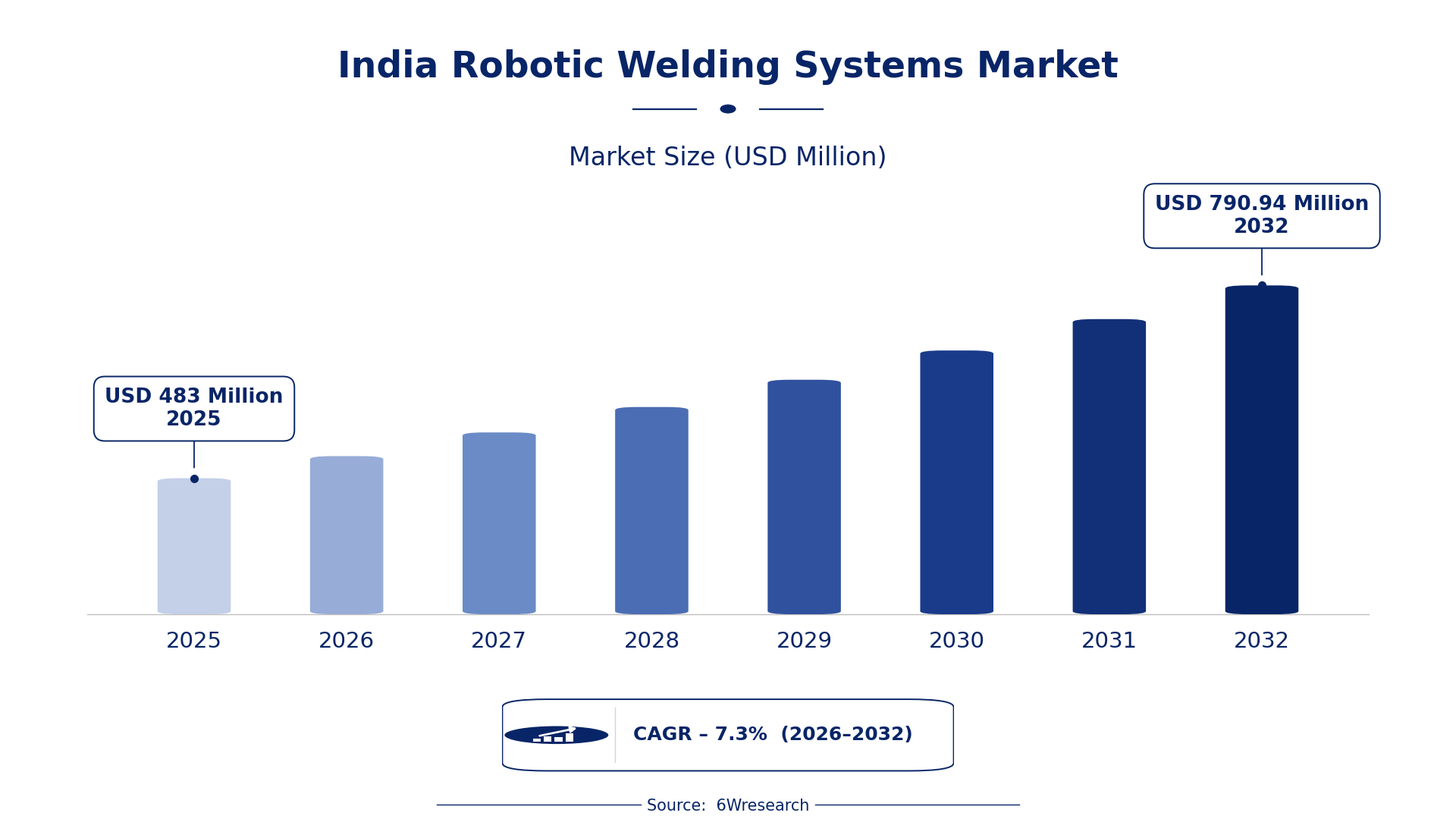
According to 6Wresearch internal database and industry insights, the India Robotic Welding Systems Market was valued at USD 483.0 million in 2025 and is projected to reach USD 790.94 million by 2032, growing at a CAGR of approximately 7.3% during 2026–2032.
India Robotic Welding Systems Market Highlights
| Report Metric | Details |
| Report Name | India Robotic Welding Systems Market |
| Market Size 2025 | USD 483.0 million |
| Market Size 2032 | USD 790.94 million |
| Absolute Growth 2025–2032 | USD 307.94 million |
| CAGR 2026–2032 | 7.3% |
| Peak Annual Growth | 8.7% in 2027 |
| Forecast Period | 2026–2032 |
| Historical Data | 2022–2025 |
| Base Year | 2025 |
| Leading Welding Type, 2025 | MIG Welding Robots (51% share) |
| Leading Robot Type, 2025 | 6-Axis Arms (42% share) |
| Leading Power Source, 2025 | Electric Arc (50% share) |
| Leading End User, 2025 | Automotive Plants (48% share) |
| Fastest-Growing Welding Type | Laser Welding Robots (8.5% CAGR) |
| Fastest-Growing Robot Type | Fiber-Laser Enabled (9.5% CAGR) |
| Fastest-Growing Power Source | High Frequency (9.7% CAGR) |
| Fastest-Growing End User | Aerospace Components (9.9% CAGR) |
| Growing Sector | Automotive manufacturing |
| Key End Users | Automotive plants, aerospace components manufacturers, electronics assembly, sheet metal factories |
India Robotic Welding Systems Market Year-wise Growth Rate and Key Drivers (2022–2032)
This graph illustrates the annual growth rates of the market from 2022 to 2032, highlighting a steady upward trajectory and projected market expansion over the forecast period.
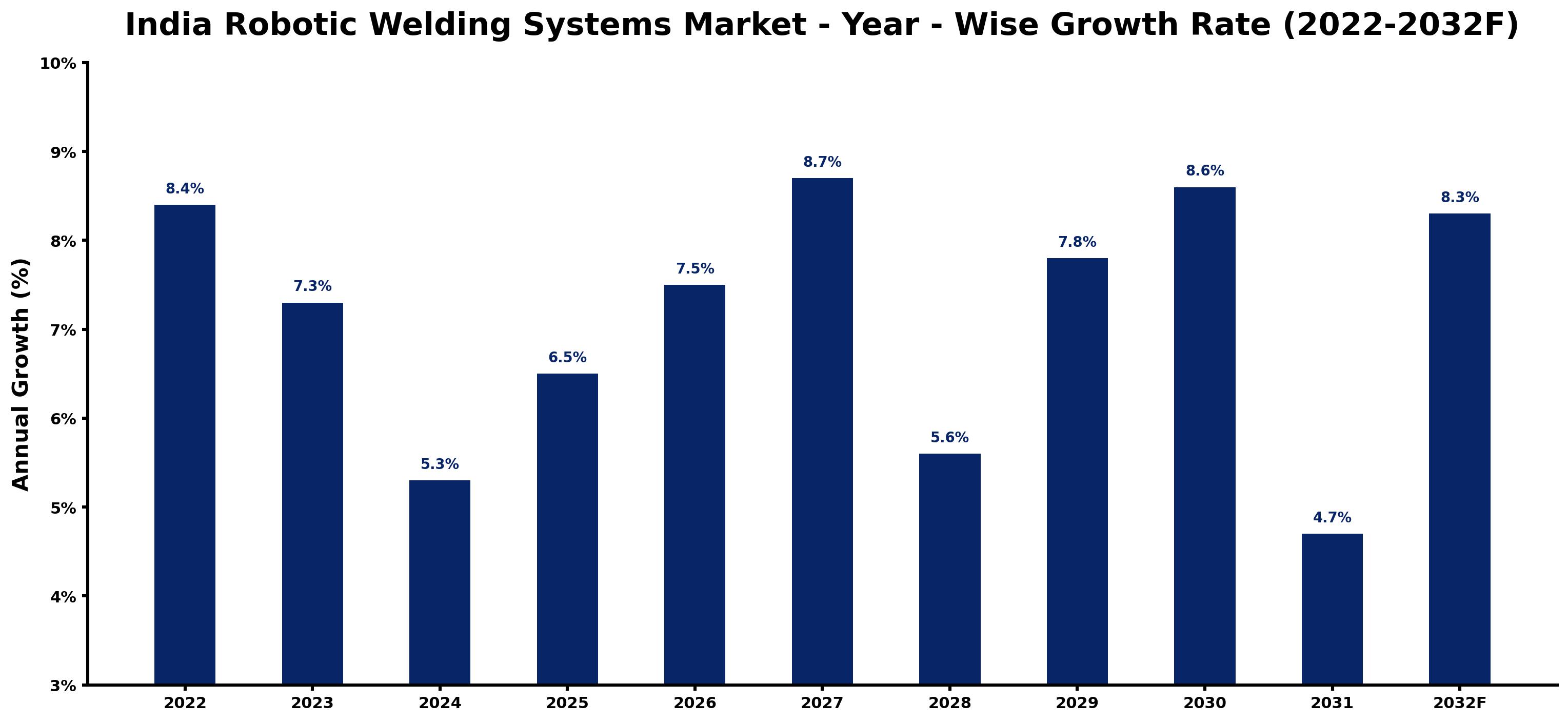
Year by year, the estimates below pair each growth rate with the development that shaped it.
| Year | Estimated Annual Growth (%) | Market Rationale |
| 2022 | 8.4 | The market experienced strong demand from automotive manufacturers, driving growth through the Make in India initiative. |
| 2023 | 7.3 | Demand from automotive plants continued, but growth slowed compared to the previous year due to production adjustments. |
| 2024 | 5.3 | Growth was constrained by a temporary slowdown in automotive production rates, affecting overall demand. |
| 2025 | 6.5 | Increased automation needs from automotive plants boosted growth rates again as production rebounded. |
| 2026 | 7.5 | The market is expected to grow as manufacturers invest in advanced automation technologies to enhance efficiency. |
| 2027 | 8.7 | A peak in growth is projected due to rising automotive production and exports, particularly in Maharashtra. |
| 2028 | 5.6 | Growth is anticipated to slow as manufacturers adjust to market conditions and production stabilises. |
| 2029 | 7.8 | Increased demand from aerospace components is expected to drive growth higher, especially in Karnataka's aerospace hubs. |
| 2030 | 8.6 | The market is projected to grow as the electronics sector expands its automation, driven by the National Policy on Electronics. |
| 2031 | 4.7 | Growth is anticipated to slow as the market stabilises after rapid expansion in the automotive sector. |
| 2032 | 8.3 | A resurgence in demand from automotive plants is expected to boost growth, supported by the Automotive Mission Plan 2026. |
Note: Market size estimations and growth projections presented in this report are based on 6Wresearch's proprietary forecasting methodology, utilizing the latest available industry data, government publications, and primary research inputs.
India Robotic Welding Systems Market Synopsis
The India Robotic Welding Systems Market encompasses automated machines used for welding processes in manufacturing. These systems integrate advanced robotics technology for precision in applications such as automotive manufacturing and aerospace components production. The market is growing due to strong demand from automotive manufacturers, driven by initiatives like the Make in India programme, which encourages domestic production and innovation. In 2023, automotive production reached 4.4 million units, further increasing the need for automation in manufacturing.
Market Dynamics Impact Analysis (2026–2032)
| Factor | Type | Impact | Primary Segment Affected |
| Growing demand from automotive plants for automation solutions | Driver | High | MIG Welding Robots |
| Increased investment in aerospace components manufacturing | Driver | High | TIG Welding Robots |
| Rising demand for high-precision welding in electronics assembly | Opportunity | High | Laser Welding Robots |
| Expansion of automotive production facilities in Maharashtra | Opportunity | High | 6-Axis Arms |
| Challenges in workforce skill development for robotic technologies | Restraint | Medium | Electric Arc |
| Regulatory compliance costs for safety and performance standards | Restraint | Medium | Spot Welding Robots |
| Limited availability of skilled technicians in robotic welding | Challenge | High | Precision Multi-Arm |
| High initial investment costs for robotic welding systems | Challenge | Medium | Resistance-Based |
Evaluation of Drivers in India Robotic Welding Systems Market (2026–2032)
The table below links each growth driver to the segment it affects and the evidence for it.
| Drivers | Primary Segment Affected | Why It Matters (Evidence) |
| Increased automotive production | MIG Welding Robots | India's automotive production reached 4.4 million units in 2023, driving demand for automation solutions. |
| Investment in aerospace manufacturing | TIG Welding Robots | The aerospace sector in Karnataka is growing, increasing the need for high-quality welding solutions. |
| Expansion of electronics manufacturing | Laser Welding Robots | The National Policy on Electronics aims for a $400 billion industry by 2025, boosting automation needs. |
| Government initiatives supporting manufacturing | 6-Axis Arms | The Make in India initiative encourages local production, increasing demand for robotic welding systems. |
| Rising demand for efficient manufacturing processes | Electric Arc | Automotive plants are increasingly adopting automation to improve production efficiency. |
Market growth for Robotic Welding Systems in India is underpinned by rising automotive production, increased investment in aerospace manufacturing, and expansion in the electronics sector. In 2023, the automotive sector's output reached 4.4 million units, driving demand for automation solutions. As automotive plants seek to improve efficiency, demand for MIG welding robots continues to rise, reflecting a shift towards automation in manufacturing.
Evaluation of Restraints in India Robotic Welding Systems Market
The key brakes on demand, and where they bite hardest, are shown below.
| Market Restraint | Primary Segment Affected | Why It Matters (Evidence) |
| Limited availability of skilled technicians | Electric Arc | The workforce lacks adequate training in robotic welding, impacting production efficiency and quality. |
| High compliance costs for safety standards | Spot Welding Robots | Manufacturers must invest in compliance with Bureau of Indian Standards guidelines, raising operational costs. |
| Regulatory hurdles in implementing new technologies | TIG Welding Robots | Aerospace manufacturers face delays in approvals for advanced welding technologies, slowing down production. |
| Initial investment costs for automation systems | Resistance-Based | High upfront costs deter small manufacturers from adopting robotic welding systems. |
| Slow adoption of advanced technologies | Laser Welding Robots | Many manufacturers hesitate to invest in newer technologies, impacting overall market growth. |
India Robotic Welding Systems Market Challenges
The India Robotic Welding Systems market encounters several practical challenges, starting with high costs for producers. Integrating advanced robotics technology can require investments exceeding 30% of project budgets, which may delay automation projects for manufacturers, especially in the automotive sector. Competition from manual welding processes pressures producers to justify the costs of robotic systems against alternatives that can save up to 40% in operational expenses. A skills gap also hampers progress, as the Electronics Sector Skills Council reports a shortage of trained personnel, potentially slowing the adoption of robotic welding technologies by 25%. Rapid technological advancements can leave buyers with outdated systems, complicating compliance with new manufacturing standards.
Trends in the India Robotic Welding Systems Market
Below mentioned are some of the trends shaping the India Robotic Welding Systems Market growth.
- Shift from Traditional to Automated Welding: Since 2022, automotive plants have increasingly embraced robotic welding systems to enhance efficiency. In Maharashtra, MIG welding robots dominate, capturing 51% of the market share, illustrating this shift towards automation.
- Emergence of High-Precision Welding: Aerospace components manufacturers are increasingly turning to TIG welding robots for high-quality welds. In Karnataka, this trend is evident as demand for precision welding escalates, with notable increases in adoption rates.
- Growth in Electronics Assembly Automation: As of 2023, the electronics assembly sector is swiftly adopting robotic welding systems. The National Policy on Electronics aims for a $400 billion industry by 2025, driving substantial automation trends.
- Expansion of Automotive Manufacturing Facilities: The Make in India initiative has spurred the establishment of new automotive manufacturing plants. As of 2023, India's automotive production reached 4.4 million units, heightening demand for robotic welding systems.
Investment Opportunities in the India Robotic Welding Systems Market
The following opportunities in the India Robotic Welding Systems Market pair current demand with a clear way in.
- Timing for Investment in Automation: With India's automotive production reaching 4.4 million units in 2023, this is an opportune moment to invest in robotic welding systems. Automotive plants are actively pursuing advanced solutions to boost efficiency.
- Entry through Local Partnerships: Local partnerships within Maharashtra's automotive sector offer a pathway for investment in robotic welding systems. Collaborating with established manufacturers can facilitate market entry and growth.
- Growing Demand from Aerospace Components: Aerospace manufacturers in Karnataka are increasingly seeking high-precision welding solutions. Investing in TIG welding robots can effectively meet this rising demand.
- Supply of Advanced Robotic Technologies: The ongoing expansion of the electronics sector generates a demand for advanced robotic welding technologies. Suppliers can penetrate this market by obtaining necessary certifications and partnering with local manufacturers.
Government Initiatives in the India Robotic Welding Systems Market
The Ministry of Heavy Industries introduced the National Automotive Policy in 2021, aiming to enhance the competitiveness of the automotive sector and promote electric vehicles. This policy encourages manufacturers to adopt advanced technologies, including robotic welding systems, to improve production efficiency. The Make in India initiative, active since 2014, continues to support domestic manufacturing and innovation, driving demand for robotic technologies. The National Manufacturing Policy, revised in 2020, seeks to increase the manufacturing sector's share in GDP, promoting automation and robotics across various industries.
The Department of Heavy Industry oversees the Robotics and Automation Industry Development Program, initiated in 2022 with a budget of ₹500 crores. This programme focuses on promoting robotics in manufacturing, providing funding for projects that enhance automation capabilities. The Skill India Mission, updated in 2020, includes training programmes for robotic welding technologies, aiming to improve workforce skills in manufacturing. Additionally, the Electronics Sector Skills Council of India actively promotes skill development in robotic technologies, ensuring a skilled workforce for the growing automation sector.
Future Insight of the India Robotic Welding Systems Market
Several forward-looking factors should support the India Robotic Welding Systems market in the coming years. The National Automotive Testing and R&D Infrastructure Project will elevate automotive manufacturing standards, driving demand for advanced robotic systems. The Production Linked Incentive scheme will stimulate investment in automation, encouraging suppliers to innovate. By 2025, the National Policy on Electronics aims for a $400 billion electronics manufacturing industry, further increasing the need for efficient welding solutions.
Market Segmentation Analysis
The report offers a comprehensive study of the following market segments and their leading categories in the market.
By Welding Type – MIG Welding Robots Dominated, Laser Welding Robots Expected to Grow Fastest
According to Shubham Padhi, Research Analyst at 6Wresearch, MIG Welding Robots took a 51% share of welding type in 2025, more than any other category. MIG welding robots dominate the market share due to their versatility in automotive manufacturing. Their widespread use in Maharashtra's automotive plants underscores their essential role in fulfilling production needs. Over 2026–2032, Laser Welding Robots are expected to post the fastest growth, at a CAGR of 8.5%. Laser welding robots are rapidly gaining traction in high-precision sectors like electronics, driven by the increasing demand for automation. This trend indicates a shift towards advanced welding technologies that enhance efficiency and precision. Suppliers should focus on advancing laser welding technologies to capture the growing market share in precision-driven applications.
By Robot Type – 6-Axis Arms Dominated, Fiber-Laser Enabled Expected to Grow Fastest
6-Axis Arms held a 42% share of the India Robotic Welding Systems Market by robot type in 2025. 6-axis arms lead the market share as they are extensively utilised for complex welding tasks across various manufacturing sectors. Their flexibility and efficiency make them crucial for meeting the diverse demands of manufacturers in India. The quickest growth will come from Fiber-Laser Enabled, forecast to expand at a CAGR of 9.5% between 2026 and 2032. Fiber-laser enabled robots are emerging as a fast-growing segment, particularly as industries seek more efficient and precise welding solutions. This trend suggests a shift towards advanced technologies in robotic welding processes. Buyers should consider investing in fiber-laser enabled systems to stay competitive in precision-focused manufacturing environments.
By Power Source – Electric Arc Dominated, High Frequency Expected to Grow Fastest
The largest power source category in 2025 was Electric Arc, with a 50% share of total revenue. Electric arc is the leading power source for robotic welding due to its reliability and effectiveness in traditional processes. Its established presence in the industry ensures consistent demand from various manufacturing sectors. High Frequency is projected to grow fastest, at a CAGR of 9.7% during 2026–2032. High frequency power sources are gaining popularity in specific welding applications, contributing to rapid growth in this segment. As manufacturers pursue greater efficiency, this power source is expected to see further expansion. Suppliers must prioritise the development of high frequency solutions to meet the specialised needs of evolving welding applications.
By End User – Automotive Plants Dominated, Aerospace Components Expected to Grow Fastest
In 2025, Automotive Plants led the end user split with a 48% share. Automotive plants represent the primary consumers of robotic welding systems, significantly impacting their market share. The robust automotive production in India, reaching 4.4 million units in 2023, drives the demand for automation in these facilities. Aerospace Components are set to record the highest CAGR in this split, 9.9% over 2026–2032. The aerospace components sector is quickly becoming the fastest-growing end user for robotic welding, propelled by the increasing need for high-precision welding in aerospace hubs like Karnataka. This growth highlights the sector's rising reliance on automation technologies. Manufacturers should strategically target aerospace applications to capitalise on the increasing demand for advanced precision welding technologies.
Key Attractiveness of the Report
- 10 Years of Market Numbers
- Historical Data Starting from 2022 to 2025
- Base Year 2025
- Forecast Data until 2032
- Key Performance Indicators Impacting the Market
- Major Upcoming Developments and Projects
Key Highlights of the Report:
- India Robotic Welding Systems Market Outlook
- Market Size of India Robotic Welding Systems Market, 2025
- Forecast of India Robotic Welding Systems Market, 2032
- Historical Data and Forecast of India Robotic Welding Systems Revenues & Volume for the Period 2022 - 2032F
- India Robotic Welding Systems Market Trend Evolution
- India Robotic Welding Systems Market Drivers and Challenges
- India Robotic Welding Systems Price Trends
- India Robotic Welding Systems Porter's Five Forces
- India Robotic Welding Systems Industry Life Cycle
- Historical Data and Forecast of India Robotic Welding Systems Market Revenues & Volume By Welding Type for the Period 2022 - 2032F
- Historical Data and Forecast of India Robotic Welding Systems Market Revenues & Volume By MIG Welding Robots for the Period 2022 - 2032F
- Historical Data and Forecast of India Robotic Welding Systems Market Revenues & Volume By TIG Welding Robots for the Period 2022 - 2032F
- Historical Data and Forecast of India Robotic Welding Systems Market Revenues & Volume By Spot Welding Robots for the Period 2022 - 2032F
- Historical Data and Forecast of India Robotic Welding Systems Market Revenues & Volume By Laser Welding Robots for the Period 2022 - 2032F
- Historical Data and Forecast of India Robotic Welding Systems Market Revenues & Volume By Robot Type for the Period 2022 - 2032F
- Historical Data and Forecast of India Robotic Welding Systems Market Revenues & Volume By 6-Axis Arms for the Period 2022 - 2032F
- Historical Data and Forecast of India Robotic Welding Systems Market Revenues & Volume By Precision Multi-Arm for the Period 2022 - 2032F
- Historical Data and Forecast of India Robotic Welding Systems Market Revenues & Volume By Dual-Electrode Arms for the Period 2022 - 2032F
- Historical Data and Forecast of India Robotic Welding Systems Market Revenues & Volume By Fiber-Laser Enabled for the Period 2022 - 2032F
- Historical Data and Forecast of India Robotic Welding Systems Market Revenues & Volume By Power Source for the Period 2022 - 2032F
- Historical Data and Forecast of India Robotic Welding Systems Market Revenues & Volume By Electric Arc for the Period 2022 - 2032F
- Historical Data and Forecast of India Robotic Welding Systems Market Revenues & Volume By High Frequency for the Period 2022 - 2032F
- Historical Data and Forecast of India Robotic Welding Systems Market Revenues & Volume By Resistance-Based for the Period 2022 - 2032F
- Historical Data and Forecast of India Robotic Welding Systems Market Revenues & Volume By Optical Control for the Period 2022 - 2032F
- Historical Data and Forecast of India Robotic Welding Systems Market Revenues & Volume By End User for the Period 2022 - 2032F
- Historical Data and Forecast of India Robotic Welding Systems Market Revenues & Volume By Automotive Plants for the Period 2022 - 2032F
- Historical Data and Forecast of India Robotic Welding Systems Market Revenues & Volume By Aerospace Components for the Period 2022 - 2032F
- Historical Data and Forecast of India Robotic Welding Systems Market Revenues & Volume By Sheet Metal Factories for the Period 2022 - 2032F
- Historical Data and Forecast of India Robotic Welding Systems Market Revenues & Volume By Electronics Assembly for the Period 2022 - 2032F
- India Robotic Welding Systems Import Export Trade Statistics
- Market Opportunity Assessment By Welding Type
- Market Opportunity Assessment By Robot Type
- Market Opportunity Assessment By Power Source
- Market Opportunity Assessment By End User
- India Robotic Welding Systems Top Companies Market Share
- India Robotic Welding Systems Competitive Benchmarking By Technical and Operational Parameters
- India Robotic Welding Systems Company Profiles
- India Robotic Welding Systems Key Strategic Recommendations
Market Covered
This report examines the market across the segments below.
By Welding Type
- MIG Welding Robots
- TIG Welding Robots
- Spot Welding Robots
- Laser Welding Robots
By Robot Type
- 6-Axis Arms
- Precision Multi-Arm
- Dual-Electrode Arms
- Fiber-Laser Enabled
By Power Source
- Electric Arc
- High Frequency
- Resistance-Based
- Optical Control
By End User
- Automotive Plants
- Aerospace Components
- Sheet Metal Factories
- Electronics Assembly































