China Robotic Welding Systems Market Size & Growth Rate
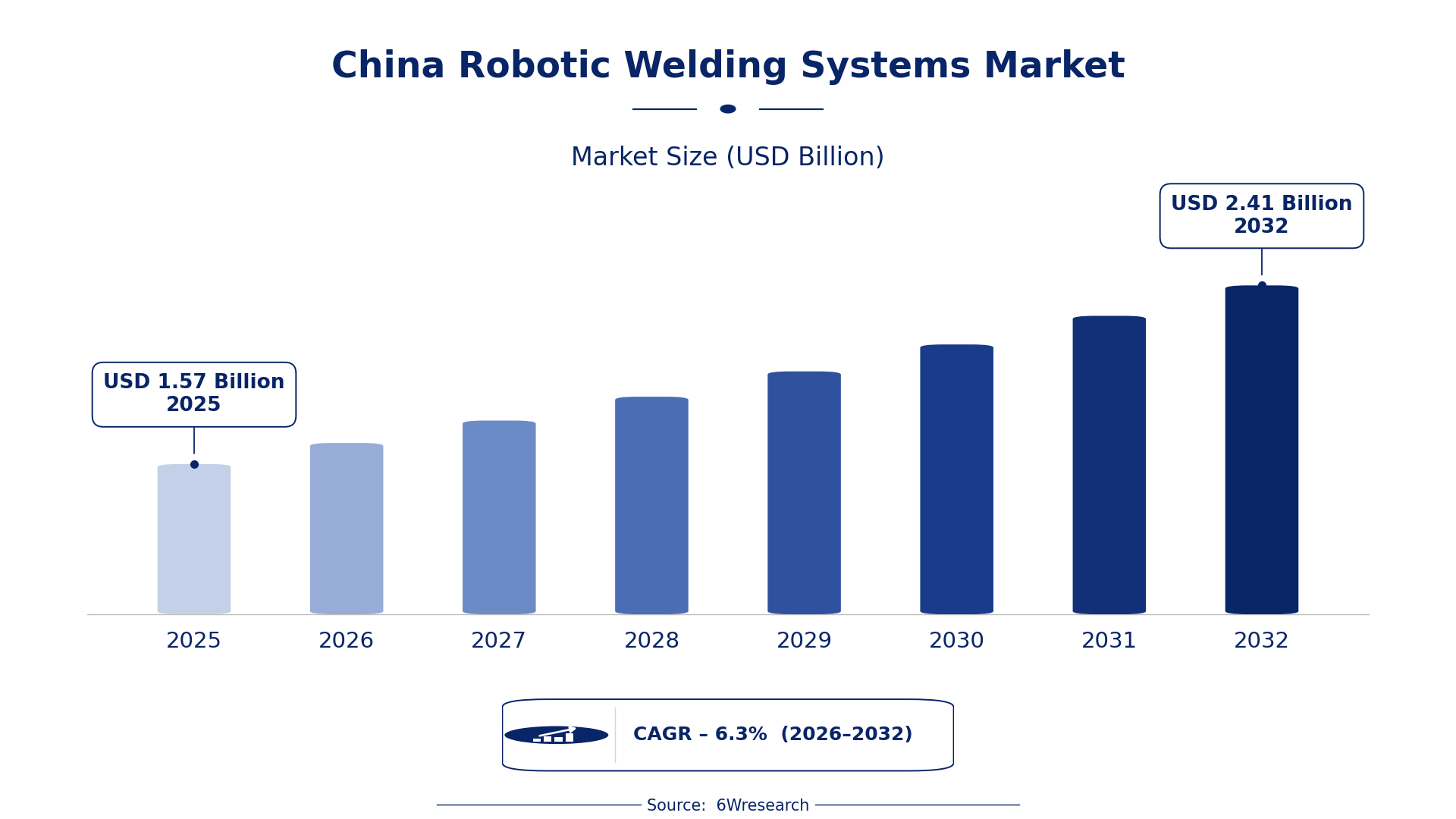
According to 6Wresearch internal database and industry insights, the China Robotic Welding Systems Market was valued at USD 1.57 billion in 2025 and is projected to reach USD 2.41 billion by 2032, growing at a CAGR of approximately 6.3% during 2026–2032.
China Robotic Welding Systems Market Highlights
| Report Metric | Details |
| Report Name | China Robotic Welding Systems Market |
| Market Size 2025 | USD 1.57 billion |
| Market Size 2032 | USD 2.41 billion |
| Absolute Growth 2025–2032 | USD 0.84 billion |
| CAGR 2026–2032 | 6.3% |
| Peak Annual Growth | 8.6% in 2029 |
| Forecast Period | 2026–2032 |
| Historical Data | 2022–2025 |
| Base Year | 2025 |
| Leading Welding Type, 2025 | MIG Welding Robots (39% share) |
| Leading Robot Type, 2025 | 6-Axis Arms (43% share) |
| Leading Power Source, 2025 | Electric Arc (42% share) |
| Leading End User, 2025 | Automotive Plants (39% share) |
| Fastest-Growing Welding Type | Laser Welding Robots (8.9% CAGR) |
| Fastest-Growing Robot Type | Fiber-Laser Enabled (7.8% CAGR) |
| Fastest-Growing End User | Electronics Assembly (8.9% CAGR) |
| Growing Sector | automotive manufacturing |
| Key End Users | automotive plants, aerospace components manufacturers, electronics assembly facilities |
China Robotic Welding Systems Market Year-wise Growth Rate and Key Drivers (2022–2032)
This graph illustrates the annual growth rates of the market from 2022 to 2032, highlighting a steady upward trajectory and projected market expansion over the forecast period.
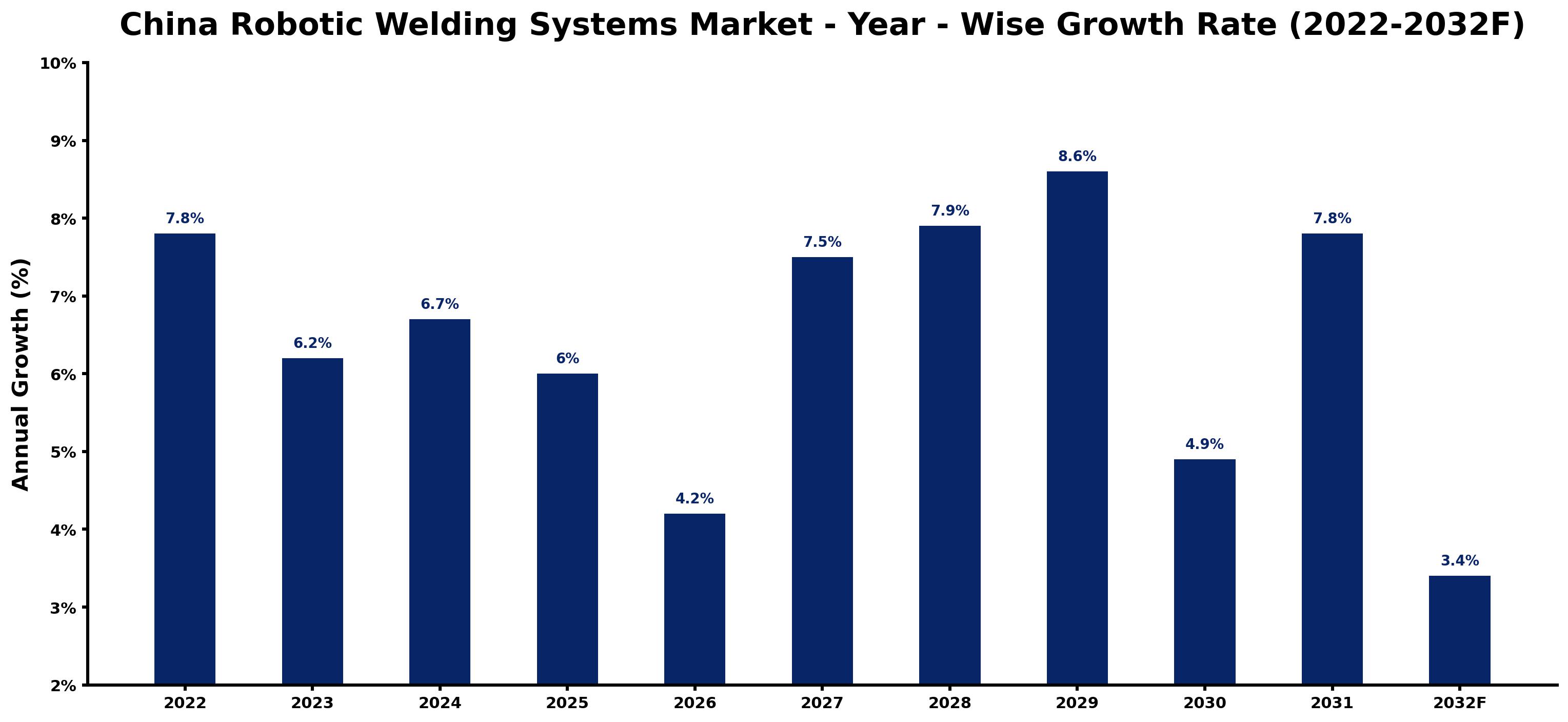
Annual growth estimates for each year appear below with the principal reason behind them, explaining the shifts that set the pace of the market.
| Year | Estimated Annual Growth (%) | Market Rationale |
| 2022 | 7.8 | The market experienced strong demand due to high automotive production levels. |
| 2023 | 6.2 | Growth slowed as manufacturers adjusted to changing market conditions and demand for automation. |
| 2024 | 6.7 | An increase in automotive production and aerospace projects boosted growth rates. |
| 2025 | 6.0 | Demand continued but at a slower pace as market saturation began to appear in the automotive sector. |
| 2026 | 4.2 | Growth slowed further as companies faced challenges in scaling automation technologies. |
| 2027 | 7.5 | A rebound occurred as investments in automation picked up momentum again following government initiatives. |
| 2028 | 7.9 | Increased adoption of advanced welding technologies drove a higher growth rate in the aerospace sector. |
| 2029 | 8.6 | The market peaked as demand surged from both automotive and electronics sectors due to new projects. |
| 2030 | 4.9 | Growth slowed as the market began to stabilise after a peak year in automotive production. |
| 2031 | 7.8 | A resurgence in demand was noted as new projects in aerospace emerged, driving further growth. |
| 2032 | 3.4 | Growth is expected to decelerate as the market adjusts to post-peak conditions in automotive production. |
Note: Market size estimations and growth projections presented in this report are based on 6Wresearch's proprietary forecasting methodology, utilizing the latest available industry data, government publications, and primary research inputs.
China Robotic Welding Systems Market Synopsis
Robotic Welding Systems represent automated machines used for welding processes in China, particularly in automotive manufacturing, aerospace components production, and electronics assembly. These systems utilise advanced robotics technology for precise welding tasks. The China Robotic Welding Systems Market is expanding due to high demand from the automotive sector, which produced over 25 million vehicles in 2022, and the growing electronics assembly industry, employing over 5 million workers. Government initiatives, such as the Intelligent Manufacturing Development Plan, are promoting automation, further driving market growth.
Market Dynamics Impact Analysis (2026–2032)
| Factor | Type | Impact | Primary Segment Affected |
| High automotive production levels drive demand for efficient welding solutions. | Driver | High | MIG Welding Robots |
| The aerospace industry's projected growth increases the need for advanced welding technologies. | Driver | High | Laser Welding Robots |
| The increasing number of automotive plants in Guangdong creates opportunities for suppliers. | Opportunity | High | Automotive Plants |
| The growing electronics assembly sector in Shanghai presents a demand for robotic welding systems. | Opportunity | High | Electronics Assembly |
| Challenges in scaling automation may limit adoption rates in some sectors. | Restraint | Medium | TIG Welding Robots |
| High initial investment costs for robotic systems can deter smaller manufacturers. | Restraint | Medium | Spot Welding Robots |
| The market faces integration challenges due to varying technology standards. | Challenge | High | 6-Axis Arms |
| A shortage of skilled workers in robotic welding can slow down implementation. | Challenge | High | Precision Multi-Arm |
Evaluation of Drivers in China Robotic Welding Systems Market (2026–2032)
The factors lifting demand, and the evidence behind each, are summarised below.
| Drivers | Primary Segment Affected | Why It Matters (Evidence) |
| Increased automotive production in China drives demand for robotic welding systems. | MIG Welding Robots | China's automotive sector produced over 25 million vehicles in 2022, leading to higher purchases of efficient welding solutions. |
| The aerospace industry's growth necessitates advanced welding technologies. | Laser Welding Robots | With a projected annual growth of 10%, the aerospace sector is investing in precision welding systems. |
| Government initiatives promote automation in manufacturing. | Spot Welding Robots | The Ministry of Industry and Information Technology's 2023 program encourages the adoption of robotic welding technologies. |
| The electronics assembly sector's expansion boosts demand for robotic solutions. | TIG Welding Robots | Employing over 5 million workers, this sector is increasingly automating processes to enhance efficiency. |
| Rising investments in advanced manufacturing technologies support market growth. | 6-Axis Arms | The National Development and Reform Commission's plan aims to enhance industrial automation by 2025. |
In 2022, the automotive sector produced over 25 million vehicles, driving demand for efficient welding solutions. The aerospace industry is projected to grow by 10% annually, necessitating advanced welding technologies. The electronics assembly sector is increasingly turning to automation to improve efficiency, employing over 5 million workers and driving further demand for robotic solutions.
Evaluation of Restraints in China Robotic Welding Systems Market
The table below lists the restraints and the evidence behind each.
| Market Restraint | Primary Segment Affected | Why It Matters (Evidence) |
| Integration challenges due to varying technology standards can hinder adoption. | TIG Welding Robots | Different standards in robotic welding technologies complicate implementation for manufacturers, affecting their efficiency. |
| High initial investment costs for robotic systems can deter smaller manufacturers. | Spot Welding Robots | The capital required for robotic systems limits access for many smaller companies, hindering their growth. |
| A shortage of skilled workers in robotic welding can slow down implementation. | 6-Axis Arms | Limited availability of trained personnel affects the speed of adopting robotic solutions, impacting production timelines. |
| Market saturation in certain sectors may limit growth opportunities. | Laser Welding Robots | As more companies adopt robotic welding, the market may face challenges in finding new customers and expanding. |
| Economic fluctuations can impact investment in automation technologies. | Precision Multi-Arm | Economic uncertainty may cause companies to delay investments in new technologies, affecting their competitiveness. |
China Robotic Welding Systems Market Challenges
Buyers in the China robotic welding systems market face rising costs due to the automotive sector producing over 25 million vehicles in 2022, which strains budgets for manufacturers. Regulatory compliance with standards like ISO 3834 imposes additional financial burdens, potentially delaying project timelines for suppliers. Increased competition from new entrants is driving aggressive pricing strategies, which can erode profit margins for established companies. Supply chain disruptions frequently occur, with delays in component availability causing production setbacks for manufacturers reliant on advanced welding technologies.
Trends in the China Robotic Welding Systems Market
Four trends stand out in the China Robotic Welding Systems Market.
- Shift Towards Automation in Automotive Manufacturing: Guangdong province is at the forefront of automation in automotive manufacturing, with over 100 plants adopting robotic welding systems. In 2022, this shift contributed to improved production efficiency.
- Growing Adoption of Laser Welding Technologies: In 2023, demand for Laser Welding Robots surged, particularly in the electronics assembly sector, which is projected to grow by 8.9%. This trend indicates a move towards precision in manufacturing processes.
- Increased Focus on Quality Standards: ISO 3834 is being increasingly adopted by manufacturers in China to ensure quality in welding processes. This standardisation boosts competitiveness and meets international quality benchmarks.
- Expansion of Vocational Training Programs: The Ministry of Education's vocational training program launched in 2023 aims to train 100,000 workers in robotic welding by 2025. This initiative addresses the skills gap in the industry.
Investment Opportunities in the China Robotic Welding Systems Market
Below are the investment opportunities with the strongest case in the China Robotic Welding Systems Market.
- Automotive Plants Seeking Advanced Solutions: Automotive manufacturers in Guangdong are looking for advanced robotic welding systems to improve production efficiency. With over 25 million vehicles produced in 2022, suppliers can tap into this growing demand.
- Electronics Assembly Facilities Expanding Automation: The electronics assembly sector in Shanghai is increasingly investing in robotic welding systems. With over 5 million workers, this sector presents an opportunity for suppliers to provide automation solutions.
- Aerospace Components Manufacturers Needing Precision: Aerospace manufacturers in the Beijing-Tianjin-Hebei region are seeking high-precision welding technologies. With the industry projected to grow by 10% annually, there is a clear gap for suppliers to fill.
- Investment in Training for Skilled Workforce: The vocational training program targets 100,000 trainees by 2025, creating opportunities for training providers. This initiative will help bridge the skills gap in robotic welding, benefiting both buyers and suppliers.
Government Initiatives in the China Robotic Welding Systems Market
In 2023, the Ministry of Science and Technology initiated the Advanced Manufacturing Technology Program to support innovation in robotic welding technologies with a budget of 300 million yuan. This program complements the Intelligent Manufacturing Development Plan launched in 2021, which aimed to improve automation in manufacturing. Together, these measures promote the adoption of advanced welding technologies across various industries, ensuring producers meet modern efficiency standards.
Automotive plants benefit from the Intelligent Manufacturing Development Plan by receiving funding for automation upgrades. The Ministry of Industry and Information Technology oversees this scheme, encouraging manufacturers to invest in robotic welding systems and thus improving productivity and competitiveness in the automotive sector. Additionally, the vocational training program launched in 2023 aims to equip workers with the necessary skills to operate these advanced systems.
Future Insight of the China Robotic Welding Systems Market
The China robotic welding systems market will experience notable changes by 2032, driven by the Ministry of Industry and Information Technology's automation programme and the National Development and Reform Commission's plans to boost industrial automation by 2025. The aerospace sector is projected to grow by 10% annually, increasing the demand for advanced welding technologies. Investments in automation will improve operational efficiency across various industries. Research initiatives funded by 500 million yuan from the Ministry of Science and Technology will support the development of next-generation welding solutions.
Market Segmentation Analysis
Each segment group is reviewed below, with the leader by share and the fastest grower by CAGR.
By Welding Type – MIG Welding Robots Dominated, Laser Welding Robots Expected to Grow Fastest
According to Shubham Padhi, Research Analyst at 6Wresearch, in 2025, MIG Welding Robots led the welding type split with a 39% share. MIG Welding Robots hold the largest market share due to their widespread application in the automotive sector, which produced over 25 million vehicles in 2022. Their efficiency makes them essential for manufacturers aiming to optimise production processes in this high-demand industry. Laser Welding Robots are projected to grow fastest, at a CAGR of 8.9% during 2026–2032. Laser Welding Robots are experiencing rapid growth as they are increasingly adopted for precision welding tasks in both the electronics and automotive sectors. This trend is driven by the need for high-quality welds that comply with strict industry standards, ensuring their continued expansion. Suppliers should focus on enhancing MIG welding offerings while also investing in laser technology to align with the evolving market demands.
By Robot Type – 6-Axis Arms Dominated, Fiber-Laser Enabled Expected to Grow Fastest
6-Axis Arms accounted for a 43% market share by robot type in 2025. 6-Axis Arms dominate the market share due to their versatility, enabling them to perform complex welding tasks across various industries, including automotive and electronics. Their adaptability is vital for manufacturers looking to improve production efficiency and capability. Over 2026–2032, Fiber-Laser Enabled is expected to post the fastest growth, at a CAGR of 7.8%. Fiber-Laser Enabled robots are the fastest-growing segment, gaining popularity for their speed and precision in high-tech applications, particularly in electronics assembly. As industries increasingly seek efficiency, the demand for these advanced systems is projected to grow significantly. Suppliers should prioritise the development of 6-Axis Arms while expanding their offerings to include Fiber-Laser Enabled options to seize emerging growth opportunities.
By Power Source – Electric Arc Dominated and Is Expected to Record the Fastest Growth
Electric Arc took a 42% share of power source in 2025, more than any other category. Electric Arc is the leading power source for robotic welding systems, serving as the standard across most applications in the industry. Its reliability and effectiveness in various welding processes solidify its position in the market. The same category is also set to grow fastest, at a CAGR of 8.7% during 2026–2032. Electric Arc also stands out as the fastest-growing power source, as its established presence allows for continuous improvements and adaptations to new technologies. This dual role as both leader and fastest will likely strengthen its market dominance. Suppliers should continue to innovate within the Electric Arc segment to maintain competitive advantage and meet increasing automation demands.
By End User – Automotive Plants Dominated, Electronics Assembly Expected to Grow Fastest
Automotive Plants held a 39% share of the China Robotic Welding Systems Market by end user in 2025. Automotive Plants are the primary users of robotic welding systems, with over 100 plants in China employing these technologies for assembly processes. The substantial vehicle production volume in the country drives a strong demand for efficient welding solutions tailored to this sector. Electronics Assembly is set to record the highest CAGR in this split, 8.9% over 2026–2032. Electronics Assembly is witnessing the fastest growth as manufacturers automate processes to improve efficiency and reduce labour costs. This trend is particularly evident in sectors employing over 5 million workers, indicating a significant shift towards automation. Suppliers must customise their offerings to address the specific needs of the automotive and electronics sectors to capitalise on the increasing demand for robotic welding systems.
Key Attractiveness of the Report
- 10 Years of Market Numbers
- Historical Data Starting from 2022 to 2025
- Base Year 2025
- Forecast Data until 2032
- Key Performance Indicators Impacting the Market
- Major Upcoming Developments and Projects
Key Highlights of the Report:
- China Robotic Welding Systems Market Outlook
- Market Size of China Robotic Welding Systems Market, 2025
- Forecast of China Robotic Welding Systems Market, 2032
- Historical Data and Forecast of China Robotic Welding Systems Revenues & Volume for the Period 2022 - 2032F
- China Robotic Welding Systems Market Trend Evolution
- China Robotic Welding Systems Market Drivers and Challenges
- China Robotic Welding Systems Price Trends
- China Robotic Welding Systems Porter's Five Forces
- China Robotic Welding Systems Industry Life Cycle
- Historical Data and Forecast of China Robotic Welding Systems Market Revenues & Volume By Welding Type for the Period 2022 - 2032F
- Historical Data and Forecast of China Robotic Welding Systems Market Revenues & Volume By MIG Welding Robots for the Period 2022 - 2032F
- Historical Data and Forecast of China Robotic Welding Systems Market Revenues & Volume By TIG Welding Robots for the Period 2022 - 2032F
- Historical Data and Forecast of China Robotic Welding Systems Market Revenues & Volume By Spot Welding Robots for the Period 2022 - 2032F
- Historical Data and Forecast of China Robotic Welding Systems Market Revenues & Volume By Laser Welding Robots for the Period 2022 - 2032F
- Historical Data and Forecast of China Robotic Welding Systems Market Revenues & Volume By Robot Type for the Period 2022 - 2032F
- Historical Data and Forecast of China Robotic Welding Systems Market Revenues & Volume By 6-Axis Arms for the Period 2022 - 2032F
- Historical Data and Forecast of China Robotic Welding Systems Market Revenues & Volume By Precision Multi-Arm for the Period 2022 - 2032F
- Historical Data and Forecast of China Robotic Welding Systems Market Revenues & Volume By Dual-Electrode Arms for the Period 2022 - 2032F
- Historical Data and Forecast of China Robotic Welding Systems Market Revenues & Volume By Fiber-Laser Enabled for the Period 2022 - 2032F
- Historical Data and Forecast of China Robotic Welding Systems Market Revenues & Volume By Power Source for the Period 2022 - 2032F
- Historical Data and Forecast of China Robotic Welding Systems Market Revenues & Volume By Electric Arc for the Period 2022 - 2032F
- Historical Data and Forecast of China Robotic Welding Systems Market Revenues & Volume By High Frequency for the Period 2022 - 2032F
- Historical Data and Forecast of China Robotic Welding Systems Market Revenues & Volume By Resistance-Based for the Period 2022 - 2032F
- Historical Data and Forecast of China Robotic Welding Systems Market Revenues & Volume By Optical Control for the Period 2022 - 2032F
- Historical Data and Forecast of China Robotic Welding Systems Market Revenues & Volume By End User for the Period 2022 - 2032F
- Historical Data and Forecast of China Robotic Welding Systems Market Revenues & Volume By Automotive Plants for the Period 2022 - 2032F
- Historical Data and Forecast of China Robotic Welding Systems Market Revenues & Volume By Aerospace Components for the Period 2022 - 2032F
- Historical Data and Forecast of China Robotic Welding Systems Market Revenues & Volume By Sheet Metal Factories for the Period 2022 - 2032F
- Historical Data and Forecast of China Robotic Welding Systems Market Revenues & Volume By Electronics Assembly for the Period 2022 - 2032F
- China Robotic Welding Systems Import Export Trade Statistics
- Market Opportunity Assessment By Welding Type
- Market Opportunity Assessment By Robot Type
- Market Opportunity Assessment By Power Source
- Market Opportunity Assessment By End User
- China Robotic Welding Systems Top Companies Market Share
- China Robotic Welding Systems Competitive Benchmarking By Technical and Operational Parameters
- China Robotic Welding Systems Company Profiles
- China Robotic Welding Systems Key Strategic Recommendations
Market Covered
Segments analysed in this report are listed below.
By Welding Type
- MIG Welding Robots
- TIG Welding Robots
- Spot Welding Robots
- Laser Welding Robots
By Robot Type
- 6-Axis Arms
- Precision Multi-Arm
- Dual-Electrode Arms
- Fiber-Laser Enabled
By Power Source
- Electric Arc
- High Frequency
- Resistance-Based
- Optical Control
By End User
- Automotive Plants
- Aerospace Components
- Sheet Metal Factories
- Electronics Assembly































