India Robotics & Automation Market Size & Growth Rate
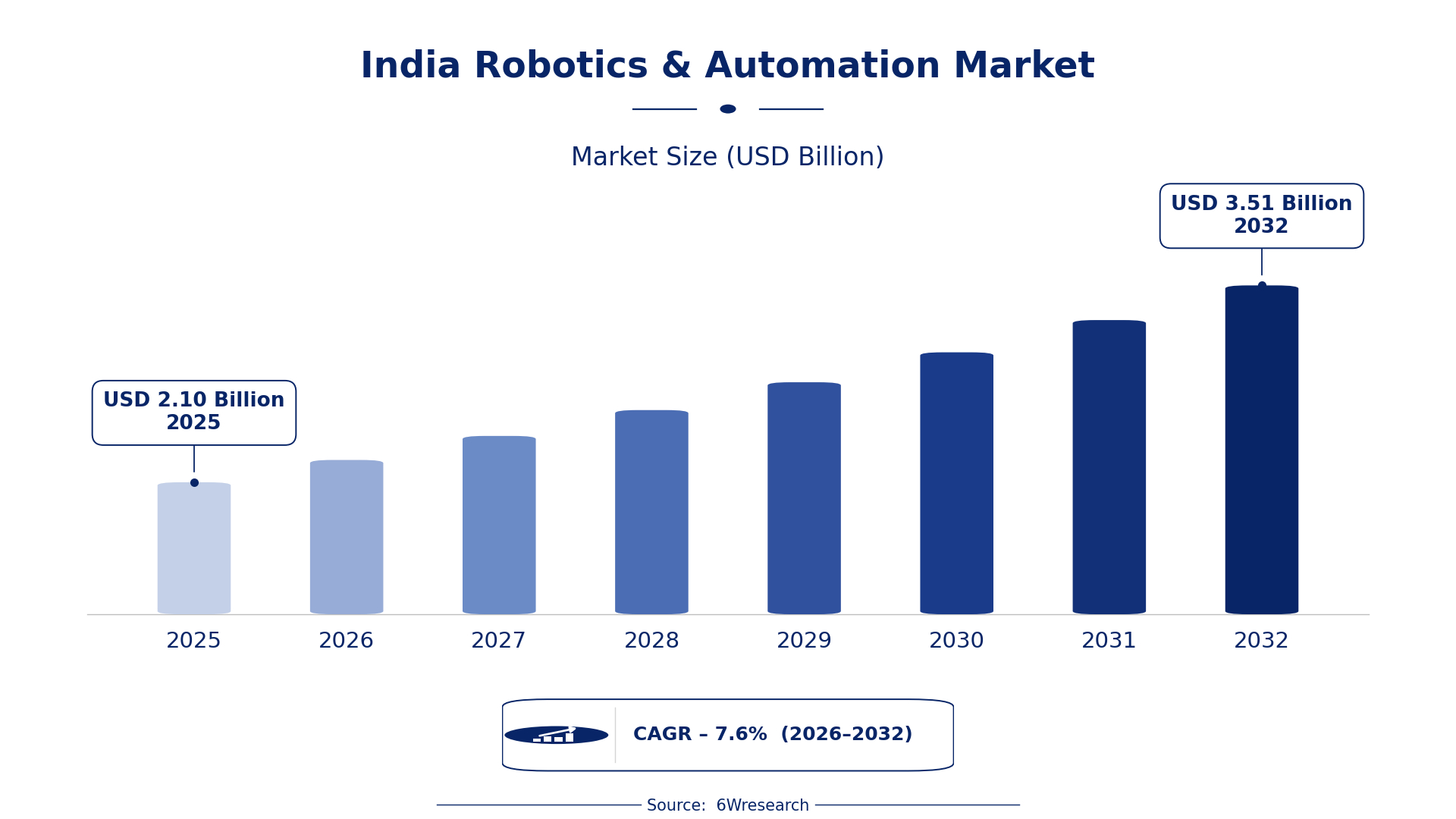
According to 6Wresearch internal database and industry insights, the India Robotics & Automation Market was valued at USD 2.10 billion in 2025 and is projected to reach USD 3.51 billion by 2032, growing at a CAGR of approximately 7.6% during 2026–2032.
India Robotics & Automation Market Highlights
| Report Metric | Details |
| Report Name | India Robotics & Automation Market |
| Market Size 2025 | USD 2.10 billion |
| Market Size 2032 | USD 3.51 billion |
| Absolute Growth 2025–2032 | USD 1.41 billion |
| CAGR 2026–2032 | 7.6% |
| Peak Annual Growth | 10.0% in 2029 |
| Forecast Period | 2026–2032 |
| Historical Data | 2022–2025 |
| Base Year | 2025 |
| Leading Application Segment, 2025 | Industrial Automation (32% share) |
| Leading Robot Category, 2025 | Manufacturing Robots (44% share) |
| Leading Integration Type, 2025 | PLC-Integrated (38% share) |
| Leading End User, 2025 | Assembly Plants (50% share) |
| Fastest-Growing Application Segment | Service Robotics (8.6% CAGR) |
| Fastest-Growing Robot Category | Domestic/Commercial Robots (9.8% CAGR) |
| Fastest-Growing Integration Type | Cloud-Based (10.1% CAGR) |
| Fastest-Growing End User | Logistics Providers (10.3% CAGR) |
| Growing Sector | Service Robotics |
| Key End Users | Industrial Automation, Service Robotics, Mobile Robotics, Humanoid Robots |
India Robotics & Automation Market Year-wise Growth Rate and Key Drivers (2022–2032)
This graph illustrates the annual growth rates of the market from 2022 to 2032, highlighting a steady upward trajectory and projected market expansion over the forecast period.
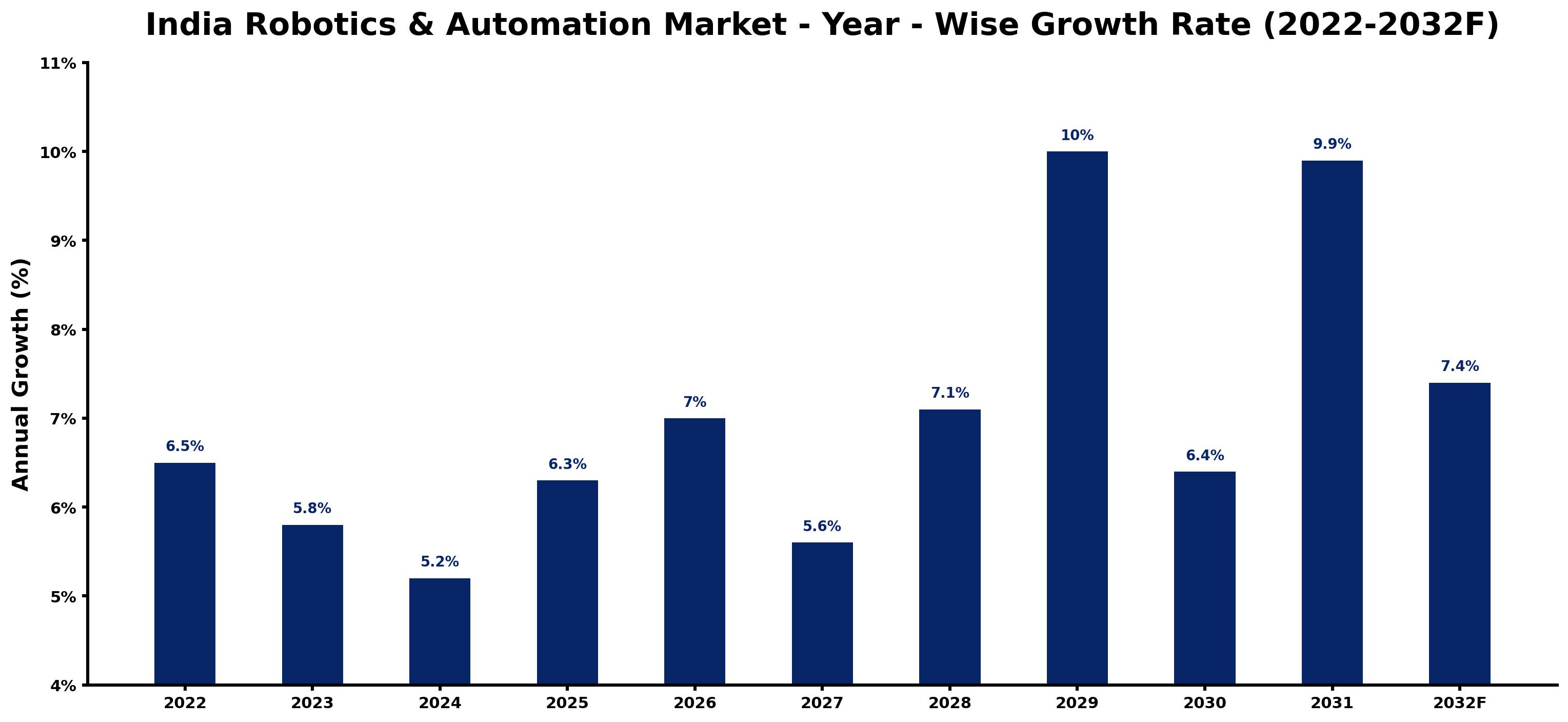
Below, each year's estimated growth is shown next to the factor that most influenced it.
| Year | Estimated Annual Growth (%) | Market Rationale |
| 2022 | 6.5 | The market experienced strong demand from the manufacturing sector, driving growth. |
| 2023 | 5.8 | Growth slowed due to adjustments in investment strategies across various sectors. |
| 2024 | 5.2 | Continued adoption of automation technologies in logistics contributed to market expansion. |
| 2025 | 6.3 | Increased implementation of robotics in healthcare boosted demand for automation solutions. |
| 2026 | 7.0 | The 'Digital India' initiative is expected to enhance automation adoption across sectors. |
| 2027 | 5.6 | Growth slowed as companies reassessed their automation investments amid economic shifts. |
| 2028 | 7.1 | Rising demand for mobile robotics in logistics is expected to drive market growth. |
| 2029 | 10.0 | The market is projected to peak due to heightened investments in manufacturing automation. |
| 2030 | 6.4 | Growth slowed as the market began to stabilise after rapid expansion in previous years. |
| 2031 | 9.9 | Increased adoption of robotics in assembly plants is expected to drive growth further. |
| 2032 | 7.4 | Growth is expected to stabilise as the market matures and the 'Skill India' programme enhances workforce capabilities. |
Note: Market size estimations and growth projections presented in this report are based on 6Wresearch's proprietary forecasting methodology, utilizing the latest available industry data, government publications, and primary research inputs.
India Robotics & Automation Market Synopsis
The Robotics & Automation Market in India encompasses advanced technologies enabling machines to perform tasks autonomously. These systems are developed through software programming, sensor integration, and hardware engineering. Growth in the market stems from increasing demand in the manufacturing sector and rising investments in automation technologies. The 'Make in India' initiative promotes local manufacturing, while the 'National Robotics Mission' advances research and development. With a population exceeding 1.4 billion, the potential for robotics applications is vast, particularly in healthcare and logistics.
Market Dynamics Impact Analysis (2026–2032)
| Factor | Type | Impact | Primary Segment Affected |
| Growing demand for industrial automation in manufacturing processes | Driver | High | Industrial Automation |
| Increased adoption of service robots in healthcare settings | Driver | High | Service Robotics |
| The need for efficient logistics solutions in urban areas | Opportunity | High | Mobile Robotics |
| Rising demand for domestic robots in households and small businesses | Opportunity | High | Domestic/Commercial Robots |
| High initial investment costs for robotics systems | Restraint | Medium | Industrial Automation |
| Limited awareness and understanding of robotics among SMEs | Restraint | Medium | Domestic/Commercial Robots |
| Challenges in workforce skill development for robotics operations | Challenge | High | Service Robotics |
| Competition from international robotics manufacturers | Challenge | Medium | Manufacturing Robots |
Evaluation of Drivers in India Robotics & Automation Market (2026–2032)
Below mentioned are some major drivers and their influence on market dynamics.
| Drivers | Primary Segment Affected | Why It Matters (Evidence) |
| Increased production efficiency through automation | Industrial Automation | The manufacturing sector, accounting for 16% of GDP, drives demand for automation technologies. |
| Growing investments in healthcare robotics | Service Robotics | Hospitals in major cities are increasingly implementing robotic systems for improved service delivery, with a 30% rise in adoption reported in 2023. |
| Expansion of logistics operations requiring automation | Mobile Robotics | The Indian logistics sector, valued at $215 billion, is adopting automation to improve operational efficiency. |
| Rising consumer interest in domestic robotics | Domestic/Commercial Robots | The growing middle class is leading to increased adoption of robots for household chores. |
| Government initiatives promoting local robotics production | Manufacturing Robots | The 'Make in India' initiative supports local manufacturing of robotics components, encouraging investment. |
The Robotics & Automation market in India is growing due to rising investments in healthcare robotics, logistics efficiency, and industrial automation. The manufacturing sector drives demand for automation technologies, contributing 16% to GDP. In 2023, hospitals reported a 30% increase in the adoption of robotic systems, improving service delivery. The logistics sector, valued at $215 billion, is increasingly adopting mobile robotics to streamline operations.
Evaluation of Restraints in India Robotics & Automation Market
The following restraints limit how fast demand can grow.
| Market Restraint | Primary Segment Affected | Why It Matters (Evidence) |
| High initial investment costs for robotics systems | Industrial Automation | The upfront costs deter many small and medium enterprises from adopting automation. |
| Limited awareness and understanding of robotics among SMEs | Domestic/Commercial Robots | Many small businesses lack knowledge about the benefits and applications of robotics. |
| Challenges in workforce skill development for robotics operations | Service Robotics | A shortage of skilled workers hampers the effective implementation of robotics in healthcare, affecting service delivery. |
| Regulatory hurdles in robotics deployment | Mobile Robotics | Stringent regulations can delay the adoption of mobile robotics in logistics, impacting operational efficiency. |
| Competition from international robotics manufacturers | Manufacturing Robots | Local manufacturers face challenges in competing with established global players, affecting market share. |
India Robotics & Automation Market Challenges
The India robotics and automation market faces practical issues, with regulatory hurdles being a primary concern. The Bureau of Indian Standards is still developing regulations, causing delays in product approvals for suppliers and hindering market entry for new technologies. High costs associated with advanced robotics systems limit accessibility for small and medium-sized enterprises, which struggle to invest in automation; many SMEs report costs exceeding 20% of their operational budgets. A skills gap exists, as many workers lack the necessary training in robotics, resulting in slower adoption rates among manufacturers. Technology integration challenges arise, as outdated infrastructure in some sectors complicates the implementation of new automation solutions, delaying operational efficiencies for buyers.
Trends in the India Robotics & Automation Market
The trends below show where the India Robotics & Automation Market is heading.
- National Robotics Mission Boosting R&D: The 'National Robotics Mission', launched in 2021, aims to promote robotics research and development in India. This initiative is projected to stimulate innovation and collaboration, focusing on industry needs and improving local capabilities.
- Service Robotics Adoption in Healthcare: Hospitals in major cities are increasingly adopting service robots, with a notable rise in their implementation. This trend is driven by the need for efficient service delivery, with hospitals reporting a 30% increase in robotic systems.
- Shift Towards Mobile Robotics in Logistics: The logistics sector is shifting towards mobile robotics for material handling and transport. In 2023, India saw a 30% increase in the deployment of Automated Guided Vehicles (AGVs) in warehouses.
- Increasing Demand for Domestic Robots: There is a noticeable increase in the adoption of domestic robots for household chores. This trend is driven by the growing middle class, leading to a projected growth rate of 9.8% for domestic robots.
Investment Opportunities in the India Robotics & Automation Market
Some of the investment opportunities in the India Robotics & Automation Market are mentioned below.
- Gap in Robotics Skills: With a growing need for skilled workers in robotics, there is an opportunity to invest in training programs. The 'Skill India' initiative aims to develop workforce capabilities in robotics, addressing the skills gap.
- Supply of Robotics Components: The 'Make in India' initiative presents an opportunity to supply robotics components locally. Manufacturers can benefit from government support and subsidies to establish production facilities.
- Growing Demand for Logistics Automation: The logistics sector's valuation of $215 billion highlights the need for automation solutions. Suppliers can enter this market by partnering with logistics providers to implement robotic systems.
- Increasing Interest in Domestic Robotics: The growing middle class is driving demand for domestic robots. Suppliers can target this segment by offering affordable and efficient robotic solutions for household tasks.
Government Initiatives in the India Robotics & Automation Market
The 'National Robotics Mission', launched by the Ministry of Electronics and Information Technology in 2021, promotes robotics research and development. This initiative fosters collaboration between industry and academia, driving innovation in robotics applications. Additionally, the 'Production Linked Incentive Scheme' was updated in 2022 to include robotics manufacturers, aiming to boost domestic production and innovation in the sector. This measure encourages local firms to invest in robotics technology and infrastructure, providing a solid foundation for growth.
The Ministry of Electronics and Information Technology oversees the implementation of various initiatives, including the 'Digital India' programme. This initiative funds projects aimed at improving the adoption of automation technologies across sectors. Furthermore, the Ministry of Skill Development and Entrepreneurship supports the 'Skill India' programme, which trains workers in robotics and automation technologies. This programme is essential for developing a skilled workforce capable of supporting the growing robotics industry.
Future Insight of the India Robotics & Automation Market
Several forward-looking factors should support the robotics and automation market in India over the coming years. The 'Make in India' initiative will enhance local manufacturing capabilities, reducing reliance on imports. By 2025, the 'Digital India' programme will accelerate automation adoption across various sectors, improving efficiency and productivity. The National Robotics Mission will drive research and development, leading to innovative solutions tailored to local needs. In 2022, the Indian logistics sector was valued at around $215 billion, indicating a strong market potential for automation technologies.
Market Segmentation Analysis
Each segment group is reviewed below, with the leader by share and the fastest grower by CAGR.
By Application Segment – Industrial Automation Dominated, Service Robotics Expected to Grow Fastest
According to Shubham Padhi, Research Analyst at 6Wresearch, Industrial Automation accounted for a 32% market share by application segment in 2025. Industrial automation holds the largest market share because it is crucial for enhancing production efficiency and reducing labour costs. The manufacturing sector's contribution of approximately 16% to India's GDP highlights the dependency on these systems for operational success. Service Robotics are set to record the highest CAGR in this split, 8.6% over 2026–2032. Service robotics is witnessing rapid growth as hospitals in major cities adopt robotic systems for service delivery, reflecting the healthcare sector's commitment to improving patient care. This trend is expected to continue as operational workflows become increasingly optimised. Suppliers should focus on developing solutions that cater to the growing demand for service robotics in healthcare.
By Robot Category – Manufacturing Robots Dominated, Domestic/Commercial Robots Expected to Grow Fastest
With a 44% revenue share in 2025, Manufacturing Robots was the largest robot category category. Manufacturing robots dominate the market as they are essential for assembly lines and production facilities, significantly increasing efficiency and output. Their widespread application across various industries reinforces their leading position in the robotics sector. Domestic/Commercial Robots are projected to grow fastest, at a CAGR of 9.8% during 2026–2032. Domestic and commercial robots are growing rapidly due to their increasing use in household chores and small business operations, reflecting a broader trend towards automation in everyday tasks. This surge indicates a rising demand for these robots in various settings. Buyers in the domestic sector should consider investing in commercial robots to enhance productivity and streamline daily operations.
By Integration Type – PLC-Integrated Dominated, Cloud-Based Expected to Grow Fastest
PLC-Integrated took a 38% share of integration type in 2025, more than any other category. PLC-integrated systems capture the largest market share as they are commonly used in industrial environments for process control, ensuring reliability and efficiency. Their established role in manufacturing processes underscores their importance in the robotics market. The quickest growth will come from Cloud-Based, forecast to expand at a CAGR of 10.1% between 2026 and 2032. Cloud-based integration is growing quickly as it supports data management and analytics for robotics, offering enhanced flexibility and scalability. This shift indicates a trend towards more interconnected and intelligent robotic systems. Suppliers should prioritise cloud-based solutions to meet the increasing demand for data-driven robotics.
By End User – Assembly Plants Dominated, Logistics Providers Expected to Grow Fastest
Assembly Plants held a 50% share of the India Robotics & Automation Market by end user in 2025. Assembly plants capture the largest market share as they heavily rely on robotics for operational efficiency and productivity. Their dependence on automation technologies highlights the critical need for advanced robotic solutions in manufacturing. Over 2026–2032, Logistics Providers are expected to post the fastest growth, at a CAGR of 10.3%. Logistics providers are the fastest-growing end users, essential for streamlining supply chain processes through automation. This growth is driven by the increasing complexity of logistics operations and the need for efficiency. Suppliers must tailor their offerings to meet the specific needs of logistics providers, who are increasingly adopting automation technologies.
Key Attractiveness of the Report
- 10 Years of Market Numbers
- Historical Data Starting from 2022 to 2025
- Base Year 2025
- Forecast Data until 2032
- Key Performance Indicators Impacting the Market
- Major Upcoming Developments and Projects
Key Highlights of the Report:
- India Robotics & Automation Market Outlook
- Market Size of India Robotics & Automation Market, 2025
- Forecast of India Robotics & Automation Market, 2032
- Historical Data and Forecast of India Robotics & Automation Revenues & Volume for the Period 2022 - 2032F
- India Robotics & Automation Market Trend Evolution
- India Robotics & Automation Market Drivers and Challenges
- India Robotics & Automation Price Trends
- India Robotics & Automation Porter's Five Forces
- India Robotics & Automation Industry Life Cycle
- Historical Data and Forecast of India Robotics & Automation Market Revenues & Volume By Application Segment for the Period 2022 - 2032F
- Historical Data and Forecast of India Robotics & Automation Market Revenues & Volume By Industrial Automation for the Period 2022 - 2032F
- Historical Data and Forecast of India Robotics & Automation Market Revenues & Volume By Service Robotics for the Period 2022 - 2032F
- Historical Data and Forecast of India Robotics & Automation Market Revenues & Volume By Mobile Robotics for the Period 2022 - 2032F
- Historical Data and Forecast of India Robotics & Automation Market Revenues & Volume By Humanoid Robots for the Period 2022 - 2032F
- Historical Data and Forecast of India Robotics & Automation Market Revenues & Volume By Robot Category for the Period 2022 - 2032F
- Historical Data and Forecast of India Robotics & Automation Market Revenues & Volume By Manufacturing Robots for the Period 2022 - 2032F
- Historical Data and Forecast of India Robotics & Automation Market Revenues & Volume By Domestic/Commercial Robots for the Period 2022 - 2032F
- Historical Data and Forecast of India Robotics & Automation Market Revenues & Volume By AGVs/AMRs for the Period 2022 - 2032F
- Historical Data and Forecast of India Robotics & Automation Market Revenues & Volume By AI-Driven Interaction for the Period 2022 - 2032F
- Historical Data and Forecast of India Robotics & Automation Market Revenues & Volume By Integration Type for the Period 2022 - 2032F
- Historical Data and Forecast of India Robotics & Automation Market Revenues & Volume By PLC-Integrated for the Period 2022 - 2032F
- Historical Data and Forecast of India Robotics & Automation Market Revenues & Volume By Cloud-Based for the Period 2022 - 2032F
- Historical Data and Forecast of India Robotics & Automation Market Revenues & Volume By Autonomous Navigation for the Period 2022 - 2032F
- Historical Data and Forecast of India Robotics & Automation Market Revenues & Volume By NLP/Visual Interface for the Period 2022 - 2032F
- Historical Data and Forecast of India Robotics & Automation Market Revenues & Volume By End User for the Period 2022 - 2032F
- Historical Data and Forecast of India Robotics & Automation Market Revenues & Volume By Assembly Plants for the Period 2022 - 2032F
- Historical Data and Forecast of India Robotics & Automation Market Revenues & Volume By Consumers/SMEs for the Period 2022 - 2032F
- Historical Data and Forecast of India Robotics & Automation Market Revenues & Volume By Logistics Providers for the Period 2022 - 2032F
- Historical Data and Forecast of India Robotics & Automation Market Revenues & Volume By Public Spaces for the Period 2022 - 2032F
- India Robotics & Automation Import Export Trade Statistics
- Market Opportunity Assessment By Application Segment
- Market Opportunity Assessment By Robot Category
- Market Opportunity Assessment By Integration Type
- Market Opportunity Assessment By End User
- India Robotics & Automation Top Companies Market Share
- India Robotics & Automation Competitive Benchmarking By Technical and Operational Parameters
- India Robotics & Automation Company Profiles
- India Robotics & Automation Key Strategic Recommendations
Market Covered
The report offers an extensive study of the following market segments.
By Application Segment
- Industrial Automation
- Service Robotics
- Mobile Robotics
- Humanoid Robots
By Robot Category
- Manufacturing Robots
- Domestic/Commercial Robots
- AGVs/AMRs
- AI-Driven Interaction
By Integration Type
- PLC-Integrated
- Cloud-Based
- Autonomous Navigation
- NLP/Visual Interface
By End User
- Assembly Plants
- Consumers/SMEs
- Logistics Providers
- Public Spaces































