China Robotics & Automation Market Size & Growth Rate
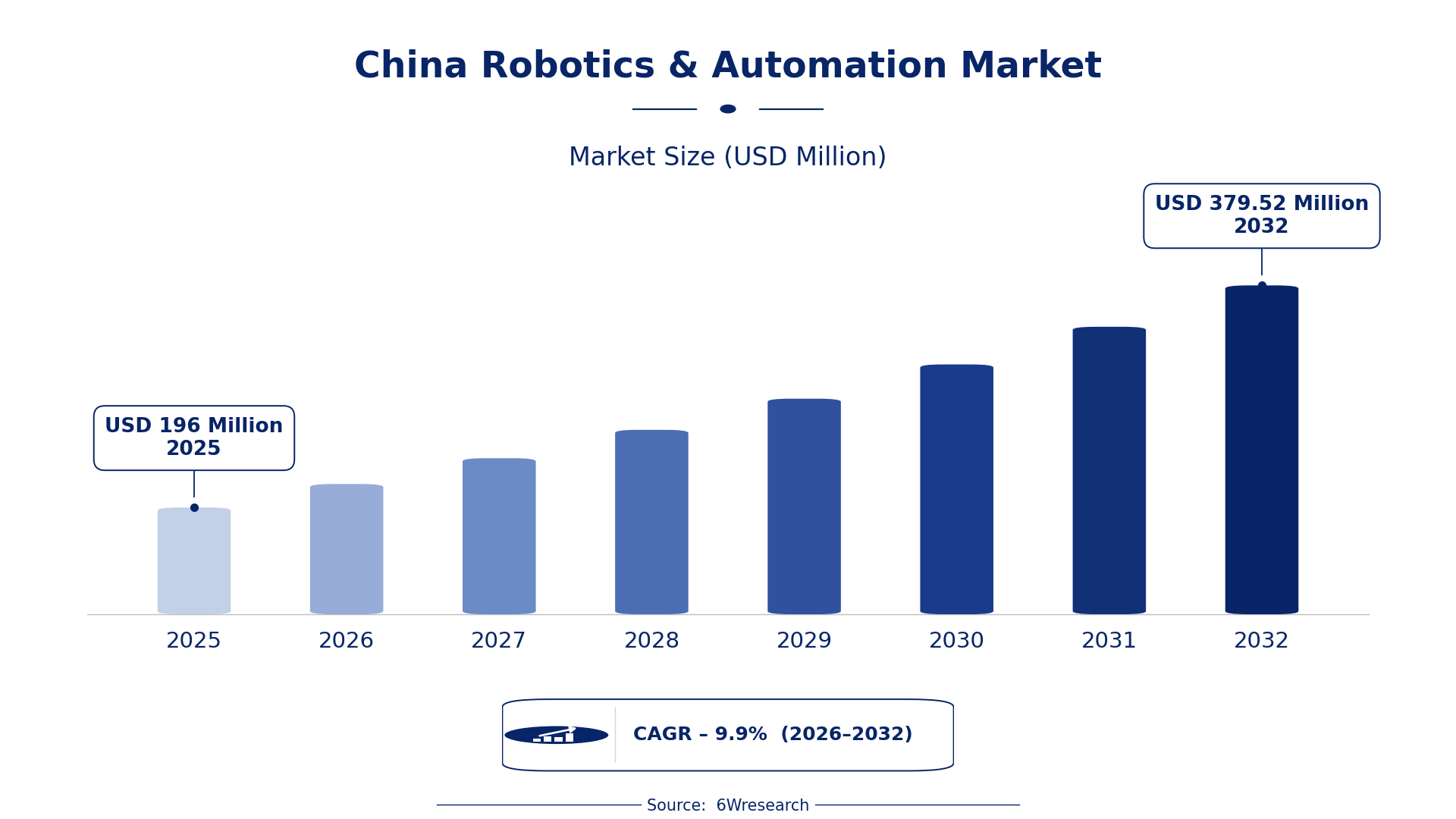
According to 6Wresearch internal database and industry insights, the China Robotics & Automation Market was valued at USD 196.0 million in 2025 and is projected to reach USD 379.52 million by 2032, growing at a CAGR of approximately 9.9% during 2026–2032.
China Robotics & Automation Market Highlights
| Report Metric | Details |
| Report Name | China Robotics & Automation Market |
| Market Size 2025 | USD 196.0 million |
| Market Size 2032 | USD 379.52 million |
| Absolute Growth 2025–2032 | USD 183.52 million |
| CAGR 2026–2032 | 9.9% |
| Peak Annual Growth | 12.0% in 2031 |
| Forecast Period | 2026–2032 |
| Historical Data | 2022–2025 |
| Base Year | 2025 |
| Leading Application Segment, 2025 | Industrial Automation (44% share) |
| Leading Robot Category, 2025 | Manufacturing Robots (40% share) |
| Leading Integration Type, 2025 | PLC-Integrated (48% share) |
| Leading End User, 2025 | Assembly Plants (48% share) |
| Fastest-Growing Application Segment | Service Robotics (11.4% CAGR) |
| Fastest-Growing Robot Category | Domestic/Commercial Robots (11.6% CAGR) |
| Fastest-Growing Integration Type | Cloud-Based (12.6% CAGR) |
| Fastest-Growing End User | Consumers/SMEs (12.0% CAGR) |
| Growing Sector | Service Robotics |
| Key End Users | Manufacturers, Healthcare Providers, Logistics Companies, Assembly Plants |
China Robotics & Automation Market Year-wise Growth Rate and Key Drivers (2022–2032)
This graph illustrates the annual growth rates of the market from 2022 to 2032, highlighting a steady upward trajectory and projected market expansion over the forecast period.
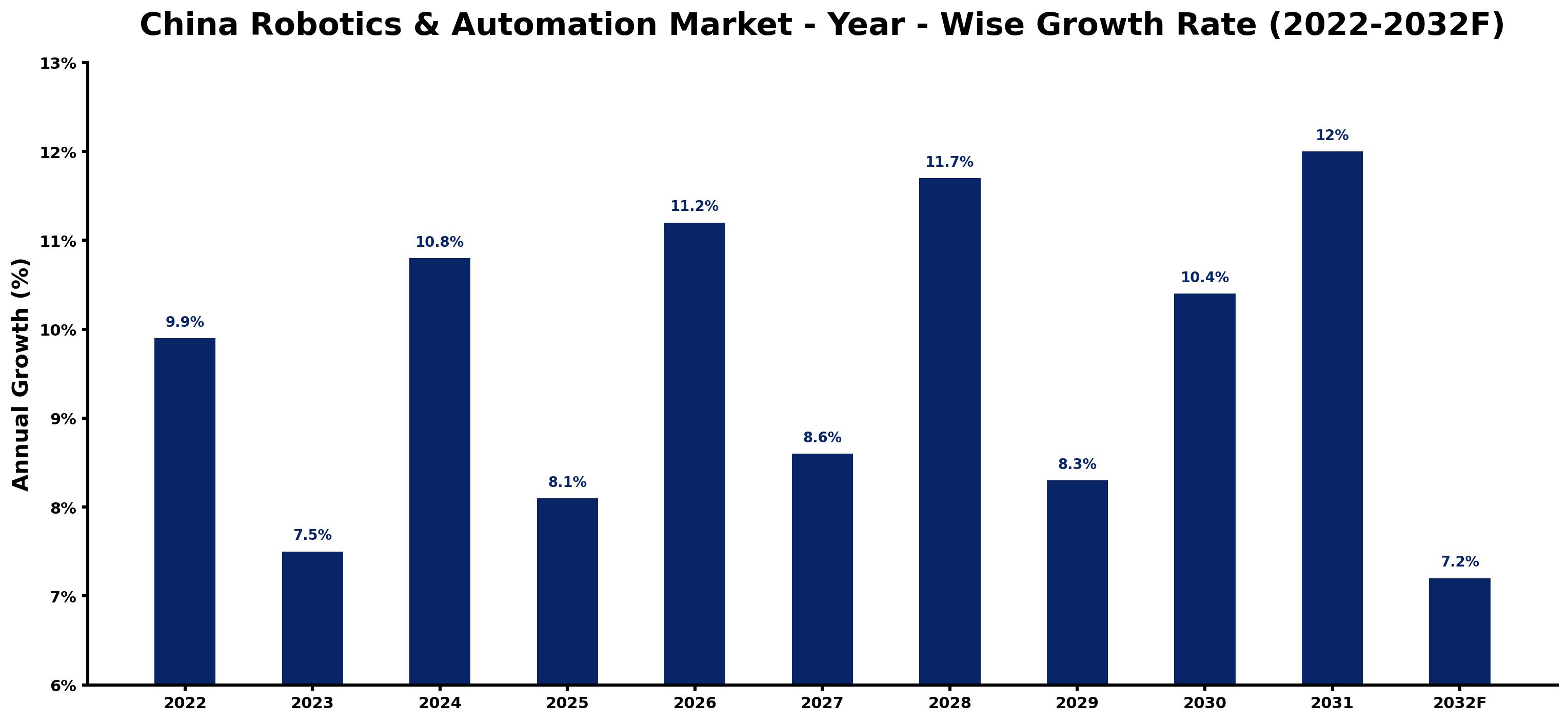
The table below sets out the estimated growth rate for each year and the main factor behind it.
| Year | Estimated Annual Growth (%) | Market Rationale |
| 2022 | 9.9 | The market experienced strong demand driven by industrial automation needs. |
| 2023 | 7.5 | Growth slowed due to market adjustments in manufacturing sectors. |
| 2024 | 10.8 | Increased investments in automation technologies boosted growth rates. |
| 2025 | 8.1 | Demand moderated as companies reassessed their automation strategies. |
| 2026 | 11.2 | Technological advancements in robotics spurred renewed growth. |
| 2027 | 8.6 | Market growth slowed as companies focused on operational efficiencies. |
| 2028 | 11.7 | Rising adoption of service robots in healthcare drove demand. |
| 2029 | 8.3 | Growth decelerated as logistics providers optimized existing systems. |
| 2030 | 10.4 | Increased integration of AGVs in warehouses supported market expansion. |
| 2031 | 12.0 | The peak growth year saw significant investments in robotics innovation. |
| 2032 | 7.2 | Growth slowed as the market stabilised after rapid expansion. |
Note: Market size estimations and growth projections presented in this report are based on 6Wresearch's proprietary forecasting methodology, utilizing the latest available industry data, government publications, and primary research inputs.
China Robotics & Automation Market Synopsis
Robotics & Automation in China includes advanced technologies that perform tasks with minimal human input. These systems find extensive application in industrial automation, logistics, and service sectors. The China Robotics & Automation Market is expanding due to strong demand from domestic manufacturing and service industries, alongside government initiatives such as the 'Made in China 2025' programme.
Market Dynamics Impact Analysis (2026–2032)
| Factor | Type | Impact | Primary Segment Affected |
| Rising demand for industrial automation in manufacturing processes | Driver | High | Industrial Automation |
| Growing adoption of service robots in healthcare facilities | Driver | High | Service Robotics |
| Increased investment in automation technologies by logistics providers | Opportunity | High | Mobile Robotics |
| Expansion of domestic robot market driven by consumer demand | Opportunity | Medium | Domestic/Commercial Robots |
| High initial investment costs for robotics systems | Restraint | High | Industrial Automation |
| Limited awareness of robotics benefits among small businesses | Restraint | Medium | Domestic/Commercial Robots |
| Challenges in integrating robotics into existing systems | Challenge | High | Mobile Robotics |
| Shortage of skilled workforce for robotics maintenance | Challenge | Medium | Service Robotics |
Evaluation of Drivers in China Robotics & Automation Market (2026–2032)
The main growth drivers and the segments they affect most are set out below.
| Drivers | Primary Segment Affected | Why It Matters (Evidence) |
| Increased production capacity of industrial robots | Manufacturing Robots | China produces over 200,000 industrial robots annually, addressing the needs of assembly plants for efficiency. |
| Growing healthcare investments | Service Robotics | The adoption rate of service robots in healthcare facilities reached 30% in 2023, improving service delivery capabilities. |
| Rising demand for logistics efficiency | Mobile Robotics | Over 50% of logistics companies in China have integrated AGVs, enhancing inventory management and operational efficiency. |
| Government support for robotics innovation | Domestic/Commercial Robots | The 'National Robotics Innovation Program' allocates 500 million yuan for R&D, boosting the domestic robot market significantly. |
| Technological advancements in automation | Industrial Automation | The '14th Five-Year Plan' aims for 70% of new manufacturing facilities to utilise automation by 2025, driving market growth. |
The country produces over 200,000 industrial robots annually, addressing the needs of assembly plants for efficiency. In 2023, the adoption rate of service robots in healthcare reached 30%, improving service delivery capabilities. Over 50% of logistics companies have integrated AGVs, streamlining inventory management processes. The '14th Five-Year Plan' targets 70% automation in new manufacturing facilities by 2025, which will drive further growth in the sector.
Evaluation of Restraints in China Robotics & Automation Market
Below mentioned are some major restraints and their influence on market dynamics.
| Market Restraint | Primary Segment Affected | Why It Matters (Evidence) |
| High initial investment costs for robotics systems | Industrial Automation | Investment costs can exceed 1 million yuan for advanced automation systems, deterring small businesses from adopting new technologies. |
| Limited awareness of robotics benefits among small businesses | Domestic/Commercial Robots | Many SMEs lack understanding of how robotics can improve efficiency, leading to slower adoption rates in this segment. |
| Challenges in integrating robotics into existing systems | Mobile Robotics | Compatibility issues with legacy systems can delay implementation and increase operational costs for companies. |
| Shortage of skilled workforce for robotics maintenance | Service Robotics | The demand for skilled technicians exceeds supply, which hinders operational efficiency in service sectors reliant on robotics. |
| Regulatory hurdles for new robotics technologies | Manufacturing Robots | Compliance with safety standards can delay the introduction of new robotics solutions, impacting market growth. |
China Robotics & Automation Market Challenges
The robotics and automation market in China still has to solve a few problems, and the first is intense competition among producers. This stems from a multitude of local manufacturers, which drives down prices and compresses profit margins for suppliers. Next, supply chain disruptions hinder the availability of essential components, causing delays for producers in fulfilling orders, with over 1 million industrial robots installed as of 2022. Buyers in healthcare face challenges integrating service robots, as only 30% of facilities have adopted them, limiting their operational efficiency. Rising raw material costs increase production expenses for manufacturers, forcing them to pass on these costs to buyers, which can deter investment in automation technologies.
Trends in the China Robotics & Automation Market
Buyers and suppliers in the China Robotics & Automation Market are adjusting to the following trends.
- Shift towards Service Robotics in Healthcare: The 'Action Plan for Promoting the Development of the Service Robot Industry' initiated in 2023 aims to double service robots in public spaces by 2025. This initiative is projected to increase the adoption of robots in healthcare facilities, with a growth rate of 30%.
- Transition to Cloud-Based Robotics Solutions: The growing trend towards cloud-based integration began in 2026, enabling real-time data management for robotics. This shift is reflected by the increasing adoption of cloud technologies, with a projected CAGR of 12.6%.
- Expansion of AGVs in Logistics: The integration of Automated Guided Vehicles (AGVs) in logistics has surged, particularly in Shanghai, where over 50% of logistics companies have adopted them. This trend reflects a growing emphasis on efficiency in supply chain management.
- Rising Demand for Domestic Robots: The consumer market for domestic robots is expanding rapidly, particularly among urban households. This trend is supported by a projected CAGR of 11.6% for domestic robots, driven by increased consumer awareness.
Investment Opportunities in the China Robotics & Automation Market
Several openings in the China Robotics & Automation Market merit attention from investors.
- Partner with Local Manufacturers: Now is the time to invest in partnerships with local manufacturers to supply advanced robotics systems. The 'Made in China 2025' initiative encourages collaboration, targeting a market worth 70 billion yuan.
- Supply Service Robots for Healthcare: With a 30% adoption rate of service robots in healthcare, there is an opportunity to supply innovative solutions. Collaborating with hospitals and clinics can facilitate market entry.
- Invest in AGV Technologies: The logistics sector's rapid adoption of AGVs presents an opportunity to supply these technologies. With over 50% of logistics companies integrating AGVs, suppliers can benefit from this growing demand.
- Focus on Cloud-Based Solutions: Investing in cloud-based robotics solutions is timely, as the market is projected to grow at 12.6%. Collaborating with tech firms can enhance product offerings.
Government Initiatives in the China Robotics & Automation Market
In 2022, the National Development and Reform Commission launched the 'Intelligent Manufacturing Development Strategy', focusing on increasing automation in traditional industries. This strategy aims to boost the adoption of robotics in manufacturing, promoting efficiency and productivity. Additionally, the '14th Five-Year Plan for the Development of the Robotics Industry' was approved in 2021, targeting a 20% annual increase in R&D investment in robotics. This plan supports the development of innovative technologies and enhances the competitiveness of the robotics sector.
The Ministry of Science and Technology oversees the 'National Robotics Innovation Program', which allocates a budget of 500 million yuan for research and development. This program aims to stimulate innovation in robotics and support startups in the sector. Furthermore, the State Council's 'Action Plan for Promoting the Development of the Service Robot Industry' introduced in 2023 aims to double the number of service robots in public spaces by 2025, facilitating growth in this segment.
Future Insight of the China Robotics & Automation Market
By 2032, the robotics and automation market in China will undergo substantial changes driven by key factors. The National Development and Reform Commission's five-year plan will push for increased automation in manufacturing, with a goal for 50% of logistics companies to fully integrate advanced robotics. The ISO 8373 standard will enhance the clarity of service robot terminology, facilitating broader adoption. The annual 'China International Robot Show' will continue to foster collaboration between innovators and established firms, leading to a more cohesive market environment.
Market Segmentation Analysis
The analysis below covers each segmentation, its leading category in 2025 and its fastest-growing category through 2032.
By Application Segment – Industrial Automation Dominated, Service Robotics Expected to Grow Fastest
According to Shubham Padhi, Research Analyst at 6Wresearch, the largest application segment category in 2025 was Industrial Automation, with a 44% share of total revenue. Industrial Automation commands the largest market share due to its essential role in enhancing manufacturing efficiency across various sectors. The Chinese government's initiative to have 70% of new manufacturing facilities utilise automation technologies by 2025 underscores the robust demand for this segment. Service Robotics are projected to grow fastest, at a CAGR of 11.4% during 2026–2032. Service Robotics is witnessing rapid growth, particularly in healthcare and hospitality, where its adoption rate reached 30% in 2023. This trend indicates a significant shift towards automated service delivery, which is likely to expand as technology progresses. Suppliers should concentrate on developing tailored solutions for healthcare and hospitality to seize the increasing demand for service robots.
By Robot Category – Manufacturing Robots Dominated, Domestic/Commercial Robots Expected to Grow Fastest
With a 40% revenue share in 2025, Manufacturing Robots was the largest robot category category. Manufacturing Robots hold the largest market share as they are crucial for assembly lines and production processes across various industries. The installed base of over 1 million industrial robots in China highlights their vital role in bolstering manufacturing capabilities. The quickest growth will come from Domestic/Commercial Robots, forecast to expand at a CAGR of 11.6% between 2026 and 2032. Domestic/Commercial Robots are experiencing the fastest growth, propelled by rising adoption in households and small businesses for cleaning and assistance. This segment's expansion reflects changing consumer preferences towards automation in daily tasks. Buyers should consider domestic robots for enhanced efficiency in household and small business operations, while suppliers need to innovate to meet this growing demand.
By Integration Type – PLC-Integrated Dominated, Cloud-Based Expected to Grow Fastest
In 2025, PLC-Integrated led the integration type split with a 48% share. PLC-Integrated systems dominate the market share as they are the standard for industrial control systems, ensuring reliability and efficiency in manufacturing operations. Their established presence in assembly plants reinforces their leading position in the sector. Cloud-Based is set to record the highest CAGR in this split, 12.6% over 2026–2032. Cloud-Based integration is gaining rapid traction, primarily for data management and analytics in robotics. As companies increasingly seek to leverage data for operational improvements, the demand for cloud solutions is expected to rise significantly. Suppliers should enhance cloud-based offerings to address the growing need for data-driven insights in robotics applications.
By End User – Assembly Plants Dominated, Consumers/SMEs Expected to Grow Fastest
Assembly Plants accounted for a 48% market share by end user in 2025. Assembly Plants represent the largest share of the market as major end-users of manufacturing robots, utilising them to streamline production processes effectively. Their reliance on automation for operational efficiency solidifies their leading position in the market. Over 2026–2032, Consumers/SMEs are expected to post the fastest growth, at a CAGR of 12.0%. Consumers/SMEs are the fastest-growing segment, indicating a rising market for domestic robots aimed at improving convenience in daily tasks. This shift suggests a broader acceptance of automation within personal and small business environments. Suppliers should target the consumer and SME segments with tailored solutions to capture the expanding market for domestic robots.
Key Attractiveness of the Report
- 10 Years of Market Numbers
- Historical Data Starting from 2022 to 2025
- Base Year 2025
- Forecast Data until 2032
- Key Performance Indicators Impacting the Market
- Major Upcoming Developments and Projects
Key Highlights of the Report:
- China Robotics & Automation Market Outlook
- Market Size of China Robotics & Automation Market, 2025
- Forecast of China Robotics & Automation Market, 2032
- Historical Data and Forecast of China Robotics & Automation Revenues & Volume for the Period 2022 - 2032F
- China Robotics & Automation Market Trend Evolution
- China Robotics & Automation Market Drivers and Challenges
- China Robotics & Automation Price Trends
- China Robotics & Automation Porter's Five Forces
- China Robotics & Automation Industry Life Cycle
- Historical Data and Forecast of China Robotics & Automation Market Revenues & Volume By Application Segment for the Period 2022 - 2032F
- Historical Data and Forecast of China Robotics & Automation Market Revenues & Volume By Industrial Automation for the Period 2022 - 2032F
- Historical Data and Forecast of China Robotics & Automation Market Revenues & Volume By Service Robotics for the Period 2022 - 2032F
- Historical Data and Forecast of China Robotics & Automation Market Revenues & Volume By Mobile Robotics for the Period 2022 - 2032F
- Historical Data and Forecast of China Robotics & Automation Market Revenues & Volume By Humanoid Robots for the Period 2022 - 2032F
- Historical Data and Forecast of China Robotics & Automation Market Revenues & Volume By Robot Category for the Period 2022 - 2032F
- Historical Data and Forecast of China Robotics & Automation Market Revenues & Volume By Manufacturing Robots for the Period 2022 - 2032F
- Historical Data and Forecast of China Robotics & Automation Market Revenues & Volume By Domestic/Commercial Robots for the Period 2022 - 2032F
- Historical Data and Forecast of China Robotics & Automation Market Revenues & Volume By AGVs/AMRs for the Period 2022 - 2032F
- Historical Data and Forecast of China Robotics & Automation Market Revenues & Volume By AI-Driven Interaction for the Period 2022 - 2032F
- Historical Data and Forecast of China Robotics & Automation Market Revenues & Volume By Integration Type for the Period 2022 - 2032F
- Historical Data and Forecast of China Robotics & Automation Market Revenues & Volume By PLC-Integrated for the Period 2022 - 2032F
- Historical Data and Forecast of China Robotics & Automation Market Revenues & Volume By Cloud-Based for the Period 2022 - 2032F
- Historical Data and Forecast of China Robotics & Automation Market Revenues & Volume By Autonomous Navigation for the Period 2022 - 2032F
- Historical Data and Forecast of China Robotics & Automation Market Revenues & Volume By NLP/Visual Interface for the Period 2022 - 2032F
- Historical Data and Forecast of China Robotics & Automation Market Revenues & Volume By End User for the Period 2022 - 2032F
- Historical Data and Forecast of China Robotics & Automation Market Revenues & Volume By Assembly Plants for the Period 2022 - 2032F
- Historical Data and Forecast of China Robotics & Automation Market Revenues & Volume By Consumers/SMEs for the Period 2022 - 2032F
- Historical Data and Forecast of China Robotics & Automation Market Revenues & Volume By Logistics Providers for the Period 2022 - 2032F
- Historical Data and Forecast of China Robotics & Automation Market Revenues & Volume By Public Spaces for the Period 2022 - 2032F
- China Robotics & Automation Import Export Trade Statistics
- Market Opportunity Assessment By Application Segment
- Market Opportunity Assessment By Robot Category
- Market Opportunity Assessment By Integration Type
- Market Opportunity Assessment By End User
- China Robotics & Automation Top Companies Market Share
- China Robotics & Automation Competitive Benchmarking By Technical and Operational Parameters
- China Robotics & Automation Company Profiles
- China Robotics & Automation Key Strategic Recommendations
Market Covered
Segments analysed in this report are listed below.
By Application Segment
- Industrial Automation
- Service Robotics
- Mobile Robotics
- Humanoid Robots
By Robot Category
- Manufacturing Robots
- Domestic/Commercial Robots
- AGVs/AMRs
- AI-Driven Interaction
By Integration Type
- PLC-Integrated
- Cloud-Based
- Autonomous Navigation
- NLP/Visual Interface
By End User
- Assembly Plants
- Consumers/SMEs
- Logistics Providers
- Public Spaces































