India Rotor Balancing Machine Market Size & Growth Rate
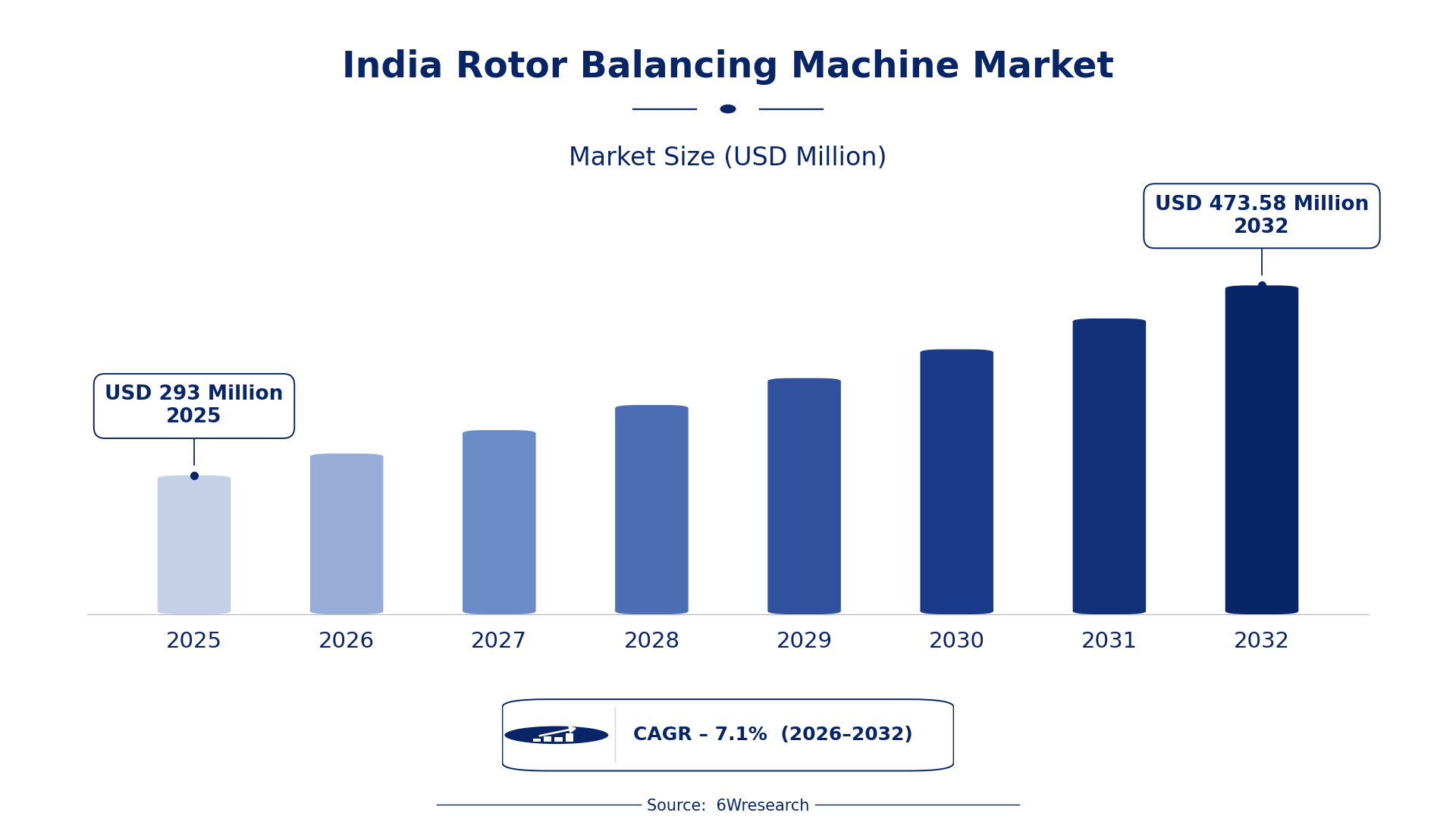
According to 6Wresearch internal database and industry insights, the India Rotor Balancing Machine Market was valued at USD 293.0 million in 2025 and is projected to reach USD 473.58 million by 2032, growing at a CAGR of approximately 7.1% during 2026–2032.
India Rotor Balancing Machine Market Highlights
| Report Metric | Details |
| Report Name | India Rotor Balancing Machine Market |
| Market Size 2025 | USD 293.0 million |
| Market Size 2032 | USD 473.58 million |
| Absolute Growth 2025–2032 | USD 180.58 million |
| CAGR 2026–2032 | 7.1% |
| Peak Annual Growth | 9.5% in 2031 |
| Forecast Period | 2026–2032 |
| Historical Data | 2022–2025 |
| Base Year | 2025 |
| Leading Machine Type, 2025 | Two-Plane Balancers (54% share) |
| Leading Balancing Method, 2025 | Static and Dynamic (42% share) |
| Leading Size Range, 2025 | Medium to Large Rotors (44% share) |
| Leading End User, 2025 | Motor Manufacturing Lines (54% share) |
| Fastest-Growing Machine Type | Portable Balancers (9.7% CAGR) |
| Fastest-Growing Balancing Method | On-Site Vibration-Based (8.7% CAGR) |
| Fastest-Growing Size Range | High-Speed Rotors (9.5% CAGR) |
| Fastest-Growing End User | Turbine & Compressor OEMs (8.7% CAGR) |
| Growing Sector | Turbine & Compressor OEMs |
| Key End Users | Motor Manufacturing Lines, Turbine & Compressor OEMs, Aerospace Component Plants, Maintenance Service Teams |
India Rotor Balancing Machine Market Year-wise Growth Rate and Key Drivers (2022–2032)
This graph illustrates the annual growth rates of the market from 2022 to 2032, highlighting a steady upward trajectory and projected market expansion over the forecast period.
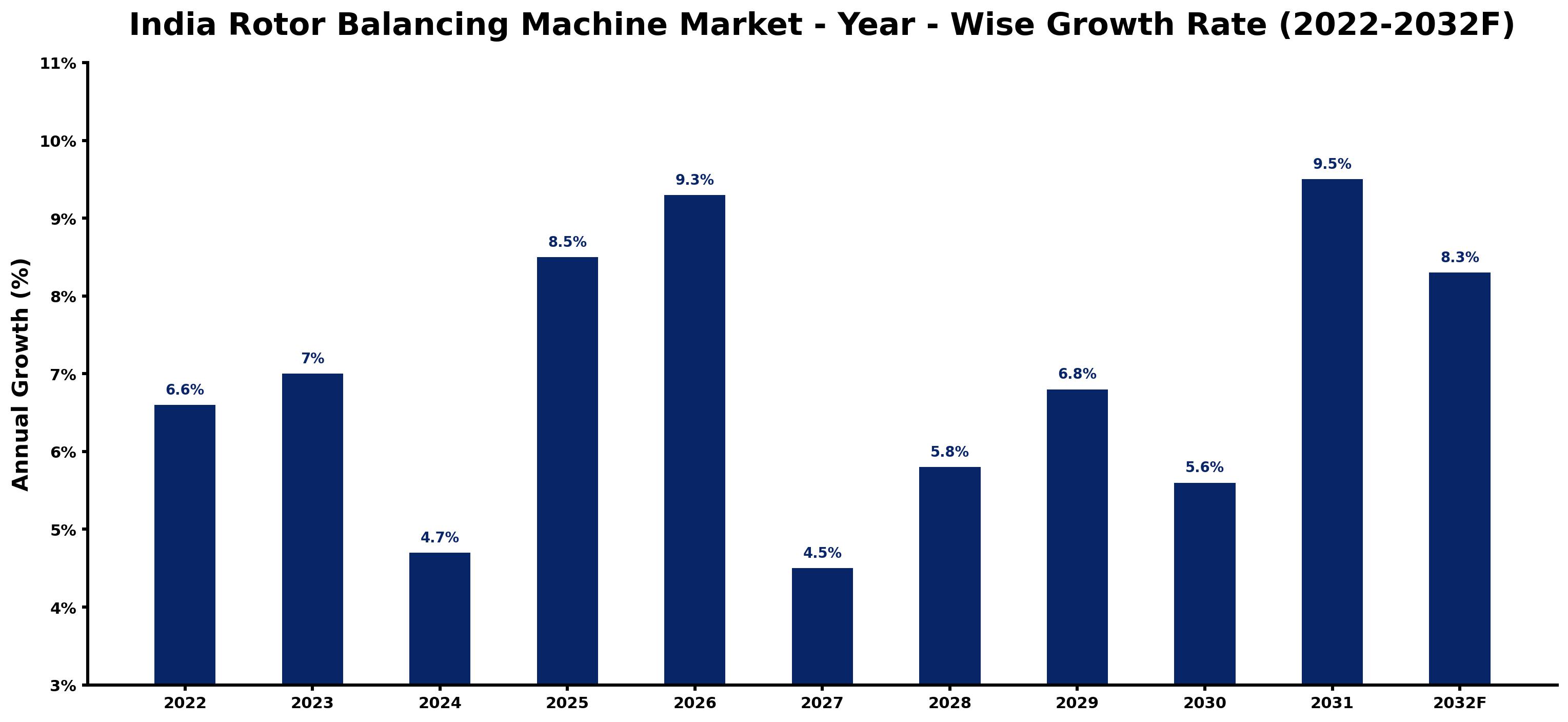
Annual growth estimates for each year appear below with the principal reason behind them, explaining the shifts that set the pace of the market.
| Year | Estimated Annual Growth (%) | Market Rationale |
| 2022 | 6.6 | The market showed steady demand due to existing motor manufacturing facilities. |
| 2023 | 7.0 | Increased activity in the aerospace sector contributed to faster growth compared to the previous year. |
| 2024 | 4.7 | Growth slowed as manufacturers adjusted to market conditions and demand patterns. |
| 2025 | 8.5 | A surge in demand from motor manufacturing lines led to faster growth than before. |
| 2026 | 9.3 | The aerospace industry's expansion is expected to drive further demand for rotor balancing machines. |
| 2027 | 4.5 | Growth is projected to slow as the market faces adjustments in production capacity and demand. |
| 2028 | 5.8 | Increased investment in advanced manufacturing technologies is expected to boost demand. |
| 2029 | 6.8 | The aerospace sector's growth continues to support demand for rotor balancing machines. |
| 2030 | 5.6 | A slight slowdown is anticipated as manufacturers adapt to evolving technological requirements. |
| 2031 | 9.5 | A notable increase in demand is expected due to the aerospace industry's growth. |
| 2032 | 8.3 | Growth is projected to slow as the Make in India initiative continues to support local production. |
Note: Market size estimations and growth projections presented in this report are based on 6Wresearch's proprietary forecasting methodology, utilizing the latest available industry data, government publications, and primary research inputs.
India Rotor Balancing Machine Market Synopsis
The Rotor Balancing Machine in India serves as a precision tool that minimises vibration in rotating machinery. These machines play a crucial role in optimising the performance and extending the lifespan of motors, turbines, and compressors. Growth in the India Rotor Balancing Machine Market is driven by the presence of over 1,000 motor manufacturing facilities and the expected expansion of the aerospace sector, projected to achieve a turnover of $70 billion by 2030. The Make in India initiative bolsters local production, increasing the demand for advanced rotor balancing technologies.
Market Dynamics Impact Analysis (2026–2032)
| Factor | Type | Impact | Primary Segment Affected |
| Growing number of motor manufacturing facilities | Driver | High | Motor Manufacturing Lines |
| Expansion of the aerospace sector | Driver | High | Aerospace Component Plants |
| Increasing demand for advanced manufacturing technologies | Opportunity | High | Motor Manufacturing Lines |
| Rising need for maintenance services in various industries | Opportunity | Medium | Maintenance Service Teams |
| High initial investment costs for advanced machinery | Restraint | High | Two-Plane Balancers |
| Limited awareness of rotor balancing technology benefits | Restraint | Medium | Two-Plane Balancers |
| Competition from imported balancing machines | Challenge | High | Two-Plane Balancers |
| Technological advancements requiring constant upgrades | Challenge | Medium | Two-Plane Balancers |
Evaluation of Drivers in India Rotor Balancing Machine Market (2026–2032)
The table below links each growth driver to the segment it affects and the evidence for it.
| Drivers | Primary Segment Affected | Why It Matters (Evidence) |
| Expansion of motor manufacturing facilities | Motor Manufacturing Lines | Demand for rotor balancing machines is increasing to ensure optimal performance in numerous facilities across India. |
| Growth of the aerospace sector | Aerospace Component Plants | The aerospace industry's projected turnover of $70 billion by 2030 drives the need for rotor balancing machines. |
| Implementation of advanced manufacturing technologies | Motor Manufacturing Lines | The Make in India initiative promotes local production, increasing demand for advanced rotor balancing solutions. |
| Rising maintenance service requirements | Maintenance Service Teams | The installed base of over 50,000 turbines necessitates regular balancing services, boosting demand. |
| Adoption of quality standards like ISO 1940 | Two-Plane Balancers | Adhering to ISO 1940 ensures quality, driving demand for compliant rotor balancing machines. |
Market growth in India for Rotor Balancing Machine rests on the expansion of motor manufacturing facilities, the growth of the aerospace sector, and the implementation of advanced manufacturing technologies. The aerospace sector's projected turnover of $70 billion by 2030 drives the need for rotor balancing machines in aerospace component plants. The installed base of over 50,000 turbines necessitates regular balancing services, boosting demand among maintenance service teams. Compliance with standards like ISO 1940 ensures quality, driving demand for rotor balancing machines. Increased investment in advanced manufacturing technologies is expected to further stimulate market growth.
Evaluation of Restraints in India Rotor Balancing Machine Market
The following restraints limit how fast demand can grow.
| Market Restraint | Primary Segment Affected | Why It Matters (Evidence) |
| High initial investment costs for advanced machinery | Two-Plane Balancers | The high costs deter smaller manufacturers from investing in rotor balancing machines, limiting market growth. |
| Limited awareness of rotor balancing technology benefits | Two-Plane Balancers | Many potential buyers are unaware of the advantages of rotor balancing, affecting demand. |
| Competition from imported balancing machines | Two-Plane Balancers | Imported machines often offer lower prices, making it challenging for local producers to compete. |
| Technological advancements requiring constant upgrades | Two-Plane Balancers | Rapid technological changes necessitate frequent updates, increasing costs for buyers. |
| Regulatory compliance challenges | Two-Plane Balancers | Producers must navigate complex standards, which can delay product launches and increase costs. |
India Rotor Balancing Machine Market Challenges
India's rotor balancing machine market faces high costs, with balancing services consuming around 20% of maintenance budgets for manufacturers. This expense arises from the precision needed in balancing, which is crucial for optimal machinery performance, directly impacting profit margins for motor producers. Technology adoption is slow, as many facilities still rely on outdated methods, leading to operational downtimes that can extend maintenance schedules by up to 30%. Buyers struggle with inconsistent quality due to varying compliance with BIS standards, resulting in potential safety risks and increased liability costs for manufacturers.
Trends in the India Rotor Balancing Machine Market
Four trends stand out in the India Rotor Balancing Machine Market.
- Shift towards Advanced Manufacturing Technologies: Motor manufacturing lines are increasingly adopting advanced rotor balancing technologies, driven by the Make in India initiative. This shift is projected to improve production efficiency and quality, with the market expected to grow significantly.
- Growth in Aerospace Component Manufacturing: The aerospace sector in India is experiencing rapid growth, projected to reach a turnover of $70 billion by 2030. This growth is driving demand for rotor balancing machines in aerospace component plants, enhancing local production capabilities.
- Increase in On-Site Balancing Solutions: Maintenance service teams are increasingly utilising portable balancers for on-site requirements. This trend is set to improve service efficiency and reduce downtime, with growing demand for these machines.
- Rising Adoption of Quality Standards: Manufacturers in India are increasingly aligning their products with ISO 1940 standards. This trend ensures quality and safety, with many producers adopting these standards to meet market demands.
Investment Opportunities in the India Rotor Balancing Machine Market
Several openings in the India Rotor Balancing Machine Market merit attention from investors.
- Gap in Advanced Rotor Balancing Solutions: With the aerospace sector projected to grow, there is a gap in advanced rotor balancing solutions. Investing in these technologies can cater to aerospace component plants, improving local manufacturing capabilities.
- Supply of Portable Balancers: The demand for portable balancers is rising due to the need for on-site solutions. Targeting maintenance service teams can provide opportunities for suppliers to meet this growing need effectively.
- Investment in High-Speed Rotors: The high-speed rotor segment is anticipated to grow rapidly. Suppliers can focus on this segment to cater to industries requiring high-performance applications, enhancing their market presence.
- Support for Local Manufacturing: The Make in India initiative encourages local production of machinery. Collaborating with motor manufacturing lines can create opportunities for suppliers to enter the market and expand their reach.
Government Initiatives in the India Rotor Balancing Machine Market
The National Manufacturing Policy, launched in 2020, aims to enhance manufacturing capabilities and promote advanced technologies like rotor balancing. This policy encourages investment in local production, ensuring manufacturers can effectively meet domestic demand. Additionally, the Atmanirbhar Bharat initiative, introduced in 2020, supports local machinery production, including rotor balancing machines, reducing import dependency and stimulating sector growth. The Production Linked Incentive (PLI) Scheme, announced in 2021, incentivises local manufacturing of precision machinery, providing financial support to manufacturers meeting specific production targets.
In 2021, the Technology Development Board under the Department of Science and Technology allocated funding for innovative manufacturing solutions, including rotor balancing technologies. This funding advances the industry by supporting research and development initiatives. Furthermore, the Ministry of Heavy Industries oversees various schemes that promote the adoption of advanced manufacturing technologies, facilitating the rotor balancing machine market's growth.
Future Insight of the India Rotor Balancing Machine Market
Several forward-looking factors should support the rotor balancing machine market in India over the coming years. The aerospace sector is expected to expand, creating a demand for advanced balancing technologies as the industry aims for a turnover of $70 billion by 2030. The Ministry of Heavy Industries' initiative to promote modern manufacturing techniques will improve production capabilities across various sectors. The automotive industry is on track to reach $300 billion by 2026, further increasing the need for effective rotor balancing solutions.
Market Segmentation Analysis
The analysis below covers each segmentation, its leading category in 2025 and its fastest-growing category through 2032.
By Machine Type – Two-Plane Balancers Dominated, Portable Balancers Expected to Grow Fastest
According to Shubham Padhi, Research Analyst at 6Wresearch, Two-Plane Balancers took a 54% share of machine type in 2025, more than any other category. Two-Plane Balancers dominate the market share in India as they are essential for complex rotor balancing tasks, particularly in the numerous motor manufacturing facilities located in Maharashtra. Their effectiveness in various industrial applications ensures they remain a preferred choice among users. Over 2026–2032, Portable Balancers are expected to post the fastest growth, at a CAGR of 9.7%. Portable Balancers are witnessing significant growth due to the increasing need for on-site balancing solutions, especially in the expanding aerospace sector. This trend indicates a shift towards convenience, allowing Portable Balancers to capture a larger market share moving forward. Suppliers should focus on enhancing the availability of portable solutions to cater to the rising demand for on-site services.
By Balancing Method – Static and Dynamic Dominated, On-Site Vibration-Based Expected to Grow Fastest
Static and Dynamic held a 42% share of the India Rotor Balancing Machine Market by balancing method in 2025. The Static and Dynamic balancing method holds the largest market share in India, as it is critical for achieving accurate rotor balancing across diverse sectors, including motor manufacturing. Its reliability and compliance with standards set by the Bureau of Indian Standards reinforce its leading position in the market. The quickest growth will come from On-Site Vibration-Based, forecast to expand at a CAGR of 8.7% between 2026 and 2032. On-Site Vibration-Based balancing is experiencing rapid growth due to its ability to provide immediate solutions, particularly with the aerospace industry's ambitious turnover goals by 2030. This method's convenience positions it well for future demand, further solidifying its market presence. Buyers will gain from investing in advanced on-site balancing technologies, which can improve operational efficiency and minimise downtime.
By Size Range – Medium to Large Rotors Dominated, High-Speed Rotors Expected to Grow Fastest
With a 44% revenue share in 2025, Medium to Large Rotors was the largest size range category. Medium to Large Rotors are essential for larger machinery in industries such as automotive and aerospace, where the installed base of turbines exceeds 50,000 units. This critical requirement drives the segment's substantial market share, reflecting the needs of major manufacturing lines. High-Speed Rotors are set to record the highest CAGR in this split, 9.5% over 2026–2032. High-Speed Rotors are gaining traction as the automotive sector is projected to reach $300 billion by 2026, necessitating advanced balancing solutions for high-performance applications. This growth indicates a shift towards more specialised rotor balancing technologies. Manufacturers should align their product offerings with the increasing demand for high-speed rotor solutions to capitalise on emerging market opportunities.
By End User – Motor Manufacturing Lines Dominated, Turbine & Compressor OEMs Expected to Grow Fastest
In 2025, Motor Manufacturing Lines led the end user split with a 54% share. Motor Manufacturing Lines are central to production processes, with over 1,000 facilities in India driving the demand for rotor balancing machines. This sector's importance ensures it commands the largest market share, reflecting its vital role in the industry. Turbine & Compressor OEMs are projected to grow fastest, at a CAGR of 8.7% during 2026–2032. Turbine & Compressor OEMs are rapidly growing, particularly with the aerospace sector's projected expansion, leading to increased demand for precision balancing solutions tailored for these applications. This trend suggests strong potential for continued market growth in this segment. Suppliers should prioritise collaborations with turbine and compressor OEMs to capitalise on the growing demand for specialised rotor balancing services.
Key Attractiveness of the Report
- 10 Years of Market Numbers
- Historical Data Starting from 2022 to 2025
- Base Year 2025
- Forecast Data until 2032
- Key Performance Indicators Impacting the Market
- Major Upcoming Developments and Projects
Key Highlights of the Report:
- India Rotor Balancing Machine Market Outlook
- Market Size of India Rotor Balancing Machine Market, 2025
- Forecast of India Rotor Balancing Machine Market, 2032
- Historical Data and Forecast of India Rotor Balancing Machine Revenues & Volume for the Period 2022 - 2032F
- India Rotor Balancing Machine Market Trend Evolution
- India Rotor Balancing Machine Market Drivers and Challenges
- India Rotor Balancing Machine Price Trends
- India Rotor Balancing Machine Porter's Five Forces
- India Rotor Balancing Machine Industry Life Cycle
- Historical Data and Forecast of India Rotor Balancing Machine Market Revenues & Volume By Machine Type for the Period 2022 - 2032F
- Historical Data and Forecast of India Rotor Balancing Machine Market Revenues & Volume By Single-Plane Balancers for the Period 2022 - 2032F
- Historical Data and Forecast of India Rotor Balancing Machine Market Revenues & Volume By Two-Plane Balancers for the Period 2022 - 2032F
- Historical Data and Forecast of India Rotor Balancing Machine Market Revenues & Volume By Portable Balancers for the Period 2022 - 2032F
- Historical Data and Forecast of India Rotor Balancing Machine Market Revenues & Volume By In-Line Balancers for the Period 2022 - 2032F
- Historical Data and Forecast of India Rotor Balancing Machine Market Revenues & Volume By Balancing Method for the Period 2022 - 2032F
- Historical Data and Forecast of India Rotor Balancing Machine Market Revenues & Volume By Static and Dynamic for the Period 2022 - 2032F
- Historical Data and Forecast of India Rotor Balancing Machine Market Revenues & Volume By Dual-Axis Balancing for the Period 2022 - 2032F
- Historical Data and Forecast of India Rotor Balancing Machine Market Revenues & Volume By On-Site Vibration-Based for the Period 2022 - 2032F
- Historical Data and Forecast of India Rotor Balancing Machine Market Revenues & Volume By On-Machine Balancing for the Period 2022 - 2032F
- Historical Data and Forecast of India Rotor Balancing Machine Market Revenues & Volume By Size Range for the Period 2022 - 2032F
- Historical Data and Forecast of India Rotor Balancing Machine Market Revenues & Volume By Small to Medium Rotors for the Period 2022 - 2032F
- Historical Data and Forecast of India Rotor Balancing Machine Market Revenues & Volume By Medium to Large Rotors for the Period 2022 - 2032F
- Historical Data and Forecast of India Rotor Balancing Machine Market Revenues & Volume By Variable Rotor Sizes for the Period 2022 - 2032F
- Historical Data and Forecast of India Rotor Balancing Machine Market Revenues & Volume By High-Speed Rotors for the Period 2022 - 2032F
- Historical Data and Forecast of India Rotor Balancing Machine Market Revenues & Volume By End User for the Period 2022 - 2032F
- Historical Data and Forecast of India Rotor Balancing Machine Market Revenues & Volume By Motor Manufacturing Lines for the Period 2022 - 2032F
- Historical Data and Forecast of India Rotor Balancing Machine Market Revenues & Volume By Turbine & Compressor OEMs for the Period 2022 - 2032F
- Historical Data and Forecast of India Rotor Balancing Machine Market Revenues & Volume By Maintenance Service Teams for the Period 2022 - 2032F
- Historical Data and Forecast of India Rotor Balancing Machine Market Revenues & Volume By Aerospace Component Plants for the Period 2022 - 2032F
- India Rotor Balancing Machine Import Export Trade Statistics
- Market Opportunity Assessment By Machine Type
- Market Opportunity Assessment By Balancing Method
- Market Opportunity Assessment By Size Range
- Market Opportunity Assessment By End User
- India Rotor Balancing Machine Top Companies Market Share
- India Rotor Balancing Machine Competitive Benchmarking By Technical and Operational Parameters
- India Rotor Balancing Machine Company Profiles
- India Rotor Balancing Machine Key Strategic Recommendations
Market Covered
The report offers an extensive study of the following market segments.
By Machine Type
- Single-Plane Balancers
- Two-Plane Balancers
- Portable Balancers
- In-Line Balancers
By Balancing Method
- Static and Dynamic
- Dual-Axis Balancing
- On-Site Vibration-Based
- On-Machine Balancing
By Size Range
- Small to Medium Rotors
- Medium to Large Rotors
- Variable Rotor Sizes
- High-Speed Rotors
By End User
- Motor Manufacturing Lines
- Turbine & Compressor OEMs
- Maintenance Service Teams
- Aerospace Component Plants































