China Rotor Balancing Machine Market Size & Growth Rate
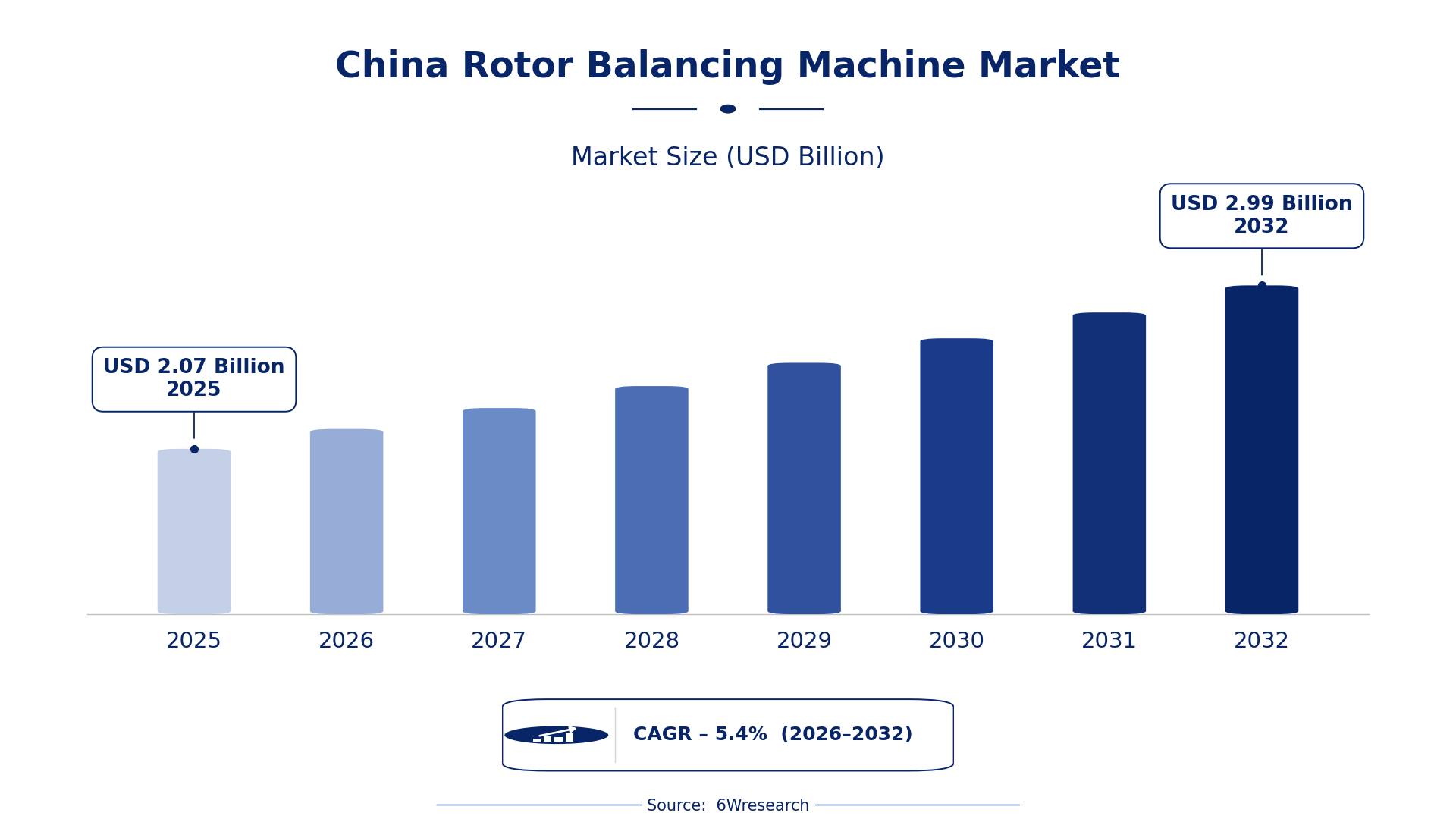
According to 6Wresearch internal database and industry insights, the China Rotor Balancing Machine Market was valued at USD 2.07 billion in 2025 and is projected to reach USD 2.99 billion by 2032, growing at a CAGR of approximately 5.4% during 2026–2032.
China Rotor Balancing Machine Market Highlights
| Report Metric | Details |
| Report Name | China Rotor Balancing Machine Market |
| Market Size 2025 | USD 2.07 billion |
| Market Size 2032 | USD 2.99 billion |
| Absolute Growth 2025–2032 | USD 0.92 billion |
| CAGR 2026–2032 | 5.4% |
| Peak Annual Growth | 7.8% in 2032 |
| Forecast Period | 2026–2032 |
| Historical Data | 2022–2025 |
| Base Year | 2025 |
| Leading Machine Type, 2025 | Two-Plane Balancers (44% share) |
| Leading Balancing Method, 2025 | Static and Dynamic (41% share) |
| Leading Size Range, 2025 | Medium to Large Rotors (49% share) |
| Leading End User, 2025 | Motor Manufacturing Lines (43% share) |
| Fastest-Growing Machine Type | Portable Balancers (7.9% CAGR) |
| Fastest-Growing Balancing Method | Dual-Axis Balancing (7.8% CAGR) |
| Fastest-Growing Size Range | High-Speed Rotors (7.0% CAGR) |
| Fastest-Growing End User | Turbine & Compressor OEMs (7.1% CAGR) |
| Growing Sector | Turbine & Compressor OEMs |
| Key End Users | Motor Manufacturing Lines, Turbine & Compressor OEMs, Aerospace Component Plants, Maintenance Service Teams |
China Rotor Balancing Machine Market Year-wise Growth Rate and Key Drivers (2022–2032)
This graph illustrates the annual growth rates of the market from 2022 to 2032, highlighting a steady upward trajectory and projected market expansion over the forecast period.
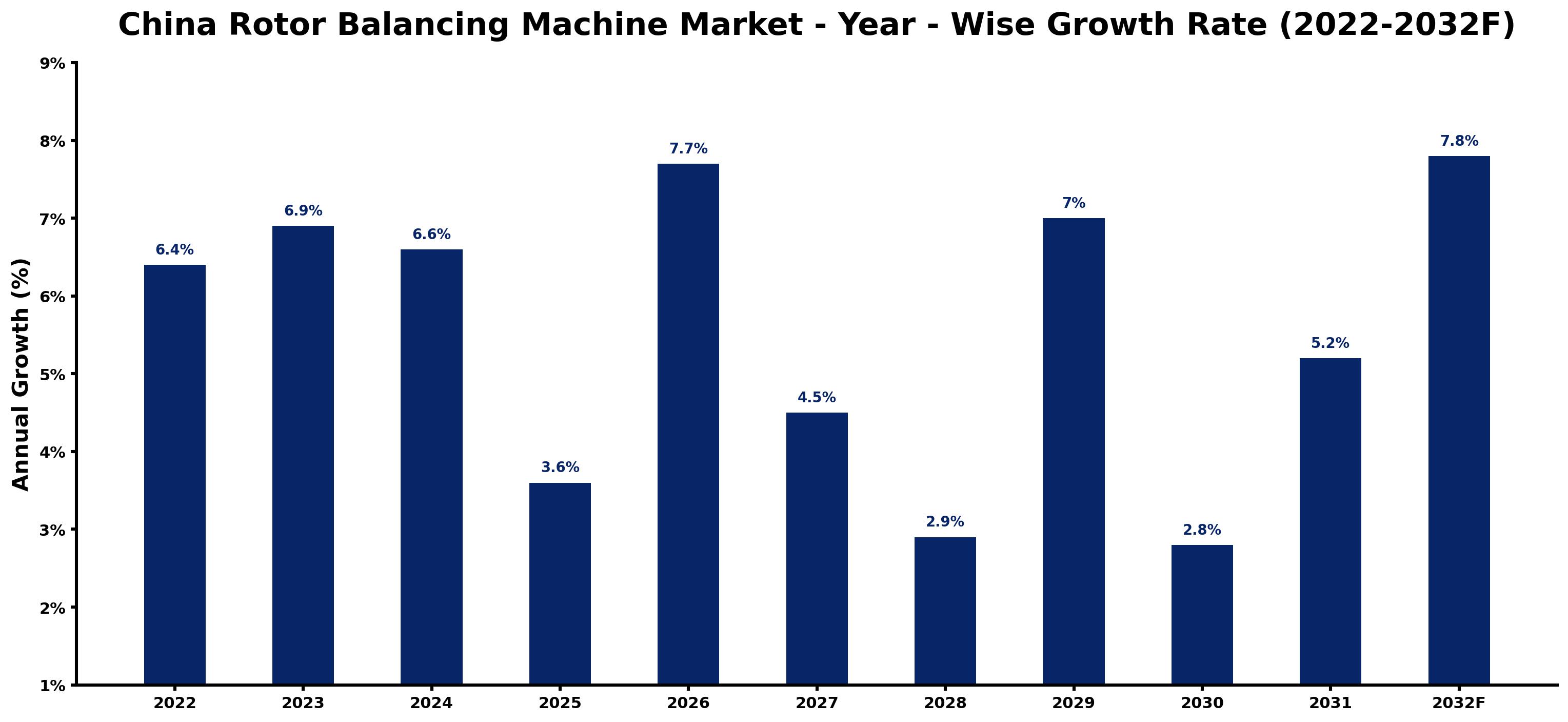
The following table presents the estimated annual growth rate for each year together with the principal factor influencing market performance.
| Year | Estimated Annual Growth (%) | Market Rationale |
| 2022 | 6.4 | Demand from motor manufacturing lines supported growth in rotor balancing machines. |
| 2023 | 6.9 | Increased production of over 1 million motors boosted the need for balancing technology. |
| 2024 | 6.6 | The market experienced a slowdown as demand stabilised after rapid growth in 2023. |
| 2025 | 3.6 | Growth slowed further due to adjustments in the production capacity of motor manufacturers. |
| 2026 | 7.7 | A surge in aerospace industry growth is expected to drive demand for advanced balancing solutions. |
| 2027 | 4.5 | Demand for rotor balancing machines is projected to slow as the market matures. |
| 2028 | 2.9 | The market continues to grow, albeit at a slower pace, reflecting trends in aerospace production. |
| 2029 | 7.0 | Aerospace and automotive sectors are anticipated to drive renewed demand for balancing machines. |
| 2030 | 2.8 | Growth is expected to slow as the market reaches a more stable phase in production. |
| 2031 | 5.2 | Increased investments in advanced manufacturing technologies are likely to boost demand for balancing machines. |
| 2032 | 7.8 | The market is projected to peak as new standards and technologies improve rotor balancing. |
Note: Market size estimations and growth projections presented in this report are based on 6Wresearch's proprietary forecasting methodology, utilizing the latest available industry data, government publications, and primary research inputs.
China Rotor Balancing Machine Market Synopsis
The Rotor Balancing Machine in China encompasses precision devices that ensure rotors are balanced to minimise vibrations during operation. These machines are essential in motor manufacturing, aerospace components, and turbine production. The China Rotor Balancing Machine Market is growing due to high demand from the motor manufacturing sector, which produced over 1 million motors in 2022. The aerospace industry is expanding, further increasing the need for advanced balancing technology. Programmes like the 'Advanced Manufacturing 2025' initiative are driving technology adoption and capabilities in the sector.
Market Dynamics Impact Analysis (2026–2032)
| Factor | Type | Impact | Primary Segment Affected |
| High demand from motor manufacturing lines drives the need for rotor balancing machines. | Driver | High | Motor Manufacturing Lines |
| Growth in the aerospace industry is increasing the need for precision balancing solutions. | Driver | High | Aerospace Component Plants |
| The shift towards high-speed rotors creates opportunities for advanced balancing solutions. | Opportunity | High | High-Speed Rotors |
| Increasing adoption of portable balancers in maintenance services presents a market gap. | Opportunity | Medium | Portable Balancers |
| High costs associated with advanced balancing technologies can limit market access. | Restraint | High | Two-Plane Balancers |
| The installed base of over 10,000 units indicates potential market saturation. | Restraint | Medium | Two-Plane Balancers |
| The Rotor Balancing Machine market in China faces challenges from high production costs. | Challenge | High | Two-Plane Balancers |
| Technological advancements require continuous investment, posing a challenge for manufacturers. | Challenge | Medium | Two-Plane Balancers |
Evaluation of Drivers in China Rotor Balancing Machine Market (2026–2032)
The main growth drivers and the segments they affect most are set out below.
| Drivers | Primary Segment Affected | Why It Matters (Evidence) |
| Increased production of over 1 million motors in 2022 drives demand for balancing machines. | Motor Manufacturing Lines | This high production volume necessitates precision balancing to ensure performance and reliability. |
| Growth in the aerospace sector is creating demand for advanced balancing solutions. | Aerospace Component Plants | As the aerospace industry expands, the need for high-quality balancing technology becomes critical. |
| The adoption of ISO 1940 standards increases the need for compliant balancing solutions. | Two-Plane Balancers | Compliance with these standards drives manufacturers to invest in advanced balancing machines. |
| The rise of high-speed rotor applications necessitates advanced balancing technologies. | High-Speed Rotors | These applications require precise balancing to minimise vibrations and ensure safety. |
| The 'Advanced Manufacturing 2025' initiative supports technology adoption in rotor balancing. | Two-Plane Balancers | This initiative encourages investment in modern balancing solutions across various industries. |
Expansion of the Rotor Balancing Machine market in China is backed by strong end-use demand from motor manufacturing lines and the aerospace sector. In 2022, the production of over 1 million motors necessitated precision balancing, driving purchases of advanced machines. The aerospace industry is expected to grow, increasing the need for balancing technology. The rise of high-speed rotor applications further boosts demand, as manufacturers seek to minimise vibrations and ensure safety. The adoption of ISO 1940 standards compels producers to invest in compliant balancing solutions, driving overall market growth.
Evaluation of Restraints in China Rotor Balancing Machine Market
The main factors holding the market back are set out below.
| Market Restraint | Primary Segment Affected | Why It Matters (Evidence) |
| High costs of advanced rotor balancing machines limit accessibility for smaller manufacturers. | Two-Plane Balancers | The investment required for advanced technology can deter smaller players from entering the market. |
| Market saturation with over 10,000 installed units may restrict growth opportunities. | Two-Plane Balancers | A saturated market can lead to increased competition and reduced margins for existing manufacturers. |
| Technological advancements require continuous investment, which can strain budgets. | Two-Plane Balancers | Manufacturers must keep up with evolving technology, leading to potential financial burdens. |
| Limited awareness of advanced balancing technologies among smaller firms can hinder adoption. | Two-Plane Balancers | Smaller manufacturers may lack the resources to educate themselves on new technologies. |
| Regulatory compliance can be complex and costly for manufacturers. | Two-Plane Balancers | Navigating compliance with national standards can require significant investment and expertise. |
China Rotor Balancing Machine Market Challenges
In the China rotor balancing machine market, producers struggle with outdated technology, as many machines lack modern measurement systems, which can delay production timelines by up to three months for manufacturers. Importers face supply chain challenges, as inconsistent access to high-quality components can increase costs by approximately 15%, impacting their pricing strategies and reducing competitiveness. Distributors encounter intense competition, with over 1 million motors produced in 2022, compelling them to invest heavily in efficient balancing solutions to maintain market share. Regulatory compliance with standards set by the Standardization Administration of China can extend project timelines by up to four weeks, increasing costs for manufacturers and hindering their ability to respond to market demands swiftly.
Trends in the China Rotor Balancing Machine Market
Below mentioned are some of the trends shaping the China Rotor Balancing Machine Market growth.
- Shift towards High-Speed Rotor Applications: The demand for high-speed rotors is increasing, especially in the aerospace and automotive sectors. This shift is reflected in the growing need for advanced balancing solutions, with a projected growth rate of 7.0% for high-speed rotors by 2032.
- Transition to Portable Balancers in Maintenance Services: Portable balancers are gaining popularity in maintenance services, reflecting a need for on-site solutions. This trend is supported by a growing market segment that has seen a rise in usage among service teams, with an estimated increase of 10% in 2023.
- Emergence of Dual-Axis Balancing: Dual-axis balancing technology is becoming more prominent, particularly in high-performance machinery applications. This method is projected to grow at a CAGR of 7.8% from 2026 to 2032, indicating a shift towards more precise balancing methods.
- Increased Adoption of National Standards: The Standardization Administration of China updated national standards for rotor balancing in 2023, promoting better industry practices. This update is expected to improve compliance and quality assurance across the sector.
Investment Opportunities in the China Rotor Balancing Machine Market
Some of the investment opportunities in the China Rotor Balancing Machine Market are mentioned below.
- Investment in High-Speed Rotor Balancing Solutions: The market gap for high-speed rotor balancing solutions presents an investment opportunity, with a projected growth rate of 7.0%. Aerospace component plants are particularly in need of these solutions, and entering this market could involve partnerships with local manufacturers.
- Supply of Portable Balancers for Maintenance Services: The increasing use of portable balancers in maintenance services indicates a growing opportunity, with an estimated 10% growth in 2023. Service teams across various sectors require these solutions, and entering this space could involve local partnerships or certifications.
- Development of Advanced Dual-Axis Balancing Technologies: The demand for dual-axis balancing technologies is rising, with a projected growth rate of 7.8%. Targeting aerospace and high-performance machinery manufacturers could yield substantial returns, necessitating collaboration with industry leaders for effective market entry.
- Expansion into the Guangdong Province for Turbine Manufacturing: The Guangdong province is known for its turbine manufacturing, creating a demand for advanced balancing solutions. Establishing a local presence could facilitate access to this growing sector.
Government Initiatives in the China Rotor Balancing Machine Market
In 2023, the Standardization Administration of China updated the national standard for rotor balancing, improving industry practices and compliance requirements. This update builds on the 'Advanced Manufacturing 2025' initiative launched in 2021, which aimed to improve technology adoption in rotor balancing. Together, these measures ensure that manufacturers adhere to high-quality standards, creating a more competitive market environment. Compliance with these standards is crucial for producers to maintain market relevance and meet customer expectations.
The Ministry of Industry and Information Technology oversees the implementation of the 'Advanced Manufacturing 2025' initiative, which funds projects aimed at supporting rotor balancing technology. Additionally, the National Development and Reform Commission promotes various schemes that encourage innovation in rotor balancing technologies. These agencies play an important role in approving funding for projects that aim to advance the capabilities of rotor balancing machines, ensuring that manufacturers have access to the latest technologies.
Future Insight of the China Rotor Balancing Machine Market
The China rotor balancing machine market is expected to evolve significantly by 2032, driven by advancements in manufacturing technology and increasing demand from the aerospace sector. The initiative from the Ministry of Industry and Information Technology to improve manufacturing capabilities will stimulate innovation and operational efficiency. The growing focus on high-speed rotor balancing in the automotive industry will prompt suppliers to adopt advanced solutions. With over 10,000 installed units, the market will likely see a shift towards portable balancers, reflecting a trend towards greater flexibility in maintenance services.
Market Segmentation Analysis
The report offers a comprehensive study of the following market segments and their leading categories in the market.
By Machine Type – Two-Plane Balancers Dominated, Portable Balancers Expected to Grow Fastest
According to Shubham Padhi, Research Analyst at 6Wresearch, Two-Plane Balancers accounted for a 44% market share by machine type in 2025. Two-Plane Balancers command the largest market share because they are essential for achieving precision in complex rotor balancing, particularly in high-performance machinery. Their significance is highlighted in the Shanghai region, a key hub for motor manufacturing where demand is consistently high. Portable Balancers are projected to grow fastest, at a CAGR of 7.9% during 2026–2032. Portable Balancers are witnessing rapid growth as they cater to the increasing trend for on-site balancing services, reflecting a shift towards more flexible solutions. The growing need for maintenance services that utilise portable equipment further accelerates this trend. Suppliers should focus on enhancing the availability of portable balancing solutions to meet the evolving demands of maintenance services.
By Balancing Method – Static and Dynamic Dominated, Dual-Axis Balancing Expected to Grow Fastest
In 2025, Static and Dynamic led the balancing method split with a 41% share. Static and Dynamic methods hold the largest market share as they are fundamental in rotor balancing processes across various sectors, including motor manufacturing and aerospace. Their effectiveness in ensuring rotor stability and performance has led to widespread adoption in the industry. Over 2026–2032, Dual-Axis Balancing is expected to post the fastest growth, at a CAGR of 7.8%. Dual-Axis Balancing is experiencing the fastest growth, primarily driven by the increasing demand for precision in advanced applications, particularly within the aerospace sector. As industries seek higher accuracy, the adoption of this method is expected to rise significantly. Buyers will benefit from investing in dual-axis balancing technology to enhance precision and reliability in their rotor balancing processes.
By Size Range – Medium to Large Rotors Dominated, High-Speed Rotors Expected to Grow Fastest
The largest size range category in 2025 was Medium to Large Rotors, with a 49% share of total revenue. Medium to Large Rotors dominate the market, primarily used in industrial applications that require robust balancing solutions for high-performance machinery. The substantial installed base of balancing machines in this category underscores their critical role in the manufacturing process. The quickest growth will come from High-Speed Rotors, forecast to expand at a CAGR of 7.0% between 2026 and 2032. High-Speed Rotors are rapidly gaining traction as the aerospace and automotive industries demand specialised balancing solutions for high-performance applications. This trend indicates a shift towards more advanced rotor technologies in the market. Suppliers should prioritise the development of high-speed rotor balancing machines to address the increasing needs of aerospace and automotive clients.
By End User – Motor Manufacturing Lines Dominated, Turbine & Compressor OEMs Expected to Grow Fastest
Motor Manufacturing Lines took a 43% share of end user in 2025, more than any other category. Motor Manufacturing Lines account for the largest market share, being the primary users of rotor balancing machines in production processes. With over 1 million motors produced in China in 2022, the demand from this sector remains strong and consistent. Turbine & Compressor OEMs are set to record the highest CAGR in this split, 7.1% over 2026–2032. Turbine & Compressor OEMs are the fastest-growing end user segment, driven by the rising need for quality assurance in turbine manufacturing. This growth reflects the expanding aerospace industry in China, which relies heavily on precise balancing technology. Suppliers should strategically target turbine and compressor OEMs to capitalise on the growing demand for rotor balancing solutions in this sector.
Key Attractiveness of the Report
- 10 Years of Market Numbers
- Historical Data Starting from 2022 to 2025
- Base Year 2025
- Forecast Data until 2032
- Key Performance Indicators Impacting the Market
- Major Upcoming Developments and Projects
Key Highlights of the Report:
- China Rotor Balancing Machine Market Outlook
- Market Size of China Rotor Balancing Machine Market, 2025
- Forecast of China Rotor Balancing Machine Market, 2032
- Historical Data and Forecast of China Rotor Balancing Machine Revenues & Volume for the Period 2022 - 2032F
- China Rotor Balancing Machine Market Trend Evolution
- China Rotor Balancing Machine Market Drivers and Challenges
- China Rotor Balancing Machine Price Trends
- China Rotor Balancing Machine Porter's Five Forces
- China Rotor Balancing Machine Industry Life Cycle
- Historical Data and Forecast of China Rotor Balancing Machine Market Revenues & Volume By Machine Type for the Period 2022 - 2032F
- Historical Data and Forecast of China Rotor Balancing Machine Market Revenues & Volume By Single-Plane Balancers for the Period 2022 - 2032F
- Historical Data and Forecast of China Rotor Balancing Machine Market Revenues & Volume By Two-Plane Balancers for the Period 2022 - 2032F
- Historical Data and Forecast of China Rotor Balancing Machine Market Revenues & Volume By Portable Balancers for the Period 2022 - 2032F
- Historical Data and Forecast of China Rotor Balancing Machine Market Revenues & Volume By In-Line Balancers for the Period 2022 - 2032F
- Historical Data and Forecast of China Rotor Balancing Machine Market Revenues & Volume By Balancing Method for the Period 2022 - 2032F
- Historical Data and Forecast of China Rotor Balancing Machine Market Revenues & Volume By Static and Dynamic for the Period 2022 - 2032F
- Historical Data and Forecast of China Rotor Balancing Machine Market Revenues & Volume By Dual-Axis Balancing for the Period 2022 - 2032F
- Historical Data and Forecast of China Rotor Balancing Machine Market Revenues & Volume By On-Site Vibration-Based for the Period 2022 - 2032F
- Historical Data and Forecast of China Rotor Balancing Machine Market Revenues & Volume By On-Machine Balancing for the Period 2022 - 2032F
- Historical Data and Forecast of China Rotor Balancing Machine Market Revenues & Volume By Size Range for the Period 2022 - 2032F
- Historical Data and Forecast of China Rotor Balancing Machine Market Revenues & Volume By Small to Medium Rotors for the Period 2022 - 2032F
- Historical Data and Forecast of China Rotor Balancing Machine Market Revenues & Volume By Medium to Large Rotors for the Period 2022 - 2032F
- Historical Data and Forecast of China Rotor Balancing Machine Market Revenues & Volume By Variable Rotor Sizes for the Period 2022 - 2032F
- Historical Data and Forecast of China Rotor Balancing Machine Market Revenues & Volume By High-Speed Rotors for the Period 2022 - 2032F
- Historical Data and Forecast of China Rotor Balancing Machine Market Revenues & Volume By End User for the Period 2022 - 2032F
- Historical Data and Forecast of China Rotor Balancing Machine Market Revenues & Volume By Motor Manufacturing Lines for the Period 2022 - 2032F
- Historical Data and Forecast of China Rotor Balancing Machine Market Revenues & Volume By Turbine & Compressor OEMs for the Period 2022 - 2032F
- Historical Data and Forecast of China Rotor Balancing Machine Market Revenues & Volume By Maintenance Service Teams for the Period 2022 - 2032F
- Historical Data and Forecast of China Rotor Balancing Machine Market Revenues & Volume By Aerospace Component Plants for the Period 2022 - 2032F
- China Rotor Balancing Machine Import Export Trade Statistics
- Market Opportunity Assessment By Machine Type
- Market Opportunity Assessment By Balancing Method
- Market Opportunity Assessment By Size Range
- Market Opportunity Assessment By End User
- China Rotor Balancing Machine Top Companies Market Share
- China Rotor Balancing Machine Competitive Benchmarking By Technical and Operational Parameters
- China Rotor Balancing Machine Company Profiles
- China Rotor Balancing Machine Key Strategic Recommendations
Market Covered
This report examines the market across the segments below.
By Machine Type
- Single-Plane Balancers
- Two-Plane Balancers
- Portable Balancers
- In-Line Balancers
By Balancing Method
- Static and Dynamic
- Dual-Axis Balancing
- On-Site Vibration-Based
- On-Machine Balancing
By Size Range
- Small to Medium Rotors
- Medium to Large Rotors
- Variable Rotor Sizes
- High-Speed Rotors
By End User
- Motor Manufacturing Lines
- Turbine & Compressor OEMs
- Maintenance Service Teams
- Aerospace Component Plants































