India Runway Safety Barrier Market Size & Growth Rate
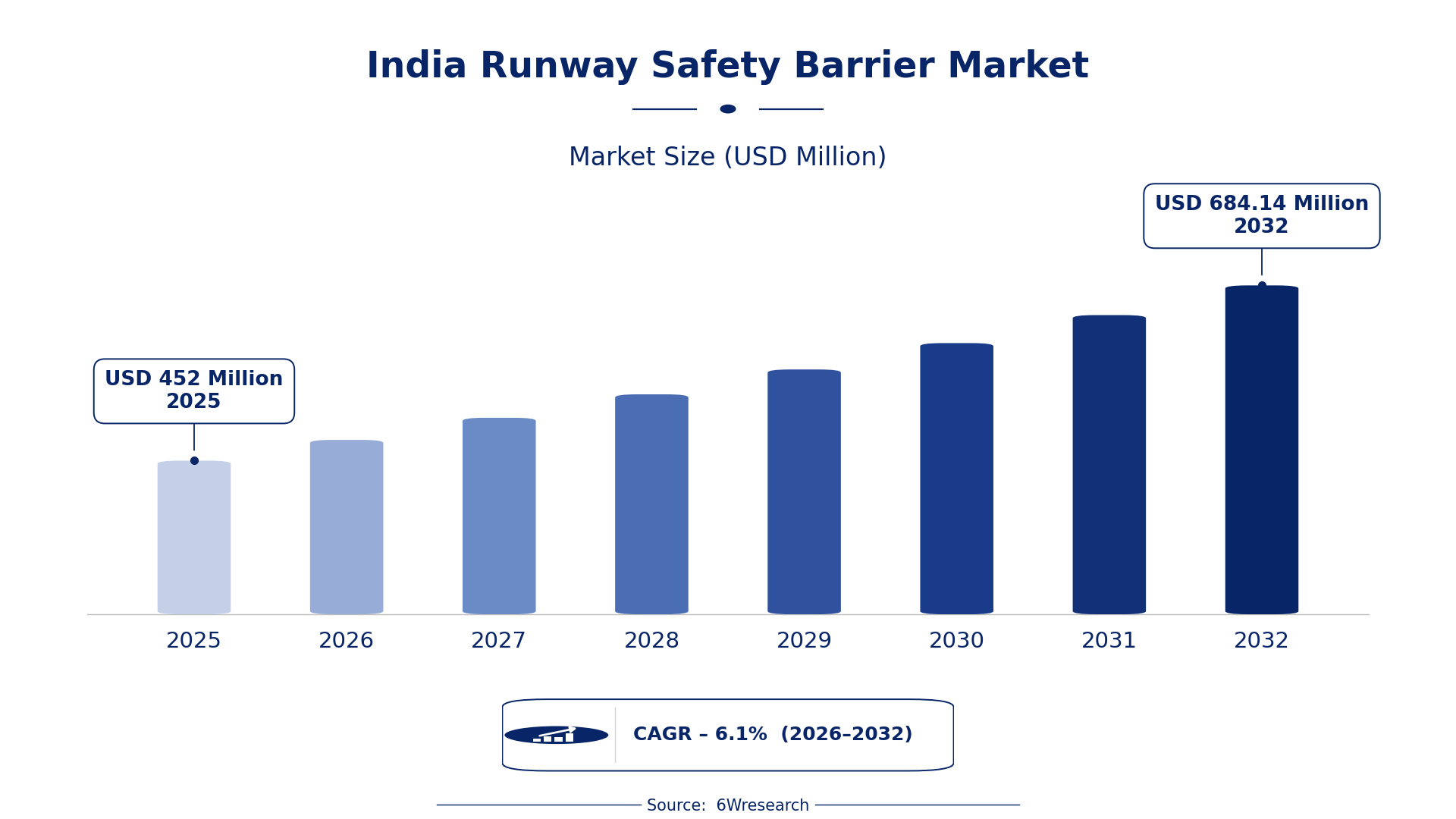
According to 6Wresearch internal database and industry insights, the India Runway Safety Barrier Market was valued at USD 452.0 million in 2025 and is projected to reach USD 684.14 million by 2032, growing at a CAGR of approximately 6.1% during 2026–2032.
India Runway Safety Barrier Market Highlights
| Report Metric | Details |
| Report Name | India Runway Safety Barrier Market |
| Market Size 2025 | USD 452.0 million |
| Market Size 2032 | USD 684.14 million |
| Absolute Growth 2025–2032 | USD 232.14 million |
| CAGR 2026–2032 | 6.1% |
| Peak Annual Growth | 8.4% in 2031 |
| Forecast Period | 2026–2032 |
| Historical Data | 2022–2025 |
| Base Year | 2025 |
| Leading Barrier Type, 2025 | Arrestor Beds (41% share) |
| Leading Material Used, 2025 | Crushed Stone (50% share) |
| Leading Deployment Type, 2025 | Fixed (50% share) |
| Leading End User, 2025 | Large Airports (35% share) |
| Fastest-Growing Barrier Type | Engineered Systems (8.3% CAGR) |
| Fastest-Growing Material Used | Foam Blocks (7.7% CAGR) |
| Fastest-Growing Deployment Type | Temporary (7.9% CAGR) |
| Fastest-Growing End User | Emergency Landing Areas (8.2% CAGR) |
| Growing Sector | aviation safety |
| Key End Users | large airports, military airstrips, civil aviation bodies |
India Runway Safety Barrier Market Year-wise Growth Rate and Key Drivers (2022–2032)
This graph illustrates the annual growth rates of the market from 2022 to 2032, highlighting a steady upward trajectory and projected market expansion over the forecast period.
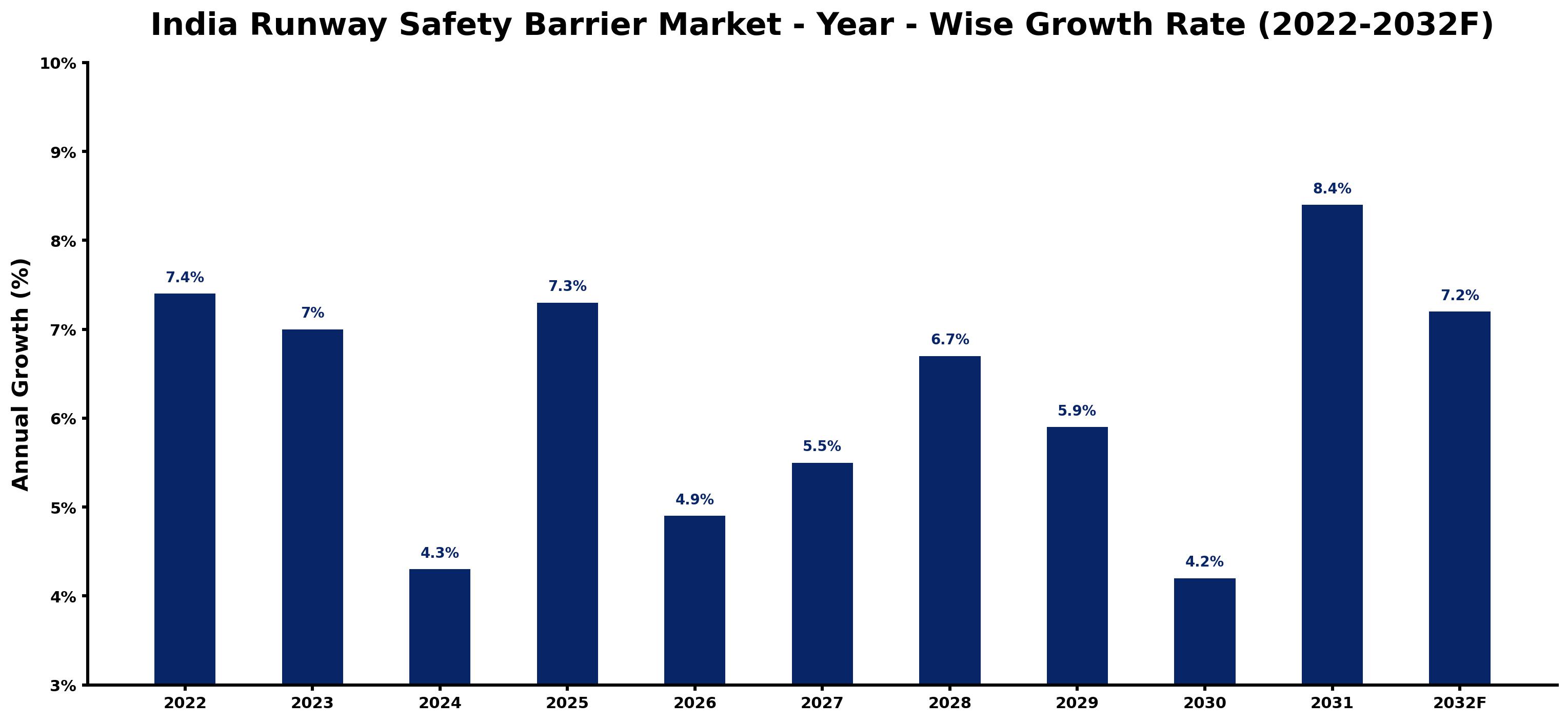
The following table presents the estimated annual growth rate for each year together with the principal factor influencing market performance.
| Year | Estimated Annual Growth (%) | Market Rationale |
| 2022 | 7.4 | The market experienced strong demand from large airports and military airstrips. |
| 2023 | 7.0 | Growth slowed due to temporary project delays in airport upgrades and safety enhancements. |
| 2024 | 4.3 | Market expansion continued but at a reduced pace as infrastructure projects faced funding challenges. |
| 2025 | 7.3 | Increased investments in airport safety infrastructure boosted demand for runway safety barriers. |
| 2026 | 4.9 | Growth slowed again as regulatory approvals for new projects took longer than anticipated. |
| 2027 | 5.5 | Demand increased as more airports prioritised safety upgrades to meet new standards. |
| 2028 | 6.7 | The market saw a rise in safety investments driven by passenger traffic growth. |
| 2029 | 5.9 | Demand growth slowed slightly as some projects faced budget constraints and delays. |
| 2030 | 4.2 | Growth continued but at a slower rate due to ongoing regulatory processes. |
| 2031 | 8.4 | The market peaked with significant investments in safety measures across major airports. |
| 2032 | 7.2 | Growth moderated as the market stabilises following peak investment years. |
Note: Market size estimations and growth projections presented in this report are based on 6Wresearch's proprietary forecasting methodology, utilizing the latest available industry data, government publications, and primary research inputs.
India Runway Safety Barrier Market Synopsis
The market is expanding due to increasing passenger traffic and heightened safety investments, particularly at major airports. The Indian aviation sector is set for growth, driving demand for effective safety solutions. Initiatives like the National Civil Aviation Policy 2016 highlight the necessity for enhanced safety measures.
Market Dynamics Impact Analysis (2026–2032)
| Factor | Type | Impact | Primary Segment Affected |
| Increased passenger traffic at large airports drives demand for safety barriers. | Driver | High | Large Airports |
| Growing military operations necessitate enhanced safety measures at airstrips. | Driver | High | Military Airstrips |
| High demand for safety upgrades presents opportunities for barrier manufacturers. | Opportunity | High | Arrestor Beds |
| Investment in airport safety infrastructure is increasing, creating demand for suppliers. | Opportunity | High | Arrestor Beds |
| Regulatory delays can hinder timely project completions and barrier installations. | Restraint | Medium | Arrestor Beds |
| Limited funding for safety upgrades can restrict market growth potential. | Restraint | Medium | Arrestor Beds |
| The market faces challenges from fluctuating material costs impacting barrier production. | Challenge | Medium | Arrestor Beds |
| Competition from alternative safety solutions may affect market share for traditional barriers. | Challenge | Medium | Arrestor Beds |
Evaluation of Drivers in India Runway Safety Barrier Market (2026–2032)
The factors lifting demand, and the evidence behind each, are summarised below.
| Drivers | Primary Segment Affected | Why It Matters (Evidence) |
| Rising passenger traffic at airports increases the need for safety measures. | Large Airports | With over 450 airports, demand for safety barriers is critical to accommodate growing passenger numbers. |
| Military operations require effective safety systems for airstrips. | Military Airstrips | The Indian Air Force operates numerous airstrips, necessitating effective runway safety solutions. |
| Government initiatives promote safety upgrades at airports. | Arrestor Beds | The National Civil Aviation Policy 2016 emphasises improvements in airport safety infrastructure. |
| Funding allocated for airport safety infrastructure boosts demand for barriers. | Arrestor Beds | The Central Government's 2023 budget includes substantial allocations for upgrading safety measures. |
| Regulatory standards mandate the installation of safety barriers at airports. | Arrestor Beds | The Directorate General of Civil Aviation enforces regulations requiring effective safety systems. |
Expansion of the Runway Safety Barrier market in India is backed by rising passenger traffic and military operations. The Indian aviation sector is projected to grow, necessitating effective safety measures across various airports. Substantial funds allocated in 2023 for upgrading safety systems further stimulate demand. Additionally, military airstrips necessitate effective safety solutions, creating a consistent need for runway safety barriers across the country.
Evaluation of Restraints in India Runway Safety Barrier Market
The key brakes on demand, and where they bite hardest, are shown below.
| Market Restraint | Primary Segment Affected | Why It Matters (Evidence) |
| Regulatory delays can slow down project timelines for barrier installations. | Arrestor Beds | Approval processes from the Directorate General of Civil Aviation can extend project durations. |
| Limited funding for safety upgrades restricts market growth potential. | Arrestor Beds | Budget constraints at airports can delay necessary safety infrastructure investments. |
| Fluctuating material costs impact the production of safety barriers. | Arrestor Beds | Rising costs of steel and foam can affect pricing and availability of barriers. |
| Competition from alternative safety solutions may reduce demand for traditional barriers. | Arrestor Beds | Emerging technologies could divert investments away from conventional runway safety systems. |
| Market saturation in certain regions may limit growth opportunities. | Arrestor Beds | High competition in major cities could restrict new market entrants. |
India Runway Safety Barrier Market Challenges
The India runway safety barrier market encounters several practical problems, beginning with a skills shortage among local contractors. Many contractors lack the necessary expertise to install and maintain these critical systems, causing delays in project timelines and increasing costs for airports and military airstrips. Technology challenges also arise; outdated safety systems at some airports do not meet current regulations, risking compliance and necessitating costly upgrades. Material costs have surged by 15% this year, straining budgets for airport infrastructure projects. Competition is intense, as new entrants lower prices, forcing established suppliers to reduce margins and invest heavily in marketing.
Trends in the India Runway Safety Barrier Market
Buyers and suppliers in the India Runway Safety Barrier Market are adjusting to the following trends.
- Shift towards Advanced Safety Systems: Large airports are increasingly adopting advanced safety systems for runway protection. This trend is evident in Delhi and Mumbai, where new safety measures are being implemented, reflecting a growing commitment to aviation safety.
- Transition from Fixed to Modular Barriers: A noticeable shift from fixed runway safety barriers to modular systems is occurring, allowing for flexibility. This change is particularly evident in military airstrips, where adaptability is valued for operational efficiency.
- Emergence of Integrated Safety Solutions: Integrated safety solutions are becoming popular among large airports, combining various safety measures into one system. This trend is supported by the Airports Authority of India, which encourages comprehensive safety upgrades.
- Growing Investment in Safety Infrastructure: Investment in safety infrastructure is on the rise, with the Central Government allocating substantial funds for upgrades. In 2023, a notable budget was set aside specifically for enhancing airport safety features.
Investment Opportunities in the India Runway Safety Barrier Market
Below are the investment opportunities with the strongest case in the India Runway Safety Barrier Market.
- Runway Safety Barriers: The demand for runway safety barriers is on the rise, particularly in large airports. With a projected market size of USD 684.14 million by 2032, suppliers can enter through partnerships with local manufacturers.
- Safety Infrastructure Upgrades: There is an opportunity for suppliers to offer safety infrastructure upgrades at military airstrips. Collaborating with the Indian Air Force can facilitate entry into this expanding market segment.
- Modular Safety Solutions: The shift towards modular safety solutions offers a chance for innovation and investment. Suppliers can focus on military airstrips, where flexibility in safety measures is increasingly valued.
- Enhanced Safety Systems: The growing emphasis on enhanced safety systems at airports creates an opportunity for suppliers. Engaging with the Airports Authority of India can provide pathways for market entry.
Government Initiatives in the India Runway Safety Barrier Market
The Directorate General of Civil Aviation mandates the installation of runway safety barriers to ensure aircraft safety. This regulation compels airports to meet safety standards, resulting in increased demand for effective barrier solutions. The National Civil Aviation Policy 2016 further underscores the importance of safety upgrades at airports, driving investments in infrastructure. The Central Government allocated funds in 2023 specifically for enhancing airport safety measures, ensuring compliance with these regulations. Such policies create a structured environment for barrier manufacturers to thrive.
The Airports Authority of India oversees the implementation of safety standards at airports. This agency is tasked with approving safety measures and funding infrastructure upgrades. In 2021, the Ministry of Civil Aviation launched the 'Airport Authority of India' initiative, aimed at improving safety protocols. This initiative has led to increased funding for safety projects, benefiting both producers and buyers. The collaboration between government agencies and airport authorities ensures that safety measures are effectively implemented.
Future Insight of the India Runway Safety Barrier Market
The India runway safety barrier market is expected to grow significantly by 2032, driven by several key factors. The National Civil Aviation Policy 2016 will encourage improvements in safety standards across airports, while the government's target to upgrade safety features by 2025 will stimulate investment in modern systems. The Central Government's allocation of funds for airport upgrades in 2023 is likely to increase demand for these barriers. With passenger traffic projected to rise, airports will prioritise effective safety measures, creating new opportunities for suppliers and buyers.
Market Segmentation Analysis
Each segment group is reviewed below, with the leader by share and the fastest grower by CAGR.
By Barrier Type – Arrestor Beds Dominated, Engineered Systems Expected to Grow Fastest
According to Shubham Padhi, Research Analyst at 6Wresearch, the largest barrier type category in 2025 was Arrestor Beds, with a 41% share of total revenue. Arrestor Beds hold the largest market share because they are essential for halting aircraft during overruns, especially at major airports like Delhi and Mumbai. Their widespread implementation is driven by strict safety regulations that mandate their use in the aviation industry. Over 2026–2032, Engineered Systems are expected to post the fastest growth, at a CAGR of 8.3%. Engineered Systems are experiencing rapid growth as airports increasingly adopt integrated solutions for runway safety, influenced by government initiatives aimed at enhancing safety measures. The recent funding allocated for upgrading airport safety infrastructure in 2023 is likely to further propel this trend. Suppliers should focus on developing advanced engineered solutions to meet the rising safety standards in the Indian runway safety barrier market.
By Material Used – Crushed Stone Dominated, Foam Blocks Expected to Grow Fastest
Crushed Stone took a 50% share of material used in 2025, more than any other category. Crushed Stone dominates the market as the preferred material for constructing runway safety barriers, thanks to its effectiveness and cost efficiency. Its widespread application across numerous airports reinforces its leading market share in this sector. The quickest growth will come from Foam Blocks, forecast to expand at a CAGR of 7.7% between 2026 and 2032. Foam Blocks are rapidly gaining traction due to their critical role in impact absorption, particularly in high-traffic areas. The emphasis on safety improvements highlighted in the National Civil Aviation Policy 2016 is driving the increased adoption of these materials. Buyers should consider the benefits of foam blocks for enhanced safety features, as demand is expected to rise with ongoing safety initiatives.
By Deployment Type – Fixed Dominated, Temporary Expected to Grow Fastest
Fixed accounted for a 50% market share by deployment type in 2025. Fixed deployment types dominate the market because they are the most common and reliable solution for runway safety at large airports. Their permanent installation aligns with regulatory requirements, ensuring a consistent safety standard across facilities. Temporary is projected to grow fastest, at a CAGR of 7.9% during 2026–2032. Temporary deployment types are growing quickly due to their specific use in emergency situations, which has become more critical as air traffic increases. The focus on safety during emergencies has prompted airports to invest in these adaptable solutions. Suppliers must diversify their offerings to include temporary solutions, as this segment is becoming increasingly important for meeting emergency safety needs.
By End User – Large Airports Dominated, Emergency Landing Areas Expected to Grow Fastest
Large Airports held a 35% share of the India Runway Safety Barrier Market by end user in 2025. Large Airports are the primary end users of runway safety barriers, commanding the largest market share due to their high traffic volumes and stringent safety requirements. Facilities like those in Delhi and Mumbai illustrate the urgent need for effective safety systems to address risks associated with aircraft overruns. Emergency Landing Areas are set to record the highest CAGR in this split, 8.2% over 2026–2032. Emergency Landing Areas are witnessing the fastest growth as the aviation sector prioritises safety measures for unexpected situations. The increase in passenger traffic and the potential for emergencies are driving greater investments in these critical areas. Suppliers should tailor their solutions for emergency landing areas, as their significance in safety protocols is anticipated to grow.
Key Attractiveness of the Report
- 10 Years of Market Numbers
- Historical Data Starting from 2022 to 2025
- Base Year 2025
- Forecast Data until 2032
- Key Performance Indicators Impacting the Market
- Major Upcoming Developments and Projects
Key Highlights of the Report:
- India Runway Safety Barrier Market Outlook
- Market Size of India Runway Safety Barrier Market, 2025
- Forecast of India Runway Safety Barrier Market, 2032
- Historical Data and Forecast of India Runway Safety Barrier Revenues & Volume for the Period 2022 - 2032F
- India Runway Safety Barrier Market Trend Evolution
- India Runway Safety Barrier Market Drivers and Challenges
- India Runway Safety Barrier Price Trends
- India Runway Safety Barrier Porter's Five Forces
- India Runway Safety Barrier Industry Life Cycle
- Historical Data and Forecast of India Runway Safety Barrier Market Revenues & Volume By Barrier Type for the Period 2022 - 2032F
- Historical Data and Forecast of India Runway Safety Barrier Market Revenues & Volume By Arrestor Beds for the Period 2022 - 2032F
- Historical Data and Forecast of India Runway Safety Barrier Market Revenues & Volume By Engineered Systems for the Period 2022 - 2032F
- Historical Data and Forecast of India Runway Safety Barrier Market Revenues & Volume By Retractable Barriers for the Period 2022 - 2032F
- Historical Data and Forecast of India Runway Safety Barrier Market Revenues & Volume By Cable Barrier Systems for the Period 2022 - 2032F
- Historical Data and Forecast of India Runway Safety Barrier Market Revenues & Volume By Material Used for the Period 2022 - 2032F
- Historical Data and Forecast of India Runway Safety Barrier Market Revenues & Volume By Crushed Stone for the Period 2022 - 2032F
- Historical Data and Forecast of India Runway Safety Barrier Market Revenues & Volume By Foam Blocks for the Period 2022 - 2032F
- Historical Data and Forecast of India Runway Safety Barrier Market Revenues & Volume By Hydraulic Steel for the Period 2022 - 2032F
- Historical Data and Forecast of India Runway Safety Barrier Market Revenues & Volume By Steel Ropes for the Period 2022 - 2032F
- Historical Data and Forecast of India Runway Safety Barrier Market Revenues & Volume By Deployment Type for the Period 2022 - 2032F
- Historical Data and Forecast of India Runway Safety Barrier Market Revenues & Volume By Fixed for the Period 2022 - 2032F
- Historical Data and Forecast of India Runway Safety Barrier Market Revenues & Volume By Temporary for the Period 2022 - 2032F
- Historical Data and Forecast of India Runway Safety Barrier Market Revenues & Volume By Mobile for the Period 2022 - 2032F
- Historical Data and Forecast of India Runway Safety Barrier Market Revenues & Volume By Modular for the Period 2022 - 2032F
- Historical Data and Forecast of India Runway Safety Barrier Market Revenues & Volume By End User for the Period 2022 - 2032F
- Historical Data and Forecast of India Runway Safety Barrier Market Revenues & Volume By Large Airports for the Period 2022 - 2032F
- Historical Data and Forecast of India Runway Safety Barrier Market Revenues & Volume By Emergency Landing Areas for the Period 2022 - 2032F
- Historical Data and Forecast of India Runway Safety Barrier Market Revenues & Volume By Military Airstrips for the Period 2022 - 2032F
- Historical Data and Forecast of India Runway Safety Barrier Market Revenues & Volume By Civil Aviation Bodies for the Period 2022 - 2032F
- India Runway Safety Barrier Import Export Trade Statistics
- Market Opportunity Assessment By Barrier Type
- Market Opportunity Assessment By Material Used
- Market Opportunity Assessment By Deployment Type
- Market Opportunity Assessment By End User
- India Runway Safety Barrier Top Companies Market Share
- India Runway Safety Barrier Competitive Benchmarking By Technical and Operational Parameters
- India Runway Safety Barrier Company Profiles
- India Runway Safety Barrier Key Strategic Recommendations
Market Covered
The report offers an extensive study of the following market segments.
By Barrier Type
- Arrestor Beds
- Engineered Systems
- Retractable Barriers
- Cable Barrier Systems
By Material Used
- Crushed Stone
- Foam Blocks
- Hydraulic Steel
- Steel Ropes
By Deployment Type
- Fixed
- Temporary
- Mobile
- Modular
By End User
- Large Airports
- Emergency Landing Areas
- Military Airstrips
- Civil Aviation Bodies






































