China Runway Safety Barrier Market Size & Growth Rate
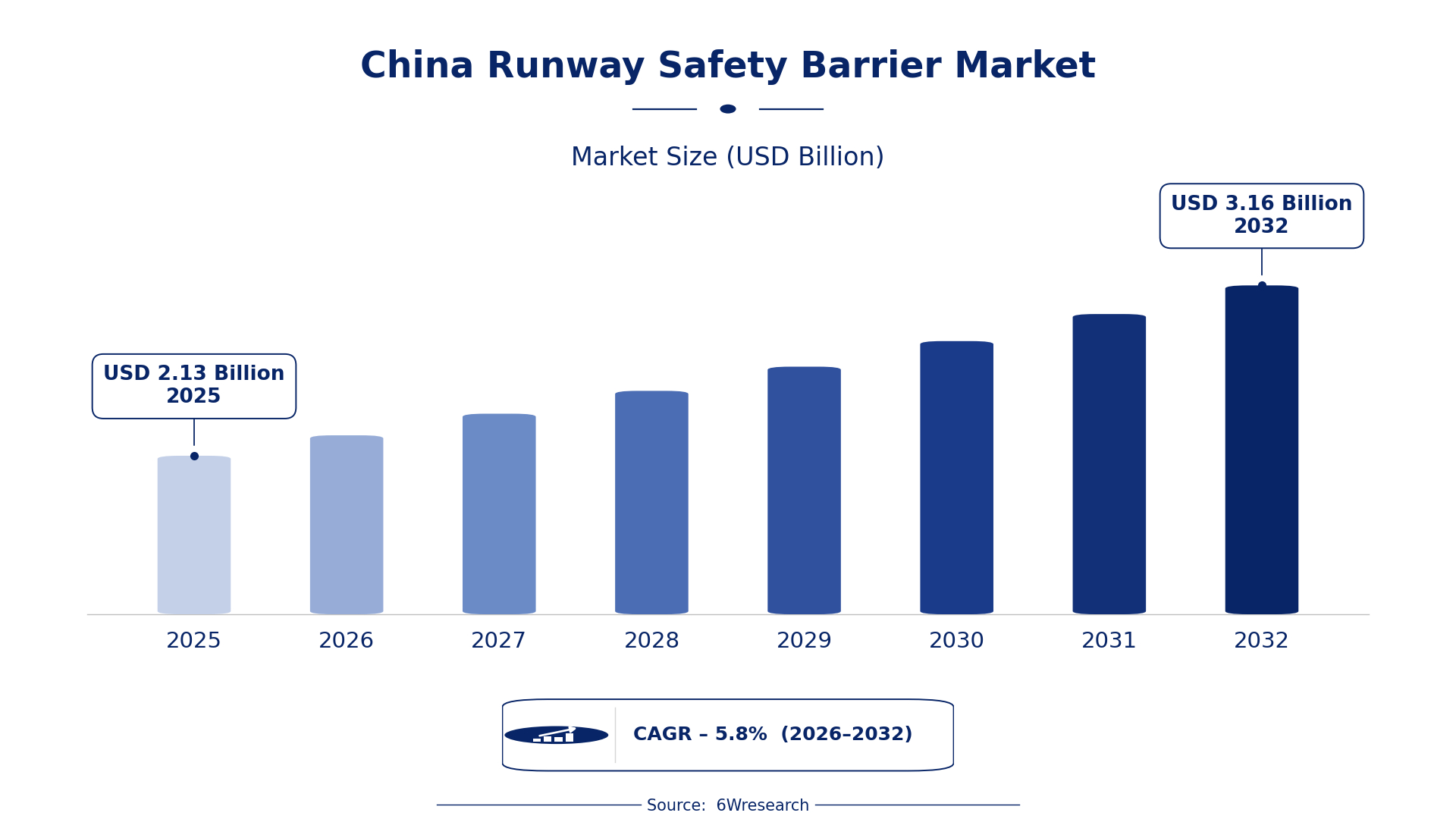
According to 6Wresearch internal database and industry insights, the China Runway Safety Barrier Market was valued at USD 2.13 billion in 2025 and is projected to reach USD 3.16 billion by 2032, growing at a CAGR of approximately 5.8% during 2026–2032.
China Runway Safety Barrier Market Highlights
| Report Metric | Details |
| Report Name | China Runway Safety Barrier Market |
| Market Size 2025 | USD 2.13 billion |
| Market Size 2032 | USD 3.16 billion |
| Absolute Growth 2025–2032 | USD 1.03 billion |
| CAGR 2026–2032 | 5.8% |
| Peak Annual Growth | 7.5% in 2026 |
| Forecast Period | 2026–2032 |
| Historical Data | 2022–2025 |
| Base Year | 2025 |
| Leading Barrier Type, 2025 | Arrestor Beds (49% share) |
| Leading Material Used, 2025 | Crushed Stone (55% share) |
| Leading Deployment Type, 2025 | Fixed (48% share) |
| Leading End User, 2025 | Large Airports (54% share) |
| Fastest-Growing Barrier Type | Engineered Systems (7.0% CAGR) |
| Fastest-Growing Material Used | Hydraulic Steel (7.2% CAGR) |
| Fastest-Growing Deployment Type | Temporary (8.5% CAGR) |
| Fastest-Growing End User | Military Airstrips (7.5% CAGR) |
| Growing Sector | Airport safety infrastructure |
| Key End Users | Large Airports, Military Airstrips, Civil Aviation Bodies, Emergency Landing Areas |
China Runway Safety Barrier Market Year-wise Growth Rate and Key Drivers (2022–2032)
This graph illustrates the annual growth rates of the market from 2022 to 2032, highlighting a steady upward trajectory and projected market expansion over the forecast period.
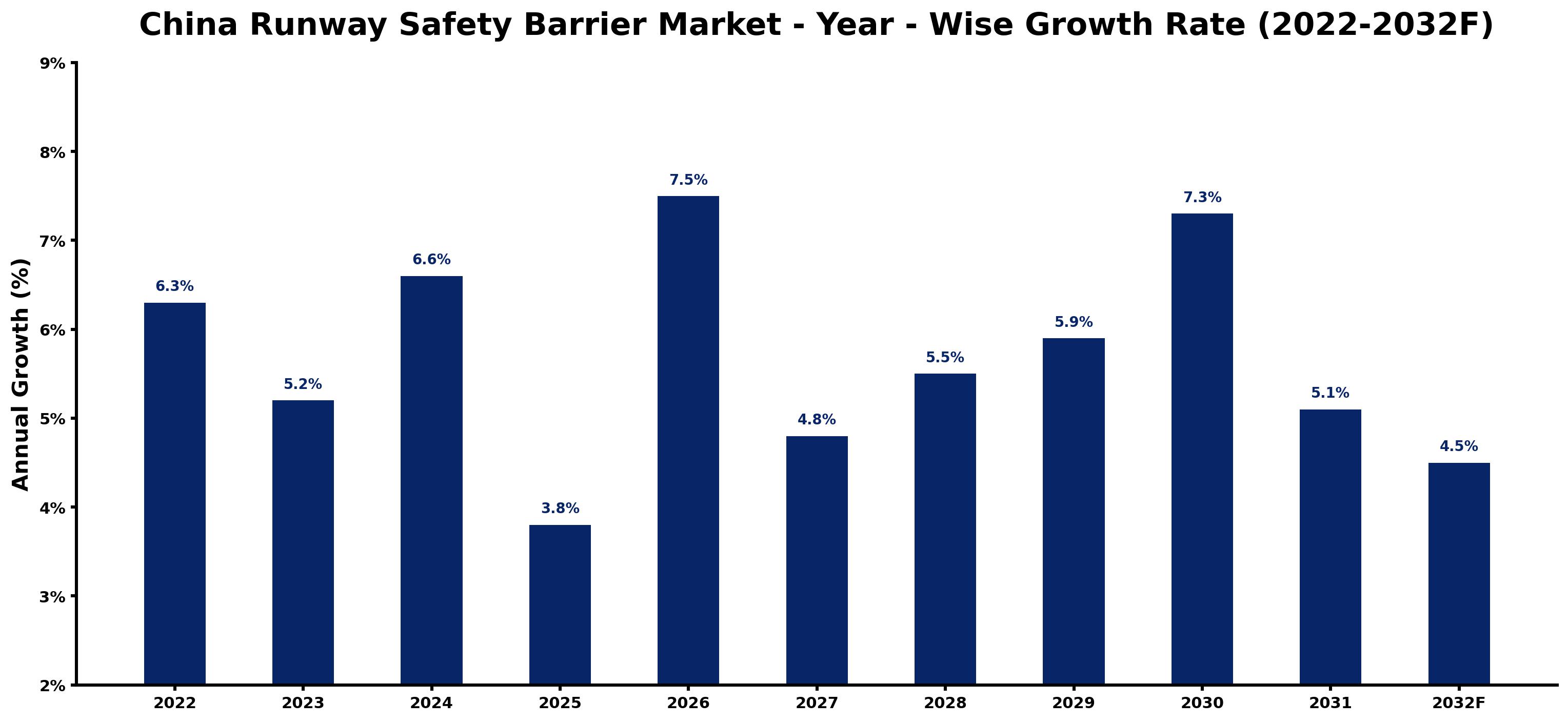
Year by year, the estimates below pair each growth rate with the development that shaped it.
| Year | Estimated Annual Growth (%) | Market Rationale |
| 2022 | 6.3 | The market experienced steady demand from large airports prioritising safety measures. |
| 2023 | 5.2 | Growth slowed due to increased regulatory scrutiny impacting new installations. |
| 2024 | 6.6 | Demand accelerated as the National Standard for Runway Safety Barriers was updated. |
| 2025 | 3.8 | A slowdown occurred as some airports delayed safety upgrades amid budget constraints. |
| 2026 | 7.5 | Growth surged as the Ministry of Transport's safety initiative gained traction. |
| 2027 | 4.8 | Demand slowed as the focus shifted to maintenance of existing safety barriers. |
| 2028 | 5.5 | Growth picked up with increased investments in airport safety infrastructure. |
| 2029 | 5.9 | Demand continued to rise as military airstrips mandated safety installations. |
| 2030 | 7.3 | Growth accelerated due to the Ministry of Transport's safety initiative promoting engineered systems. |
| 2031 | 5.1 | A slowdown occurred as large airports reassessed their safety budgets. |
| 2032 | 4.5 | Growth slowed as the National Defense Ministry's Military Airstrip Safety Enhancement Plan began to show effects. |
Note: Market size estimations and growth projections presented in this report are based on 6Wresearch's proprietary forecasting methodology, utilizing the latest available industry data, government publications, and primary research inputs.
China Runway Safety Barrier Market Synopsis
The market is expanding due to ongoing investments in airport infrastructure and safety regulations. With over 200 large airports requiring these installations, demand is driven by both civil aviation and military airstrips. The government's focus on safety initiatives further propels growth, ensuring protection for lives and equipment during emergencies.
Market Dynamics Impact Analysis (2026–2032)
| Factor | Type | Impact | Primary Segment Affected |
| Growing investments in airport safety infrastructure | Driver | High | Large Airports |
| Increased regulatory requirements for safety measures | Driver | High | Military Airstrips |
| Expansion of safety standards in airport constructions | Opportunity | High | Emergency Landing Areas |
| Investment in advanced runway safety technologies | Opportunity | Medium | Civil Aviation Bodies |
| Budget constraints affecting safety upgrades | Restraint | High | Large Airports |
| Slow adoption of innovative safety systems | Restraint | Medium | Engineered Systems |
| Limited funding for safety enhancements | Challenge | High | Military Airstrips |
| Regulatory delays in safety certification processes | Challenge | Medium | Emergency Landing Areas |
Evaluation of Drivers in China Runway Safety Barrier Market (2026–2032)
The main growth drivers and the segments they affect most are set out below.
| Drivers | Primary Segment Affected | Why It Matters (Evidence) |
| Increased airport safety investments | Large Airports | Over 200 large airports in China require runway safety barriers, driving purchases. |
| Regulatory compliance for safety standards | Military Airstrips | National defense regulations mandate safety barriers, ensuring consistent demand. |
| Updated safety standards for new constructions | Emergency Landing Areas | The National Standard for Runway Safety Barriers promotes barrier installations in new projects. |
| Government safety initiatives funding upgrades | Civil Aviation Bodies | The 2023 safety initiative allocated 500 million CNY for airport safety improvements. |
| Technological advancements in barrier systems | Engineered Systems | Growing interest in engineered systems improves safety features for various aviation environments. |
The Runway Safety Barrier market in China is expanding as large airports, military airstrips, and civil aviation bodies increase their investments in safety measures. The updated National Standard for Runway Safety Barriers mandates installations in new constructions, further driving purchases. Technological advancements in barrier systems are attracting buyers looking for improved solutions to strengthen safety measures.
Evaluation of Restraints in China Runway Safety Barrier Market
The table below lists the restraints and the evidence behind each.
| Market Restraint | Primary Segment Affected | Why It Matters (Evidence) |
| Budget constraints limiting safety upgrades | Large Airports | Many airports have delayed safety improvements due to financial limitations, affecting barrier installations. |
| Slow adoption of advanced safety technologies | Engineered Systems | Some airports are hesitant to invest in new technologies, preferring traditional systems. |
| Limited funding for military safety upgrades | Military Airstrips | Budgetary restrictions within the defense sector hinder timely upgrades of safety barriers. |
| Regulatory delays in certification processes | Emergency Landing Areas | Bureaucratic hurdles slow down the approval of new safety installations. |
| Inconsistent demand from smaller airports | Civil Aviation Bodies | Smaller airports may not prioritise runway safety barriers, leading to fluctuating demand. |
China Runway Safety Barrier Market Challenges
The China Runway Safety Barrier Market faces challenges that impact buyers directly. Buyers contend with high installation costs, as compliance with stringent safety standards from the Civil Aviation Administration inflates expenses by approximately 30%. Competition among suppliers creates price pressures, which can lead to compromised quality, affecting buyers who rely on dependable safety features. Additionally, supply chain disruptions often delay the procurement of essential materials, extending project timelines by several months for airports. Regulatory updates, such as the revised National Standard for Runway Safety Barriers, require extra investments from suppliers, complicating timely installations for buyers.
Trends in the China Runway Safety Barrier Market
The trends below show where the China Runway Safety Barrier Market is heading.
- Shift from Traditional to Engineered Systems: Since 2021, airports have increasingly adopted engineered systems for safety. This shift is evident at Shanghai Pudong International Airport, which implemented these systems, reflecting a growing preference for tailored safety solutions.
- Transition to Modular Safety Barriers: In 2023, modular safety barriers gained traction at emergency landing areas. The flexibility of these barriers allows for quick deployment, meeting safety needs in various scenarios, with significant installations reported across multiple regions.
- Emergence of Updated Safety Standards: The National Standard for Runway Safety Barriers, updated in 2021, has led to stricter compliance requirements. This change has resulted in a notable increase in barrier installations across large airports, ensuring higher safety levels.
- Increase in Military Airstrip Safety Measures: The Military Airstrip Safety Enhancement Plan initiated in 2023 mandates improved safety measures. This initiative has led to a significant uptick in barrier installations, with military airstrips across China now prioritising safety.
Investment Opportunities in the China Runway Safety Barrier Market
Several openings in the China Runway Safety Barrier Market merit attention from investors.
- Investment in Airport Safety Infrastructure: Guangdong province is currently investing heavily in airport safety upgrades, with a budget of 500 million CNY. Suppliers can enter this market by partnering with local authorities to provide runway safety barriers.
- Supply of Advanced Engineered Systems: The demand for engineered systems is rising, particularly in large airports. Suppliers can capitalise on this trend by developing tailored solutions that meet specific safety requirements, ensuring compliance with updated standards.
- Expansion of Safety Barrier Installations: Military airstrips are mandated to enhance safety measures, presenting a promising opportunity for suppliers. Engaging with military procurement agencies can facilitate entry into this market segment.
- Focus on Modular Safety Solutions: With emergency landing areas increasingly adopting modular barriers, there is a growing need for suppliers to provide these flexible solutions. Collaborating with civil aviation bodies can open pathways for new contracts.
Government Initiatives in the China Runway Safety Barrier Market
In 2022, the Ministry of Transport approved the 'National Runway Safety Barrier Standard', mandating certified barriers in all new airport constructions. This measure ensures compliance across the aviation sector, building on previous regulations that lacked specificity. Additionally, the 2023 'Military Airstrip Safety Enhancement Plan' initiated by the National Defense Ministry allocates funding for safety upgrades, improving measures at military airstrips nationwide. This initiative ensures compliance with updated standards and improves overall safety.
The 2023 'Airport Safety Improvement Program' by the Civil Aviation Administration of China focuses on upgrading safety protocols across major airports. This program allocates substantial resources for implementing advanced safety measures, enabling producers to meet the latest standards. Furthermore, the Ministry of Industry and Information Technology is funding the development of advanced runway safety technologies, promoting innovation and compliance in the market.
Future Insight of the China Runway Safety Barrier Market
The China Runway Safety Barrier Market is expected to evolve by 2032, driven by key developments. The government’s allocation of 500 million CNY for airport safety upgrades will enhance infrastructure across the country. The Ministry of Transport's safety initiative will encourage the adoption of advanced safety systems in new airport constructions. Demand for engineered systems is likely to rise, improving safety measures during emergencies, while military airstrips will continue to enforce strict safety regulations, ensuring consistent growth in barrier installations.
Market Segmentation Analysis
The report offers a comprehensive study of the following market segments and their leading categories in the market.
By Barrier Type – Arrestor Beds Dominated, Engineered Systems Expected to Grow Fastest
According to Shubham Padhi, Research Analyst at 6Wresearch, Arrestor Beds took a 49% share of barrier type in 2025, more than any other category. Arrestor beds hold the largest market share as they are extensively used at major airports to safely decelerate aircraft during runway overruns. Their critical role in ensuring safety is exemplified by installations at facilities like Beijing Capital International Airport. The quickest growth will come from Engineered Systems, forecast to expand at a CAGR of 7.0% between 2026 and 2032. Engineered systems are experiencing rapid growth as they are tailored to meet specific safety requirements, with notable implementations at Shanghai Pudong International Airport. This focused approach to runway safety is driving increased adoption across various aviation environments, further widening the gap with arrestor beds. Suppliers should prioritise the development of engineered systems to align with evolving safety standards and capture the increasing demand.
By Material Used – Crushed Stone Dominated, Hydraulic Steel Expected to Grow Fastest
Crushed Stone held a 55% share of the China Runway Safety Barrier Market by material used in 2025. Crushed stone holds the largest market share due to its effective energy-absorbing properties, making it the preferred material for arrestor beds at numerous airports. Its reliability in safety installations significantly contributes to its widespread adoption across the country. Over 2026–2032, Hydraulic Steel is expected to post the fastest growth, at a CAGR of 7.2%. Hydraulic steel is gaining traction as a preferred material for engineered systems, reflecting a shift towards more advanced safety solutions. This growing preference highlights a broader trend towards enhanced safety measures in aviation infrastructure, indicating potential for future growth. Buyers may benefit from considering innovative materials like hydraulic steel to improve runway safety and ensure compliance with updated regulations.
By Deployment Type – Fixed Dominated, Temporary Expected to Grow Fastest
With a 48% revenue share in 2025, Fixed was the largest deployment type category. Fixed barriers represent the largest share of the market as they are the most common choice for permanent installations at airports, providing consistent safety measures. Their reliability in protecting lives during runway overruns solidifies their leading position in the market. Temporary is projected to grow fastest, at a CAGR of 8.5% during 2026–2032. Temporary barriers are witnessing the fastest growth due to their flexibility in specific situations, allowing for quick deployment when needed. This adaptability is becoming increasingly important in dynamic aviation environments, suggesting a shift in operational strategies. Suppliers should explore developing more versatile temporary solutions to meet the changing demands of airport safety requirements.
By End User – Large Airports Dominated, Military Airstrips Expected to Grow Fastest
In 2025, Large Airports led the end user split with a 54% share. Large airports account for the majority of the market share as they are the primary users of runway safety barriers, ensuring operational safety for millions of passengers. Their significant investments in safety infrastructure are a key factor in maintaining their leading position in the market. Military Airstrips are set to record the highest CAGR in this split, 7.5% over 2026–2032. Military airstrips are experiencing the fastest growth in demand for runway safety barriers, driven by stringent safety regulations and increased military operations. This heightened focus on safety is likely to expand further as military needs continue to evolve. Suppliers should target military airstrips with tailored solutions to capitalise on this growing segment and enhance overall safety measures.
Key Attractiveness of the Report
- 10 Years of Market Numbers
- Historical Data Starting from 2022 to 2025
- Base Year 2025
- Forecast Data until 2032
- Key Performance Indicators Impacting the Market
- Major Upcoming Developments and Projects
Key Highlights of the Report:
- China Runway Safety Barrier Market Outlook
- Market Size of China Runway Safety Barrier Market, 2025
- Forecast of China Runway Safety Barrier Market, 2032
- Historical Data and Forecast of China Runway Safety Barrier Revenues & Volume for the Period 2022 - 2032F
- China Runway Safety Barrier Market Trend Evolution
- China Runway Safety Barrier Market Drivers and Challenges
- China Runway Safety Barrier Price Trends
- China Runway Safety Barrier Porter's Five Forces
- China Runway Safety Barrier Industry Life Cycle
- Historical Data and Forecast of China Runway Safety Barrier Market Revenues & Volume By Barrier Type for the Period 2022 - 2032F
- Historical Data and Forecast of China Runway Safety Barrier Market Revenues & Volume By Arrestor Beds for the Period 2022 - 2032F
- Historical Data and Forecast of China Runway Safety Barrier Market Revenues & Volume By Engineered Systems for the Period 2022 - 2032F
- Historical Data and Forecast of China Runway Safety Barrier Market Revenues & Volume By Retractable Barriers for the Period 2022 - 2032F
- Historical Data and Forecast of China Runway Safety Barrier Market Revenues & Volume By Cable Barrier Systems for the Period 2022 - 2032F
- Historical Data and Forecast of China Runway Safety Barrier Market Revenues & Volume By Material Used for the Period 2022 - 2032F
- Historical Data and Forecast of China Runway Safety Barrier Market Revenues & Volume By Crushed Stone for the Period 2022 - 2032F
- Historical Data and Forecast of China Runway Safety Barrier Market Revenues & Volume By Foam Blocks for the Period 2022 - 2032F
- Historical Data and Forecast of China Runway Safety Barrier Market Revenues & Volume By Hydraulic Steel for the Period 2022 - 2032F
- Historical Data and Forecast of China Runway Safety Barrier Market Revenues & Volume By Steel Ropes for the Period 2022 - 2032F
- Historical Data and Forecast of China Runway Safety Barrier Market Revenues & Volume By Deployment Type for the Period 2022 - 2032F
- Historical Data and Forecast of China Runway Safety Barrier Market Revenues & Volume By Fixed for the Period 2022 - 2032F
- Historical Data and Forecast of China Runway Safety Barrier Market Revenues & Volume By Temporary for the Period 2022 - 2032F
- Historical Data and Forecast of China Runway Safety Barrier Market Revenues & Volume By Mobile for the Period 2022 - 2032F
- Historical Data and Forecast of China Runway Safety Barrier Market Revenues & Volume By Modular for the Period 2022 - 2032F
- Historical Data and Forecast of China Runway Safety Barrier Market Revenues & Volume By End User for the Period 2022 - 2032F
- Historical Data and Forecast of China Runway Safety Barrier Market Revenues & Volume By Large Airports for the Period 2022 - 2032F
- Historical Data and Forecast of China Runway Safety Barrier Market Revenues & Volume By Emergency Landing Areas for the Period 2022 - 2032F
- Historical Data and Forecast of China Runway Safety Barrier Market Revenues & Volume By Military Airstrips for the Period 2022 - 2032F
- Historical Data and Forecast of China Runway Safety Barrier Market Revenues & Volume By Civil Aviation Bodies for the Period 2022 - 2032F
- China Runway Safety Barrier Import Export Trade Statistics
- Market Opportunity Assessment By Barrier Type
- Market Opportunity Assessment By Material Used
- Market Opportunity Assessment By Deployment Type
- Market Opportunity Assessment By End User
- China Runway Safety Barrier Top Companies Market Share
- China Runway Safety Barrier Competitive Benchmarking By Technical and Operational Parameters
- China Runway Safety Barrier Company Profiles
- China Runway Safety Barrier Key Strategic Recommendations
Market Covered
This report examines the market across the segments below.
By Barrier Type
- Arrestor Beds
- Engineered Systems
- Retractable Barriers
- Cable Barrier Systems
By Material Used
- Crushed Stone
- Foam Blocks
- Hydraulic Steel
- Steel Ropes
By Deployment Type
- Fixed
- Temporary
- Mobile
- Modular
By End User
- Large Airports
- Emergency Landing Areas
- Military Airstrips
- Civil Aviation Bodies






































