India Rural Broadband Market Size & Growth Rate
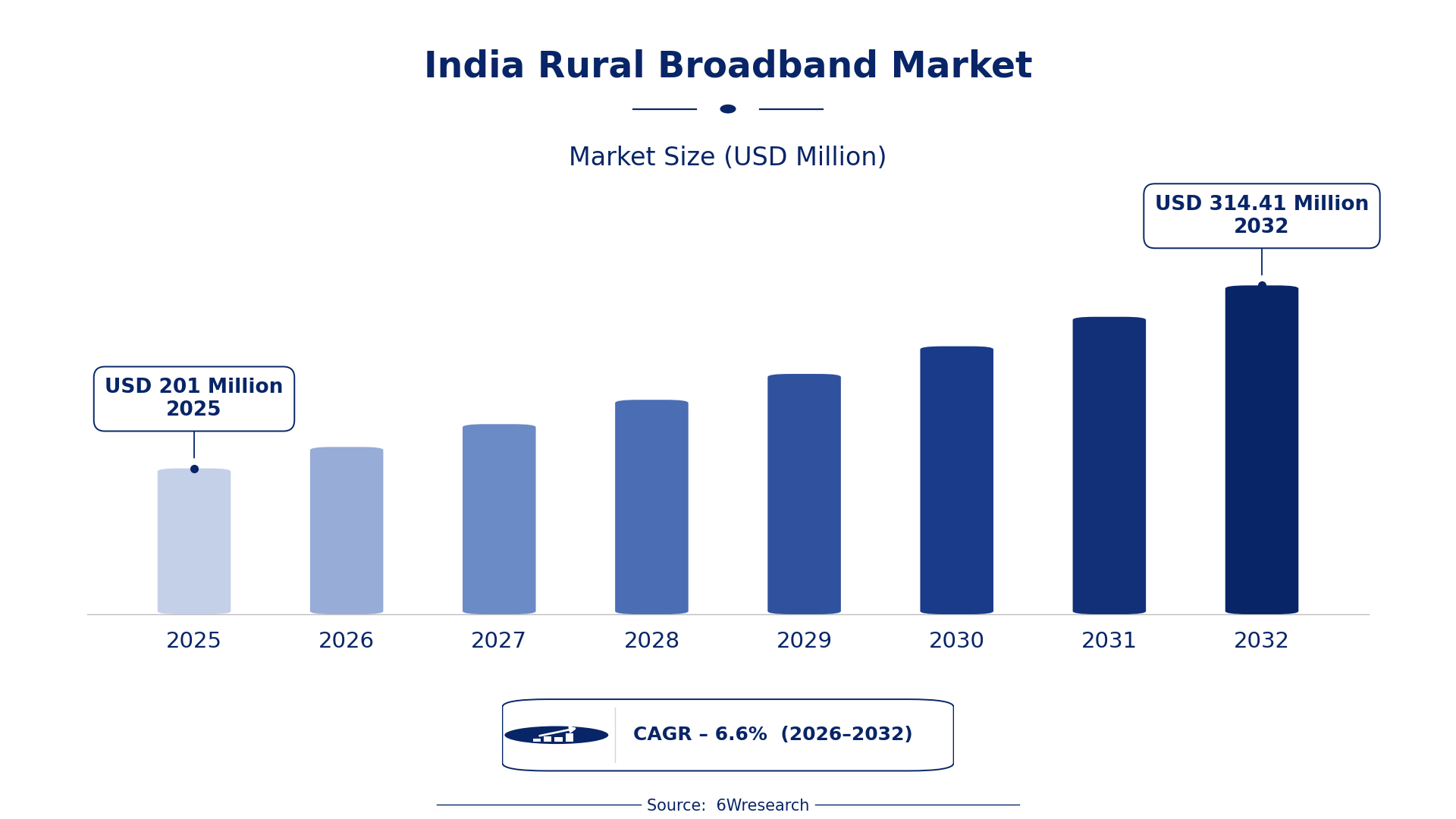
According to 6Wresearch internal database and industry insights, the India Rural Broadband Market was valued at USD 201.0 million in 2025 and is projected to reach USD 314.41 million by 2032, growing at a CAGR of approximately 6.6% during 2026–2032.
India Rural Broadband Market Highlights
| Report Metric | Details |
| Report Name | India Rural Broadband Market |
| Market Size 2025 | USD 201.0 million |
| Market Size 2032 | USD 314.41 million |
| Absolute Growth 2025–2032 | USD 113.41 million |
| CAGR 2026–2032 | 6.6% |
| Peak Annual Growth | 8.8% in 2030 |
| Forecast Period | 2026–2032 |
| Historical Data | 2022–2025 |
| Base Year | 2025 |
| Leading Technology Type, 2025 | Fiber-to-the-Home (46% share) |
| Leading Network Type, 2025 | Wireless Broadband (35% share) |
| Leading Delivery Method, 2025 | Government Initiatives (35% share) |
| Leading End User, 2025 | Rural Households (48% share) |
| Fastest-Growing Technology Type | Fixed Wireless Access (8.9% CAGR) |
| Fastest-Growing Delivery Method | Private Operators (8.2% CAGR) |
| Fastest-Growing End User | Agriculture Enterprises (8.2% CAGR) |
| Growing Sector | Rural Households |
| Key End Users | Rural Households, Small Businesses, Agriculture Enterprises, Remote Communities |
India Rural Broadband Market Year-wise Growth Rate and Key Drivers (2022–2032)
This graph illustrates the annual growth rates of the market from 2022 to 2032, highlighting a steady upward trajectory and projected market expansion over the forecast period.
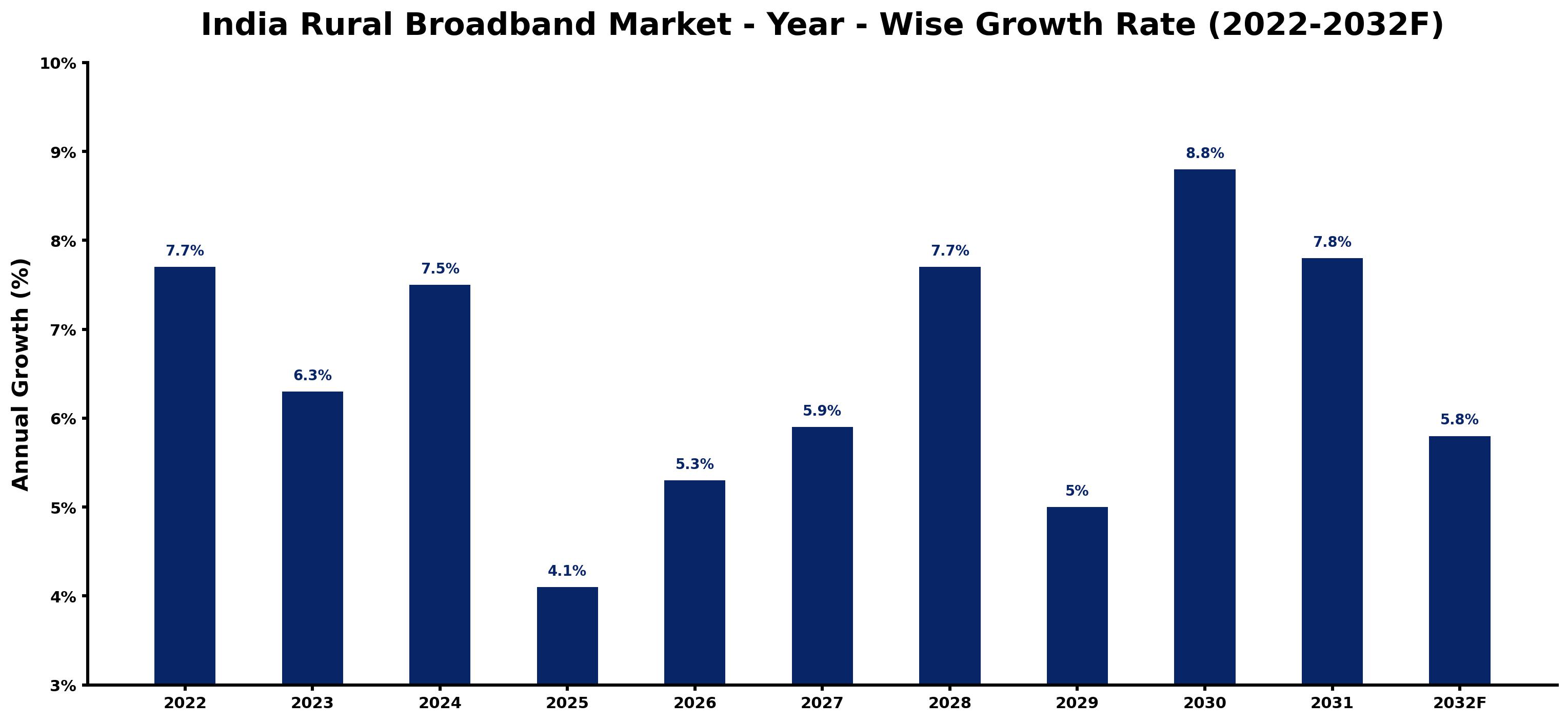
Below, each year's estimated growth is shown next to the factor that most influenced it.
| Year | Estimated Annual Growth (%) | Market Rationale |
| 2022 | 7.7 | The market experienced strong growth due to increased government initiatives and private investments. |
| 2023 | 6.3 | Growth slowed as infrastructure development faced delays in rural areas. |
| 2024 | 7.5 | Demand rose with improved connectivity solutions and ongoing government support. |
| 2025 | 4.1 | A slowdown occurred as market saturation began in some regions. |
| 2026 | 5.3 | Growth accelerated with the introduction of new broadband technologies. |
| 2027 | 5.9 | Demand increased as rural households sought better internet access. |
| 2028 | 7.7 | The market grew as more private operators entered rural broadband. |
| 2029 | 5.0 | Growth slowed again as competition intensified among service providers. |
| 2030 | 8.8 | A peak in growth was reached with significant investments in infrastructure. |
| 2031 | 7.8 | The market experienced a slowdown as rural areas became more connected. |
| 2032 | 5.8 | Growth continued but at a reduced pace as market maturity set in. |
Note: Market size estimations and growth projections presented in this report are based on 6Wresearch's proprietary forecasting methodology, utilizing the latest available industry data, government publications, and primary research inputs.
India Rural Broadband Market Synopsis
Rural Broadband in India refers to high-speed internet access in rural areas, primarily through technologies like fiber optics and wireless. This sector aims to improve communication and support education and e-commerce in rural communities. The India Rural Broadband Market is expanding, driven by over 100 million rural households lacking reliable internet access and government initiatives like the National Broadband Mission, which aims to provide broadband access to 300 million citizens by 2025.
Market Dynamics Impact Analysis (2026–2032)
| Factor | Type | Impact | Primary Segment Affected |
| Increased government funding for rural broadband initiatives | Driver | High | Government Initiatives |
| Growing demand for reliable internet among rural households | Driver | High | Rural Households |
| Investment opportunities in broadband infrastructure development | Opportunity | High | Private Operators |
| Expanding demand for broadband in agricultural enterprises | Opportunity | High | Agriculture Enterprises |
| Infrastructure challenges in remote areas hinder connectivity | Restraint | High | Satellite Internet |
| Slow adoption of advanced technologies in some regions | Restraint | Medium | Fiber-to-the-Home |
| High operational costs for service providers in rural areas | Challenge | High | Telecom Providers |
| Regulatory hurdles affecting service expansion | Challenge | Medium | National Rollouts |
Evaluation of Drivers in India Rural Broadband Market (2026–2032)
Key forces behind demand, with the segment each one moves most, are listed below.
| Drivers | Primary Segment Affected | Why It Matters (Evidence) |
| Government funding for rural broadband projects | Government Initiatives | The government allocated ₹6,000 crore under the Digital India programme, driving infrastructure development and access in rural areas, benefiting millions of users. |
| Rising demand for connectivity among rural households | Rural Households | Over 100 million rural households currently lack reliable internet access, prompting increased service provision and investment from private operators. |
| Investment by private operators in broadband infrastructure | Private Operators | Private operators have invested over ₹10,000 crore since 2020, enhancing service availability and competition in rural markets, leading to better options for users. |
| Adoption of Fiber-to-the-Home technology | Fiber-to-the-Home | States like Karnataka and Maharashtra are deploying this technology, improving internet speeds and reliability for rural users, with coverage increasing by 20% annually. |
| Expansion of Wireless Broadband services | Wireless Broadband | Wireless Broadband accounts for approximately 40% of rural internet connections, providing flexibility and mobility for users, especially in remote areas. |
Over 100 million rural households currently lack reliable internet access, creating strong demand for services. Private operators have invested over ₹10,000 crore since 2020, improving service availability and competition. The adoption of new technologies, particularly in states like Karnataka and Maharashtra, is improving internet speeds and accessibility for rural users.
Evaluation of Restraints in India Rural Broadband Market
The table below lists the restraints and the evidence behind each.
| Market Restraint | Primary Segment Affected | Why It Matters (Evidence) |
| Infrastructure challenges in remote areas | Satellite Internet | Connectivity remains difficult in remote Himalayan regions, limiting service reach and availability for users, affecting over 10 million households. |
| Slow technology adoption in rural areas | Fiber-to-the-Home | Some regions lag in deploying advanced broadband technologies, affecting service quality and user experience, with only 30% coverage in certain states. |
| High operational costs for rural service providers | Telecom Providers | Providers face increased costs in maintaining infrastructure in sparsely populated areas, impacting service affordability for rural users by up to 20%. |
| Regulatory hurdles affecting service expansion | National Rollouts | Complex regulations can delay the rollout of broadband services in rural regions, hindering market growth and affecting service availability for millions. |
| Limited consumer awareness of available services | Rural Households | Many rural households are unaware of the broadband options available to them, reducing potential adoption rates and limiting market penetration. |
India Rural Broadband Market Challenges
The India Rural Broadband Market still faces several challenges, with technology limitations being the foremost. Over 100 million rural households lack reliable internet access, restricting communication and e-commerce opportunities for these users. Supply chain issues persist, as the deployment of Fiber-to-the-Home technology in states like Karnataka and Maharashtra is slow, delaying connectivity for communities. Regulatory challenges arise from the Telecom Regulatory Authority of India’s standards, complicating compliance for service providers and ultimately affecting service quality for buyers. Many rural users encounter high costs due to limited options, which restricts their ability to choose affordable broadband solutions.
Trends in the India Rural Broadband Market
Buyers and suppliers in the India Rural Broadband Market are adjusting to the following trends.
- Shift towards Fiber-to-the-Home in Karnataka: Karnataka is increasingly adopting Fiber-to-the-Home technology, improving internet speeds for rural users. As of 2023, this technology is being deployed in multiple districts, enhancing connectivity for local communities.
- Transition from DSL to Wireless Broadband: Since 2022, rural areas have shifted from DSL connections to Wireless Broadband, which offers greater flexibility and mobility. This change is evident as Wireless Broadband now accounts for 40% of rural internet connections.
- Government Initiatives gaining momentum: The National Broadband Mission is gaining traction, aiming to connect 300 million rural citizens by 2025. This initiative has led to a 30% increase in rural internet penetration over the last two years, benefiting many households.
- Emergence of Private Operators in Rural Markets: Private Operators are increasingly entering the rural broadband market, driven by substantial investments. Since 2020, they have invested over ₹10,000 crore, enhancing competition and service availability in underserved areas.
Investment Opportunities in the India Rural Broadband Market
The following opportunities in the India Rural Broadband Market pair current demand with a clear way in.
- Investment in broadband infrastructure in Andhra Pradesh: With ₹3,000 crore allocated for rural digital infrastructure development, there is an opportunity for investment in Andhra Pradesh's broadband projects. Local partnerships can facilitate entry into this growing market.
- Supply of Wireless Broadband equipment: The demand for Wireless Broadband equipment is rising, particularly in rural areas. With 40% of rural connections relying on this technology, suppliers can target rural telecom providers for partnerships.
- Expansion of Satellite Internet services: The need for Satellite Internet in remote Himalayan regions presents a unique opportunity. With limited terrestrial options, suppliers can focus on providing satellite connectivity solutions to underserved communities.
- Development of e-commerce platforms for rural households: As rural households increasingly seek online services, there is a growing need for e-commerce platforms. Investing in platforms tailored to rural users can capture this expanding market.
Government Initiatives in the India Rural Broadband Market
{'paragraph 1': 'The National Broadband Mission, initiated by the Ministry of Communications in 2020, aims to ensure affordable broadband access for all citizens by 2025. This measure complements the Digital India initiative, which has been funding rural broadband projects since 2015, focusing on enhancing digital infrastructure. In 2022, a ₹3,000 crore fund was announced by the Ministry of Electronics and Information Technology to support rural digital infrastructure development. These initiatives require service providers to enhance their network capabilities and expand their service offerings, ultimately benefiting rural users. The BharatNet project, overseen by the Department of Telecommunications, aims to connect over 2.5 lakh gram panchayats by 2025, further boosting broadband access in rural areas.'}
{'paragraph 2': 'Rural households are the primary beneficiaries of the Digital India initiative, which funds various broadband projects across the country. For instance, the AP Fiber Grid project, launched by the State Government of Andhra Pradesh in 2021, aims to provide high-speed internet to rural areas, enhancing connectivity for local communities. The ₹6,000 crore allocated for rural broadband initiatives under the Digital India programme enables local governments to improve infrastructure and expand internet access. Additionally, the Ministry of Communications oversees the implementation of these projects, ensuring that rural users receive reliable and affordable broadband services. This comprehensive approach supports the growing demand for connectivity among rural households and small businesses.'}
Future Insight of the India Rural Broadband Market
By 2032, the India Rural Broadband Market will undergo substantial changes driven by infrastructure improvements and government initiatives. The National Broadband Mission aims to connect 300 million rural citizens, which will enhance internet accessibility across the country. With ₹6,000 crore allocated for rural broadband initiatives, investment will increase in network solutions. The expansion of wireless technology will improve connectivity options for users, while the focus on agricultural innovation will empower farmers through better access to information and resources.
Market Segmentation Analysis
The report offers a comprehensive study of the following market segments and their leading categories in the market.
By Technology Type – Fiber-to-the-Home Dominated, Fixed Wireless Access Expected to Grow Fastest
According to Shubham Padhi, Research Analyst at 6Wresearch, in 2025, Fiber-to-the-Home led the technology type split with a 46% share. Fiber-to-the-Home technology leads the market due to its direct provision of high-speed internet to homes, which is essential for communication and e-commerce. Significant deployments in states like Karnataka and Maharashtra cater to millions of users seeking reliable connectivity. The quickest growth will come from Fixed Wireless Access, forecast to expand at a CAGR of 8.9% between 2026 and 2032. Fixed Wireless Access is experiencing rapid growth because it offers reliable internet connectivity without the need for physical cables, making it ideal for areas lacking traditional infrastructure. This method's flexibility is particularly beneficial in rural regions where installation challenges exist, ensuring continued demand. Suppliers should focus on expanding Fiber-to-the-Home and Fixed Wireless Access solutions to meet the increasing demand in rural areas.
By Network Type – Wireless Broadband Dominated and Is Expected to Record the Fastest Growth
The largest network type category in 2025 was Wireless Broadband, with a 35% share of total revenue. Wireless Broadband holds the largest market share as it provides flexibility and mobility, which are essential for rural users needing reliable internet access. Approximately 40% of rural internet connections rely on this technology, making it a cornerstone of connectivity in these areas. Wireless Broadband is also forecast to expand faster than any other category, at a CAGR of 8.4% over 2026–2032. Wireless Broadband is also the fastest-growing segment, as its adaptability meets the rising demand for internet services in rural areas. Recent government initiatives have further accelerated its adoption, ensuring quicker access for more users. Providers must invest in enhancing Wireless Broadband infrastructure to satisfy the growing demand and maintain a competitive edge.
By Delivery Method – Government Initiatives Dominated, Private Operators Expected to Grow Fastest
With a 35% revenue share in 2025, Government Initiatives was the largest delivery method category. Government Initiatives dominate the market by driving infrastructure development and access programs, significantly improving rural connectivity. The allocation of ₹6,000 crore under the Digital India programme illustrates the commitment to enhancing broadband access for rural citizens. Private Operators are projected to grow fastest, at a CAGR of 8.2% during 2026–2032. Private Operators are the fastest-growing segment as they compete to provide services in rural markets, responding to the rising demand for connectivity. Their investments, exceeding ₹10,000 crore since 2020, highlight their critical role in expanding broadband access. Collaboration between government initiatives and private operators will be vital for achieving widespread rural broadband access.
By End User – Rural Households Dominated, Agriculture Enterprises Expected to Grow Fastest
Rural Households accounted for a 48% market share by end user in 2025. Rural Households represent the largest share of users in the rural broadband market, as they are the primary beneficiaries of improved internet access. With over 100 million rural households lacking reliable internet, the demand for services is substantial and growing. Agriculture Enterprises are set to record the highest CAGR in this split, 8.2% over 2026–2032. Agriculture Enterprises are the fastest-growing end user segment, utilising broadband for modern farming techniques and agricultural innovation. This sector's increasing reliance on technology for efficiency and productivity is driving significant growth in demand. Suppliers should tailor their offerings to address the specific needs of Rural Households and Agriculture Enterprises to maximise market opportunities.
Key Attractiveness of the Report
- 10 Years of Market Numbers
- Historical Data Starting from 2022 to 2025
- Base Year 2025
- Forecast Data until 2032
- Key Performance Indicators Impacting the Market
- Major Upcoming Developments and Projects
Key Highlights of the Report:
- India Rural Broadband Market Outlook
- Market Size of India Rural Broadband Market, 2025
- Forecast of India Rural Broadband Market, 2032
- Historical Data and Forecast of India Rural Broadband Revenues & Volume for the Period 2022 - 2032F
- India Rural Broadband Market Trend Evolution
- India Rural Broadband Market Drivers and Challenges
- India Rural Broadband Price Trends
- India Rural Broadband Porter's Five Forces
- India Rural Broadband Industry Life Cycle
- Historical Data and Forecast of India Rural Broadband Market Revenues & Volume By Technology Type for the Period 2022 - 2032F
- Historical Data and Forecast of India Rural Broadband Market Revenues & Volume By Fiber-to-the-Home for the Period 2022 - 2032F
- Historical Data and Forecast of India Rural Broadband Market Revenues & Volume By Fixed Wireless Access for the Period 2022 - 2032F
- Historical Data and Forecast of India Rural Broadband Market Revenues & Volume By Satellite Internet for the Period 2022 - 2032F
- Historical Data and Forecast of India Rural Broadband Market Revenues & Volume By DSL Connections for the Period 2022 - 2032F
- Historical Data and Forecast of India Rural Broadband Market Revenues & Volume By Network Type for the Period 2022 - 2032F
- Historical Data and Forecast of India Rural Broadband Market Revenues & Volume By Wired Broadband for the Period 2022 - 2032F
- Historical Data and Forecast of India Rural Broadband Market Revenues & Volume By Wireless Broadband for the Period 2022 - 2032F
- Historical Data and Forecast of India Rural Broadband Market Revenues & Volume By Satellite for the Period 2022 - 2032F
- Historical Data and Forecast of India Rural Broadband Market Revenues & Volume By Copper Line for the Period 2022 - 2032F
- Historical Data and Forecast of India Rural Broadband Market Revenues & Volume By Delivery Method for the Period 2022 - 2032F
- Historical Data and Forecast of India Rural Broadband Market Revenues & Volume By Government Initiatives for the Period 2022 - 2032F
- Historical Data and Forecast of India Rural Broadband Market Revenues & Volume By Private Operators for the Period 2022 - 2032F
- Historical Data and Forecast of India Rural Broadband Market Revenues & Volume By National Rollouts for the Period 2022 - 2032F
- Historical Data and Forecast of India Rural Broadband Market Revenues & Volume By Telecom Providers for the Period 2022 - 2032F
- Historical Data and Forecast of India Rural Broadband Market Revenues & Volume By End User for the Period 2022 - 2032F
- Historical Data and Forecast of India Rural Broadband Market Revenues & Volume By Rural Households for the Period 2022 - 2032F
- Historical Data and Forecast of India Rural Broadband Market Revenues & Volume By Small Businesses for the Period 2022 - 2032F
- Historical Data and Forecast of India Rural Broadband Market Revenues & Volume By Remote Communities for the Period 2022 - 2032F
- Historical Data and Forecast of India Rural Broadband Market Revenues & Volume By Agriculture Enterprises for the Period 2022 - 2032F
- India Rural Broadband Import Export Trade Statistics
- Market Opportunity Assessment By Technology Type
- Market Opportunity Assessment By Network Type
- Market Opportunity Assessment By Delivery Method
- Market Opportunity Assessment By End User
- India Rural Broadband Top Companies Market Share
- India Rural Broadband Competitive Benchmarking By Technical and Operational Parameters
- India Rural Broadband Company Profiles
- India Rural Broadband Key Strategic Recommendations
Market Covered
This report examines the market across the segments below.
By Technology Type
- Fiber-to-the-Home
- Fixed Wireless Access
- Satellite Internet
- DSL Connections
By Network Type
- Wired Broadband
- Wireless Broadband
- Satellite
- Copper Line
By Delivery Method
- Government Initiatives
- Private Operators
- National Rollouts
- Telecom Providers
By End User
- Rural Households
- Small Businesses
- Remote Communities
- Agriculture Enterprises































