China Rural Broadband Market Size & Growth Rate
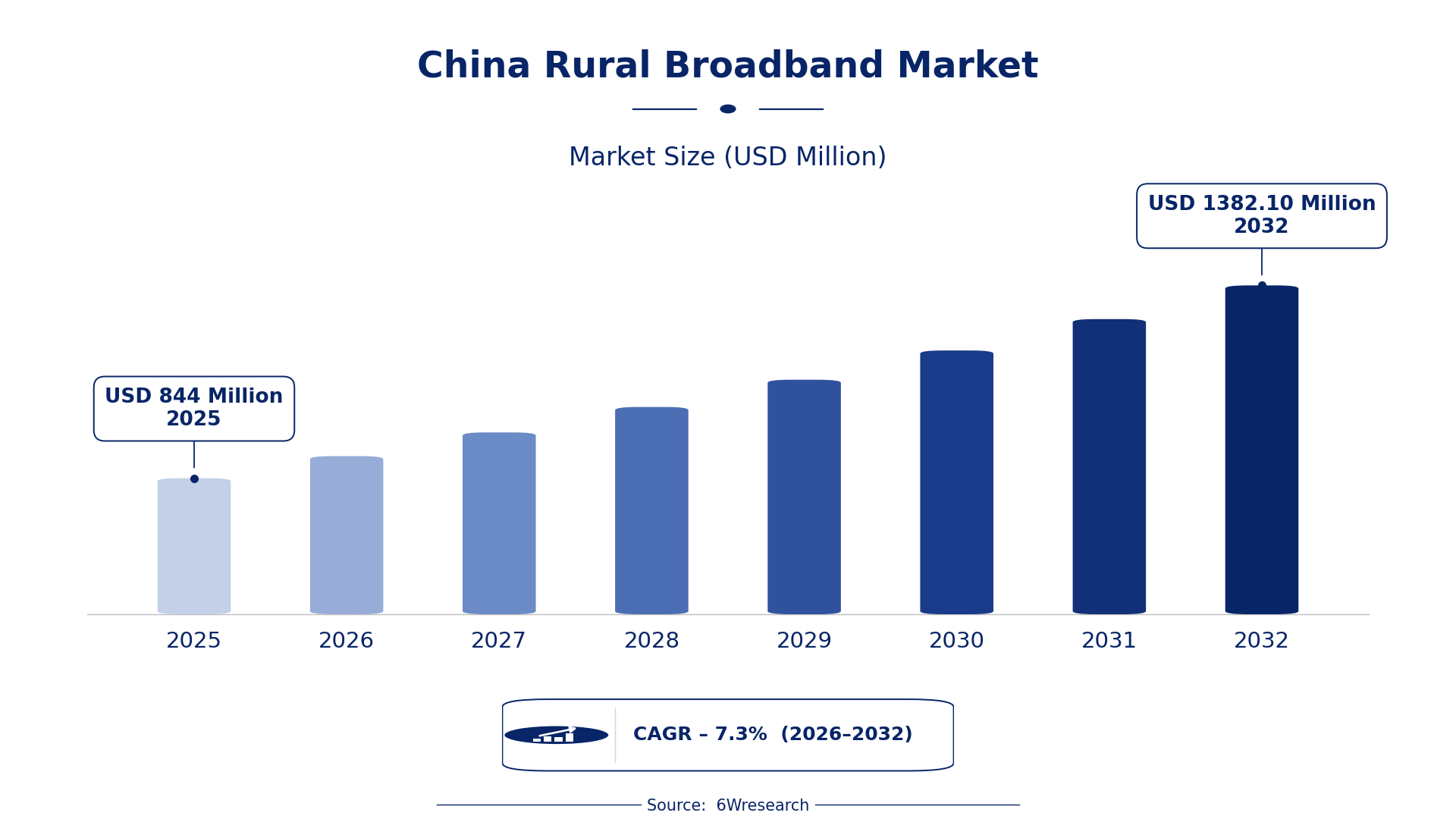
According to 6Wresearch internal database and industry insights, the China Rural Broadband Market was valued at USD 844.0 million in 2025 and is projected to reach USD 1,382.10 million by 2032, growing at a CAGR of approximately 7.3% during 2026–2032.
China Rural Broadband Market Highlights
| Report Metric | Details |
| Report Name | China Rural Broadband Market |
| Market Size 2025 | USD 844.0 million |
| Market Size 2032 | USD 1,382.10 million |
| Absolute Growth 2025–2032 | USD 538.10 million |
| CAGR 2026–2032 | 7.3% |
| Peak Annual Growth | 9.6% in 2032 |
| Forecast Period | 2026–2032 |
| Historical Data | 2022–2025 |
| Base Year | 2025 |
| Leading Technology Type, 2025 | Fiber-to-the-Home (41% share) |
| Leading Network Type, 2025 | Wired Broadband (50% share) |
| Leading Delivery Method, 2025 | Government Initiatives (47% share) |
| Leading End User, 2025 | Rural Households (41% share) |
| Fastest-Growing Technology Type | Fixed Wireless Access (8.7% CAGR) |
| Fastest-Growing Network Type | Wireless Broadband (10.0% CAGR) |
| Fastest-Growing Delivery Method | Private Operators (9.5% CAGR) |
| Fastest-Growing End User | Agriculture Enterprises (8.7% CAGR) |
| Growing Sector | Agriculture |
| Key End Users | Rural Households, Small Businesses, Agriculture Enterprises, Remote Communities |
China Rural Broadband Market Year-wise Growth Rate and Key Drivers (2022–2032)
This graph illustrates the annual growth rates of the market from 2022 to 2032, highlighting a steady upward trajectory and projected market expansion over the forecast period.
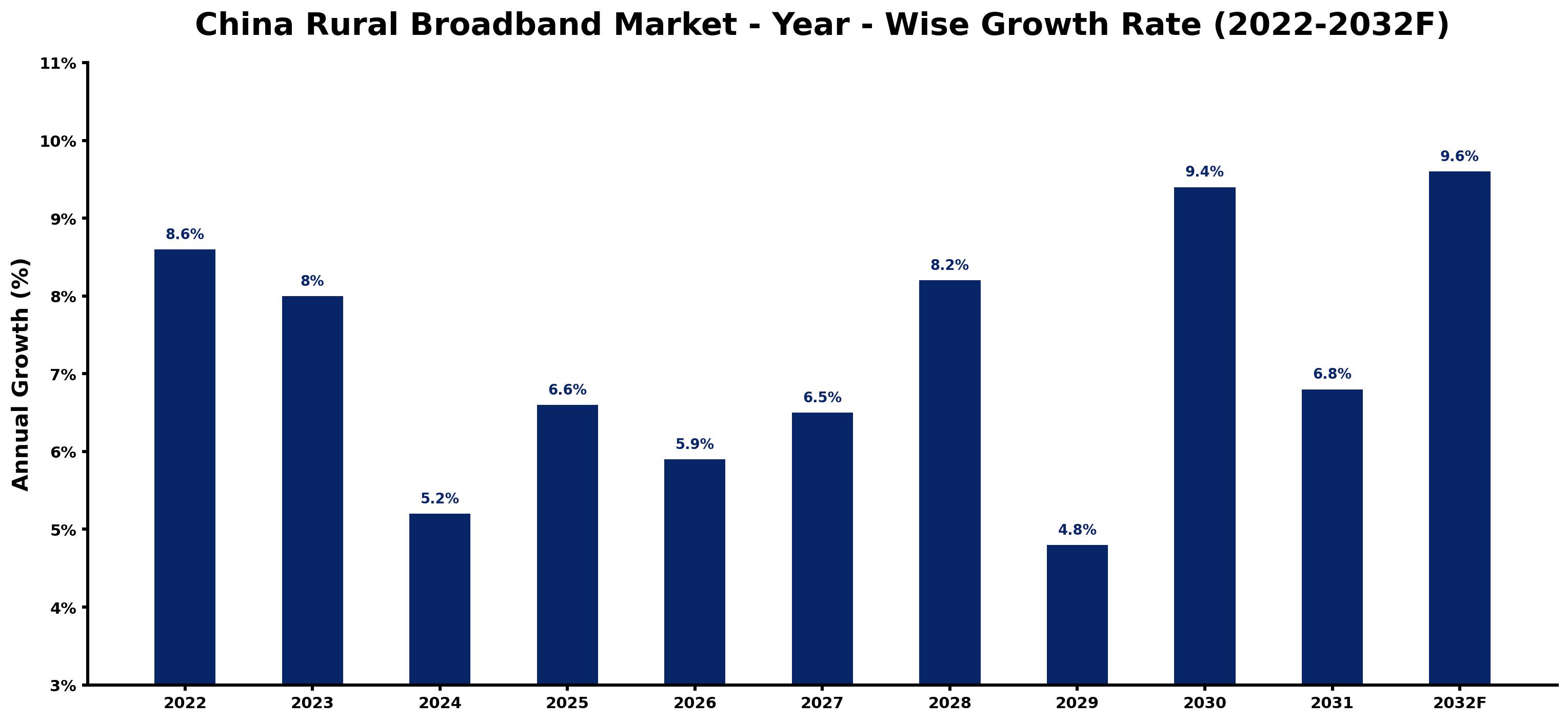
The table below sets out the estimated growth rate for each year and the main factor behind it.
| Year | Estimated Annual Growth (%) | Market Rationale |
| 2022 | 8.6 | The market experienced a strong demand surge due to the National Development and Reform Commission's initiatives. |
| 2023 | 8.0 | Growth slowed as rural broadband infrastructure development faced challenges from geographical barriers. |
| 2024 | 5.2 | Demand continued to rise, albeit at a slower pace, driven by ongoing government support through the Digital Rural Development Strategy. |
| 2025 | 6.6 | An increase in rural broadband subscriptions contributed to a faster growth rate this year, supported by the Rural Broadband Expansion Initiative. |
| 2026 | 5.9 | Growth is expected to slow again as the market adjusts to previous expansions and investments in infrastructure. |
| 2027 | 6.5 | Demand will pick up due to expanding fixed wireless access networks in remote areas, enhancing connectivity for underserved populations. |
| 2028 | 8.2 | The market is projected to experience renewed momentum as average internet speeds improve across rural regions. |
| 2029 | 4.8 | Growth is expected to slow as the market approaches saturation in some rural regions, particularly in areas with existing broadband coverage. |
| 2030 | 9.4 | A surge in demand for smart farming technologies will boost broadband subscriptions this year, driven by agricultural enterprises' reliance on connectivity. |
| 2031 | 6.8 | Growth will decelerate slightly as competition among providers intensifies in rural areas, affecting pricing and service quality. |
| 2032 | 9.6 | The market is projected to peak with high demand for broadband services driven by agricultural enterprises seeking to modernise their operations. |
Note: Market size estimations and growth projections presented in this report are based on 6Wresearch's proprietary forecasting methodology, utilizing the latest available industry data, government publications, and primary research inputs.
China Rural Broadband Market Synopsis
Rural Broadband in China focuses on providing high-speed internet to underserved areas through technologies like fibre optics and fixed wireless access. This market serves over 50 million rural households, with the National Broadband Plan aiming for 100% coverage by 2025. Demand is driven by government initiatives and the increasing reliance on broadband for education, agriculture, and small businesses. As connectivity improves, the market is expected to grow steadily, creating opportunities for rural communities and enterprises.
Market Dynamics Impact Analysis (2026–2032)
| Factor | Type | Impact | Primary Segment Affected |
| Government initiatives funding infrastructure projects | Driver | High | Government Initiatives |
| Growing demand from rural households for reliable internet access | Driver | High | Rural Households |
| Investment in broadband technology by private operators | Opportunity | High | Private Operators |
| Expansion of smart farming practices requiring internet connectivity | Opportunity | High | Agriculture Enterprises |
| Challenges in infrastructure deployment in remote areas | Restraint | Medium | Fixed Wireless Access |
| Limited awareness among rural communities about broadband benefits | Restraint | Medium | Rural Households |
| Competition among providers leading to pricing pressures | Challenge | High | Telecom Providers |
| Regulatory compliance costs for broadband service providers | Challenge | Medium | Telecom Providers |
Evaluation of Drivers in China Rural Broadband Market (2026–2032)
Key forces behind demand, with the segment each one moves most, are listed below.
| Drivers | Primary Segment Affected | Why It Matters (Evidence) |
| Government funding for rural broadband infrastructure | Government Initiatives | The government allocated 10 billion RMB for rural broadband infrastructure development in 2023, improving access. |
| Increasing rural household demand for broadband services | Rural Households | Over 70% of rural small businesses utilize broadband for e-commerce, driving further demand. |
| Expansion of fixed wireless access networks | Fixed Wireless Access | Telecom providers are improving fixed wireless access networks in remote regions to boost connectivity. |
| Investment in smart agriculture technologies | Agriculture Enterprises | China's agricultural sector increasingly relies on broadband for smart farming technologies, boosting subscriptions. |
| Rising competition among private operators | Private Operators | Private operators are expanding their services to rural areas, increasing competition and service quality. |
Over 70% of rural small businesses now utilize broadband for e-commerce, indicating strong demand for reliable internet. The expansion of fixed wireless access networks in remote regions improves connectivity for underserved populations. Additionally, the agricultural sector increasingly relies on broadband for smart farming technologies, which is driving further subscriptions.
Evaluation of Restraints in China Rural Broadband Market
The key brakes on demand, and where they bite hardest, are shown below.
| Market Restraint | Primary Segment Affected | Why It Matters (Evidence) |
| Infrastructure deployment challenges in remote areas | Fixed Wireless Access | Deployment in remote areas is often hindered by geographical barriers, delaying service availability. |
| Low awareness of broadband benefits among rural communities | Rural Households | Many rural households remain unaware of the advantages of broadband, limiting adoption rates. |
| Regulatory compliance costs for service providers | Telecom Providers | Providers face costs to meet regulatory standards, impacting profitability. |
| Limited investment in broadband infrastructure by private operators | Private Operators | Some private operators hesitate to invest in rural areas due to perceived low returns. |
| Competition leading to price wars among providers | Telecom Providers | Intense competition has resulted in price wars, affecting service quality. |
China Rural Broadband Market Challenges
Buyers in the China Rural Broadband market face supply challenges due to uneven infrastructure deployment, with over 50 million rural households still lacking adequate access. This issue exists because telecom providers prioritise urban areas, delaying essential connectivity for rural users and hindering educational and business growth. Service maintenance suffers from a shortage of skilled technicians in remote regions, impacting reliability for users. Regulatory hurdles from the National Telecommunications Regulatory Authority can slow project approvals, causing further delays in service rollout. The average monthly cost of broadband at approximately 100 RMB strains low-income households, limiting their access to high-speed internet.
Trends in the China Rural Broadband Market
The trends below show where the China Rural Broadband Market is heading.
- Shift towards Fibre-to-the-Home technology: As of 2023, Fibre-to-the-Home technology is being deployed in over 200 rural counties, improving internet access for millions of households.
- Increased reliance on broadband for smart agriculture: The agricultural sector's reliance on broadband for smart farming technologies has surged, with over 70% of rural small businesses utilising broadband for operational efficiency.
- Expansion of fixed wireless access networks: Telecom providers are expanding fixed wireless access networks in remote regions, improving connectivity for underserved areas and enhancing service availability.
- Government initiatives driving broadband adoption: The National Broadband Plan aims to achieve 100% coverage in rural areas by 2025, boosting demand for broadband services and improving digital inclusion.
Investment Opportunities in the China Rural Broadband Market
Below are the investment opportunities with the strongest case in the China Rural Broadband Market.
- Growing demand for broadband in agriculture: With over 70% of rural small businesses now utilising broadband, there is an opportunity to invest in agricultural broadband solutions tailored for modern farming practices.
- Partnerships with local telecom providers: Now is the time to collaborate with local telecom providers to improve broadband infrastructure in rural areas, supported by government funding initiatives.
- Investment in smart farming technologies: Investing in broadband solutions tailored for agriculture can meet the rising demand for smart farming practices in rural regions, enhancing productivity and market access.
- Expansion of private operator services: Private operators can capitalise on the increasing demand for broadband by expanding their services in underserved rural areas, supported by government initiatives.
Government Initiatives in the China Rural Broadband Market
The "Rural Broadband Expansion Initiative" launched by the Ministry of Industry and Information Technology in 2023, with a budget of 10 billion RMB, aims to enhance internet access in remote areas. This initiative focuses on deploying infrastructure such as fibre optics and wireless networks to underserved regions, ensuring that more households gain reliable connectivity. Additionally, the "Digital Rural Development Strategy" by the National Development and Reform Commission targets 100% broadband coverage for rural households by 2025, significantly reducing the digital divide. This approach mandates that telecom providers enhance service quality and expand their reach in rural areas. The updated standards from the National Telecommunications Regulatory Authority in 2020 ensure compliance and quality in broadband services, benefiting both producers and consumers.
The Ministry of Agriculture and Rural Affairs utilises the "Smart Agriculture through Broadband" program initiated in 2022 to integrate internet technologies in farming practices. This program funds training sessions for farmers, helping them adopt smart farming techniques that rely on broadband connectivity. Additionally, the government has approved various projects under the "Broadband for All" policy, which enhances connectivity in underserved regions. The National Development and Reform Commission oversees the allocation of funds to improve infrastructure, ensuring that rural communities can access high-speed internet. By supporting these initiatives, the government aims to empower rural households and small businesses, promoting economic growth and development.
Future Insight of the China Rural Broadband Market
Several forward-looking factors should support the China Rural Broadband market over the coming years. The National Broadband Plan aims for full coverage by 2025, significantly broadening access for underserved users. Infrastructure investments, including 10 billion RMB allocated for development, will drive service expansion. Training initiatives from the Ministry of Agriculture and Rural Affairs will promote broadband adoption in agriculture, enhancing smart farming practices. By 2025, efforts to bridge the digital divide will empower more rural small businesses to utilise e-commerce opportunities.
Market Segmentation Analysis
The report offers a comprehensive study of the following market segments and their leading categories in the market.
By Technology Type – Fiber-to-the-Home Dominated, Fixed Wireless Access Expected to Grow Fastest
According to Shubham Padhi, Research Analyst at 6Wresearch, Fiber-to-the-Home held a 41% share of the China Rural Broadband Market by technology type in 2025. Fiber-to-the-Home technology commands the largest market share as it directly connects over 50 million rural households in China to high-speed internet. This technology is essential for improving connectivity in underserved regions, facilitating better access to online resources. Fixed Wireless Access is set to record the highest CAGR in this split, 8.7% over 2026–2032. Fixed Wireless Access is experiencing rapid growth due to its capacity to deliver internet without physical cables, making it particularly suitable for remote areas. The government's allocation of 10 billion RMB for rural broadband infrastructure development in 2023 is significantly boosting this segment's expansion. Suppliers should focus on developing Fixed Wireless Access solutions to meet the rising demand for adaptable internet services in rural regions.
By Network Type – Wired Broadband Dominated, Wireless Broadband Expected to Grow Fastest
With a 50% revenue share in 2025, Wired Broadband was the largest network type category. Wired Broadband leads the market as it includes reliable fiber connections that ensure stable internet access for rural users. This segment benefits from the ongoing government initiatives aimed at achieving 100% coverage in rural areas by 2025. Over 2026–2032, Wireless Broadband is expected to post the fastest growth, at a CAGR of 10.0%. Wireless Broadband is growing quickly due to its ability to connect users without physical infrastructure, making it essential in rural settings. The increasing reliance on broadband for e-commerce by over 70% of rural small businesses drives this growth. Buyers in rural areas may find more competitive pricing and service offerings as Wireless Broadband expands.
By Delivery Method – Government Initiatives Dominated, Private Operators Expected to Grow Fastest
The largest delivery method category in 2025 was Government Initiatives, with a 47% share of total revenue. Government Initiatives hold the largest market share as they provide vital funding and structured programmes aimed at enhancing rural broadband access. The National Broadband Plan, which aims for 100% coverage by 2025, highlights the effectiveness of these initiatives in driving connectivity. Private Operators are projected to grow fastest, at a CAGR of 9.5% during 2026–2032. Private Operators are rapidly increasing their market share by improving competition and service quality in rural areas. The recent government subsidy programme for low-income households is incentivising private sector involvement and propelling growth in this segment. Suppliers should explore collaborations with private operators to leverage government support and enhance service delivery in rural markets.
By End User – Rural Households Dominated, Agriculture Enterprises Expected to Grow Fastest
Rural Households accounted for a 41% market share by end user in 2025. Rural Households constitute the largest end-user group, greatly benefiting from enhanced internet access for education and daily activities. With an average internet speed of 50 Mbps, these households are experiencing significant improvements in their online capabilities. The quickest growth will come from Agriculture Enterprises, forecast to expand at a CAGR of 8.7% between 2026 and 2032. Agriculture Enterprises are the fastest-growing segment as they increasingly rely on broadband for smart farming technologies and better market access. Government training programmes that promote broadband use in agriculture are further accelerating this growth. Suppliers should customise their offerings to address the specific needs of Agriculture Enterprises to capture this swiftly expanding market.
Key Attractiveness of the Report
- 10 Years of Market Numbers
- Historical Data Starting from 2022 to 2025
- Base Year 2025
- Forecast Data until 2032
- Key Performance Indicators Impacting the Market
- Major Upcoming Developments and Projects
Key Highlights of the Report:
- China Rural Broadband Market Outlook
- Market Size of China Rural Broadband Market, 2025
- Forecast of China Rural Broadband Market, 2032
- Historical Data and Forecast of China Rural Broadband Revenues & Volume for the Period 2022 - 2032F
- China Rural Broadband Market Trend Evolution
- China Rural Broadband Market Drivers and Challenges
- China Rural Broadband Price Trends
- China Rural Broadband Porter's Five Forces
- China Rural Broadband Industry Life Cycle
- Historical Data and Forecast of China Rural Broadband Market Revenues & Volume By Technology Type for the Period 2022 - 2032F
- Historical Data and Forecast of China Rural Broadband Market Revenues & Volume By Fiber-to-the-Home for the Period 2022 - 2032F
- Historical Data and Forecast of China Rural Broadband Market Revenues & Volume By Fixed Wireless Access for the Period 2022 - 2032F
- Historical Data and Forecast of China Rural Broadband Market Revenues & Volume By Satellite Internet for the Period 2022 - 2032F
- Historical Data and Forecast of China Rural Broadband Market Revenues & Volume By DSL Connections for the Period 2022 - 2032F
- Historical Data and Forecast of China Rural Broadband Market Revenues & Volume By Network Type for the Period 2022 - 2032F
- Historical Data and Forecast of China Rural Broadband Market Revenues & Volume By Wired Broadband for the Period 2022 - 2032F
- Historical Data and Forecast of China Rural Broadband Market Revenues & Volume By Wireless Broadband for the Period 2022 - 2032F
- Historical Data and Forecast of China Rural Broadband Market Revenues & Volume By Satellite for the Period 2022 - 2032F
- Historical Data and Forecast of China Rural Broadband Market Revenues & Volume By Copper Line for the Period 2022 - 2032F
- Historical Data and Forecast of China Rural Broadband Market Revenues & Volume By Delivery Method for the Period 2022 - 2032F
- Historical Data and Forecast of China Rural Broadband Market Revenues & Volume By Government Initiatives for the Period 2022 - 2032F
- Historical Data and Forecast of China Rural Broadband Market Revenues & Volume By Private Operators for the Period 2022 - 2032F
- Historical Data and Forecast of China Rural Broadband Market Revenues & Volume By National Rollouts for the Period 2022 - 2032F
- Historical Data and Forecast of China Rural Broadband Market Revenues & Volume By Telecom Providers for the Period 2022 - 2032F
- Historical Data and Forecast of China Rural Broadband Market Revenues & Volume By End User for the Period 2022 - 2032F
- Historical Data and Forecast of China Rural Broadband Market Revenues & Volume By Rural Households for the Period 2022 - 2032F
- Historical Data and Forecast of China Rural Broadband Market Revenues & Volume By Small Businesses for the Period 2022 - 2032F
- Historical Data and Forecast of China Rural Broadband Market Revenues & Volume By Remote Communities for the Period 2022 - 2032F
- Historical Data and Forecast of China Rural Broadband Market Revenues & Volume By Agriculture Enterprises for the Period 2022 - 2032F
- China Rural Broadband Import Export Trade Statistics
- Market Opportunity Assessment By Technology Type
- Market Opportunity Assessment By Network Type
- Market Opportunity Assessment By Delivery Method
- Market Opportunity Assessment By End User
- China Rural Broadband Top Companies Market Share
- China Rural Broadband Competitive Benchmarking By Technical and Operational Parameters
- China Rural Broadband Company Profiles
- China Rural Broadband Key Strategic Recommendations
Market Covered
This report examines the market across the segments below.
By Technology Type
- Fiber-to-the-Home
- Fixed Wireless Access
- Satellite Internet
- DSL Connections
By Network Type
- Wired Broadband
- Wireless Broadband
- Satellite
- Copper Line
By Delivery Method
- Government Initiatives
- Private Operators
- National Rollouts
- Telecom Providers
By End User
- Rural Households
- Small Businesses
- Remote Communities
- Agriculture Enterprises































