India SaaS Operations Market Size & Growth Rate
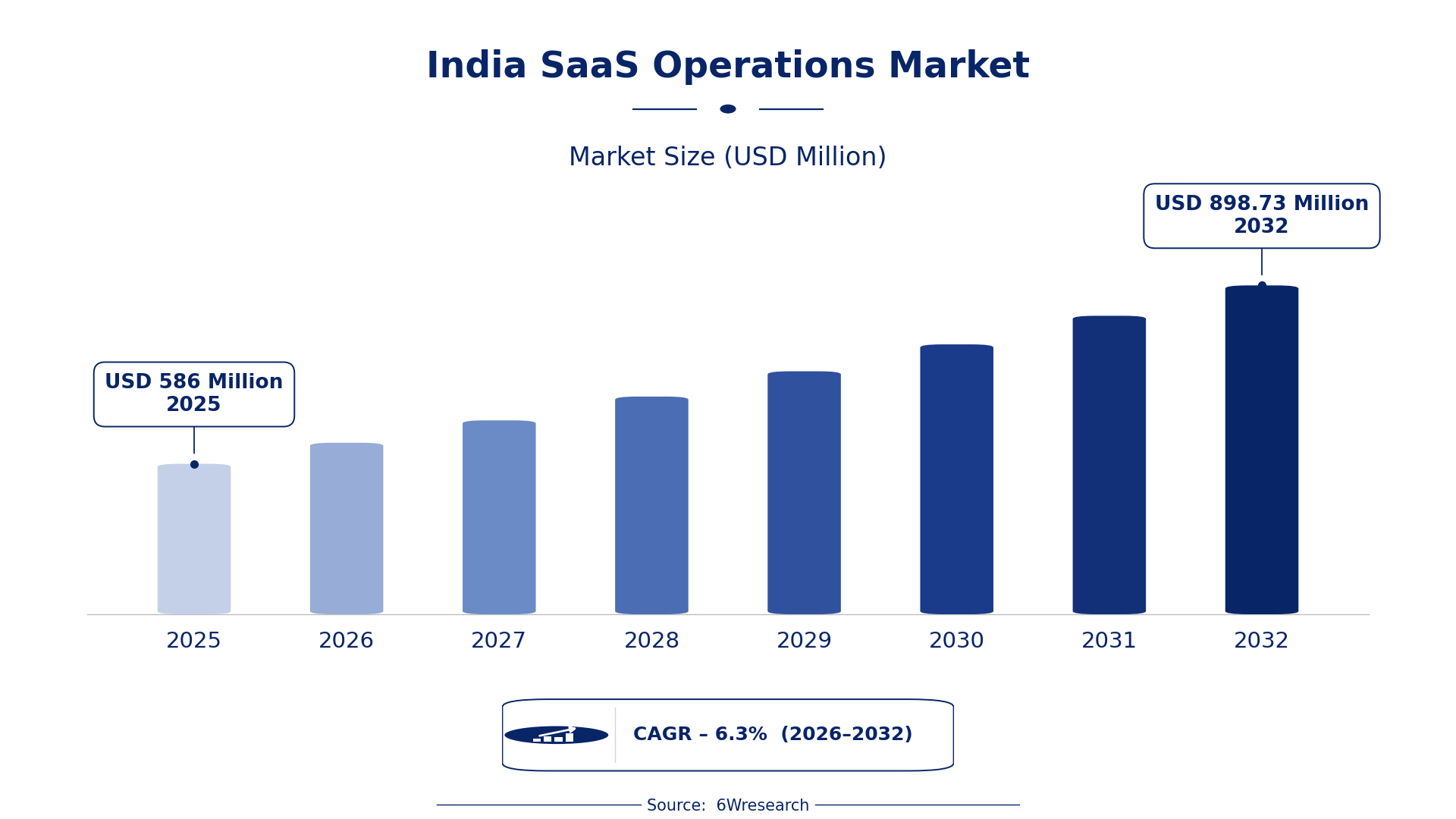
According to 6Wresearch internal database and industry insights, the India SaaS Operations Market was valued at USD 586.0 million in 2025 and is projected to reach USD 898.73 million by 2032, growing at a CAGR of approximately 6.3% during 2026–2032.
India SaaS Operations Market Highlights
| Report Metric | Details |
| Report Name | India SaaS Operations Market |
| Market Size 2025 | USD 586.0 million |
| Market Size 2032 | USD 898.73 million |
| Absolute Growth 2025–2032 | USD 312.73 million |
| CAGR 2026–2032 | 6.3% |
| Peak Annual Growth | 8.5% in 2030 |
| Forecast Period | 2026–2032 |
| Historical Data | 2022–2025 |
| Base Year | 2025 |
| Leading Functionality Type, 2025 | SaaS Management (44% share) |
| Leading Integration Level, 2025 | Multi-App (42% share) |
| Leading Application Area, 2025 | License Management (41% share) |
| Leading End User, 2025 | Large Corporations (44% share) |
| Fastest-Growing Functionality Type | Spend Optimization (7.8% CAGR) |
| Fastest-Growing Integration Level | Low-Code Integration (8.4% CAGR) |
| Fastest-Growing Application Area | Cost Control (8.1% CAGR) |
| Fastest-Growing End User | Finance Departments (8.7% CAGR) |
| Growing Sector | IT and Software Services |
| Key End Users | Large Corporations, Finance Departments, SaaS Vendors, Legal Teams |
India SaaS Operations Market Year-wise Growth Rate and Key Drivers (2022–2032)
This graph illustrates the annual growth rates of the market from 2022 to 2032, highlighting a steady upward trajectory and projected market expansion over the forecast period.
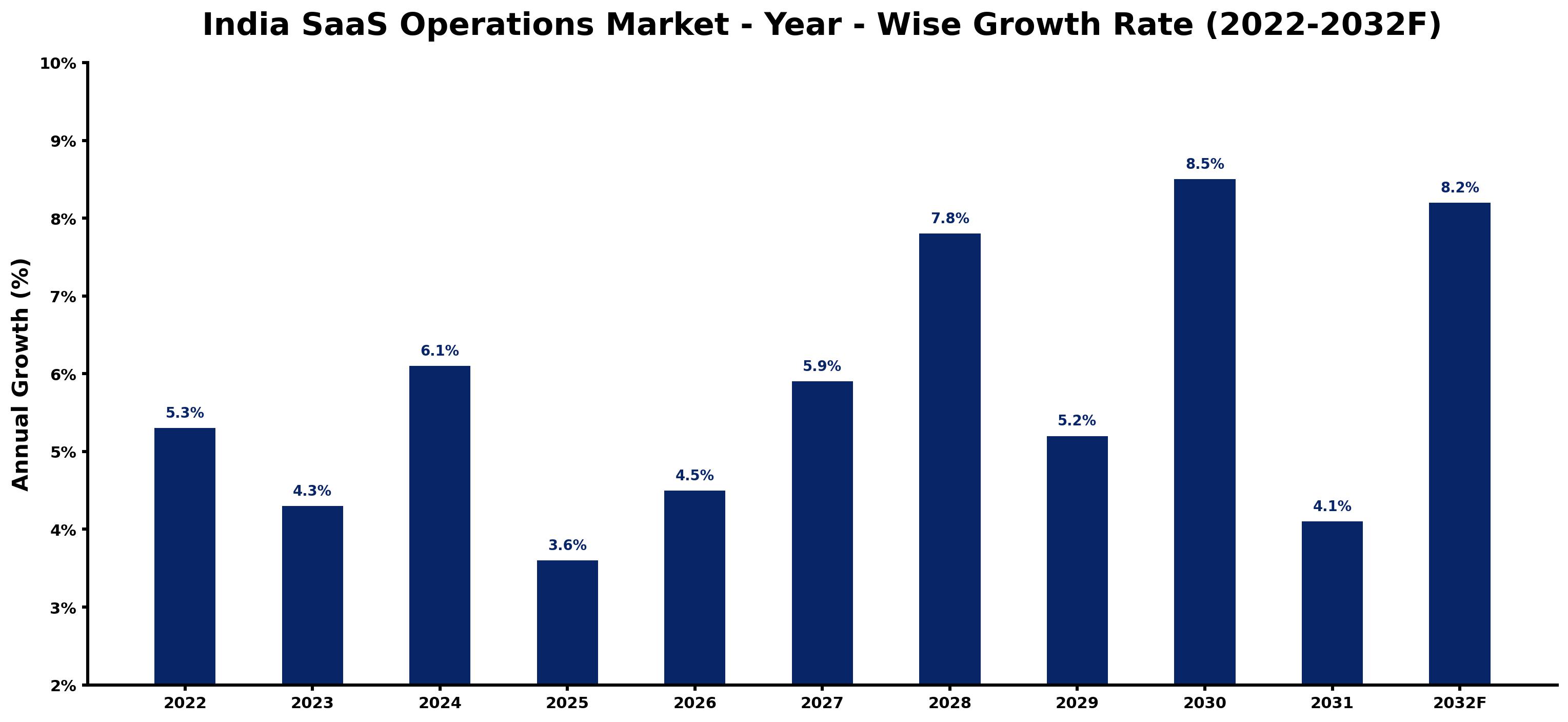
Annual growth estimates for each year appear below with the principal reason behind them, explaining the shifts that set the pace of the market.
| Year | Estimated Annual Growth (%) | Market Rationale |
| 2022 | 5.3 | The market experienced steady growth, driven by increased SaaS adoption among enterprises. |
| 2023 | 4.3 | Growth slowed due to market adjustments as companies evaluated their software needs. |
| 2024 | 6.1 | Demand surged as more businesses recognised the efficiency benefits of SaaS solutions. |
| 2025 | 3.6 | A slowdown occurred as companies faced budget constraints amidst economic uncertainty. |
| 2026 | 4.5 | Growth picked up again as organisations sought to optimise their software expenditures. |
| 2027 | 5.9 | Increased demand for workflow automation solutions supported market growth. |
| 2028 | 7.8 | The market expanded significantly as enterprises embraced low-code integration for rapid deployment. |
| 2029 | 5.2 | Growth slowed as competition intensified among SaaS providers. |
| 2030 | 8.5 | A peak in growth was reached, driven by heightened demand for compliance monitoring solutions. |
| 2031 | 4.1 | The market saw a slowdown as companies reassessed their SaaS investments. |
| 2032 | 8.2 | Growth accelerated again as large corporations increasingly adopted advanced SaaS solutions. |
Note: Market size estimations and growth projections presented in this report are based on 6Wresearch's proprietary forecasting methodology, utilizing the latest available industry data, government publications, and primary research inputs.
India SaaS Operations Market Synopsis
SaaS Operations in India encompasses cloud-based software solutions that manage diverse business functions. These solutions improve operational efficiency, manage software subscriptions, and ensure compliance. The India SaaS Operations Market is expanding due to rising enterprise adoption, with around 70% of companies utilising SaaS. The Digital India initiative and the support of the National Association of Software and Service Companies (NASSCOM) further fuel this growth, creating a vibrant environment for SaaS providers and users alike.
Market Dynamics Impact Analysis (2026–2032)
| Factor | Type | Impact | Primary Segment Affected |
| Increased enterprise SaaS adoption | Driver | High | SaaS Management |
| Growing demand for workflow automation | Driver | High | Workflow Automation |
| Emerging need for compliance solutions | Opportunity | High | Compliance Monitoring |
| Rising interest in low-code solutions | Opportunity | High | Low-Code Integration |
| Budget constraints limiting software investments | Restraint | Medium | Spend Optimization |
| Intense competition among SaaS providers | Restraint | Medium | SaaS Management |
| Talent shortages in tech development | Challenge | High | SaaS Vendors |
| Regulatory compliance complexities | Challenge | Medium | Compliance Monitoring |
Evaluation of Drivers in India SaaS Operations Market (2026–2032)
The table below links each growth driver to the segment it affects and the evidence for it.
| Drivers | Primary Segment Affected | Why It Matters (Evidence) |
| Increasing SaaS adoption rates among enterprises | SaaS Management | Around 70% of enterprises in India are adopting SaaS solutions, driving demand for management tools to optimise operations. |
| Need for operational efficiency | Workflow Automation | The IT sector, contributing 8% to GDP, drives demand for automation to improve productivity and streamline processes. |
| Focus on cost control and optimisation | Spend Optimization | Businesses are actively seeking solutions to manage software expenditures effectively, particularly in the current economic climate. |
| Demand for compliance solutions in regulated industries | Compliance Monitoring | Regulated industries, such as finance and healthcare, require adherence to strict compliance standards, boosting demand for monitoring tools. |
| Growth in low-code development platforms | Low-Code Integration | The rise of low-code platforms facilitates rapid application deployment, increasing demand for integration solutions among enterprises. |
The SaaS Operations market in India is growing on the back of increased enterprise adoption, operational efficiency needs, and compliance requirements. Approximately 70% of enterprises are adopting SaaS solutions, which drives demand for management tools to optimise operations. The IT sector contributes around 8% to the GDP, creating a strong need for automation to improve productivity. Companies are actively seeking solutions to manage software expenditures effectively, further propelling demand. The rise of low-code platforms facilitates rapid application deployment, increasing demand for integration solutions among enterprises.
Evaluation of Restraints in India SaaS Operations Market
The following restraints limit how fast demand can grow.
| Market Restraint | Primary Segment Affected | Why It Matters (Evidence) |
| Budget constraints limiting software investments | Spend Optimization | Many companies are facing budget restrictions, impacting their ability to invest in new software solutions, which affects overall IT budgets. |
| Intense competition among SaaS providers | SaaS Management | The growing number of SaaS providers creates pricing pressures, making it challenging for some to maintain profitability in a crowded market. |
| Talent shortages in tech development | SaaS Vendors | A lack of skilled professionals in technology hampers the development of SaaS solutions, delaying product launches and increasing costs for providers. |
| Regulatory compliance complexities | Compliance Monitoring | Navigating complex regulations can deter companies from adopting new SaaS solutions, leading to increased operational costs and delays in implementation. |
| Market saturation in certain application areas | Workflow Automation | As more companies adopt similar solutions, differentiation becomes challenging in a saturated market, limiting growth opportunities for providers. |
India SaaS Operations Market Challenges
Buyers and suppliers in the India SaaS Operations market face intense competition from both domestic and international providers, which drives down prices and reduces profit margins for local firms. Regulatory compliance is another major challenge, as meeting standards like ISO/IEC 27001 can raise operational costs and delay product launches for developers. Buyers often struggle with the rapid pace of technological change, leading to increased training and update costs that can reach up to 20% of their operational budgets. A shortage of skilled professionals in cloud technology further complicates matters, forcing companies to invest heavily in employee training, which can detract from their innovation efforts.
Trends in the India SaaS Operations Market
Below mentioned are some of the trends shaping the India SaaS Operations Market growth.
- Shift towards Low-Code Integration: Bengaluru is experiencing a shift towards low-code integration solutions, enabling faster application deployment. This trend is supported by a projected growth rate of 8.4% in low-code platforms, facilitating rapid development.
- Growing Focus on Compliance Monitoring: The need for compliance monitoring solutions has intensified, particularly in regulated industries. This shift is evidenced by the increasing demand for adherence to standards like ISO/IEC 27001, critical for SaaS providers.
- Increased Adoption of Workflow Automation: The trend towards workflow automation is gaining momentum as businesses seek to streamline operations. This is reflected in the growing interest in automation tools, projected to rise by 7.8% in the coming years, enhancing productivity.
- Expansion of SaaS Management Solutions: The SaaS Management segment is expanding as enterprises strive to manage multiple applications efficiently. This growth is highlighted by the 44% market share held by SaaS Management solutions, indicating strong demand.
Investment Opportunities in the India SaaS Operations Market
Several openings in the India SaaS Operations Market merit attention from investors.
- Large Corporations seeking SaaS solutions: Large Corporations are increasingly looking for SaaS solutions to optimise operations, with the market projected to reach USD 586.0 million by 2025, indicating a strong demand for management tools.
- Growing demand for compliance solutions: With over 1,000 SaaS companies in India, there is an opportunity to supply compliance monitoring tools, particularly in regulated sectors like finance and healthcare, where adherence is essential.
- Investment in low-code platforms: The current gap in low-code integration solutions presents an opportunity for investment, especially as adoption rates rise to 8.4%, creating demand for rapid deployment capabilities.
- Bengaluru as a tech hub: Bengaluru, housing over 60% of Indian SaaS companies, offers a prime location for investment in SaaS operations and development, capitalising on the city's thriving tech ecosystem.
Government Initiatives in the India SaaS Operations Market
The regulatory framework for SaaS Operations in India is shaped by several key initiatives. The Digital India initiative, launched in 2020, aims to improve IT infrastructure and increase technology adoption across sectors. Additionally, the National Digital Communications Policy, set to enhance digital infrastructure by 2025, supports the growth of SaaS by improving connectivity and access to cloud services. The Make in India initiative encourages local SaaS development, fostering innovation and reducing dependency on foreign solutions, benefiting both producers and buyers.
The Ministry of Electronics and Information Technology (MeitY) plays a vital role in promoting cloud computing and SaaS development. It approves various technology projects and provides funding under the Startup India initiative, which supports technology startups with incubation facilities. The Software Technology Parks of India (STPI) also offers support to SaaS startups, facilitating their growth and development through infrastructure and resources, enabling them to compete effectively in the market.
Future Insight of the India SaaS Operations Market
The India SaaS Operations market is set for substantial evolution by 2032, influenced by government initiatives like Digital India and the National Digital Communications Policy. These programmes will enhance IT infrastructure, enabling faster deployment of SaaS solutions across various sectors. The integration of AI and machine learning will become commonplace, allowing providers to offer tailored functionalities that meet specific client needs. The industry is projected to create over 1 million new jobs in the next five years, underscoring its growing importance in the Indian economy.
Market Segmentation Analysis
Each segment group is reviewed below, with the leader by share and the fastest grower by CAGR.
By Functionality Type – SaaS Management Dominated, Spend Optimization Expected to Grow Fastest
According to Shubham Padhi, Research Analyst at 6Wresearch, SaaS Management took a 44% share of functionality type in 2025, more than any other category. SaaS Management holds the largest share as it is crucial for effectively managing multiple SaaS applications, especially in large enterprises that require streamlined operations. With India's SaaS adoption rate around 70%, this functionality is increasingly indispensable for efficient business management. Spend Optimization is set to record the highest CAGR in this split, 7.8% over 2026–2032. Spend Optimization is witnessing rapid growth as organizations aim to control and optimize their software expenditures, particularly in a competitive market. The average annual growth rate of SaaS in India, estimated at 30%, indicates a strong focus on operational efficiency and cost management. Suppliers should prioritise robust SaaS Management solutions to meet the rising demand from large enterprises.
By Integration Level – Multi-App Dominated, Low-Code Integration Expected to Grow Fastest
In 2025, Multi-App led the integration level split with a 42% share. Multi-App integration captures the largest share due to its ability to connect various applications seamlessly, enhancing operational efficiency across businesses. This is particularly relevant in tech hubs like Bengaluru, where a significant portion of Indian SaaS companies are based. Low-Code Integration is projected to grow fastest, at a CAGR of 8.4% during 2026–2032. Low-Code Integration is growing quickly as it allows for the rapid deployment of applications with minimal coding, addressing the need for agility in business processes. This trend aligns with government initiatives aimed at improving digital infrastructure in India. Buyers will benefit from investing in Low-Code Integration solutions to accelerate their digital transformation efforts.
By Application Area – License Management Dominated, Cost Control Expected to Grow Fastest
License Management held a 41% share of the India SaaS Operations Market by application area in 2025. License Management commands the largest share as it is vital for tracking software licenses and ensuring compliance, which is essential for large corporations. The IT sector's contribution of approximately 8% to India's GDP underscores the importance of effective license management in business operations. The quickest growth will come from Cost Control, forecast to expand at a CAGR of 8.1% between 2026 and 2032. Cost Control is the fastest-growing area as companies strive to manage their IT budgets more effectively amid rising operational costs. The increasing adoption of SaaS solutions reflects a strong emphasis on financial prudence and budget management. Suppliers should focus on enhancing solutions that improve Cost Control capabilities to cater to cost-conscious enterprises.
By End User – Large Corporations Dominated, Finance Departments Expected to Grow Fastest
The largest end user category in 2025 was Large Corporations, with a 44% share of total revenue. Large Corporations dominate the market share as they are the primary users of SaaS for various operational needs, leveraging these solutions to boost productivity. The employment of over 4 million people in the IT and software services sector highlights the significance of SaaS in large-scale operations. Over 2026–2032, Finance Departments are expected to post the fastest growth, at a CAGR of 8.7%. Finance Departments are rapidly growing as they utilise SaaS for financial management and reporting, which is essential in today's data-driven environment. This trend is likely to continue as businesses seek more efficient financial operations. Suppliers should tailor their offerings to meet the specific needs of Finance Departments to capture this expanding segment.
Key Attractiveness of the Report
- 10 Years of Market Numbers
- Historical Data Starting from 2022 to 2025
- Base Year 2025
- Forecast Data until 2032
- Key Performance Indicators Impacting the Market
- Major Upcoming Developments and Projects
Key Highlights of the Report:
- India SaaS Operations Market Outlook
- Market Size of India SaaS Operations Market, 2025
- Forecast of India SaaS Operations Market, 2032
- Historical Data and Forecast of India SaaS Operations Revenues & Volume for the Period 2022 - 2032F
- India SaaS Operations Market Trend Evolution
- India SaaS Operations Market Drivers and Challenges
- India SaaS Operations Price Trends
- India SaaS Operations Porter's Five Forces
- India SaaS Operations Industry Life Cycle
- Historical Data and Forecast of India SaaS Operations Market Revenues & Volume By Functionality Type for the Period 2022 - 2032F
- Historical Data and Forecast of India SaaS Operations Market Revenues & Volume By SaaS Management for the Period 2022 - 2032F
- Historical Data and Forecast of India SaaS Operations Market Revenues & Volume By Spend Optimization for the Period 2022 - 2032F
- Historical Data and Forecast of India SaaS Operations Market Revenues & Volume By Workflow Automation for the Period 2022 - 2032F
- Historical Data and Forecast of India SaaS Operations Market Revenues & Volume By Compliance Monitoring for the Period 2022 - 2032F
- Historical Data and Forecast of India SaaS Operations Market Revenues & Volume By Integration Level for the Period 2022 - 2032F
- Historical Data and Forecast of India SaaS Operations Market Revenues & Volume By Multi-App for the Period 2022 - 2032F
- Historical Data and Forecast of India SaaS Operations Market Revenues & Volume By Low-Code Integration for the Period 2022 - 2032F
- Historical Data and Forecast of India SaaS Operations Market Revenues & Volume By High Integration for the Period 2022 - 2032F
- Historical Data and Forecast of India SaaS Operations Market Revenues & Volume By Plug & Play for the Period 2022 - 2032F
- Historical Data and Forecast of India SaaS Operations Market Revenues & Volume By Application Area for the Period 2022 - 2032F
- Historical Data and Forecast of India SaaS Operations Market Revenues & Volume By License Management for the Period 2022 - 2032F
- Historical Data and Forecast of India SaaS Operations Market Revenues & Volume By Cost Control for the Period 2022 - 2032F
- Historical Data and Forecast of India SaaS Operations Market Revenues & Volume By HR/Payroll Systems for the Period 2022 - 2032F
- Historical Data and Forecast of India SaaS Operations Market Revenues & Volume By Regulated Industries for the Period 2022 - 2032F
- Historical Data and Forecast of India SaaS Operations Market Revenues & Volume By End User for the Period 2022 - 2032F
- Historical Data and Forecast of India SaaS Operations Market Revenues & Volume By Large Corporations for the Period 2022 - 2032F
- Historical Data and Forecast of India SaaS Operations Market Revenues & Volume By Finance Departments for the Period 2022 - 2032F
- Historical Data and Forecast of India SaaS Operations Market Revenues & Volume By SaaS Vendors for the Period 2022 - 2032F
- Historical Data and Forecast of India SaaS Operations Market Revenues & Volume By Legal Teams for the Period 2022 - 2032F
- India SaaS Operations Import Export Trade Statistics
- Market Opportunity Assessment By Functionality Type
- Market Opportunity Assessment By Integration Level
- Market Opportunity Assessment By Application Area
- Market Opportunity Assessment By End User
- India SaaS Operations Top Companies Market Share
- India SaaS Operations Competitive Benchmarking By Technical and Operational Parameters
- India SaaS Operations Company Profiles
- India SaaS Operations Key Strategic Recommendations
Market Covered
Segments analysed in this report are listed below.
By Functionality Type
- SaaS Management
- Spend Optimization
- Workflow Automation
- Compliance Monitoring
By Integration Level
- Multi-App
- Low-Code Integration
- High Integration
- Plug & Play
By Application Area
- License Management
- Cost Control
- HR/Payroll Systems
- Regulated Industries
By End User
- Large Corporations
- Finance Departments
- SaaS Vendors
- Legal Teams































