China SaaS Operations Market Size & Growth Rate
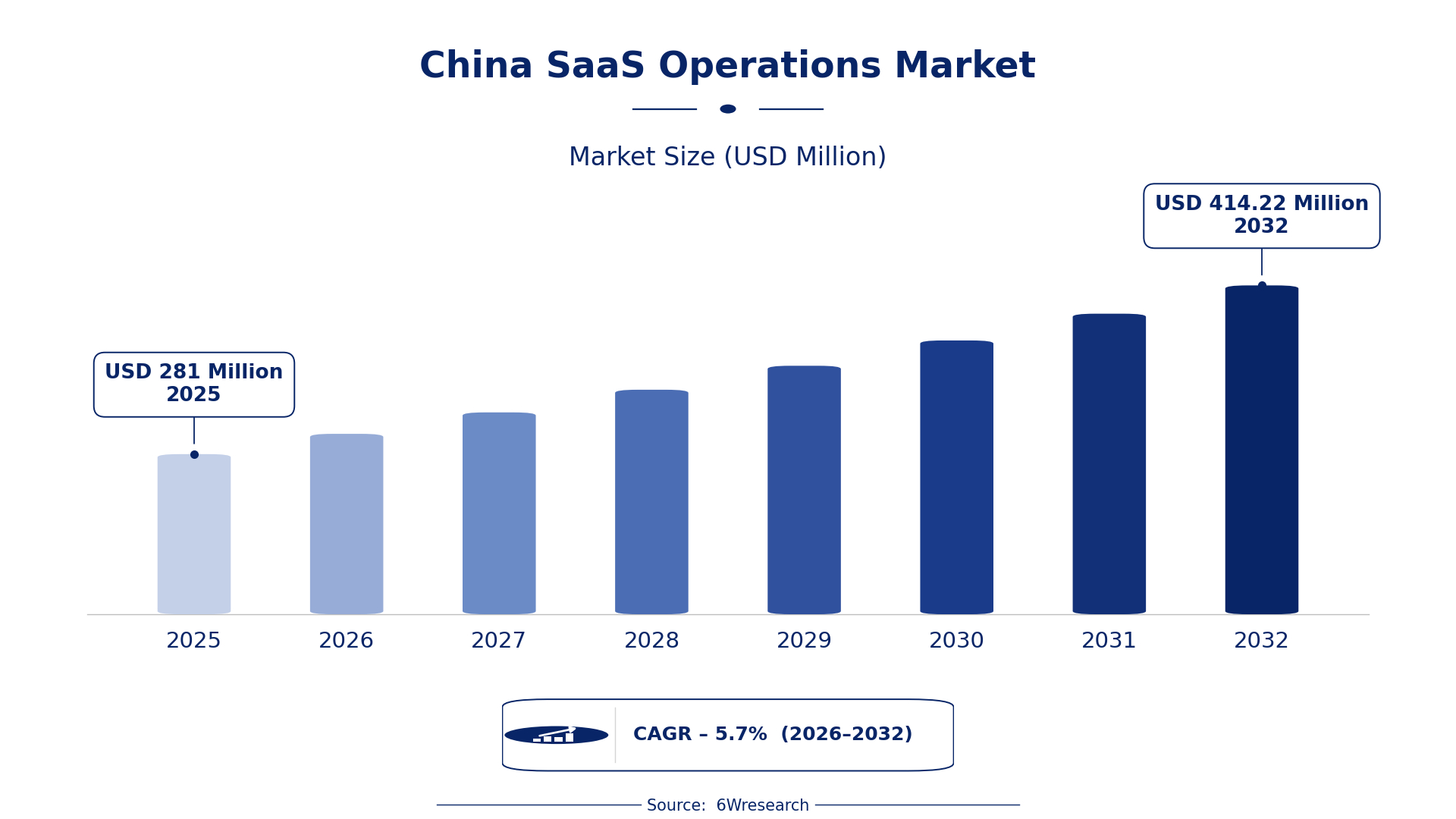
According to 6Wresearch internal database and industry insights, the China SaaS Operations Market was valued at USD 281.0 million in 2025 and is projected to reach USD 414.22 million by 2032, growing at a CAGR of approximately 5.7% during 2026–2032.
China SaaS Operations Market Highlights
| Report Metric | Details |
| Report Name | China SaaS Operations Market |
| Market Size 2025 | USD 281.0 million |
| Market Size 2032 | USD 414.22 million |
| Absolute Growth 2025–2032 | USD 133.22 million |
| CAGR 2026–2032 | 5.7% |
| Peak Annual Growth | 8.2% in 2031 |
| Forecast Period | 2026–2032 |
| Historical Data | 2022–2025 |
| Base Year | 2025 |
| Leading Functionality Type, 2025 | SaaS Management (39% share) |
| Leading Integration Level, 2025 | High Integration (39% share) |
| Leading Application Area, 2025 | HR/Payroll Systems (50% share) |
| Leading End User, 2025 | Large Corporations (47% share) |
| Fastest-Growing Functionality Type | Spend Optimization (8.5% CAGR) |
| Fastest-Growing Application Area | Cost Control (8.2% CAGR) |
| Fastest-Growing End User | Finance Departments (6.8% CAGR) |
| Growing Sector | SaaS Management |
| Key End Users | Large Corporations, Finance Departments, SaaS Vendors |
China SaaS Operations Market Year-wise Growth Rate and Key Drivers (2022–2032)
This graph illustrates the annual growth rates of the market from 2022 to 2032, highlighting a steady upward trajectory and projected market expansion over the forecast period.
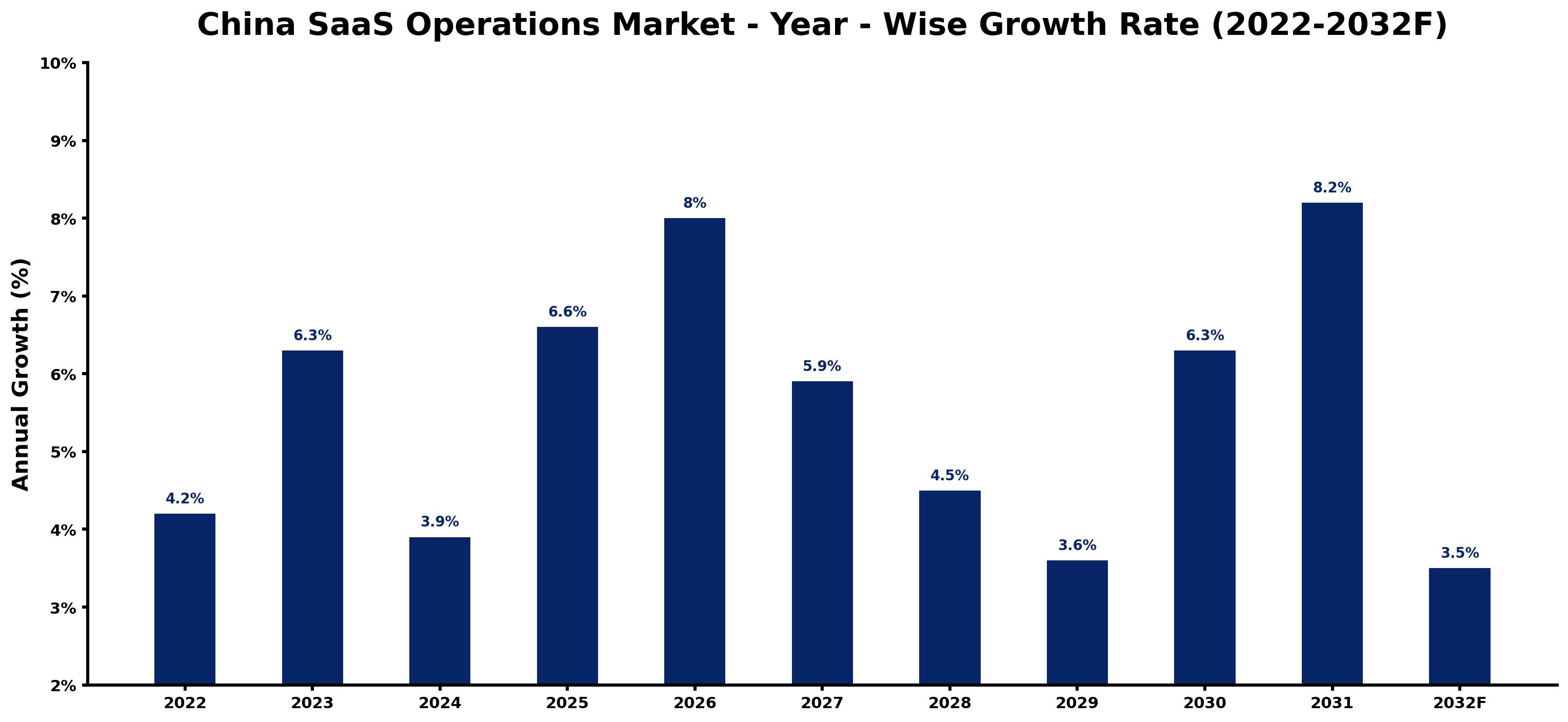
Year by year, the estimates below pair each growth rate with the development that shaped it.
| Year | Estimated Annual Growth (%) | Market Rationale |
| 2022 | 4.2 | SaaS adoption was strong among large corporations, reflecting the market's established presence. |
| 2023 | 6.3 | Demand surged due to increased digital transformation initiatives across various sectors. |
| 2024 | 3.9 | Growth slowed as companies reassessed their SaaS investments amid economic uncertainties. |
| 2025 | 6.6 | A resurgence in demand occurred as enterprises focused on operational efficiency and cost control. |
| 2026 | 8.0 | The market is expected to grow as high integration needs drive SaaS adoption. |
| 2027 | 5.9 | A slight slowdown is projected as companies consolidate their existing SaaS solutions. |
| 2028 | 4.5 | Demand will continue to slow as businesses focus on optimizing their SaaS expenditures. |
| 2029 | 3.6 | Growth is expected to decelerate as market saturation begins to take effect in some sectors. |
| 2030 | 6.3 | A rebound in growth is anticipated as companies renew their focus on digital transformation. |
| 2031 | 8.2 | The market is projected to peak with strong demand for innovative SaaS solutions across industries. |
| 2032 | 3.5 | Growth is expected to moderate as the market stabilizes after recent peaks. |
Note: Market size estimations and growth projections presented in this report are based on 6Wresearch's proprietary forecasting methodology, utilizing the latest available industry data, government publications, and primary research inputs.
China SaaS Operations Market Synopsis
SaaS Operations in China encompasses cloud-based software solutions that manage various business functions through subscription models. These solutions are essential for improving operational efficiency, cost management, and regulatory compliance. The China SaaS Operations Market is expanding rapidly, driven by increasing adoption among large corporations and a burgeoning number of SaaS vendors. In 2023, the 'Cloud Computing Development Plan' is stimulating demand, promoting innovation and investment in the sector.
Market Dynamics Impact Analysis (2026–2032)
| Factor | Type | Impact | Primary Segment Affected |
| Increasing adoption of SaaS solutions among large corporations enhances operational efficiency. | Driver | High | SaaS Management |
| Growing need for compliance monitoring in regulated industries drives demand for SaaS solutions. | Driver | High | Compliance Monitoring |
| Investment in SaaS startups is rising, creating opportunities for innovation. | Opportunity | High | SaaS Vendors |
| The Beijing-Tianjin-Hebei region is emerging as a hub for SaaS development, attracting investments. | Opportunity | Medium | SaaS Management |
| Budget constraints limit the adoption of new SaaS solutions by SMEs. | Restraint | High | SaaS Management |
| Concerns over data security may hinder the growth of SaaS adoption in sensitive sectors. | Restraint | Medium | Compliance Monitoring |
| The SaaS Operations market in China faces challenges from rapid technological changes. | Challenge | High | SaaS Management |
| Integration issues between different SaaS applications can delay implementation. | Challenge | Medium | SaaS Management |
Evaluation of Drivers in China SaaS Operations Market (2026–2032)
Key forces behind demand, with the segment each one moves most, are listed below.
| Drivers | Primary Segment Affected | Why It Matters (Evidence) |
| High integration needs among businesses drive demand for SaaS Management solutions. | SaaS Management | Over 70% of large corporations in China use SaaS solutions for operations, indicating a strong market demand. |
| The push for compliance monitoring in regulated industries increases demand for SaaS solutions. | Compliance Monitoring | Legal teams in regulated industries are increasingly adopting SaaS for compliance monitoring, reflecting a growing need for these solutions. |
| Rising digital transformation initiatives lead to increased SaaS spending. | SaaS Management | The average spending on SaaS per enterprise in China is around 100,000 RMB annually, highlighting significant investment in these technologies. |
| The growth of SaaS vendors boosts service offerings and competition in the market. | SaaS Vendors | As of 2022, there are over 300 SaaS companies registered in Shenzhen, enhancing market competition. |
| The need for workflow automation drives demand for SaaS solutions across sectors. | Workflow Automation | The SaaS market in China is growing at a rate of 20% annually according to industry reports, indicating strong demand. |
The SaaS Operations market in China is expanding as large corporations increasingly turn to SaaS solutions for cost management and operational efficiency. The average spending on SaaS per enterprise in China is approximately 100,000 RMB annually, reflecting a strong commitment to these technologies. The influx of numerous SaaS vendors is intensifying competition and innovation in the market, while the push for workflow automation is further driving demand, especially in regulated industries.
Evaluation of Restraints in China SaaS Operations Market
The key brakes on demand, and where they bite hardest, are shown below.
| Market Restraint | Primary Segment Affected | Why It Matters (Evidence) |
| Budget constraints limit the adoption of new SaaS solutions by SMEs. | SaaS Management | Many small and medium enterprises face financial limitations that restrict their ability to invest in SaaS solutions, with an average spending of around 100,000 RMB per enterprise. |
| Concerns over data security may hinder the growth of SaaS adoption in sensitive sectors. | Compliance Monitoring | Data security issues can deter companies from fully embracing SaaS solutions, especially in regulated industries. |
| Integration challenges between various SaaS applications can complicate implementation. | SaaS Management | Businesses often struggle with integrating multiple SaaS applications, leading to delays in operational efficiency. |
| Market saturation in certain sectors slows new customer acquisition for SaaS vendors. | SaaS Vendors | As the market matures, finding new customers becomes increasingly challenging, particularly in established industries like finance. |
| Rapid technological changes can outpace the adaptation of existing SaaS solutions. | SaaS Management | Vendors may struggle to keep up with the pace of technological advancements, affecting their service offerings. |
China SaaS Operations Market Challenges
The China SaaS Operations market encounters regulatory complexities that can consume up to 15% of a buyer's annual budget due to compliance with the ISO/IEC 27001 standard. These regulations frequently change, causing delays in implementation for producers, which can extend project timelines by several months. The average expenditure of around 100,000 RMB per enterprise adds financial pressure, particularly for small and medium enterprises that find it challenging to invest in cloud solutions. Technology integration issues also arise, as many buyers face compatibility challenges with existing systems, leading to operational disruptions that can persist for weeks.
Trends in the China SaaS Operations Market
Four trends stand out in the China SaaS Operations Market.
- Launch of the 'Cloud Computing Development Plan': In 2023, the Ministry of Industry and Information Technology unveiled the 'Cloud Computing Development Plan', aimed at promoting SaaS adoption. This initiative is expected to boost the number of SaaS users by 30% across various sectors.
- Growth of SaaS vendors in the Beijing-Tianjin-Hebei region: The Beijing-Tianjin-Hebei region is becoming a key hub for SaaS development, with over 300 companies registered in Shenzhen. This concentration of vendors is driving innovation and competition, having a substantial impact on the market.
- Increase in compliance monitoring solutions: As of 2022, legal teams in regulated industries are increasingly turning to SaaS for compliance monitoring. This trend is anticipated to grow as companies seek to meet regulatory requirements more efficiently.
- Shift towards high integration SaaS solutions: High Integration solutions are leading the market, holding a 39% share in 2025. This shift reflects the growing need for efficient data flow between systems, driven by demands for operational efficiency.
Investment Opportunities in the China SaaS Operations Market
The following opportunities in the China SaaS Operations Market pair current demand with a clear way in.
- Supply SaaS Management solutions for large corporations: Large corporations are increasingly adopting SaaS Management solutions, with over 70% using them. Suppliers can enter this market by forming partnerships with local vendors in major hubs like Beijing.
- Develop tailored compliance monitoring solutions for regulated industries: With rising demand for compliance monitoring, there is an opportunity to create specific SaaS solutions. Suppliers can target legal teams in sectors like finance and healthcare to meet their needs.
- Focus on workflow automation for operational efficiency: The need for workflow automation is driving demand for SaaS solutions. Suppliers can invest in developing tools that improve efficiency in repetitive tasks for large corporations.
- Expand SaaS offerings in the Beijing-Tianjin-Hebei region: The concentration of SaaS vendors in the Beijing-Tianjin-Hebei region presents opportunities for investment. Local partnerships can facilitate entry into this competitive market.
Government Initiatives in the China SaaS Operations Market
In 2023, the Ministry of Finance introduced the 'Digital Economy Development Fund' aimed at supporting SaaS companies with grants and subsidies. This measure complements the '14th Five-Year Plan for Digital Economy Development' launched in 2021, which focused on promoting SaaS adoption across industries. Together, these measures provide financial support and strategic direction for SaaS development in China, encouraging innovation and growth in the sector.
The National Development and Reform Commission is responsible for approving funding programs for SaaS innovation. This agency supports various initiatives that stimulate the growth of SaaS companies, ensuring they have access to necessary resources. The commission's funding programs are designed to improve the competitive environment for SaaS solutions in China, with a focus on enhancing service offerings and operational efficiency.
Future Insight of the China SaaS Operations Market
By 2032, buyers and suppliers in the China SaaS Operations market can expect transformative changes driven by the government's 'Cloud Computing Development Plan' and a targeted 30% increase in cloud adoption among SMEs by 2025. The rise of over 300 SaaS companies in regions like Shenzhen will foster competition, driving innovation and improving service offerings. Continued support from the National Development and Reform Commission will facilitate funding for new SaaS solutions, enhancing operational efficiency across various sectors.
Market Segmentation Analysis
The report offers a comprehensive study of the following market segments and their leading categories in the market.
By Functionality Type – SaaS Management Dominated, Spend Optimization Expected to Grow Fastest
According to Shubham Padhi, Research Analyst at 6Wresearch, SaaS Management accounted for a 39% market share by functionality type in 2025. SaaS Management holds the largest share in the China SaaS Operations Market as it is essential for overseeing multiple SaaS applications effectively. Large corporations utilise SaaS Management to ensure streamlined workflows and operational efficiency across various departments, reflecting its critical importance. Spend Optimization is set to record the highest CAGR in this split, 8.5% over 2026–2032. Spend Optimization is rapidly growing as businesses increasingly focus on controlling budgets and minimising operational costs. With an average annual SaaS spending of around 100,000 RMB per enterprise, the emphasis on financial efficiency is driving this segment's expansion. Suppliers should focus on developing advanced Spend Optimization solutions to meet the rising demand from enterprises seeking cost-effective operations.
By Integration Level – High Integration Dominated and Is Expected to Record the Fastest Growth
High Integration took a 39% share of integration level in 2025, more than any other category. High Integration commands a leading share in the market as it is vital for seamless data flow between various systems. This capability is particularly crucial for large corporations that depend on interconnected applications to enhance their operational efficiency. High Integration is also forecast to expand faster than any other category, at a CAGR of 8.4% over 2026–2032. High Integration is also the fastest-growing segment, as its significance rises with the increasing complexity of business operations. As companies adopt more SaaS solutions, the demand for integrated systems will intensify, further strengthening its market position. This trend indicates that suppliers must enhance their integration capabilities to satisfy the growing expectations of businesses seeking cohesive SaaS solutions.
By Application Area – HR/Payroll Systems Dominated, Cost Control Expected to Grow Fastest
With a 50% revenue share in 2025, HR/Payroll Systems was the largest application area category. HR/Payroll Systems dominate the market share due to their critical role in managing employee data and payroll processes for large organisations. These systems are fundamental for ensuring compliance and operational efficiency in human resources management, making them indispensable. The quickest growth will come from Cost Control, forecast to expand at a CAGR of 8.2% between 2026 and 2032. Cost Control is witnessing significant growth as businesses prioritise financial management and budgeting. The increasing focus on cost efficiency highlights the need for effective cost control measures within SaaS applications, driving this segment's rapid expansion. Vendors should develop solutions that enhance cost control functionalities to align with the financial management needs of enterprises.
By End User – Large Corporations Dominated, Finance Departments Expected to Grow Fastest
Large Corporations held a 47% share of the China SaaS Operations Market by end user in 2025. Large Corporations represent the largest share of the market as they are the primary users of SaaS solutions, driven by their complex operational requirements. Their substantial investments in SaaS technologies reflect the need for enhanced efficiency across multiple functions, solidifying their leading position. Finance Departments are projected to grow fastest, at a CAGR of 6.8% during 2026–2032. Finance Departments are the fastest-growing end user segment, increasingly adopting SaaS for improved financial management and reporting. The rising demand for accurate financial data and analytics is propelling this growth, indicating a shift in operational focus. Suppliers should tailor their offerings to meet the specific needs of finance departments, ensuring they provide effective solutions for financial management.
Key Attractiveness of the Report
- 10 Years of Market Numbers
- Historical Data Starting from 2022 to 2025
- Base Year 2025
- Forecast Data until 2032
- Key Performance Indicators Impacting the Market
- Major Upcoming Developments and Projects
Key Highlights of the Report:
- China SaaS Operations Market Outlook
- Market Size of China SaaS Operations Market, 2025
- Forecast of China SaaS Operations Market, 2032
- Historical Data and Forecast of China SaaS Operations Revenues & Volume for the Period 2022 - 2032F
- China SaaS Operations Market Trend Evolution
- China SaaS Operations Market Drivers and Challenges
- China SaaS Operations Price Trends
- China SaaS Operations Porter's Five Forces
- China SaaS Operations Industry Life Cycle
- Historical Data and Forecast of China SaaS Operations Market Revenues & Volume By Functionality Type for the Period 2022 - 2032F
- Historical Data and Forecast of China SaaS Operations Market Revenues & Volume By SaaS Management for the Period 2022 - 2032F
- Historical Data and Forecast of China SaaS Operations Market Revenues & Volume By Spend Optimization for the Period 2022 - 2032F
- Historical Data and Forecast of China SaaS Operations Market Revenues & Volume By Workflow Automation for the Period 2022 - 2032F
- Historical Data and Forecast of China SaaS Operations Market Revenues & Volume By Compliance Monitoring for the Period 2022 - 2032F
- Historical Data and Forecast of China SaaS Operations Market Revenues & Volume By Integration Level for the Period 2022 - 2032F
- Historical Data and Forecast of China SaaS Operations Market Revenues & Volume By Multi-App for the Period 2022 - 2032F
- Historical Data and Forecast of China SaaS Operations Market Revenues & Volume By Low-Code Integration for the Period 2022 - 2032F
- Historical Data and Forecast of China SaaS Operations Market Revenues & Volume By High Integration for the Period 2022 - 2032F
- Historical Data and Forecast of China SaaS Operations Market Revenues & Volume By Plug & Play for the Period 2022 - 2032F
- Historical Data and Forecast of China SaaS Operations Market Revenues & Volume By Application Area for the Period 2022 - 2032F
- Historical Data and Forecast of China SaaS Operations Market Revenues & Volume By License Management for the Period 2022 - 2032F
- Historical Data and Forecast of China SaaS Operations Market Revenues & Volume By Cost Control for the Period 2022 - 2032F
- Historical Data and Forecast of China SaaS Operations Market Revenues & Volume By HR/Payroll Systems for the Period 2022 - 2032F
- Historical Data and Forecast of China SaaS Operations Market Revenues & Volume By Regulated Industries for the Period 2022 - 2032F
- Historical Data and Forecast of China SaaS Operations Market Revenues & Volume By End User for the Period 2022 - 2032F
- Historical Data and Forecast of China SaaS Operations Market Revenues & Volume By Large Corporations for the Period 2022 - 2032F
- Historical Data and Forecast of China SaaS Operations Market Revenues & Volume By Finance Departments for the Period 2022 - 2032F
- Historical Data and Forecast of China SaaS Operations Market Revenues & Volume By SaaS Vendors for the Period 2022 - 2032F
- Historical Data and Forecast of China SaaS Operations Market Revenues & Volume By Legal Teams for the Period 2022 - 2032F
- China SaaS Operations Import Export Trade Statistics
- Market Opportunity Assessment By Functionality Type
- Market Opportunity Assessment By Integration Level
- Market Opportunity Assessment By Application Area
- Market Opportunity Assessment By End User
- China SaaS Operations Top Companies Market Share
- China SaaS Operations Competitive Benchmarking By Technical and Operational Parameters
- China SaaS Operations Company Profiles
- China SaaS Operations Key Strategic Recommendations
Market Covered
This report examines the market across the segments below.
By Functionality Type
- SaaS Management
- Spend Optimization
- Workflow Automation
- Compliance Monitoring
By Integration Level
- Multi-App
- Low-Code Integration
- High Integration
- Plug & Play
By Application Area
- License Management
- Cost Control
- HR/Payroll Systems
- Regulated Industries
By End User
- Large Corporations
- Finance Departments
- SaaS Vendors
- Legal Teams































