India Satellite Servicing Market Size & Growth Rate
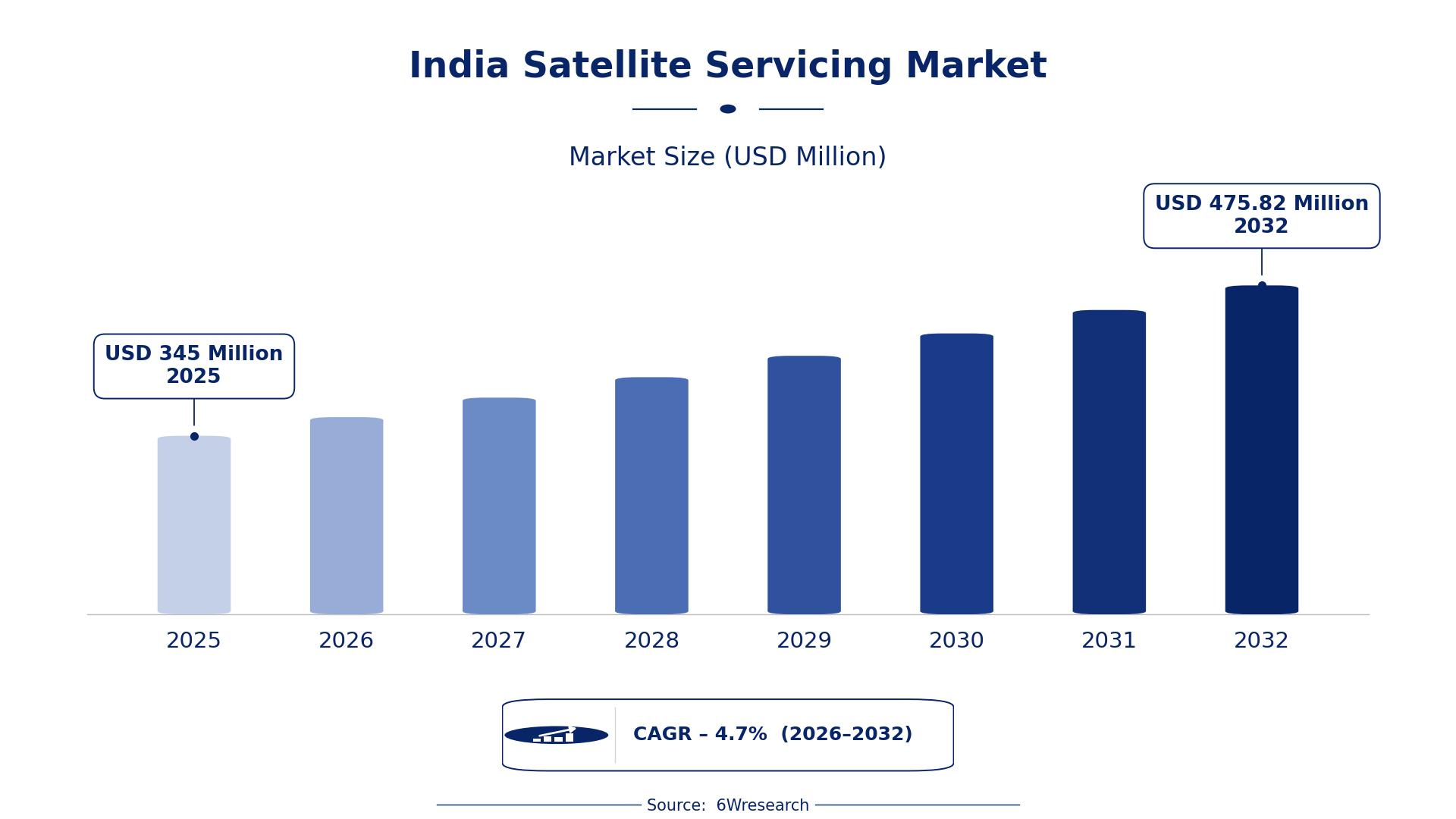
According to 6Wresearch internal database and industry insights, the India Satellite Servicing Market was valued at USD 345.0 million in 2025 and is projected to reach USD 475.82 million by 2032, growing at a CAGR of approximately 4.7% during 2026–2032.
India Satellite Servicing Market Highlights
| Report Metric | Details |
| Report Name | India Satellite Servicing Market |
| Market Size 2025 | USD 345.0 million |
| Market Size 2032 | USD 475.82 million |
| Absolute Growth 2025–2032 | USD 130.82 million |
| CAGR 2026–2032 | 4.7% |
| Peak Annual Growth | 6.7% in 2026 |
| Forecast Period | 2026–2032 |
| Historical Data | 2022–2025 |
| Base Year | 2025 |
| Leading Service Type, 2025 | Repair & Maintenance (41% share) |
| Leading Operation Type, 2025 | Robotic (52% share) |
| Leading Orbit Type, 2025 | GEO (49% share) |
| Leading End User, 2025 | Government Satellites (46% share) |
| Fastest-Growing Service Type | Refueling (6.4% CAGR) |
| Fastest-Growing Orbit Type | LEO (6.2% CAGR) |
| Fastest-Growing End User | Commercial Satellite Owners (6.6% CAGR) |
| Growing Sector | Satellite Servicing |
| Key End Users | Government Agencies, Commercial Satellite Owners, Space Agencies, Space Debris Control |
India Satellite Servicing Market Year-wise Growth Rate and Key Drivers (2022–2032)
This graph illustrates the annual growth rates of the market from 2022 to 2032, highlighting a steady upward trajectory and projected market expansion over the forecast period.
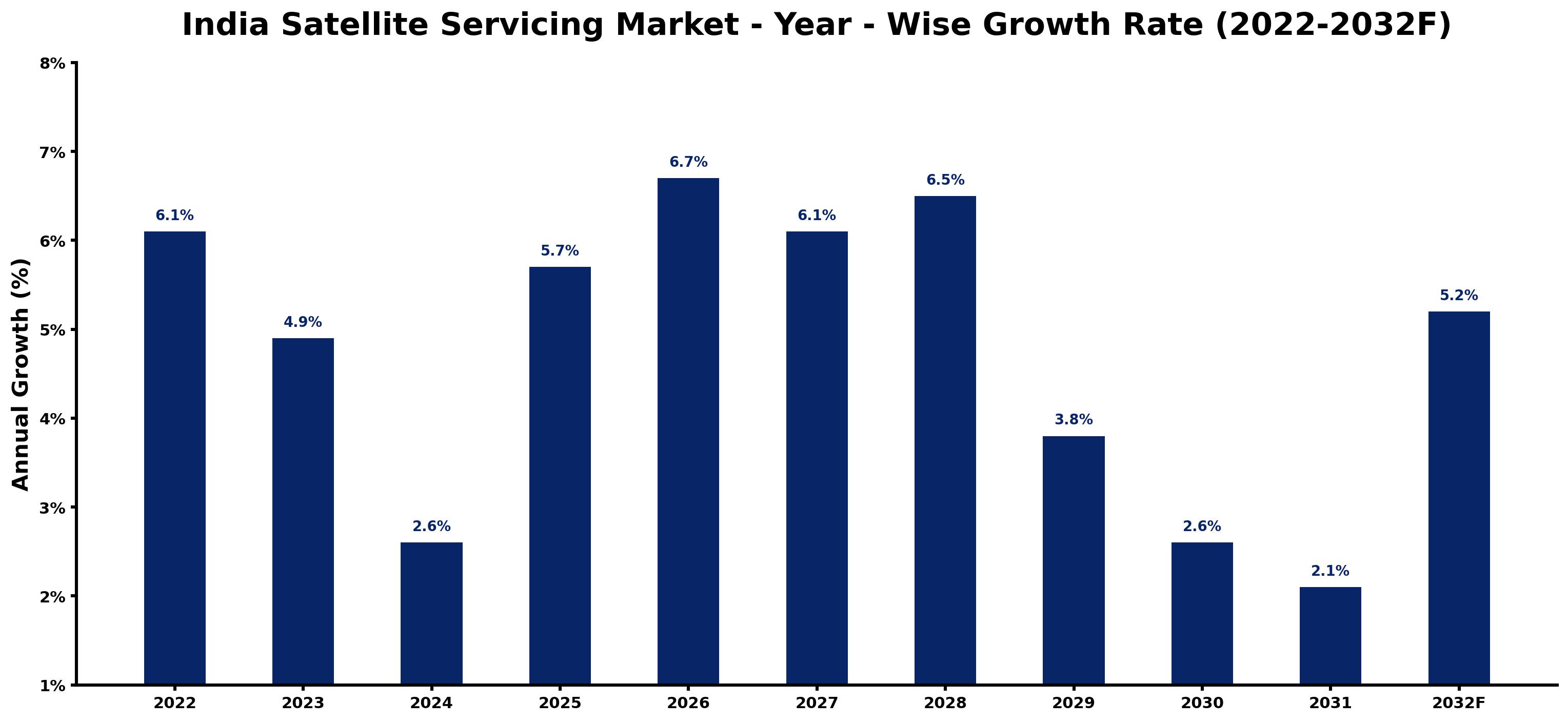
The following table presents the estimated annual growth rate for each year together with the principal factor influencing market performance.
| Year | Estimated Annual Growth (%) | Market Rationale |
| 2022 | 6.1 | The market exhibited strong growth due to increased satellite launches and servicing interest. |
| 2023 | 4.9 | Growth slowed as the market adjusted to earlier high activity levels and investment patterns. |
| 2024 | 2.6 | Continued investment in satellite technologies led to a further slowdown in growth rates. |
| 2025 | 5.7 | An increase in satellite servicing contracts contributed to a faster growth rate this year. |
| 2026 | 6.7 | The peak growth rate was driven by advancements in servicing technologies and capabilities, particularly from ISRO. |
| 2027 | 6.1 | Growth slowed slightly as the market began to stabilise after rapid advancements in satellite servicing. |
| 2028 | 6.5 | A resurgence in satellite servicing demand led to faster growth than the previous year, driven by the National Space Policy. |
| 2029 | 3.8 | Growth slowed again as the market faced maturity and saturation in certain segments, particularly in GEO. |
| 2030 | 2.6 | The market continued to grow but at a slower pace due to increasing competition in the servicing sector. |
| 2031 | 2.1 | A further slowdown in growth occurred as the market adjusted to new operational realities, affecting investment. |
| 2032 | 5.2 | An uptick in investment and new projects is expected to drive growth faster than before, particularly in LEO. |
Note: Market size estimations and growth projections presented in this report are based on 6Wresearch's proprietary forecasting methodology, utilizing the latest available industry data, government publications, and primary research inputs.
India Satellite Servicing Market Synopsis
The Satellite Servicing Market in India encompasses the maintenance, repair, and upgrading of satellites in orbit. This process involves technologies such as robotic arms and autonomous systems, primarily aimed at extending satellite lifespans and improving capabilities. The market is expanding due to increased investments from government space agencies and private players. As of 2023, over 300 satellites have been launched, driving demand for servicing solutions. The National Space Policy, 2023 highlights the importance of servicing capabilities in the country's space strategy.
Market Dynamics Impact Analysis (2026–2032)
| Factor | Type | Impact | Primary Segment Affected |
| Increased investment in satellite servicing technologies | Driver | High | Repair & Maintenance |
| Growing demand for satellite upgrades and maintenance | Driver | High | Upgrading |
| Rising need for compliance with space debris regulations | Opportunity | Medium | De-Orbiting |
| Expansion of commercial satellite ownership in India | Opportunity | High | Commercial Satellite Owners |
| Limited awareness of satellite servicing benefits | Restraint | Medium | Repair & Maintenance |
| High initial costs of satellite servicing technologies | Restraint | High | Robotic |
| The Satellite Servicing Market in India faces regulatory challenges | Challenge | High | Repair & Maintenance |
| Competition from international satellite servicing providers | Challenge | Medium | Repair & Maintenance |
Evaluation of Drivers in India Satellite Servicing Market (2026–2032)
The main growth drivers and the segments they affect most are set out below.
| Drivers | Primary Segment Affected | Why It Matters (Evidence) |
| Increased satellite launches | Repair & Maintenance | As of 2023, over 300 satellites have been launched, increasing demand for maintenance services. |
| Technological advancements in servicing capabilities | Upgrading | The Indian Space Research Organisation is developing new technologies, improving upgrade opportunities for existing satellites. |
| Government initiatives promoting satellite servicing | De-Orbiting | The Space Activities Bill, 2020 encourages private participation in servicing, driving demand for de-orbiting services. |
| Rising number of commercial satellite owners | Commercial Satellite Owners | The growing commercial sector is expected to drive demand for servicing solutions, particularly in LEO. |
| Implementation of space debris mitigation guidelines | De-Orbiting | ISRO's Space Debris Mitigation Guidelines are pushing for compliance, increasing the need for de-orbiting services. |
With over 300 satellites launched as of 2023, there is a heightened demand for maintenance and repair services. The Indian Space Research Organisation is actively developing new servicing technologies, which improves upgrade opportunities for existing satellites. The Space Activities Bill, 2020 encourages private participation in servicing, further driving demand. The implementation of space debris mitigation guidelines is increasing the need for de-orbiting services, creating a dynamic market environment.
Evaluation of Restraints in India Satellite Servicing Market
Below mentioned are some major restraints and their influence on market dynamics.
| Market Restraint | Primary Segment Affected | Why It Matters (Evidence) |
| Limited awareness of satellite servicing benefits | Repair & Maintenance | Many potential users remain unaware of the advantages of satellite servicing, hindering market growth. |
| High initial costs of servicing technologies | Robotic | The investment required for advanced robotic servicing technologies limits accessibility for smaller players. |
| Regulatory challenges in satellite servicing | Repair & Maintenance | The regulatory requirements create hurdles for new entrants and existing players in the market. |
| Competition from international satellite servicing providers | Repair & Maintenance | Local providers face stiff competition from established international firms, affecting market share and pricing. |
| Technological gaps in servicing capabilities | Upgrading | The lack of advanced technologies compared to global standards limits the effectiveness of local servicing solutions. |
India Satellite Servicing Market Challenges
In the India Satellite Servicing Market, producers face high operational costs associated with advanced technologies, consuming up to 20% of project budgets and hindering project launches. Buyers encounter regulatory challenges, as the Space Activities Bill, 2020 imposes complex compliance requirements that can delay project timelines by six months. Importers deal with technological constraints, as current servicing capabilities are still evolving, limiting the range of services available to buyers. Additionally, the lack of established standards creates uncertainty for importers, complicating the integration of new technologies and potentially increasing costs for buyers.
Trends in the India Satellite Servicing Market
Buyers and suppliers in the India Satellite Servicing Market are adjusting to the following trends.
- Shift from Manual to Robotic Servicing: Since 2021, there has been a notable shift towards robotic servicing technologies, driven by ISRO's ongoing projects. This transition aims to improve precision and efficiency in satellite maintenance, with a projected growth of 6.4% in robotic servicing by 2026.
- Increase in Government Initiatives: In 2023, the Indian government allocated 13 billion INR for space technology development, reflecting a growing commitment to satellite servicing. This funding is expected to stimulate innovation and attract private investment in the sector.
- Focus on Space Debris Management: The implementation of the Space Debris Mitigation Guidelines in 2021 has intensified focus on managing orbital debris. This initiative is driving demand for de-orbiting services, with a projected rise in related projects anticipated.
- Expansion of Commercial Satellite Ownership: As of 2023, the number of commercial satellite owners is increasing, creating demand for servicing solutions. This trend is expected to grow, with commercial satellite ownership projected to rise significantly by 2025.
Investment Opportunities in the India Satellite Servicing Market
Several openings in the India Satellite Servicing Market merit attention from investors.
- Collaborate with Government Agencies: With the Indian government allocating 13 billion INR for space technology, there is an opportunity for partnerships. Collaborating with government agencies can improve capabilities in satellite servicing and increase market access.
- Invest in Robotic Servicing Technologies: The shift towards robotic servicing presents a lucrative opportunity, with a projected growth of 6.4% in this segment. Companies can invest in developing advanced robotic systems to meet rising demand from satellite operators.
- Target De-Orbiting Solutions: The implementation of space debris guidelines creates a pressing need for de-orbiting services. Companies can focus on government agencies and commercial satellite owners to provide compliant solutions.
- Expand into LEO Servicing: The expected growth of India's LEO satellite constellation presents an opportunity for servicing providers. Focusing on LEO servicing can attract commercial satellite owners looking for maintenance solutions.
Government Initiatives in the India Satellite Servicing Market
The Space Activities Bill, 2020, by the Department of Space, promotes private participation in satellite servicing. This measure encourages investment in servicing technologies and streamlines regulatory processes for private players. It aims to create a more competitive environment and improve service offerings in the market. The National Space Policy, 2023, further supports this by outlining strategies to boost satellite servicing capabilities, ensuring a structured approach to industry growth.
The Atal Innovation Mission, launched in 2020, supports startups in satellite servicing technologies by providing funding and resources. This initiative helps innovative companies develop new solutions, fostering a vibrant ecosystem for satellite servicing. Additionally, the ISRO Technology Transfer Programme encourages the commercialization of satellite servicing innovations, allowing startups to access advanced technologies and expertise.
Future Insight of the India Satellite Servicing Market
Several forward-looking factors should support the India Satellite Servicing Market in the coming years. The Indian government's allocation of 13 billion INR for space technology development will enhance research in satellite servicing. The expected expansion of India's LEO satellite constellation by 2025 will create new opportunities for servicing projects. ISRO's Gaganyaan mission is set to elevate servicing capabilities, while the National Space Policy, 2023 will clarify regulations, encouraging private investment and fostering a more robust market environment.
Market Segmentation Analysis
The report offers a comprehensive study of the following market segments and their leading categories in the market.
By Service Type – Repair & Maintenance Dominated, Refueling Expected to Grow Fastest
According to Shubham Padhi, Research Analyst at 6Wresearch, Repair & Maintenance accounted for a 41% market share by service type in 2025. Repair and maintenance hold the largest share in the India Satellite Servicing Market due to their necessity for ensuring the functionality and reliability of the over 300 satellites launched. This segment is crucial for domestic satellite operators and government agencies that rely on operational satellites for various applications. The quickest growth will come from Refueling, forecast to expand at a CAGR of 6.4% between 2026 and 2032. Refueling is experiencing rapid growth as it is essential for extending satellite operational life, particularly with the increasing number of satellites being launched. The demand for refueling services is set to rise significantly as India's LEO satellite constellation expands by 2025. Suppliers should focus on developing advanced refueling technologies to meet the growing needs of satellite operators.
By Operation Type – Robotic Dominated and Is Expected to Record the Fastest Growth
In 2025, Robotic led the operation type split with a 52% share. Robotic operations dominate the market share as they are employed for precise tasks in satellite servicing, ensuring effective maintenance and upgrades. This technology is vital for the operations of the Indian Space Research Organisation and private sector players engaged in satellite servicing. Robotic is also forecast to expand faster than any other category, at a CAGR of 5.7% over 2026–2032. The robotic segment is also the fastest-growing due to technological advancements that enhance the efficiency and capabilities of satellite servicing. As the market expands, the demand for robotic solutions will continue to increase, further solidifying its lead. Buyers will benefit from investing in robotic technologies that improve servicing efficiency and reduce operational costs.
By Orbit Type – GEO Dominated, LEO Expected to Grow Fastest
GEO took a 49% share of orbit type in 2025, more than any other category. GEO satellites represent the largest share in the market as most of the over 300 satellites launched are positioned in this orbit, making them prime candidates for servicing. The benefits of servicing in GEO are critical for maintaining communication and observation capabilities. LEO is set to record the highest CAGR in this split, 6.2% over 2026–2032. LEO is the fastest-growing segment due to the increasing number of satellites requiring servicing in this orbit, driven by new satellite constellations. The growth in LEO satellites will create more opportunities for servicing companies to expand their offerings. Suppliers should strategically target LEO servicing capabilities to capitalise on the anticipated growth in this orbit.
By End User – Government Satellites Dominated, Commercial Satellite Owners Expected to Grow Fastest
With a 46% revenue share in 2025, Government Satellites was the largest end user category. Government satellites account for the largest share in the market because government agencies play a central role in satellite servicing by managing numerous operational satellites. Their substantial investment in space technology development significantly supports this segment's dominance. Commercial Satellite Owners are projected to grow fastest, at a CAGR of 6.6% during 2026–2032. Commercial satellite owners are the fastest-growing end-user group, representing a significant market for servicing due to increased private sector investments in satellite technology. This trend indicates a shift towards more commercial applications of satellite servicing. Suppliers must tailor their services to meet the unique needs of commercial satellite owners to capture this growing market.
Key Attractiveness of the Report
- 10 Years of Market Numbers
- Historical Data Starting from 2022 to 2025
- Base Year 2025
- Forecast Data until 2032
- Key Performance Indicators Impacting the Market
- Major Upcoming Developments and Projects
Key Highlights of the Report:
- India Satellite Servicing Market Outlook
- Market Size of India Satellite Servicing Market, 2025
- Forecast of India Satellite Servicing Market, 2032
- Historical Data and Forecast of India Satellite Servicing Revenues & Volume for the Period 2022 - 2032F
- India Satellite Servicing Market Trend Evolution
- India Satellite Servicing Market Drivers and Challenges
- India Satellite Servicing Price Trends
- India Satellite Servicing Porter's Five Forces
- India Satellite Servicing Industry Life Cycle
- Historical Data and Forecast of India Satellite Servicing Market Revenues & Volume By Service Type for the Period 2022 - 2032F
- Historical Data and Forecast of India Satellite Servicing Market Revenues & Volume By Refueling for the Period 2022 - 2032F
- Historical Data and Forecast of India Satellite Servicing Market Revenues & Volume By Repair & Maintenance for the Period 2022 - 2032F
- Historical Data and Forecast of India Satellite Servicing Market Revenues & Volume By De-Orbiting for the Period 2022 - 2032F
- Historical Data and Forecast of India Satellite Servicing Market Revenues & Volume By Upgrading for the Period 2022 - 2032F
- Historical Data and Forecast of India Satellite Servicing Market Revenues & Volume By Operation Type for the Period 2022 - 2032F
- Historical Data and Forecast of India Satellite Servicing Market Revenues & Volume By Robotic for the Period 2022 - 2032F
- Historical Data and Forecast of India Satellite Servicing Market Revenues & Volume By Autonomous/Manual for the Period 2022 - 2032F
- Historical Data and Forecast of India Satellite Servicing Market Revenues & Volume By Tethered Tug Systems for the Period 2022 - 2032F
- Historical Data and Forecast of India Satellite Servicing Market Revenues & Volume By Modular Component for the Period 2022 - 2032F
- Historical Data and Forecast of India Satellite Servicing Market Revenues & Volume By Orbit Type for the Period 2022 - 2032F
- Historical Data and Forecast of India Satellite Servicing Market Revenues & Volume By GEO for the Period 2022 - 2032F
- Historical Data and Forecast of India Satellite Servicing Market Revenues & Volume By LEO for the Period 2022 - 2032F
- Historical Data and Forecast of India Satellite Servicing Market Revenues & Volume By MEO for the Period 2022 - 2032F
- Historical Data and Forecast of India Satellite Servicing Market Revenues & Volume By Any Orbit for the Period 2022 - 2032F
- Historical Data and Forecast of India Satellite Servicing Market Revenues & Volume By End User for the Period 2022 - 2032F
- Historical Data and Forecast of India Satellite Servicing Market Revenues & Volume By Commercial Satellite Owners for the Period 2022 - 2032F
- Historical Data and Forecast of India Satellite Servicing Market Revenues & Volume By Government Satellites for the Period 2022 - 2032F
- Historical Data and Forecast of India Satellite Servicing Market Revenues & Volume By Space Debris Control for the Period 2022 - 2032F
- Historical Data and Forecast of India Satellite Servicing Market Revenues & Volume By Space Agencies for the Period 2022 - 2032F
- India Satellite Servicing Import Export Trade Statistics
- Market Opportunity Assessment By Service Type
- Market Opportunity Assessment By Operation Type
- Market Opportunity Assessment By Orbit Type
- Market Opportunity Assessment By End User
- India Satellite Servicing Top Companies Market Share
- India Satellite Servicing Competitive Benchmarking By Technical and Operational Parameters
- India Satellite Servicing Company Profiles
- India Satellite Servicing Key Strategic Recommendations
Market Covered
Segments analysed in this report are listed below.
By Service Type
- Refueling
- Repair & Maintenance
- De-Orbiting
- Upgrading
By Operation Type
- Robotic
- Autonomous/Manual
- Tethered Tug Systems
- Modular Component
By Orbit Type
- GEO
- LEO
- MEO
- Any Orbit
By End User
- Commercial Satellite Owners
- Government Satellites
- Space Debris Control
- Space Agencies






































