China Satellite Servicing Market Size & Growth Rate
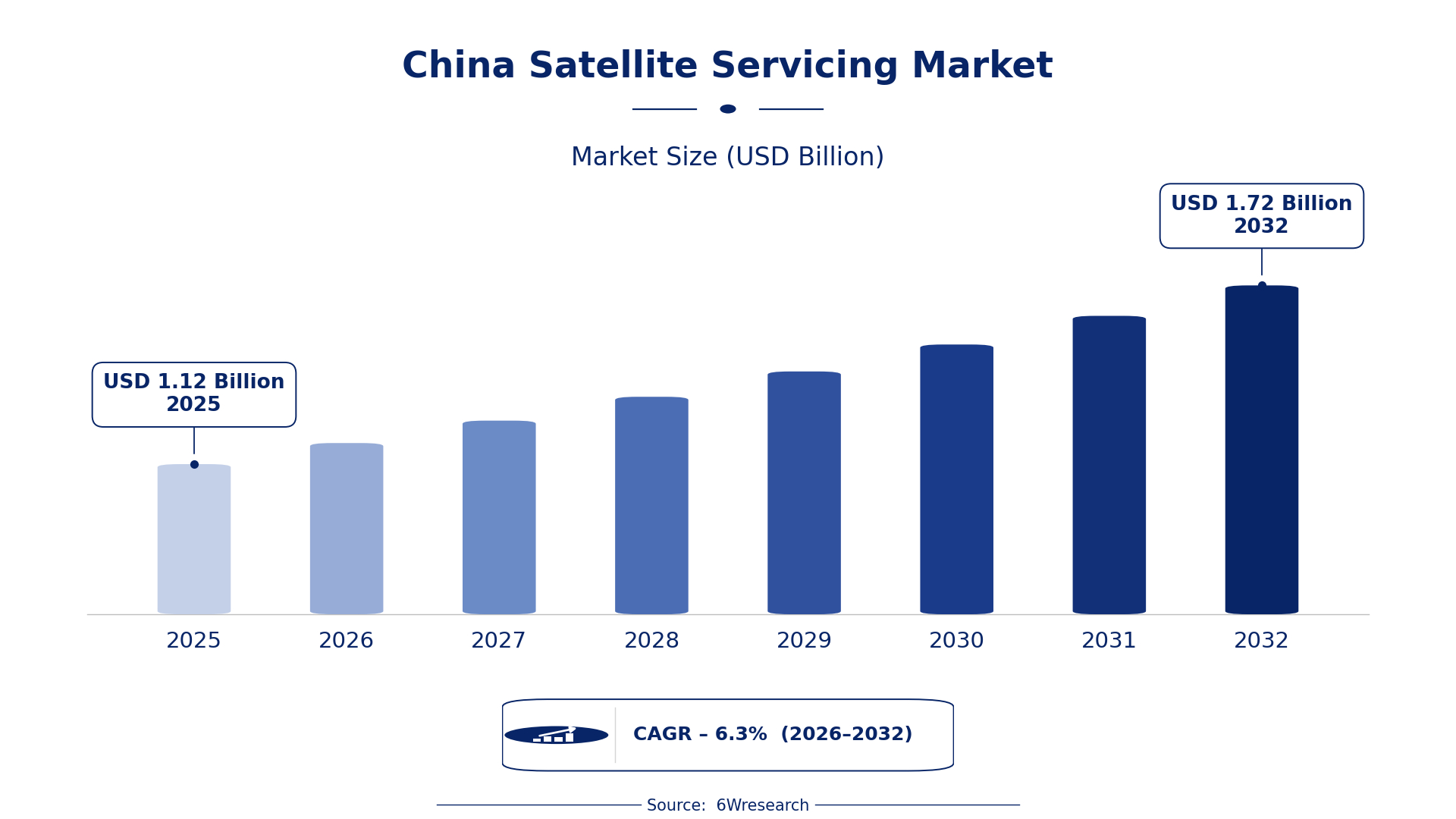
According to 6Wresearch internal database and industry insights, the China Satellite Servicing Market was valued at USD 1.12 billion in 2025 and is projected to reach USD 1.72 billion by 2032, growing at a CAGR of approximately 6.3% during 2026–2032.
China Satellite Servicing Market Highlights
| Report Metric | Details |
| Report Name | China Satellite Servicing Market |
| Market Size 2025 | USD 1.12 billion |
| Market Size 2032 | USD 1.72 billion |
| Absolute Growth 2025–2032 | USD 0.60 billion |
| CAGR 2026–2032 | 6.3% |
| Peak Annual Growth | 8.8% in 2029 |
| Forecast Period | 2026–2032 |
| Historical Data | 2022–2025 |
| Base Year | 2025 |
| Leading Service Type, 2025 | Repair & Maintenance (41% share) |
| Leading Operation Type, 2025 | Robotic (33% share) |
| Leading Orbit Type, 2025 | LEO (39% share) |
| Leading End User, 2025 | Government Satellites (42% share) |
| Fastest-Growing Service Type | Upgrading (8.1% CAGR) |
| Fastest-Growing Orbit Type | GEO (8.3% CAGR) |
| Fastest-Growing End User | Space Debris Control (7.6% CAGR) |
| Growing Sector | Government Satellites |
| Key End Users | Government Satellites, Commercial Satellite Owners, Space Agencies, Space Debris Control |
China Satellite Servicing Market Year-wise Growth Rate and Key Drivers (2022–2032)
This graph illustrates the annual growth rates of the market from 2022 to 2032, highlighting a steady upward trajectory and projected market expansion over the forecast period.
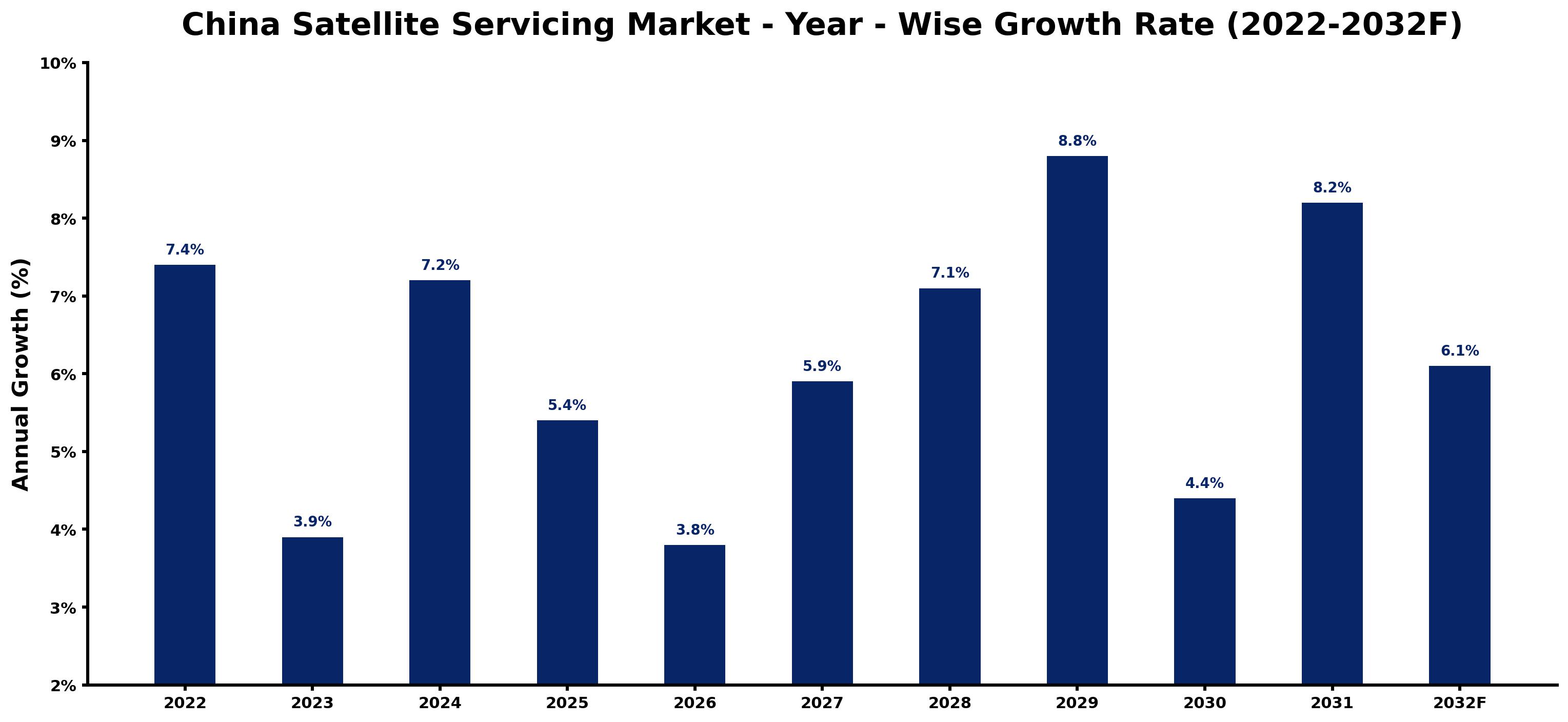
Year by year, the estimates below pair each growth rate with the development that shaped it.
| Year | Estimated Annual Growth (%) | Market Rationale |
| 2022 | 7.4 | The market experienced strong demand due to the launch of 40 satellites, increasing servicing needs. |
| 2023 | 3.9 | Growth slowed as the market adjusted to new servicing protocols established by the updated space debris mitigation standards. |
| 2024 | 7.2 | Demand rose as satellite servicing technologies advanced, supporting the need for repairs and upgrades. |
| 2025 | 5.4 | The market continued to grow, driven by the government's focus on improving satellite maintenance capabilities through the National Space Technology Development Plan. |
| 2026 | 3.8 | Growth is expected to slow due to the maturation of existing servicing technologies and market conditions. |
| 2027 | 5.9 | Increased demand for robotic servicing technologies is projected as new capabilities are demonstrated. |
| 2028 | 7.1 | The market is expected to grow as the focus on space debris control intensifies, leading to more servicing opportunities. |
| 2029 | 8.8 | The peak growth rate is projected as commercial space activities surge, driving significant demand for servicing. |
| 2030 | 4.4 | Growth is expected to slow as the market begins to stabilise after reaching peak levels in the previous year. |
| 2031 | 8.2 | Demand is projected to accelerate again as advancements in autonomous servicing technologies are realised. |
| 2032 | 6.1 | The market is expected to grow steadily as the focus on sustainable space operations continues. |
Note: Market size estimations and growth projections presented in this report are based on 6Wresearch's proprietary forecasting methodology, utilizing the latest available industry data, government publications, and primary research inputs.
China Satellite Servicing Market Synopsis
Satellite Servicing in China encompasses the maintenance, repair, and upgrading of satellites in orbit. This technology employs advanced robotics to extend satellite life and functionality. The China Satellite Servicing Market is expanding due to rising government initiatives and commercial space activities. In 2023, the government allocated $2 billion for advancements in space technology, reflecting the growing demand for satellite servicing. The National Space Administration's initiatives are driving investments in this sector.
Market Dynamics Impact Analysis (2026–2032)
| Factor | Type | Impact | Primary Segment Affected |
| Growing demand for satellite upgrades due to increased satellite launches | Driver | High | Repair & Maintenance |
| Rising focus on space debris control and compliance with international regulations | Driver | High | De-Orbiting |
| Increased investment in robotic servicing technologies | Opportunity | High | Robotic |
| Expansion of commercial satellite operations requiring servicing | Opportunity | High | Commercial Satellite Owners |
| Limited awareness of servicing technologies among potential users | Restraint | Medium | Upgrading |
| High initial costs associated with implementing servicing technologies | Restraint | Medium | Repair & Maintenance |
| Challenges in developing autonomous servicing systems | Challenge | High | Robotic |
| Competition from international satellite servicing providers | Challenge | Medium | Government Satellites |
Evaluation of Drivers in China Satellite Servicing Market (2026–2032)
Key forces behind demand, with the segment each one moves most, are listed below.
| Drivers | Primary Segment Affected | Why It Matters (Evidence) |
| Increased satellite launches drive demand for repairs and upgrades | Repair & Maintenance | China launched 40 satellites in 2022, necessitating servicing to extend their operational life. |
| Growing emphasis on sustainability leads to de-orbiting services | De-Orbiting | The updated space debris mitigation standards in 2021 require compliance through servicing. |
| Advancements in robotics improve servicing capabilities | Robotic | The Tianwen-1 mission demonstrated the effectiveness of robotic technologies in servicing. |
| Rising commercial space activities increase servicing needs | Commercial Satellite Owners | The 2023 National Space Technology Development Plan highlights the importance of servicing. |
| Government initiatives boost funding for servicing technologies | Government Satellites | The Chinese government allocated $2 billion for space technology advancements in 2023. |
In 2022, 40 satellites were launched, driving demand for servicing to extend operational life. The updated space debris mitigation standards in 2021 require compliance through servicing, further boosting demand. The Tianwen-1 mission showcased advancements in robotic servicing, improving operational capabilities.
Evaluation of Restraints in China Satellite Servicing Market
The main factors holding the market back are set out below.
| Market Restraint | Primary Segment Affected | Why It Matters (Evidence) |
| Limited awareness of satellite servicing benefits among stakeholders | Upgrading | Many potential users remain uninformed about the advantages of satellite servicing technologies. |
| High costs associated with implementing advanced servicing technologies | Repair & Maintenance | Initial investments for robotic and autonomous systems can deter potential buyers. |
| Regulatory hurdles in adopting new servicing protocols | De-Orbiting | Compliance with updated space debris mitigation standards can complicate servicing operations. |
| Technical challenges in developing reliable autonomous systems | Robotic | The complexity of autonomous servicing technologies can delay market entry. |
| Competition from established international servicing providers | Government Satellites | Local providers face challenges competing with well-established international players. |
China Satellite Servicing Market Challenges
The China Satellite Servicing Market faces several challenges, starting with technology limitations. Current robotic systems lack the precision required for complex repairs, which can delay servicing operations for satellite owners and extend downtime by several weeks. Supply chain disruptions also present a challenge, as reliance on specific components can lead to increased costs, with some parts experiencing price hikes of up to 30%. Skills shortages in aerospace engineering hinder the development of advanced servicing techniques, compelling suppliers to compete for a limited talent pool of over 200,000 professionals. Regulatory compliance complicates matters, as evolving standards can lead to project delays for government agencies and private firms alike, affecting mission timelines.
Trends in the China Satellite Servicing Market
The trends below show where the China Satellite Servicing Market is heading.
- Shift towards Robotic Servicing Technologies: Government Satellites are increasingly adopting robotic servicing technologies, as demonstrated by the Tianwen-1 mission. In 2023, funding for robotic systems reached $500 million, indicating a strong trend towards automation in satellite servicing.
- Growing Focus on Space Debris Management: In 2021, China updated its space debris mitigation standards to include servicing protocols. This shift is important for sustainable space operations, as over 300 operational satellites in LEO require potential servicing.
- Increase in Commercial Satellite Servicing: The Guangdong province is emerging as a hub for commercial satellite servicing operations. With over 200,000 professionals in the space industry, this region is positioned to meet the growing demand for servicing technologies.
- Expansion of Government Initiatives: The National Space Administration of China launched the 'Satellite Servicing Initiative' in 2023. With a budget of $500 million, this initiative aims to improve satellite maintenance capabilities across the country.
Investment Opportunities in the China Satellite Servicing Market
Investors looking at the China Satellite Servicing Market should consider the following areas.
- Commercial Satellite Owners Seeking Servicing Solutions: With over 300 operational satellites in LEO, there is a gap in servicing solutions. Partnering with local firms in Guangdong can facilitate entry into this growing market.
- Joint Ventures for Advanced Servicing Technologies: The government allocated $2 billion for space technology advancements, creating opportunities for joint ventures. Collaborating with local space agencies can improve technology development and market reach.
- Investment in Robotic Servicing Systems: The demand for robotic servicing technologies is increasing, with a projected growth rate of 7.9%. Investing in R&D for these systems can position firms advantageously in the market.
- Focus on Space Debris Control Initiatives: As China aims to improve its space debris management strategies, there is a growing need for servicing technologies. Engaging with the National Space Administration can provide access to funding and resources.
Government Initiatives in the China Satellite Servicing Market
The 'National Space Debris Mitigation Strategy' approved in 2021 integrates satellite servicing as a key component for sustainable space operations. This law mandates compliance with international standards, ensuring that servicing practices align with global efforts to manage space debris. The 'Space Law of China' established in 2022 further supports this framework, providing provisions for satellite servicing and debris management, thus improving the operational environment for service providers.
In 2023, the National Space Administration of China launched the 'Satellite Servicing Initiative' with a budget of $500 million to improve satellite maintenance capabilities. This initiative aims to develop advanced servicing technologies and promote international collaboration. The Ministry of Industry and Information Technology announced the '2023 Space Technology Development Plan', which focuses on satellite servicing technologies and includes funding for research and development projects.
Future Insight of the China Satellite Servicing Market
The China Satellite Servicing Market is expected to undergo notable changes by 2032, primarily driven by advancements in autonomous servicing technologies. The National Space Administration's initiative aims for a dedicated satellite servicing mission by 2025, which will improve operational capabilities. With the government's projected space budget of $10 billion for 2023, suppliers will benefit from increased investment in innovative servicing solutions. Updated debris mitigation standards will also create new opportunities for buyers to engage in sustainable satellite management practices, enhancing overall market efficiency.
Market Segmentation Analysis
The analysis below covers each segmentation, its leading category in 2025 and its fastest-growing category through 2032.
By Service Type – Repair & Maintenance Dominated, Upgrading Expected to Grow Fastest
According to Shubham Padhi, Research Analyst at 6Wresearch, with a 41% revenue share in 2025, Repair & Maintenance was the largest service type category. Repair and maintenance hold the largest share in the China Satellite Servicing Market due to their essential role in ensuring satellite functionality and longevity. With over 300 operational satellites in low Earth orbit, government entities are the primary buyers of these crucial services. Upgrading is projected to grow fastest, at a CAGR of 8.1% during 2026–2032. The upgrading segment is experiencing rapid growth as it is vital for enhancing satellite capabilities and integrating new technologies. The Chinese government's focus on advanced satellite technologies, as highlighted in its 2023 budget, is a key driver of this growth. Suppliers should prioritise the development of advanced upgrading solutions to meet the increasing market demand.
By Operation Type – Robotic Dominated and Is Expected to Record the Fastest Growth
Robotic accounted for a 33% market share by operation type in 2025. Robotic operations dominate the market share as they are extensively used for precision tasks in satellite servicing, ensuring effective maintenance and upgrades. Successful missions like Tianwen-1 showcase the effectiveness of robotic technologies, solidifying their leading position. Its lead should widen, with a projected CAGR of 7.9% during 2026–2032, the highest in this split. Robotic operations are also the fastest-growing segment, with advancements in robotics technology continuously improving servicing efficiency and capabilities. This synergy between leadership and growth will likely widen the lead of robotic operations in the market. Buyers will gain from investing in robotic servicing technologies that enhance operational efficiency and reduce costs.
By Orbit Type – LEO Dominated, GEO Expected to Grow Fastest
LEO held a 39% share of the China Satellite Servicing Market by orbit type in 2025. Low Earth Orbit (LEO) holds the largest share in the satellite servicing market due to the growing number of satellites requiring maintenance in this region. The increasing launch of satellites, with 40 launched in 2022 alone, underscores the demand for servicing in LEO. The quickest growth will come from GEO, forecast to expand at a CAGR of 8.3% between 2026 and 2032. Geostationary Orbit (GEO) is the fastest-growing segment as most satellites operate in this orbit, necessitating servicing to maintain their functionality. The projected growth in GEO servicing aligns with China's strategic focus on satellite technology advancements. Suppliers should prioritise GEO servicing solutions to meet the rising demand from satellite operators.
By End User – Government Satellites Dominated, Space Debris Control Expected to Grow Fastest
The largest end user category in 2025 was Government Satellites, with a 42% share of total revenue. Government satellites represent the largest share of the market as they are the primary users for national security and scientific missions. The Chinese government's substantial investment in space technology, including a $2 billion allocation in 2023, reinforces this trend. Over 2026–2032, Space Debris Control is expected to post the fastest growth, at a CAGR of 7.6%. Space debris control is the fastest-growing segment due to the increasing emphasis on international space sustainability efforts. The updated space debris mitigation standards from 2021 underscore the urgency for effective debris management solutions. Buyers must consider investing in space debris control technologies to align with global sustainability initiatives.
Key Attractiveness of the Report
- 10 Years of Market Numbers
- Historical Data Starting from 2022 to 2025
- Base Year 2025
- Forecast Data until 2032
- Key Performance Indicators Impacting the Market
- Major Upcoming Developments and Projects
Key Highlights of the Report:
- China Satellite Servicing Market Outlook
- Market Size of China Satellite Servicing Market, 2025
- Forecast of China Satellite Servicing Market, 2032
- Historical Data and Forecast of China Satellite Servicing Revenues & Volume for the Period 2022 - 2032F
- China Satellite Servicing Market Trend Evolution
- China Satellite Servicing Market Drivers and Challenges
- China Satellite Servicing Price Trends
- China Satellite Servicing Porter's Five Forces
- China Satellite Servicing Industry Life Cycle
- Historical Data and Forecast of China Satellite Servicing Market Revenues & Volume By Service Type for the Period 2022 - 2032F
- Historical Data and Forecast of China Satellite Servicing Market Revenues & Volume By Refueling for the Period 2022 - 2032F
- Historical Data and Forecast of China Satellite Servicing Market Revenues & Volume By Repair & Maintenance for the Period 2022 - 2032F
- Historical Data and Forecast of China Satellite Servicing Market Revenues & Volume By De-Orbiting for the Period 2022 - 2032F
- Historical Data and Forecast of China Satellite Servicing Market Revenues & Volume By Upgrading for the Period 2022 - 2032F
- Historical Data and Forecast of China Satellite Servicing Market Revenues & Volume By Operation Type for the Period 2022 - 2032F
- Historical Data and Forecast of China Satellite Servicing Market Revenues & Volume By Robotic for the Period 2022 - 2032F
- Historical Data and Forecast of China Satellite Servicing Market Revenues & Volume By Autonomous/Manual for the Period 2022 - 2032F
- Historical Data and Forecast of China Satellite Servicing Market Revenues & Volume By Tethered Tug Systems for the Period 2022 - 2032F
- Historical Data and Forecast of China Satellite Servicing Market Revenues & Volume By Modular Component for the Period 2022 - 2032F
- Historical Data and Forecast of China Satellite Servicing Market Revenues & Volume By Orbit Type for the Period 2022 - 2032F
- Historical Data and Forecast of China Satellite Servicing Market Revenues & Volume By GEO for the Period 2022 - 2032F
- Historical Data and Forecast of China Satellite Servicing Market Revenues & Volume By LEO for the Period 2022 - 2032F
- Historical Data and Forecast of China Satellite Servicing Market Revenues & Volume By MEO for the Period 2022 - 2032F
- Historical Data and Forecast of China Satellite Servicing Market Revenues & Volume By Any Orbit for the Period 2022 - 2032F
- Historical Data and Forecast of China Satellite Servicing Market Revenues & Volume By End User for the Period 2022 - 2032F
- Historical Data and Forecast of China Satellite Servicing Market Revenues & Volume By Commercial Satellite Owners for the Period 2022 - 2032F
- Historical Data and Forecast of China Satellite Servicing Market Revenues & Volume By Government Satellites for the Period 2022 - 2032F
- Historical Data and Forecast of China Satellite Servicing Market Revenues & Volume By Space Debris Control for the Period 2022 - 2032F
- Historical Data and Forecast of China Satellite Servicing Market Revenues & Volume By Space Agencies for the Period 2022 - 2032F
- China Satellite Servicing Import Export Trade Statistics
- Market Opportunity Assessment By Service Type
- Market Opportunity Assessment By Operation Type
- Market Opportunity Assessment By Orbit Type
- Market Opportunity Assessment By End User
- China Satellite Servicing Top Companies Market Share
- China Satellite Servicing Competitive Benchmarking By Technical and Operational Parameters
- China Satellite Servicing Company Profiles
- China Satellite Servicing Key Strategic Recommendations
Market Covered
This report examines the market across the segments below.
By Service Type
- Refueling
- Repair & Maintenance
- De-Orbiting
- Upgrading
By Operation Type
- Robotic
- Autonomous/Manual
- Tethered Tug Systems
- Modular Component
By Orbit Type
- GEO
- LEO
- MEO
- Any Orbit
By End User
- Commercial Satellite Owners
- Government Satellites
- Space Debris Control
- Space Agencies






































