India Seafood Production Market Size & Growth Rate
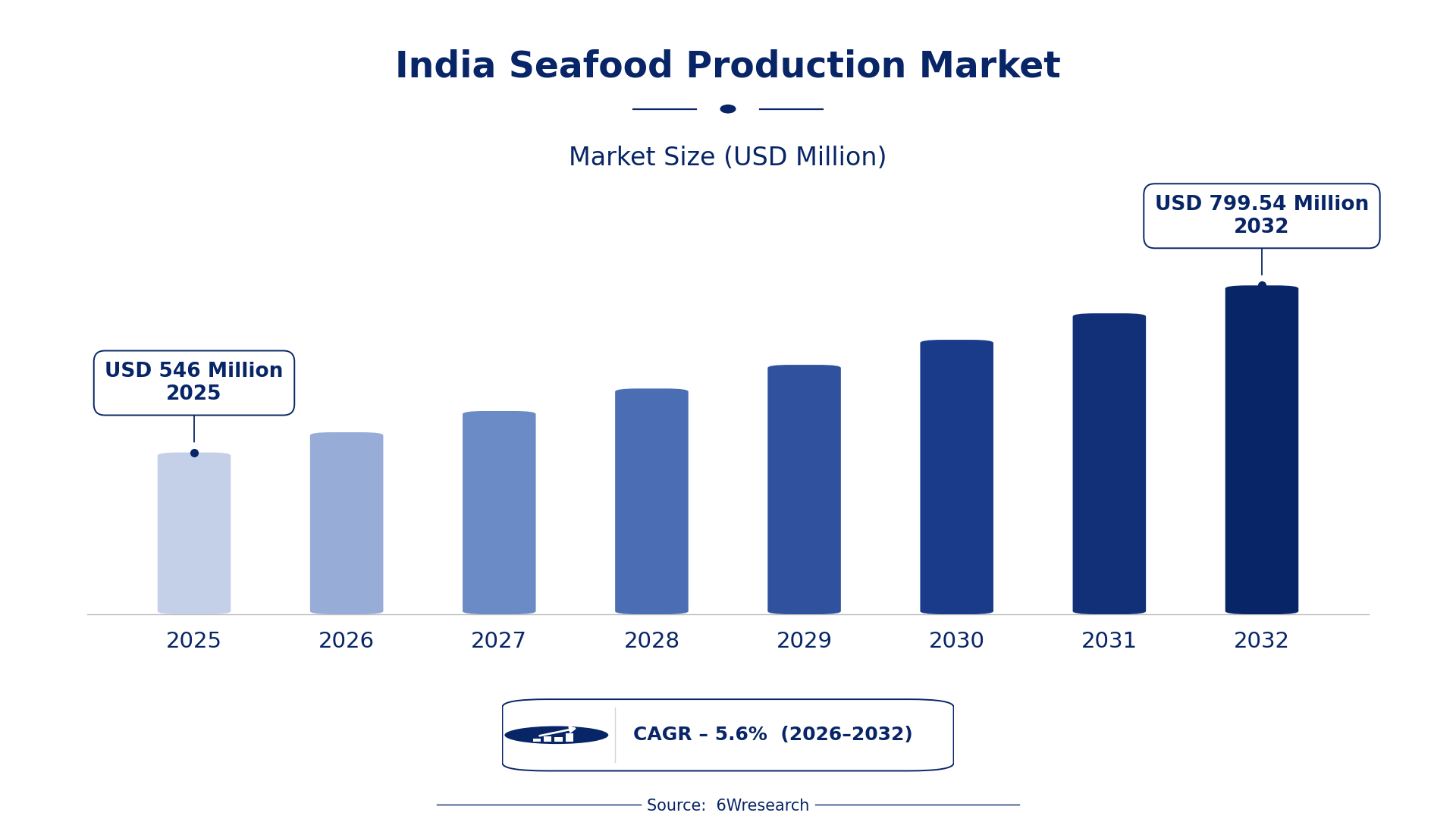
According to 6Wresearch internal database and industry insights, the India Seafood Production Market was valued at USD 546.0 million in 2025 and is projected to reach USD 799.54 million by 2032, growing at a CAGR of approximately 5.6% during 2026–2032.
India Seafood Production Market Highlights
| Report Metric | Details |
| Report Name | India Seafood Production Market |
| Market Size 2025 | USD 546.0 million |
| Market Size 2032 | USD 799.54 million |
| Absolute Growth 2025–2032 | USD 253.54 million |
| CAGR 2026–2032 | 5.6% |
| Peak Annual Growth | 7.5% in 2030 |
| Forecast Period | 2026–2032 |
| Historical Data | 2022–2025 |
| Base Year | 2025 |
| Leading Production Method, 2025 | Aquaculture (41% share) |
| Leading Species, 2025 | Shrimp (35% share) |
| Leading Farming Type, 2025 | Pond / Cage Farming (34% share) |
| Leading End User, 2025 | Export Companies (41% share) |
| Fastest-Growing Production Method | Recirculating Aquaculture Systems (RAS) (7.7% CAGR) |
| Fastest-Growing Species | Tilapia (7.5% CAGR) |
| Fastest-Growing Farming Type | Indoor Farming (7.3% CAGR) |
| Fastest-Growing End User | Foodservice Providers (8.2% CAGR) |
| Growing Sector | Export Companies |
| Key End Users | Export Companies, Seafood Distributors, Foodservice Providers, Retail Seafood Markets |
India Seafood Production Market Year-wise Growth Rate and Key Drivers (2022–2032)
This graph illustrates the annual growth rates of the market from 2022 to 2032, highlighting a steady upward trajectory and projected market expansion over the forecast period.
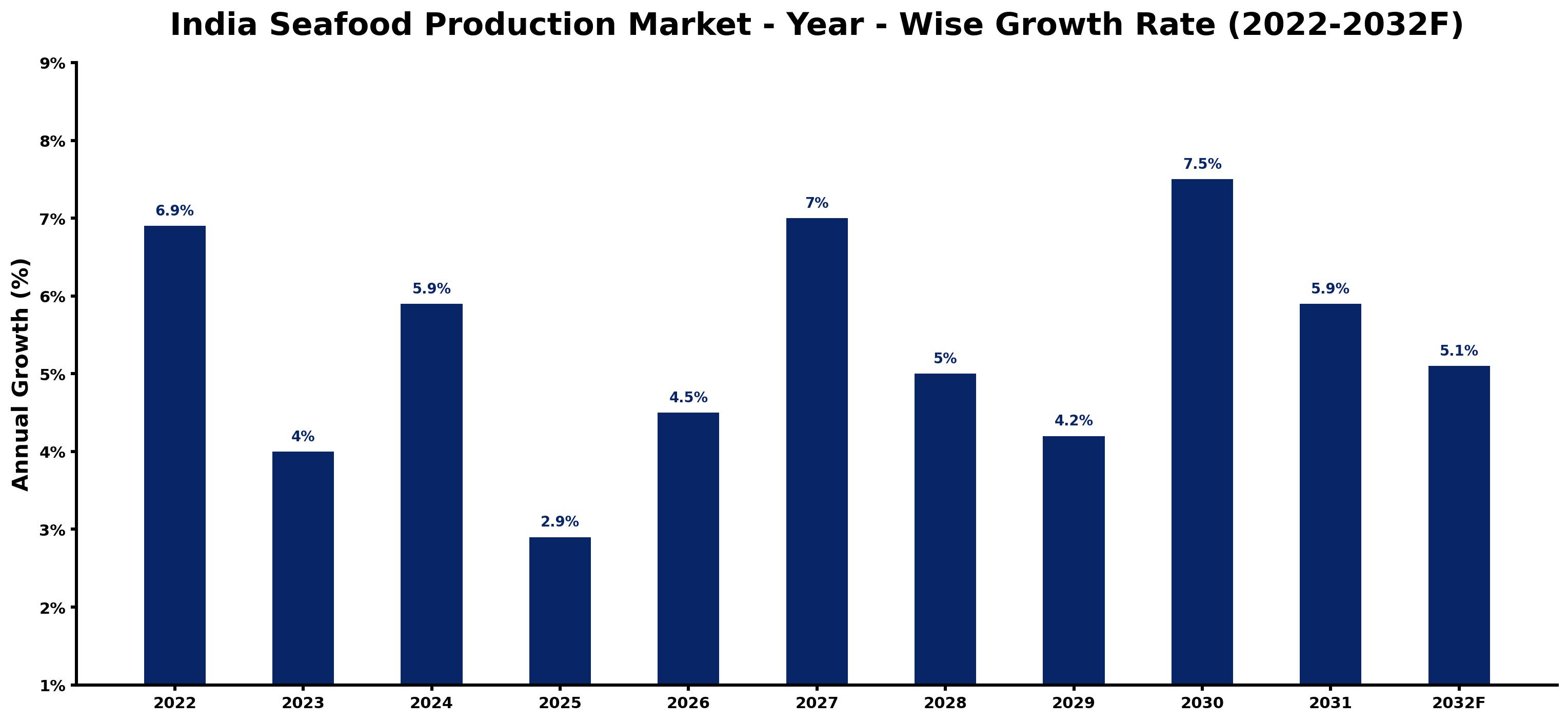
The following table presents the estimated annual growth rate for each year together with the principal factor influencing market performance.
| Year | Estimated Annual Growth (%) | Market Rationale |
| 2022 | 6.9 | The seafood production market was active, with strong domestic consumption and export demand. |
| 2023 | 4.0 | Growth slowed due to global supply chain disruptions affecting export activities. |
| 2024 | 5.9 | Increased local demand for seafood products boosted growth rates significantly. |
| 2025 | 2.9 | Growth slowed again as the market adjusted to previous high production levels. |
| 2026 | 4.5 | Rising investments in aquaculture infrastructure spurred growth in seafood production. |
| 2027 | 7.0 | Demand for shrimp exports surged, driving higher production rates. |
| 2028 | 5.0 | Growth slowed as market saturation began to impact production levels. |
| 2029 | 4.2 | Domestic consumption remained steady, but export growth faced challenges. |
| 2030 | 7.5 | A peak in growth was reached as international demand for seafood surged. |
| 2031 | 5.9 | Growth slowed as the market stabilised after rapid expansion in previous years. |
| 2032 | 5.1 | The market continues to grow, albeit at a slower pace, reflecting mature demand. |
Note: Market size estimations and growth projections presented in this report are based on 6Wresearch's proprietary forecasting methodology, utilizing the latest available industry data, government publications, and primary research inputs.
India Seafood Production Market Synopsis
Seafood Production in India includes both aquaculture and wild capture methods, with a focus on species such as shrimp and tuna. This industry plays a crucial role in meeting domestic consumption needs and driving exports, with seafood production reaching 4.6 million tons in 2022. The India Seafood Production Market is expanding due to growing demand from export companies and increased domestic consumption. The National Fisheries Policy aims to elevate fish production to 22 million tons by 2025, further propelling market growth.
Market Dynamics Impact Analysis (2026–2032)
| Factor | Type | Impact | Primary Segment Affected |
| Rising domestic consumption of seafood products | Driver | High | Export Companies |
| Increased investment in aquaculture infrastructure | Driver | High | Aquaculture |
| Growing demand for sustainable seafood practices | Opportunity | Medium | Aquaculture |
| Expansion of seafood processing facilities | Opportunity | Medium | Seafood Distributors |
| Regulatory challenges in seafood exports | Restraint | High | Export Companies |
| Limited adoption of advanced aquaculture systems | Restraint | Medium | Aquaculture |
| Supply chain disruptions affecting exports | Challenge | High | Export Companies |
| Competition from international seafood markets | Challenge | Medium | Seafood Distributors |
Evaluation of Drivers in India Seafood Production Market (2026–2032)
The table below links each growth driver to the segment it affects and the evidence for it.
| Drivers | Primary Segment Affected | Why It Matters (Evidence) |
| Increased domestic seafood consumption | Retail Seafood Markets | This drives local production and sales, with consumption reaching approximately 9 kg per capita annually. |
| Surge in shrimp exports | Export Companies | Shrimp exports accounted for 1.5 billion USD in 2021, boosting production levels. |
| Investment in aquaculture infrastructure | Aquaculture | The Fisheries and Aquaculture Infrastructure Development Fund, with a budget of 7,522 crore INR, supports infrastructure development, improving production capabilities. |
| Support for sustainable fishing practices | Aquaculture | The National Fisheries Development Board promotes sustainable practices, increasing market appeal. |
| Expansion of seafood processing plants | Seafood Distributors | India has over 200 certified processing plants, facilitating higher export volumes. |
Expansion of the Seafood Production market in India is backed by rising domestic consumption, increased investment in aquaculture infrastructure, and a surge in shrimp exports. The seafood consumption per capita is approximately 9 kg annually, leading to greater local demand. The Fisheries and Aquaculture Infrastructure Development Fund, with a budget of 7,522 crore INR, supports infrastructure projects, improving production capabilities. Shrimp exports accounted for 1.5 billion USD in 2021, driving higher production levels.
Evaluation of Restraints in India Seafood Production Market
The table below lists the restraints and the evidence behind each.
| Market Restraint | Primary Segment Affected | Why It Matters (Evidence) |
| Regulatory challenges in seafood exports | Export Companies | The Marine Products Export Development Authority regulates exports, creating compliance hurdles for exporters. |
| Limited adoption of advanced aquaculture systems | Aquaculture | The adoption of Recirculating Aquaculture Systems (RAS) is limited compared to traditional methods, restricting growth. |
| Environmental concerns impacting fishing practices | Wild Capture | The Marine Fisheries Regulation Act aims to protect marine biodiversity, affecting fishing operations. |
| Infrastructure limitations in remote regions | Aquaculture | Access to modern facilities is limited in certain coastal areas, hindering production growth. |
| Fluctuating global seafood prices | Export Companies | Volatility in international seafood markets affects pricing strategies and profit margins. |
India Seafood Production Market Challenges
Buyers and suppliers in the India Seafood Production Market face high production costs, primarily due to rising feed prices that can increase expenses by up to 20%. Producers struggle with a shortage of skilled labour in aquaculture, which leads to operational inefficiencies and delays in production timelines. Importers encounter challenges from slow technology adoption, as many rely on outdated harvesting methods, resulting in yields that fall 15% short of potential modern techniques. Exporters deal with regulatory hurdles from the Marine Products Export Development Authority, which complicates compliance and often causes shipment delays.
Trends in the India Seafood Production Market
Four trends stand out in the India Seafood Production Market.
- Shift to Sustainable Seafood Practices: Export companies are increasingly embracing sustainable seafood practices to satisfy global demand. The National Fisheries Development Board's initiatives support these practices, with aquaculture accounting for 60% of seafood production in India.
- Growth of Aquaculture Infrastructure: The Fisheries and Aquaculture Infrastructure Development Fund has catalysed substantial investments in aquaculture facilities. With a budget of 7,522 crore INR, this trend bolsters production capabilities.
- Surge in Shrimp Exports: Shrimp exports have surged, with India generating 1.5 billion USD in 2021. This shift in demand is driving higher production rates in aquaculture, benefiting local producers.
- Increase in Seafood Processing Facilities: The number of certified seafood processing plants in India has exceeded 200, enhancing export capacity. This growth supports the overall seafood production market and improves market access.
Investment Opportunities in the India Seafood Production Market
The following opportunities in the India Seafood Production Market pair current demand with a clear way in.
- Investment in Aquaculture Infrastructure: There is a chance to invest in aquaculture infrastructure development, supported by the Fisheries and Aquaculture Infrastructure Development Fund's budget of 7,522 crore INR. This will benefit local aquaculture producers and improve productivity.
- Expansion of Seafood Processing Facilities: With over 200 certified processing plants, there is an opportunity to improve processing capabilities. Targeting seafood distributors in coastal regions can facilitate market entry and growth.
- Supply of Sustainable Seafood Products: The growing demand for sustainable seafood creates opportunities for suppliers to meet this need. Collaborating with the National Fisheries Development Board can improve market access and compliance.
- Focus on Export Markets: Now is the time to invest in export-oriented seafood production, as shrimp exports reached 1.5 billion USD in 2021. Engaging with export companies can open new avenues for growth.
Government Initiatives in the India Seafood Production Market
The National Fisheries Policy, launched by the Ministry of Fisheries, Animal Husbandry and Dairying in 2020, aims to increase fish production to 22 million tons by 2025, promoting sustainable practices across the country. This policy sets a framework for seafood producers, ensuring they align with national production targets. The Pradhan Mantri Matsya Sampada Yojana, initiated in 2020, has a budget of 20,050 crore INR to support fisheries and aquaculture development, driving growth in the sector. Additionally, the Marine Fisheries Regulation Act, amended in 2021, aims to ensure sustainable fishing practices and protect marine biodiversity, impacting fishing operations and compliance requirements for producers.
The Marine Products Export Development Authority (MPEDA) oversees seafood exports, ensuring compliance with international standards. This agency approves processing plants for export, facilitating market access for seafood producers. The Fisheries and Aquaculture Infrastructure Development Fund, administered by the Ministry of Fisheries, supports infrastructure projects aimed at improving aquaculture capabilities. The National Fisheries Development Board also funds initiatives to empower fish farmers, such as the Fish Farmer Producer Organization Scheme launched in 2021, which enhances collective marketing and production efforts.
Future Insight of the India Seafood Production Market
Several factors are poised to support the India Seafood Production Market in the coming years. The National Fisheries Development Board's initiative to double fish production by 2025 will boost supply for both domestic and export markets. The Fisheries and Aquaculture Infrastructure Development Fund will allocate resources for modernisation, enhancing efficiency across the sector. The adoption of ISO 22000 standards will improve food safety levels, increasing the global competitiveness of Indian seafood.
Market Segmentation Analysis
The report offers a comprehensive study of the following market segments and their leading categories in the market.
By Production Method – Aquaculture Dominated, Recirculating Aquaculture Systems (RAS) Expected to Grow Fastest
According to Shubham Padhi, Research Analyst at 6Wresearch, Aquaculture held a 41% share of the India Seafood Production Market by production method in 2025. Aquaculture holds the largest share in India's seafood production, particularly in coastal states like Andhra Pradesh and Tamil Nadu, which excel in aquaculture practices. This method accounts for 60% of total seafood production, fulfilling both domestic consumption and export needs. The quickest growth will come from Recirculating Aquaculture Systems (RAS), forecast to expand at a CAGR of 7.7% between 2026 and 2032. Recirculating Aquaculture Systems (RAS) is set for rapid growth, driven by an increasing focus on sustainable practices among aquaculture farmers. As awareness of environmental impacts rises, the adoption of RAS is likely to accelerate, further expanding its market presence. Suppliers should focus on developing RAS technologies to meet the rising demand for sustainable seafood production.
By Species – Shrimp Dominated, Tilapia Expected to Grow Fastest
Shrimp accounted for a 35% market share by species in 2025. Shrimp is the leading species in India's seafood market, greatly contributing to exports valued at 1.5 billion USD in 2021. Its strong demand in international markets reinforces its status as a key revenue driver within the seafood production sector. Tilapia is projected to grow fastest, at a CAGR of 7.5% during 2026–2032. Tilapia is emerging as the fastest-growing species, gaining popularity in local aquaculture due to its adaptability and increasing consumer acceptance. This trend suggests a potential diversification in aquaculture species, which may enhance competition in the market. Buyers should consider diversifying their seafood offerings to include tilapia, aligning with changing consumer preferences.
By Farming Type – Pond / Cage Farming Dominated, Indoor Farming Expected to Grow Fastest
With a 34% revenue share in 2025, Pond / Cage Farming was the largest farming type category. Pond / Cage Farming is the predominant method in India's aquaculture, widely adopted for its effectiveness and the familiarity of local farmers with this practice. Its extensive use significantly enhances the overall seafood production capacity in the country. Indoor Farming is set to record the highest CAGR in this split, 7.3% over 2026–2032. Indoor Farming is gaining traction as the fastest-growing segment, driven by the need for controlled environments that improve yield and reduce disease risks. Although currently limited in scale, its growth potential is attracting interest from forward-thinking aquaculture practitioners. Suppliers should invest in indoor farming technologies to capitalise on anticipated growth in this segment.
By End User – Export Companies Dominated, Foodservice Providers Expected to Grow Fastest
The largest end user category in 2025 was Export Companies, with a 41% share of total revenue. Export Companies dominate the end-user segment, playing a vital role in the seafood export market and influencing production trends. Their demand for high-quality seafood significantly shapes industry standards and practices. Over 2026–2032, Foodservice Providers are expected to post the fastest growth, at a CAGR of 8.2%. Foodservice Providers are rapidly increasing their market share as they seek fresh seafood to meet consumer demand in restaurants and catering services. This shift reflects changing dietary preferences and the growing popularity of seafood in dining establishments. Suppliers must strengthen partnerships with foodservice providers to take advantage of the expanding seafood market in the hospitality sector.
Key Attractiveness of the Report
- 10 Years of Market Numbers
- Historical Data Starting from 2022 to 2025
- Base Year 2025
- Forecast Data until 2032
- Key Performance Indicators Impacting the Market
- Major Upcoming Developments and Projects
Key Highlights of the Report:
- India Seafood Production Market Outlook
- Market Size of India Seafood Production Market, 2025
- Forecast of India Seafood Production Market, 2032
- Historical Data and Forecast of India Seafood Production Revenues & Volume for the Period 2022 - 2032F
- India Seafood Production Market Trend Evolution
- India Seafood Production Market Drivers and Challenges
- India Seafood Production Price Trends
- India Seafood Production Porter's Five Forces
- India Seafood Production Industry Life Cycle
- Historical Data and Forecast of India Seafood Production Market Revenues & Volume By Production Method for the Period 2022 - 2032F
- Historical Data and Forecast of India Seafood Production Market Revenues & Volume By Aquaculture for the Period 2022 - 2032F
- Historical Data and Forecast of India Seafood Production Market Revenues & Volume By Wild Capture for the Period 2022 - 2032F
- Historical Data and Forecast of India Seafood Production Market Revenues & Volume By Recirculating Aquaculture Systems (RAS) for the Period 2022 - 2032F
- Historical Data and Forecast of India Seafood Production Market Revenues & Volume By Mollusk Farming for the Period 2022 - 2032F
- Historical Data and Forecast of India Seafood Production Market Revenues & Volume By Species for the Period 2022 - 2032F
- Historical Data and Forecast of India Seafood Production Market Revenues & Volume By Shrimp, Salmon for the Period 2022 - 2032F
- Historical Data and Forecast of India Seafood Production Market Revenues & Volume By Tuna, Mackerel for the Period 2022 - 2032F
- Historical Data and Forecast of India Seafood Production Market Revenues & Volume By Tilapia for the Period 2022 - 2032F
- Historical Data and Forecast of India Seafood Production Market Revenues & Volume By Oysters, Mussels for the Period 2022 - 2032F
- Historical Data and Forecast of India Seafood Production Market Revenues & Volume By Farming Type for the Period 2022 - 2032F
- Historical Data and Forecast of India Seafood Production Market Revenues & Volume By Pond / Cage Farming for the Period 2022 - 2032F
- Historical Data and Forecast of India Seafood Production Market Revenues & Volume By Longline, Trawling for the Period 2022 - 2032F
- Historical Data and Forecast of India Seafood Production Market Revenues & Volume By Indoor Farming for the Period 2022 - 2032F
- Historical Data and Forecast of India Seafood Production Market Revenues & Volume By Coastal Farming for the Period 2022 - 2032F
- Historical Data and Forecast of India Seafood Production Market Revenues & Volume By End User for the Period 2022 - 2032F
- Historical Data and Forecast of India Seafood Production Market Revenues & Volume By Export Companies for the Period 2022 - 2032F
- Historical Data and Forecast of India Seafood Production Market Revenues & Volume By Seafood Distributors for the Period 2022 - 2032F
- Historical Data and Forecast of India Seafood Production Market Revenues & Volume By Foodservice Providers for the Period 2022 - 2032F
- Historical Data and Forecast of India Seafood Production Market Revenues & Volume By Retail Seafood Markets for the Period 2022 - 2032F
- India Seafood Production Import Export Trade Statistics
- Market Opportunity Assessment By Production Method
- Market Opportunity Assessment By Species
- Market Opportunity Assessment By Farming Type
- Market Opportunity Assessment By End User
- India Seafood Production Top Companies Market Share
- India Seafood Production Competitive Benchmarking By Technical and Operational Parameters
- India Seafood Production Company Profiles
- India Seafood Production Key Strategic Recommendations
Market Covered
The report offers an extensive study of the following market segments.
By Production Method
- Aquaculture
- Wild Capture
- Recirculating Aquaculture Systems (RAS)
- Mollusk Farming
By Species
- Shrimp
- Salmon
- Tuna
- Mackerel
- Tilapia
- Oysters
- Mussels
By Farming Type
- Pond / Cage Farming
- Longline
- Trawling
- Indoor Farming
- Coastal Farming
By End User
- Export Companies
- Seafood Distributors
- Foodservice Providers
- Retail Seafood Markets































