China Seafood Production Market Size & Growth Rate
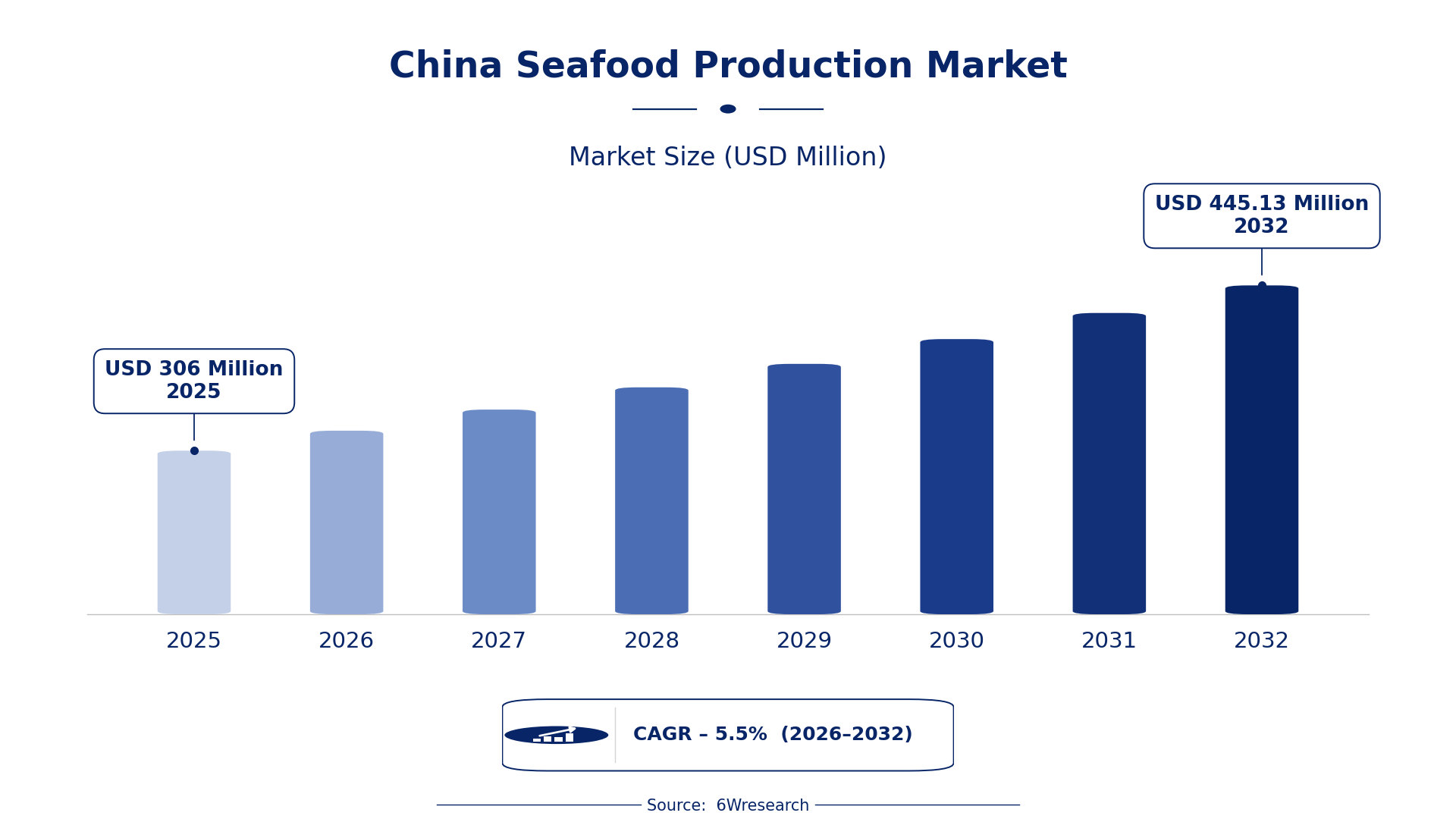
According to 6Wresearch internal database and industry insights, the China Seafood Production Market was valued at USD 306.0 million in 2025 and is projected to reach USD 445.13 million by 2032, growing at a CAGR of approximately 5.5% during 2026–2032.
China Seafood Production Market Highlights
| Report Metric | Details |
| Report Name | China Seafood Production Market |
| Market Size 2025 | USD 306.0 million |
| Market Size 2032 | USD 445.13 million |
| Absolute Growth 2025–2032 | USD 139.13 million |
| CAGR 2026–2032 | 5.5% |
| Peak Annual Growth | 8.5% in 2032 |
| Forecast Period | 2026–2032 |
| Historical Data | 2022–2025 |
| Base Year | 2025 |
| Leading Production Method, 2025 | Aquaculture (39% share) |
| Leading Species, 2025 | Shrimp (43% share) |
| Leading Farming Type, 2025 | Pond / Cage Farming (44% share) |
| Leading End User, 2025 | Export Companies (35% share) |
| Fastest-Growing Production Method | Recirculating Aquaculture Systems (RAS) (7.7% CAGR) |
| Fastest-Growing Species | Tilapia (7.8% CAGR) |
| Fastest-Growing Farming Type | Indoor Farming (8.0% CAGR) |
| Fastest-Growing End User | Foodservice Providers (7.6% CAGR) |
| Growing Sector | Aquaculture |
| Key End Users | Export Companies, Foodservice Providers, Seafood Distributors, Retail Seafood Markets |
China Seafood Production Market Year-wise Growth Rate and Key Drivers (2022–2032)
This graph illustrates the annual growth rates of the market from 2022 to 2032, highlighting a steady upward trajectory and projected market expansion over the forecast period.
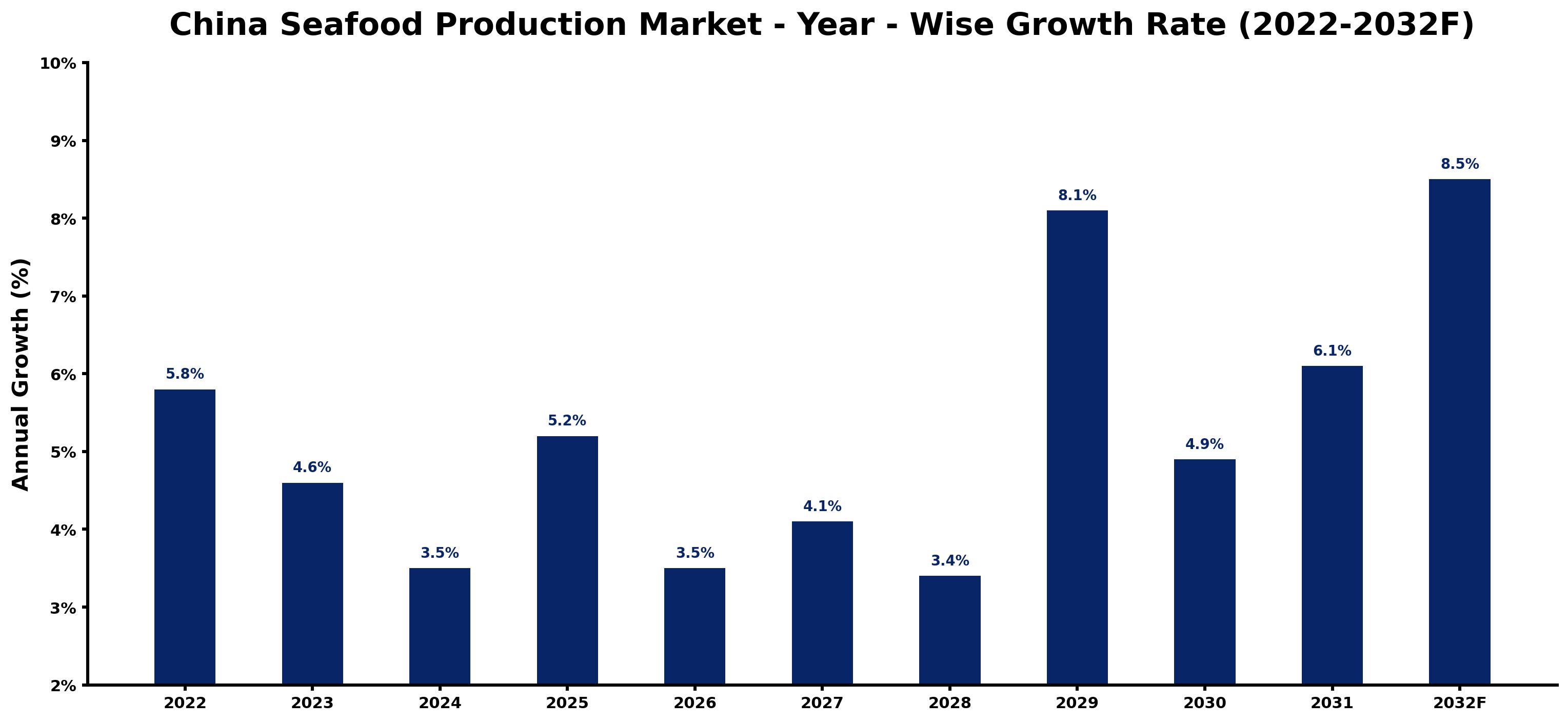
The table below sets out the estimated growth rate for each year and the main factor behind it.
| Year | Estimated Annual Growth (%) | Market Rationale |
| 2022 | 5.8 | The market experienced strong demand from foodservice providers and retail markets, particularly in coastal provinces. |
| 2023 | 4.6 | Growth slowed due to regulatory adjustments affecting aquaculture practices, particularly the updated Food Safety Law. |
| 2024 | 3.5 | The market continued to slow as aquaculture faced challenges in production efficiency amid rising operational costs. |
| 2025 | 5.2 | Demand increased as seafood exports rose, driven by international market needs, particularly from export companies. |
| 2026 | 3.5 | Growth is expected to slow again as producers adjust to new safety regulations under the Food Safety Law. |
| 2027 | 4.1 | The market is projected to see a slight recovery as domestic consumption picks up, particularly in retail seafood markets. |
| 2028 | 3.4 | Growth is expected to slow as competition among seafood producers intensifies, particularly from imported options. |
| 2029 | 8.1 | Demand is projected to surge due to rising health awareness and dietary changes, particularly among foodservice providers. |
| 2030 | 4.9 | The market growth is expected to slow as supply chain issues begin to emerge, affecting product availability. |
| 2031 | 6.1 | Growth is expected to accelerate as aquaculture innovations improve production methods, supported by government initiatives. |
| 2032 | 8.5 | The market is projected to peak as the government promotes sustainable aquaculture practices through new regulations. |
Note: Market size estimations and growth projections presented in this report are based on 6Wresearch's proprietary forecasting methodology, utilizing the latest available industry data, government publications, and primary research inputs.
China Seafood Production Market Synopsis
Seafood Production in China encompasses aquaculture and wild capture methods, primarily focusing on farming practices like pond and cage farming. This sector is vital for both domestic consumption and export, with strong demand from foodservice providers and retail markets. The China Seafood Production Market is growing due to increasing health awareness, dietary changes, and substantial investments in aquaculture technologies. In 2022, the country exported seafood worth approximately $18 billion, reflecting its strong position in the global market. The government's initiatives, such as the Sustainable Aquaculture Development Plan, further support this growth.
Market Dynamics Impact Analysis (2026–2032)
| Factor | Type | Impact | Primary Segment Affected |
| Increasing health awareness among consumers drives demand for seafood products. | Driver | High | Aquaculture |
| Growing international demand for seafood exports creates new opportunities. | Driver | High | Export Companies |
| Investment in aquaculture technologies presents a significant opportunity for growth. | Opportunity | High | Aquaculture |
| The demand for sustainable seafood products is rising among consumers. | Opportunity | Medium | Foodservice Providers |
| Regulatory changes may impact production practices and costs. | Restraint | High | Aquaculture |
| Supply chain disruptions can affect the availability of seafood products. | Restraint | Medium | Seafood Distributors |
| High operational costs can limit profitability for producers. | Challenge | High | Aquaculture |
| Competition from imported seafood can affect local market share. | Challenge | Medium | Retail Seafood Markets |
Evaluation of Drivers in China Seafood Production Market (2026–2032)
The factors lifting demand, and the evidence behind each, are summarised below.
| Drivers | Primary Segment Affected | Why It Matters (Evidence) |
| Rising domestic consumption of seafood products boosts aquaculture demand. | Aquaculture | In 2022, the average per capita seafood consumption reached around 38 kg, encouraging production growth. |
| Increasing seafood exports drive investment in production capacity. | Export Companies | China exported seafood worth approximately $18 billion in 2022, spurring growth in production capacity. |
| Technological advancements in aquaculture improve production efficiency. | Aquaculture | The National Aquaculture Development Plan aims to improve efficiency by 2025, increasing output by 15%. |
| Health trends favour seafood consumption over red meats. | Foodservice Providers | Growing health awareness is shifting consumer preferences towards seafood options, increasing demand by 20%. |
| Government subsidies for innovation encourage aquaculture development. | Aquaculture | In 2023, a subsidy program was launched with a budget of $50 million for aquaculture innovation. |
The Seafood Production market in China is growing on the back of rising domestic consumption, increasing seafood exports, and technological advancements in aquaculture. The average per capita seafood consumption reached around 38 kg, driving demand for local production. In 2022, seafood exports worth approximately $18 billion spurred investment in production capacity. The National Aquaculture Development Plan aims to improve efficiency by 2025, increasing output by 15%.
Evaluation of Restraints in China Seafood Production Market
Below mentioned are some major restraints and their influence on market dynamics.
| Market Restraint | Primary Segment Affected | Why It Matters (Evidence) |
| Regulatory changes can impose additional costs on seafood producers. | Aquaculture | The updated Food Safety Law in 2021 requires stricter compliance, increasing operational costs by up to 15%. |
| Supply chain disruptions can lead to product shortages. | Seafood Distributors | Global supply chain issues have affected the availability of seafood products, leading to delays of up to three weeks. |
| High operational costs can limit profitability for aquaculture farms. | Aquaculture | Rising costs of feed and equipment impact profit margins for producers, reducing profitability by approximately 20%. |
| Competition from imported seafood can reduce market share for local producers. | Retail Seafood Markets | Imported seafood options often offer lower prices, affecting local sales and market share by about 10%. |
| Environmental regulations can restrict fishing practices and aquaculture expansion. | Aquaculture | Marine protected areas limit fishing zones, impacting supply capabilities and reducing available fishing areas by 30%. |
China Seafood Production Market Challenges
China's seafood production market faces significant challenges that hinder its growth. Supply chain disruptions occur due to reliance on coastal provinces like Guangdong and Fujian, leading to localized shortages that can inflate input costs for producers by 15% during adverse weather events. Regulatory compliance with the updated Seafood Safety and Quality Standards requires substantial investment, causing delays in new processing plant approvals by six months for suppliers. A skills gap is evident, as over 5 million workers need advanced training to meet modern aquaculture demands, which limits productivity. Technology adoption remains slow, with many producers lacking access to modern farming techniques, potentially reducing efficiency by 20%, ultimately impacting supply for buyers.
Trends in the China Seafood Production Market
The trends below show where the China Seafood Production Market is heading.
- Shift towards Sustainable Aquaculture Practices: Foodservice providers are increasingly prioritising sustainable seafood options, driven by consumer demand. In 2023, the Sustainable Aquaculture Development Plan was launched, promoting eco-friendly practices. This trend is stimulating innovation in aquaculture.
- Increase in Aquaculture Technology Adoption: Aquaculture technology adoption is on the rise, concentrating on improving efficiency. The Aquaculture Innovation Support Program, initiated in 2022, allocated $50 million to fund research. This investment is boosting production capabilities.
- Growing Demand for Local Seafood: Consumers are increasingly seeking locally sourced seafood, impacting retail markets. In 2022, the average per capita seafood consumption was around 38 kg, reflecting this trend. Retail seafood markets are adapting to meet local preferences.
- Expansion of Export Markets for Seafood: Export companies are exploring new international markets for seafood products. In 2022, China exported seafood worth approximately $18 billion, highlighting growth opportunities. This trend is driving further investments in production.
Investment Opportunities in the China Seafood Production Market
Investors looking at the China Seafood Production Market should consider the following areas.
- Partnerships for Aquaculture Innovation: Local partnerships are essential for entering the aquaculture market, especially with government support. With a $50 million budget for innovation, collaborating with local entities can improve production capabilities significantly.
- Investment in Sustainable Seafood Production: The seafood market is currently experiencing a shift towards sustainability, with a projected growth in eco-friendly practices. Foodservice providers are increasingly demanding sustainable options, creating opportunities for suppliers to innovate.
- Expansion into Export Markets: With seafood exports valued at approximately $18 billion in 2022, there is a significant gap for new entrants. Export companies are looking for innovative products to meet international demand, providing an entry point for new suppliers.
- Utilising Technological Advancements: The current focus on aquaculture technology presents a unique investment opportunity. The Aquaculture Innovation Support Program encourages innovation, making it an ideal time for suppliers to enter the market.
Government Initiatives in the China Seafood Production Market
In 2023, the Ministry of Agriculture launched the "Sustainable Aquaculture Development Plan" to promote environmentally friendly practices in aquaculture. This plan builds on the 2021 revisions to the "Food Safety Law," which strengthened regulations on seafood safety and quality assurance. Together, these measures improve the overall sustainability and safety of seafood production in China, ensuring compliance and enhancing market access for producers.
The National Fisheries Administration oversees the implementation of various seafood production regulations. It approves funding for initiatives like the Aquaculture Innovation Support Program, which has a budget of $50 million aimed at advancing aquaculture technologies. This agency plays a key role in ensuring compliance with safety standards and promoting sustainable practices, enabling producers to enhance their operational capabilities.
Future Insight of the China Seafood Production Market
The seafood production market in China is expected to evolve by 2032, driven by several key initiatives. The Sustainable Aquaculture Development Plan aims for aquaculture to comprise 70% of total seafood production by 2025, significantly reshaping supply dynamics. Investment in advanced farming techniques from research institutes will improve production efficiency and species diversity. The Ministry of Agriculture's subsidy program for innovation will motivate producers to implement new technologies, enhancing competitiveness. Growing health awareness among consumers will further increase demand for high-quality seafood, influencing market trends.
Market Segmentation Analysis
The analysis below covers each segmentation, its leading category in 2025 and its fastest-growing category through 2032.
By Production Method – Aquaculture Dominated, Recirculating Aquaculture Systems (RAS) Expected to Grow Fastest
According to Shubham Padhi, Research Analyst at 6Wresearch, the largest production method category in 2025 was Aquaculture, with a 39% share of total revenue. Aquaculture holds the largest share of the seafood production market in China, crucial for satisfying both domestic and export demands. With production reaching approximately 60 million tons in 2022, it underscores its essential role in the overall market. Over 2026–2032, Recirculating Aquaculture Systems (RAS) is expected to post the fastest growth, at a CAGR of 7.7%. Recirculating Aquaculture Systems (RAS) is gaining attention as a promising technology that could significantly improve production efficiency. The recent government subsidy programme for aquaculture innovation indicates a strong push towards adopting RAS, which could reshape the industry's future. Suppliers should prioritise investments in RAS technologies to align with government initiatives and meet future market demands.
By Species – Shrimp Dominated, Tilapia Expected to Grow Fastest
Shrimp took a 43% share of species in 2025, more than any other category. Shrimp dominates the market share in China's seafood production, driven by high demand for both domestic consumption and exports. Its versatility in various culinary applications reinforces its strong position in the market. Tilapia is projected to grow fastest, at a CAGR of 7.8% during 2026–2032. Tilapia is witnessing rapid growth due to its extensive farming and consumption in China, appealing to health-conscious consumers. The increasing emphasis on dietary changes is further elevating tilapia's visibility in the seafood market. Buyers should consider diversifying their seafood offerings to include tilapia, aligning with shifting consumer preferences.
By Farming Type – Pond / Cage Farming Dominated, Indoor Farming Expected to Grow Fastest
Pond / Cage Farming accounted for a 44% market share by farming type in 2025. Pond and cage farming is the predominant method in China's aquaculture sector, vital for sustaining high production levels. This traditional approach is particularly prevalent in coastal provinces such as Guangdong and Fujian, where it thrives. Indoor Farming is set to record the highest CAGR in this split, 8.0% over 2026–2032. Indoor farming is emerging as a promising alternative, although its current adoption remains limited. The focus on innovative farming practices could enhance efficiency and sustainability in the seafood sector over time. Suppliers should investigate opportunities in indoor farming technologies to maintain competitiveness and address future sustainability goals.
By End User – Export Companies Dominated, Foodservice Providers Expected to Grow Fastest
With a 35% revenue share in 2025, Export Companies was the largest end user category. Export companies are integral to China's seafood supply chain, significantly impacting the overall market share. Their active participation in international trade underscores their critical role within the industry. The quickest growth will come from Foodservice Providers, forecast to expand at a CAGR of 7.6% between 2026 and 2032. Foodservice providers are rapidly increasing their demand for seafood products, reflecting evolving consumer tastes and preferences. This growth signals a broader trend towards dining experiences that prominently feature seafood offerings. Suppliers must cultivate strong partnerships with foodservice providers to capture emerging demand and adapt to market trends.
Key Attractiveness of the Report
- 10 Years of Market Numbers
- Historical Data Starting from 2022 to 2025
- Base Year 2025
- Forecast Data until 2032
- Key Performance Indicators Impacting the Market
- Major Upcoming Developments and Projects
Key Highlights of the Report:
- China Seafood Production Market Outlook
- Market Size of China Seafood Production Market, 2025
- Forecast of China Seafood Production Market, 2032
- Historical Data and Forecast of China Seafood Production Revenues & Volume for the Period 2022 - 2032F
- China Seafood Production Market Trend Evolution
- China Seafood Production Market Drivers and Challenges
- China Seafood Production Price Trends
- China Seafood Production Porter's Five Forces
- China Seafood Production Industry Life Cycle
- Historical Data and Forecast of China Seafood Production Market Revenues & Volume By Production Method for the Period 2022 - 2032F
- Historical Data and Forecast of China Seafood Production Market Revenues & Volume By Aquaculture for the Period 2022 - 2032F
- Historical Data and Forecast of China Seafood Production Market Revenues & Volume By Wild Capture for the Period 2022 - 2032F
- Historical Data and Forecast of China Seafood Production Market Revenues & Volume By Recirculating Aquaculture Systems (RAS) for the Period 2022 - 2032F
- Historical Data and Forecast of China Seafood Production Market Revenues & Volume By Mollusk Farming for the Period 2022 - 2032F
- Historical Data and Forecast of China Seafood Production Market Revenues & Volume By Species for the Period 2022 - 2032F
- Historical Data and Forecast of China Seafood Production Market Revenues & Volume By Shrimp, Salmon for the Period 2022 - 2032F
- Historical Data and Forecast of China Seafood Production Market Revenues & Volume By Tuna, Mackerel for the Period 2022 - 2032F
- Historical Data and Forecast of China Seafood Production Market Revenues & Volume By Tilapia for the Period 2022 - 2032F
- Historical Data and Forecast of China Seafood Production Market Revenues & Volume By Oysters, Mussels for the Period 2022 - 2032F
- Historical Data and Forecast of China Seafood Production Market Revenues & Volume By Farming Type for the Period 2022 - 2032F
- Historical Data and Forecast of China Seafood Production Market Revenues & Volume By Pond / Cage Farming for the Period 2022 - 2032F
- Historical Data and Forecast of China Seafood Production Market Revenues & Volume By Longline, Trawling for the Period 2022 - 2032F
- Historical Data and Forecast of China Seafood Production Market Revenues & Volume By Indoor Farming for the Period 2022 - 2032F
- Historical Data and Forecast of China Seafood Production Market Revenues & Volume By Coastal Farming for the Period 2022 - 2032F
- Historical Data and Forecast of China Seafood Production Market Revenues & Volume By End User for the Period 2022 - 2032F
- Historical Data and Forecast of China Seafood Production Market Revenues & Volume By Export Companies for the Period 2022 - 2032F
- Historical Data and Forecast of China Seafood Production Market Revenues & Volume By Seafood Distributors for the Period 2022 - 2032F
- Historical Data and Forecast of China Seafood Production Market Revenues & Volume By Foodservice Providers for the Period 2022 - 2032F
- Historical Data and Forecast of China Seafood Production Market Revenues & Volume By Retail Seafood Markets for the Period 2022 - 2032F
- China Seafood Production Import Export Trade Statistics
- Market Opportunity Assessment By Production Method
- Market Opportunity Assessment By Species
- Market Opportunity Assessment By Farming Type
- Market Opportunity Assessment By End User
- China Seafood Production Top Companies Market Share
- China Seafood Production Competitive Benchmarking By Technical and Operational Parameters
- China Seafood Production Company Profiles
- China Seafood Production Key Strategic Recommendations
Market Covered
Segments analysed in this report are listed below.
By Production Method
- Aquaculture
- Wild Capture
- Recirculating Aquaculture Systems (RAS)
- Mollusk Farming
By Species
- Shrimp
- Salmon
- Tuna
- Mackerel
- Tilapia
- Oysters
- Mussels
By Farming Type
- Pond / Cage Farming
- Longline
- Trawling
- Indoor Farming
- Coastal Farming
By End User
- Export Companies
- Seafood Distributors
- Foodservice Providers
- Retail Seafood Markets































