India Second-Generation Biofuel Market Size & Growth Rate
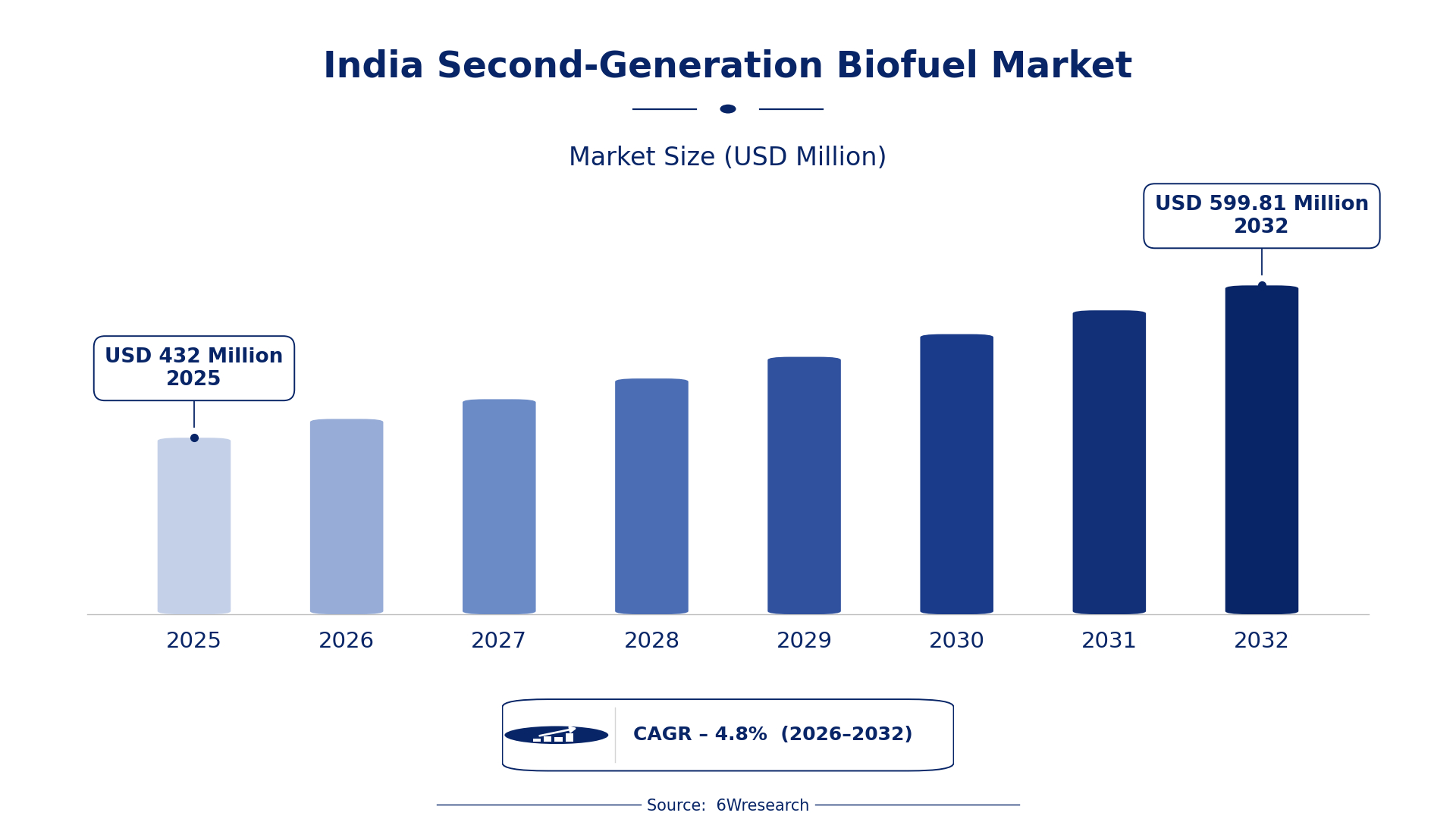
According to 6Wresearch internal database and industry insights, the India Second-Generation Biofuel Market was valued at USD 432.0 million in 2025 and is projected to reach USD 599.81 million by 2032, growing at a CAGR of approximately 4.8% during 2026–2032.
India Second-Generation Biofuel Market Highlights
| Report Metric | Details |
| Report Name | India Second-Generation Biofuel Market |
| Market Size 2025 | USD 432.0 million |
| Market Size 2032 | USD 599.81 million |
| Absolute Growth 2025–2032 | USD 167.81 million |
| CAGR 2026–2032 | 4.8% |
| Peak Annual Growth | 7.2% in 2026 |
| Forecast Period | 2026–2032 |
| Historical Data | 2022–2025 |
| Base Year | 2025 |
| Leading Feedstock, 2025 | Agricultural Residue (42% share) |
| Leading Biofuel Type, 2025 | 2G Ethanol (46% share) |
| Leading Production Technology, 2025 | Enzymatic Hydrolysis (36% share) |
| Leading End User, 2025 | Transportation Fuel Suppliers (36% share) |
| Fastest-Growing Feedstock | Algae-Derived Biofuel (7.4% CAGR) |
| Fastest-Growing Biofuel Type | Biogas (Upgraded RNG) (7.1% CAGR) |
| Fastest-Growing Production Technology | Anaerobic Digestion (6.1% CAGR) |
| Fastest-Growing End User | Urban Utility Providers (7.3% CAGR) |
| Growing Sector | Transportation Fuel Suppliers |
| Key End Users | Transportation Fuel Suppliers, Urban Utility Providers, Industrial Fuel Consumers |
India Second-Generation Biofuel Market Year-wise Growth Rate and Key Drivers (2022–2032)
This graph illustrates the annual growth rates of the market from 2022 to 2032, highlighting a steady upward trajectory and projected market expansion over the forecast period.
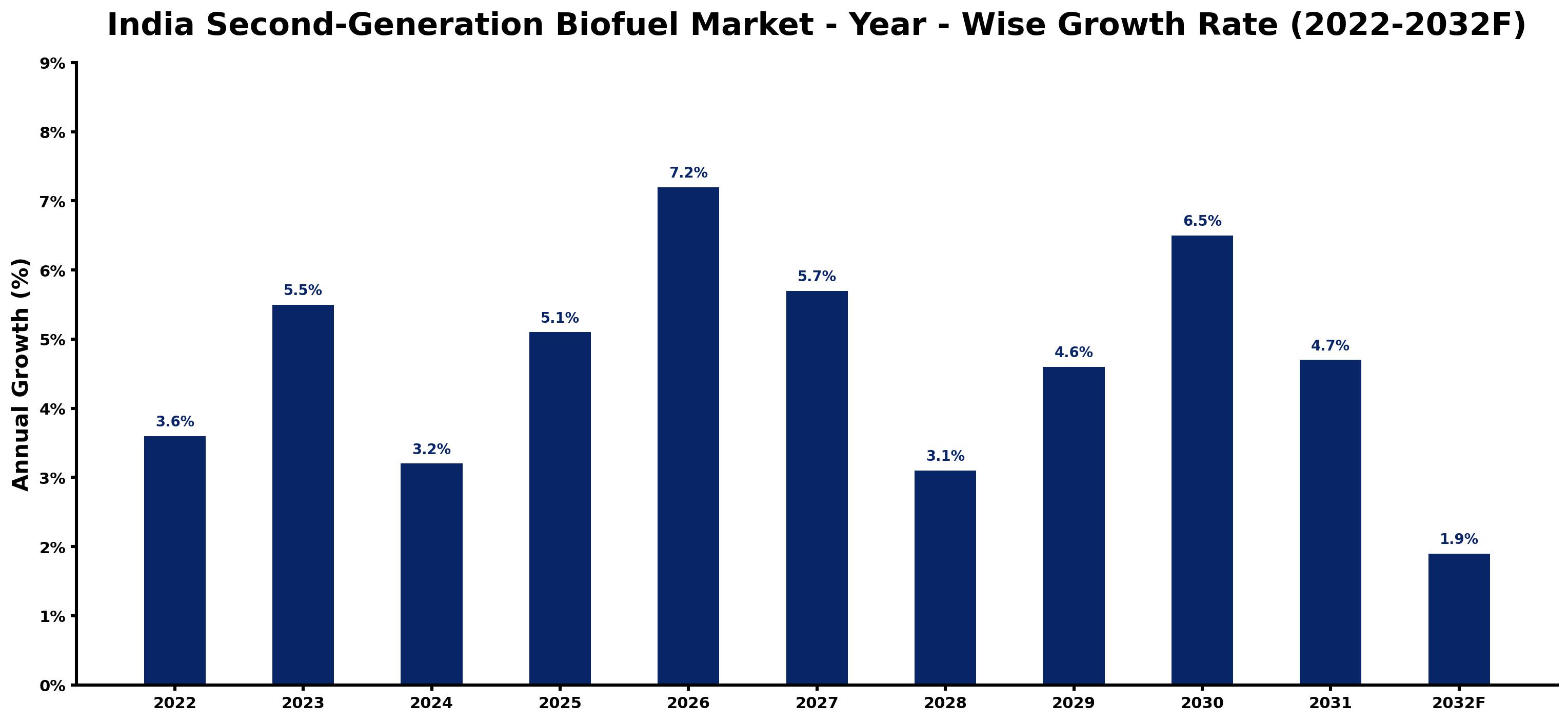
Each row of the following table gives one year's estimated growth and the event or demand shift that explains it.
| Year | Estimated Annual Growth (%) | Market Rationale |
| 2022 | 3.6 | The market experienced steady growth due to rising domestic demand for biofuels, particularly from agricultural residue suppliers. |
| 2023 | 5.5 | Increased focus on sustainable energy sources accelerated growth compared to the previous year, driven by the National Biofuel Policy 2018. |
| 2024 | 3.2 | Growth slowed slightly as fluctuations in agricultural residue availability impacted production capabilities. |
| 2025 | 5.1 | Demand surged as the government pushed for higher ethanol blending in petrol, aiming for 20% by 2025. |
| 2026 | 7.2 | The market is expected to see a boost driven by advancements in biogas technology and increased investments. |
| 2027 | 5.7 | Growth is projected to moderate as producers face challenges in scaling production to meet rising demand. |
| 2028 | 3.1 | A further slowdown is expected due to inconsistent agricultural residue supply impacting production schedules. |
| 2029 | 4.6 | Demand is anticipated to pick up again as urban utility providers expand biogas use, supported by government initiatives. |
| 2030 | 6.5 | Growth is expected to accelerate with new investments in biofuel infrastructure and production technologies. |
| 2031 | 4.7 | The market will face slower growth as competition intensifies among producers, impacting pricing strategies. |
| 2032 | 1.9 | Growth is projected to decelerate as the market approaches maturity, with established quality standards in place. |
Note: Market size estimations and growth projections presented in this report are based on 6Wresearch's proprietary forecasting methodology, utilizing the latest available industry data, government publications, and primary research inputs.
India Second-Generation Biofuel Market Synopsis
The Second-Generation Biofuel Market in India includes biofuels derived from non-food biomass sources, produced through advanced technologies like enzymatic hydrolysis and anaerobic digestion. With a target of 20% ethanol blending in petrol by 2025, demand is primarily driven by transportation fuel suppliers and agricultural sectors. Government initiatives, such as the National Biofuel Policy 2018, are propelling this growth, encouraging investments in biofuel production and technology.
Market Dynamics Impact Analysis (2026–2032)
| Factor | Type | Impact | Primary Segment Affected |
| Government initiatives promoting biofuel production and blending targets | Driver | High | Transportation Fuel Suppliers |
| Growing availability of agricultural residues as feedstock | Driver | High | Agricultural Residue |
| Increasing investments in biogas plants in rural areas | Opportunity | Medium | Urban Utility Providers |
| Rising demand for sustainable energy sources in transportation | Opportunity | High | Transportation Fuel Suppliers |
| Challenges in scaling production capacity due to technology limitations | Restraint | High | 2G Ethanol |
| Fluctuations in feedstock availability impacting production | Restraint | Medium | Agricultural Residue |
| High initial investment costs for biofuel production facilities | Challenge | High | Biogas (Upgraded RNG) |
| Regulatory complexities affecting market entry for new players | Challenge | Medium | Biodiesel |
Evaluation of Drivers in India Second-Generation Biofuel Market (2026–2032)
Key forces behind demand, with the segment each one moves most, are listed below.
| Drivers | Primary Segment Affected | Why It Matters (Evidence) |
| Government's target for 20% ethanol blending by 2025 | 2G Ethanol | This target encourages transportation fuel suppliers to increase biofuel purchases, aiming for compliance. |
| Availability of over 30 million tons of agricultural residue annually | Agricultural Residue | This abundant feedstock source enables producers to meet growing biofuel demand efficiently. |
| Investment in biogas plants under the National Mission on Sustainable Agriculture | Biogas (Upgraded RNG) | This initiative supports urban utility providers in expanding their renewable energy offerings. |
| Technological advancements in enzymatic hydrolysis processes | Enzymatic Hydrolysis | These improvements increase production efficiency, prompting higher demand from fuel producers. |
| Increased consumer awareness of sustainable energy options | Biodiesel | This awareness drives industrial fuel consumers to seek biofuel alternatives for cleaner energy. |
The target of 20% ethanol blending by 2025 motivates transportation fuel suppliers to increase biofuel purchases. With over 30 million tons of agricultural residue available annually, producers can efficiently meet demand. Investment in biogas plants aids urban utility providers in expanding their renewable energy offerings, while advancements in enzymatic hydrolysis processes improve production efficiency. This combination of elements is driving notable growth in the market.
Evaluation of Restraints in India Second-Generation Biofuel Market
The table below lists the restraints and the evidence behind each.
| Market Restraint | Primary Segment Affected | Why It Matters (Evidence) |
| High initial investment costs for biofuel production facilities | 2G Ethanol | Producers face substantial capital requirements, which can deter new entrants and limit production expansion. |
| Fluctuations in feedstock availability impacting production | Agricultural Residue | Inconsistent supply of agricultural residues can disrupt production schedules for biofuel manufacturers. |
| Regulatory complexities affecting market entry for new players | Biodiesel | Navigating regulatory requirements can delay new projects, impacting overall market growth. |
| Technology limitations in scaling production capacity | Biogas (Upgraded RNG) | Current technologies may not support the rapid scaling needed to meet increasing demand. |
| Competition from fossil fuels impacting pricing strategies | Transportation Fuel Suppliers | Price volatility in fossil fuels can make biofuels less attractive to consumers. |
India Second-Generation Biofuel Market Challenges
The India Second-Generation Biofuel Market faces several practical issues, with cost being a primary concern. High production costs due to advanced processing methods can inflate prices for producers, making it difficult to compete with fossil fuels. Supply chain inefficiencies create delays in delivering raw materials to production facilities, impacting output for buyers and potentially leading to a 15% reduction in availability. Buyers also experience price volatility stemming from inconsistent supply, complicating budgeting for agricultural sectors that depend on biofuels. Regulatory hurdles add to the complexity, as compliance with evolving standards can delay project approvals for producers, stalling market growth by up to 12 months.
Trends in the India Second-Generation Biofuel Market
Four trends stand out in the India Second-Generation Biofuel Market.
- Shift towards Biogas Utilization in Rural Areas: India is increasingly adopting biogas plants, particularly in rural areas, to promote clean energy. The National Mission on Sustainable Agriculture supports this shift, with an estimated ₹5 billion allocated for biogas initiatives.
- Transition from Traditional to Advanced Biofuels: The focus is shifting from first-generation to second-generation biofuels, supported by the National Biofuel Policy 2018. This policy aims for 20% ethanol blending by 2025, enhancing energy security and reducing emissions.
- Emergence of Anaerobic Digestion Technologies: Anaerobic digestion is gaining traction as a key production technology for biofuels. With a projected CAGR of 6.1%, this method is becoming increasingly popular among producers seeking efficient biomass conversion.
- Increase in Urban Utility Providers' Biogas Adoption: Urban utility providers are expanding their use of biogas for energy supply, driven by government support. This trend is expected to grow as more than 80 million households are targeted for clean cooking fuel.
Investment Opportunities in the India Second-Generation Biofuel Market
Some of the investment opportunities in the India Second-Generation Biofuel Market are mentioned below.
- Supply of Advanced Biofuel Production Technologies: With a growing market for second-generation biofuels, there is a need for advanced production technologies. Urban utility providers are seeking efficient solutions, presenting an opportunity for technology suppliers.
- Investment in Biogas Plant Infrastructure: The Indian government allocated ₹10 billion for biofuel development, creating a gap in biogas plant infrastructure. Urban utility providers can capitalize on this funding by partnering with local firms to enhance their capabilities.
- Expansion of Transportation Fuel Blending Services: As the government pushes for higher ethanol blending, transportation fuel suppliers must improve blending services. This presents an opportunity for suppliers to invest in blending technologies and infrastructure.
- Development of Quality Standards for Biodiesel: With the Bureau of Indian Standards establishing biodiesel quality specifications, there is a need for compliance solutions. Producers can invest in quality assurance processes to meet these standards.
Government Initiatives in the India Second-Generation Biofuel Market
The updated National Policy on Biofuels in 2022, established by the Ministry of Petroleum and Natural Gas, aims to achieve 20% ethanol blending by 2025. This policy promotes the use of second-generation biofuels, enhancing energy security and reducing emissions. The Biofuel Technology Mission, initiated in 2021, focuses on advancing biofuel technologies with a budget of ₹5 billion, encouraging investments in production processes.
The Ministry of New and Renewable Energy supports biogas projects through various schemes, including the Pradhan Mantri Ujjwala Yojana. This initiative aims to provide clean cooking fuel to 80 million households, promoting biogas use. Additionally, the Indian Renewable Energy Development Agency funds biofuel projects, ensuring financial support for producers and enhancing market growth. With ₹10 billion allocated in 2022, these measures significantly boost biofuel production capabilities.
Future Insight of the India Second-Generation Biofuel Market
The India Second-Generation Biofuel Market is expected to develop significantly by 2032, driven by several key factors. The government’s target of 20% ethanol blending in petrol by 2025 will drive production and consumption. Investment in biogas plants, promoted by the Ministry of New and Renewable Energy, will enhance rural energy access and create job opportunities. With over 30 million tons of agricultural residue available annually, producers will have ample feedstock to meet rising demand. The establishment of biodiesel quality specifications by the Bureau of Indian Standards will improve product reliability and consumer trust.
Market Segmentation Analysis
The report offers a comprehensive study of the following market segments and their leading categories in the market.
By Feedstock – Agricultural Residue Dominated, Algae-Derived Biofuel Expected to Grow Fastest
According to Shubham Padhi, Research Analyst at 6Wresearch, the largest feedstock category in 2025 was Agricultural Residue, with a 42% share of total revenue. Agricultural residue serves as a primary feedstock for second-generation biofuels, with over 30 million tons available annually in India. This abundant supply supports rural economies and ensures a steady stream of biomass for biofuel production. Algae-Derived Biofuel is set to record the highest CAGR in this split, 7.4% over 2026–2032. Algae-derived biofuel is experiencing rapid growth due to advancements in production technologies and increasing interest in sustainable energy sources. Its potential for high yield and minimal land use positions it as a future leader in the market. Suppliers should focus on developing algae-based solutions to capture emerging opportunities in the biofuel market.
By Biofuel Type – 2G Ethanol Dominated, Biogas (Upgraded RNG) Expected to Grow Fastest
2G Ethanol held a 46% share of the India Second-Generation Biofuel Market by biofuel type in 2025. 2G Ethanol commands the largest market share due to its extensive application in transportation fuels, which aligns with India's goal of achieving 20% ethanol blending in petrol by 2025. This high demand is further reinforced by supportive policies and initiatives promoting its use across various states. Over 2026–2032, Biogas (Upgraded RNG) is expected to post the fastest growth, at a CAGR of 7.1%. Biogas (Upgraded RNG) is witnessing rapid growth as urban utility providers increasingly adopt it for energy generation and heating, reflecting a shift towards renewable energy solutions. This trend is likely to continue as urban areas prioritise sustainable energy practices and infrastructure development. Suppliers should prioritise the expansion of biogas production capabilities to capitalise on the increasing demand for renewable energy in urban markets.
By Production Technology – Enzymatic Hydrolysis Dominated, Anaerobic Digestion Expected to Grow Fastest
With a 36% revenue share in 2025, Enzymatic Hydrolysis was the largest production technology category. Enzymatic Hydrolysis is the leading production technology, essential for efficiently converting biomass into sugars that are subsequently transformed into biofuels. Its established processes and effectiveness in large-scale production contribute to its dominant market position. Anaerobic Digestion is projected to grow fastest, at a CAGR of 6.1% during 2026–2032. Anaerobic Digestion is rapidly gaining traction as it effectively transforms organic waste into biogas, appealing to urban utility providers looking for sustainable energy solutions. The technology's ability to scale up production supports its swift adoption in the market. Suppliers must prioritise investments in anaerobic digestion technologies to cater to the increasing demand for sustainable energy solutions.
By End User – Transportation Fuel Suppliers Dominated, Urban Utility Providers Expected to Grow Fastest
In 2025, Transportation Fuel Suppliers led the end user split with a 36% share. Transportation Fuel Suppliers hold the largest market share among end users, as they heavily depend on biofuels for blending to meet regulatory requirements. Their significant role in the market highlights the importance of biofuels in fulfilling energy needs within the transportation sector. The quickest growth will come from Urban Utility Providers, forecast to expand at a CAGR of 7.3% between 2026 and 2032. Urban Utility Providers are rapidly increasing their biogas consumption for energy supply, driven by the urgent need for cleaner energy options in urban settings. This growth is expected to accelerate as cities enhance their efforts towards sustainable energy solutions. Suppliers should focus on engaging urban utility providers to tap into the rising demand for biogas in energy applications.
Key Attractiveness of the Report
- 10 Years of Market Numbers
- Historical Data Starting from 2022 to 2025
- Base Year 2025
- Forecast Data until 2032
- Key Performance Indicators Impacting the Market
- Major Upcoming Developments and Projects
Key Highlights of the Report:
- India Second-Generation Biofuel Market Outlook
- Market Size of India Second-Generation Biofuel Market, 2025
- Forecast of India Second-Generation Biofuel Market, 2032
- Historical Data and Forecast of India Second-Generation Biofuel Revenues & Volume for the Period 2022 - 2032F
- India Second-Generation Biofuel Market Trend Evolution
- India Second-Generation Biofuel Market Drivers and Challenges
- India Second-Generation Biofuel Price Trends
- India Second-Generation Biofuel Porter's Five Forces
- India Second-Generation Biofuel Industry Life Cycle
- Historical Data and Forecast of India Second-Generation Biofuel Market Revenues & Volume By Feedstock for the Period 2022 - 2032F
- Historical Data and Forecast of India Second-Generation Biofuel Market Revenues & Volume By Lignocellulosic Biomass for the Period 2022 - 2032F
- Historical Data and Forecast of India Second-Generation Biofuel Market Revenues & Volume By Algae-Derived Biofuel for the Period 2022 - 2032F
- Historical Data and Forecast of India Second-Generation Biofuel Market Revenues & Volume By Agricultural Residue for the Period 2022 - 2032F
- Historical Data and Forecast of India Second-Generation Biofuel Market Revenues & Volume By Forestry Residue for the Period 2022 - 2032F
- Historical Data and Forecast of India Second-Generation Biofuel Market Revenues & Volume By Biofuel Type for the Period 2022 - 2032F
- Historical Data and Forecast of India Second-Generation Biofuel Market Revenues & Volume By 2G Ethanol for the Period 2022 - 2032F
- Historical Data and Forecast of India Second-Generation Biofuel Market Revenues & Volume By Biodiesel for the Period 2022 - 2032F
- Historical Data and Forecast of India Second-Generation Biofuel Market Revenues & Volume By Biogas (Upgraded RNG) for the Period 2022 - 2032F
- Historical Data and Forecast of India Second-Generation Biofuel Market Revenues & Volume By Synthetic Hydrocarbons for the Period 2022 - 2032F
- Historical Data and Forecast of India Second-Generation Biofuel Market Revenues & Volume By Production Technology for the Period 2022 - 2032F
- Historical Data and Forecast of India Second-Generation Biofuel Market Revenues & Volume By Enzymatic Hydrolysis for the Period 2022 - 2032F
- Historical Data and Forecast of India Second-Generation Biofuel Market Revenues & Volume By Transesterification for the Period 2022 - 2032F
- Historical Data and Forecast of India Second-Generation Biofuel Market Revenues & Volume By Anaerobic Digestion for the Period 2022 - 2032F
- Historical Data and Forecast of India Second-Generation Biofuel Market Revenues & Volume By Fischer-Tropsch for the Period 2022 - 2032F
- Historical Data and Forecast of India Second-Generation Biofuel Market Revenues & Volume By End User for the Period 2022 - 2032F
- Historical Data and Forecast of India Second-Generation Biofuel Market Revenues & Volume By Transportation Fuel Suppliers for the Period 2022 - 2032F
- Historical Data and Forecast of India Second-Generation Biofuel Market Revenues & Volume By Aviation & Marine Fuel Firms for the Period 2022 - 2032F
- Historical Data and Forecast of India Second-Generation Biofuel Market Revenues & Volume By Urban Utility Providers for the Period 2022 - 2032F
- Historical Data and Forecast of India Second-Generation Biofuel Market Revenues & Volume By Industrial Fuel Consumers for the Period 2022 - 2032F
- India Second-Generation Biofuel Import Export Trade Statistics
- Market Opportunity Assessment By Feedstock
- Market Opportunity Assessment By Biofuel Type
- Market Opportunity Assessment By Production Technology
- Market Opportunity Assessment By End User
- India Second-Generation Biofuel Top Companies Market Share
- India Second-Generation Biofuel Competitive Benchmarking By Technical and Operational Parameters
- India Second-Generation Biofuel Company Profiles
- India Second-Generation Biofuel Key Strategic Recommendations
Market Covered
Segments analysed in this report are listed below.
By Feedstock
- Lignocellulosic Biomass
- Algae-Derived Biofuel
- Agricultural Residue
- Forestry Residue
By Biofuel Type
- 2G Ethanol
- Biodiesel
- Biogas (Upgraded RNG)
- Synthetic Hydrocarbons
By Production Technology
- Enzymatic Hydrolysis
- Transesterification
- Anaerobic Digestion
- Fischer-Tropsch
By End User
- Transportation Fuel Suppliers
- Aviation & Marine Fuel Firms
- Urban Utility Providers
- Industrial Fuel Consumers































