China Second-Generation Biofuel Market Size & Growth Rate
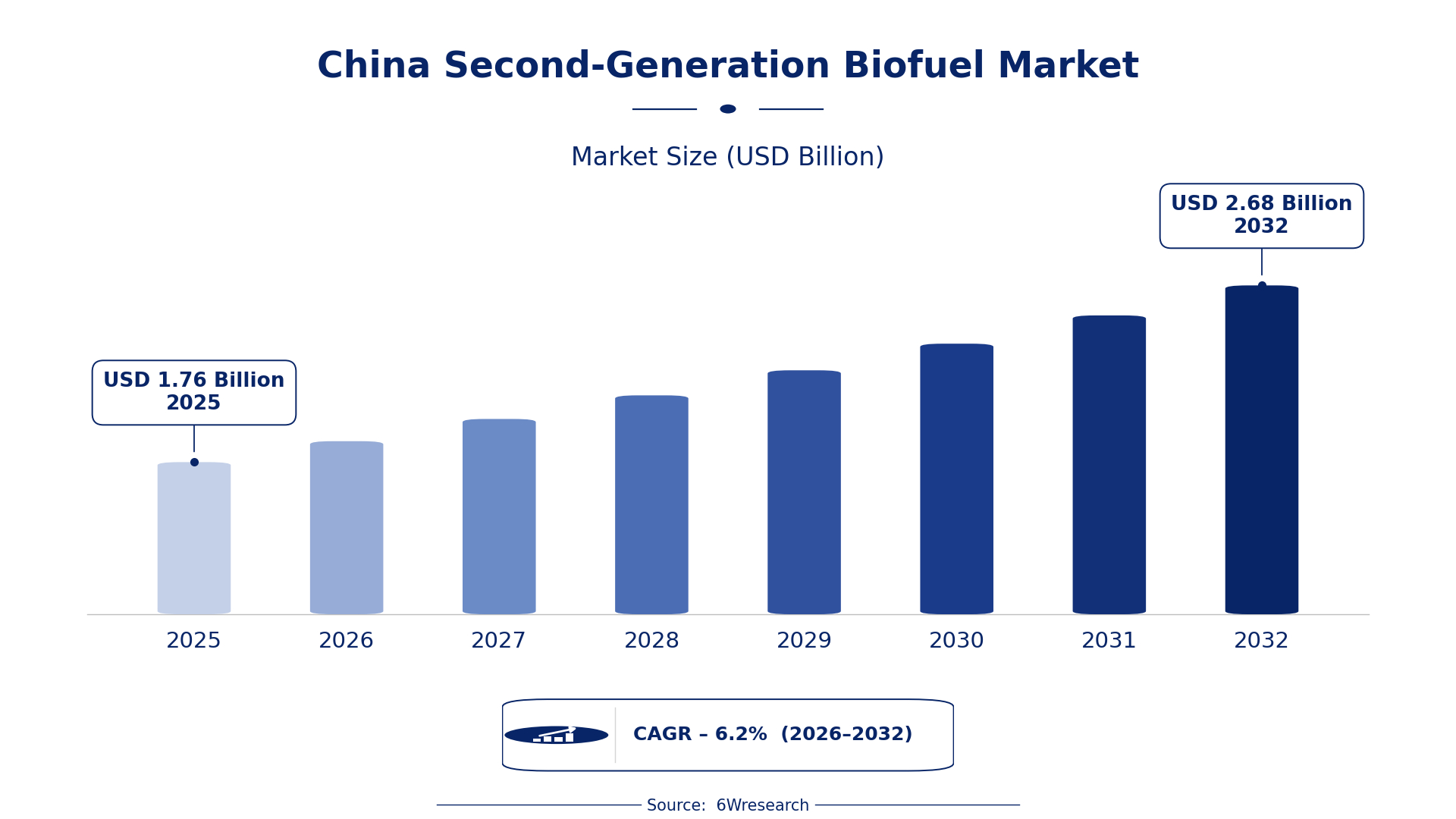
According to 6Wresearch internal database and industry insights, the China Second-Generation Biofuel Market was valued at USD 1.76 billion in 2025 and is projected to reach USD 2.68 billion by 2032, growing at a CAGR of approximately 6.2% during 2026–2032.
China Second-Generation Biofuel Market Highlights
| Report Metric | Details |
| Report Name | China Second-Generation Biofuel Market |
| Market Size 2025 | USD 1.76 billion |
| Market Size 2032 | USD 2.68 billion |
| Absolute Growth 2025–2032 | USD 0.92 billion |
| CAGR 2026–2032 | 6.2% |
| Peak Annual Growth | 8.8% in 2028 |
| Forecast Period | 2026–2032 |
| Historical Data | 2022–2025 |
| Base Year | 2025 |
| Leading Feedstock, 2025 | Lignocellulosic Biomass (44% share) |
| Leading Biofuel Type, 2025 | 2G Ethanol (45% share) |
| Leading Production Technology, 2025 | Enzymatic Hydrolysis (50% share) |
| Leading End User, 2025 | Transportation Fuel Suppliers (47% share) |
| Fastest-Growing Feedstock | Algae-Derived Biofuel (8.1% CAGR) |
| Fastest-Growing Biofuel Type | Biogas (Upgraded RNG) (9.0% CAGR) |
| Fastest-Growing Production Technology | Anaerobic Digestion (7.4% CAGR) |
| Fastest-Growing End User | Aviation & Marine Fuel Firms (7.6% CAGR) |
| Growing Sector | Transportation Fuel |
| Key End Users | Transportation Fuel Suppliers, Aviation & Marine Fuel Firms, Industrial Fuel Consumers |
China Second-Generation Biofuel Market Year-wise Growth Rate and Key Drivers (2022–2032)
This graph illustrates the annual growth rates of the market from 2022 to 2032, highlighting a steady upward trajectory and projected market expansion over the forecast period.
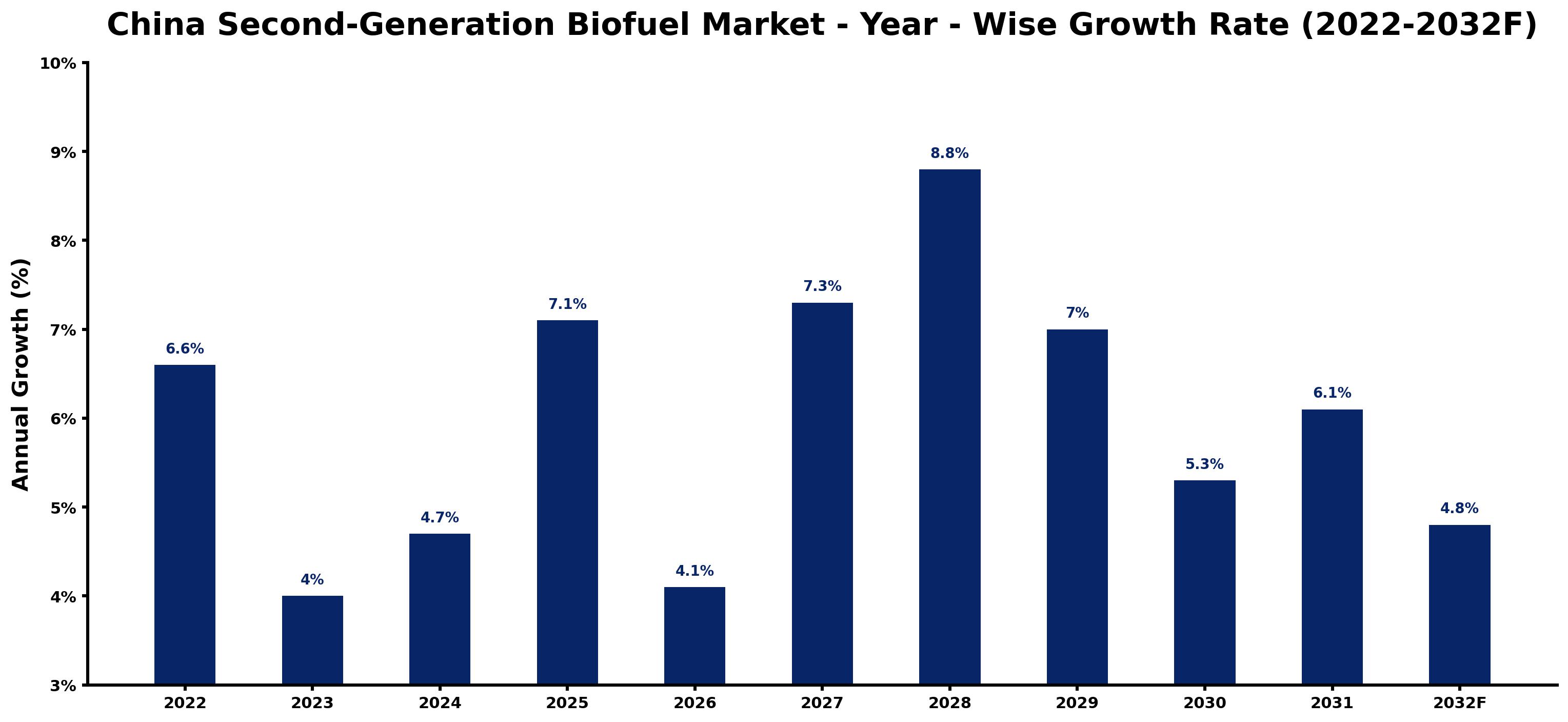
Year by year, the estimates below pair each growth rate with the development that shaped it.
| Year | Estimated Annual Growth (%) | Market Rationale |
| 2022 | 6.6 | The market experienced solid growth due to increased biofuel production initiatives. |
| 2023 | 4.0 | Growth slowed as the market adjusted to new regulatory frameworks and production challenges. |
| 2024 | 4.7 | Demand picked up as technological advancements in biofuel production gained traction. |
| 2025 | 7.1 | The market surged with the implementation of the Renewable Energy Development Plan. |
| 2026 | 4.1 | Growth slowed again as competition intensified among biofuel producers. |
| 2027 | 7.3 | Increased investments in biofuel technology spurred faster growth compared to the previous year. |
| 2028 | 8.8 | The market peaked as demand for sustainable energy solutions surged significantly. |
| 2029 | 7.0 | Growth slowed as market saturation began to impact new investments. |
| 2030 | 5.3 | Demand continued to grow but at a slower pace due to regulatory adjustments. |
| 2031 | 6.1 | The market rebounded with renewed interest in biofuel applications across sectors. |
| 2032 | 4.8 | Growth slowed as the market stabilised, reflecting mature production capabilities. |
Note: Market size estimations and growth projections presented in this report are based on 6Wresearch's proprietary forecasting methodology, utilizing the latest available industry data, government publications, and primary research inputs.
China Second-Generation Biofuel Market Synopsis
Second-Generation Biofuel in China encompasses biofuels produced from non-food biomass sources, primarily through enzymatic hydrolysis and transesterification. This biofuel is derived from lignocellulosic materials, algae, and agricultural residues, serving as renewable energy for transportation and industrial applications. The China Second-Generation Biofuel Market is expanding due to government initiatives promoting renewable energy sources and increasing domestic demand. In 2022, the country produced approximately 2.5 million tons of second-generation biofuel, with expectations to reach 5 million tons by 2025.
Market Dynamics Impact Analysis (2026–2032)
| Factor | Type | Impact | Primary Segment Affected |
| Government initiatives promote biofuel production and sustainability. | Driver | High | Lignocellulosic Biomass |
| Technological advancements enhance production efficiency and capacity. | Driver | High | Enzymatic Hydrolysis |
| Rising demand for renewable energy sources creates new market opportunities. | Opportunity | High | Transportation Fuel Suppliers |
| Increased investment in biofuel research and development opens new avenues for growth. | Opportunity | High | Algae-Derived Biofuel |
| Regulatory compliance costs can burden smaller producers. | Restraint | Medium | Biodiesel |
| Limited public awareness of biofuel benefits may hinder market expansion. | Restraint | Medium | Biogas (Upgraded RNG) |
| Infrastructure challenges affect biofuel distribution and accessibility. | Challenge | High | Transportation Fuel Suppliers |
| Competition from alternative energy sources may impact market share. | Challenge | High | 2G Ethanol |
Evaluation of Drivers in China Second-Generation Biofuel Market (2026–2032)
Below mentioned are some major drivers and their influence on market dynamics.
| Drivers | Primary Segment Affected | Why It Matters (Evidence) |
| Government initiatives like the Renewable Energy Development Plan boost production. | Lignocellulosic Biomass | This plan aims to increase biofuel production capacity by 20% by 2025. |
| Technological advancements in enzymatic hydrolysis improve efficiency. | Enzymatic Hydrolysis | These advancements are expected to raise production rates significantly over the next few years. |
| Growing demand for renewable energy sources drives biofuel consumption. | Transportation Fuel Suppliers | China's biofuel consumption is projected to reach 5 million tons by 2025. |
| Investment in algae-derived biofuels is increasing due to sustainability concerns. | Algae-Derived Biofuel | Research at universities is focusing on improving oil yield from algae, enhancing market potential. |
| Public transportation systems are adopting biofuels to meet sustainability goals. | Biodiesel | The government promotes biofuels in public transport to reduce emissions, increasing demand. |
The Renewable Energy Development Plan aims to increase biofuel production capacity by 20% by 2025, driving consumption. In 2022, approximately 2.5 million tons of second-generation biofuel were produced, with expectations to reach 5 million tons by 2025. Investments in enzymatic hydrolysis are improving production efficiency, while public transportation systems are increasingly adopting biodiesel to meet sustainability targets. Research at universities is focusing on improving oil yield from algae, further stimulating market expansion.
Evaluation of Restraints in China Second-Generation Biofuel Market
The main factors holding the market back are set out below.
| Market Restraint | Primary Segment Affected | Why It Matters (Evidence) |
| Infrastructure challenges limit biofuel distribution efficiency. | Transportation Fuel Suppliers | Limited infrastructure can delay delivery and increase costs for suppliers. |
| Regulatory compliance can increase operational costs for producers. | Biodiesel | Smaller producers may struggle to meet stringent environmental regulations, raising their costs. |
| Limited consumer awareness of biofuels may hinder adoption rates. | Biogas (Upgraded RNG) | Consumers may prefer conventional fuels due to lack of knowledge about biofuels, impacting demand. |
| Competition from fossil fuels impacts market growth. | 2G Ethanol | Lower prices for fossil fuels can deter investments in biofuels, affecting market growth. |
| Market saturation may limit new entrants and innovation. | Algae-Derived Biofuel | Established players dominate, making it hard for newcomers to compete and innovate. |
China Second-Generation Biofuel Market Challenges
The China Second-Generation Biofuel Market faces a few practical problems, starting with stringent regulations that can delay project approvals. The Ministry of Ecology and Environment enforces environmental standards, which can extend timelines for new biofuel initiatives by up to six months for producers. Intense competition from fossil fuels persists, as traditional energy sources often provide lower prices, making it difficult for buyers to justify the switch to biofuels. Additionally, many buyers are reluctant due to the perception that second-generation biofuels can be 15% more expensive than conventional fuels, complicating adoption efforts.
Trends in the China Second-Generation Biofuel Market
Several trends are reshaping the China Second-Generation Biofuel Market; the most important are set out below.
- Shift towards Sustainable Feedstocks: In 2022, over 60% of biofuel production in China came from lignocellulosic biomass, reflecting a shift towards sustainable feedstocks. This trend is supported by the Agricultural Residue Utilization Program, which promotes the use of agricultural waste for biofuel production.
- Increase in Algae-Derived Biofuel Research: Research into algae-derived biofuels is gaining momentum, with several universities in China focusing on this area. In 2023, funding for algae research reached 500 million yuan, indicating a strong commitment to exploring sustainable alternatives.
- Expansion of Biofuel Use in Public Transport: The Chinese government has been promoting the use of biofuels in public transportation systems since 2021. This initiative is expected to increase biofuel consumption significantly, with projections of reaching 5 million tons by 2025.
- Growth of Biogas Plant Installations: By 2023, the installed base for biogas plants in China reached 1,000 units, showcasing a growing interest in biogas as a renewable energy source. This expansion aligns with the Biofuel Industry Development Action Plan.
Investment Opportunities in the China Second-Generation Biofuel Market
The following opportunities in the China Second-Generation Biofuel Market pair current demand with a clear way in.
- Rising Demand for Renewable Energy Solutions: With China's biofuel consumption projected to reach 5 million tons by 2025, there is an opportunity for suppliers to meet this demand. Transportation fuel suppliers are particularly well-positioned to benefit from this trend.
- Investment in Biofuel Technology: Now is an ideal time for investment in biofuel technology, especially in enzymatic hydrolysis. Collaborating with research institutions can improve production capabilities and efficiency, attracting funding and support.
- Partnerships with Public Transport Providers: Transportation fuel suppliers can explore partnerships with public transport providers to supply biofuels. This collaboration aligns with government initiatives to promote sustainable energy solutions in urban areas.
- Expansion into Emerging Markets: The aviation and marine fuel sectors are emerging markets for biofuels, with a projected growth rate of 7.6%. Targeting these sectors can provide new revenue streams for biofuel producers.
Government Initiatives in the China Second-Generation Biofuel Market
The Renewable Energy Development Plan (2021-2025) launched by the National Energy Administration aims to boost biofuel production and sustainability measures. This plan sets clear targets for increasing biofuel capacity by 20% and encourages investment in renewable energy technologies. Additionally, the Biofuel Industry Development Action Plan (2021-2025) focuses on increasing biofuel usage in transportation, ensuring a supportive regulatory environment for producers. These measures aim to improve production efficiency and market growth, benefiting both producers and consumers.
The Agricultural Residue Utilization Program initiated by the Ministry of Agriculture and Rural Affairs in 2022 promotes the use of agricultural waste for biofuel production. This program provides funding and resources to farmers and producers, encouraging them to convert agricultural residues into biofuels. The Green Energy Subsidy Program introduced by the National Development and Reform Commission in 2022 further incentivizes biofuel production and use, ensuring that buyers can access affordable and sustainable energy options. These initiatives support the overall growth of the biofuel market in China.
Future Insight of the China Second-Generation Biofuel Market
Several forward-looking factors should support the China Second-Generation Biofuel Market over the coming years. The government aims to boost biofuel production capacity by 20% by 2025, which will enhance supply for buyers. A research funding allocation of 500 million yuan will facilitate technological advancements that improve production efficiency. The Biofuel Industry Development Action Plan will promote infrastructure upgrades, further encouraging market growth. By 2025, biofuel consumption is projected to reach 5 million tons, indicating rising demand that will prompt suppliers to expand their production capabilities.
Market Segmentation Analysis
Each segment group is reviewed below, with the leader by share and the fastest grower by CAGR.
By Feedstock – Lignocellulosic Biomass Dominated, Algae-Derived Biofuel Expected to Grow Fastest
According to Shubham Padhi, Research Analyst at 6Wresearch, Lignocellulosic Biomass held a 44% share of the China Second-Generation Biofuel Market by feedstock in 2025. Lignocellulosic biomass holds the largest share in China's second-generation biofuel market due to its abundant availability and cost-effectiveness as a feedstock. This material is crucial for initiatives in regions like Jiangsu, where over 60% of biofuel production is derived from it. Over 2026–2032, Algae-Derived Biofuel is expected to post the fastest growth, at a CAGR of 8.1%. Algae-derived biofuel is witnessing rapid growth, driven by its high oil yield and sustainability, making it an attractive alternative for biofuel production. Ongoing research at various universities and institutes in China is enhancing the technology, indicating a strong growth trajectory for this feedstock. Suppliers should focus on developing algae-derived biofuel solutions to capitalise on the increasing demand for sustainable energy sources.
By Biofuel Type – 2G Ethanol Dominated, Biogas (Upgraded RNG) Expected to Grow Fastest
2G Ethanol accounted for a 45% market share by biofuel type in 2025. 2G ethanol dominates the market share as it is specifically produced from lignocellulosic biomass, aligning with China's renewable energy goals. Its established production processes and government support through initiatives like the Renewable Energy Development Plan contribute to its leading position. The quickest growth will come from Biogas (Upgraded RNG), forecast to expand at a CAGR of 9.0% between 2026 and 2032. Biogas, particularly upgraded renewable natural gas, is experiencing rapid growth due to increasing organic waste utilisation and government backing. The push for cleaner energy solutions in transportation and industry is further accelerating its adoption. Buyers should consider diversifying their biofuel sources to include biogas, which is gaining traction as a sustainable energy alternative.
By Production Technology – Enzymatic Hydrolysis Dominated, Anaerobic Digestion Expected to Grow Fastest
Enzymatic Hydrolysis took a 50% share of production technology in 2025, more than any other category. Enzymatic hydrolysis dominates the production technology segment, as it is essential for converting lignocellulosic biomass into fermentable sugars for biofuel. Its established processes and compatibility with existing biofuel facilities ensure a strong market share. Anaerobic Digestion is projected to grow fastest, at a CAGR of 7.4% during 2026–2032. Anaerobic digestion is the fastest-growing technology, valued for its efficiency in converting organic waste into biogas. This method aligns with China's waste management strategies, driving its rapid adoption within the biofuel sector. Suppliers should explore investments in anaerobic digestion technologies to meet the rising demand for efficient waste-to-energy solutions.
By End User – Transportation Fuel Suppliers Dominated, Aviation & Marine Fuel Firms Expected to Grow Fastest
With a 47% revenue share in 2025, Transportation Fuel Suppliers was the largest end user category. Transportation fuel suppliers represent the largest market share as they are the primary consumers of biofuels for vehicles. The growing demand for renewable energy in transportation, supported by government initiatives, solidifies their leading role in the market. Aviation & Marine Fuel Firms are set to record the highest CAGR in this split, 7.6% over 2026–2032. Aviation and marine fuel firms are the fastest-growing segment, driven by the industry's shift towards sustainable fuels to reduce carbon emissions. This emerging market is gaining momentum as regulations tighten and environmental concerns rise. Buyers in the aviation and marine sectors should explore partnerships with biofuel suppliers to secure sustainable fuel sources for future operations.
Key Attractiveness of the Report
- 10 Years of Market Numbers
- Historical Data Starting from 2022 to 2025
- Base Year 2025
- Forecast Data until 2032
- Key Performance Indicators Impacting the Market
- Major Upcoming Developments and Projects
Key Highlights of the Report:
- China Second-Generation Biofuel Market Outlook
- Market Size of China Second-Generation Biofuel Market, 2025
- Forecast of China Second-Generation Biofuel Market, 2032
- Historical Data and Forecast of China Second-Generation Biofuel Revenues & Volume for the Period 2022 - 2032F
- China Second-Generation Biofuel Market Trend Evolution
- China Second-Generation Biofuel Market Drivers and Challenges
- China Second-Generation Biofuel Price Trends
- China Second-Generation Biofuel Porter's Five Forces
- China Second-Generation Biofuel Industry Life Cycle
- Historical Data and Forecast of China Second-Generation Biofuel Market Revenues & Volume By Feedstock for the Period 2022 - 2032F
- Historical Data and Forecast of China Second-Generation Biofuel Market Revenues & Volume By Lignocellulosic Biomass for the Period 2022 - 2032F
- Historical Data and Forecast of China Second-Generation Biofuel Market Revenues & Volume By Algae-Derived Biofuel for the Period 2022 - 2032F
- Historical Data and Forecast of China Second-Generation Biofuel Market Revenues & Volume By Agricultural Residue for the Period 2022 - 2032F
- Historical Data and Forecast of China Second-Generation Biofuel Market Revenues & Volume By Forestry Residue for the Period 2022 - 2032F
- Historical Data and Forecast of China Second-Generation Biofuel Market Revenues & Volume By Biofuel Type for the Period 2022 - 2032F
- Historical Data and Forecast of China Second-Generation Biofuel Market Revenues & Volume By 2G Ethanol for the Period 2022 - 2032F
- Historical Data and Forecast of China Second-Generation Biofuel Market Revenues & Volume By Biodiesel for the Period 2022 - 2032F
- Historical Data and Forecast of China Second-Generation Biofuel Market Revenues & Volume By Biogas (Upgraded RNG) for the Period 2022 - 2032F
- Historical Data and Forecast of China Second-Generation Biofuel Market Revenues & Volume By Synthetic Hydrocarbons for the Period 2022 - 2032F
- Historical Data and Forecast of China Second-Generation Biofuel Market Revenues & Volume By Production Technology for the Period 2022 - 2032F
- Historical Data and Forecast of China Second-Generation Biofuel Market Revenues & Volume By Enzymatic Hydrolysis for the Period 2022 - 2032F
- Historical Data and Forecast of China Second-Generation Biofuel Market Revenues & Volume By Transesterification for the Period 2022 - 2032F
- Historical Data and Forecast of China Second-Generation Biofuel Market Revenues & Volume By Anaerobic Digestion for the Period 2022 - 2032F
- Historical Data and Forecast of China Second-Generation Biofuel Market Revenues & Volume By Fischer-Tropsch for the Period 2022 - 2032F
- Historical Data and Forecast of China Second-Generation Biofuel Market Revenues & Volume By End User for the Period 2022 - 2032F
- Historical Data and Forecast of China Second-Generation Biofuel Market Revenues & Volume By Transportation Fuel Suppliers for the Period 2022 - 2032F
- Historical Data and Forecast of China Second-Generation Biofuel Market Revenues & Volume By Aviation & Marine Fuel Firms for the Period 2022 - 2032F
- Historical Data and Forecast of China Second-Generation Biofuel Market Revenues & Volume By Urban Utility Providers for the Period 2022 - 2032F
- Historical Data and Forecast of China Second-Generation Biofuel Market Revenues & Volume By Industrial Fuel Consumers for the Period 2022 - 2032F
- China Second-Generation Biofuel Import Export Trade Statistics
- Market Opportunity Assessment By Feedstock
- Market Opportunity Assessment By Biofuel Type
- Market Opportunity Assessment By Production Technology
- Market Opportunity Assessment By End User
- China Second-Generation Biofuel Top Companies Market Share
- China Second-Generation Biofuel Competitive Benchmarking By Technical and Operational Parameters
- China Second-Generation Biofuel Company Profiles
- China Second-Generation Biofuel Key Strategic Recommendations
Market Covered
Segments analysed in this report are listed below.
By Feedstock
- Lignocellulosic Biomass
- Algae-Derived Biofuel
- Agricultural Residue
- Forestry Residue
By Biofuel Type
- 2G Ethanol
- Biodiesel
- Biogas (Upgraded RNG)
- Synthetic Hydrocarbons
By Production Technology
- Enzymatic Hydrolysis
- Transesterification
- Anaerobic Digestion
- Fischer-Tropsch
By End User
- Transportation Fuel Suppliers
- Aviation & Marine Fuel Firms
- Urban Utility Providers
- Industrial Fuel Consumers































