India Seed Inoculation Market Size & Growth Rate
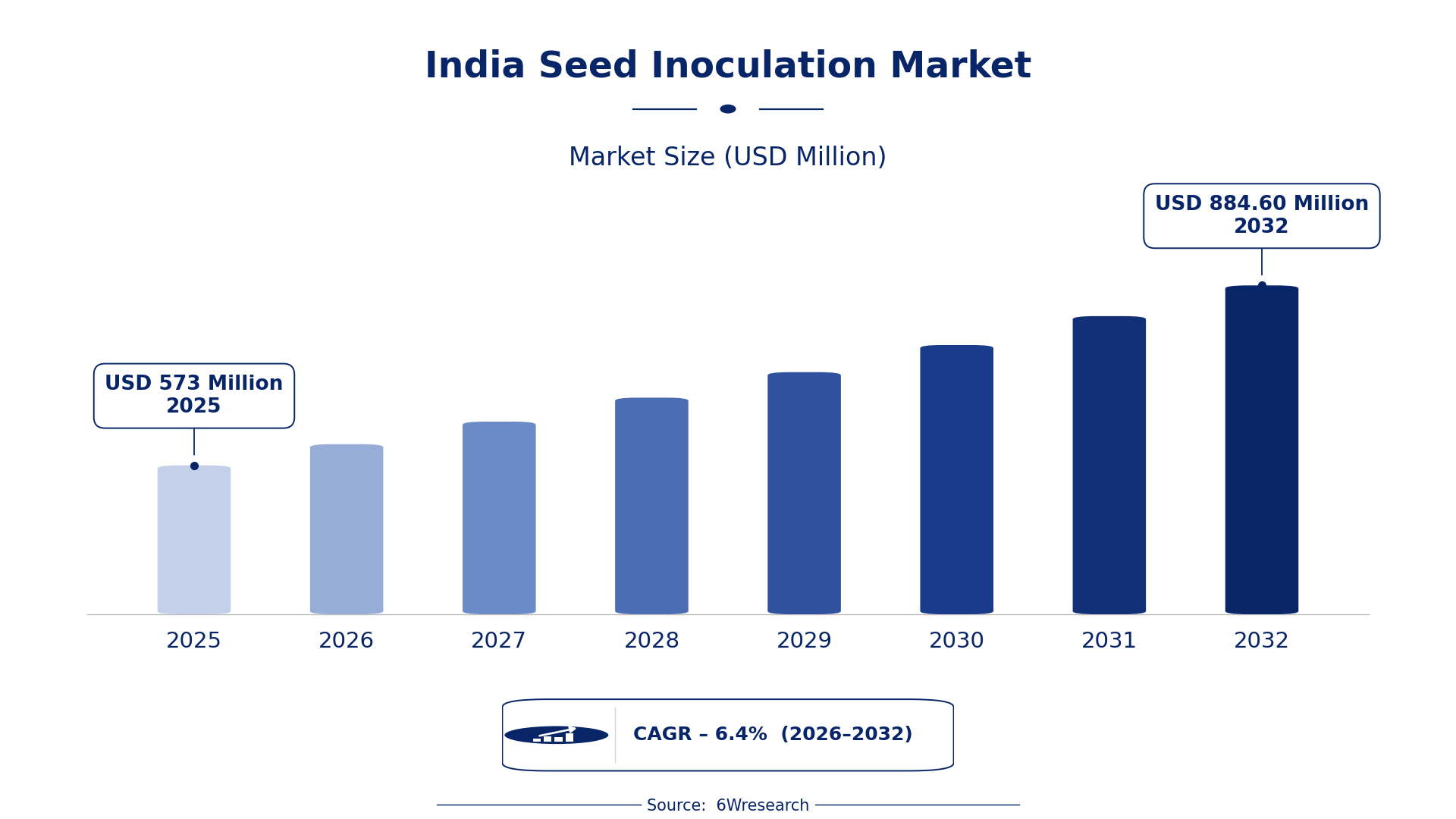
According to 6Wresearch internal database and industry insights, the India Seed Inoculation Market was valued at USD 573.0 million in 2025 and is projected to reach USD 884.60 million by 2032, growing at a CAGR of approximately 6.4% during 2026–2032.
India Seed Inoculation Market Highlights
| Report Metric | Details |
| Report Name | India Seed Inoculation Market |
| Market Size 2025 | USD 573.0 million |
| Market Size 2032 | USD 884.60 million |
| Absolute Growth 2025–2032 | USD 311.60 million |
| CAGR 2026–2032 | 6.4% |
| Peak Annual Growth | 8.7% in 2029 |
| Forecast Period | 2026–2032 |
| Historical Data | 2022–2025 |
| Base Year | 2025 |
| Leading Inoculant Type, 2025 | Rhizobium (40% share) |
| Leading Crop Type, 2025 | Legumes (44% share) |
| Leading Application Method, 2025 | Coating (44% share) |
| Leading End User, 2025 | Organic Farmers (44% share) |
| Fastest-Growing Inoculant Type | Azospirillum (8.3% CAGR) |
| Fastest-Growing Crop Type | Pulses (8.3% CAGR) |
| Fastest-Growing Application Method | Seed Soaking (8.0% CAGR) |
| Growing Sector | Organic Agriculture |
| Key End Users | Organic Farmers, Agricultural Institutes, Horticulturists |
India Seed Inoculation Market Year-wise Growth Rate and Key Drivers (2022–2032)
This graph illustrates the annual growth rates of the market from 2022 to 2032, highlighting a steady upward trajectory and projected market expansion over the forecast period.
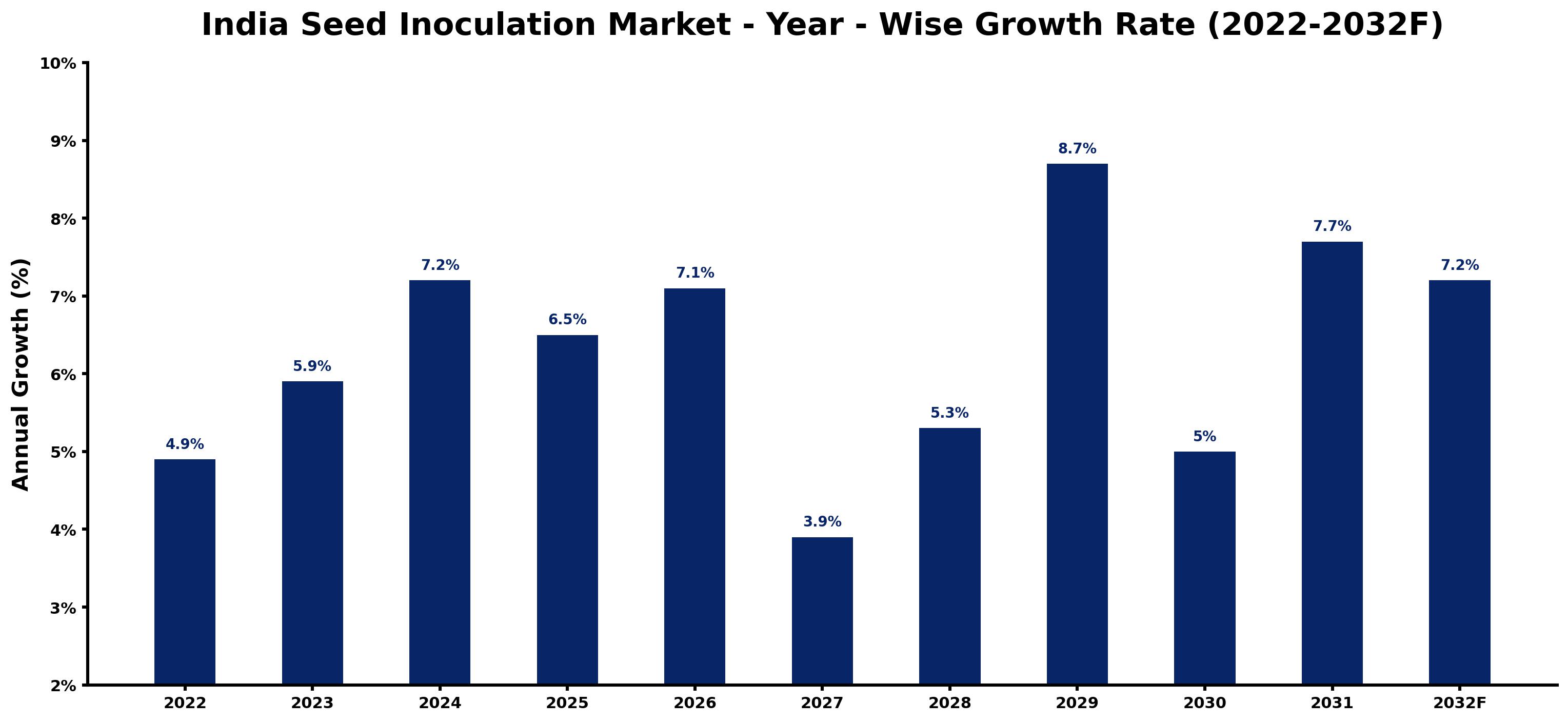
Annual growth estimates for each year appear below with the principal reason behind them, explaining the shifts that set the pace of the market.
| Year | Estimated Annual Growth (%) | Market Rationale |
| 2022 | 4.9 | The market experienced steady growth due to the National Programme for Organic Production promoting biofertilizers. |
| 2023 | 5.9 | Demand accelerated as farmers sought sustainable practices amid rising costs of conventional inputs. |
| 2024 | 7.2 | Adoption of seed inoculation surged, driven by the Ministry of Agriculture's initiatives promoting organic farming practices. |
| 2025 | 6.5 | Growth slowed as market adjustments occurred following rapid expansion in previous years. |
| 2026 | 7.1 | Increased investment in agricultural technology is anticipated to spur demand for inoculants among organic farmers. |
| 2027 | 3.9 | A slowdown in growth is expected due to market saturation in regions like Punjab. |
| 2028 | 5.3 | Awareness programs by agricultural institutes will revitalise interest in seed inoculation among farmers. |
| 2029 | 8.7 | Peak growth is expected as major agricultural states embrace advanced inoculation practices. |
| 2030 | 5.0 | Growth will decelerate slightly as the market stabilises after a peak in demand. |
| 2031 | 7.7 | Demand will increase again, driven by a resurgence in organic farming initiatives. |
| 2032 | 7.2 | Growth will continue at a stable rate as farmers increasingly rely on sustainable practices. |
Note: Market size estimations and growth projections presented in this report are based on 6Wresearch's proprietary forecasting methodology, utilizing the latest available industry data, government publications, and primary research inputs.
India Seed Inoculation Market Synopsis
Seed Inoculation in India involves applying beneficial microorganisms to seeds to improve growth and nutrient uptake, primarily through fermentation processes. This practice is crucial for increasing crop yields and supporting sustainable agriculture. The India Seed Inoculation Market is expanding due to rising demand from domestic farmers and agricultural institutes, driven by initiatives like the National Programme for Organic Production. With over 140 million hectares of arable land, the market demonstrates a strong commitment to sustainable agricultural practices. As farmers increasingly adopt these methods, the market is poised for substantial growth.
Market Dynamics Impact Analysis (2026–2032)
| Factor | Type | Impact | Primary Segment Affected |
| Increased adoption of biofertilizers among farmers | Driver | High | Rhizobium |
| Growing awareness of sustainable agriculture practices | Driver | High | Organic Farmers |
| Rising demand for organic produce | Opportunity | High | Legumes |
| Investment in agricultural research and development | Opportunity | High | Agricultural Institutes |
| Quality control issues affecting product reliability | Restraint | High | Mycorrhizae |
| Limited awareness in some regions about benefits | Restraint | Medium | Cereals |
| Supply chain disruptions affecting availability | Challenge | High | Seed Processing Units |
| Competition from synthetic fertilizers impacting adoption | Challenge | Medium | Pulses |
Evaluation of Drivers in India Seed Inoculation Market (2026–2032)
The main growth drivers and the segments they affect most are set out below.
| Drivers | Primary Segment Affected | Why It Matters (Evidence) |
| Increased crop yields from inoculation | Legumes | Inoculation can increase legume yields by up to 30% in optimal conditions, encouraging farmers to adopt these practices. |
| Government support for organic farming | Organic Farmers | The National Agricultural Development Programme allocates INR 500 crore for research, enhancing the development of effective inoculants. |
| Research funding for microbial inoculants | Agricultural Institutes | Funding from the National Agricultural Development Programme supports research, leading to the development of effective inoculants. |
| Growing market for biofertilizers | Rhizobium | The Indian market for biofertilizers is projected to grow significantly, driving demand for seed inoculation. |
| Awareness programs on benefits of inoculation | Horticulturists | The Ministry of Agriculture runs awareness programs, increasing understanding and adoption of seed inoculation practices. |
Market growth for Seed Inoculation in India is underpinned by increased crop yields from inoculation and government support for organic farming. Inoculation can increase legume yields by up to 30% in optimal conditions, prompting farmers to adopt these methods. The National Programme for Organic Production promotes sustainable practices, which drives higher demand for seed inoculation. Funding from the National Agricultural Development Programme supports research, leading to the development of effective inoculants. Awareness campaigns run by agricultural institutes are increasing understanding and adoption of seed inoculation practices among farmers, particularly in regions with high agricultural activity.
Evaluation of Restraints in India Seed Inoculation Market
The table below lists the restraints and the evidence behind each.
| Market Restraint | Primary Segment Affected | Why It Matters (Evidence) |
| Quality control issues affecting product reliability | Mycorrhizae | The Fertilizer Control Order regulates the quality of inoculants, but inconsistencies can lead to reduced trust among users. |
| Limited awareness in some regions about benefits | Cereals | Despite the advantages, many farmers remain unaware of the benefits of inoculation, limiting market growth. |
| Supply chain disruptions affecting availability | Seed Processing Units | Logistical challenges can delay the distribution of inoculants, impacting farmers' access to these products. |
| Competition from synthetic fertilizers impacting adoption | Pulses | Farmers may prefer synthetic fertilizers due to immediate results, hindering the adoption of biofertilizers. |
| Regulatory hurdles in product approval | Azospirillum | The Bureau of Indian Standards has set guidelines that can slow down the introduction of new inoculants. |
India Seed Inoculation Market Challenges
Farmers in the India seed inoculation market face regulatory hurdles, as the Fertilizer Control Order mandates strict quality standards that can delay product availability, impacting planting schedules for over 140 million hectares of arable land. Suppliers deal with technological constraints, as many rely on outdated fermentation methods for microbial cultivation, leading to lower efficacy of inoculants and diminishing crop yields for producers. High sourcing costs for specific inoculants, such as Rhizobium, can inflate expenses by up to 30%, making it challenging for farmers to adopt these beneficial practices. A shortage of skilled agricultural workers limits effective application techniques, restricting the yield improvements that inoculation can deliver for growers.
Trends in the India Seed Inoculation Market
Below mentioned are some of the trends shaping the India Seed Inoculation Market growth.
- Shift from Traditional to Organic Farming: Since 2023, there has been a notable shift towards organic farming practices in India, driven by government initiatives. The National Programme for Organic Production has led to a 20% increase in organic farmers adopting seed inoculation.
- Transition to Advanced Inoculant Types: Inoculants are increasingly moving towards advanced types like Azospirillum, which improve root growth. This trend is evident in Maharashtra, where usage has grown by 15% since 2022, benefiting local farmers.
- Emerging Focus on Soil Health: The emphasis on soil health has risen significantly, particularly with the Soil Health Management program launched in 2021. This initiative aims to cover 10 million hectares by 2025, promoting biofertilizers and improving soil quality.
- Increased Adoption of Seed Soaking Techniques: Beginning in 2026, seed soaking techniques are gaining popularity among organic farmers, offering effective inoculation methods. This change is reflected in a 25% increase in adoption rates across various states.
Investment Opportunities in the India Seed Inoculation Market
Investors looking at the India Seed Inoculation Market should consider the following areas.
- Growing Demand for Organic Products: With the organic market expanding, there is a pressing need for effective seed inoculation solutions. The organic farming community, particularly in Punjab, is projected to grow, creating opportunities for suppliers.
- Investment in Research and Development: The National Agricultural Development Programme's funding for microbial inoculants presents a chance for innovation. Collaborating with agricultural institutes can improve product offerings and market reach.
- Growing Interest in Sustainable Practices: As farmers increasingly seek sustainable practices, there is an opportunity to supply advanced inoculants. Organic farmers in Haryana are particularly interested in these solutions, presenting a target market.
- Partnerships with Local Agricultural Bodies: Now is an ideal time to establish partnerships with local agricultural bodies for product distribution. Engaging with the Ministry of Agriculture can facilitate access to farmers and increase market penetration.
Government Initiatives in the India Seed Inoculation Market
In 2021, the Ministry of Agriculture launched the 'Soil Health Management' program to promote the use of biofertilizers, aiming to cover 10 million hectares by 2025. This initiative builds upon existing frameworks by focusing on soil health, which is vital for sustainable agriculture. It encourages farmers to adopt practices that improve soil fertility and crop yields, thereby increasing the demand for seed inoculation.
In 2023, the government allocated INR 500 crore for promoting biofertilizers under the Pradhan Mantri Krishi Sinchai Yojana. The Ministry of Agriculture oversees this initiative, which aims to improve irrigation and promote the use of biofertilizers, including seed inoculation, to enhance agricultural productivity. This funding supports research and development, ensuring that farmers have access to effective inoculants.
Future Insight of the India Seed Inoculation Market
The India seed inoculation market will undergo a transformation by 2032, driven by increased biofertilizer adoption as government initiatives like the National Programme for Organic Production gain traction. Research funded by the National Agricultural Innovation Project will improve the effectiveness of microbial inoculants, providing better outcomes for farmers. Awareness campaigns from the Ministry of Agriculture and Farmers' Welfare will educate farmers on the benefits of inoculation, enhancing crop resilience. By 2025, the biofertilizer market, which encompasses seed inoculants, is projected to grow significantly, reflecting a national commitment to sustainable agricultural practices.
Market Segmentation Analysis
Each segment group is reviewed below, with the leader by share and the fastest grower by CAGR.
By Inoculant Type – Rhizobium Dominated, Azospirillum Expected to Grow Fastest
According to Shubham Padhi, Research Analyst at 6Wresearch, with a 40% revenue share in 2025, Rhizobium was the largest inoculant type category. Rhizobium holds the largest market share due to its crucial role in nitrogen fixation for legumes, particularly in high-yield states like Punjab and Haryana. This widespread use among farmers ensures a solid installed base, reinforcing its dominance in the seed inoculation market. The quickest growth will come from Azospirillum, forecast to expand at a CAGR of 8.3% between 2026 and 2032. Azospirillum is experiencing rapid growth as it enhances root development and nutrient absorption in various crops, with farmers increasingly recognising its benefits. This growing awareness is driving demand for Azospirillum inoculants, which will further widen the gap with Rhizobium. Suppliers should focus on expanding their offerings of Azospirillum to capitalise on its growth while maintaining support for the established Rhizobium segment.
By Crop Type – Legumes Dominated, Pulses Expected to Grow Fastest
In 2025, Legumes led the crop type split with a 44% share. Legumes dominate the market share as they are the primary crops benefiting from inoculation for nitrogen fixation, especially in regions with intensive agricultural activity. The extensive cultivation of legumes ensures a consistent demand for inoculants, solidifying their market position. Pulses are projected to grow fastest, at a CAGR of 8.3% during 2026–2032. Pulses are witnessing the fastest growth due to their similar nitrogen fixation advantages as legumes, with farmers increasingly interested in enhancing crop yields. This trend reflects a shift towards sustainable farming practices that favour pulse cultivation. The growth in the pulses segment offers suppliers opportunities to create targeted marketing strategies that meet the specific needs of pulse farmers.
By Application Method – Coating Dominated, Seed Soaking Expected to Grow Fastest
Coating held a 44% share of the India Seed Inoculation Market by application method in 2025. Coating is the leading application method, widely preferred for its effectiveness in applying inoculants to seeds. The method's simplicity and efficiency contribute to its strong market share among farmers. Over 2026–2032, Seed Soaking is expected to post the fastest growth, at a CAGR of 8.0%. Seed soaking is rapidly gaining popularity as it effectively enhances seed treatment, with farmers increasingly choosing this method to improve germination rates. The rising recognition of its benefits is expected to drive further adoption in the future. Suppliers should consider expanding their product lines to include seed soaking solutions to meet the growing demand for this application method.
By End User – Organic Farmers Dominated and Is Expected to Record the Fastest Growth
The largest end user category in 2025 was Organic Farmers, with a 44% share of total revenue. Organic farmers represent the largest share of the market as they actively seek sustainable practices that align with their farming philosophies. Their commitment to organic methods drives the demand for seed inoculation, ensuring a strong market presence. Organic Farmers are also forecast to expand faster than any other category, at a CAGR of 8.3% over 2026–2032. Organic farmers are also the fastest-growing segment, as the increasing shift towards organic agriculture fuels their need for effective seed inoculation solutions. This dual role as both leader and fastest segment underscores the rising importance of sustainability in agriculture. Suppliers must align their strategies with the needs of organic farmers to capture the expanding opportunities within this segment.
Key Attractiveness of the Report
- 10 Years of Market Numbers
- Historical Data Starting from 2022 to 2025
- Base Year 2025
- Forecast Data until 2032
- Key Performance Indicators Impacting the Market
- Major Upcoming Developments and Projects
Key Highlights of the Report:
- India Seed Inoculation Market Outlook
- Market Size of India Seed Inoculation Market, 2025
- Forecast of India Seed Inoculation Market, 2032
- Historical Data and Forecast of India Seed Inoculation Revenues & Volume for the Period 2022 - 2032F
- India Seed Inoculation Market Trend Evolution
- India Seed Inoculation Market Drivers and Challenges
- India Seed Inoculation Price Trends
- India Seed Inoculation Porter's Five Forces
- India Seed Inoculation Industry Life Cycle
- Historical Data and Forecast of India Seed Inoculation Market Revenues & Volume By Inoculant Type for the Period 2022 - 2032F
- Historical Data and Forecast of India Seed Inoculation Market Revenues & Volume By Rhizobium for the Period 2022 - 2032F
- Historical Data and Forecast of India Seed Inoculation Market Revenues & Volume By Azospirillum for the Period 2022 - 2032F
- Historical Data and Forecast of India Seed Inoculation Market Revenues & Volume By Mycorrhizae for the Period 2022 - 2032F
- Historical Data and Forecast of India Seed Inoculation Market Revenues & Volume By Phosphate Solubilizing Bacteria for the Period 2022 - 2032F
- Historical Data and Forecast of India Seed Inoculation Market Revenues & Volume By Crop Type for the Period 2022 - 2032F
- Historical Data and Forecast of India Seed Inoculation Market Revenues & Volume By Legumes for the Period 2022 - 2032F
- Historical Data and Forecast of India Seed Inoculation Market Revenues & Volume By Cereals for the Period 2022 - 2032F
- Historical Data and Forecast of India Seed Inoculation Market Revenues & Volume By Vegetables for the Period 2022 - 2032F
- Historical Data and Forecast of India Seed Inoculation Market Revenues & Volume By Pulses for the Period 2022 - 2032F
- Historical Data and Forecast of India Seed Inoculation Market Revenues & Volume By Application Method for the Period 2022 - 2032F
- Historical Data and Forecast of India Seed Inoculation Market Revenues & Volume By Coating for the Period 2022 - 2032F
- Historical Data and Forecast of India Seed Inoculation Market Revenues & Volume By Seed Soaking for the Period 2022 - 2032F
- Historical Data and Forecast of India Seed Inoculation Market Revenues & Volume By In-Furrow Application for the Period 2022 - 2032F
- Historical Data and Forecast of India Seed Inoculation Market Revenues & Volume By Granular Form for the Period 2022 - 2032F
- Historical Data and Forecast of India Seed Inoculation Market Revenues & Volume By End User for the Period 2022 - 2032F
- Historical Data and Forecast of India Seed Inoculation Market Revenues & Volume By Organic Farmers for the Period 2022 - 2032F
- Historical Data and Forecast of India Seed Inoculation Market Revenues & Volume By Agricultural Institutes for the Period 2022 - 2032F
- Historical Data and Forecast of India Seed Inoculation Market Revenues & Volume By Horticulturists for the Period 2022 - 2032F
- Historical Data and Forecast of India Seed Inoculation Market Revenues & Volume By Seed Processing Units for the Period 2022 - 2032F
- India Seed Inoculation Import Export Trade Statistics
- Market Opportunity Assessment By Inoculant Type
- Market Opportunity Assessment By Crop Type
- Market Opportunity Assessment By Application Method
- Market Opportunity Assessment By End User
- India Seed Inoculation Top Companies Market Share
- India Seed Inoculation Competitive Benchmarking By Technical and Operational Parameters
- India Seed Inoculation Company Profiles
- India Seed Inoculation Key Strategic Recommendations
Market Covered
This report examines the market across the segments below.
By Inoculant Type
- Rhizobium
- Azospirillum
- Mycorrhizae
- Phosphate Solubilizing Bacteria
By Crop Type
- Legumes
- Cereals
- Vegetables
- Pulses
By Application Method
- Coating
- Seed Soaking
- In-Furrow Application
- Granular Form
By End User
- Organic Farmers
- Agricultural Institutes
- Horticulturists
- Seed Processing Units































