China Seed Inoculation Market Size & Growth Rate
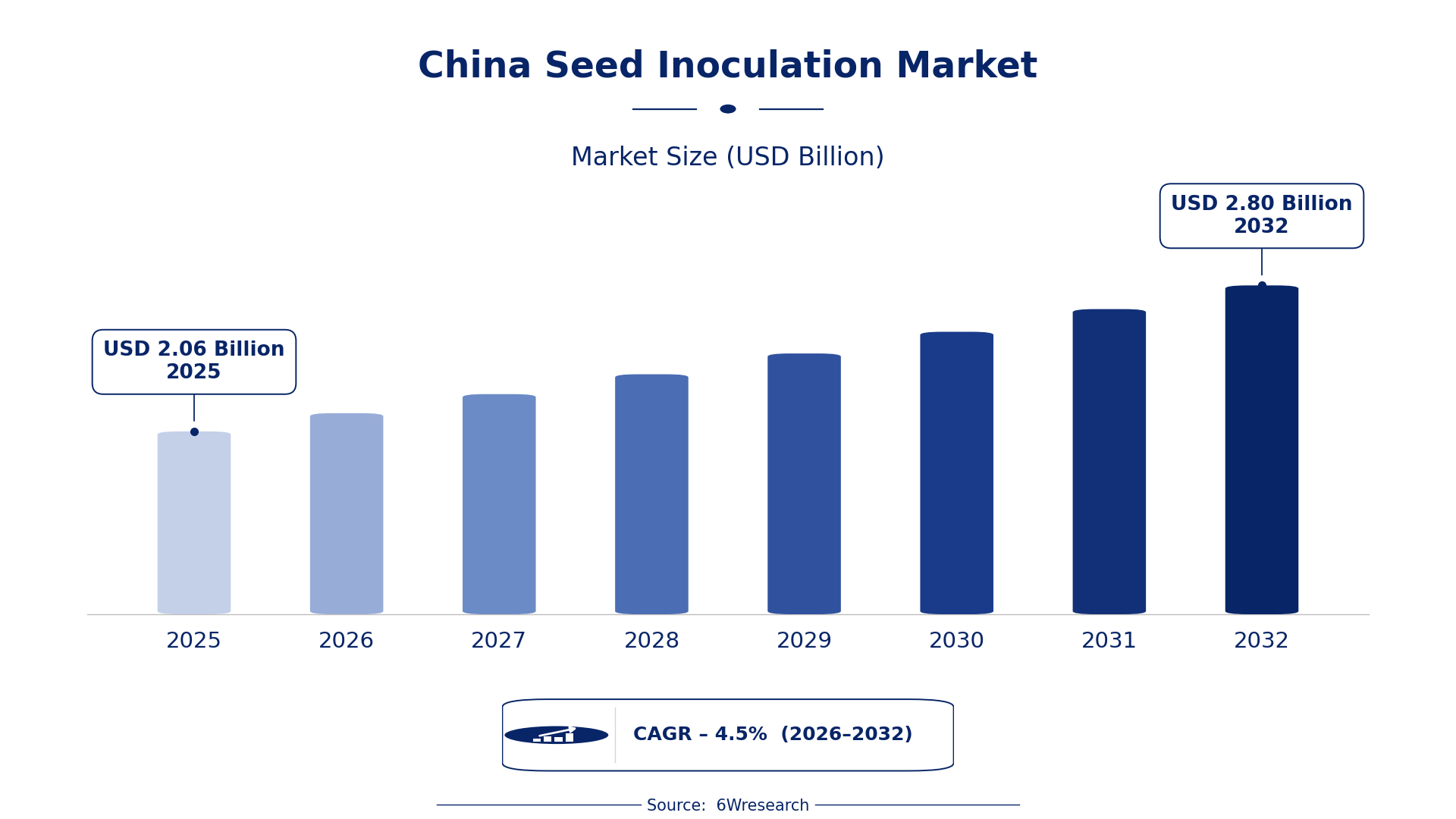
According to 6Wresearch internal database and industry insights, the China Seed Inoculation Market was valued at USD 2.06 billion in 2025 and is projected to reach USD 2.80 billion by 2032, growing at a CAGR of approximately 4.5% during 2026–2032.
China Seed Inoculation Market Highlights
| Report Metric | Details |
| Report Name | China Seed Inoculation Market |
| Market Size 2025 | USD 2.06 billion |
| Market Size 2032 | USD 2.80 billion |
| Absolute Growth 2025–2032 | USD 0.74 billion |
| CAGR 2026–2032 | 4.5% |
| Peak Annual Growth | 6.6% in 2027 |
| Forecast Period | 2026–2032 |
| Historical Data | 2022–2025 |
| Base Year | 2025 |
| Leading Inoculant Type, 2025 | Rhizobium (39% share) |
| Leading Crop Type, 2025 | Legumes (52% share) |
| Leading Application Method, 2025 | Coating (49% share) |
| Leading End User, 2025 | Organic Farmers (38% share) |
| Fastest-Growing Inoculant Type | Mycorrhizae (6.0% CAGR) |
| Fastest-Growing Crop Type | Vegetables (7.0% CAGR) |
| Fastest-Growing Application Method | Seed Soaking (6.5% CAGR) |
| Fastest-Growing End User | Agricultural Institutes (6.2% CAGR) |
| Growing Sector | Organic Farming |
| Key End Users | Organic Farmers, Agricultural Institutes, Seed Processing Units |
China Seed Inoculation Market Year-wise Growth Rate and Key Drivers (2022–2032)
This graph illustrates the annual growth rates of the market from 2022 to 2032, highlighting a steady upward trajectory and projected market expansion over the forecast period.
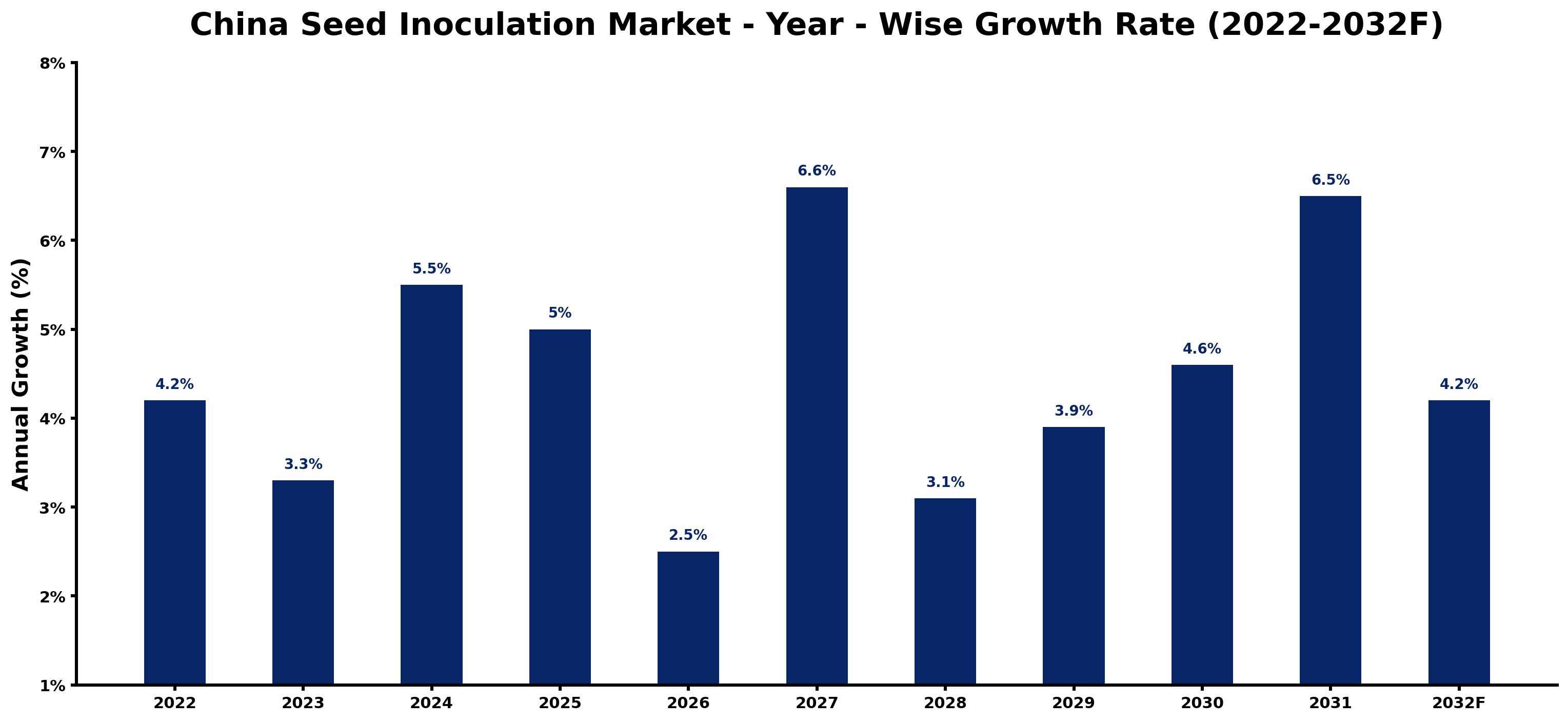
Below, each year's estimated growth is shown next to the factor that most influenced it.
| Year | Estimated Annual Growth (%) | Market Rationale |
| 2022 | 4.2 | The market showed steady growth, driven by the 'National Agricultural Technology Extension Service Center' promoting sustainable practices. |
| 2023 | 3.3 | Growth slowed as farmers focused on traditional farming methods, impacting inoculant adoption. |
| 2024 | 5.5 | Demand accelerated as more farmers adopted seed inoculation techniques for legumes, particularly through agricultural institutes. |
| 2025 | 5.0 | The market continued to grow, supported by rising interest in organic farming practices, especially among organic farmers. |
| 2026 | 2.5 | Growth is expected to slow as farmers face challenges in accessing quality inoculants, particularly in rural regions. |
| 2027 | 6.6 | Demand is projected to surge as the government promotes seed inoculation through the 'Green Agriculture Development Plan'. |
| 2028 | 3.1 | Growth is anticipated to slow again as farmers adjust to new agricultural technologies and practices. |
| 2029 | 3.9 | Demand is expected to increase as research on inoculants expands in agricultural institutes, leading to better product offerings. |
| 2030 | 4.6 | Growth is projected to pick up as more farmers recognise the benefits of inoculants, particularly in legumes. |
| 2031 | 6.5 | Demand is expected to rise sharply due to successful government campaigns promoting sustainable practices, including seed inoculation. |
| 2032 | 4.2 | Growth is projected to slow as the market begins to stabilise after rapid expansion, with farmers adjusting to new standards. |
Note: Market size estimations and growth projections presented in this report are based on 6Wresearch's proprietary forecasting methodology, utilizing the latest available industry data, government publications, and primary research inputs.
China Seed Inoculation Market Synopsis
Seed Inoculation in China involves applying beneficial microorganisms to seeds to improve growth and nutrient uptake. This process is vital for improving soil fertility and increasing crop yields, particularly in legumes. The China Seed Inoculation Market is expanding due to significant demand from domestic farmers and agricultural institutions. The area planted with legumes reached approximately 6 million hectares in 2022, highlighting the need for improved agricultural practices. Government initiatives, such as the 'Green Agriculture Development Plan', are further driving this growth by promoting sustainable farming methods.
Market Dynamics Impact Analysis (2026–2032)
| Factor | Type | Impact | Primary Segment Affected |
| Growing adoption of Rhizobium inoculants among legume farmers | Driver | High | Rhizobium |
| Increasing interest in organic farming practices | Driver | High | Organic Farmers |
| Rising investment in agricultural research projects | Opportunity | Medium | Agricultural Institutes |
| Expanding market for vegetable inoculants | Opportunity | Medium | Vegetables |
| Limited access to quality inoculants in rural areas | Restraint | High | Legumes |
| Challenges in educating farmers about inoculant benefits | Restraint | Medium | Organic Farmers |
| Seed Inoculation in China faces practical problems, particularly in rural areas | Challenge | High | Seed Processing Units |
| Competition from synthetic fertilisers remains a challenge | Challenge | Medium | Cereals |
Evaluation of Drivers in China Seed Inoculation Market (2026–2032)
Below mentioned are some major drivers and their influence on market dynamics.
| Drivers | Primary Segment Affected | Why It Matters (Evidence) |
| Increased adoption of Rhizobium inoculants | Rhizobium | The average yield increase for legumes using Rhizobium inoculants is reported to be 30%, encouraging more farmers to adopt these practices. |
| Growing interest in organic farming | Organic Farmers | The adoption rate of seed inoculation among organic farmers is estimated at 60%, reflecting a shift towards sustainable practices. |
| Government initiatives promoting sustainable agriculture | Agricultural Institutes | The 'Green Agriculture Development Plan' launched in 2023 aims to promote sustainable farming, increasing demand for seed inoculation. |
| Research projects on inoculants | Agricultural Institutes | Over 50 research projects on seed inoculation techniques are being conducted, leading to improved product offerings and farmer education. |
| Expansion of vegetable inoculants | Vegetables | The use of mycorrhizal fungi has been shown to increase vegetable yields by up to 25%, driving demand for these products. |
The Seed Inoculation market in China is growing on the back of increased investment in quality inoculants and rising end-use demand from farmers. The average yield increase for legumes using Rhizobium inoculants is reported to be 30%, prompting farmers to invest in this technology. Agricultural institutes are conducting over 50 research projects on seed inoculation techniques, leading to improved product offerings and farmer education. The adoption rate of seed inoculation among organic farmers is estimated at 60%, reflecting a shift towards sustainable practices.
Evaluation of Restraints in China Seed Inoculation Market
The following restraints limit how fast demand can grow.
| Market Restraint | Primary Segment Affected | Why It Matters (Evidence) |
| Limited access to quality inoculants in rural areas | Legumes | Many farmers in rural regions struggle to obtain quality inoculants, hindering their adoption and impacting crop yields. |
| Challenges in educating farmers about inoculant benefits | Organic Farmers | Many organic farmers lack awareness of the advantages of inoculants, which affects their willingness to adopt these practices. |
| Competition from synthetic fertilisers remains a challenge | Cereals | Synthetic fertilisers are often more readily available and familiar to farmers, making it difficult for inoculants to gain traction. |
| Higher initial costs of inoculants compared to traditional methods | Legumes | The upfront investment in inoculants can deter farmers who are accustomed to conventional farming techniques. |
| Inconsistent quality of inoculants in the market | Vegetables | The variability in quality among available inoculants can lead to farmer dissatisfaction and reluctance to adopt these products. |
China Seed Inoculation Market Challenges
The China Seed Inoculation Market faces several practical issues, with cost being a primary concern. High production costs for inoculants can lead to prices that deter small-scale producers, especially in rural areas, from adopting these beneficial products. Technology adoption is another challenge, as many agricultural workers lack access to modern seed inoculation techniques, resulting in lower crop yields and missed opportunities for sustainable practices. A shortage of skilled labour limits effective application of these methods, which can delay yield improvements for farmers. Competition from traditional farming practices continues to challenge suppliers, making it difficult to persuade producers to switch, thereby restricting market growth.
Trends in the China Seed Inoculation Market
Four trends stand out in the China Seed Inoculation Market.
- Growing Focus on Sustainable Practices in Agriculture: China is increasingly prioritising sustainable agricultural practices, as seen in the 'Green Agriculture Development Plan' launched in 2023. This initiative aims to promote seed inoculation, with a target of increasing organic farming by 20% by 2025.
- Increased Interest in Mycorrhizal Fungi: The use of mycorrhizal fungi is gaining traction among vegetable growers, with reports indicating a yield increase of up to 25%. This trend reflects a shift towards biological solutions in crop production.
- Expansion of Research Initiatives on Inoculants: Agricultural institutes are conducting over 50 research projects on seed inoculation techniques, highlighting a growing interest in improving agricultural productivity through biological methods.
- Rising Popularity of Coating Methods for Inoculants: The coating application method for inoculants is becoming more popular, holding a 49% market share in 2025. This method is preferred for its ease of application and effectiveness.
Investment Opportunities in the China Seed Inoculation Market
The following opportunities in the China Seed Inoculation Market pair current demand with a clear way in.
- Supply of High-Quality Seed Inoculants: There is an opportunity to supply high-quality seed inoculants, particularly Rhizobium, as the area planted with legumes reached approximately 6 million hectares in 2022. Collaborating with agricultural institutes can facilitate market entry.
- Partnerships with Organic Farmers: Now is an ideal time to partner with organic farmers who are increasingly adopting seed inoculation technologies. The adoption rate among this group is estimated at 60%, indicating a strong market for suppliers.
- Educational Programs for Farmers: Investing in educational programs for farmers can drive awareness about the benefits of inoculants. With many farmers unaware of these advantages, targeted initiatives can significantly improve adoption rates.
- Expansion into Northern Regions: There is a growing demand for phosphate solubilising bacteria, particularly in phosphorus-deficient soils in northern China. Entering this market can be achieved through local partnerships or certifications.
Government Initiatives in the China Seed Inoculation Market
The 'Green Agriculture Development Plan' launched in 2023 by the Ministry of Agriculture and Rural Affairs aims to promote sustainable agricultural practices, including seed inoculation. This measure builds on previous initiatives like the 'National Plan for Agricultural Technology Innovation' (2021), which targeted a 15% increase in biological product usage by 2025, thereby improving the overall framework for sustainable agriculture in China. The updated 'National Standard for Biofertilizers' in 2021 also provides guidelines for the production and application of seed inoculants, ensuring quality and safety for producers and buyers.
Organic farmers benefit from the subsidy program introduced in 2022 by the Ministry of Agriculture, which allocates 100 million RMB to support the adoption of seed inoculation technologies. This funding helps offset initial costs and encourages the transition to more sustainable farming practices. The 'Soil Health Action Plan' (2021) further promotes the use of microbial inoculants to improve soil quality and crop productivity across China, enabling farmers to enhance their yields.
Future Insight of the China Seed Inoculation Market
By 2032, transformative changes in the China Seed Inoculation Market will reshape buyer and supplier dynamics. The government's 'Green Agriculture Development Plan' will promote awareness and adoption of seed inoculation practices across the agricultural sector. Ongoing research on seed inoculation techniques will generate new insights, driving innovation in product development. With the area planted with legumes at approximately 6 million hectares, demand for effective inoculants will rise, benefiting suppliers. As the adoption rate among organic producers increases, the market will see heightened interest in sustainable agricultural practices.
Market Segmentation Analysis
Each segment group is reviewed below, with the leader by share and the fastest grower by CAGR.
By Inoculant Type – Rhizobium Dominated, Mycorrhizae Expected to Grow Fastest
According to Shubham Padhi, Research Analyst at 6Wresearch, in 2025, Rhizobium led the inoculant type split with a 39% share. Rhizobium commands a substantial market share as it plays a crucial role in nitrogen fixation for legumes, which are essential for food security in China. With approximately 6 million hectares planted with legumes, farmers increasingly rely on Rhizobium inoculants to enhance crop productivity. Over 2026–2032, Mycorrhizae is expected to post the fastest growth, at a CAGR of 6.0%. Mycorrhizae is witnessing rapid growth due to its proven ability to increase vegetable yields by up to 25%, making it an attractive option for farmers. As agricultural policies increasingly promote sustainable practices, the adoption of mycorrhizal fungi is expected to accelerate further. This trend suggests that suppliers should prioritise the development and marketing of mycorrhizal products to align with the rising demand for sustainable farming solutions.
By Crop Type – Legumes Dominated, Vegetables Expected to Grow Fastest
The largest crop type category in 2025 was Legumes, with a 52% share of total revenue. Legumes dominate the market share in seed inoculation as they are the primary beneficiaries of these treatments. The reported average yield increase of 30% for legumes using Rhizobium inoculants highlights their critical role in enhancing agricultural productivity across China. Vegetables are set to record the highest CAGR in this split, 7.0% over 2026–2032. Vegetables are the fastest-growing segment in this market, driven by rising consumer demand for improved yields and quality. The increasing focus on sustainable farming practices is further propelling the adoption of inoculation techniques among vegetable producers. This indicates that suppliers should adapt their offerings to cater specifically to the needs of vegetable growers, ensuring they have access to effective inoculation solutions.
By Application Method – Coating Dominated, Seed Soaking Expected to Grow Fastest
Coating held a 49% share of the China Seed Inoculation Market by application method in 2025. Coating is the leading application method for seed inoculation due to its effectiveness in uniformly applying inoculants to seeds. This method is widely embraced by farmers, ensuring optimal performance of the inoculants during the planting process. The quickest growth will come from Seed Soaking, forecast to expand at a CAGR of 6.5% between 2026 and 2032. Seed soaking is rapidly gaining popularity as it provides a highly effective means of inoculating seeds before planting. The simplicity and effectiveness of this method are driving its increasing adoption among farmers seeking to enhance crop yields. Suppliers should consider promoting seed soaking techniques to capitalise on the growing interest in effective inoculation methods.
By End User – Organic Farmers Dominated, Agricultural Institutes Expected to Grow Fastest
Organic Farmers accounted for a 38% market share by end user in 2025. Organic farmers represent the largest segment in the seed inoculation market as they heavily depend on biological solutions to improve crop production. Their commitment to sustainable agricultural practices significantly drives the demand for effective inoculants tailored for organic farming. Agricultural Institutes are projected to grow fastest, at a CAGR of 6.2% during 2026–2032. Agricultural institutes are the fastest-growing end user segment, as they engage in extensive research on inoculants and their applications. Their focus on developing new techniques and refining existing ones is contributing to rapid growth in this area. This indicates that suppliers should collaborate with agricultural institutes to support research and development efforts, ensuring their products align with emerging scientific standards.
Key Attractiveness of the Report
- 10 Years of Market Numbers
- Historical Data Starting from 2022 to 2025
- Base Year 2025
- Forecast Data until 2032
- Key Performance Indicators Impacting the Market
- Major Upcoming Developments and Projects
Key Highlights of the Report:
- China Seed Inoculation Market Outlook
- Market Size of China Seed Inoculation Market, 2025
- Forecast of China Seed Inoculation Market, 2032
- Historical Data and Forecast of China Seed Inoculation Revenues & Volume for the Period 2022 - 2032F
- China Seed Inoculation Market Trend Evolution
- China Seed Inoculation Market Drivers and Challenges
- China Seed Inoculation Price Trends
- China Seed Inoculation Porter's Five Forces
- China Seed Inoculation Industry Life Cycle
- Historical Data and Forecast of China Seed Inoculation Market Revenues & Volume By Inoculant Type for the Period 2022 - 2032F
- Historical Data and Forecast of China Seed Inoculation Market Revenues & Volume By Rhizobium for the Period 2022 - 2032F
- Historical Data and Forecast of China Seed Inoculation Market Revenues & Volume By Azospirillum for the Period 2022 - 2032F
- Historical Data and Forecast of China Seed Inoculation Market Revenues & Volume By Mycorrhizae for the Period 2022 - 2032F
- Historical Data and Forecast of China Seed Inoculation Market Revenues & Volume By Phosphate Solubilizing Bacteria for the Period 2022 - 2032F
- Historical Data and Forecast of China Seed Inoculation Market Revenues & Volume By Crop Type for the Period 2022 - 2032F
- Historical Data and Forecast of China Seed Inoculation Market Revenues & Volume By Legumes for the Period 2022 - 2032F
- Historical Data and Forecast of China Seed Inoculation Market Revenues & Volume By Cereals for the Period 2022 - 2032F
- Historical Data and Forecast of China Seed Inoculation Market Revenues & Volume By Vegetables for the Period 2022 - 2032F
- Historical Data and Forecast of China Seed Inoculation Market Revenues & Volume By Pulses for the Period 2022 - 2032F
- Historical Data and Forecast of China Seed Inoculation Market Revenues & Volume By Application Method for the Period 2022 - 2032F
- Historical Data and Forecast of China Seed Inoculation Market Revenues & Volume By Coating for the Period 2022 - 2032F
- Historical Data and Forecast of China Seed Inoculation Market Revenues & Volume By Seed Soaking for the Period 2022 - 2032F
- Historical Data and Forecast of China Seed Inoculation Market Revenues & Volume By In-Furrow Application for the Period 2022 - 2032F
- Historical Data and Forecast of China Seed Inoculation Market Revenues & Volume By Granular Form for the Period 2022 - 2032F
- Historical Data and Forecast of China Seed Inoculation Market Revenues & Volume By End User for the Period 2022 - 2032F
- Historical Data and Forecast of China Seed Inoculation Market Revenues & Volume By Organic Farmers for the Period 2022 - 2032F
- Historical Data and Forecast of China Seed Inoculation Market Revenues & Volume By Agricultural Institutes for the Period 2022 - 2032F
- Historical Data and Forecast of China Seed Inoculation Market Revenues & Volume By Horticulturists for the Period 2022 - 2032F
- Historical Data and Forecast of China Seed Inoculation Market Revenues & Volume By Seed Processing Units for the Period 2022 - 2032F
- China Seed Inoculation Import Export Trade Statistics
- Market Opportunity Assessment By Inoculant Type
- Market Opportunity Assessment By Crop Type
- Market Opportunity Assessment By Application Method
- Market Opportunity Assessment By End User
- China Seed Inoculation Top Companies Market Share
- China Seed Inoculation Competitive Benchmarking By Technical and Operational Parameters
- China Seed Inoculation Company Profiles
- China Seed Inoculation Key Strategic Recommendations
Market Covered
This report examines the market across the segments below.
By Inoculant Type
- Rhizobium
- Azospirillum
- Mycorrhizae
- Phosphate Solubilizing Bacteria
By Crop Type
- Legumes
- Cereals
- Vegetables
- Pulses
By Application Method
- Coating
- Seed Soaking
- In-Furrow Application
- Granular Form
By End User
- Organic Farmers
- Agricultural Institutes
- Horticulturists
- Seed Processing Units































