India Self-Driving System Market Size & Growth Rate
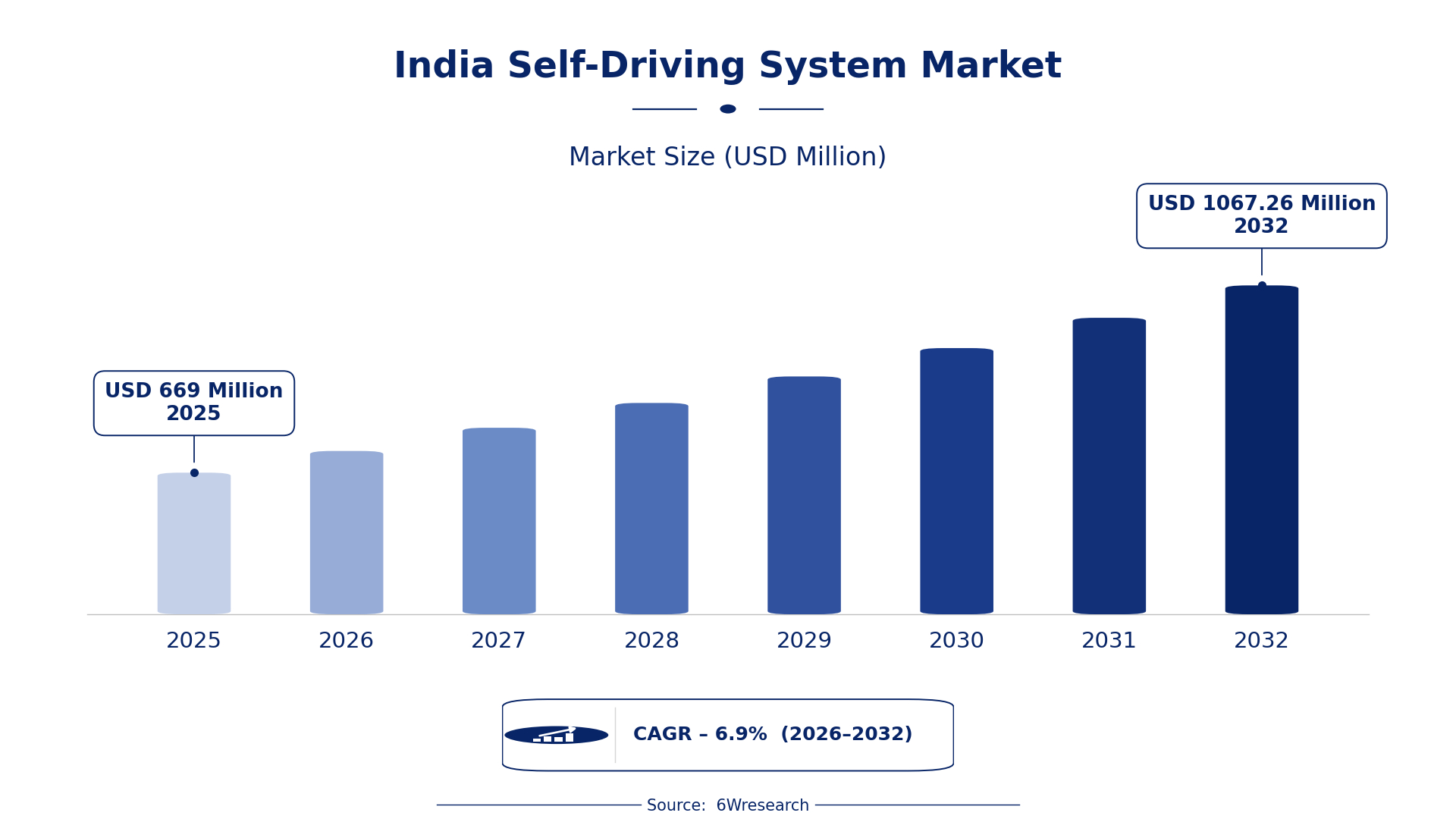
According to 6Wresearch internal database and industry insights, the India Self-Driving System Market was valued at USD 669.0 million in 2025 and is projected to reach USD 1,067.26 million by 2032, growing at a CAGR of approximately 6.9% during 2026–2032.
India Self-Driving System Market Highlights
| Report Metric | Details |
| Report Name | India Self-Driving System Market |
| Market Size 2025 | USD 669.0 million |
| Market Size 2032 | USD 1,067.26 million |
| Absolute Growth 2025–2032 | USD 398.26 million |
| CAGR 2026–2032 | 6.9% |
| Peak Annual Growth | 9.3% in 2028 |
| Forecast Period | 2026–2032 |
| Historical Data | 2022–2025 |
| Base Year | 2025 |
| Leading System Type, 2025 | Perception System (48% share) |
| Leading Core Component, 2025 | LiDAR (43% share) |
| Leading Integration Level, 2025 | Vehicle Integrated (41% share) |
| Leading End User, 2025 | OEM Manufacturers (38% share) |
| Fastest-Growing System Type | Planning System (8.2% CAGR) |
| Fastest-Growing Core Component | AI + Decision-Making (8.5% CAGR) |
| Fastest-Growing Integration Level | Drive-by-Wire Interface (8.6% CAGR) |
| Fastest-Growing End User | ADAS Developers (8.3% CAGR) |
| Growing Sector | ADAS Developers |
| Key End Users | OEM Manufacturers, ADAS Developers, Automotive Software Cos., Robotics Startups |
India Self-Driving System Market Year-wise Growth Rate and Key Drivers (2022–2032)
This graph illustrates the annual growth rates of the market from 2022 to 2032, highlighting a steady upward trajectory and projected market expansion over the forecast period.
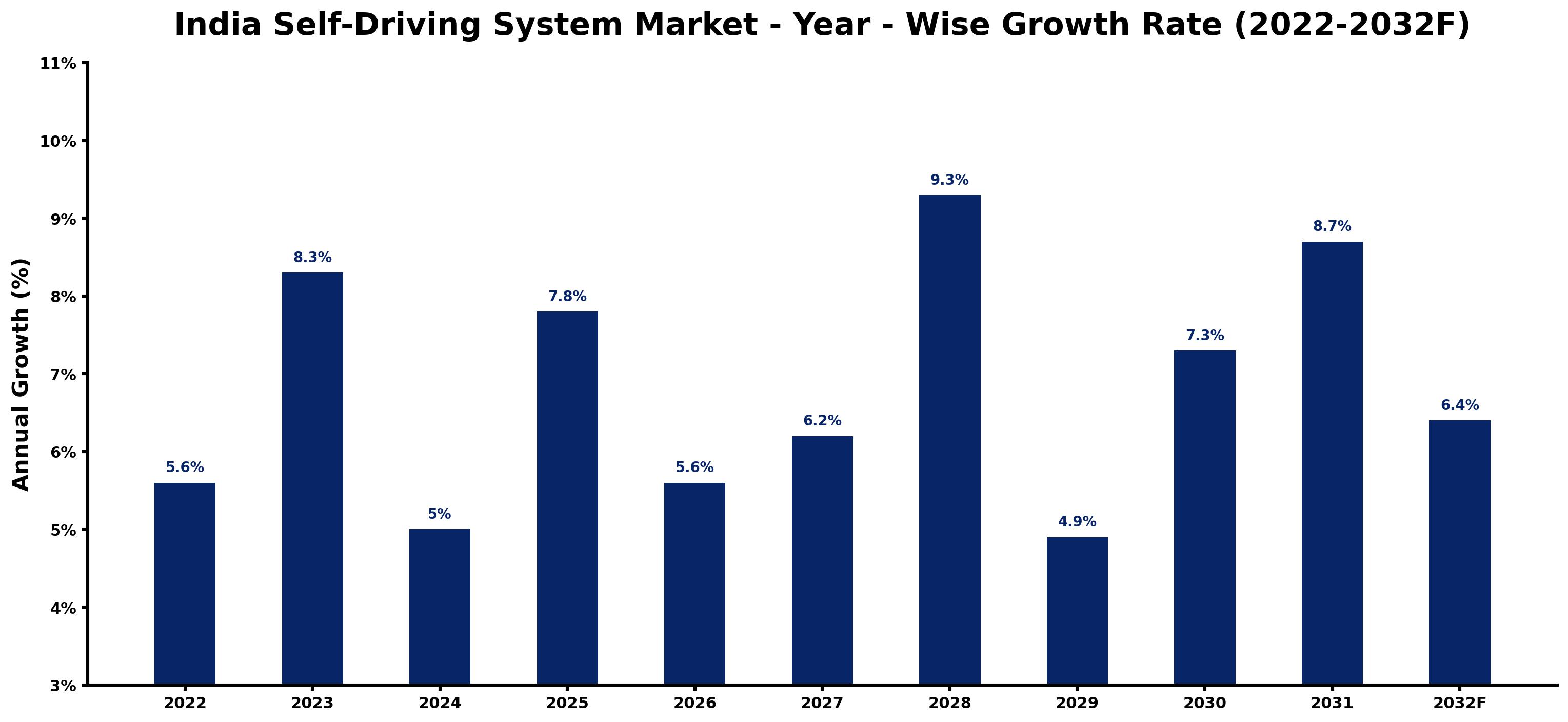
Below, each year's estimated growth is shown next to the factor that most influenced it.
| Year | Estimated Annual Growth (%) | Market Rationale |
| 2022 | 5.6 | The market experienced steady growth, driven by rising interest in autonomous technologies and the National Electric Mobility Mission Plan. |
| 2023 | 8.3 | Demand surged due to the introduction of new electric vehicle standards and consumer adoption of electric vehicles. |
| 2024 | 5.0 | Growth slowed as manufacturers adjusted to new regulations and the Motor Vehicle Act's provisions for autonomous vehicles. |
| 2025 | 7.8 | A rise in electric vehicle registrations boosted demand for self-driving systems, particularly among OEM manufacturers. |
| 2026 | 5.6 | The market is expected to see a slowdown as companies face challenges in technology integration and funding. |
| 2027 | 6.2 | Increased investments in R&D are projected to lead to a rebound in market growth, especially in perception systems. |
| 2028 | 9.3 | The peak growth is driven by heightened demand for advanced safety features and the establishment of testing protocols under NATRiP. |
| 2029 | 4.9 | Growth is expected to slow as the market begins to stabilise after rapid expansion and increased competition. |
| 2030 | 7.3 | A renewed focus on electric vehicles is projected to spur demand for self-driving technologies among OEM manufacturers. |
| 2031 | 8.7 | Investment in infrastructure and technology integration will drive growth higher, supported by the Production Linked Incentive scheme. |
| 2032 | 6.4 | The market is expected to stabilise as companies adapt to evolving consumer preferences and regulatory requirements. |
Note: Market size estimations and growth projections presented in this report are based on 6Wresearch's proprietary forecasting methodology, utilizing the latest available industry data, government publications, and primary research inputs.
India Self-Driving System Market Synopsis
The Self-Driving System in India encompasses technologies that enable vehicles to operate autonomously using sensors and artificial intelligence. These systems are essential for improving safety and traffic efficiency, with applications in various vehicle types. The market is growing due to a surge in vehicle registrations, with over 1.4 million electric vehicles registered in 2023. The National Electric Mobility Mission Plan aims for 30% electric vehicle adoption by 2030, stimulating further demand. OEM manufacturers are increasingly focusing on integrating self-driving technologies to meet consumer expectations.
Market Dynamics Impact Analysis (2026–2032)
| Factor | Type | Impact | Primary Segment Affected |
| Increasing registrations of electric vehicles drive demand for self-driving systems. | Driver | High | OEM Manufacturers |
| The push for enhanced vehicle safety features creates opportunities for autonomous systems. | Driver | High | ADAS Developers |
| The growing automotive manufacturing hub in Maharashtra presents investment opportunities. | Opportunity | High | OEM Manufacturers |
| The need for advanced testing facilities for self-driving technologies offers market entry points. | Opportunity | Medium | Perception System |
| High development costs can limit the ability of startups to enter the market. | Restraint | High | Robotics Startups |
| Regulatory hurdles can delay the deployment of self-driving technologies. | Restraint | Medium | ADAS Developers |
| The Self-Driving System Market in India faces challenges related to technology integration. | Challenge | High | OEM Manufacturers |
| Limited consumer awareness about autonomous vehicles can hinder market growth. | Challenge | Medium | Perception System |
Evaluation of Drivers in India Self-Driving System Market (2026–2032)
Below mentioned are some major drivers and their influence on market dynamics.
| Drivers | Primary Segment Affected | Why It Matters (Evidence) |
| Rising electric vehicle registrations increase the demand for self-driving systems. | OEM Manufacturers | Over 1.4 million electric vehicles were registered in India as of 2023, prompting manufacturers to integrate autonomous technologies. |
| The push for advanced vehicle safety features drives demand for autonomous systems. | ADAS Developers | The Bureau of Indian Standards has established guidelines for vehicle safety, prompting investment in autonomous technologies. |
| Investment in R&D for autonomous technologies is increasing. | Perception System | The National Policy on Electronics aims to boost domestic production, improving self-driving system capabilities. |
| The need for testing facilities supports the development of self-driving systems. | Perception System | NATRiP supports the establishment of testing protocols for autonomous vehicles, facilitating their integration. |
| Consumer demand for traffic efficiency encourages the adoption of self-driving technologies. | OEM Manufacturers | India's population exceeds 1.4 billion, creating a vast market for automotive innovations. |
Market growth in India for Self-Driving System rests on rising electric vehicle registrations, increasing demand for advanced safety features, and investments in research and development. Over 1.4 million electric vehicles were registered in India as of 2023, prompting manufacturers to integrate autonomous technologies. The establishment of guidelines for vehicle safety by the Bureau of Indian Standards is driving investment in autonomous systems. With a population exceeding 1.4 billion, the demand for traffic efficiency is pushing the adoption of self-driving systems among manufacturers.
Evaluation of Restraints in India Self-Driving System Market
The main factors holding the market back are set out below.
| Market Restraint | Primary Segment Affected | Why It Matters (Evidence) |
| High development costs limit market entry for new players. | Robotics Startups | Funding challenges and technology integration can hinder the growth of startups in the self-driving sector, causing delays in product development. |
| Regulatory hurdles delay the deployment of autonomous technologies. | ADAS Developers | The Motor Vehicle Act's provisions for autonomous vehicles complicate testing and implementation, causing delays for developers. |
| Limited consumer awareness about autonomous vehicles can hinder market growth. | Perception System | Consumers may hesitate to adopt new technologies without a clear understanding of their benefits, affecting overall demand. |
| Competition from established players can stifle innovation. | OEM Manufacturers | New entrants may struggle to compete against well-established manufacturers with significant resources, limiting market diversity. |
| Supply chain disruptions can affect component availability. | LiDAR | Global supply chain issues can delay the production of critical components for self-driving systems, impacting delivery timelines. |
India Self-Driving System Market Challenges
The India Self-Driving System market encounters several practical problems, starting with technology integration. Many producers face difficulties in effectively combining sensors and algorithms, which can extend product development timelines by six months. Competition is another hurdle, as numerous automotive manufacturers are striving to innovate, leading to resource dilution and potential setbacks for smaller firms. Supply chain issues in sourcing essential components can disrupt production, costing producers approximately 20% of potential revenue. Lastly, high development costs associated with advanced technologies can deter new entrants, limiting options for buyers seeking diverse solutions.
Trends in the India Self-Driving System Market
Several trends are reshaping the India Self-Driving System Market; the most important are set out below.
- Shift from Traditional to Autonomous Vehicles: India is experiencing a shift from traditional vehicles to autonomous systems, driven by increasing consumer demand for safety and efficiency. The National Electric Mobility Mission is facilitating this transition, aiming for 30% electric vehicle adoption by 2030.
- Emergence of Testing Facilities: The establishment of advanced testing facilities under the National Automotive Testing and R&D Infrastructure Project is advancing the development of self-driving technologies. This initiative supports rigorous testing protocols, ensuring safety and reliability in autonomous systems.
- Focus on Electric Vehicle Integration: The automotive sector is prioritising the integration of electric and self-driving technologies, responding to government initiatives. With over 1.4 million electric vehicles registered in 2023, manufacturers are adapting their offerings to meet evolving consumer expectations.
- Increased Investment in R&D: Investment in research and development for autonomous technologies is rising, driven by a competitive market. The National Policy on Electronics aims to boost domestic production, further supporting innovation in self-driving systems.
Investment Opportunities in the India Self-Driving System Market
Below are the investment opportunities with the strongest case in the India Self-Driving System Market.
- Partnerships with Local Manufacturers: Forming joint ventures with local automotive manufacturers can facilitate market entry. With a growing demand for self-driving technologies among OEMs, collaboration can improve product offerings and market reach.
- Investment in Testing Facilities: The establishment of testing facilities presents an opportunity for investment. The National Automotive Testing and R&D Infrastructure Project aims to support the development of autonomous vehicles, creating demand for advanced testing services.
- Focus on Consumer Education: Investing in consumer education initiatives can help raise awareness about autonomous technologies. With limited consumer understanding, targeted campaigns can drive adoption rates and expand the market.
- Development of Custom Solutions: There is an opportunity to develop tailored solutions for specific market needs. OEM manufacturers are seeking unique self-driving technologies to meet diverse consumer demands.
Government Initiatives in the India Self-Driving System Market
In 2021, the Ministry of Heavy Industries launched the National Electric Mobility Mission Plan 2020, aiming for 30% electric vehicle adoption by 2030. This initiative complements existing laws by promoting the integration of electric and autonomous vehicles, improving the overall market for self-driving systems. The updated Motor Vehicle Act in 2020 also facilitates the testing and deployment of autonomous vehicles, ensuring compliance with safety standards.
The Automotive Research Association of India (ARAI) is responsible for developing testing protocols for autonomous vehicles under the National Automotive Testing and R&D Infrastructure Project (NATRiP). This agency approves testing facilities and standards, ensuring that self-driving technologies meet regulatory requirements. The Production Linked Incentive scheme, with a budget of $3 billion, further supports the auto sector by enhancing manufacturing capabilities and encouraging local production.
Future Insight of the India Self-Driving System Market
By 2032, the India Self-Driving System market will undergo notable transformations, influenced by several key factors. The National Electric Mobility Mission Plan will accelerate the adoption of autonomous vehicles, creating new market opportunities. With over 1.4 million electric vehicles registered in 2023, demand for self-driving technologies will likely surge. The establishment of testing facilities under the National Automotive Testing and R&D Infrastructure Project will streamline innovation processes, promoting a competitive environment. The Production Linked Incentive scheme will stimulate local manufacturing, enhancing domestic capabilities.
Market Segmentation Analysis
Each segment group is reviewed below, with the leader by share and the fastest grower by CAGR.
By System Type – Perception System Dominated, Planning System Expected to Grow Fastest
According to Shubham Padhi, Research Analyst at 6Wresearch, with a 48% revenue share in 2025, Perception System was the largest system type category. The Perception System holds the largest share due to its critical role in ensuring vehicle awareness and navigation, which are essential for safe autonomous driving. Many automotive manufacturers in India are investing in advanced sensors and algorithms to enhance these capabilities, reflecting a strong market focus on this technology. Planning System is projected to grow fastest, at a CAGR of 8.2% during 2026–2032. The Planning System is growing rapidly as it plays a key role in optimising routes and improving decision-making, which are vital for the efficiency of self-driving vehicles. The increasing demand for smarter navigation solutions is propelling this segment's growth. Suppliers should prioritise the development of planning technologies to meet the rising demands of the self-driving system market.
By Core Component – LiDAR Dominated, AI + Decision-Making Expected to Grow Fastest
LiDAR accounted for a 43% market share by core component in 2025. LiDAR is the leading component as it is vital for accurate distance measurement and environment mapping, ensuring safe navigation for self-driving vehicles. Its importance is underscored by the increasing number of electric vehicles registered in India, which demand advanced sensing technologies. Over 2026–2032, AI + Decision-Making is expected to post the fastest growth, at a CAGR of 8.5%. AI + Decision-Making is the fastest-growing component, driven by the need for sophisticated data processing to make real-time driving decisions. The surge in electric vehicle adoption further fuels this segment's growth as manufacturers seek smarter solutions. Buyers should prioritise suppliers that offer advanced AI solutions to stay competitive in the self-driving systems market.
By Integration Level – Vehicle Integrated Dominated, Drive-by-Wire Interface Expected to Grow Fastest
Vehicle Integrated held a 41% share of the India Self-Driving System Market by integration level in 2025. The Vehicle Integrated level leads the market because it is crucial for the seamless operation of self-driving technologies within vehicles. This integration is particularly important for manufacturers aiming to deliver fully autonomous vehicles, making it a key focus area in the industry. The quickest growth will come from Drive-by-Wire Interface, forecast to expand at a CAGR of 8.6% between 2026 and 2032. The Drive-by-Wire Interface is experiencing rapid growth as it is essential for the electronic control of vehicle systems, which is increasingly sought after by automotive developers. As the industry transitions towards electric and autonomous technologies, this segment's expansion is expected to continue. Suppliers must focus on developing robust drive-by-wire technologies to align with the evolving needs of the automotive sector.
By End User – OEM Manufacturers Dominated, ADAS Developers Expected to Grow Fastest
The largest end user category in 2025 was OEM Manufacturers, with a 38% share of total revenue. OEM Manufacturers dominate the market as they are the primary developers and integrators of self-driving technologies, significantly impacting the adoption of these systems in new vehicles. Their considerable investments in research and development for autonomous vehicles solidify their leading market share. ADAS Developers are set to record the highest CAGR in this split, 8.3% over 2026–2032. ADAS Developers are the fastest-growing end user segment, concentrating on enhancing vehicle safety features through automation, which is increasingly crucial in the competitive automotive landscape. The demand for safer driving solutions is driving this segment's rapid expansion. Suppliers should customise their offerings to address the specific requirements of ADAS developers to capitalise on this growing segment.
Key Attractiveness of the Report
- 10 Years of Market Numbers
- Historical Data Starting from 2022 to 2025
- Base Year 2025
- Forecast Data until 2032
- Key Performance Indicators Impacting the Market
- Major Upcoming Developments and Projects
Key Highlights of the Report:
- India Self-Driving System Market Outlook
- Market Size of India Self-Driving System Market, 2025
- Forecast of India Self-Driving System Market, 2032
- Historical Data and Forecast of India Self-Driving System Revenues & Volume for the Period 2022 - 2032F
- India Self-Driving System Market Trend Evolution
- India Self-Driving System Market Drivers and Challenges
- India Self-Driving System Price Trends
- India Self-Driving System Porter's Five Forces
- India Self-Driving System Industry Life Cycle
- Historical Data and Forecast of India Self-Driving System Market Revenues & Volume By System Type for the Period 2022 - 2032F
- Historical Data and Forecast of India Self-Driving System Market Revenues & Volume By Perception System for the Period 2022 - 2032F
- Historical Data and Forecast of India Self-Driving System Market Revenues & Volume By Planning System for the Period 2022 - 2032F
- Historical Data and Forecast of India Self-Driving System Market Revenues & Volume By Control System for the Period 2022 - 2032F
- Historical Data and Forecast of India Self-Driving System Market Revenues & Volume By Simulation Systems for the Period 2022 - 2032F
- Historical Data and Forecast of India Self-Driving System Market Revenues & Volume By Core Component for the Period 2022 - 2032F
- Historical Data and Forecast of India Self-Driving System Market Revenues & Volume By LiDAR, Radar for the Period 2022 - 2032F
- Historical Data and Forecast of India Self-Driving System Market Revenues & Volume By AI + Decision-Making for the Period 2022 - 2032F
- Historical Data and Forecast of India Self-Driving System Market Revenues & Volume By Motor Controllers for the Period 2022 - 2032F
- Historical Data and Forecast of India Self-Driving System Market Revenues & Volume By ML-Based Models for the Period 2022 - 2032F
- Historical Data and Forecast of India Self-Driving System Market Revenues & Volume By Integration Level for the Period 2022 - 2032F
- Historical Data and Forecast of India Self-Driving System Market Revenues & Volume By Vehicle Integrated for the Period 2022 - 2032F
- Historical Data and Forecast of India Self-Driving System Market Revenues & Volume By ECU Based for the Period 2022 - 2032F
- Historical Data and Forecast of India Self-Driving System Market Revenues & Volume By Drive-by-Wire Interface for the Period 2022 - 2032F
- Historical Data and Forecast of India Self-Driving System Market Revenues & Volume By Cloud Testing for the Period 2022 - 2032F
- Historical Data and Forecast of India Self-Driving System Market Revenues & Volume By End User for the Period 2022 - 2032F
- Historical Data and Forecast of India Self-Driving System Market Revenues & Volume By OEM Manufacturers for the Period 2022 - 2032F
- Historical Data and Forecast of India Self-Driving System Market Revenues & Volume By Automotive Software Cos. for the Period 2022 - 2032F
- Historical Data and Forecast of India Self-Driving System Market Revenues & Volume By Robotics Startups for the Period 2022 - 2032F
- Historical Data and Forecast of India Self-Driving System Market Revenues & Volume By ADAS Developers for the Period 2022 - 2032F
- India Self-Driving System Import Export Trade Statistics
- Market Opportunity Assessment By System Type
- Market Opportunity Assessment By Core Component
- Market Opportunity Assessment By Integration Level
- Market Opportunity Assessment By End User
- India Self-Driving System Top Companies Market Share
- India Self-Driving System Competitive Benchmarking By Technical and Operational Parameters
- India Self-Driving System Company Profiles
- India Self-Driving System Key Strategic Recommendations
Market Covered
This report examines the market across the segments below.
By System Type
- Perception System
- Planning System
- Control System
- Simulation Systems
By Core Component
- LiDAR
- Radar
- AI + Decision-Making
- Motor Controllers
- ML-Based Models
By Integration Level
- Vehicle Integrated
- ECU Based
- Drive-by-Wire Interface
- Cloud Testing
By End User
- OEM Manufacturers
- Automotive Software Cos.
- Robotics Startups
- ADAS Developers































