China Self-Driving System Market Size & Growth Rate
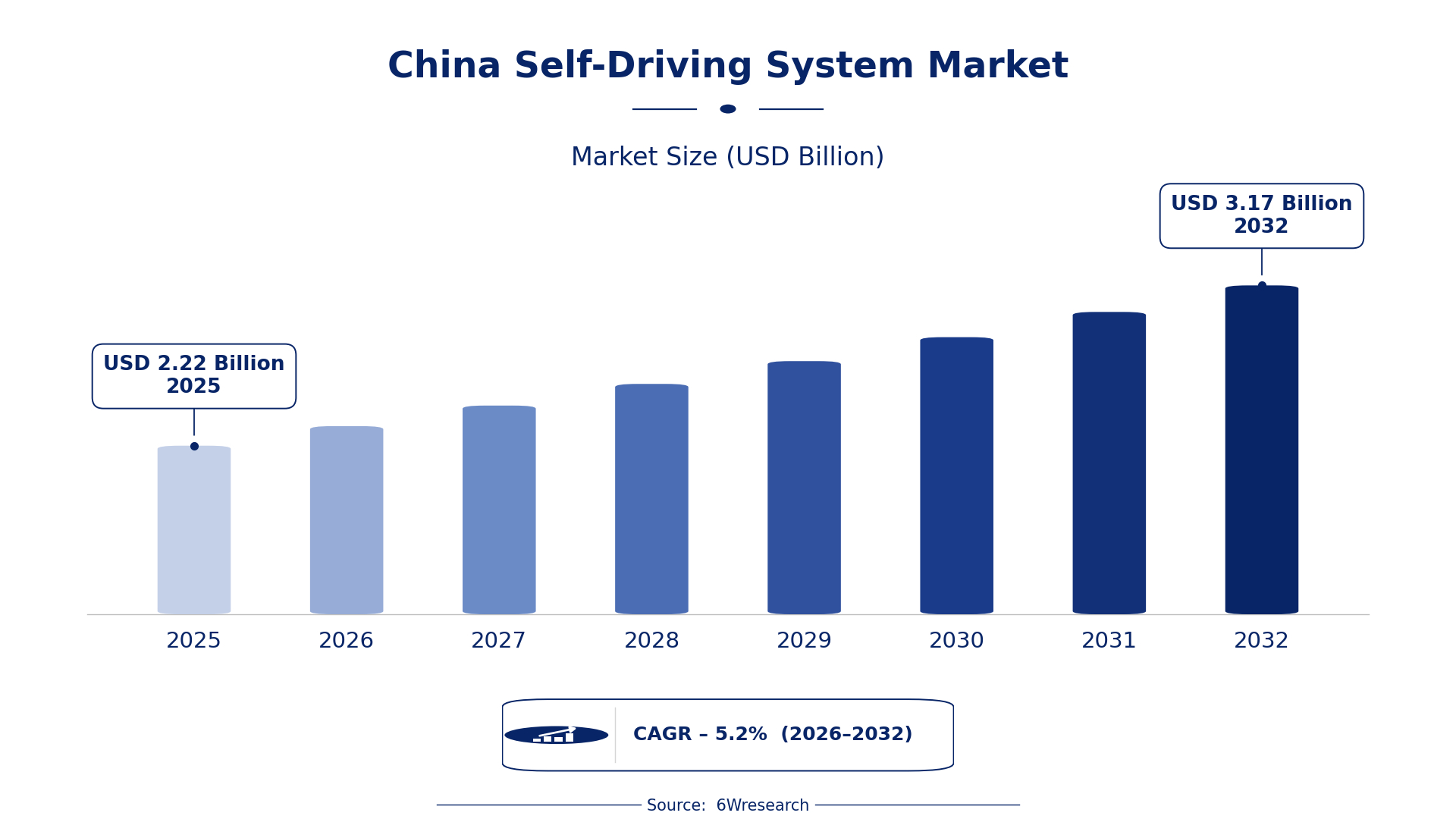
According to 6Wresearch internal database and industry insights, the China Self-Driving System Market was valued at USD 2.22 billion in 2025 and is projected to reach USD 3.17 billion by 2032, growing at a CAGR of approximately 5.2% during 2026–2032.
China Self-Driving System Market Highlights
| Report Metric | Details |
| Report Name | China Self-Driving System Market |
| Market Size 2025 | USD 2.22 billion |
| Market Size 2032 | USD 3.17 billion |
| Absolute Growth 2025–2032 | USD 0.95 billion |
| CAGR 2026–2032 | 5.2% |
| Peak Annual Growth | 7.2% in 2031 |
| Forecast Period | 2026–2032 |
| Historical Data | 2022–2025 |
| Base Year | 2025 |
| Leading System Type, 2025 | Perception System (46% share) |
| Leading Core Component, 2025 | LiDAR (40% share) |
| Leading Integration Level, 2025 | Vehicle Integrated (39% share) |
| Leading End User, 2025 | OEM Manufacturers (52% share) |
| Fastest-Growing System Type | Planning System (7.9% CAGR) |
| Fastest-Growing Core Component | AI + Decision-Making (7.8% CAGR) |
| Fastest-Growing End User | ADAS Developers (6.4% CAGR) |
| Growing Sector | Automotive |
| Key End Users | OEM Manufacturers, ADAS Developers, Automotive Software Companies, Robotics Startups |
China Self-Driving System Market Year-wise Growth Rate and Key Drivers (2022–2032)
This graph illustrates the annual growth rates of the market from 2022 to 2032, highlighting a steady upward trajectory and projected market expansion over the forecast period.
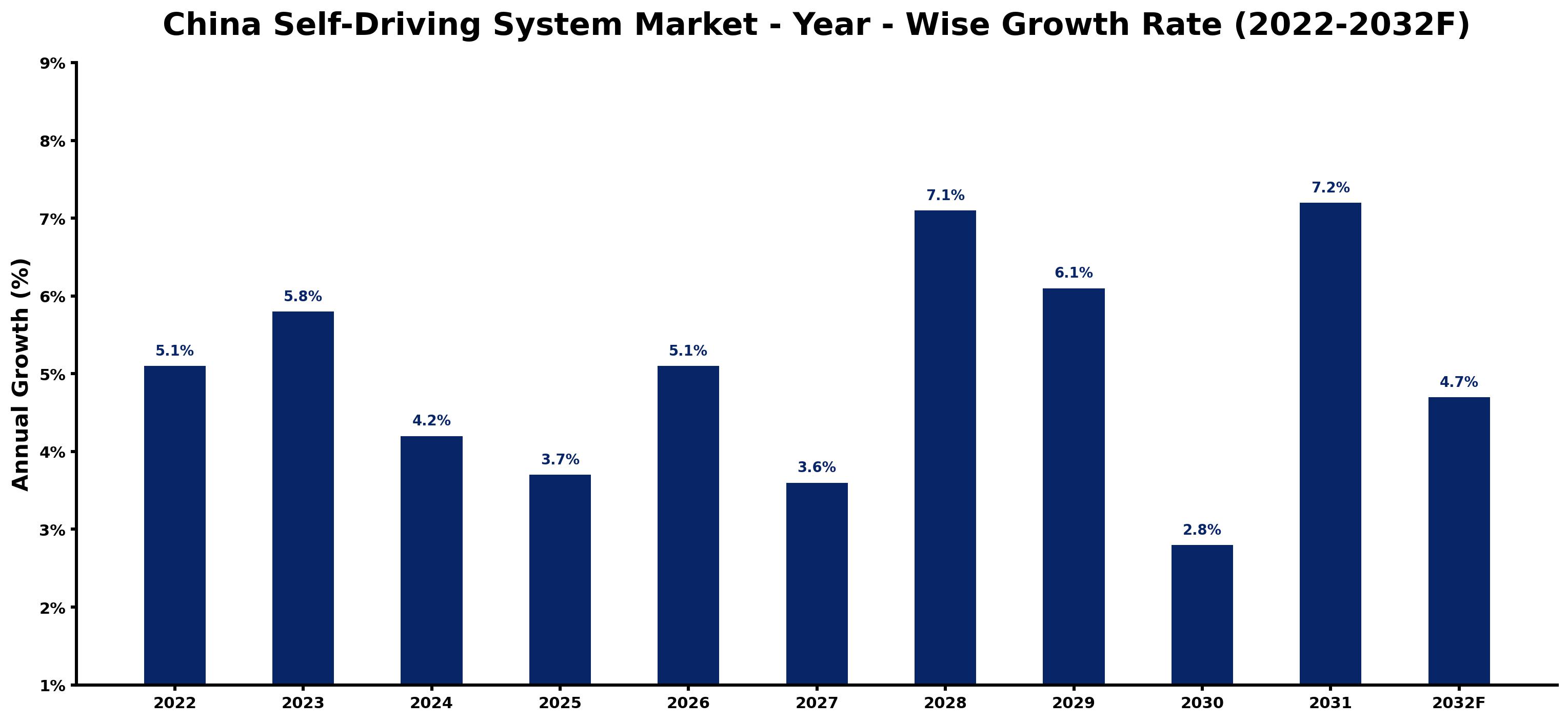
Annual growth estimates for each year appear below with the principal reason behind them, explaining the shifts that set the pace of the market.
| Year | Estimated Annual Growth (%) | Market Rationale |
| 2022 | 5.1 | The market experienced steady growth with increasing interest in autonomous technologies. |
| 2023 | 5.8 | Growth accelerated due to more approved self-driving vehicle trials in urban areas. |
| 2024 | 4.2 | The market saw a slowdown as some trials faced regulatory hurdles. |
| 2025 | 3.7 | Growth continued to slow as the market adjusted to new standards and regulations. |
| 2026 | 5.1 | Demand rebounded with renewed investments in autonomous vehicle technology. |
| 2027 | 3.6 | Growth slowed again as companies faced challenges in scaling production. |
| 2028 | 7.1 | The market surged as advancements in AI and LiDAR technology gained traction. |
| 2029 | 6.1 | Growth decelerated slightly as competition intensified among manufacturers. |
| 2030 | 2.8 | A further slowdown occurred as the market adjusted to evolving consumer preferences. |
| 2031 | 7.2 | The market peaked with advancements in autonomous driving capabilities driven by new technologies. |
| 2032 | 4.7 | Growth slowed as the market stabilised after reaching new technological heights. |
Note: Market size estimations and growth projections presented in this report are based on 6Wresearch's proprietary forecasting methodology, utilizing the latest available industry data, government publications, and primary research inputs.
China Self-Driving System Market Synopsis
Self-Driving System in China encompasses advanced technologies that allow vehicles to navigate autonomously. These systems integrate sensors, AI algorithms, and control systems to improve safety and efficiency. The China Self-Driving System Market is expanding due to substantial investments in smart transportation solutions and the increasing adoption of autonomous features. By 2030, the government aims for 50% of new vehicles to include these technologies. Regions like Beijing and Shanghai are at the forefront of this transformation with numerous trials and developments that enhance urban mobility.
Market Dynamics Impact Analysis (2026–2032)
| Factor | Type | Impact | Primary Segment Affected |
| Growing investments in smart transportation solutions | Driver | High | OEM Manufacturers |
| Increased demand for safety and efficiency in transportation | Driver | High | ADAS Developers |
| High demand for autonomous delivery services | Opportunity | High | Robotics Startups |
| Significant growth in the AI industry | Opportunity | High | Automotive Software Cos. |
| Regulatory hurdles slowing down deployment | Restraint | High | Simulation Systems |
| High costs associated with advanced technology development | Restraint | Medium | Control System |
| Limited public acceptance of autonomous vehicles | Challenge | High | Perception System |
| Challenges in standardisation of technology | Challenge | Medium | Planning System |
Evaluation of Drivers in China Self-Driving System Market (2026–2032)
The main growth drivers and the segments they affect most are set out below.
| Drivers | Primary Segment Affected | Why It Matters (Evidence) |
| Increased government support for autonomous vehicle trials | OEM Manufacturers | Over 100 self-driving vehicle trials were approved in urban areas, boosting demand for these systems. |
| Rising consumer demand for vehicle safety features | ADAS Developers | The AI industry in China is projected to surpass $150 billion by 2025, driving demand for self-driving systems. |
| Investment in smart transportation initiatives | Robotics Startups | The 'Smart Transportation Development Plan' aims to improve urban mobility through autonomous systems. |
| Technological advancements in AI and LiDAR | Automotive Software Cos. | China's LiDAR market is expected to grow significantly, driven by self-driving applications. |
| Integration of autonomous features in new energy vehicles | Control System | The 'New Energy Vehicle Development Plan' promotes the integration of self-driving technologies. |
Over 100 self-driving vehicle trials were approved in urban areas, boosting demand among OEM Manufacturers. The AI industry is expected to surpass $150 billion by 2025, driving demand for self-driving systems from ADAS Developers. The 'Smart Transportation Development Plan' aims to improve urban mobility, further encouraging Robotics Startups to innovate. Technological advancements in AI and LiDAR are set to increase market capacity, improving overall system performance.
Evaluation of Restraints in China Self-Driving System Market
The table below lists the restraints and the evidence behind each.
| Market Restraint | Primary Segment Affected | Why It Matters (Evidence) |
| Regulatory hurdles limiting trial deployments | Simulation Systems | The 'Autonomous Driving Road Testing Regulations' introduced in 2021 imposed strict conditions on testing. |
| High costs of developing advanced autonomous technologies | Control System | Investment in R&D for autonomous systems is substantial, impacting overall project budgets. |
| Limited public acceptance of self-driving vehicles | Perception System | Consumer hesitation regarding safety and reliability of autonomous vehicles remains a challenge. |
| Lack of standardisation across technologies | Planning System | The absence of unified standards complicates integration efforts among various manufacturers. |
| Competition among numerous startups and established firms | OEM Manufacturers | The influx of new entrants has intensified competition, affecting pricing and market share. |
China Self-Driving System Market Challenges
The self-driving system market in China faces several pressing issues that must be addressed. In 2023, over 100 self-driving vehicle trials were approved in urban areas, yet buyers struggle with high costs stemming from a shortage of advanced components, potentially delaying project timelines by up to six months. A shortage of skilled professionals in AI and robotics hampers the development of self-driving systems, compelling companies to invest in lengthy training programmes that can take years to yield qualified workers. Established firms also contend with increased competition from startups in cities like Shenzhen, which pressures them to innovate rapidly, often leading to rushed product launches that compromise quality. Lastly, the rapid pace of technological evolution outstrips current regulations, creating compliance challenges that can stall deployment for producers and suppliers alike.
Trends in the China Self-Driving System Market
Below mentioned are some of the trends shaping the China Self-Driving System Market growth.
- Shift from Traditional to Autonomous Delivery Services: In 2022, the demand for autonomous delivery services surged, driven by urban logistics needs. Regions like Shenzhen are leading this trend, with over 10,000 registered autonomous vehicles improving delivery efficiency.
- Transition from Manual to Automated Driving Systems: The transition towards automated driving systems began in 2021, with significant investments from local governments. The 'New Energy Vehicle Industry Development Plan' aims for a substantial increase in autonomous vehicle production by 2025.
- Emergence of AI-Driven Decision-Making in Vehicles: Since 2023, AI-driven decision-making has become essential in self-driving systems. This shift is supported by the growing AI industry, projected to exceed $150 billion in China by 2025.
- Integration of LiDAR Technology in Autonomous Vehicles: Starting in 2021, LiDAR technology has been increasingly integrated into self-driving systems. This integration is vital for safe navigation, with the LiDAR market expected to grow significantly.
Investment Opportunities in the China Self-Driving System Market
Several openings in the China Self-Driving System Market merit attention from investors.
- OEM Manufacturers seeking advanced technologies: With the government targeting 50% of new vehicles to have autonomous features by 2030, there is a strong opportunity to supply advanced self-driving systems.
- Robotics Startups focused on autonomous solutions: The demand for autonomous delivery services is growing, with over 10,000 registered autonomous vehicles in China, presenting a ripe market for innovative solutions.
- Automotive Software Companies developing AI solutions: The AI industry is expected to surpass $150 billion by 2025, creating a need for software solutions that improve self-driving functionalities.
- ADAS Developers investing in safety technologies: The push for enhanced safety features in vehicles creates opportunities for suppliers of advanced driver-assistance systems, particularly in urban areas.
Government Initiatives in the China Self-Driving System Market
In 2022, the 'National Standard for Autonomous Driving' was issued by the Standardization Administration of China, establishing guidelines for safety and performance. This measure builds on previous regulations, ensuring that manufacturers comply with updated safety protocols and performance metrics for self-driving systems. The 'Autonomous Driving Road Testing Regulations' introduced in 2021 expanded testing capabilities in urban areas, allowing for more comprehensive trials.
The Ministry of Housing and Urban-Rural Development oversees the implementation of various schemes, including the 'Smart City Development Program' initiated in 2023. This program funds projects that integrate self-driving technology into urban infrastructure, benefiting local governments and enhancing mobility solutions. The 'Intelligent Vehicle Innovation Action Plan' encourages investments in R&D, allowing producers to develop advanced autonomous systems.
Future Insight of the China Self-Driving System Market
Several forward-looking factors should support the self-driving system market in China over the coming years. The government's goal for 50% of new vehicles to include autonomous features by 2030 will elevate demand for these systems. The 'New Energy Vehicle Development Plan' will encourage the integration of self-driving technologies within the automotive sector. By 2025, the AI industry in China is expected to surpass $150 billion, which will further enhance the development of autonomous systems. National standards established in 2021 will streamline development processes, improving safety and efficiency in autonomous vehicle deployment.
Market Segmentation Analysis
The report offers a comprehensive study of the following market segments and their leading categories in the market.
By System Type – Perception System Dominated, Planning System Expected to Grow Fastest
According to Shubham Padhi, Research Analyst at 6Wresearch, Perception System took a 46% share of system type in 2025, more than any other category. The Perception System holds the largest share as it is vital for sensing the environment, allowing vehicles to accurately gauge their surroundings. The extensive trials in urban areas like Beijing and Shanghai underline its essential role in advancing self-driving technologies. Over 2026–2032, Planning System is expected to post the fastest growth, at a CAGR of 7.9%. The Planning System is experiencing rapid growth due to its critical function in route and behaviour planning for autonomous vehicles. With over 100 self-driving vehicle trials approved in urban areas in 2023, the demand for effective planning solutions is surging. Suppliers should prioritise advancements in planning technologies to meet the increasing demand from manufacturers and developers.
By Core Component – LiDAR Dominated, AI + Decision-Making Expected to Grow Fastest
In 2025, LiDAR led the core component split with a 40% share. LiDAR commands the highest market share as it provides essential distance measurements necessary for the safe navigation of autonomous vehicles. The growth in registered autonomous vehicles, which exceeded 10,000 in China by 2022, highlights the reliance on this technology. AI + Decision-Making is set to record the highest CAGR in this split, 7.8% over 2026–2032. AI + Decision-Making is the fastest-growing component, as it is crucial for interpreting data and making real-time driving decisions. The anticipated growth of China's AI industry, projected to surpass $150 billion by 2025, is a key factor driving this demand. Buyers should focus on incorporating advanced decision-making capabilities to enhance the effectiveness of their self-driving systems.
By Integration Level – Vehicle Integrated Dominated and Is Expected to Record the Fastest Growth
With a 39% revenue share in 2025, Vehicle Integrated was the largest integration level category. Vehicle Integrated systems dominate the market share as they are embedded within vehicles, facilitating real-time data processing crucial for autonomous operation. This integration aligns with the government's goal of having 50% of new vehicles equipped with autonomous features by 2030. Its lead should widen, with a projected CAGR of 7.1% during 2026–2032, the highest in this split. The Vehicle Integrated segment is also the fastest-growing due to its seamless integration capabilities, which are increasingly sought after by manufacturers. As urban mobility initiatives expand, the demand for integrated solutions will continue to grow. Suppliers must concentrate on developing more integrated solutions to meet the rising market expectations for autonomous vehicles.
By End User – OEM Manufacturers Dominated, ADAS Developers Expected to Grow Fastest
OEM Manufacturers held a 52% share of the China Self-Driving System Market by end user in 2025. OEM Manufacturers hold the largest share as they are the primary developers of self-driving vehicles, driving substantial investments in autonomous technology. Their significant role is evident in ongoing projects aimed at meeting national standards for autonomous driving established in 2021. The quickest growth will come from ADAS Developers, forecast to expand at a CAGR of 6.4% between 2026 and 2032. ADAS Developers represent the fastest-growing segment as they focus on advanced driver-assistance systems that enhance autonomous features. The increasing emphasis on safety and efficiency in urban mobility is propelling their growth. Suppliers should explore partnerships with ADAS developers to capitalise on the heightened focus on advanced safety features in self-driving systems.
Key Attractiveness of the Report
- 10 Years of Market Numbers
- Historical Data Starting from 2022 to 2025
- Base Year 2025
- Forecast Data until 2032
- Key Performance Indicators Impacting the Market
- Major Upcoming Developments and Projects
Key Highlights of the Report:
- China Self-Driving System Market Outlook
- Market Size of China Self-Driving System Market, 2025
- Forecast of China Self-Driving System Market, 2032
- Historical Data and Forecast of China Self-Driving System Revenues & Volume for the Period 2022 - 2032F
- China Self-Driving System Market Trend Evolution
- China Self-Driving System Market Drivers and Challenges
- China Self-Driving System Price Trends
- China Self-Driving System Porter's Five Forces
- China Self-Driving System Industry Life Cycle
- Historical Data and Forecast of China Self-Driving System Market Revenues & Volume By System Type for the Period 2022 - 2032F
- Historical Data and Forecast of China Self-Driving System Market Revenues & Volume By Perception System for the Period 2022 - 2032F
- Historical Data and Forecast of China Self-Driving System Market Revenues & Volume By Planning System for the Period 2022 - 2032F
- Historical Data and Forecast of China Self-Driving System Market Revenues & Volume By Control System for the Period 2022 - 2032F
- Historical Data and Forecast of China Self-Driving System Market Revenues & Volume By Simulation Systems for the Period 2022 - 2032F
- Historical Data and Forecast of China Self-Driving System Market Revenues & Volume By Core Component for the Period 2022 - 2032F
- Historical Data and Forecast of China Self-Driving System Market Revenues & Volume By LiDAR, Radar for the Period 2022 - 2032F
- Historical Data and Forecast of China Self-Driving System Market Revenues & Volume By AI + Decision-Making for the Period 2022 - 2032F
- Historical Data and Forecast of China Self-Driving System Market Revenues & Volume By Motor Controllers for the Period 2022 - 2032F
- Historical Data and Forecast of China Self-Driving System Market Revenues & Volume By ML-Based Models for the Period 2022 - 2032F
- Historical Data and Forecast of China Self-Driving System Market Revenues & Volume By Integration Level for the Period 2022 - 2032F
- Historical Data and Forecast of China Self-Driving System Market Revenues & Volume By Vehicle Integrated for the Period 2022 - 2032F
- Historical Data and Forecast of China Self-Driving System Market Revenues & Volume By ECU Based for the Period 2022 - 2032F
- Historical Data and Forecast of China Self-Driving System Market Revenues & Volume By Drive-by-Wire Interface for the Period 2022 - 2032F
- Historical Data and Forecast of China Self-Driving System Market Revenues & Volume By Cloud Testing for the Period 2022 - 2032F
- Historical Data and Forecast of China Self-Driving System Market Revenues & Volume By End User for the Period 2022 - 2032F
- Historical Data and Forecast of China Self-Driving System Market Revenues & Volume By OEM Manufacturers for the Period 2022 - 2032F
- Historical Data and Forecast of China Self-Driving System Market Revenues & Volume By Automotive Software Cos. for the Period 2022 - 2032F
- Historical Data and Forecast of China Self-Driving System Market Revenues & Volume By Robotics Startups for the Period 2022 - 2032F
- Historical Data and Forecast of China Self-Driving System Market Revenues & Volume By ADAS Developers for the Period 2022 - 2032F
- China Self-Driving System Import Export Trade Statistics
- Market Opportunity Assessment By System Type
- Market Opportunity Assessment By Core Component
- Market Opportunity Assessment By Integration Level
- Market Opportunity Assessment By End User
- China Self-Driving System Top Companies Market Share
- China Self-Driving System Competitive Benchmarking By Technical and Operational Parameters
- China Self-Driving System Company Profiles
- China Self-Driving System Key Strategic Recommendations
Market Covered
Segments analysed in this report are listed below.
By System Type
- Perception System
- Planning System
- Control System
- Simulation Systems
By Core Component
- LiDAR
- Radar
- AI + Decision-Making
- Motor Controllers
- ML-Based Models
By Integration Level
- Vehicle Integrated
- ECU Based
- Drive-by-Wire Interface
- Cloud Testing
By End User
- OEM Manufacturers
- Automotive Software Cos.
- Robotics Startups
- ADAS Developers































