India Self-Learning Systems Market Size & Growth Rate
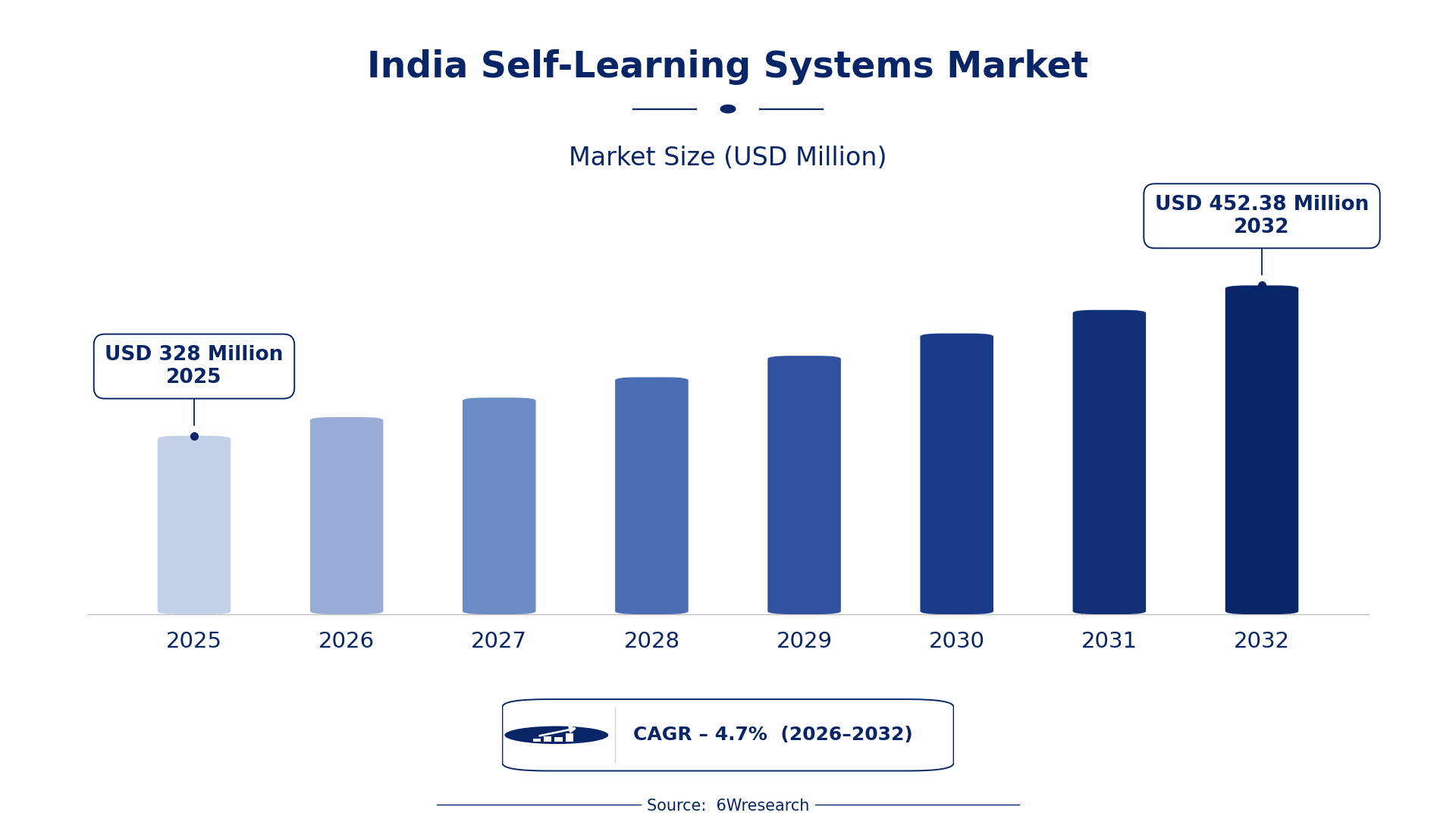
According to 6Wresearch internal database and industry insights, the India Self-Learning Systems Market was valued at USD 328.0 million in 2025 and is projected to reach USD 452.38 million by 2032, growing at a CAGR of approximately 4.7% during 2026–2032.
India Self-Learning Systems Market Highlights
| Report Metric | Details |
| Report Name | India Self-Learning Systems Market |
| Market Size 2025 | USD 328.0 million |
| Market Size 2032 | USD 452.38 million |
| Absolute Growth 2025–2032 | USD 124.38 million |
| CAGR 2026–2032 | 4.7% |
| Peak Annual Growth | 6.4% in 2027 |
| Forecast Period | 2026–2032 |
| Historical Data | 2022–2025 |
| Base Year | 2025 |
| Leading Learning Type, 2025 | Supervised Learning (47% share) |
| Leading Application Area, 2025 | Customer Analytics (45% share) |
| Leading Technology Stack, 2025 | AI + Big Data (41% share) |
| Leading End User, 2025 | E-Commerce Firms (46% share) |
| Fastest-Growing Learning Type | Unsupervised Learning (6.1% CAGR) |
| Fastest-Growing Application Area | Data Privacy Management (7.2% CAGR) |
| Fastest-Growing Technology Stack | Edge AI (7.5% CAGR) |
| Fastest-Growing End User | Cybersecurity Companies (7.3% CAGR) |
| Growing Sector | E-commerce |
| Key End Users | E-Commerce Firms, Cybersecurity Companies, Industrial Automation Firms |
India Self-Learning Systems Market Year-wise Growth Rate and Key Drivers (2022–2032)
This graph illustrates the annual growth rates of the market from 2022 to 2032, highlighting a steady upward trajectory and projected market expansion over the forecast period.
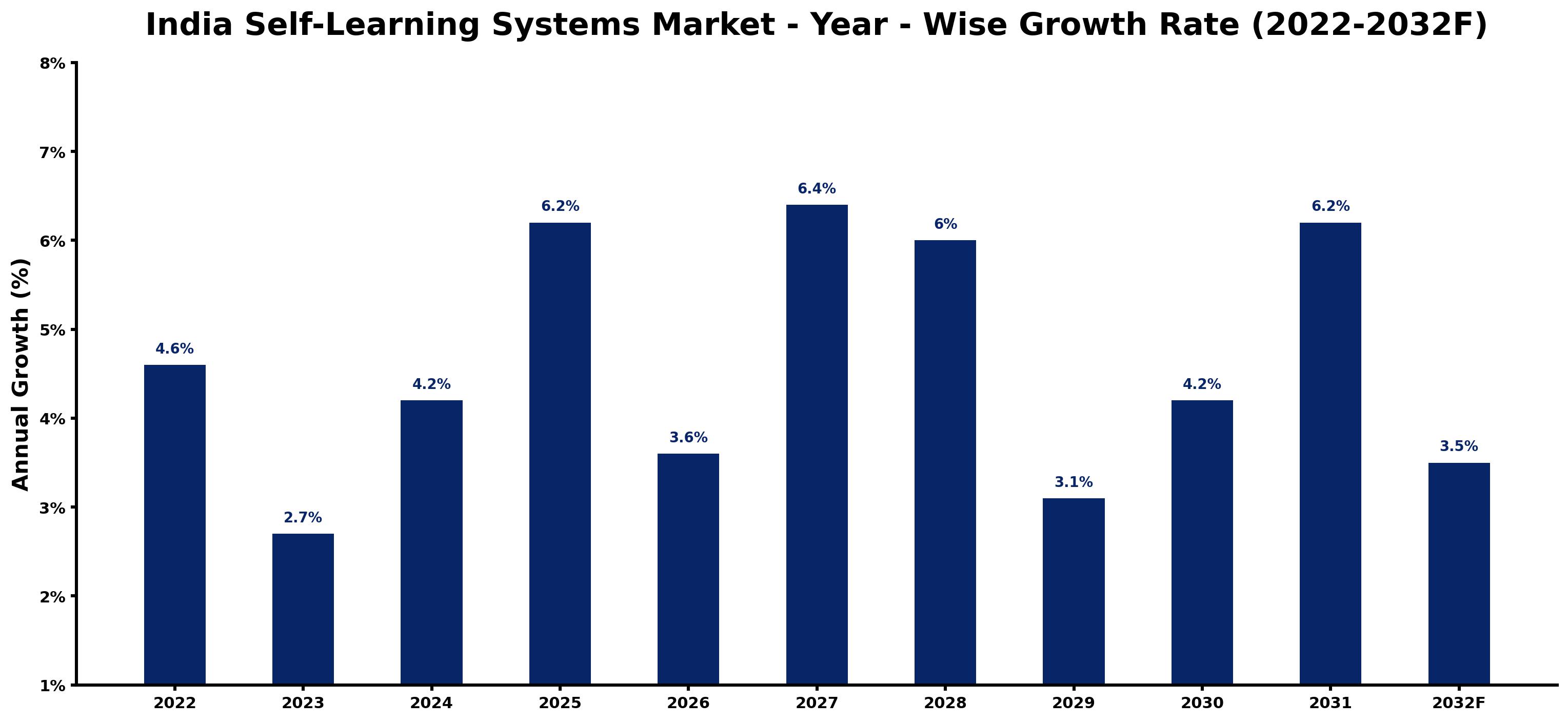
The following table presents the estimated annual growth rate for each year together with the principal factor influencing market performance.
| Year | Estimated Annual Growth (%) | Market Rationale |
| 2022 | 4.6 | The market showed steady growth, reflecting increased investment in AI technologies. |
| 2023 | 2.7 | Growth slowed as firms adjusted to evolving AI integration challenges. |
| 2024 | 4.2 | A resurgence in demand occurred as companies adopted new AI capabilities. |
| 2025 | 6.2 | The market peaked with substantial investments in customer analytics solutions. |
| 2026 | 3.6 | Growth is expected to slow due to saturation in certain application areas. |
| 2027 | 6.4 | A new peak is projected as demand surges for advanced AI applications. |
| 2028 | 6.0 | Growth will slow as firms focus on optimising existing AI systems. |
| 2029 | 3.1 | A further slowdown is expected as the market matures and competition intensifies. |
| 2030 | 4.2 | Growth is anticipated to resume as new AI applications emerge across sectors. |
| 2031 | 6.2 | The market is projected to expand again with renewed interest in cybersecurity solutions. |
| 2032 | 3.5 | Growth is expected to slow as firms consolidate their AI investments and strategies. |
Note: Market size estimations and growth projections presented in this report are based on 6Wresearch's proprietary forecasting methodology, utilizing the latest available industry data, government publications, and primary research inputs.
India Self-Learning Systems Market Synopsis
Self-Learning Systems in India are advanced AI technologies that enable machines to learn from data without explicit programming. These systems are essential for applications like customer analytics, cyber threat detection, and autonomous robotics. The India Self-Learning Systems Market is growing due to strong demand from sectors such as e-commerce and cybersecurity, driven by initiatives like the National AI Strategy launched in 2020. Over 70% of Indian firms are investing in AI technologies, which is propelling further adoption and innovation in this space.
Market Dynamics Impact Analysis (2026–2032)
| Factor | Type | Impact | Primary Segment Affected |
| Rising e-commerce investments drive demand for customer analytics solutions. | Driver | High | Customer Analytics |
| Increased cybersecurity spending enhances demand for threat detection systems. | Driver | High | Cyber Threat Detection |
| The gap in AI expertise creates opportunities for training and consultancy services. | Opportunity | High | AI + Big Data |
| Growing interest in data privacy management opens avenues for compliance solutions. | Opportunity | Medium | Data Privacy Management |
| Limited understanding of AI technologies restrains adoption in smaller firms. | Restraint | High | Customer Analytics |
| High implementation costs deter some companies from investing in AI solutions. | Restraint | Medium | Cyber Threat Detection |
| The market still has to solve a few problems, including a skills gap. | Challenge | High | AI + Big Data |
| Integration challenges with legacy systems hinder smooth AI adoption. | Challenge | Medium | Customer Analytics |
Evaluation of Drivers in India Self-Learning Systems Market (2026–2032)
The factors lifting demand, and the evidence behind each, are summarised below.
| Drivers | Primary Segment Affected | Why It Matters (Evidence) |
| Increased investment in AI technologies by e-commerce firms drives demand for customer analytics solutions. | Customer Analytics | The e-commerce sector in India is expected to grow to $200 billion by 2026. |
| Growing cybersecurity spending drives demand for advanced threat detection systems. | Cyber Threat Detection | Cybersecurity spending in India is projected to reach $3.5 billion by 2025. |
| The widespread adoption of AI + Big Data technologies supports various sectors' needs. | AI + Big Data | Over 70% of Indian firms are investing in AI technologies as of 2023. |
| The rise of data privacy regulations creates demand for compliance solutions. | Data Privacy Management | The National Digital Communications Policy aims to boost AI and data analytics by 2022. |
| The increasing number of startups in AI drives innovation and demand for solutions. | AI + Big Data | The Atal Innovation Mission supports startups and innovation in AI and machine learning technologies. |
The Self-Learning Systems market in India is expanding due to increased investment in AI technologies, growing end-use demand, and heightened cybersecurity needs. The e-commerce sector is anticipated to reach $200 billion by 2026, boosting demand for customer analytics solutions. Cybersecurity expenditure is projected to rise to $3.5 billion by 2025, amplifying the need for advanced threat detection systems. Additionally, over 70% of firms are committing resources to AI technologies, underscoring a strong focus on innovation. The integration of AI with Big Data technologies propels this growth, as companies aim to leverage data for competitive advantage.
Evaluation of Restraints in India Self-Learning Systems Market
Below mentioned are some major restraints and their influence on market dynamics.
| Market Restraint | Primary Segment Affected | Why It Matters (Evidence) |
| Limited understanding of AI technologies among smaller firms restricts adoption. | Customer Analytics | Many small businesses lack the expertise to implement AI solutions effectively. |
| High implementation costs deter companies from investing in AI solutions. | Cyber Threat Detection | Initial investments for cybersecurity technologies can be substantial, limiting access. |
| Integration challenges with legacy systems hinder smooth AI adoption. | AI + Big Data | Existing infrastructure may not support new AI technologies, causing delays. |
| Data privacy concerns create hesitation in adopting AI solutions. | Data Privacy Management | Regulatory requirements may complicate the deployment of AI systems. |
| The skills gap in AI expertise limits the market's growth potential. | Customer Analytics | A shortage of qualified professionals hampers effective AI implementation. |
India Self-Learning Systems Market Challenges
The India Self-Learning Systems market still has to solve a few problems, and the first is regulatory compliance. The Ministry of Electronics and Information Technology enforces strict AI policies, which can delay project approvals for producers by up to six months, hindering their innovation efforts. Competition is another challenge, as over 70% of Indian firms are investing in AI technologies, resulting in price wars that can cut margins for suppliers. Technology adoption is also an issue, with buyers facing costs of around 20% annually to keep systems updated due to rapid advancements. Skills shortages in AI talent mean that producers struggle to find qualified professionals, leading to project delays that can last up to a year for firms implementing new systems.
Trends in the India Self-Learning Systems Market
Buyers and suppliers in the India Self-Learning Systems Market are adjusting to the following trends.
- Shift towards Data Privacy Management: As data privacy regulations become stricter, firms are increasingly turning to AI solutions for compliance. The National Digital Communications Policy aims to enhance AI and data analytics by 2022, promoting investments in privacy management solutions.
- Emergence of AI + Big Data Technologies: The adoption of AI combined with Big Data technologies is accelerating, with over 70% of Indian firms investing in these solutions. This trend supports enhanced data processing capabilities across various sectors, including e-commerce.
- Increased Focus on Cybersecurity Solutions: With cybersecurity spending projected to reach $3.5 billion by 2025, firms are prioritising advanced threat detection systems. The updated Cyber Security Policy highlights the necessity for effective digital security measures.
- Growth in AI Startups and Innovation: The Atal Innovation Mission is nurturing a dynamic startup ecosystem in AI, promoting new technologies. As of 2023, this initiative has spurred increased investments and innovation in AI solutions.
Investment Opportunities in the India Self-Learning Systems Market
Investors looking at the India Self-Learning Systems Market should consider the following areas.
- Gap in AI Expertise Creates Training Opportunities: With over 70% of firms investing in AI, there exists a notable gap in expertise. Training and consultancy services for AI implementation can flourish, especially among e-commerce firms aiming to enhance analytics.
- Rising Demand for Data Privacy Solutions: As data privacy regulations tighten, firms are in search of compliance solutions. This opens avenues for service providers in data privacy management, particularly within the e-commerce sector.
- Investment in Cybersecurity Technologies: With cybersecurity spending expected to reach $3.5 billion by 2025, there is a clear opportunity for firms to supply advanced threat detection systems. Collaborating with cybersecurity companies can ease market entry.
- Growth in AI + Big Data Solutions: The increasing adoption of AI combined with Big Data technologies presents an opportunity for firms to provide innovative solutions. Partnering with companies in the e-commerce sector can facilitate market entry.
Government Initiatives in the India Self-Learning Systems Market
The National AI Strategy, launched by NITI Aayog in 2020, aims to position India as a global leader in AI by promoting research and development. This strategy builds on previous policies by offering a structured framework for AI adoption across sectors, encouraging investments in advanced technologies. The Digital India Programme, initiated in 2015, further supports this vision by transforming India into a digitally empowered society, thereby increasing the demand for self-learning systems across various industries.
The Ministry of Electronics and Information Technology oversees AI policy in India, approving projects that align with national objectives. The Cyber Security Policy, updated in 2020, focuses on enhancing cybersecurity measures across sectors, providing funding for initiatives that improve digital security. Additionally, the Atal Innovation Mission supports startups and innovation in AI and machine learning technologies, funding projects that contribute to the development of self-learning systems.
Future Insight of the India Self-Learning Systems Market
The India Self-Learning Systems market is set to evolve by 2032, supported by several key factors. The e-commerce sector is projected to grow to $200 billion by 2026, increasing the demand for advanced AI solutions. Cybersecurity spending is expected to reach $3.5 billion by 2025, creating a greater need for self-learning technologies. The National AI Strategy will continue to promote AI adoption, while the updated National Cyber Security Policy strengthens the framework for secure AI applications. These developments will enable buyers and suppliers to leverage AI more effectively across various sectors.
Market Segmentation Analysis
Each segment group is reviewed below, with the leader by share and the fastest grower by CAGR.
By Learning Type – Supervised Learning Dominated, Unsupervised Learning Expected to Grow Fastest
According to Shubham Padhi, Research Analyst at 6Wresearch, in 2025, Supervised Learning led the learning type split with a 47% share. Supervised Learning holds the largest share as it is extensively used for training models with labelled data, crucial for sectors like e-commerce that depend on precise predictions. Its widespread application among firms aiming to extract actionable insights from their data underlines its dominance. Unsupervised Learning is set to record the highest CAGR in this split, 6.1% over 2026–2032. Unsupervised Learning is experiencing the fastest growth due to its ability to reveal hidden patterns in data, essential for businesses aiming to enhance customer experiences. The surge in data generation across various sectors in India further propels the demand for this learning type. This indicates that suppliers should focus on advancing their capabilities in unsupervised learning to effectively seize the growing market opportunities.
By Application Area – Customer Analytics Dominated, Data Privacy Management Expected to Grow Fastest
With a 45% revenue share in 2025, Customer Analytics was the largest application area category. Customer Analytics leads the market share as it is widely used for improving customer experience, especially in the booming e-commerce sector. Companies are increasingly investing in these systems to better understand consumer behaviour and preferences. Data Privacy Management is projected to grow fastest, at a CAGR of 7.2% during 2026–2032. Data Privacy Management is the fastest-growing area, driven by stringent regulatory requirements for data protection and privacy. As firms strive to comply with these regulations, the demand for effective data privacy solutions is surging. Buyers must prioritise solutions that ensure compliance with data privacy regulations to stay competitive.
By Technology Stack – AI + Big Data Dominated, Edge AI Expected to Grow Fastest
AI + Big Data accounted for a 41% market share by technology stack in 2025. AI + Big Data dominates the market share as it is integral for processing large datasets effectively, a necessity for sectors like e-commerce and cybersecurity. This combination allows firms to harness vast amounts of data for actionable insights. Over 2026–2032, Edge AI is expected to post the fastest growth, at a CAGR of 7.5%. Edge AI is gaining interest as it enables data processing closer to the source, reducing latency and improving response times. With the rise of IoT devices, this technology is becoming increasingly relevant for real-time analytics. Suppliers should invest in edge AI capabilities to meet the growing demand for real-time data processing solutions.
By End User – E-Commerce Firms Dominated, Cybersecurity Companies Expected to Grow Fastest
The largest end user category in 2025 was E-Commerce Firms, with a 46% share of total revenue. E-Commerce Firms represent the largest share as they heavily rely on analytics for operations, driving the need for self-learning systems to optimise customer interactions and inventory management. This sector's growth is a key factor in the overall market expansion. The quickest growth will come from Cybersecurity Companies, forecast to expand at a CAGR of 7.3% between 2026 and 2032. Cybersecurity Companies are the fastest-growing end user, as they require advanced self-learning systems for effective threat detection and response. The increasing frequency of cyber threats in India is propelling this demand. Suppliers should tailor their offerings to meet the specific needs of cybersecurity firms to capitalise on this growth.
Key Attractiveness of the Report
- 10 Years of Market Numbers
- Historical Data Starting from 2022 to 2025
- Base Year 2025
- Forecast Data until 2032
- Key Performance Indicators Impacting the Market
- Major Upcoming Developments and Projects
Key Highlights of the Report:
- India Self-Learning Systems Market Outlook
- Market Size of India Self-Learning Systems Market, 2025
- Forecast of India Self-Learning Systems Market, 2032
- Historical Data and Forecast of India Self-Learning Systems Revenues & Volume for the Period 2022 - 2032F
- India Self-Learning Systems Market Trend Evolution
- India Self-Learning Systems Market Drivers and Challenges
- India Self-Learning Systems Price Trends
- India Self-Learning Systems Porter's Five Forces
- India Self-Learning Systems Industry Life Cycle
- Historical Data and Forecast of India Self-Learning Systems Market Revenues & Volume By Learning Type for the Period 2022 - 2032F
- Historical Data and Forecast of India Self-Learning Systems Market Revenues & Volume By Supervised Learning for the Period 2022 - 2032F
- Historical Data and Forecast of India Self-Learning Systems Market Revenues & Volume By Unsupervised Learning for the Period 2022 - 2032F
- Historical Data and Forecast of India Self-Learning Systems Market Revenues & Volume By Reinforcement Learning for the Period 2022 - 2032F
- Historical Data and Forecast of India Self-Learning Systems Market Revenues & Volume By Federated Learning for the Period 2022 - 2032F
- Historical Data and Forecast of India Self-Learning Systems Market Revenues & Volume By Application Area for the Period 2022 - 2032F
- Historical Data and Forecast of India Self-Learning Systems Market Revenues & Volume By Customer Analytics for the Period 2022 - 2032F
- Historical Data and Forecast of India Self-Learning Systems Market Revenues & Volume By Cyber Threat Detection for the Period 2022 - 2032F
- Historical Data and Forecast of India Self-Learning Systems Market Revenues & Volume By Autonomous Robotics for the Period 2022 - 2032F
- Historical Data and Forecast of India Self-Learning Systems Market Revenues & Volume By Data Privacy Management for the Period 2022 - 2032F
- Historical Data and Forecast of India Self-Learning Systems Market Revenues & Volume By Technology Stack for the Period 2022 - 2032F
- Historical Data and Forecast of India Self-Learning Systems Market Revenues & Volume By AI + Big Data for the Period 2022 - 2032F
- Historical Data and Forecast of India Self-Learning Systems Market Revenues & Volume By ML + Neural Networks for the Period 2022 - 2032F
- Historical Data and Forecast of India Self-Learning Systems Market Revenues & Volume By Deep Learning + Sensors for the Period 2022 - 2032F
- Historical Data and Forecast of India Self-Learning Systems Market Revenues & Volume By Edge AI for the Period 2022 - 2032F
- Historical Data and Forecast of India Self-Learning Systems Market Revenues & Volume By End User for the Period 2022 - 2032F
- Historical Data and Forecast of India Self-Learning Systems Market Revenues & Volume By E-Commerce Firms for the Period 2022 - 2032F
- Historical Data and Forecast of India Self-Learning Systems Market Revenues & Volume By Cybersecurity Companies for the Period 2022 - 2032F
- Historical Data and Forecast of India Self-Learning Systems Market Revenues & Volume By Industrial Automation Firms for the Period 2022 - 2032F
- Historical Data and Forecast of India Self-Learning Systems Market Revenues & Volume By SaaS Providers for the Period 2022 - 2032F
- India Self-Learning Systems Import Export Trade Statistics
- Market Opportunity Assessment By Learning Type
- Market Opportunity Assessment By Application Area
- Market Opportunity Assessment By Technology Stack
- Market Opportunity Assessment By End User
- India Self-Learning Systems Top Companies Market Share
- India Self-Learning Systems Competitive Benchmarking By Technical and Operational Parameters
- India Self-Learning Systems Company Profiles
- India Self-Learning Systems Key Strategic Recommendations
Market Covered
This report examines the market across the segments below.
By Learning Type
- Supervised Learning
- Unsupervised Learning
- Reinforcement Learning
- Federated Learning
By Application Area
- Customer Analytics
- Cyber Threat Detection
- Autonomous Robotics
- Data Privacy Management
By Technology Stack
- AI + Big Data
- ML + Neural Networks
- Deep Learning + Sensors
- Edge AI
By End User
- E-Commerce Firms
- Cybersecurity Companies
- Industrial Automation Firms
- SaaS Providers































