China Self-Learning Systems Market Size & Growth Rate
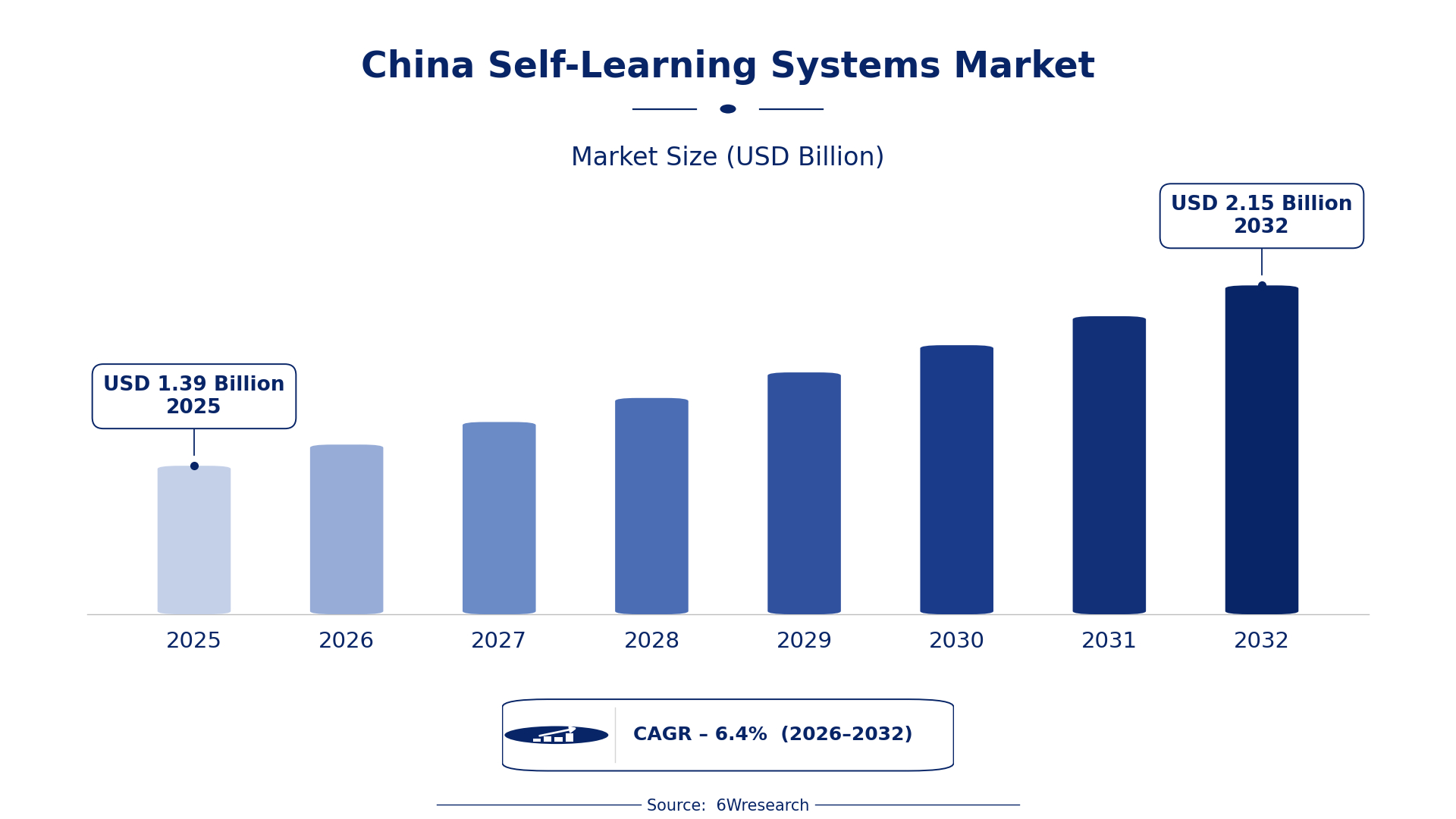
According to 6Wresearch internal database and industry insights, the China Self-Learning Systems Market was valued at USD 1.39 billion in 2025 and is projected to reach USD 2.15 billion by 2032, growing at a CAGR of approximately 6.4% during 2026–2032.
China Self-Learning Systems Market Highlights
| Report Metric | Details |
| Report Name | China Self-Learning Systems Market |
| Market Size 2025 | USD 1.39 billion |
| Market Size 2032 | USD 2.15 billion |
| Absolute Growth 2025–2032 | USD 0.76 billion |
| CAGR 2026–2032 | 6.4% |
| Peak Annual Growth | 9.5% in 2032 |
| Forecast Period | 2026–2032 |
| Historical Data | 2022–2025 |
| Base Year | 2025 |
| Leading Learning Type, 2025 | Supervised Learning (38% share) |
| Leading Application Area, 2025 | Customer Analytics (45% share) |
| Leading Technology Stack, 2025 | AI + Big Data (42% share) |
| Leading End User, 2025 | E-Commerce Firms (50% share) |
| Fastest-Growing Learning Type | Unsupervised Learning (8.3% CAGR) |
| Fastest-Growing Application Area | Data Privacy Management (8.8% CAGR) |
| Fastest-Growing Technology Stack | Edge AI (9.0% CAGR) |
| Fastest-Growing End User | Industrial Automation Firms (9.0% CAGR) |
| Growing Sector | E-Commerce |
| Key End Users | E-Commerce Firms, Cybersecurity Companies, SaaS Providers, Industrial Automation Firms |
China Self-Learning Systems Market Year-wise Growth Rate and Key Drivers (2022–2032)
This graph illustrates the annual growth rates of the market from 2022 to 2032, highlighting a steady upward trajectory and projected market expansion over the forecast period.
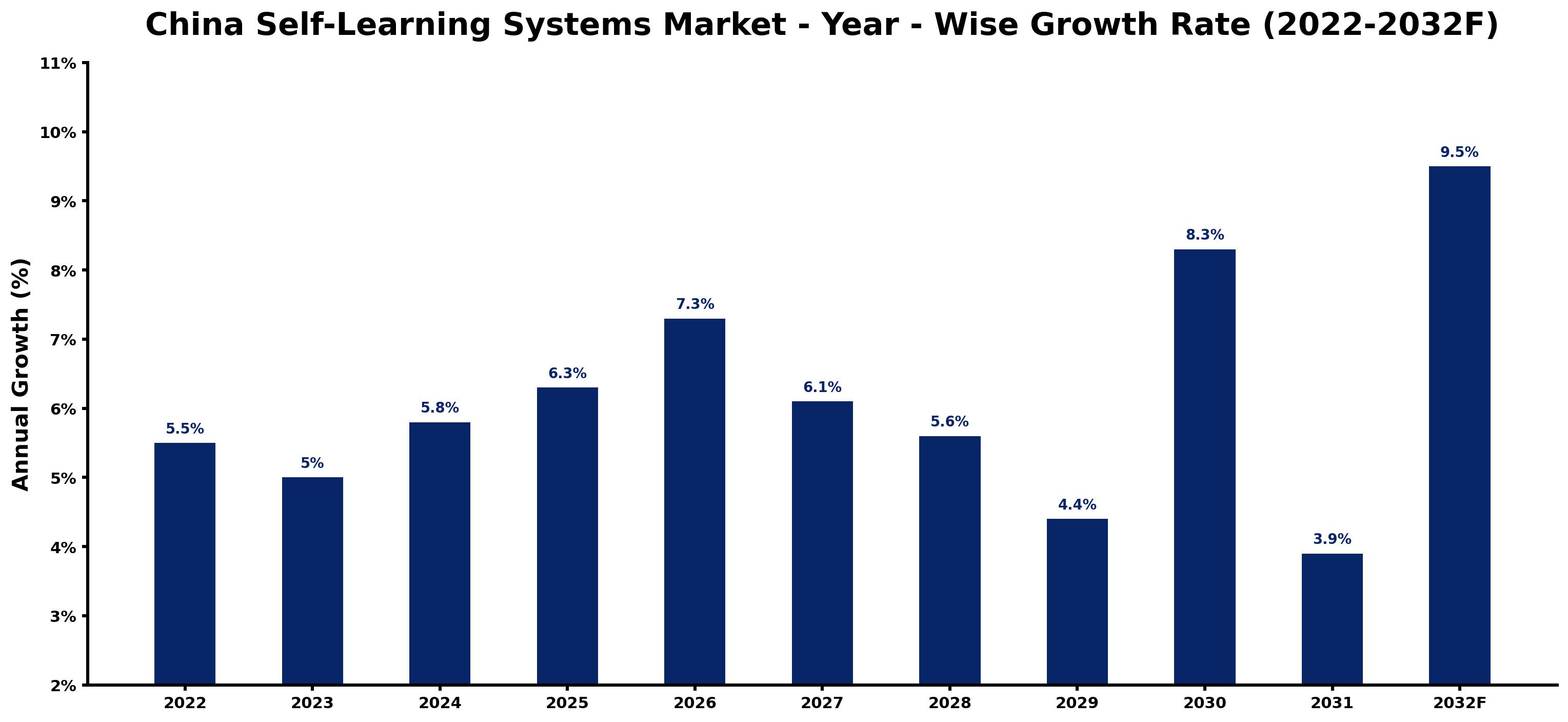
Each row of the following table gives one year's estimated growth and the event or demand shift that explains it.
| Year | Estimated Annual Growth (%) | Market Rationale |
| 2022 | 5.5 | The market experienced steady growth as demand for self-learning systems increased among e-commerce firms. |
| 2023 | 5.0 | Growth slowed due to adjustments following the launch of the 'AI Innovation Action Plan' aimed at boosting AI adoption. |
| 2024 | 5.8 | Demand accelerated as more businesses adopted self-learning systems for customer analytics, particularly in e-commerce. |
| 2025 | 6.3 | The market reached its historical peak, driven by rising cybersecurity spending and expansion in the e-commerce sector. |
| 2026 | 7.3 | Growth continued as AI investment surged, improving capabilities across various sectors, including cybersecurity. |
| 2027 | 6.1 | A slowdown occurred as the market stabilised after a period of rapid expansion in AI technologies. |
| 2028 | 5.6 | Demand remained steady, influenced by ongoing advancements in AI applications and the need for data privacy solutions. |
| 2029 | 4.4 | Growth slowed further as market saturation began to affect new investments in self-learning systems. |
| 2030 | 8.3 | A rebound is expected as new AI initiatives, such as the 'AI Innovation Action Plan', are launched to support industry growth. |
| 2031 | 3.9 | Growth slowed again as the market adjusts to the influx of new technologies and increased competition. |
| 2032 | 9.5 | The market is projected to peak, driven by increased demand for advanced self-learning systems and cybersecurity solutions. |
Note: Market size estimations and growth projections presented in this report are based on 6Wresearch's proprietary forecasting methodology, utilizing the latest available industry data, government publications, and primary research inputs.
China Self-Learning Systems Market Synopsis
The Self-Learning Systems Market in China encompasses advanced AI technologies that improve performance through data inputs. These systems find applications in customer analytics, cybersecurity, and automation. The market is expanding due to rising demand from e-commerce firms and cybersecurity companies. With over 900 million online shoppers projected by 2025, the need for advanced analytics is propelling purchases. Substantial investments in AI research and development are driving growth in this sector.
Market Dynamics Impact Analysis (2026–2032)
| Factor | Type | Impact | Primary Segment Affected |
| Increasing demand for customer insights drives the need for advanced analytics tools. | Driver | High | Customer Analytics |
| Rising cybersecurity threats necessitate advanced detection systems. | Driver | High | Cyber Threat Detection |
| Emerging demand for data privacy management solutions creates new market avenues. | Opportunity | High | Data Privacy Management |
| Growing e-commerce sector presents opportunities for analytics solutions. | Opportunity | High | Customer Analytics |
| Limited availability of skilled AI professionals constrains market growth. | Restraint | High | Supervised Learning |
| High development costs for self-learning systems can deter investment. | Restraint | Medium | Supervised Learning |
| Integration challenges with existing systems can delay adoption. | Challenge | High | Supervised Learning |
| Rapid technological advancements require constant updates and training. | Challenge | Medium | Supervised Learning |
Evaluation of Drivers in China Self-Learning Systems Market (2026–2032)
The table below links each growth driver to the segment it affects and the evidence for it.
| Drivers | Primary Segment Affected | Why It Matters (Evidence) |
| Growing e-commerce sector demands advanced customer analytics. | Customer Analytics | The e-commerce sector in China is projected to have over 900 million online shoppers by 2025, increasing the need for analytics. |
| Rising cybersecurity threats drive demand for self-learning systems. | Cyber Threat Detection | Cybersecurity spending in China is expected to exceed 30 billion USD by 2025, necessitating advanced threat detection solutions. |
| Investment in AI research boosts capabilities across industries. | Supervised Learning | China's investment in AI research and development reached 22 billion USD in 2022, improving system capabilities. |
| The need for data privacy management solutions is increasing. | Data Privacy Management | Emerging regulations are prompting businesses to adopt advanced data privacy management systems. |
| The AI talent pool is expanding, supporting market growth. | Supervised Learning | China's AI talent pool is estimated to be over 1 million professionals as of 2023, facilitating development. |
Growth in the Self-Learning Systems market in China comes from rising demand for customer analytics, driven by the projected 900 million online shoppers by 2025. Cybersecurity threats are pushing organizations to invest in self-learning systems, with cybersecurity spending expected to exceed 30 billion USD by 2025. Investment in AI research reached 22 billion USD in 2022, boosting capabilities across various sectors. With over 1 million AI professionals in the talent pool, the market is well-positioned to meet these demands.
Evaluation of Restraints in China Self-Learning Systems Market
The following restraints limit how fast demand can grow.
| Market Restraint | Primary Segment Affected | Why It Matters (Evidence) |
| Limited availability of skilled AI professionals hampers growth. | Supervised Learning | The shortage of qualified personnel can delay project timelines and increase costs for businesses. |
| High development costs for self-learning systems deter investment. | Supervised Learning | Upfront costs can limit the number of companies willing to invest in these technologies. |
| Integration challenges with existing systems can slow adoption. | Supervised Learning | Difficulty in integrating new systems with legacy infrastructure can lead to implementation delays. |
| Rapid technological advancements require constant updates. | Supervised Learning | The need for ongoing training and updates can strain resources for companies. |
| Market saturation may limit new investments. | Supervised Learning | As more players enter the market, competition can reduce profit margins. |
China Self-Learning Systems Market Challenges
The China Self-Learning Systems market still has to solve a few problems, and the first is high costs for buyers. Initial investments in advanced algorithms and large datasets can exceed 1 million USD, making it difficult for smaller businesses to adopt these technologies. Competition is fierce, with over 1,000 AI startups vying for market share, leading to price wars that can erode profit margins for producers. Supply chain issues arise from the necessity of high-quality data inputs, which can delay project timelines for developers by up to six months. Regulatory uncertainties complicate compliance for suppliers, as the National Standards for AI systems are still under development, hindering timely market entry.
Trends in the China Self-Learning Systems Market
Four trends stand out in the China Self-Learning Systems Market.
- Shift towards Improved Data Privacy Management: There is a growing emphasis on data privacy management in China, driven by new regulations. The demand for self-learning systems in this area is expected to rise, with an estimated 30 billion USD in cybersecurity spending by 2025.
- Increasing Adoption of AI in E-Commerce: Cybersecurity companies are rapidly adopting self-learning systems for threat detection. With spending expected to exceed 30 billion USD by 2025, this trend is crucial for improving security measures.
- Expansion of AI Talent Development Programs: China is focusing on developing its AI talent pool through initiatives like the AI Talent Development Program. This program aims to train 500,000 professionals by 2025, supporting industry growth.
- Growth of AI Startups in Guangdong Province: Guangdong province is emerging as a hub for AI startups, encouraging innovation. With over 1,000 AI startups as of 2023, this region is pivotal for self-learning systems development.
Investment Opportunities in the China Self-Learning Systems Market
The following opportunities in the China Self-Learning Systems Market pair current demand with a clear way in.
- E-Commerce Firms Seeking Advanced Analytics: E-commerce firms are in need of advanced analytics solutions to improve customer insights. With over 900 million online shoppers projected by 2025, there is a strong opportunity for suppliers in this sector.
- Partnerships with Cybersecurity Companies: Cybersecurity companies are looking for innovative self-learning systems to improve threat detection. Collaborating with local firms can facilitate entry into this growing market, especially with expected spending of over 30 billion USD by 2025.
- Focus on Data Privacy Management Solutions: The increasing focus on data privacy presents an opportunity for suppliers of self-learning systems. With new regulations emerging, businesses are seeking solutions to comply, creating a demand for innovative products.
- Expansion in Guangdong Province: Guangdong province is a major hub for AI development, presenting opportunities for investment. Establishing partnerships with local firms can improve market entry and growth.
Government Initiatives in the China Self-Learning Systems Market
In 2023, the Ministry of Industry and Information Technology launched the 'AI Innovation Action Plan' to promote AI integration across industries, which builds on the 'New Generation AI Development Plan' from 2020. This initiative aims to establish a comprehensive AI ecosystem by 2030, involving significant investment in research and infrastructure. Together, these measures are designed to support the growth of self-learning systems in China.
The 'AI Talent Development Program' initiated by the National Development and Reform Commission aims to train 500,000 AI professionals by 2025. This program, along with the 'Artificial Intelligence Standardization Framework' approved in 2021, supports the growth of self-learning systems by ensuring a skilled workforce and setting guidelines for development and application.
Future Insight of the China Self-Learning Systems Market
By 2032, buyers and suppliers in the China Self-Learning Systems market will see substantial changes driven by several key factors. The 'AI Innovation Action Plan' will accelerate technology adoption across sectors, while cybersecurity spending will exceed 30 billion USD, boosting system capabilities. The growing talent pool of AI professionals will spur innovation and enhance product development. Additionally, the Guangdong province's prominence as an AI hub will promote collaboration, positioning China as a frontrunner in self-learning technologies.
Market Segmentation Analysis
The report offers a comprehensive study of the following market segments and their leading categories in the market.
By Learning Type – Supervised Learning Dominated, Unsupervised Learning Expected to Grow Fastest
According to Shubham Padhi, Research Analyst at 6Wresearch, with a 38% revenue share in 2025, Supervised Learning was the largest learning type category. Supervised Learning commands the largest market share due to its extensive application in training models with labelled data, particularly in e-commerce where understanding customer behaviour is essential. This method's effectiveness in providing accurate insights drives its widespread adoption across various sectors. Over 2026–2032, Unsupervised Learning is expected to post the fastest growth, at a CAGR of 8.3%. Unsupervised Learning is experiencing rapid growth as businesses increasingly seek to uncover hidden patterns in vast datasets, especially within the booming e-commerce sector. With projections indicating over 900 million online shoppers by 2025, the demand for sophisticated analytics will further propel this segment's expansion. Suppliers should focus on enhancing their supervised learning solutions while also exploring unsupervised learning opportunities to align with growing market demands.
By Application Area – Customer Analytics Dominated, Data Privacy Management Expected to Grow Fastest
Customer Analytics held a 45% share of the China Self-Learning Systems Market by application area in 2025. Customer Analytics leads the market share as it is essential for businesses to comprehend consumer behaviour and preferences, especially in the booming e-commerce sector. The increasing number of online shoppers necessitates sophisticated analytics solutions to drive sales and improve customer engagement. Data Privacy Management is set to record the highest CAGR in this split, 8.8% over 2026–2032. Data Privacy Management is the fastest-growing area, fuelled by rising awareness and regulatory requirements regarding data protection. With cybersecurity spending in China projected to exceed 30 billion USD by 2025, the demand for effective data privacy solutions will continue to grow. Suppliers must focus on customer analytics while also developing capabilities in data privacy management to align with market trends.
By Technology Stack – AI + Big Data Dominated, Edge AI Expected to Grow Fastest
AI + Big Data accounted for a 42% market share by technology stack in 2025. AI + Big Data captures the largest market share as it serves as the foundational technology stack for developing self-learning systems, essential in sectors such as e-commerce and cybersecurity. This integration enables businesses to leverage large datasets effectively for actionable insights and automation. Edge AI is projected to grow fastest, at a CAGR of 9.0% during 2026–2032. Edge AI is the fastest-growing segment, driven by the rising demand for real-time data processing and analytics at the source. As more industries adopt IoT devices, the need for edge computing solutions will increase, further enhancing the capabilities of self-learning systems. Suppliers should strengthen their AI + Big Data offerings while investing in edge AI technologies to capitalise on emerging opportunities.
By End User – E-Commerce Firms Dominated, Industrial Automation Firms Expected to Grow Fastest
E-Commerce Firms took a 50% share of end user in 2025, more than any other category. E-Commerce Firms hold the largest market share as they heavily depend on self-learning systems for analytics and personalisation, which are vital for enhancing customer experiences. The anticipated increase in online shoppers in China underscores the sustained demand for these technologies. The quickest growth will come from Industrial Automation Firms, forecast to expand at a CAGR of 9.0% between 2026 and 2032. Industrial Automation Firms represent the fastest-growing segment, as they increasingly implement self-learning systems to optimise specific automation tasks. The push for efficiency improvements across industries is expected to accelerate this segment's growth in the near future. Suppliers should address the needs of e-commerce firms while also tapping into the potential of industrial automation to capture new market segments.
Key Attractiveness of the Report
- 10 Years of Market Numbers
- Historical Data Starting from 2022 to 2025
- Base Year 2025
- Forecast Data until 2032
- Key Performance Indicators Impacting the Market
- Major Upcoming Developments and Projects
Key Highlights of the Report:
- China Self-Learning Systems Market Outlook
- Market Size of China Self-Learning Systems Market, 2025
- Forecast of China Self-Learning Systems Market, 2032
- Historical Data and Forecast of China Self-Learning Systems Revenues & Volume for the Period 2022 - 2032F
- China Self-Learning Systems Market Trend Evolution
- China Self-Learning Systems Market Drivers and Challenges
- China Self-Learning Systems Price Trends
- China Self-Learning Systems Porter's Five Forces
- China Self-Learning Systems Industry Life Cycle
- Historical Data and Forecast of China Self-Learning Systems Market Revenues & Volume By Learning Type for the Period 2022 - 2032F
- Historical Data and Forecast of China Self-Learning Systems Market Revenues & Volume By Supervised Learning for the Period 2022 - 2032F
- Historical Data and Forecast of China Self-Learning Systems Market Revenues & Volume By Unsupervised Learning for the Period 2022 - 2032F
- Historical Data and Forecast of China Self-Learning Systems Market Revenues & Volume By Reinforcement Learning for the Period 2022 - 2032F
- Historical Data and Forecast of China Self-Learning Systems Market Revenues & Volume By Federated Learning for the Period 2022 - 2032F
- Historical Data and Forecast of China Self-Learning Systems Market Revenues & Volume By Application Area for the Period 2022 - 2032F
- Historical Data and Forecast of China Self-Learning Systems Market Revenues & Volume By Customer Analytics for the Period 2022 - 2032F
- Historical Data and Forecast of China Self-Learning Systems Market Revenues & Volume By Cyber Threat Detection for the Period 2022 - 2032F
- Historical Data and Forecast of China Self-Learning Systems Market Revenues & Volume By Autonomous Robotics for the Period 2022 - 2032F
- Historical Data and Forecast of China Self-Learning Systems Market Revenues & Volume By Data Privacy Management for the Period 2022 - 2032F
- Historical Data and Forecast of China Self-Learning Systems Market Revenues & Volume By Technology Stack for the Period 2022 - 2032F
- Historical Data and Forecast of China Self-Learning Systems Market Revenues & Volume By AI + Big Data for the Period 2022 - 2032F
- Historical Data and Forecast of China Self-Learning Systems Market Revenues & Volume By ML + Neural Networks for the Period 2022 - 2032F
- Historical Data and Forecast of China Self-Learning Systems Market Revenues & Volume By Deep Learning + Sensors for the Period 2022 - 2032F
- Historical Data and Forecast of China Self-Learning Systems Market Revenues & Volume By Edge AI for the Period 2022 - 2032F
- Historical Data and Forecast of China Self-Learning Systems Market Revenues & Volume By End User for the Period 2022 - 2032F
- Historical Data and Forecast of China Self-Learning Systems Market Revenues & Volume By E-Commerce Firms for the Period 2022 - 2032F
- Historical Data and Forecast of China Self-Learning Systems Market Revenues & Volume By Cybersecurity Companies for the Period 2022 - 2032F
- Historical Data and Forecast of China Self-Learning Systems Market Revenues & Volume By Industrial Automation Firms for the Period 2022 - 2032F
- Historical Data and Forecast of China Self-Learning Systems Market Revenues & Volume By SaaS Providers for the Period 2022 - 2032F
- China Self-Learning Systems Import Export Trade Statistics
- Market Opportunity Assessment By Learning Type
- Market Opportunity Assessment By Application Area
- Market Opportunity Assessment By Technology Stack
- Market Opportunity Assessment By End User
- China Self-Learning Systems Top Companies Market Share
- China Self-Learning Systems Competitive Benchmarking By Technical and Operational Parameters
- China Self-Learning Systems Company Profiles
- China Self-Learning Systems Key Strategic Recommendations
Market Covered
Segments analysed in this report are listed below.
By Learning Type
- Supervised Learning
- Unsupervised Learning
- Reinforcement Learning
- Federated Learning
By Application Area
- Customer Analytics
- Cyber Threat Detection
- Autonomous Robotics
- Data Privacy Management
By Technology Stack
- AI + Big Data
- ML + Neural Networks
- Deep Learning + Sensors
- Edge AI
By End User
- E-Commerce Firms
- Cybersecurity Companies
- Industrial Automation Firms
- SaaS Providers































